
All Topics  
Fahrenheit 451

 
Fahrenheit 451

   Email Print
   Bookmark   Link


Fahrenheit 451


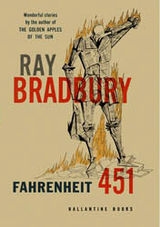
Fahrenheit 451 is a dystopia
Dystopia

A dystopia is the vision of a society that is the opposite of utopia. A dystopian society is one in which the conditions of life are suffering, characterized by human misery, poverty, oppression, violence, disease, and/or pollution....
n speculative fiction
Speculative fiction

Speculative fiction is a term used as an inclusive descriptor covering a group of fiction genres that speculate about worlds that are unlike the real world in various important ways....
 novel
Novel

File:2009 stapelweise Neuerscheinungen im Buchladen.JPGA novel is today a long narrative in literary prose. The genre has historical roots both in the fields of the medieval and early modern Romance and in the tradition of the novella....
 authored by Ray Bradbury
Ray Bradbury

Ray Douglas Bradbury is an United States literature, fantasy, Horror fiction, science fiction, and mystery writer.Best known for his dystopian novel Fahrenheit 451 and The Martian Chronicles, Bradbury is widely considered one of the greatest and most popular American writers of speculative fiction of the twentieth century....
 and first published in 1953.

The novel presents a future American society in which the masses are hedonistic
Hedonism

Hedonism is a school of philosophy which argues that pleasure has an intrinsic value and is the most important pursuit of humanity....
, and critical thought through reading is outlawed. The central character, Guy Montag
Guy Montag

Guy Montag is the protagonist in Ray Bradbury's 1953 novel Fahrenheit 451. He makes his living as a fireman in a futuristic town.At the opening of the novel, he is happy in his work as a fireman and never wonders about his role as a tool of thought suppression....
, is employed as a "fireman" (which, in this future, means "book burner
Book burning

Book burning is the practice of destroying, often ceremony, one or more copies of a book or other written material. In modern times, other forms of media, such as gramophone record, Video, and Compact disc have also been ceremoniously burned, torched, or shredded....
"). The number "451" refers to the temperature (in Fahrenheit
Fahrenheit

Fahrenheit is a temperature scale named after the physicist Daniel Gabriel Fahrenheit , who proposed it in 1724. Today, the scale has largely been replaced by the Celsius scale; it is still in use for non-scientific purposes in the United States and a few other countries such as Belize....
) at which the books burn when the "firemen" burn them "for the good of humanity".


Discussion
Ask a question about 'Fahrenheit 451'
Start a new discussion about 'Fahrenheit 451'
Answer questions from other users
Full Discussion Forum


Recent Posts


Quotations


... watch for a man running ... watch for the running man . . . watch for a man alone, on foot . . . watch..

I'm seventeen and I'm crazy. My uncle says the two always go together. When people ask your age, he said, always say seventeen and insane.

Monday burn Millay, Wednesday Whitman, Friday Faulkner, burn 'em to ashes, then burn the ashes. That's our official slogan.

The good writers touch life often. The mediocre ones run a quick hand over her. The bad ones rape her and leave her for the flies.

The search is over, Montag is dead; a crime against society has been avenged.

Walk carefully. Guard your health. If anything should happen to Harris, you are the Book of Ecclesiastes.


Encyclopedia


Fahrenheit 451 is a dystopia
Dystopia

A dystopia is the vision of a society that is the opposite of utopia. A dystopian society is one in which the conditions of life are suffering, characterized by human misery, poverty, oppression, violence, disease, and/or pollution....
n speculative fiction
Speculative fiction

Speculative fiction is a term used as an inclusive descriptor covering a group of fiction genres that speculate about worlds that are unlike the real world in various important ways....
 novel
Novel

File:2009 stapelweise Neuerscheinungen im Buchladen.JPGA novel is today a long narrative in literary prose. The genre has historical roots both in the fields of the medieval and early modern Romance and in the tradition of the novella....
 authored by Ray Bradbury
Ray Bradbury

Ray Douglas Bradbury is an United States literature, fantasy, Horror fiction, science fiction, and mystery writer.Best known for his dystopian novel Fahrenheit 451 and The Martian Chronicles, Bradbury is widely considered one of the greatest and most popular American writers of speculative fiction of the twentieth century....
 and first published in 1953.

The novel presents a future American society in which the masses are hedonistic
Hedonism

Hedonism is a school of philosophy which argues that pleasure has an intrinsic value and is the most important pursuit of humanity....
, and critical thought through reading is outlawed. The central character, Guy Montag
Guy Montag

Guy Montag is the protagonist in Ray Bradbury's 1953 novel Fahrenheit 451. He makes his living as a fireman in a futuristic town.At the opening of the novel, he is happy in his work as a fireman and never wonders about his role as a tool of thought suppression....
, is employed as a "fireman" (which, in this future, means "book burner
Book burning

Book burning is the practice of destroying, often ceremony, one or more copies of a book or other written material. In modern times, other forms of media, such as gramophone record, Video, and Compact disc have also been ceremoniously burned, torched, or shredded....
"). The number "451" refers to the temperature (in Fahrenheit
Fahrenheit

Fahrenheit is a temperature scale named after the physicist Daniel Gabriel Fahrenheit , who proposed it in 1724. Today, the scale has largely been replaced by the Celsius scale; it is still in use for non-scientific purposes in the United States and a few other countries such as Belize....
) at which the books burn when the "firemen" burn them "for the good of humanity". Written in the early years of the Cold War
Cold War

The Cold War was the continuing state of conflict, tension and competition that existed between a number of world powers, including the United States, the Soviet Union, People's Republic of China, France, United Kingdom and those countries' respective allies from the mid-1940s to the early 1990s....
, the novel is a critique of what Bradbury saw as an increasingly dysfunctional American society.

The concept began with Bradbury's short story "Bright Phoenix," written in 1947 but first published in the Magazine of Fantasy and Science Fiction in 1963. The original short story was reworked into the novella
Novella

A novella is a writing, fictional, prose narrative longer than a novelette but shorter than a novel. While there is disagreement as to what length defines a novella, the Science Fiction and Fantasy Writers of America Nebula Awards for science fiction define the novella as having a word count between 17,500 and 40,000....
, The Fireman, and published in the February 1951 issue of Galaxy Science Fiction
Galaxy Science Fiction

Galaxy Science Fiction was an USA digest size science fiction magazine, the creation of noted editor H. L. Gold, who found a responsive readership when he put the emphasis on imaginative sociological explorations of science fiction rather than hardware and pulp prose....
. The novel was also serialized in the March, April, and May 1954 issues of Playboy
Playboy

Playboy is an American men's magazine, founded in Chicago, Illinois, by Hugh Hefner and his associates, which has grown into Playboy Enterprises, with a presence in nearly every medium....
 magazine. Bradbury wrote the entire novel on a pay typewriter in the basement of UCLA's
University of California, Los Angeles

The University of California, Los Angeles is a public research university located in Westwood, Los Angeles, California, California, United States....
 Powell Library
Powell Library

Powell Library is the main college undergraduate library on the campus of the University of California, Los Angeles . It was constructed from 1926 to 1929 and was one of the original four buildings that comprised the UCLA campus in the early period of the university's life....
. His original intention in writing Fahrenheit 451 was to show his great love for books and libraries. He has often referred to Montag as an allusion
Allusion

An allusion is a figure of speech that makes a reference to, or representation of, a place, event, literary work, mythology, or work of art, either directly or by implication....
 to himself.

Over the years, the novel has been subject to various interpretations, primarily focusing on the historical role of book burning in suppressing dissenting ideas
Dissent

'Dissent' is a sentiment or philosophy of non-agreement or opposition to an idea or an entity . The term's antonyms include ...
. Bradbury has stated that the novel is not about censorship
Censorship

Censorship is the suppression of freedom of speech or deletion of communicative material which may be considered objectionable, harmful or sensitive, as determined by a censor....
; he states that Fahrenheit 451 is a story about how television destroys interest in reading literature, which leads to a perception of knowledge as being composed of "factoids", partial information devoid of context, e.g., Napoleon
Napoleon I of France

Napoleon Bonaparte later known as Emperor Napoleon I, was a military and political leader of France whose actions shaped European politics in the early 19th century....
's birth date alone, without an indication of who he was.

A movie version of the novel was released in 1966. At least two BBC Radio 4
BBC Radio 4

BBC Radio 4 is a domestic UK radio station that broadcasts a wide variety of spoken-word programmes, including news, drama, comedy, science and history....
 dramatizations have also been aired, both of which follow the book very closely.

Plot summary


Fahrenheit 451 takes place in an unspecified future time (dialogue on one page places it after 1990) in a hedonistic anti-intellectual America
United States

The United States of America is a Federal government constitutional republic comprising U.S. state and a federal district. The country is situated mostly in central North America, where its Contiguous United States and Washington, D.C., the Capital districts and territories, lie between the Pacific Ocean and Atlantic Oceans, Borders of the U...
 that has completely abandoned self-control. This America is filled with lawlessness in the streets ranging from teenagers crashing cars into people to firemen at a station who set their 'mechanical hound' to hunt various animals by their amino acid sequence for the simple and grotesque pleasure of watching them die. Anyone caught reading books is, at the minimum, confined to a mental hospital while the books are burned by the said firemen. Illegal books mainly include famous works of literature, such as Walt Whitman
Walt Whitman

Walter Whitman was an United States Poetry of the United States, essayist, journalism, and humanism. He was a part of the transition between Transcendentalism and literary realism, incorporating both views in his works....
 and William Faulkner
William Faulkner

William Faulkner was a Nobel Prize in Literature-winning United States author. One of the most influential writers of the 20th century, his reputation is based on his novels, novellas and short story....
, as well as the Bible
Bible

The Bible is the central religious text of Judaism and Christianity. The exact Books of the Bible is dependent on the religious traditions of specific denominations....
 and all historical texts.

One rainy night returning from his job, fireman Guy Montag
Guy Montag

Guy Montag is the protagonist in Ray Bradbury's 1953 novel Fahrenheit 451. He makes his living as a fireman in a futuristic town.At the opening of the novel, he is happy in his work as a fireman and never wonders about his role as a tool of thought suppression....
 meets his new neighbor Clarisse McClellan
Clarisse McClellan

Clarisse McClellan is a character from Ray Bradbury's novel Fahrenheit 451.In Bradbury's original book, Clarisse is a sixteen-year old girl ....
, whose free-thinking ideals and liberating spirit force him to question his life, his ideals, and his own perceived happiness. Later, Clarisse is killed in a car accident.

After meeting Clarisse, Montag returns home to find his wife Mildred asleep with an empty bottle of sleeping pills next to her bed. He calls for medical help; two technicians respond by proceeding to suck out Mildred's blood with a machine and insert new blood into her. The technicians' utter disregard for Mildred forces Montag to question the state of society.

In the following days, while ransacking the book-filled house of an old woman before the inevitable burning, Montag accidentally reads a line in one of her books: "Time has fallen asleep in the afternoon sunshine". This prompts him to steal one of the books. The woman refuses to leave her house and her books, choosing instead to light a match she had concealed from the firemen's view, prematurely igniting the kerosene and martyr
Martyr

The term martyr is most commonly used today to describe an individual who sacrifices his or her life in order to further a cause or belief for many....
ing herself. This disturbs Montag, who wonders why someone would die for books, which he considers to be without value.

Jarred by the woman's suicide, Montag calls for sick leave, wherein he receives a visit from his fire chief Captain Beatty, who explains to him the political and social causes which underlie the work they perform. Captain Beatty claims that society, in its search for happiness and in an attempt to minimize cultural offenses through political correctness
Political correctness

Political correctness is a term applied to language, ideas, policies, or behavior seen as seeking to minimize offense to gender, racial, cultural, disabled, aged or other identity groups....
, brought about the suppression of literature as an act of self-censorship and that the government merely took advantage of the situation. Beatty adds that all firemen eventually steal a book out of curiosity, but all would be well if the book is turned in within 24 hours. Montag argues with his wife, Mildred, over the book he has himself stolen, showing his growing disgust for her and for his society.

It is revealed that Montag has, over the course of a year, hidden dozens of books in the ventilation shafts of his own house, and tries to memorize them to preserve their contents, but becomes frustrated that the words seem to simply fall away from his memory. He then remembers a man he had met at one time: Faber, a former English professor. Montag seeks Faber's help, whereafter Faber begins teaching Montag about the vagaries and ambiguities but overall importance of literature in its attempt to explain human existence. He also gives Montag a green bullet-shaped ear-piece so that Faber can offer guidance throughout his daily activities.

During a card game at the firehouse, Beatty tells Montag he had a dream about him, and relates the literary argument he claims to have had in his dream. Beatty quotes many books and shows an amazing knowledge of literature to prove to Montag that books can confuse the thoughts. Then follows another call to arms; Beatty theatrically leads the crew to Montag's own home. He reveals that he knew all along of Montag's books, and orders Montag to destroy the house. Montag sees Mildred, who had betrayed his secret, moving away from the house and sets to work burning their home; not content destroying the books, he burns the televisions, beds, and other emblems of his past life. When Beatty finds Faber's earpiece, he threatens to track Faber down, whereupon Montag turns the flamethrower on Beatty, killing him, and then knocks out two other firemen. He is soon a fugitive for these crimes. When the firehouse's mechanical hound attacks him, he turns the flamethrower on it, destroying it.

He flees to Faber's house, with another firehouse's mechanical hound and television network helicopters in hot pursuit. The newscasters hope to document his escape as a spectacle, and distract the people from the oncoming threat of war, a threat that has been foreshadowed throughout the book. Faber tells Montag of vagabond book-lovers in the countryside. Montag then escapes to a local river, floats downstream and meets a group of older men who, to Montag's astonishment, have memorized entire books, preserving them orally until the law against books is overturned. They burn the books they read to prevent discovery, retaining the verbatim content (and possibly valid interpretations) in their minds. The group leader, Granger, discusses the legendary phoenix
Phoenix (mythology)

The phoenix is a Mythologyical sacred fire bird which originated in the Sub-continent of India in ancient mythologies mentioned in the Ancient Egyptian religion and later the Sanchuniathon and the Greek Mythology....
 and its endless cycle of long life, death in flames, and rebirth, adding that the phoenix must have some relation to mankind, which constantly repeats its mistakes.

Meanwhile, the television network helicopters surround and kill another man (who regularly walks about) who they kill instead of Montag to maintain the illusion of a successful hunt.

The war begins. Montag watches helplessly as jet bombers fly overhead and attack the city with nuclear weapons. Mildred is implied to die, though Faber is assumed to have left the city. It is implied that more cities across the country have been incinerated as well; a bitter irony in that the world that sought to burn thought is burned itself. At the moment of the explosion, the emotion of seeing the city burned causes a key phrase from the Bible to emerge from the depths of Montag's memory.

The novel is concluded in a shocking but slightly optimistic tone. It is suggested that the society Montag knew has almost completely collapsed and a new society must be built from the ashes. Whether this new society will meet the same fate is unknown, but it is implied that the book-keepers will begin to build mirror factories (a literary allusion wherein mirrors are a metaphor for books) to show people who they are, what they have become, and how they can change with time and knowledge.

Characters

  • Guy Montag
    Guy Montag

    Guy Montag is the protagonist in Ray Bradbury's 1953 novel Fahrenheit 451. He makes his living as a fireman in a futuristic town.At the opening of the novel, he is happy in his work as a fireman and never wonders about his role as a tool of thought suppression....
     is the protagonist
    Protagonist

    A protagonist is the main Character of a drama or Narrative. The word "protagonist" derives from the Greek language p??ta????st?? , "one who plays the first part, chief actor." In the theatre of Ancient Greece, three actors played all of the main dramatic roles in a tragedy; the leading role was played by the protagonist, while the othe...
     and fireman (see above) whose metamorphosis is illustrated throughout the book and who presents the dystopia through the eyes of a loyal worker to it, a man in conflict about it, and one resolved to be free of it. Through most of the book, Montag lacks knowledge and believes what he hears. Bradbury notes in his afterword that he noticed, after the book was published, that Montag is the name of a paper company.
  • Faber
    Faber (character)

    Faber is a main character in Ray Bradbury's 1953 novel, Fahrenheit 451. Faber was named after a brand of pencil, Eberhard Faber, or Faber-Castell....
     is a former English professor who represents those who know what is being done is wrong but are too fearful to act. Bradbury notes in his afterword that Faber is part of the name of a German manufacturer of pencil
    Pencil

    A pencil is a writing or drawing instrument consisting of a thin stick of pigment and clay, usually encased in a thin wood cylinder, though paper and plastic sheaths are also used....
    s, Faber-Castell
    Faber-Castell

    File:Geroldsgr?n-Faber-Castell.jpgFile:Stein Faber-Castell.jpgFaber-Castell is a Germany manufacturer of writing instruments, art supplies, staplers and slide rules, founded in 1761 in Nuremberg by Kaspar Faber....
    .
  • Mildred Montag
    Mildred Montag

    Mildred Montag is a minor character in Ray Bradbury's Fahrenheit 451.Mildred is Guy Montag's wife, but they do not act as a normal couple....
     is Guy Montag's wife, who makes an attempt at suicide early on in the book by overdosing herself with sleeping pills. She is used symbolically as the opposite of Clarisse McClellan. She is known as Linda Montag in the 1966 film.
  • Clarisse McClellan
    Clarisse McClellan

    Clarisse McClellan is a character from Ray Bradbury's novel Fahrenheit 451.In Bradbury's original book, Clarisse is a sixteen-year old girl ....
     displays every trait Mildred does not, in that she is outgoing, naturally cheerful, unorthodox, and intuitive. She serves as the wake-up call for Montag by posing the question “Why?” to him. She is unpopular among peers and disliked by teachers for (as Captain Beatty puts it) asking why instead of how and focusing on nature rather than on technology. Montag regards her as odd until she goes missing; the book gives no definitive explanation. It is said that Captain Beatty and Mildred know that Clarisse has been killed by a car. Her behavior is similar to that of Leonard Mead from Bradbury's short story The Pedestrian
    The Pedestrian

    "The Pedestrian" is a short story by author Ray Bradbury. This story was originally published in 1951 by The Fortnightly Publishing Company. It is included in the collection The Golden Apples of the Sun ....
    . Her uncle, who presumably taught her to think as she does, may be an allusion to that short story, as he was once arrested for being a pedestrian.
  • Captain Beatty is Montag's boss and the fire chief. Once an avid reader, he has come to hate books as a result of life's tragedies and of the fact that books contradict and refute each other. Beatty tries to entice Montag back into the book-burning business but is burned to death by Montag when he underestimates Montag's resolve. Montag later realizes that Beatty might have wanted to die, purposely provoking Montag to kill him. In a scene written years later by Bradbury for the Fahrenheit 451 play, Beatty invites Montag to his house where he shows him walls of books left to molder on their shelves. Beatty is the symbolic opposite of Granger.
  • Granger is the leader of a group of wandering intellectual exiles who memorize books so they will be saved. Where Beatty destroys, he preserves; where Beatty uses fire for the purpose of burning, Granger uses it for the purpose of warming. His acceptance of Montag is considered the final step in Montag's metamorphosis from embracing Beatty's ultimate value of happiness and complacency to embracing Granger's value of love of knowledge.
  • Mechanical Hound The mechanical hound, presumably a parody of the traditional pet of fire-fighters, exists in the original book but not in the 1966 film. It is an emotionless, 8-legged killing machine that can be programmed to seek out and destroy free thinkers, hunting them down by scent. It can remember as many as 10,000 scents at a time. The hound is blind to anything but the destruction for which it is programmed. It has a proboscis in a sheath on its snout, which injects lethal amounts of procaine
    Procaine

    Procaine is a local anesthetic drug of the amino ester group. It is used primarily to reduce the pain of intramuscular injection of penicillin, and is also used in dentistry....
    . Although Montag is able to survive a partial injection into his leg, he suffers severe discomfort and numbness for a short time. The first hound encountered in the novel is destroyed when Montag sets it on fire with a flamethrower. The second was sent to kill Montag but lost his scent when he jumped into a river. The hound then goes and finds a random victim to show that the hound never fails. The public thinks the hound succeeded but really Montag escaped. Bradbury notes in his afterword that the hound is "my robot clone of A. Conan Doyle
    Arthur Conan Doyle

    Sir Arthur Ignatius Conan Doyle, Deputy Lieutenant was a Scotland author most noted for his stories about the Detective fiction Sherlock Holmes, which are generally considered a major innovation in the field of crime fiction, and for the adventures of Professor Challenger....
    's great Baskerville beast", referring to the famous Sherlock Holmes
    Sherlock Holmes

    Sherlock Holmes is a fictional character of the late nineteenth and early twentieth centuries, who first appeared in publication in 1887. He is the creation of Scotland-born author and physician Sir Arthur Conan Doyle....
     mystery The Hound of the Baskervilles
    The Hound of the Baskervilles

    The Hound of the Baskervilles is a Detective fiction by Sir Arthur Conan Doyle featuring the detective Sherlock Holmes. Originally serial in the British Strand Magazine from August 1901 to April 1902, it is set mainly on Dartmoor in Devon in England's West Country....
    .
  • Mildred's friends (Mrs. Bowles and Mrs. Phelps) Mildred's friends represent the average citizens in the numbed society portrayed in the novel. They are examples of the people in the society who are unhappy but do not think they are. When they are introduced to literature (Dover Beach
    Dover Beach

    "Dover Beach" is a short lyric poetry by England poet Matthew Arnold. It was first published in 1867 in the collection New Poems, but surviving notes indicate its composition may have begun as early as 1849....
    ), which symbolizes the pain and happiness that has been censored from them, Mrs. Phelps is overwhelmed by the rush of emotion that she has not felt before.


Themes

The novel reflects several major concerns of the time of its writing, leading many to interpret it differently than intended by Bradbury (see "Censorship and the effects of mass media" below). Among the themes attributed to the novel were what Bradbury has called "the thought-destroying force" of censorship, the book-burnings in Nazi Germany
Nazi Germany

Nazi Germany and the Third Reich are the colloquial English names for Germany under the regime of Adolf Hitler and the Nazi Party , which established a Totalitarianism dictatorship that existed from 1933 to 1945....
 in 1933 and the horrible consequences of the explosion of a nuclear weapon
Nuclear weapon

A nuclear weapon is an explosive device that derives its destructive force from nuclear reactions, either nuclear fission or a combination of fission and nuclear fusion....
. "I meant all kinds of tyrannies anywhere in the world at any time, right, left, or middle," Bradbury has said.

One particularly ironic circumstance is that, unbeknownst to Bradbury, his publisher released a censored edition in 1967, omitting the words "damn" and "hell," for distribution to schools. Later editions with all words restored include a coda from the author describing this event and further thoughts on censorship and "well-meaning" revisionism.

Censorship and the effects of mass media

The novel is frequently interpreted as being critical of state-sponsored censorship, but Bradbury has disputed this interpretation. He said in a 2007 interview that the book explored the effects of television and mass media on the reading of literature.

Yet in the paperback edition released in 1979, Bradbury wrote a new coda for the book containing multiple comments on censorship and its relation to the novel. The coda is also present in the 1987 mass market paperback, which is still in print.

In the late '50s, Bradbury observed that the novel touches on the alienation of people by media:

Bradbury directly foretells this incident, and perhaps the ubiquitous iPod
IPod

iPod is a brand of portable media players designed and marketed by Apple Inc. and launched on . The product line-up includes the hard drive-based iPod Classic, the touchscreen iPod Touch, the video-capable iPod Nano, and the compact iPod Shuffle....
 a half century later, early in the work:

Films


1966 film


Fahrenheit 451 was a film written and directed by François Truffaut
François Truffaut

Fran?ois Roland Truffaut was an influential filmmaker and one of the founders of the French New Wave; and remains an icon of the Cinema of France industry....
 and starring Oskar Werner
Oskar Werner

Oskar Werner was an Austrian actor. Born Oskar Josef Bschlie?mayer in Vienna, he started off his career as a stage actor for the famous Burgtheater until making his film debut in Der Engel mit der Posaune in 1948....
 and Julie Christie
Julie Christie

Julie Frances Christie is a British actor. She was a pop icon of the "swinging London" era of the 1960s, and has won the Academy Award, Golden Globe, British Academy of Film and Television Arts, and Screen Actors Guild Awards....
. The film was released in 1966.

Future film

In July 1994, a new film adaptation of Fahrenheit 451 began development with the studio Warner Bros.
Warner Bros.

Warner Bros. Entertainment, Inc. is one of the world's largest film producer of film and television.It is a subsidiary of Time Warner, with its headquarters in Burbank, California and New York City....
 and actor Mel Gibson
Mel Gibson

Mel Columcille Gerard Gibson, Officer of the Order of Australia is an Australian-American actor, film director, film producer and screenwriter....
, who planned to star in the lead role. Scripts were written by Bradbury, Tony Puryear, and Terry Hayes
Terry Hayes

Terry Hayes is an English people screenwriter and film producer born on the 8 October 1951. In 2001 in film, he was nominated for the Bram Stoker Award for Best Screenplay for his work on From Hell....
. With the project estimated to be expensive and Gibson believing himself too old to portray the film's protagonist Guy Montag
Guy Montag

Guy Montag is the protagonist in Ray Bradbury's 1953 novel Fahrenheit 451. He makes his living as a fireman in a futuristic town.At the opening of the novel, he is happy in his work as a fireman and never wonders about his role as a tool of thought suppression....
, the actor decided in 1997 to instead direct the film. By 1999, he had planned to begin filming with actor Tom Cruise
Tom Cruise

Thomas Cruise Mapother IV , better known by his Stage name Tom Cruise, is an United States actor and film producer. Forbes magazine ranked him as the world's most powerful celebrity in 2006....
 in the lead role, but Gibson was forced to postpone due to Cruise's unavailability. Actor Brad Pitt
Brad Pitt

William Bradley "Brad" Pitt is an American actor and film producer. He has been cited as one of the world's most attractive men and his off-screen life is widely reported....
 was also approached for the lead role, but a deal was never made. According to Gibson, there was difficulty in finding a script that would be appropriate for the film, and that with the advent of computers, the concept of book-burning in a futuristic period may no longer work.

In February 2001, the project was revived as director Frank Darabont
Frank Darabont

Frank Darabont is a three-time Academy Award-nominatedUnited States film director, screenwriter and film producer. He has directed two Academy Awards-nominated films, The Shawshank Redemption and The Green Mile ....
 entered negotiations with Warner Bros. to rewrite Terry Hayes's script and direct the film. Gibson was confirmed to be involved only as a producer, and Darabont planned to complete the script by the end of 2002. In July 2004, Darabont said that he had completed the script and hoped to begin filming Fahrenheit 451 after completing a script for Mission: Impossible III
Mission: Impossible III

Mission: Impossible III is a 2006 in film action film, the third based on the spy-themed television series Mission: Impossible starring Tom Cruise who reprises his role of an agent of Impossible Mission Force, an unofficial branch of the CIA likely modelled after their elite Special Activities Division, agent Ethan Hunt....
. Darabont did not begin Fahrenheit 451 immediately, instead going on to direct The Mist
The Mist (film)

The Mist , is a 2007 in film Cinema of the United States horror film based on the 1980 in literature novella The Mist by Stephen King. The screenwriter and director is Frank Darabont, who had previously adapted Stephen King's work in the immensely popular films The Shawshank Redemption and The Green Mile , the former often cited a...
. The director said in November 2006 that he would do long-term preparation work for Fahrenheit 451 while filming The Mist and hoped that he would begin filming after The Mist was completed.

In August 2007, Darabont expressed his intent to film Fahrenheit 451 in the summer of 2008, and that he would place the story's setting in an "intentionally nebulous" future, approximately 50 years from the contemporary period. Darabont planned to keep certain elements from the book, such as the mechanical hound, in the film. The director did not comment on rumors of Tom Hanks
Tom Hanks

Thomas Jeffrey "Tom" Hanks is an American film actor, film director, voice-over artist, writer and film producer. Hanks worked in television and family-friendly comedies before achieving success as a dramatic actor portraying several notable roles, including Andrew Beckett in Philadelphia , the title role in Forrest Gump, Commander J...
 as Guy Montag. The director said that the protagonist had been cast and would be announced soon. The following November, the director confirmed Hanks's involvement with the film and described the actor to be "the perfect embodiment of the regular guy". In March 2008, Hanks withdrew from the film, citing prior commitments as the reason. Darabont is now looking for a new lead, explaining the difficulty, "It needs to be somebody like Hanks who has the ability to trigger a greenlight but is also the right guy for the part. It's a narrow target. It's a short list of people."

Theatrical adaptation

The Obie Award
Obie Award

The Obie Awards or Off-Broadway Theater Awards are annual awards bestowed by The Village Voice newspaper to theater artists in New York City....
 winning off-Broadway
Off-Broadway

Off Broadway theater is an umbrella term for a defined set of Play , musical theater or revues performed in New York City. Originally referring to the location of a venue and its productions on a street intersecting Broadway in Manhattan's Theatre District, New York, the hub of the theater industry in the United States, the term later becam...
 theatre The American Place Theatre
The American Place Theatre

The American Place Theatre was founded in 1963 by Wynn Handman, Sidney Lanier, and Michael Tolan at St. Clement's Church, far west on 46th Street in New York City and was incorporated as a not-for-profit theatre in that year....
 is presenting a one man show
One man show

In performing arts and entertainment, a one person show or solo show is frequently performed by, but not limited to, stand-up comedians. It is similar to stand-up comedy in that it usually involves a solitary performer on stage for about an hour, speaking directly to the audience, thereby acknowledging the absence of the fourth wall....
 adaptation of Fahrenheit 451 as a part of their 2008-2009 Literature to Life season .

Allusions and references in other works

Fahrenheit451
The title of Bradbury's book has become a well-known byword amongst those who oppose censorship
Censorship

Censorship is the suppression of freedom of speech or deletion of communicative material which may be considered objectionable, harmful or sensitive, as determined by a censor....
, in much the way George Orwell
George Orwell

Eric Arthur Blair , better known by his pen name George Orwell, was an England author. His work is marked by a profound consciousness of social injustice, an intense dislike of totalitarianism, and a passion for clarity in language....
's 1984
Nineteen Eighty-Four

Nineteen Eighty-Four is a classic utopian and dystopian fiction by English author George Orwell. Published in 1949 in literature, it is set in the eponymous year and focuses on a repressive, totalitarian regime....
 or Aldous Huxley
Aldous Huxley

Aldous Leonard Huxley was an English writer and one of the most prominent members of the famous Huxley family. He spent the later part of his life in the United States, living in Los Angeles from 1937 until his death in 1963....
's Brave New World
Brave New World

Brave New World is a novel by Aldous Huxley, written in 1931 in literature and published in 1932 in literature. Set in the London of AD 2540 , the novel anticipates developments in reproductive technology and sleep-learning that combine to change society....
 have. As such, it has been alluded to many times, including in the ACLU
American Civil Liberties Union

The American Civil Liberties Union consists of two separate non-profit organizations: the ACLU Foundation, a 501 organization which focuses on litigation and communication efforts, and the American Civil Liberties Union, a 501 organization which focuses on legislative lobbying....
's 1997 white paper Fahrenheit 451.2: Is Cyberspace Burning? and Michael Moore
Michael Moore

Michael Francis Moore is an Academy Award-winning United States filmmaker, author and Modern liberalism in the United States political commentator....
's 2004 documentary Fahrenheit 9/11
Fahrenheit 9/11

Fahrenheit 9/11 is an award-winning 2004 in film documentary film by United States filmmaker Michael Moore. The film takes a critical look at the presidency of George W....
. Bradbury objected to the latter's allusion to his work, claiming that Moore "stole my title and changed the numbers without ever asking me for permission."

Artist Micah Wright
Micah Wright

Micah Ian Wright is an United States author who has worked in film, television, animation, video games and comic books....
 used the theme "Hand all books to your local fireman for safe disposal" overlaid on a 1940s fireman propaganda poster.

Hungarian
Hungary

Hungary , officially in English the Republic of Hungary , is a landlocked country in the Carpathian Basin of Central Europe, bordered by Austria, Slovakia, Ukraine, Romania, Serbia, Croatia, and Slovenia....
 poet
Poet

A poet is a person who writes poetry....
 György Faludy
György Faludy

Gy?rgy Faludy , sometimes Anglicisation as George Faludy, was a Hungary-History of the Jews in Hungary poet, writer and translator....
 includes the lines in the opening stanza of his 1983 poem "Learn by Heart This Poem of Mine": "Learn by heart this poem of mine, / Books only last a little time, / And this one will be borrowed, scarred, [...] / Or slowly brown and self-combust, / When climbing Fahrenheit has got / To 451, for that's how hot / it will be when your town burns down. / Learn by heart this poem of mine."

The theme and plot of the movie Equilibrium
Equilibrium (film)

Equilibrium, released in 2002, is a science fiction film/ Action movie film written and directed by Kurt Wimmer.Christian Bale portrays the film's main character ....
, starring Christian Bale
Christian Bale

Christian Charles Philip Bale is an English people actor whose film credits include American Psycho , Batman Begins, The Dark Knight , The Prestige , 3:10 to Yuma , and the upcoming film Terminator Salvation, in which he will play the role of John Connor....
 and Sean Bean
Sean Bean

Shaun Mark Bean is an England film and theatre actor. Bean has also acted in a number of television productions as well as performing voice work for computer games and television adverts....
, draws heavily from Fahrenheit 451, as well as from 1984 and Brave New World.

Ray Bradbury also alludes to himself in his book Let's All Kill Constance
Let's All Kill Constance

Let's All Kill Constance is a 2003 in literature mystery novel novel by Ray Bradbury. Narrated by an unnamed Los Angeles writer , and set in 1960, it chronicles an unexpected visit from aging Hollywood actress Constance Rattigan who gives him two death lists of once-famous people ? with Constance's name on one of them, and the gradual unr...
 as the main character, a writer, thinks about writing a book about a "hero who smells of kerosene" and muses about the possibility of books being used to start fires in the future.

A 1986 computer text adventure
Fahrenheit 451 (computer game)

Fahrenheit 451 is a computer strategy game released in 1986 by Telarium, based on the Fahrenheit 451 of the same name by Ray Bradbury. The player's goal is to help Guy Montag, the main character of the novel and the game, to evade the authorities and make contact with an underground movement....
 revisits the story of Fahrenheit 451.

In a Japanese light novel
Light novel

A is a novel primarily targeting teens and young adults. The term "light novel" is a wasei-eigo, or a Japanese term formed from words in the English language....
, manga
Manga

, , are comics and print cartoons , in the Japanese language and conforming to the style developed in Japan in the late 20th century. In their modern form, manga date from shortly after World War II, but they have a long, complex pre-history in earlier Japanese art....
 and anime
Anime

is animation in Japan and considered to be "Japanese animation" in the rest of the world. Anime dates from about 1917.Anime, in addition to manga , is extremely popular in Japan and well known throughout the world....
 series Toshokan Senso
Toshokan Senso

is a Japanese light novel series by Hiro Arikawa, with illustrations by Sukumo Adabana. There are four novels in the series, though only the first novel is called Toshokan Senso; the subsequent novels are named Toshokan Nairan, Toshokan Kiki, and Toshokan Kakumei....
 (lit. "Library War"), a book referred to as "The Book of Prophecy" simply titled K505 was targeted for termination. This title alludes to Fahrenheit 451, as K505 can be read as 505 units of the Kelvin measurement of temperature that approximates 451 degrees Fahrenheit. Characters in the series' fictional, near-future setting also reference the book as being written "60 years ago" and how "a French director adapted it into a film."

In the season three episode of The Simpsons
The Simpsons

The Simpsons is an Television in the United States animated cartoon Situation comedy created by Matt Groening for the Fox Broadcasting Company....
 entitled "Dog of Death
Dog of Death

"Dog of Death" is the 19th episode of The Simpsons The Simpsons . It was first broadcast in North America on March 12, 1992...
", Homer Simpson
Homer Simpson

Homer Jay Simpson is a fictional main character in the animated television series The Simpsons and father of the Simpson family. He is voiced by Dan Castellaneta and first appeared on television, along with the rest of his family, in The Tracey Ullman Show The Simpsons shorts "Good Night " on April 19, 1987....
 throws a series of books on a fireplace during the course of the episode. One of these is Fahrenheit 451, in which the throwing of the book on the fire is a reference to the plotline of the book itself.

Fahrenheit 451 was one of several books used in Dominique Gonzalez-Foerster
Dominique Gonzalez-Foerster

Dominique Gonzalez-Foerster, born in 1965 in Strasbourg, is a France artist working with video art and installation art. She lives and works in Paris and Rio de Janeiro....
's art installation
Installation art

Installation art is the use of sculptural materials and other interesting material to transform a space or, argueably, an area. Installation art is not necessarily confined to gallery spaces and can be any material intervention in everyday public or private spaces....
 "TH.2058" in the Turbine Hall at Tate Modern
Tate Modern

The Tate Modern in London is United Kingdom's national museum of international modern art and is, with Tate Britain, Tate Liverpool, Tate St Ives, and Tate#Tate Online, part of the group now known simply as Tate Gallery....
 in London in 2008.

American power metal band Steel Prophet
Steel Prophet

Steel Prophet is an United States power metal band led by the founder and main writer Steve Kachinsky....
's 1999 album "Dark Hallucinations" has 5 songs which recount the story. The songs are Montag (Chapter One), Strange Encounter (Chapter Two), The Secret (Chapter Three), Betrayal (Chapter Four), and New Life (Chapter Five).

Printings

"The Fireman" (Galaxy Science Fiction
Galaxy Science Fiction

Galaxy Science Fiction was an USA digest size science fiction magazine, the creation of noted editor H. L. Gold, who found a responsive readership when he put the emphasis on imaginative sociological explorations of science fiction rather than hardware and pulp prose....
, Vol. 1 No. 5, February 1951)

First edition (1953) – This edition was actually published in three formats, and included two short stories: "The Playground" and "And the Rock Cried Out"
  • Paperback
    Paperback

    Paperback, softback, or softcover describe and refer to a book by the nature of its bookbinding. The book covers of such books are usually made of paper or cardboard, and are usually held together with adhesive rather than stitches or Staple s....
     (Ballantine
    Ballantine Books

    The Ballantine Publishing Group, better known as Ballantine Books, is a major American book publisher founded in 1952 by Ian Ballantine. It was acquired by Random House in 1973 and remains part of that company today....
     No. 41) – The true first edition, preceding the hardcovers by six weeks.
  • Standard hardcover
    Hardcover

    A hardcover is a book bookbinding with rigid protective covers . They may have flexible sewn spines which allow the book to lie flat on a surface when opened, although most modern commercial hardcover books have glued spines....
     – Limited to about 4,500 copies.
  • Asbestos
    Asbestos

    Asbestos is a naturally occurring silicate mineral with long, thin fibrous crystals. The word asbestos is derived from a Greek language adjective meaning inextinguishable....
     hardcover – Just over 200 copies were signed and numbered, before being bound in "Johns-Manville Quinterra", a fire resistant asbestos material.


Later editions:
  • Serialized version (Playboy
    Playboy

    Playboy is an American men's magazine, founded in Chicago, Illinois, by Hugh Hefner and his associates, which has grown into Playboy Enterprises, with a presence in nearly every medium....
    , March, April, & May 1954)
  • First British hardcover edition (Rupert Hart-Davis
    Rupert Hart-Davis

    Sir Rupert Charles Hart-Davis was an English publisher, editor and man of letters. He founded the publishing company Rupert Hart-Davis Ltd. As a biographer, he is remembered for his Hugh Walpole , as an editor, for his Collected Letters of Oscar Wilde , and, as both editor and part-author, for the Lyttelton/Hart-Davis Letters....
    , 1954) – Title novel only.
  • Science Fiction Book Club (London
    London

    London is the capital of both England and the United Kingdom, and the most populous municipality in the European Union. An important settlement for two millennia, History of London goes back to its founding by the Roman Empire....
    , 1955) – Title novel only.
  • First British paperback edition (Corgi
    Transworld (company)

    Transworld Publishers is a United Kingdom publishing division of Random House and belongs to Bertelsmann, one of the world's largest media groups....
     No. T389, 1957) – Title novel only.
  • Softcover edition (Ballantine Books
    Ballantine Books

    The Ballantine Publishing Group, better known as Ballantine Books, is a major American book publisher founded in 1952 by Ian Ballantine. It was acquired by Random House in 1973 and remains part of that company today....
    , 1962) - Issued with a new cover illustration by Joe Mugnaini.
  • Student softcover edition (Bal-Hi
    Ballantine Books

    The Ballantine Publishing Group, better known as Ballantine Books, is a major American book publisher founded in 1952 by Ian Ballantine. It was acquired by Random House in 1973 and remains part of that company today....
    , 1967) – Includes a two page "Note to Teachers and Parents" by Richard Tyre and features an enlarged and revised version of the 1962 cover illustration. Reprinted ten times through 1973.
  • Hardcover edition (Simon & Schuster
    Simon & Schuster

    Simon & Schuster, Inc., a division of CBS Corporation, is a publisher founded in New York City in 1924 by Richard L. Simon and M. Lincoln Schuster....
    , 1967) – Full contents of the first edition (novel and two short stories) with a new introduction by Bradbury.
  • Softcover edition (Ballantine Books
    Ballantine Books

    The Ballantine Publishing Group, better known as Ballantine Books, is a major American book publisher founded in 1952 by Ian Ballantine. It was acquired by Random House in 1973 and remains part of that company today....
    , 1969) - Issued with a new cover illustration by Bob Pepper.
  • Special Book Club edition (1976)
  • Panther science fiction (Granada Publishing, 1976, reprinted 1977, 1978) ISBN 058604356X
  • Hardcover edition (Del Rey Gold Seal
    Del Rey Books

    Del Rey Books is a branch of Ballantine Books, which is owned by Random House. It is a separate imprint established in 1977 under the editorship of author Lester del Rey and his wife Judy-Lynn del Rey....
    , 1981) – Issued without a dust jacket, and includes "Investing Dimes", an afterword by Bradbury.
  • Hardcover edition (Limited Editions Club, 1982) – Issued in a slipcase without a dust jacket, and includes an original lithograph and threefold-out color plates by Joseph Mugnaini
    Joseph Mugnaini

    Joseph Anthony Mugnaini was an artist and illustrator. He is best known for his collaborations with writer Ray Bradbury, beginning in 1952.He was born Giuseppe Mugnaini in Viareggio in the Tuscany region of Italy, and immigrated with his family to America when he was three months old....
    . 2000 copies were signed by Bradbury & Mugnaini.
  • Large print cloth edition (G K Hall & Co., 1988, ISBN 0745171060)
  • Hardcover edition (Buccaneer Books, 1995, ISBN 089968484X) – Issued without a dust jacket, and includes the "Investing Dimes" afterword, and a "Coda" by Bradbury.
  • 40th anniversary cloth edition (Simon & Schuster
    Simon & Schuster

    Simon & Schuster, Inc., a division of CBS Corporation, is a publisher founded in New York City in 1924 by Richard L. Simon and M. Lincoln Schuster....
    , 1996) – Limited to 7500 copies, with 500 signed and numbered by Bradbury.
  • Trade paper edition (Del Rey
    Del Rey Books

    Del Rey Books is a branch of Ballantine Books, which is owned by Random House. It is a separate imprint established in 1977 under the editorship of author Lester del Rey and his wife Judy-Lynn del Rey....
    , 1996, ISBN 0345410017)
  • Mass-market paperback edition (Del Rey, ISBN 0345342968)
  • 50th anniversary edition


In Canada:
  • First Edition - February 1963
  • Seventh Printing - October 1972


Bibliography

  • Bustard, Ned (2004), Fahrenheit 451 Comprehension Guide, Veritas Press.
  • Bradbury, Ray Fahrenheit 451, New York: Ballantine Books, 1953


External links

  • online multimedia e-book (Chapter 1).