

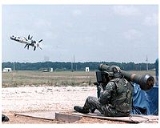
FGM-148 Javelin

Encyclopedia
The FGM-148 Javelin is a United States
-made man-portable third generation
anti-tank missile fielded to replace the Dragon antitank missile.
missile with lock-on before launch and automatic self-guidance. The system takes a top-attack flight profile against armored vehicles (attacking the top armor which is generally thinner) but can also take a direct-attack mode for use against buildings or fortifications. This missile also has the ability to engage helicopters in the direct attack mode. It can reach a peak altitude of 150 m (500 ft) in top-attack mode and 60 m in direct-fire mode and is equipped with an imaging infrared seeker. The tandem warhead is fitted with two shaped charge
s: a precursor warhead to detonate any explosive reactive armor and a primary warhead to penetrate base armor. The Javelin was used in the 2003 Invasion of Iraq
on Iraqi Lion of Babylon tank
s and Type 69 tanks.
The missile is ejected from the launcher so that it reaches a safe distance from the operator before the main rocket motors ignite; a "soft launch
arrangement". This makes it harder to identify the launcher; however, back-blast from the launch tube still poses a hazard to nearby personnel. Thanks to this "fire and forget" system, the firing team may move on as soon as the missile has been launched.
The missile system is carried most often by a two man team consisting of a gunner and an ammo bearer, although it can be fired with just one person if necessary. While the gunner aims and fires the missile, the ammo bearer scans for prospective targets, watches for threats such as enemy vehicles and troops, and ensures personnel and obstacles are clear of the missile's back blast.
introduced its AAWS-M (Advanced Anti-Tank Weapon System—Medium) requirement and, in 1985, the AAWS-M was approved for development. In August 1986, the Proof-of-Principle (POP) phase of the development began, with $30 million contract awarded for technical proof demonstrators: Ford Aerospace (laser-beam riding), Hughes Aircraft Missile System Group (imaging infra-red combined with a fiber-optic cable link) and Texas Instruments (imaging infra-red). In late 1988, the POP phase ended and, in June 1989, the full-scale development contract was awarded to a joint venture of Texas Instruments
and Martin Marietta
(now Raytheon
and Lockheed-Martin). The AAWS-M received the designation of FGM-148.
In April 1991, the first test-flight of the Javelin succeeded, and in March 1993, the first test-firing from the launcher succeeded. In 1994, low levels of production were authorized, and the first Javelins were deployed with US Army units in 1996.
DT&E is an iterative process of designing, building, testing, identifying deficiencies, fixing, retesting, and repeating. It is performed in the factory, laboratory, and on the proving ground by the contractors and the government. Contractor and government testing is combined into one integrated test program and conducted to determine if the performance requirements have been met and to provide data to the decision authority.
The General Accounting Office (GAO) published a report questioning the adequacy of Javelin testing. The report, called “Army Acquisition—Javelin Is Not Ready for Multiyear Procurement”, opposed entering into full-rate production in 1997 and expressed the need for further operational testing due to the many redesigns undergone.
In 1995, Secretary of Defense William Perry had set forth five new operational test initiatives. These included: 1) getting operational testers involved early in development; 2) use of modeling and simulation; 3) integrating development and operational testing; 4) combining testing and training; and 5) applying concepts to demos and acquisitions.
The late-phase development of the Javelin retroactively benefited from the then new operational test initiatives set forth by the Secretary of Defense, as well as further test conducted as a consequence of the Army’s response to the GAO report. Before the Milestone III decision and before fielding to 3rd Battalion 75th Ranger Regiment at Fort Benning (also Army Rangers, Special Forces, airborne, air assault, and light infantry), the Javelin was subjected to limited parts of the five operational test and evaluation initiatives, as well as a portability operational test program (an additional test phase of the so-called Product Verification Test), which included live firings with the full-rate configuration weapon.
Per initiatives and as a DT&E function, the Institute for Defense Analyses
(IDA) and the Defense Department’s Director of Operational Test and Evaluation (DOT&E) became involved in three development test activities, including: 1) reviewing initial operational test and evaluation plans; 2) monitoring initial operational test and evaluation; and 3) structuring follow-on test and evaluation activities. The results of these efforts detected problems (training included) and corrected significant problems which led to modified test plans, savings in test costs, and GAO satisfaction.
The All-up-Round Test Sets includes: Extreme temperature testing; Missile tracker testing (Track rate error, Tracking sensitivity); Seeker/focal plane array testing (Cool-down time, Dead/defective pixels, Seeker identification); Pneumatic leakage; Continuity measurements; Ready time; and Guidance sections (Guidance commands, Fin movement).
type. This round utilizes an explosive shaped charge
to create a stream of superplastically
deformed metal formed from trumpet-shaped metallic liners. The result is a narrow high velocity particle stream that can penetrate armor.
The Javelin counters the advent of explosive reactive armor (ERA). ERA boxes or tiles lie over a vehicle’s main armor and explode when struck by a warhead. This explosion does not harm the vehicle’s main armor, but causes steel panels to fly across the path of the HEAT round’s particle stream, so that the warhead expends much of its energy cutting through the panels instead of the main armor. The Javelin uses two shaped-charge warheads in tandem. The smaller diameter HEAT precursor charge sets off the ERA and clears it from the path of the much larger diameter HEAT warhead, which then penetrates the target’s primary armor.
A two-layered molybdenum
liner is used for the precursor and a copper liner for the main warhead.
To protect the main charge from the explosive blast, shock, and debris caused by the impact of the missile's nose and the detonation of the precursor charge, a blast shield is used between the main and precursor charge. This was the first composite material
blast shield and the first that had a hole through the middle to provide a jet that is less spread out.
A newer main charge liner produces a higher velocity jet. While making the warhead smaller, this change makes it more effective leaving more room for propellant for the main rocket motor, thus increase the missile's range.
Electronic arming and fusing, called Electronic Safe Arming and Fire (ESAF), is used. The ESAF system enables the firing and arming process to proceed, while imposing a series of safety checks on the missile. ESAF cues the launch motor after the trigger is pulled. When the missile reaches a key acceleration point (indicating that it has cleared the launch tube), the ESAF initiates a second arming signal to fire the flight motor. After another check on missile conditions (target lock check), ESAF initiates final arming to enable the warheads for detonation upon target impact. When the missile strikes the target, ESAF enables the tandem warhead function (provide appropriate time between the detonation of the precursor charge and the detonation
of the main charge).
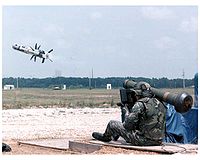 Most rocket launchers require a large clear area behind the gunner to prevent injury from backblast. To address this shortcoming without increasing recoil to an unacceptable level, the Javelin system uses a soft launch
mechanism. A launch motor using conventional rocket propellant
ejects the missile from the launcher, but stops burning before the missile clears the tube. The flight motor is ignited only after a delay to allow for sufficient clearance from the operator. To save weight, the two motors are integrated with a burst disc between them; it is designed to tolerate the pressure of the launch motor from one side, but to easily rupture from the other when the flight motor ignites. Both motors use a common nozzle, with the flight motor's exhaust flowing through the expended launch motor. Because the launch motor casing remains in place, an unusual annular (ring-shaped) igniter is used to start it; a normal igniter would be blown out the back of the missile when the flight motor ignited and could injure the operator.
In the event that the launch motor malfunctions and the launch tube is overpressurized—for example, if the rocket gets stuck—the Javelin missile includes a pressure release system to prevent the launcher from exploding. The launch motor is held in place by a set of shear pins, which fracture if the pressure rises too high and allow the motor to be pushed out the back of the tube.
The gunner uses the CLU’s IR system to find and identify the target then switches to the missile’s independent IR system to set a track box around the target and establish a lock. The gunner places brackets around the image for locking.
The seeker stays focused on the target’s image continuing to track it as the target moves or the missile’s flight path alters or as attack angles change. The seeker has three main components: focal plane array (FPA), cooling and calibration and stabilization.
The seeker assembly is encased in a dome which is transparent to long-wave infrared
radiation. The IR radiation passes through the dome and then through lenses that focus the energy. The IR energy is reflected by mirrors on to the FPA. The seeker is a two-dimensional staring FPA of 64x64 MerCad (HgCdTe) detector elements. The FPA processes the signals from the detectors and relays a signal to the missile’s tracker.
The staring array is a photo-capacitive device where the incident photons stimulate electrons and are stored in the detector as an accumulated charge. The electrons are discharged, pixel by pixel, as currents to a readout integrated circuits attached at the rear of the detector.
The FPA must be cooled and calibrated. The CLU’s IR detectors are cooled using a Dewar flask
and a closed-cycle Stirling engine
. But there is insufficient space in the missile for a similar solution. So, prior to launch, a cooler mounted on the outside of the launch tube activates the electrical systems in the missile and supplies cold gas from a Joule-Thompson expander to the missile detector assembly while the missile is still in the launch tube. When the missile is fired this external connection is broken and coolant gas is supplied internally by an onboard argon
gas bottle. The gas is held in a small bottle at high pressure and contains enough coolant for the duration of the flight of approximately 19 seconds.
The seeker is calibrated using a chopper wheel. This device is a fan of 6 blades: 5 black blades with very low IR emissivity and one semi-reflective blade. These blades spin in front of the seeker optics in a synchronized fashion such that the FPA is continually provided with points of reference in addition to viewing the scene. These reference points allow the FPA to reduce noise introduced by response variations in the detector elements.
The platform on which the seeker is mounted must be stabilized with respect to the motion of the missile body and the seeker must be moved to stay aligned with the target. The stabilization system must cope with rapid acceleration, up/down and lateral movements. This is done by a gimbal
system, accelerometer
s, spinning-mass gyros (or MEMS
), and motors to drive changes in position of the platform. The system is basically an autopilot
. Information from the gyros is fed to the guidance electronics which drive a torque motor attached to the seeker platform to keep the seeker aligned with the target. The wires that connect the seeker with the rest of the missile have no friction to keep the seeker platform balanced.
algorithms. At the end of each frame the reference is updated. The tracker is able to keep track of the target even though the seeker’s point of view can change radically in the course of flight.
To guide the missile the tracker locates the target in the current frame and compares this position with the aim point. If this position is off center the tracker computes a correction and passes it to the guidance system
which makes the appropriate adjustments to the four movable tail fins, as well as six fixed wings at mid-body. This is an autopilot
. To guide the missile the system has sensors that check that the fins are positioned as requested. If not, the deviation is sent back to the controller for further adjustment. This is a closed-loop controller.
There are three stages in the flight managed by the tracker: 1) an initial phase just after launch; 2) a mid-flight phase that lasts for most of the flight; and 3) a terminal phase in which the tracker selects the sweet spot for the point of impact. With guidance algorithms, the autopilot uses data from the seeker and tracker to determine when to transition the missile from one phase of flight to another. Depending on whether the missile is in top attack or direct attack mode, the profile of the flight can change significantly. The top attack mode requires the missile to climb sharply after launch and cruise at high altitude then dive on the top of the target (curveball). In direct attack mode (fastball), the missile cruises at a lower altitude directly at target. The exact flight path which takes into account the range to the target is calculated by the guidance unit.
s with thermal sights. This makes infantry personnel more flexible and able to perceive threats they would not otherwise be able to detect. In 2006 a contract was awarded to Toyon Research Corporation to begin development of an upgrade to the CLU enabling the transmission of target image and GPS location data to other units.
.
radiation
and find both troops and vehicles otherwise too well hidden to detect. The screen shows a "green scale" view which can be adjusted in both contrast and brightness. The inside of the CLU is cooled by a small refrigeration
unit attached to the sight. This greatly increases the sensitivity of the thermal imaging capability since the temperature inside the sight is much lower than that of the objects it detects. Due to the sensitivity this causes, the gunner is able to "focus" the CLU to show a very detailed image of the area being viewed by showing temperature differences of only a few degrees. The gunner operates this view with the use of two hand stations similar to the control stick found in modern cockpits. It is from this view that the gunner focuses the image and determines the area that gives the best heat signature on which to lock the missile.
troops are trained on the system at the Infantry School
in Fort Benning
, Georgia
, for two weeks. The soldiers are taught basic care and maintenance, operation and abilities, assembly and disassembly, and the positions it can be fired from. Soldiers are also taught to distinguish between a variety of vehicle types even when only a rough outline is visible. The soldiers must accomplish several timed drills with set standards before being qualified to operate the system in both training and wartime situations. There are also smaller training programs set up on most Army bases that instruct soldiers on the proper use of the system. At these courses the training program might be changed in small ways. This is most commonly only minor requirements left out due to budget, the amount of soldiers vs. simulation equipment, and available time and resources. Both types of training courses have required proficiency levels that must be met before the soldier can operate the system in training exercises or wartime missions.
requires a heavy tripod stand, a bulky protective case for the thermal sight, a larger, longer launch tube, and requires much more time to assemble and prepare. The Javelin (although still very heavy) is lighter than the other missiles and their necessary parts.
Although the CLU's thermal imaging may hinder aiming, its thermal targeting allows the Javelin to be a fire-and-forget
system. This gives the firer an opportunity to be out of sight and possibly moving to a new angle of fire, or out of the area by the time the enemy realizes they are under attack. This is much safer than using a wire-guided system where the firer must stay stationary to guide the missile into the target.
Another advantage is the Javelin's power at impact. The missile's tandem
shaped charge
warhead is made to penetrate reactive armor. The Javelin was created with the intent to be able to penetrate any tank armor and was tested on the M1 Abrams
. With the top attack
mode it has an even greater ability to destroy the tank because it can attack where most tanks are weakest.
The soft launch
capability of the Javelin allows it to have only a minimal backblast area
. In addition to reducing the visible launch signature from the enemy, this enables the Javelin to be fired from inside structures with minimal preparation, which gives the Javelin advantages in urban fighting over the widely used AT4
(which has a very large backblast area, although this is lessened in the AT4 CS). A large backblast area would seriously injure personnel if fired from inside an unprepared structure, and may betray the location of the launch to enemy observers.
The missile also has a greater range than the system it replaces, the M47 Dragon
.
Another drawback of the system is the reliance on a thermal view to acquire targets. The thermal views are not able to operate until the refrigeration component has cooled the system. The manufacturer estimates 30 seconds until this is complete, but depending on the ambient temperature, this process may take much longer.
Also, Javelin launchers and missiles are rather expensive. A single Javelin unit costs about $125,000, and a missile costs about $40,000.
The system can fire only at targets in line of sight, which casts doubt on its advantages over 2nd generation ATGMs (Metis-M, Kornet) at ranges of more than 1000 meters. At distances up to 600 meters there is a similar problem—rational use of lighter and cheap hand-held rocket launchers, also realizing the principle of "fire and forget".
The operator of the complex has no opportunity to correct the flight of the rocket after launch (when the target contrasts poorly with the terrain, the missile can miss).
United States
The United States of America is a federal constitutional republic comprising fifty states and a federal district...
-made man-portable third generation
Fire-and-forget
Fire-and-forget is a third-generation method of missile guidance. The military uses the term for a type of missile which does not require further guidance after launch such as illumination of the target or wire guidance , and can hit its target without the launcher being in line-of-sight of the...
anti-tank missile fielded to replace the Dragon antitank missile.
Overview
Javelin is a fire-and-forgetFire-and-forget
Fire-and-forget is a third-generation method of missile guidance. The military uses the term for a type of missile which does not require further guidance after launch such as illumination of the target or wire guidance , and can hit its target without the launcher being in line-of-sight of the...
missile with lock-on before launch and automatic self-guidance. The system takes a top-attack flight profile against armored vehicles (attacking the top armor which is generally thinner) but can also take a direct-attack mode for use against buildings or fortifications. This missile also has the ability to engage helicopters in the direct attack mode. It can reach a peak altitude of 150 m (500 ft) in top-attack mode and 60 m in direct-fire mode and is equipped with an imaging infrared seeker. The tandem warhead is fitted with two shaped charge
Shaped charge
A shaped charge is an explosive charge shaped to focus the effect of the explosive's energy. Various types are used to cut and form metal, to initiate nuclear weapons, to penetrate armor, and in the oil and gas industry...
s: a precursor warhead to detonate any explosive reactive armor and a primary warhead to penetrate base armor. The Javelin was used in the 2003 Invasion of Iraq
2003 invasion of Iraq
The 2003 invasion of Iraq , was the start of the conflict known as the Iraq War, or Operation Iraqi Freedom, in which a combined force of troops from the United States, the United Kingdom, Australia and Poland invaded Iraq and toppled the regime of Saddam Hussein in 21 days of major combat operations...
on Iraqi Lion of Babylon tank
Lion of Babylon tank
The Lion of Babylon or Asad Babil was an Iraqi-built version of the Soviet T-72 main battle tank, assembled in a factory established in the 1980s near Taji, north of Baghdad....
s and Type 69 tanks.
The missile is ejected from the launcher so that it reaches a safe distance from the operator before the main rocket motors ignite; a "soft launch
Soft launch
Soft launch can be used in regards to either the method for launching a missile or the release of a product or service.- Missile launch :Soft launching is the method of launching a missile in such a way that the rocket motor ignites outside of the launch tube; the missile is ejected non-explosively...
arrangement". This makes it harder to identify the launcher; however, back-blast from the launch tube still poses a hazard to nearby personnel. Thanks to this "fire and forget" system, the firing team may move on as soon as the missile has been launched.
The missile system is carried most often by a two man team consisting of a gunner and an ammo bearer, although it can be fired with just one person if necessary. While the gunner aims and fires the missile, the ammo bearer scans for prospective targets, watches for threats such as enemy vehicles and troops, and ensures personnel and obstacles are clear of the missile's back blast.
Development
In 1983, the United States ArmyUnited States Army
The United States Army is the main branch of the United States Armed Forces responsible for land-based military operations. It is the largest and oldest established branch of the U.S. military, and is one of seven U.S. uniformed services...
introduced its AAWS-M (Advanced Anti-Tank Weapon System—Medium) requirement and, in 1985, the AAWS-M was approved for development. In August 1986, the Proof-of-Principle (POP) phase of the development began, with $30 million contract awarded for technical proof demonstrators: Ford Aerospace (laser-beam riding), Hughes Aircraft Missile System Group (imaging infra-red combined with a fiber-optic cable link) and Texas Instruments (imaging infra-red). In late 1988, the POP phase ended and, in June 1989, the full-scale development contract was awarded to a joint venture of Texas Instruments
Texas Instruments
Texas Instruments Inc. , widely known as TI, is an American company based in Dallas, Texas, United States, which develops and commercializes semiconductor and computer technology...
and Martin Marietta
Martin Marietta
Martin Marietta Corporation was an American company founded in 1961 through the merger of The Martin Company and American-Marietta Corporation. The combined company became a leader in chemicals, aerospace, and electronics. In 1995, it merged with Lockheed Corporation to form Lockheed Martin. The...
(now Raytheon
Raytheon
Raytheon Company is a major American defense contractor and industrial corporation with core manufacturing concentrations in weapons and military and commercial electronics. It was previously involved in corporate and special-mission aircraft until early 2007...
and Lockheed-Martin). The AAWS-M received the designation of FGM-148.
In April 1991, the first test-flight of the Javelin succeeded, and in March 1993, the first test-firing from the launcher succeeded. In 1994, low levels of production were authorized, and the first Javelins were deployed with US Army units in 1996.
Test and evaluation
Development test and evaluation (DT&E) is conducted to demonstrate that the engineering design and development process is complete. It is used to reduce risk, validate and qualify the design, and ensure that the product is ready for government acceptance. The DT&E results are evaluated to ensure that design risks have been minimized and the system will meet specifications. The results are also used to estimate the system’s military utility when it is introduced into service. DT&E serves a critical purpose in reducing the risks of development by testing selected high-risk components or subsystems. DT&E is the government developing agency tool used to confirm that the system performs as technically specified and that the system is ready for field testing.DT&E is an iterative process of designing, building, testing, identifying deficiencies, fixing, retesting, and repeating. It is performed in the factory, laboratory, and on the proving ground by the contractors and the government. Contractor and government testing is combined into one integrated test program and conducted to determine if the performance requirements have been met and to provide data to the decision authority.
The General Accounting Office (GAO) published a report questioning the adequacy of Javelin testing. The report, called “Army Acquisition—Javelin Is Not Ready for Multiyear Procurement”, opposed entering into full-rate production in 1997 and expressed the need for further operational testing due to the many redesigns undergone.
In 1995, Secretary of Defense William Perry had set forth five new operational test initiatives. These included: 1) getting operational testers involved early in development; 2) use of modeling and simulation; 3) integrating development and operational testing; 4) combining testing and training; and 5) applying concepts to demos and acquisitions.
The late-phase development of the Javelin retroactively benefited from the then new operational test initiatives set forth by the Secretary of Defense, as well as further test conducted as a consequence of the Army’s response to the GAO report. Before the Milestone III decision and before fielding to 3rd Battalion 75th Ranger Regiment at Fort Benning (also Army Rangers, Special Forces, airborne, air assault, and light infantry), the Javelin was subjected to limited parts of the five operational test and evaluation initiatives, as well as a portability operational test program (an additional test phase of the so-called Product Verification Test), which included live firings with the full-rate configuration weapon.
Per initiatives and as a DT&E function, the Institute for Defense Analyses
Institute for Defense Analyses
The Institute for Defense Analyses is a non-profit corporation that administers three federally funded research and development centers to assist the United States government in addressing important national security issues, particularly those requiring scientific and technical expertise...
(IDA) and the Defense Department’s Director of Operational Test and Evaluation (DOT&E) became involved in three development test activities, including: 1) reviewing initial operational test and evaluation plans; 2) monitoring initial operational test and evaluation; and 3) structuring follow-on test and evaluation activities. The results of these efforts detected problems (training included) and corrected significant problems which led to modified test plans, savings in test costs, and GAO satisfaction.
Qualification testing
The Javelin Environmental Test System (JETS) is a mobile test set for Javelin All-Up-Round (AUR) and the Command Launch Unit (CLU). It can be configured to functionally test the AUR or the CLU individually or both units in a mated tactical mode. This mobile unit may be repositioned at the various environmental testing facilities. The mobile system is used for all phases of Javelin qualification testing. There is also a non-mobile JETS used for stand-alone CLU testing. This system is equipped with an environmental chamber and is primarily used for Product Verification Testing (PRVT). Capabilities include: Javelin CLU testing; Javelin AUR testing; Javelin Mated Mode testing; Javelin testing in various environmental conditions; and CLU PRVT.The All-up-Round Test Sets includes: Extreme temperature testing; Missile tracker testing (Track rate error, Tracking sensitivity); Seeker/focal plane array testing (Cool-down time, Dead/defective pixels, Seeker identification); Pneumatic leakage; Continuity measurements; Ready time; and Guidance sections (Guidance commands, Fin movement).
Warhead
The Javelin missile’s tandem warhead is a HEATHeat
In physics and thermodynamics, heat is energy transferred from one body, region, or thermodynamic system to another due to thermal contact or thermal radiation when the systems are at different temperatures. It is often described as one of the fundamental processes of energy transfer between...
type. This round utilizes an explosive shaped charge
Shaped charge
A shaped charge is an explosive charge shaped to focus the effect of the explosive's energy. Various types are used to cut and form metal, to initiate nuclear weapons, to penetrate armor, and in the oil and gas industry...
to create a stream of superplastically
Superplasticity
In materials science, superplasticity is a state in which solid crystalline material is deformed well beyond its usual breaking point, usually over about 200% during tensile deformation. Such a state is usually achieved at high homologous temperature, typically half the absolute melting point. ...
deformed metal formed from trumpet-shaped metallic liners. The result is a narrow high velocity particle stream that can penetrate armor.
The Javelin counters the advent of explosive reactive armor (ERA). ERA boxes or tiles lie over a vehicle’s main armor and explode when struck by a warhead. This explosion does not harm the vehicle’s main armor, but causes steel panels to fly across the path of the HEAT round’s particle stream, so that the warhead expends much of its energy cutting through the panels instead of the main armor. The Javelin uses two shaped-charge warheads in tandem. The smaller diameter HEAT precursor charge sets off the ERA and clears it from the path of the much larger diameter HEAT warhead, which then penetrates the target’s primary armor.
A two-layered molybdenum
Molybdenum
Molybdenum , is a Group 6 chemical element with the symbol Mo and atomic number 42. The name is from Neo-Latin Molybdaenum, from Ancient Greek , meaning lead, itself proposed as a loanword from Anatolian Luvian and Lydian languages, since its ores were confused with lead ores...
liner is used for the precursor and a copper liner for the main warhead.
To protect the main charge from the explosive blast, shock, and debris caused by the impact of the missile's nose and the detonation of the precursor charge, a blast shield is used between the main and precursor charge. This was the first composite material
Composite material
Composite materials, often shortened to composites or called composition materials, are engineered or naturally occurring materials made from two or more constituent materials with significantly different physical or chemical properties which remain separate and distinct at the macroscopic or...
blast shield and the first that had a hole through the middle to provide a jet that is less spread out.
A newer main charge liner produces a higher velocity jet. While making the warhead smaller, this change makes it more effective leaving more room for propellant for the main rocket motor, thus increase the missile's range.
Electronic arming and fusing, called Electronic Safe Arming and Fire (ESAF), is used. The ESAF system enables the firing and arming process to proceed, while imposing a series of safety checks on the missile. ESAF cues the launch motor after the trigger is pulled. When the missile reaches a key acceleration point (indicating that it has cleared the launch tube), the ESAF initiates a second arming signal to fire the flight motor. After another check on missile conditions (target lock check), ESAF initiates final arming to enable the warheads for detonation upon target impact. When the missile strikes the target, ESAF enables the tandem warhead function (provide appropriate time between the detonation of the precursor charge and the detonation
Detonation
Detonation involves a supersonic exothermic front accelerating through a medium that eventually drives a shock front propagating directly in front of it. Detonations are observed in both conventional solid and liquid explosives, as well as in reactive gases...
of the main charge).
Propulsion
Soft launch
Soft launch can be used in regards to either the method for launching a missile or the release of a product or service.- Missile launch :Soft launching is the method of launching a missile in such a way that the rocket motor ignites outside of the launch tube; the missile is ejected non-explosively...
mechanism. A launch motor using conventional rocket propellant
Propellant
A propellant is a material that produces pressurized gas that:* can be directed through a nozzle, thereby producing thrust ;...
ejects the missile from the launcher, but stops burning before the missile clears the tube. The flight motor is ignited only after a delay to allow for sufficient clearance from the operator. To save weight, the two motors are integrated with a burst disc between them; it is designed to tolerate the pressure of the launch motor from one side, but to easily rupture from the other when the flight motor ignites. Both motors use a common nozzle, with the flight motor's exhaust flowing through the expended launch motor. Because the launch motor casing remains in place, an unusual annular (ring-shaped) igniter is used to start it; a normal igniter would be blown out the back of the missile when the flight motor ignited and could injure the operator.
In the event that the launch motor malfunctions and the launch tube is overpressurized—for example, if the rocket gets stuck—the Javelin missile includes a pressure release system to prevent the launcher from exploding. The launch motor is held in place by a set of shear pins, which fracture if the pressure rises too high and allow the motor to be pushed out the back of the tube.
Seeker
As a fire-and-forget missile, after launch the missile has to be able to track and destroy its target without the gunner. This is done by coupling an onboard imaging IR system (different from CLU imaging system) with an onboard tracking system.The gunner uses the CLU’s IR system to find and identify the target then switches to the missile’s independent IR system to set a track box around the target and establish a lock. The gunner places brackets around the image for locking.
The seeker stays focused on the target’s image continuing to track it as the target moves or the missile’s flight path alters or as attack angles change. The seeker has three main components: focal plane array (FPA), cooling and calibration and stabilization.
Focal plane array (FPA)
The seeker assembly is encased in a dome which is transparent to long-wave infrared
Infrared
Infrared light is electromagnetic radiation with a wavelength longer than that of visible light, measured from the nominal edge of visible red light at 0.74 micrometres , and extending conventionally to 300 µm...
radiation. The IR radiation passes through the dome and then through lenses that focus the energy. The IR energy is reflected by mirrors on to the FPA. The seeker is a two-dimensional staring FPA of 64x64 MerCad (HgCdTe) detector elements. The FPA processes the signals from the detectors and relays a signal to the missile’s tracker.
The staring array is a photo-capacitive device where the incident photons stimulate electrons and are stored in the detector as an accumulated charge. The electrons are discharged, pixel by pixel, as currents to a readout integrated circuits attached at the rear of the detector.
Cooling/Calibration
The FPA must be cooled and calibrated. The CLU’s IR detectors are cooled using a Dewar flask
Dewar flask
A Dewar flask is a vessel designed to provide very good thermal insulation. For instance, when filled with a hot liquid, the vessel will not allow the heat to easily escape, and the liquid will stay hot for far longer than in a typical container...
and a closed-cycle Stirling engine
Stirling engine
A Stirling engine is a heat engine operating by cyclic compression and expansion of air or other gas, the working fluid, at different temperature levels such that there is a net conversion of heat energy to mechanical work....
. But there is insufficient space in the missile for a similar solution. So, prior to launch, a cooler mounted on the outside of the launch tube activates the electrical systems in the missile and supplies cold gas from a Joule-Thompson expander to the missile detector assembly while the missile is still in the launch tube. When the missile is fired this external connection is broken and coolant gas is supplied internally by an onboard argon
Argon
Argon is a chemical element represented by the symbol Ar. Argon has atomic number 18 and is the third element in group 18 of the periodic table . Argon is the third most common gas in the Earth's atmosphere, at 0.93%, making it more common than carbon dioxide...
gas bottle. The gas is held in a small bottle at high pressure and contains enough coolant for the duration of the flight of approximately 19 seconds.
The seeker is calibrated using a chopper wheel. This device is a fan of 6 blades: 5 black blades with very low IR emissivity and one semi-reflective blade. These blades spin in front of the seeker optics in a synchronized fashion such that the FPA is continually provided with points of reference in addition to viewing the scene. These reference points allow the FPA to reduce noise introduced by response variations in the detector elements.
Stabilization
The platform on which the seeker is mounted must be stabilized with respect to the motion of the missile body and the seeker must be moved to stay aligned with the target. The stabilization system must cope with rapid acceleration, up/down and lateral movements. This is done by a gimbal
Gimbal
A gimbal is a pivoted support that allows the rotation of an object about a single axis. A set of two gimbals, one mounted on the other with pivot axes orthogonal, may be used to allow an object mounted on the innermost gimbal to remain immobile regardless of the motion of its support...
system, accelerometer
Accelerometer
An accelerometer is a device that measures proper acceleration, also called the four-acceleration. This is not necessarily the same as the coordinate acceleration , but is rather the type of acceleration associated with the phenomenon of weight experienced by a test mass that resides in the frame...
s, spinning-mass gyros (or MEMS
Microelectromechanical systems
Microelectromechanical systems is the technology of very small mechanical devices driven by electricity; it merges at the nano-scale into nanoelectromechanical systems and nanotechnology...
), and motors to drive changes in position of the platform. The system is basically an autopilot
Autopilot
An autopilot is a mechanical, electrical, or hydraulic system used to guide a vehicle without assistance from a human being. An autopilot can refer specifically to aircraft, self-steering gear for boats, or auto guidance of space craft and missiles...
. Information from the gyros is fed to the guidance electronics which drive a torque motor attached to the seeker platform to keep the seeker aligned with the target. The wires that connect the seeker with the rest of the missile have no friction to keep the seeker platform balanced.
Tracker
The tracker is key to guidance/control for an eventual hit. The signals from each of the 4,096 detector elements (64x64 pixel array) in the seeker are passed to the FPA readout integrated circuits which reads then creates a video frame that is sent to the tracker system for processing. By comparing the individual frames the tracker determines the need to correct so as to keep the missile on target. The tracker must be able to determine which portion of the image represents the target. The target is initially defined by the gunner who places a configurable frame around it. The tracker then uses algorithms to compare that region of the frame based on image, geometric, and movement data to the new image frames being sent from the seeker, similar to pattern recognitionPattern recognition
In machine learning, pattern recognition is the assignment of some sort of output value to a given input value , according to some specific algorithm. An example of pattern recognition is classification, which attempts to assign each input value to one of a given set of classes...
algorithms. At the end of each frame the reference is updated. The tracker is able to keep track of the target even though the seeker’s point of view can change radically in the course of flight.
To guide the missile the tracker locates the target in the current frame and compares this position with the aim point. If this position is off center the tracker computes a correction and passes it to the guidance system
Guidance system
A guidance system is a device or group of devices used to navigate a ship, aircraft, missile, rocket, satellite, or other craft. Typically, this refers to a system that navigates without direct or continuous human control...
which makes the appropriate adjustments to the four movable tail fins, as well as six fixed wings at mid-body. This is an autopilot
Autopilot
An autopilot is a mechanical, electrical, or hydraulic system used to guide a vehicle without assistance from a human being. An autopilot can refer specifically to aircraft, self-steering gear for boats, or auto guidance of space craft and missiles...
. To guide the missile the system has sensors that check that the fins are positioned as requested. If not, the deviation is sent back to the controller for further adjustment. This is a closed-loop controller.
There are three stages in the flight managed by the tracker: 1) an initial phase just after launch; 2) a mid-flight phase that lasts for most of the flight; and 3) a terminal phase in which the tracker selects the sweet spot for the point of impact. With guidance algorithms, the autopilot uses data from the seeker and tracker to determine when to transition the missile from one phase of flight to another. Depending on whether the missile is in top attack or direct attack mode, the profile of the flight can change significantly. The top attack mode requires the missile to climb sharply after launch and cruise at high altitude then dive on the top of the target (curveball). In direct attack mode (fastball), the missile cruises at a lower altitude directly at target. The exact flight path which takes into account the range to the target is calculated by the guidance unit.
Launch Tube Assembly
Both men carry a disposable tube called the Launch Tube Assembly which houses the missile and protects the missile from harsh environments. The tube also has built in electronics and a locking hinge system that makes attachment and detachment of the missile to and from the Command Launch Unit a very quick and simple process.Command Launch Unit
The gunner carries a reusable Command Launch Unit (in addition to the Launch Tube Assembly) more commonly referred to as a CLU . The CLU is the targeting component of the two part system. The CLU has three views which are used to find, target, and fire the missile. The CLU may also be used separately from the missile as a portable thermal sight. Infantry are no longer required to stay in constant contact with armored personnel carriers and tankTank
A tank is a tracked, armoured fighting vehicle designed for front-line combat which combines operational mobility, tactical offensive, and defensive capabilities...
s with thermal sights. This makes infantry personnel more flexible and able to perceive threats they would not otherwise be able to detect. In 2006 a contract was awarded to Toyon Research Corporation to begin development of an upgrade to the CLU enabling the transmission of target image and GPS location data to other units.
Day Field of View
The first view is a 4× magnification day view. It is mainly used to scan areas for light during night operation because light is not visible in the thermal views. It is also used to scan during times following the sunrise and sunset when the thermal image is hard to focus due to the natural rapid heating and/or cooling of the EarthEarth
Earth is the third planet from the Sun, and the densest and fifth-largest of the eight planets in the Solar System. It is also the largest of the Solar System's four terrestrial planets...
.
WFOV (Wide Field of View)
The second view is the 4x magnification night view, and shows the gunner a thermal representation of the area viewed. This is also the primary view used due to its ability to detect infraredInfrared
Infrared light is electromagnetic radiation with a wavelength longer than that of visible light, measured from the nominal edge of visible red light at 0.74 micrometres , and extending conventionally to 300 µm...
radiation
Radiation
In physics, radiation is a process in which energetic particles or energetic waves travel through a medium or space. There are two distinct types of radiation; ionizing and non-ionizing...
and find both troops and vehicles otherwise too well hidden to detect. The screen shows a "green scale" view which can be adjusted in both contrast and brightness. The inside of the CLU is cooled by a small refrigeration
Refrigeration
Refrigeration is a process in which work is done to move heat from one location to another. This work is traditionally done by mechanical work, but can also be done by magnetism, laser or other means...
unit attached to the sight. This greatly increases the sensitivity of the thermal imaging capability since the temperature inside the sight is much lower than that of the objects it detects. Due to the sensitivity this causes, the gunner is able to "focus" the CLU to show a very detailed image of the area being viewed by showing temperature differences of only a few degrees. The gunner operates this view with the use of two hand stations similar to the control stick found in modern cockpits. It is from this view that the gunner focuses the image and determines the area that gives the best heat signature on which to lock the missile.
NFOV (Narrow Field of View)
The third field of view is a 9x thermal sight used to better identify the target vehicle. Once the CLU has been focused in WFOV, the gunner may switch to NFOV for target recognition before activating Seeker FOV.Seeker Field of View
Once the best target area is chosen the gunner presses one of the two triggers and automatically is sent to the fourth view. The Seeker FOV is a 9x magnification thermal view. This process is similar to the automatic zoom feature on most modern cameras. This view is also available along with the previously mentioned views, all of which may be accessed with press of a button. It is not as popular however, because a high magnification view takes longer to scan a wide area. This view allows the gunner to further aim the missile and set the guidance system housed inside the actual missile. During this view is when information is passed from the CLU, through the connection electronics of the Launch Tube Assembly, and into the missile's guidance system. If the gunner feels uncomfortable with firing the missile, he can still cycle back to the other views without having to fire the missile. When the gunner is comfortable with the target picture he pulls the second trigger and establishes a "lock”. The missile launches after a short hesitation.Training
A great familiarity of each control and swift operation needs to be achieved before the unit can be deployed efficiently. AmericanUnited States
The United States of America is a federal constitutional republic comprising fifty states and a federal district...
troops are trained on the system at the Infantry School
United States Army Infantry School
The United States Army Infantry School is located in Fort Benning, Georgia. It is made up of the following components:*192d Infantry Brigade...
in Fort Benning
Fort Benning
Fort Benning is a United States Army post located southeast of the city of Columbus in Muscogee and Chattahoochee counties in Georgia and Russell County, Alabama...
, Georgia
Georgia (U.S. state)
Georgia is a state located in the southeastern United States. It was established in 1732, the last of the original Thirteen Colonies. The state is named after King George II of Great Britain. Georgia was the fourth state to ratify the United States Constitution, on January 2, 1788...
, for two weeks. The soldiers are taught basic care and maintenance, operation and abilities, assembly and disassembly, and the positions it can be fired from. Soldiers are also taught to distinguish between a variety of vehicle types even when only a rough outline is visible. The soldiers must accomplish several timed drills with set standards before being qualified to operate the system in both training and wartime situations. There are also smaller training programs set up on most Army bases that instruct soldiers on the proper use of the system. At these courses the training program might be changed in small ways. This is most commonly only minor requirements left out due to budget, the amount of soldiers vs. simulation equipment, and available time and resources. Both types of training courses have required proficiency levels that must be met before the soldier can operate the system in training exercises or wartime missions.
Advantages
The portable system is easy to separate into main components and easy to set up when needed. Compared to more cumbersome anti-tank weapon systems, the difference is noticeable. For example, a TOWBGM-71 TOW
The BGM-71 TOW is an anti-tank missile. "BGM" is a weapon classification that stands for "Multiple Environment , Surface-Attack , Missile ". "TOW" is an acronym that stands for "Tube-launched, Optically-tracked, Wire command data link, guided missile"...
requires a heavy tripod stand, a bulky protective case for the thermal sight, a larger, longer launch tube, and requires much more time to assemble and prepare. The Javelin (although still very heavy) is lighter than the other missiles and their necessary parts.
Although the CLU's thermal imaging may hinder aiming, its thermal targeting allows the Javelin to be a fire-and-forget
Fire-and-forget
Fire-and-forget is a third-generation method of missile guidance. The military uses the term for a type of missile which does not require further guidance after launch such as illumination of the target or wire guidance , and can hit its target without the launcher being in line-of-sight of the...
system. This gives the firer an opportunity to be out of sight and possibly moving to a new angle of fire, or out of the area by the time the enemy realizes they are under attack. This is much safer than using a wire-guided system where the firer must stay stationary to guide the missile into the target.
Another advantage is the Javelin's power at impact. The missile's tandem
Tandem-charge
A tandem-charge weapon is an explosive device or projectile that has two or more stages of detonation. It is effective against cage armor, which is designed to protect an armored vehicle against anti-tank munitions. The first stage of the weapon triggers the reactive armor of the target, limiting...
shaped charge
Shaped charge
A shaped charge is an explosive charge shaped to focus the effect of the explosive's energy. Various types are used to cut and form metal, to initiate nuclear weapons, to penetrate armor, and in the oil and gas industry...
warhead is made to penetrate reactive armor. The Javelin was created with the intent to be able to penetrate any tank armor and was tested on the M1 Abrams
M1 Abrams
The M1 Abrams is a third-generation main battle tank produced in the United States. It is named after General Creighton Abrams, former Army Chief of Staff and Commander of US military forces in Vietnam from 1968 to 1972. The M1 is a well armed, heavily armored, and highly mobile tank designed for...
. With the top attack
Top attack
A top attack device is designed to attack armoured vehicles from above, as the armour is usually thinnest at the top. Ideally, it will penetrate perpendicular to the attacked surface. The device may be delivered by a missile, artillery shell, or even an emplaced munition...
mode it has an even greater ability to destroy the tank because it can attack where most tanks are weakest.
The soft launch
Soft launch
Soft launch can be used in regards to either the method for launching a missile or the release of a product or service.- Missile launch :Soft launching is the method of launching a missile in such a way that the rocket motor ignites outside of the launch tube; the missile is ejected non-explosively...
capability of the Javelin allows it to have only a minimal backblast area
Backblast area
The backblast area is a cone-shaped area behind a rocket launcher, rocket-assisted takeoff unit or recoilless rifle, where hot gases are expelled when the rocket or rifle is discharged. The backblast area is dangerous to ground personnel, who may be burned by the gases or exposed to overpressure...
. In addition to reducing the visible launch signature from the enemy, this enables the Javelin to be fired from inside structures with minimal preparation, which gives the Javelin advantages in urban fighting over the widely used AT4
AT4
The AT4 is an 84-mm unguided, portable, single-shot recoilless smoothbore weapon built in Sweden by Saab Bofors Dynamics...
(which has a very large backblast area, although this is lessened in the AT4 CS). A large backblast area would seriously injure personnel if fired from inside an unprepared structure, and may betray the location of the launch to enemy observers.
The missile also has a greater range than the system it replaces, the M47 Dragon
M47 Dragon
The M47 Dragon is an American shoulder-fired, man-portable anti-tank missile system. It has since been phased out in US service, in favor of the newer FGM-148 Javelin system.-Description:...
.
Disadvantages
The main drawback of the complete system (missile, tube, and CLU) is its 49.2 lb (22.3 kg) total weight. The system is designed to be portable by infantry on foot and weighs more than the original specified weight the Army called for.Another drawback of the system is the reliance on a thermal view to acquire targets. The thermal views are not able to operate until the refrigeration component has cooled the system. The manufacturer estimates 30 seconds until this is complete, but depending on the ambient temperature, this process may take much longer.
Also, Javelin launchers and missiles are rather expensive. A single Javelin unit costs about $125,000, and a missile costs about $40,000.
The system can fire only at targets in line of sight, which casts doubt on its advantages over 2nd generation ATGMs (Metis-M, Kornet) at ranges of more than 1000 meters. At distances up to 600 meters there is a similar problem—rational use of lighter and cheap hand-held rocket launchers, also realizing the principle of "fire and forget".
The operator of the complex has no opportunity to correct the flight of the rocket after launch (when the target contrasts poorly with the terrain, the missile can miss).
Users
- 92 launchers.: 13 launchers.: Purchased 3 launchers and 12 missiles for its special forces (intended for use in Afghanistan).: Purchased 200 launchers and 840 missiles for its army.: 76 launchers and 260 missiles for use in Afghanistan. : India will buy some of the systems off-the-shelf, while a much larger number will be indigenously manufactured under licensed production. While the exact number of Javelin systems India will induct is yet to be decided, it could well run into >60,000. The Army has a shortfall of around 44,000 ATGMs.: 162 JAVELIN Command Launch Units (CLUs), 18 Fly-to-Buy Missiles, 1,808 JAVELIN Anti-Tank Guided Missiles and other support equipment. The estimated cost is $388 million.: 40 launchers.: 24 launchers and 120 missiles.: 100 launchers and 526 missiles. Delivered from 2006, in use from 2009.: 30 launchers.: In 2002, Taiwan bought 360 Javelin missiles and 40 launcher units for $39 million. The contract also included training devices, logistics support, associated equipment and training. In 2008, the United States issued a congressional notification for the sale of a further 20 launchers and 182 more missiles.: In January 2003, the UK Ministry of DefenceMinistry of Defence (United Kingdom)The Ministry of Defence is the United Kingdom government department responsible for implementation of government defence policy and is the headquarters of the British Armed Forces....
announced that it had decided to procure Javelin for the Light Forces Anti-Tank Guided Weapon System (LFATGWS) requirement. It entered UK service in 2005 replacing the MILANMILANMILAN " is French and German for "kite bird") is a European anti-tank guided missile. Design of the MILAN started in 1962. It was ready for trials in 1971, and was accepted for service in 1972. It is a wire guided SACLOS missile, which means the sight of the launch unit has to be aimed at the...
and SwingfireSwingfireSwingfire was a British wire-guided anti-tank missile developed in the 1960s and produced from 1966 until 1993.-Development:Swingfire was developed by Fairey Engineering Ltd and the British Aircraft Corporation. It replaced the Vickers Vigilant missile in British service...
systems.: In 2003, the United States General Accounting Office (GAO) reported that the Army had lost 36 Javelin command launch units in Iraq totaling approximately $2.8 million. The New York Times later reported supply chain problems at military armories and warehouses in 2004 and expressed concerns of weapons falling into enemy hands.
See also
- Spike (missile)Spike (missile)Spike is a fourth generation man-portable fire-and-forget anti-tank guided missile with tandem-charged HEAT warhead, developed and designed by the Israeli company Rafael Advanced Defense Systems and in service with a number of nations....
- Type 01 LMATType 01 LMATThe is a Japanese man-portable fire-and-forget anti-tank missile. Development began in 1993 at Kawasaki Heavy Industries and was accepted into service in 2001. During development, the missile was designated with the codename XATM-5...
- 9K115-2 Metis-M9K115-2 Metis-MThe 9K115-2 Metis-M is a Russian anti-tank missile system. "9K115-2" is the GRAU designation of the missile. Its NATO reporting name is AT-13 Saxhorn-2.The system is designed to augment the combat power of company-levelmotorized units....
- List of missiles