


Führerbunker

Encyclopedia
Reich Chancellery
The Reich Chancellery was the traditional name of the office of the Chancellor of Germany in the period of the German Reich from 1871 to 1945...
in Berlin
Berlin
Berlin is the capital city of Germany and is one of the 16 states of Germany. With a population of 3.45 million people, Berlin is Germany's largest city. It is the second most populous city proper and the seventh most populous urban area in the European Union...
, Germany
Germany
Germany , officially the Federal Republic of Germany , is a federal parliamentary republic in Europe. The country consists of 16 states while the capital and largest city is Berlin. Germany covers an area of 357,021 km2 and has a largely temperate seasonal climate...
. It was part of a subterranean bunker complex which was constructed in two major phases, one part in 1936 and the other in 1943. It was the last of the Führer Headquarters
Führer Headquarters
The Führer Headquarters , abbreviated FHQ, is a common name for a number of official headquarters used by the Nazi leader Adolf Hitler and various German commanders and officials throughout Europe during World War II...
(Führerhauptquartiere) to be used by Hitler.
Adolf Hitler
Adolf Hitler
Adolf Hitler was an Austrian-born German politician and the leader of the National Socialist German Workers Party , commonly referred to as the Nazi Party). He was Chancellor of Germany from 1933 to 1945, and head of state from 1934 to 1945...
took up residence in the Führerbunker in January 1945 and until the last week of the war it became the epicentre of the Nazi regime. It was here during the last week of April 1945 that Hitler married Eva Braun
Eva Braun
Eva Anna Paula Hitler was the longtime companion of Adolf Hitler and, for less than 40 hours, his wife. Braun met Hitler in Munich, when she was 17 years old, while working as an assistant and model for his personal photographer and began seeing him often about two years later...
shortly before they committed suicide
Suicide
Suicide is the act of intentionally causing one's own death. Suicide is often committed out of despair or attributed to some underlying mental disorder, such as depression, bipolar disorder, schizophrenia, alcoholism, or drug abuse...
.
The ruins of both the old and new Chancellery buildings were levelled by the Soviets between 1945 and 1949 but the bunker largely survived, although some areas were partially flooded. Apart from one unsuccessful attempt by the government of East Germany in 1959 to blow it up, the underground complex remained largely undisturbed, until after the reunification of Germany. During the reconstruction of that area of Berlin after reunification, those sections of the complex that were excavated were for the most part destroyed.
The site remained unmarked until 2006 when a small plaque was installed with a schematic of the bunker to mark the location. Some of the corridors of the bunker still exist today, sealed off from the public.
Construction
Air-raid shelter
Air-raid shelters, also known as bomb shelters, are structures for the protection of the civil population as well as military personnel against enemy attacks from the air...
for Hitler, but the increased bombing of Berlin led to expansion of the complex as an improvised permanent shelter. The elaborate complex consisted of two separate levels, the Vorbunker
Vorbunker
The Vorbunker or "forward bunker" was located behind the large reception hall that was added onto the old Reich Chancellery, in Berlin, Germany. It was meant to be a temporary air-raid shelter for Adolf Hitler, his guards, and servants...
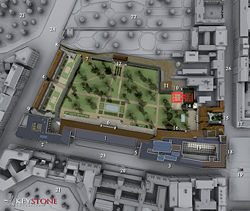
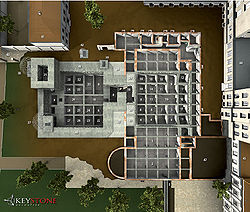
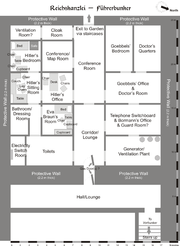
(the upper bunker) or "forward bunker" and the newer Führerbunker located one level below. They were connected by a stairway set at right angles (they were not spiral) which could be closed off from each other by a bulkhead and steel door. The Führerbunker was located about 8.2 metres beneath the garden of the old Reich Chancellery building at Wilhelmstraße 77, about 120 metres north of the new Reich Chancellery building, which had the address Voßstraße 6. The Vorbunker was located beneath the large reception hall behind the old Reich Chancellery, which was connected to the new Reich Chancellery. The Führerbunker was located somewhat lower than the Vorbunker and to the west-southwest of it.
The complex was protected by approximately four metres of concrete, and about 30 small rooms were distributed over two levels with exits into the main buildings and an emergency exit into the gardens. The complex was built in two distinct phases, one part in 1936 and the other in 1943. The 1943 development was built by the Hochtief
Hochtief
Hochtief Aktiengesellschaft is Germany's largest construction company. It is based in Essen but operates globally, ranking as the top general builder in the United States through its Turner Corporation subsidiary, and in Australia through the Leighton Group. In 2010 it employed more than 70,000...
company as part of an extensive program of subterranean construction in Berlin begun in 1940. The accommodations for Hitler were in the newer, lower section and by February 1945 had been decorated with high-quality furniture taken from the Chancellery along with several framed oil paintings.
Events in 1945
Martin Bormann
Martin Ludwig Bormann was a prominent Nazi official. He became head of the Party Chancellery and private secretary to Adolf Hitler...
, and later, Eva Braun
Eva Braun
Eva Anna Paula Hitler was the longtime companion of Adolf Hitler and, for less than 40 hours, his wife. Braun met Hitler in Munich, when she was 17 years old, while working as an assistant and model for his personal photographer and began seeing him often about two years later...
and Joseph Goebbels
Joseph Goebbels
Paul Joseph Goebbels was a German politician and Reich Minister of Propaganda in Nazi Germany from 1933 to 1945. As one of Adolf Hitler's closest associates and most devout followers, he was known for his zealous oratory and anti-Semitism...
with Magda
Magda Goebbels
Johanna Maria Magdalena "Magda" Goebbels was the wife of Nazi Germany's Propaganda Minister Joseph Goebbels...
and their six children
Goebbels children
The Goebbels children were the five daughters and one son born to Nazi propaganda minister Joseph Goebbels and his wife Magda Goebbels. The children, born between 1932 and 1940, were murdered by their parents in Berlin on May 1, 1945, the day both parents committed suicide.Magda Goebbels had an...
who took residence in the upper Vorbunker
Vorbunker
The Vorbunker or "forward bunker" was located behind the large reception hall that was added onto the old Reich Chancellery, in Berlin, Germany. It was meant to be a temporary air-raid shelter for Adolf Hitler, his guards, and servants...
. Two or three dozen support, medical and administrative staff were also sheltered there. These included Hitler's secretaries (including Traudl Junge
Traudl Junge
Traudl Junge was Adolf Hitler's youngest personal private secretary, from December 1942 to April 1945.-Early life:...
), a nurse named Erna Flegel
Erna Flegel
Erna Flegel , born in Kiel in 1911, was a German nurse.From January 1943 until the end of World War II, Flegel served in that capacity for Hitler's entourage and during the Battle of Berlin. She is believed to have been in Hitler's bunker when he committed suicide. She had originally worked...
and telephonist Rochus Misch
Rochus Misch
Rochus Misch is a former Oberscharführer in the 1st SS Division Leibstandarte SS Adolf Hitler during World War II. He served as a courier, bodyguard and telephone operator for German leader Adolf Hitler from 1940 to 1945...
. Hitler's dog Blondi
Blondi
Blondi was Adolf Hitler's German Shepherd dog, given to him as a gift in 1941 by Martin Bormann. Blondi stayed with Hitler even after his move into the Führerbunker located underneath the garden of the Reich Chancellery on January 16, 1945...
was also one of the occupants of the underground bunker. Initially, Hitler would often stroll around in the chancellery garden with Blondi until March 1945 when shelling became very common.
The bunker complex was supplied with large quantities of food and other necessities and by all accounts successfully protected its occupants from the relentless and lethal shelling that went on overhead in the closing days of April 1945. In the final days of the war, it is said that Hitler still enjoyed 10 to 16 cups of tea per day even though it was hard to obtain. Many witnesses later spoke of the constant droning sound of the underground complex's ventilation
Ventilation (architecture)
Ventilating is the process of "changing" or replacing air in any space to provide high indoor air quality...
system.
On 16 April the Red Army
Red Army
The Workers' and Peasants' Red Army started out as the Soviet Union's revolutionary communist combat groups during the Russian Civil War of 1918-1922. It grew into the national army of the Soviet Union. By the 1930s the Red Army was among the largest armies in history.The "Red Army" name refers to...
started the Battle of Berlin
Battle of Berlin
The Battle of Berlin, designated the Berlin Strategic Offensive Operation by the Soviet Union, was the final major offensive of the European Theatre of World War II....
by attacking German front line positions
Battle of the Oder-Neisse
The Battle of the Oder–Neisse is the German name for the initial phase of one of the last two strategic offensives conducted by the Red Army in the Campaign in Central Europe during World War II. Its initial breakthrough phase was fought over four days, from 16 April until 19 April 1945, within...
on the rivers Oder
Oder
The Oder is a river in Central Europe. It rises in the Czech Republic and flows through western Poland, later forming of the border between Poland and Germany, part of the Oder-Neisse line...
and Neisse. By 19 April Soviet spearheads had broken through the German lines and were starting to encircle Berlin.
On 20 April, his 56th birthday, Hitler made his last trip to the surface to award Iron Cross
Iron Cross
The Iron Cross is a cross symbol typically in black with a white or silver outline that originated after 1219 when the Kingdom of Jerusalem granted the Teutonic Order the right to combine the Teutonic Black Cross placed above a silver Cross of Jerusalem....
es to some boy soldiers of the Hitler Youth
Hitler Youth
The Hitler Youth was a paramilitary organization of the Nazi Party. It existed from 1922 to 1945. The HJ was the second oldest paramilitary Nazi group, founded one year after its adult counterpart, the Sturmabteilung...
.
On 21 April Hitler gave orders which showed that his grasp of the military situation was gone. He ordered German army formations to counterattack to pinch off the two massive Soviet pincers that were encircling Berlin. The northern attack was to be commanded by SS-General Felix Steiner
Felix Steiner
Felix Martin Julius Steiner was a German Reichswehr and Waffen-SS officer who served in both World War I and World War II. He was also a recipient of the Knight's Cross of the Iron Cross with Oak Leaves and Swords...
's Army Detachment
Army Detachment Steiner
Army Detachment Steiner , was a temporary military unit, something more than a corps but less than an army, created on paper by German dictator Adolf Hitler on 21 April 1945 during the Battle of Berlin, and placed under the command of SS Obergruppenführer Felix Steiner...
. Steiner tried to explain to his superiors that the only offensive capability he had was two battalions of the 4th SS Police Division and they had no heavy weapons. No one passed on this information to Hitler. The southern counterattack was also unrealistic, because the German Ninth Army
German Ninth Army
The 9th Army was a World War II field army.The 9th Army was activated on May 15, 1940 with General Johannes Blaskowitz in command.-1940:The 9th Army first saw service along the Siegfried Line when it was involved in the invasion of France...
was being pushed back into the Halbe pocket.
On April 22, at his afternoon situation conference Hitler fell into a tearful rage when he realised that his plans of the day before were not going to be carried out. Hitler openly declared for the first time the war was lost and blamed the generals. Hitler announced he would stay in Berlin until the end and then shoot himself. In an attempt to coax Hitler out of his rage, General Alfred Jodl
Alfred Jodl
Alfred Josef Ferdinand Jodl was a German military commander, attaining the position of Chief of the Operations Staff of the Armed Forces High Command during World War II, acting as deputy to Wilhelm Keitel...
speculated that the German Twelfth Army
German Twelfth Army
- History :The 12th Army was activated on October 13, 1939 with General Wilhelm List in command. First seeing defensive action along the Siegfried Line, the army was involved in the invasion and occupation of France...
, under the command of General Walther Wenck
Walther Wenck
-Captive, prisoner, and death:Wenck was captured and put in a prisoner of war camp. He was released in 1947. In 1982, Wenck died in a car accident in Bad Rothenfelde.-See also:* Battle of Berlin - 1945* Battle of Halbe - 1945* Hans Krebs, Chief of Staff...
, that was facing the Americans, could move to Berlin because the Americans, already on the Elbe
Elbe
The Elbe is one of the major rivers of Central Europe. It rises in the Krkonoše Mountains of the northwestern Czech Republic before traversing much of Bohemia , then Germany and flowing into the North Sea at Cuxhaven, 110 km northwest of Hamburg...
River, were unlikely to move farther east. Hitler immediately seized on the idea and within hours Wenck was ordered to disengage from the Americans and move the Twelfth Army north-east to support Berlin. It was then realized that, if the Ninth Army moved west, it could link up with the Twelfth Army. In the evening Heinrici was given permission to make the link up.
On 23 April, Hitler appointed German General of the Artillery (General der Artillerie) Helmuth Weidling
Helmuth Weidling
Helmuth Otto Ludwig Weidling was an officer in the German Army before and during World War II...
as the commander of the Berlin Defense Area. Only a day earlier, Hitler had ordered that Weidling be executed by firing squad. This was due to a misunderstanding concerning a retreat order issued by Weidling as commander of the LVI Panzer Corps. On 20 April, Weidling had been appointed commander of the LVI Panzer Corps. Weidling replaced Lieutenant-Colonel (Oberstleutnant) Ernst Kaether
Ernst Kaether
Ernst Kaether was an officer in the German Army during World War II.As a Lieutenant-Colonel , Kaether commanded the 14th Infantry Regiment of the 5th Jäger Division...
as commander of Berlin.
Despite the commands issuing from the Führerbunker by April 25 the Soviets had consolidated their investment
Investment (military)
Investment is the military tactic of surrounding an enemy fort with armed forces to prevent entry or escape.A circumvallation is a line of fortifications, built by the attackers around the besieged fortification facing towards the enemy fort...
of Berlin and leading Soviet units were probing and penetrating the S-Bahn defensive ring. By the end of 25 April there was no prospect that the German defence of the city could do anything but delay the capture of the city by the Soviets as the decisive stages of the battle had already been fought and lost by the Germans outside the city.
Hitler summoned Field Marshal Robert Ritter von Greim
Robert Ritter von Greim
Robert Ritter von Greim was a German Field Marshal, pilot, army officer, and the last commander of the Luftwaffe during the Second World War.-Early years:...
from Munich to Berlin to take over command of the Luftwaffe from Göring
Göring
- People :* Albert Göring, a German businessman, brother of Hermann Göring* Carin Göring, first wife of Hermann Göring* Carl Göring, German master of chess and philosopher* Emmy Göring, German actress and second wife of Hermann Göring...
. On 26 April while flying over Berlin in a Fieseler Storch, von Greim was seriously wounded by Soviet anti-aircraft fire. Hanna Reitsch
Hanna Reitsch
Hanna Reitsch was a German aviator and the only woman awarded the Iron Cross First Class and the Luftwaffe Combined Pilots-Observation Badge in Gold with Diamonds during World War II...
, his mistress and a crack test pilot, landed von Greim on an improvised air strip in the Tiergarten
Tiergarten
Tiergarten is a locality within the borough of Mitte, in central Berlin . Notable for the great and homonymous urban park, before German reunification, it was a part of West Berlin...
near the Brandenburg Gate
Brandenburg Gate
The Brandenburg Gate is a former city gate and one of the most well-known landmarks of Berlin and Germany. It is located west of the city centre at the junction of Unter den Linden and Ebertstraße, immediately west of the Pariser Platz. It is the only remaining gate of a series through which...
.
On 28 April, Hitler learned of Reichsführer-SS Heinrich Himmler
Heinrich Himmler
Heinrich Luitpold Himmler was Reichsführer of the SS, a military commander, and a leading member of the Nazi Party. As Chief of the German Police and the Minister of the Interior from 1943, Himmler oversaw all internal and external police and security forces, including the Gestapo...
's contacts with Count Folke Bernadotte
Folke Bernadotte
Folke Bernadotte, Count of Wisborg was a Swedish diplomat and nobleman noted for his negotiation of the release of about 31,000 prisoners from German concentration camps during World War II, including 450 Danish Jews from Theresienstadt released on 14 April 1945...
in Lübeck
Lübeck
The Hanseatic City of Lübeck is the second-largest city in Schleswig-Holstein, in northern Germany, and one of the major ports of Germany. It was for several centuries the "capital" of the Hanseatic League and, because of its Brick Gothic architectural heritage, is listed by UNESCO as a World...
. Himmler had offered surrender to the western Allies and the offer had been declined. Himmler had implied that he had the authority for such a surrender. Hitler considered this treason and his anger poured out into a rage against Himmler. Hitler had Hermann Fegelein
Hermann Fegelein
SS-Obergruppenführer Hans Georg Otto Hermann Fegelein was a General of the Waffen-SS in Nazi Germany, a member of Adolf Hitler's entourage, brother-in-law to Eva Braun through his marriage to her sister, Gretl, and husband of the sister-in-law to Adolf Hitler through Hitler's marriage to Eva...
(Himmler's SS representative at Hitler's HQ in Berlin) shot. Hitler further ordered von Greim (with Reitsch) to fly to Dönitz's headquarters at Ploen and arrest the "traitor" Himmler.
General Hans Krebs
Hans Krebs (general)
Hans Krebs was a German Army general of infantry who served during World War II.-Early life:Krebs was born in Helmstedt. He volunteered for service in the Imperial German Army in 1914, was promoted to lieutenant in 1915, and to first lieutenant in 1925...
made his last telephone call from the Führerbunker. He called Field Marshal
Field Marshal
Field Marshal is a military rank. Traditionally, it is the highest military rank in an army.-Etymology:The origin of the rank of field marshal dates to the early Middle Ages, originally meaning the keeper of the king's horses , from the time of the early Frankish kings.-Usage and hierarchical...
Wilhelm Keitel
Wilhelm Keitel
Wilhelm Bodewin Gustav Keitel was a German field marshal . As head of the Oberkommando der Wehrmacht and de facto war minister, he was one of Germany's most senior military leaders during World War II...
Chief of OKW (German Armed Forces High Command) in Fürstenberg
Fürstenberg
Fürstenberg and can refer to the following.- Historical states :* Fürstenberg , county * Fürstenberg-Baar, county * Fürstenberg-Blumberg, county...
. Krebs told Keitel that, if relief did not arrive within 48 hours, all would be lost. Keitel promised to exert the utmost pressure on Generals Walther Wenck
Walther Wenck
-Captive, prisoner, and death:Wenck was captured and put in a prisoner of war camp. He was released in 1947. In 1982, Wenck died in a car accident in Bad Rothenfelde.-See also:* Battle of Berlin - 1945* Battle of Halbe - 1945* Hans Krebs, Chief of Staff...
, commander of Twelfth Army, and Theodor Busse
Theodor Busse
Ernst Hermann August Theodor Busse was a German officer during World War I and World War II.- Career :...
commander of the Ninth Army. Meanwhile, Martin Bormann
Martin Bormann
Martin Ludwig Bormann was a prominent Nazi official. He became head of the Party Chancellery and private secretary to Adolf Hitler...
wired to German Admiral Karl Dönitz
Karl Dönitz
Karl Dönitz was a German naval commander during World War II. He started his career in the German Navy during World War I. In 1918, while he was in command of , the submarine was sunk by British forces and Dönitz was taken prisoner...
: "Reich Chancellery
Reich Chancellery
The Reich Chancellery was the traditional name of the office of the Chancellor of Germany in the period of the German Reich from 1871 to 1945...
(Reichskanzlei) a heap of rubble." He went on to say that the foreign press was reporting fresh acts of treason and "that without exception Schörner, Wenck and the others must give evidence of their loyalty by the quickest relief of the Führer". Bormann was the head of the Nazi Party Chancellery
Party Chancellery
Party Chancellery , until 1941 Staff of the Deputy Führer , was the name of the head office of the German Nazi Party .-Organization:...
(Parteikanzlei) and Hitler's private secretary.
During the evening, von Greim and Reitsch flew out from Berlin in an Arado Ar 96
Arado Ar 96
-See also:-Bibliography:* Green, William. Warplanes of the Third Reich. London: Macdonald and Jane's Publishers Ltd., 1970 . ISBN 0-356-02382-6....
trainer. Field Marshal von Greim was ordered to get the Luftwaffe to attack the Soviet forces that had just reached Potsdamerplatz (only a city block from the Führerbunker). Fearing that Hitler was escaping in the plane, troops of the Soviet 3rd Shock Army, which was fighting its way through the Tiergarten from the north, tried to shoot the Arado down. The Soviet troops failed in their efforts and the plane took off successfully.
During the night of 28 April, General Wenck reported to Keitel that his Twelfth Army had been forced back along the entire front. This was particularly true of XX Corps that had been able to establish temporary contact with the Potsdam garrison. According to Wenck, no relief for Berlin by his army was now possible. This was even more so as support from the Ninth Army could no longer be expected. Keitel gave Wenck permission to break off his attempt to relieve Berlin.
After midnight on 29 April, Hitler married Eva Braun
Eva Braun
Eva Anna Paula Hitler was the longtime companion of Adolf Hitler and, for less than 40 hours, his wife. Braun met Hitler in Munich, when she was 17 years old, while working as an assistant and model for his personal photographer and began seeing him often about two years later...
in a small civil ceremony in a map room within the Führerbunker. Thereafter, Hitler then took secretary Traudl Junge
Traudl Junge
Traudl Junge was Adolf Hitler's youngest personal private secretary, from December 1942 to April 1945.-Early life:...
to another room and dictated his last will and testament
Last will and testament of Adolf Hitler
The last will and testament of Adolf Hitler was dictated by Hitler to his secretary Traudl Junge in his Berlin Führerbunker on April 29, 1945, the day he and Eva Braun married. They committed suicide the next day , two days before the surrender of Berlin to the Soviets on May 2, and just over a...
. At approximately 4:00 AM, Hans Krebs, Wilhelm Burgdorf
Wilhelm Burgdorf
Wilhelm Burgdorf was a German general. Born in Fürstenwalde, Burgdorf served as a commander and staff officer in the German Army during World War II.- Military career :...
, Joseph Goebbels, and Martin Bormann witnessed and signed the documents. Hitler then retired to bed.
Late in the evening of 29 April, Krebs contacted General Alfred Jodl
Alfred Jodl
Alfred Josef Ferdinand Jodl was a German military commander, attaining the position of Chief of the Operations Staff of the Armed Forces High Command during World War II, acting as deputy to Wilhelm Keitel...
(Supreme Army Command) by radio: "Request immediate report. Firstly of the whereabouts of Wenck's spearheads. Secondly of time intended to attack. Thirdly of the location of the Ninth Army. Fourthly of the precise place in which the Ninth Army will break through. Fifthly of the whereabouts of General Rudolf Holste
Rudolf Holste
Rudolf Holste was a German officer during World War I and World War II. He was also a recipient of the Knight's Cross of the Iron Cross with Oak Leaves...
's spearhead." In the early morning of 30 April, Jodl replied to Krebs: "Firstly, Wenck's spearhead bogged down south of Schwielow Lake. Secondly, Twelfth Army therefore unable to continue attack on Berlin. Thirdly, bulk of Ninth Army surrounded. Fourthly, Holste's Corps on the defensive."
During the morning of April 30, SS Brigadeführer
Brigadeführer
SS-Brigadeführer was an SS rank that was used in Nazi Germany between the years of 1932 and 1945. Brigadeführer was also an SA rank....
Wilhelm Mohnke
Wilhelm Mohnke
SS-Brigadeführer Wilhelm Mohnke was one of the original 120 members of the SS-Staff Guard "Berlin" formed in March 1933. From those ranks, Mohnke rose to become one of Adolf Hitler's last remaining generals.Mohnke saw action with the 1st SS Division Leibstandarte SS Adolf Hitler in France, Poland...
, commander of the centre (government) district of Berlin, informed Hitler the center would be able to hold for less than two days. Later that morning Weidling informed Hitler in person that the defenders would probably exhaust their ammunition that night and again asked Hitler permission to break out. At about 13:00 Weidling, who was back in his headquarters in the Bendlerblock
Bendlerblock
The Bendlerblock is a building in Berlin, located on the Stauffenbergstraße , south of the Tiergarten. The building was erected between 1911 and 1914 for the Imperial German Navy Offices. During the Weimar Republic it served as the seat of the Reichswehr command and the Ministry of Defence...
, finally received Hitler's permission to attempt a breakout. During the afternoon Hitler shot himself
Death of Adolf Hitler
Adolf Hitler committed suicide by gunshot on Monday, 30 April 1945 in his Führerbunker in Berlin. His wife Eva , committed suicide with him by ingesting cyanide...
and Braun took cyanide
Cyanide
A cyanide is a chemical compound that contains the cyano group, -C≡N, which consists of a carbon atom triple-bonded to a nitrogen atom. Cyanides most commonly refer to salts of the anion CN−. Most cyanides are highly toxic....
. In accordance with Hitler's instructions, the bodies were burned in the garden behind the Reich Chancellery
Reich Chancellery
The Reich Chancellery was the traditional name of the office of the Chancellor of Germany in the period of the German Reich from 1871 to 1945...
. In accordance with Hitler's last will and testament, Joseph Goebbels
Joseph Goebbels
Paul Joseph Goebbels was a German politician and Reich Minister of Propaganda in Nazi Germany from 1933 to 1945. As one of Adolf Hitler's closest associates and most devout followers, he was known for his zealous oratory and anti-Semitism...
, the Minister for Public Enlightenment and Propaganda, became the new "Head of Government
Head of government
Head of government is the chief officer of the executive branch of a government, often presiding over a cabinet. In a parliamentary system, the head of government is often styled prime minister, chief minister, premier, etc...
" and Chancellor of Germany (Reichskanzler). At 3:15 am, Reichskanzler Goebbels and Bormann sent a radio message to Admiral Karl Dönitz
Karl Dönitz
Karl Dönitz was a German naval commander during World War II. He started his career in the German Navy during World War I. In 1918, while he was in command of , the submarine was sunk by British forces and Dönitz was taken prisoner...
informing him of Hitler's death. In accordance with Hitler's last wishes, Dönitz was appointed as the new "President of Germany" (Reichspräsident
Reichspräsident
The Reichspräsident was the German head of state under the Weimar constitution, which was officially in force from 1919 to 1945. In English he was usually simply referred to as the President of Germany...
).
By the end of that same day, 30 April, the Soviets had captured the Reichstag, which was of huge symbolic importance to the Soviets and one of the last German strong points defending the area around the Reich Chancellery
Reich Chancellery
The Reich Chancellery was the traditional name of the office of the Chancellor of Germany in the period of the German Reich from 1871 to 1945...
and the Führerbunker.
At about 04:00 on 1 May, Krebs talked to General Vasily Chuikov
Vasily Chuikov
Vasily Ivanovich Chuikov was a Russian lieutenant general in the Red Army during World War II, twice Hero of the Soviet Union , who after the war became a Marshal of the Soviet Union.-Early life and career:Born into a peasant family in the village of Serebryanye Prudy, he joined the Red Army during...
commander of the Soviet 8th Guards Army. Krebs returned empty handed after refusing to agree to an unconditional surrender. Only Reichskanzler Goebbels now had the authority to agree to an unconditional surrender. In the late afternoon, Goebbels had his children poisoned. At about 20:00, Goebbels and his wife, Magda, left the bunker; close to the entrance they bit on a cyanide ampule and either shot themselves at the same time or were given a coup de grâce
Coup de grâce
The expression coup de grâce means a death blow intended to end the suffering of a wounded creature. The phrase can refer to the killing of civilians or soldiers, friends or enemies, with or without the consent of the sufferer...
by the SS guard detailed to dispose of their bodies.

Weidendammer Bridge
The Weidendammer Bridge is an long bridge where the Friedrichstrasse crosses the Spree river in the central Mitte district of Berlin, Germany...
over which the mass breakout took place and crossed by a footbridge, but Mohnke's group became split (Mohnke could not break through the Soviet rings and was captured the next day and like others who were captured and had been in the Führerbunker was interrogated by SMERSH
SMERSH
SMERSH was the counter-intelligence agency in the Red Army formed in late 1942 or even earlier, but officially founded on April 14, 1943. The name SMERSH was coined by Joseph Stalin...
). A Tiger tank that spearheaded the first attempt to storm the Weidendammer bridge was destroyed. There followed two more attempts and on the third attempt, made around 1:00 (2 May), Martin Bormann
Martin Bormann
Martin Ludwig Bormann was a prominent Nazi official. He became head of the Party Chancellery and private secretary to Adolf Hitler...
in another group from the Reich Chancellery managed to cross the Spree. He was reported to have died a short distance from the bridge, his body was seen and identified by Arthur Axmann who followed the same route.
Ironically the last defenders of the bunker complex were the French SS volunteers of the 33rd Waffen Grenadier Division of the SS Charlemagne (1st French)
33rd Waffen Grenadier Division of the SS Charlemagne (1st French)
The 33. Waffen-Grenadier-Division der SS Charlemagne and Charlemagne Regiment are collective names used for units of French volunteers in the Wehrmacht and later Waffen-SS during World War II...
who remained until the early morning of May 2 to prevent the Russians from capturing the bunker on May Day.
At 01:00 the Soviets picked up radio message from the German LVI Corps requesting a cease-fire and stating that emissaries would come under a white flag to Potsdamer bridge. Early in the morning of 2 May the Soviets stormed the Reich Chancellery. General Weidling surrendered with his staff at 06:00.
General Burgdorf (who played a key role in the death of Erwin Rommel
Erwin Rommel
Erwin Johannes Eugen Rommel , popularly known as the Desert Fox , was a German Field Marshal of World War II. He won the respect of both his own troops and the enemies he fought....
) and General Krebs chose to commit suicide rather than attempt to break out. Few people remained in the bunker, and they were subsequently captured by Soviet troops on 2 May. Soviet intelligence operatives investigating the complex found more than a dozen bodies (the persons had apparently committed suicide) along with the cinders of many burned papers and documents.
Post-war events
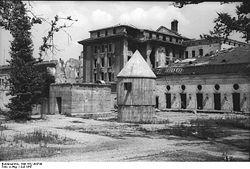
The ruins of both the old and new Chancellery buildings were levelled by the Soviets between 1945 and 1949 but the bunker largely survived, although some areas were partially flooded. In 1947 the Soviets tried to blow up the bunker but only the separation walls were damaged. In 1959 the East German government also tried to blast the bunker, apparently without much effect. Since it was near the Berlin WallBerlin Wall
The Berlin Wall was a barrier constructed by the German Democratic Republic starting on 13 August 1961, that completely cut off West Berlin from surrounding East Germany and from East Berlin...
, the site was undeveloped and neglected until after reunification. During the construction of residential housing and other buildings on the site in 1988–89 several underground sections of the old bunker were uncovered by work crews and were for the most part destroyed.
The former Chancellery was situated at the corner of Wilhelmstraße and Voßstraße. Other parts of the Chancellery underground complex were uncovered during extensive construction work in the 1990s, but these were ignored, filled in or quickly resealed.
Since 1945 government authorities have been consistently concerned about the site of the bunker evolving into a Neo-Nazi shrine. The strategy for avoiding this has largely been to ensure the surroundings remain anonymous and unremarkable. In 2005 the location of the bunker was not marked. The immediate area was occupied by a small Chinese restaurant and shopping centre
Shopping mall
A shopping mall, shopping centre, shopping arcade, shopping precinct or simply mall is one or more buildings forming a complex of shops representing merchandisers, with interconnecting walkways enabling visitors to easily walk from unit to unit, along with a parking area — a modern, indoor version...
while the emergency exit point for the bunker (which had been in the Chancellery gardens) was occupied by a car park
Parking lot
A parking lot , also known as car lot, is a cleared area that is intended for parking vehicles. Usually, the term refers to a dedicated area that has been provided with a durable or semi-durable surface....
.

2006 FIFA World Cup
The 2006 FIFA World Cup was the 18th FIFA World Cup, the quadrennial international football world championship tournament. It was held from 9 June to 9 July 2006 in Germany, which won the right to host the event in July 2000. Teams representing 198 national football associations from all six...
a small plaque was installed with a schematic of the bunker to mark the location. The plaque can be found at the corner of In den Ministergärten and Gertrud-Kolmar-Straße, two small streets about three minutes' walk from Potsdamer Platz. Hitler's bodyguard, Rochus Misch
Rochus Misch
Rochus Misch is a former Oberscharführer in the 1st SS Division Leibstandarte SS Adolf Hitler during World War II. He served as a courier, bodyguard and telephone operator for German leader Adolf Hitler from 1940 to 1945...
, one of the last people living who was in the bunker at the time of Hitler's suicide, was on hand for the ceremony.
Armin Lehmann, one of the last living bunker occupants, provided researchers with historical facts. Lehmann was a 16-year-old Hitler Youth
Hitler Youth
The Hitler Youth was a paramilitary organization of the Nazi Party. It existed from 1922 to 1945. The HJ was the second oldest paramilitary Nazi group, founded one year after its adult counterpart, the Sturmabteilung...
member assigned to Artur Axmann
Artur Axmann
Artur Axmann was the German Nazi leader of the Hitler Youth from 1940 through war's end in 1945.-Early life:Axmann was born in Hagen on 18 February 1913...
's staff as Hitler's courier. He died on 10 October 2008 in Coos Bay, Oregon
Coos Bay, Oregon
Coos Bay is a city located in Coos County, Oregon, United States, where the Coos River enters Coos Bay on the Pacific Ocean. The city borders the city of North Bend, and together they are often referred to as one entity called either Coos Bay-North Bend or the Bay Area...
at the age of eighty.
Dramatisations
- The Death of Adolf HitlerThe Death of Adolf HitlerThe Death of Adolf Hitler was a 1973 British television film starring Frank Finlay as Adolf Hitler and Caroline Mortimer as Eva Braun. The film details the last 10 days of Hitler's life as World War II comes to an end and Allied troops are closing in on the Führerbunker. Michael Sheard and Tony...
is a British 1973 made-for-television production. Set in the Führerbunker it follows the last ten days of Hitler’s life. Starring Frank FinlayFrank FinlayFrancis Finlay, CBE is an English stage, film and television actor.-Personal life:Finlay was born in Farnworth, Lancashire, the son of Margaret and Josiah Finlay, a butcher. A devout Catholic, he belongs to the British Catholic Stage Guild. He was educated at St...
in the title role. - Hitler: The Last Ten DaysHitler: The Last Ten DaysHitler: The Last Ten Days is a 1973 film depicting the days leading up to Adolf Hitler's suicide. It stars Alec Guinness and Simon Ward. The original music score was composed by Mischa Spoliansky...
is a 1973 feature film directed by Ennio De Concini and starring Sir Alec GuinnessAlec GuinnessSir Alec Guinness, CH, CBE was an English actor. He was featured in several of the Ealing Comedies, including Kind Hearts and Coronets in which he played eight different characters. He later won the Academy Award for Best Actor for his role as Colonel Nicholson in The Bridge on the River Kwai...
in the title role. - The BunkerThe Bunker (1981 film)The Bunker is a 1981 CBS television film, Time/Life production based on the book The Bunker. The movie makes significant deviations from James O'Donnell's book--published in 1978. The deviations are mainly due to an effort to clarify the events, and allowing the actors license to interpret some of...
was a 1981 made-for-television film directed by George Schaefer. Sir Anthony HopkinsAnthony HopkinsSir Philip Anthony Hopkins, KBE , best known as Anthony Hopkins, is a Welsh actor of film, stage and television...
won an Emmy Award for his portrayal of Hitler. - The 2004 German film Der UntergangDownfall (film)Downfall is a 2004 German/Italian/Austrian epic war film directed by Oliver Hirschbiegel, depicting the final ten days of Adolf Hitler's life in his Berlin bunker and Nazi Germany in 1945....
(The Downfall) is largely set in and around the Führerbunker, with director Oliver HirschbiegelOliver HirschbiegelOliver Hirschbiegel is a German film director. His works include Das Experiment and the Oscar nominated Der Untergang.- Career :...
accurately reconstructing the actual look and atmosphere as best he could through eyewitness accounts, various survivors' memoirs, and other verified sources. Bruno GanzBruno GanzBruno Ganz is a Swiss actor, known for his roles as Damiel in Wings of Desire and Adolf Hitler in Downfall.- Early life :Bruno Ganz was born in Zürich to a Swiss mechanic father and a northern Italian mother. He had decided to pursue an acting career by the time he entered university...
portrays Hitler in the film. - Hitler's bunker is the setting for the vast majority of Der Untergang parodies on YoutubeYouTubeYouTube is a video-sharing website, created by three former PayPal employees in February 2005, on which users can upload, view and share videos....
.
Documentaries
- "Ruins of the Reich DVD. R.J. Adams 2008, ASIN: B000PATNP8 (Bunker ruins and tour of interior chancellery bunker today).
- "The Fuehrer Bunker (1935–1942) DVD. Christoph Neubauer Verlag, Waldkirchen 2007, ISBN 978-3-9811593-0-1 (Computer Animation of the Fuehrer Bunker).
- "Albert Speers Berlin - Die Reichskanzlei DVD. Christoph Neubauer Verlag, Waldkirchen 2008, ISBN 978-3-9811593-3-2 (Computer Animation of the Reich's Chancellery).
- Adolf Hitler's Last Days, from the BBC series Secrets of World War II, recounts the story of Hitler's last days.
- The World at War (1974) is a Thames TelevisionThames TelevisionThames Television was a licensee of the British ITV television network, covering London and parts of the surrounding counties on weekdays from 30 July 1968 until 31 December 1992....
episode 21 Nemesis-Germany (February–May 1945). Included interviews with several people who visited the bunker, including secretary Traudl JungeTraudl JungeTraudl Junge was Adolf Hitler's youngest personal private secretary, from December 1942 to April 1945.-Early life:...
, reminiscing about the very end in the bunker. - Unsolved HistoryUnsolved HistoryUnsolved History is an American documentary television series that aired from 2002 to 2005. The program was produced by MorningStar Entertainment, Termite Art Productions, and others for the Discovery Channel. The series lasted over three seasons and had a total of 47 episodes, in which a team of...
: Hitler's Bunker (2002), from the Discovery ChannelDiscovery ChannelDiscovery Channel is an American satellite and cable specialty channel , founded by John Hendricks and distributed by Discovery Communications. It is a publicly traded company run by CEO David Zaslav...
's series Unsolved History. Historians digitally reconstruct the entire bunker as it existed more than 50 years ago using authentic period photographs, samples of paint, state-of-the-art mapping techniques and the original schematics.
See also
- Death of Adolf HitlerDeath of Adolf HitlerAdolf Hitler committed suicide by gunshot on Monday, 30 April 1945 in his Führerbunker in Berlin. His wife Eva , committed suicide with him by ingesting cyanide...
- Führer HeadquartersFührer HeadquartersThe Führer Headquarters , abbreviated FHQ, is a common name for a number of official headquarters used by the Nazi leader Adolf Hitler and various German commanders and officials throughout Europe during World War II...
- Wolf's Lair
- Nazi architectureNazi architectureNazi architecture was an architectural plan which played a role in the Nazi party's plans to create a cultural and spiritual rebirth in Germany as part of the Third Reich....
- Matsushiro Underground Imperial HeadquartersMatsushiro Underground Imperial HeadquartersThe was a large underground bunker complex built during the Second World War in the Matsushiro suburb of Nagano, Japan.. The facility was to be used by Emperor Hirohito, his family, and the Imperial General Headquarters to direct Japanese armed forces fighting against the Allied invasion of...
Further reading
Books- Guido, Pietro, Fuehrerbunker-Discovered its Mysteries", ISEM, Fifth Edition, 2009 - Milan
- Junge, TraudlTraudl JungeTraudl Junge was Adolf Hitler's youngest personal private secretary, from December 1942 to April 1945.-Early life:...
, Until the Final Hour, Weidenfeld & Nicolson, 2003 - Kellerhoff, Sven Felix. The Führer Bunker - Hitler's Last Refuge. Berlin Story Verlag, Berlin 2006, ISBN 978-3-929829-23-5.
- O'Donnell, James, The BunkerThe BunkerThe Bunker is an account, written by American journalist James P. O'Donnell, of the history of the Führerbunker in early 1945, as well as the last days of German dictator Adolf Hitler...
, Da Capo Press, reprint 2001, (orig. pub. 1978). ISBN 0-306-80958-3 - Petrova, Ada and Watson, Peter. The Death of Hitler: The Full Story with New Evidence from Secret Russian Archives (book excerpt and a review by Richard Breitman in Washington Post, April 14, 1996)
- Trevor-Roper, HughHugh Trevor-Roper, Baron Dacre of GlantonHugh Redwald Trevor-Roper was an English historian of early modern Britain and Nazi Germany. He was made a life peer by Margaret Thatcher in 1979, choosing the title Baron Dacre of Glanton.-Early life and education:...
, The Last Days of Hitler, University of Chicago Press, paperback edition 1992 (orig. pub. 1947). ISBN 0-226-81224-3
Articles
- Ramsey, Winston G. (editor) & Posch, Tom (researcher), The Berlin Führerbunker: The Thirteenth Hole, After the Battle, No.61, Special Edition, Battle of Britain International Ltd, 1988, London
- Staff. The Führerbunker: Info and Plans, MalGo Media Services Ltd.
- Staff. The Who-Is-Who of the Bunker, MalGo Media Services Ltd.
Visual representations
- Adams, R.J. The Berlin Chancellery Bunker today only known existing footage.
- Allied Intelligence Map of Key Buildings in Berlin (Third Edition, 1945)
- Neubauer, Christoph. The Fuehrerbunker 3D. three dimensional virtual reconstruction of the bunker.
- Bogoe, Dines. Führerbunker m. v. External images and maps of the Führerbunker.