


Exclamation mark

Encyclopedia
The exclamation mark, exclamation point, or bang, or "dembanger" is a punctuation
mark usually used after an interjection
or exclamation
to indicate strong feelings or high volume (shouting), and often marks the end of a sentence. Example: “Watch out!” The character is encoded in Unicode at . This punctuation mark is called, in the newspaper world, "a screamer, a gasper, [or] a startler". It is sometimes called a "dog's cock" by typesetters.
sense of wonderment. One theory of its origin is that it was originally a Latin exclamation of “joy” (io), written with the “I” above the “o”.
The exclamation mark was introduced into English printing in the 15th century, and was called the “sign of admiration or exclamation” or the “note of admiration” until the mid-17th century. In German orthography, the sign made its first appearance in the Luther Bible
in 1797.
The ! mark was not featured on standard manual typewriters before the 1970s. Instead, one typed a period
, backspaced, and typed an apostrophe
. In the 900
, secretarial dictation and typesetting manuals referred to the mark as "bang," most likely adapted from comic books where the ! appeared in dialogue balloons to represent a gun being fired, although the nickname probably emerged from letterpress printing. This bang usage is behind the titles of the interrobang
, an uncommon typographic character, and a shebang line, a feature of unix
computer systems.
(“Wow!”, “Boo!”), the imperative mood
(“Stop!”), or intended to be astonishing or show astonishment: “They were the footprints of a gigantic hound!” Exclamation points can also be placed mid-sentence with a function similar to a comma: “On the walk, oh! there was a frightful noise.”
Casually, exclamation marks may be repeated for additional emphasis ("That's great!!!"), but this practice is generally considered unacceptable in formal prose.
The exclamation mark is sometimes used in conjunction with the question mark
. This can be in protest or astonishment ("Out of all places; the squatter-camp?!") however this can be replaced with a single, nonstandard punctuation mark, the interrobang
, which is the union of a question mark and an exclamation point. Again, this is informal.
Overly frequent use of the exclamation mark is generally considered poor writing, for it distracts the reader and reduces the mark's meaning.
Some authors however, most notably Tom Wolfe
, are known for unashamedly liberal use of the exclamation mark. In comic book
s, the very frequent use of exclamation mark is common—see Comics, below.
For information on the use of spaces after an exclamation mark, see the discussion of spacing after a full stop.
One study has shown that women use exclamation marks more than men do.
, although usage varies slightly between languages. The exclamation point is also used in languages with other scripts, such as Greek
, Russian
, Arabic
, Hebrew
, Chinese
, Korean
and Japanese
but it has never been found in Hindi.
, next to marking exclamations or indicating astonishment, the exclamation mark is also commonly used to mark orders or requests: Viens ici ! (English: "Come here!"). A space (« espace fine ») is used between the last word and the exclamation mark.
, the exclamation mark has several specific uses for which English
employs other forms of punctuation
:
, a sentence or clause ending in an exclamation mark must also begin with an inverted exclamation mark (the same also applies to the question mark):
For informal written online communications, however, usage of inverted question and exclamation marks has become less common.
, an exclamation mark is used after a sentence or phrase for emphasis
, and is common following both commands and the addressees of such commands. For example, in Ordular! İlk hedefiniz Akdenizdir, ileri! ("Armies! Your first target is the Mediterranean Sea, forward!"), a famous order by Atatürk, ordular (the armies) constitute the addressee. It is further used in parentheses "(!)" after a sentence or phrase to indicate irony
or sarcasm
: Çok iyi bir iş yaptın (!) ("You've done a very good job – Not!
").
, and the International Phonetic Alphabet
, the exclamation mark is used as a letter to indicate the postalveolar click
sound (represented as q in Zulu
orthography). In Unicode
, this letter is properly coded as and distinguished from the common punctuation symbol to allow software to deal properly with word breaks.
The exclamation point has sometimes been used as a phonetic symbol to indicate that a consonant is ejective
. More commonly this is represented by an apostrophe
, or a superscript glottal stop
symbol .
called interrobang
, which resembles those marks superimposed over one another ("") but the sequence of "?!" or "!?" is used more often.
service Yahoo!
, the game show
Jeopardy!
and the '60s musical TV show "Shindig!
". The titles of the musicals
Oklahoma!
, Oliver!
and Oh! Calcutta!
and the movies Airplane!
and Moulin Rouge!
also contain exclamation points. Writer Elliot S! Maggin
and cartoonist Scott Shaw!
include exclamation marks in their names.
town of Westward Ho!
, named after the novel
by Charles Kingsley
, is the only place name in the United Kingdom
that officially contains an exclamation point. There is a town in Quebec
called Saint-Louis-du-Ha! Ha!
, which is spelled with two exclamation marks. The city of Hamilton
, Ohio
, changed its name to Hamilton! in 1986.
 Exclamation points are used to emphasize a precautionary statement.
On warning sign
s, an exclamation mark is often used to draw attention to a warning of danger, hazards, and the unexpected. These signs are common in hazardous environments or on potentially dangerous equipment. A common type of this warning is a yellow triangle
with a black exclamation point, but a white triangle with a red border is common on Europe
an road warning signs
.
, especially in British English
, a (!) symbol (an exclamation point within parentheses) implies that a character has made an obviously sarcastic
comment e.g.: "Ooh, a sarcasm detector. That's a really useful invention(!)"
Related forms are encoded:
Some scripts have their own exclamation point:
, the symbol represents the factorial
operation. The expression n! means "the product of the integers from 1 to n". For example, 4! (read four factorial) is 4 × 3 × 2 × 1 = 24. (0! is defined as 1, which is a neutral element in multiplication
, not multiplied by anything.)
, the exclamation mark (sometimes called a "bang") corresponds to ASCII
character
33 (21 in hexadecimal
). It is therefore found in Unicode at . The inverted exclamation mark is found in ISO-8859-1, 9 and 15 at position 161 (A1HEX) and in Unicode at .
The name given to "!" by programmers varies according to their background. In the UK the term pling was popular in the earlier days of computing, whilst in the USA the term shriek
was used.
Several computer languages use "!" for various meanings, most importantly for logical negation; e.g. A != B means "A is not equal
to B", and !A means "the logical negation
of A" (also called "not A"). It is claimed that these word usages were invented in the US and shriek is from Stanford or MIT; however, shriek for the ! sign is found in the Oxford English Dictionary dating from the 1860s.
Plings are also used in Acorn RISC OS
to denote an application directory
: a folder that when double clicked executes a program file inside called !Run. Other files in the appfolder generally contain resources the application needs to run. The appfolder can be viewed as a normal folder by double-clicking with the shift key
held down. In addition, other special resource files such as !Boot (executed the first time the application containing it comes into view of the filer), !Sprites (an icon file containing icon definitions loaded if !Boot cannot be found) and !Help (a text, HTML or other executable file listed in the filer menu for the application) also start with a pling.
Early e-mail
systems also used the exclamation mark as a separator character between hostnames for routing information, usually referred to as "bang path" notation.
In the IRC
protocol, a user's nickname and ident
are separated by an exclamation point in the hostmask assigned to him or her by the server.
In the Geek Code
version 3, "!" is used before a letter to denote that the geek refuses to participate in the topic at hand. In some cases, it has an alternate meaning, such as G! denoting a geek of no qualifications, !d denoting not wearing any clothes, P! denoting not being allowed to use Perl, and so on. They all share some negative connotations however.
When computer programs display messages that alert the user, an exclamation mark may be shown alongside it to indicate that the message is important and should be read. This often happens when an error is made, or to obtain user consent for hazardous operations such as deleting data.
In UNIX
scripting (typically for UNIX shell
or Perl
), "!" is usually used after a "#" in the first line of a script, the interpreter directive
, to tell the OS what program to use to run the script. The "#!" is usually called a "hash-bang" or shebang
.
An exclamation mark starts history expansions in many Unix shell
s such as bash and tcsh
where !! executes the previous command and !* refers to all of the arguments from the previous command.
In the ML programming language (including Standard ML
and OCaml), "!" is the operator to get the value out of a "reference" data structure.
In the Haskell
programming language, "!" is used to express strictness.
In the Scheme and Ruby
programming languages, "!" is conventionally the suffix for functions and special forms which mutate their input.
series of stealth games, a red exclamation point (!) appears above an enemy's head with a short, loud noise if they see the player. When this happens, the enemy will try to attack the player.
In the Pokémon
series, rival trainers have an exclamation point appear above the head of other trainers when they spot the main character's trainer. In the first generation of Pokémon, every single statement in the game ends with an exclamation point. In certain Versions of the game an exclamation point also appears on the main character's head when they hook a fish on one of the game's three rods (Old Rod, Good Rod and Super Rod).
In the Paper Mario
series, enemies have an exclamation point appear over their heads if they notice Mario, Luigi, Peach, or Bowser.
In the Warcraft
series, NPCs
having available quests for players are represented with an yellow exclamation point floating over their heads. If the quest is repeatable it is represented with a blue exclamation point.
In the Counter-Strike
games, a green exclamation point appears above a player's head if this player uses a radio command.
is used, an excessive way of expressing exclamation in text is seen as !!!!!!111. This notation originates from the eagerness to add multiple exclamation points but failing to properly hit the combination (which produces the mark on most keyboard layout
s). Later this behavior has evolved into a sign of recognition for certain Internet cultures who now intentionally add 1s after their expressions either to ridicule people who do it without purpose or as a sign of recognition towards others who also are familiar with the behavior. As a further pun to this development of linguistics
, some add literal ones such as !!!!!one!11 to explicitly state that their use of 1s was intentionally typed, since it is impossible to type 'one' by accident. Some people go as far as to type in eleven, as in: !!!!1one1!!eleven11, or even !!!!11one11cos(0).
In fandom
and fanfiction, ! is used to signify a defining quality in a character, usually signifying an alternate interpretation of a character from a canonical
work. Examples of this would be "Romantic!Draco" or "Vampire!Harry" from Harry Potter
fandom. It is also used to clarify the current persona of a character with multiple identities or appearances, such as to distinguish "Armor!Al" from "Human!Al" in a work based on Fullmetal Alchemist
. The origin of this usage is unknown, although it is hypothesized to have originated with certain Teenage Mutant Ninja Turtles
action figures, for example, "Football Player! Leonardo", "Rockstar! Raphael", and "Breakdancer! Michelangelo".
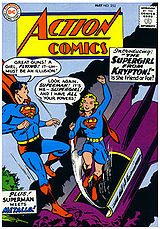 Some comic book
s, especially superhero
comics of the mid-20th century, routinely use the exclamation point instead of the period, which means the character has just realized something; unlike when the question mark appears instead, which means the character is confused, surprised or he does not know what is happening. This tends to lead to exaggerated speech, in line with the other hyperbole
s common in comic books. A portion of the motivation, however, was simply that a period might disappear in the printing process used at the time, whereas an exclamation point would likely remain recognizable even if there was a printing glitch. For a short period Stan Lee
, as Editor-in-Chief of Marvel Comics
, attempted to curb their overuse by a short-lived ban on exclamation points altogether, which led to an inadvertent lack of ending punctuation on many sentences.
Comic book writer Elliot S! Maggin once accidentally signed his name with an exclamation due to the habit of using them when writing comic scripts; it became his professional name from then on. Similarly, comic artist Scott Shaw!
has used the exclamation point after his name throughout his career.
In comic books and comics
in general, a large exclamation point is often used in the proximity of a character's head to indicate surprise. A question mark
can similarly be used to indicate confusion. This practice also appears in some computer and video games
.
"!" denotes a good move, "!!" denotes an excellent move, "?!" denotes a dubious move, and "!?" denotes an interesting, risky move. Likewise, in some chess variants such as large board Shogi variant
s, "!" is used to record pieces capturing by stationary feeding or burning.
s can be used on scorecards to denote a "great defensive play".
" uses exclamation points as its name.
In 2008, the pop punk band Panic! At the Disco
dropped the exclamation point in its name; this became the "most-discussed topic on [fan] message boards around the world". In 2009, the exclamation mark was re-inserted following the band's split.
Punctuation
Punctuation marks are symbols that indicate the structure and organization of written language, as well as intonation and pauses to be observed when reading aloud.In written English, punctuation is vital to disambiguate the meaning of sentences...
mark usually used after an interjection
Interjection
In grammar, an interjection or exclamation is a word used to express an emotion or sentiment on the part of the speaker . Filled pauses such as uh, er, um are also considered interjections...
or exclamation
Exclamation
Exclamation may refer to:* Exclamation mark, the punctuation mark "!"* Exclamation, an emphatic sentence* Exclamation, an emphatic interjection* Exclamation, a statement against penal interest in criminal law* Exclamation, a fragrance by Coty, Inc....
to indicate strong feelings or high volume (shouting), and often marks the end of a sentence. Example: “Watch out!” The character is encoded in Unicode at . This punctuation mark is called, in the newspaper world, "a screamer, a gasper, [or] a startler". It is sometimes called a "dog's cock" by typesetters.
History
The exclamation mark comes from the term “note of admiration”, in which admiration referred to its LatinLatin
Latin is an Italic language originally spoken in Latium and Ancient Rome. It, along with most European languages, is a descendant of the ancient Proto-Indo-European language. Although it is considered a dead language, a number of scholars and members of the Christian clergy speak it fluently, and...
sense of wonderment. One theory of its origin is that it was originally a Latin exclamation of “joy” (io), written with the “I” above the “o”.
The exclamation mark was introduced into English printing in the 15th century, and was called the “sign of admiration or exclamation” or the “note of admiration” until the mid-17th century. In German orthography, the sign made its first appearance in the Luther Bible
Luther Bible
The Luther Bible is a German Bible translation by Martin Luther, first printed with both testaments in 1534. This translation became a force in shaping the Modern High German language. The project absorbed Luther's later years. The new translation was very widely disseminated thanks to the printing...
in 1797.
The ! mark was not featured on standard manual typewriters before the 1970s. Instead, one typed a period
Period
Period may mean a full stop: a punctuation in American-English.Period or periodic may also refer to:-Science:* Orbital period, a concept in astronomy...
, backspaced, and typed an apostrophe
Apostrophe
The apostrophe is a punctuation mark, and sometimes a diacritic mark, in languages that use the Latin alphabet or certain other alphabets...
. In the 900
, secretarial dictation and typesetting manuals referred to the mark as "bang," most likely adapted from comic books where the ! appeared in dialogue balloons to represent a gun being fired, although the nickname probably emerged from letterpress printing. This bang usage is behind the titles of the interrobang
Interrobang
The interrobang, interabang , , is a nonstandard punctuation mark used in various written languages and intended to combine the functions of the question mark and the exclamation mark or exclamation point . The glyph is a superimposition of these two marks...
, an uncommon typographic character, and a shebang line, a feature of unix
Unix
Unix is a multitasking, multi-user computer operating system originally developed in 1969 by a group of AT&T employees at Bell Labs, including Ken Thompson, Dennis Ritchie, Brian Kernighan, Douglas McIlroy, and Joe Ossanna...
computer systems.
Usage
A sentence ending in an exclamation mark is an actual exclamationExclamation
Exclamation may refer to:* Exclamation mark, the punctuation mark "!"* Exclamation, an emphatic sentence* Exclamation, an emphatic interjection* Exclamation, a statement against penal interest in criminal law* Exclamation, a fragrance by Coty, Inc....
(“Wow!”, “Boo!”), the imperative mood
Imperative mood
The imperative mood expresses commands or requests as a grammatical mood. These commands or requests urge the audience to act a certain way. It also may signal a prohibition, permission, or any other kind of exhortation.- Morphology :...
(“Stop!”), or intended to be astonishing or show astonishment: “They were the footprints of a gigantic hound!” Exclamation points can also be placed mid-sentence with a function similar to a comma: “On the walk, oh! there was a frightful noise.”
Casually, exclamation marks may be repeated for additional emphasis ("That's great!!!"), but this practice is generally considered unacceptable in formal prose.
The exclamation mark is sometimes used in conjunction with the question mark
Question mark
The question mark , is a punctuation mark that replaces the full stop at the end of an interrogative sentence in English and many other languages. The question mark is not used for indirect questions...
. This can be in protest or astonishment ("Out of all places; the squatter-camp?!") however this can be replaced with a single, nonstandard punctuation mark, the interrobang
Interrobang
The interrobang, interabang , , is a nonstandard punctuation mark used in various written languages and intended to combine the functions of the question mark and the exclamation mark or exclamation point . The glyph is a superimposition of these two marks...
, which is the union of a question mark and an exclamation point. Again, this is informal.
Overly frequent use of the exclamation mark is generally considered poor writing, for it distracts the reader and reduces the mark's meaning.
- Cut out all those exclamation points. An exclamation point is like laughing at your own jokes.
- —F. Scott FitzgeraldF. Scott FitzgeraldFrancis Scott Key Fitzgerald was an American author of novels and short stories, whose works are the paradigm writings of the Jazz Age, a term he coined himself. He is widely regarded as one of the greatest American writers of the 20th century. Fitzgerald is considered a member of the "Lost...
Some authors however, most notably Tom Wolfe
Tom Wolfe
Thomas Kennerly "Tom" Wolfe, Jr. is a best-selling American author and journalist. He is one of the founders of the New Journalism movement of the 1960s and 1970s.-Early life and education:...
, are known for unashamedly liberal use of the exclamation mark. In comic book
Comic book
A comic book or comicbook is a magazine made up of comics, narrative artwork in the form of separate panels that represent individual scenes, often accompanied by dialog as well as including...
s, the very frequent use of exclamation mark is common—see Comics, below.
For information on the use of spaces after an exclamation mark, see the discussion of spacing after a full stop.
One study has shown that women use exclamation marks more than men do.
Languages
The exclamation mark is common to languages using the Latin alphabetLatin alphabet
The Latin alphabet, also called the Roman alphabet, is the most recognized alphabet used in the world today. It evolved from a western variety of the Greek alphabet called the Cumaean alphabet, which was adopted and modified by the Etruscans who ruled early Rome...
, although usage varies slightly between languages. The exclamation point is also used in languages with other scripts, such as Greek
Greek language
Greek is an independent branch of the Indo-European family of languages. Native to the southern Balkans, it has the longest documented history of any Indo-European language, spanning 34 centuries of written records. Its writing system has been the Greek alphabet for the majority of its history;...
, Russian
Russian language
Russian is a Slavic language used primarily in Russia, Belarus, Uzbekistan, Kazakhstan, Tajikistan and Kyrgyzstan. It is an unofficial but widely spoken language in Ukraine, Moldova, Latvia, Turkmenistan and Estonia and, to a lesser extent, the other countries that were once constituent republics...
, Arabic
Arabic language
Arabic is a name applied to the descendants of the Classical Arabic language of the 6th century AD, used most prominently in the Quran, the Islamic Holy Book...
, Hebrew
Hebrew language
Hebrew is a Semitic language of the Afroasiatic language family. Culturally, is it considered by Jews and other religious groups as the language of the Jewish people, though other Jewish languages had originated among diaspora Jews, and the Hebrew language is also used by non-Jewish groups, such...
, Chinese
Chinese language
The Chinese language is a language or language family consisting of varieties which are mutually intelligible to varying degrees. Originally the indigenous languages spoken by the Han Chinese in China, it forms one of the branches of Sino-Tibetan family of languages...
, Korean
Korean language
Korean is the official language of the country Korea, in both South and North. It is also one of the two official languages in the Yanbian Korean Autonomous Prefecture in People's Republic of China. There are about 78 million Korean speakers worldwide. In the 15th century, a national writing...
and Japanese
Japanese language
is a language spoken by over 130 million people in Japan and in Japanese emigrant communities. It is a member of the Japonic language family, which has a number of proposed relationships with other languages, none of which has gained wide acceptance among historical linguists .Japanese is an...
but it has never been found in Hindi.
French
In FrenchFrench language
French is a Romance language spoken as a first language in France, the Romandy region in Switzerland, Wallonia and Brussels in Belgium, Monaco, the regions of Quebec and Acadia in Canada, and by various communities elsewhere. Second-language speakers of French are distributed throughout many parts...
, next to marking exclamations or indicating astonishment, the exclamation mark is also commonly used to mark orders or requests: Viens ici ! (English: "Come here!"). A space (« espace fine ») is used between the last word and the exclamation mark.
German
In GermanGerman language
German is a West Germanic language, related to and classified alongside English and Dutch. With an estimated 90 – 98 million native speakers, German is one of the world's major languages and is the most widely-spoken first language in the European Union....
, the exclamation mark has several specific uses for which English
English language
English is a West Germanic language that arose in the Anglo-Saxon kingdoms of England and spread into what was to become south-east Scotland under the influence of the Anglian medieval kingdom of Northumbria...
employs other forms of punctuation
Punctuation
Punctuation marks are symbols that indicate the structure and organization of written language, as well as intonation and pauses to be observed when reading aloud.In written English, punctuation is vital to disambiguate the meaning of sentences...
:
- In the salutation line of a letter, for which English uses a commaComma (punctuation)The comma is a punctuation mark. It has the same shape as an apostrophe or single closing quotation mark in many typefaces, but it differs from them in being placed on the baseline of the text. Some typefaces render it as a small line, slightly curved or straight but inclined from the vertical, or...
: Lieber Hans! (English: "Dear Hans,") In this case, the first word of the following sentence begins with a capital letter. However, usage of a comma, as in English, is both also acceptable and far more common. - On signs, not just those warning of danger as discussed below, the exclamation mark is used to emphasize the sign's content: Betreten verboten! (English: "No trespassing")
- At the end of an imperativeImperative moodThe imperative mood expresses commands or requests as a grammatical mood. These commands or requests urge the audience to act a certain way. It also may signal a prohibition, permission, or any other kind of exhortation.- Morphology :...
sentence: Ruf mich morgen an! (English: "Call me tomorrow.")
Spanish
In SpanishSpanish language
Spanish , also known as Castilian , is a Romance language in the Ibero-Romance group that evolved from several languages and dialects in central-northern Iberia around the 9th century and gradually spread with the expansion of the Kingdom of Castile into central and southern Iberia during the...
, a sentence or clause ending in an exclamation mark must also begin with an inverted exclamation mark (the same also applies to the question mark):
- ¿Estás loco? ¡Casi la matas! (English: "Are you crazy? You almost killed her!")
For informal written online communications, however, usage of inverted question and exclamation marks has become less common.
Turkish
In TurkishTurkish language
Turkish is a language spoken as a native language by over 83 million people worldwide, making it the most commonly spoken of the Turkic languages. Its speakers are located predominantly in Turkey and Northern Cyprus with smaller groups in Iraq, Greece, Bulgaria, the Republic of Macedonia, Kosovo,...
, an exclamation mark is used after a sentence or phrase for emphasis
Emphasis
Emphasis or emphatic may refer to:* Emphasis , intentional alteration of the amplitude-vs.-frequency characteristics of the signal to reduce adverse effects of noise...
, and is common following both commands and the addressees of such commands. For example, in Ordular! İlk hedefiniz Akdenizdir, ileri! ("Armies! Your first target is the Mediterranean Sea, forward!"), a famous order by Atatürk, ordular (the armies) constitute the addressee. It is further used in parentheses "(!)" after a sentence or phrase to indicate irony
Irony
Irony is a rhetorical device, literary technique, or situation in which there is a sharp incongruity or discordance that goes beyond the simple and evident intention of words or actions...
or sarcasm
Sarcasm
Sarcasm is “a sharp, bitter, or cutting expression or remark; a bitter jibe or taunt.” Though irony and understatement is usually the immediate context, most authorities distinguish sarcasm from irony; however, others argue that sarcasm may or often does involve irony or employs...
: Çok iyi bir iş yaptın (!) ("You've done a very good job – Not!
Not!
Not! is a grammatical construction in the English language that became a sarcastic catchphrase in North America in the 1990s. A declarative statement is made, followed by a pause and then an emphatic "not!" is postfixed. The result is a negation of the original declarative statement...
").
Phonetics
In Khoisan languagesKhoisan languages
The Khoisan languages are the click languages of Africa which do not belong to other language families. They include languages indigenous to southern and eastern Africa, though some, such as the Khoi languages, appear to have moved to their current locations not long before the Bantu expansion...
, and the International Phonetic Alphabet
International Phonetic Alphabet
The International Phonetic Alphabet "The acronym 'IPA' strictly refers [...] to the 'International Phonetic Association'. But it is now such a common practice to use the acronym also to refer to the alphabet itself that resistance seems pedantic...
, the exclamation mark is used as a letter to indicate the postalveolar click
Postalveolar click
The alveolar or postalveolar clicks are a family of click consonants found only in Africa and in the Damin ritual jargon of Australia.The symbol in the International Phonetic Alphabet that represents the place of articulation of these sounds is...
sound (represented as q in Zulu
Zulu language
Zulu is the language of the Zulu people with about 10 million speakers, the vast majority of whom live in South Africa. Zulu is the most widely spoken home language in South Africa as well as being understood by over 50% of the population...
orthography). In Unicode
Unicode
Unicode is a computing industry standard for the consistent encoding, representation and handling of text expressed in most of the world's writing systems...
, this letter is properly coded as and distinguished from the common punctuation symbol to allow software to deal properly with word breaks.
The exclamation point has sometimes been used as a phonetic symbol to indicate that a consonant is ejective
Ejective consonant
In phonetics, ejective consonants are voiceless consonants that are pronounced with simultaneous closure of the glottis. In the phonology of a particular language, ejectives may contrast with aspirated or tenuis consonants...
. More commonly this is represented by an apostrophe
Apostrophe
The apostrophe is a punctuation mark, and sometimes a diacritic mark, in languages that use the Latin alphabet or certain other alphabets...
, or a superscript glottal stop
Glottal stop
The glottal stop, or more fully, the voiceless glottal plosive, is a type of consonantal sound used in many spoken languages. In English, the feature is represented, for example, by the hyphen in uh-oh! and by the apostrophe or [[ʻokina]] in Hawaii among those using a preservative pronunciation of...
symbol .
Interrobang
There is a punctuation mark intended to combine the functions of a question mark and an exclamation mark in EnglishEnglish language
English is a West Germanic language that arose in the Anglo-Saxon kingdoms of England and spread into what was to become south-east Scotland under the influence of the Anglian medieval kingdom of Northumbria...
called interrobang
Interrobang
The interrobang, interabang , , is a nonstandard punctuation mark used in various written languages and intended to combine the functions of the question mark and the exclamation mark or exclamation point . The glyph is a superimposition of these two marks...
, which resembles those marks superimposed over one another ("") but the sequence of "?!" or "!?" is used more often.
Proper names
Although exclamation marks are, as a standard, part of a complete sentence and not the spelling of individual words, they appear in many proper names, especially in commercial advertising. Prominent examples include the WebWorld Wide Web
The World Wide Web is a system of interlinked hypertext documents accessed via the Internet...
service Yahoo!
Yahoo!
Yahoo! Inc. is an American multinational internet corporation headquartered in Sunnyvale, California, United States. The company is perhaps best known for its web portal, search engine , Yahoo! Directory, Yahoo! Mail, Yahoo! News, Yahoo! Groups, Yahoo! Answers, advertising, online mapping ,...
, the game show
Game show
A game show is a type of radio or television program in which members of the public, television personalities or celebrities, sometimes as part of a team, play a game which involves answering questions or solving puzzles usually for money and/or prizes...
Jeopardy!
Jeopardy!
Griffin's first conception of the game used a board comprising ten categories with ten clues each, but after finding that this board could not be shown on camera easily, he reduced it to two rounds of thirty clues each, with five clues in each of six categories...
and the '60s musical TV show "Shindig!
Shindig!
Shindig! was an American musical variety series which aired on ABC from September 16, 1964 to January 8, 1966. The show was hosted by Jimmy O'Neill, a disc jockey in Los Angeles at the time who also created the show along with his wife Sharon Sheeley and production executive Art Stolnitz....
". The titles of the musicals
Musical theatre
Musical theatre is a form of theatre combining songs, spoken dialogue, acting, and dance. The emotional content of the piece – humor, pathos, love, anger – as well as the story itself, is communicated through the words, music, movement and technical aspects of the entertainment as an...
Oklahoma!
Oklahoma!
Oklahoma! is the first musical written by composer Richard Rodgers and librettist Oscar Hammerstein II. The musical is based on Lynn Riggs' 1931 play, Green Grow the Lilacs. Set in Oklahoma Territory outside the town of Claremore in 1906, it tells the story of cowboy Curly McLain and his romance...
, Oliver!
Oliver!
Oliver! is a British musical, with script, music and lyrics by Lionel Bart. The musical is based upon the novel Oliver Twist by Charles Dickens....
and Oh! Calcutta!
Oh! Calcutta!
Oh! Calcutta! is an avant-garde theatrical revue, created by British drama critic Kenneth Tynan. The show, consisting of sketches on sex-related topics, debuted Off-Broadway in 1969 and then in London in 1970. It ran in London for over 3,900 performances, and in New York initially for 1,314...
and the movies Airplane!
Airplane!
Airplane! is a 1980 American satirical comedy film directed and written by David Zucker, Jim Abrahams, and Jerry Zucker and released by Paramount Pictures...
and Moulin Rouge!
Moulin Rouge!
Moulin Rouge! is a 2001 romantic jukebox musical film directed, produced, and co-written by Baz Luhrmann. Following the Red Curtain Cinema principles, the film is based on the Orphean myth, La Traviata, and La Bohème...
also contain exclamation points. Writer Elliot S! Maggin
Elliot S! Maggin
Elliot S. Maggin, also spelled Elliot S! Maggin , is an American writer of comic books, film, television and novels. He was a main writer for DC Comics during the Bronze and early Modern ages of comics in the 1970s and 1980s...
and cartoonist Scott Shaw!
Scott Shaw (artist)
Scott Shaw is a United States cartoonist and animator, and is also an esteemed conductor of the concert band at Mary Institute and Country Day School...
include exclamation marks in their names.
Place names
The EnglishEngland
England is a country that is part of the United Kingdom. It shares land borders with Scotland to the north and Wales to the west; the Irish Sea is to the north west, the Celtic Sea to the south west, with the North Sea to the east and the English Channel to the south separating it from continental...
town of Westward Ho!
Westward Ho!
Westward Ho! is a seaside village near Bideford in Devon, England. The A39 road provides access from the towns of Barnstaple, Bideford and Bude...
, named after the novel
Westward Ho! (novel)
Westward Ho! is an 1855 British historical novel by Charles Kingsley, inspired in part by an Elizabethan travelogue by privateer Admiral Sir Richard Hawkins and by the Crimean War.-Plot summary:...
by Charles Kingsley
Charles Kingsley
Charles Kingsley was an English priest of the Church of England, university professor, historian and novelist, particularly associated with the West Country and northeast Hampshire.-Life and character:...
, is the only place name in the United Kingdom
United Kingdom
The United Kingdom of Great Britain and Northern IrelandIn the United Kingdom and Dependencies, other languages have been officially recognised as legitimate autochthonous languages under the European Charter for Regional or Minority Languages...
that officially contains an exclamation point. There is a town in Quebec
Quebec
Quebec or is a province in east-central Canada. It is the only Canadian province with a predominantly French-speaking population and the only one whose sole official language is French at the provincial level....
called Saint-Louis-du-Ha! Ha!
Saint-Louis-du-Ha! Ha!, Quebec
Saint-Louis-du-Ha! Ha! is a parish in the regional county municipality of Témiscouata, Quebec, near the south shore of the Saint Lawrence River in Canada...
, which is spelled with two exclamation marks. The city of Hamilton
Hamilton, Ohio
Hamilton is a city in Butler County, southwestern Ohio, United States. The population was 62,447 at the 2010 census. It is the county seat of Butler County. The city is part of the Cincinnati metropolitan area....
, Ohio
Ohio
Ohio is a Midwestern state in the United States. The 34th largest state by area in the U.S.,it is the 7th‑most populous with over 11.5 million residents, containing several major American cities and seven metropolitan areas with populations of 500,000 or more.The state's capital is Columbus...
, changed its name to Hamilton! in 1986.
Warnings
On warning sign
Warning sign
A traffic warning sign is a type of traffic sign that indicates a hazard ahead on the road that may not be readily apparent to a driver.In most countries, they usually take the shape of an equilateral triangle with a white background and a thick red border...
s, an exclamation mark is often used to draw attention to a warning of danger, hazards, and the unexpected. These signs are common in hazardous environments or on potentially dangerous equipment. A common type of this warning is a yellow triangle
Triangle
A triangle is one of the basic shapes of geometry: a polygon with three corners or vertices and three sides or edges which are line segments. A triangle with vertices A, B, and C is denoted ....
with a black exclamation point, but a white triangle with a red border is common on Europe
Europe
Europe is, by convention, one of the world's seven continents. Comprising the westernmost peninsula of Eurasia, Europe is generally 'divided' from Asia to its east by the watershed divides of the Ural and Caucasus Mountains, the Ural River, the Caspian and Black Seas, and the waterways connecting...
an road warning signs
Warning sign
A traffic warning sign is a type of traffic sign that indicates a hazard ahead on the road that may not be readily apparent to a driver.In most countries, they usually take the shape of an equilateral triangle with a white background and a thick red border...
.
Sarcasm
In writing and often subtitlesSubtitle (captioning)
Subtitles are textual versions of the dialog in films and television programs, usually displayed at the bottom of the screen. They can either be a form of written translation of a dialog in a foreign language, or a written rendering of the dialog in the same language, with or without added...
, especially in British English
British English
British English, or English , is the broad term used to distinguish the forms of the English language used in the United Kingdom from forms used elsewhere...
, a (!) symbol (an exclamation point within parentheses) implies that a character has made an obviously sarcastic
Sarcasm
Sarcasm is “a sharp, bitter, or cutting expression or remark; a bitter jibe or taunt.” Though irony and understatement is usually the immediate context, most authorities distinguish sarcasm from irony; however, others argue that sarcasm may or often does involve irony or employs...
comment e.g.: "Ooh, a sarcasm detector. That's a really useful invention(!)"
Unicode
The mark is encoded as .Related forms are encoded:
Some scripts have their own exclamation point:
Mathematics
In mathematicsMathematics
Mathematics is the study of quantity, space, structure, and change. Mathematicians seek out patterns and formulate new conjectures. Mathematicians resolve the truth or falsity of conjectures by mathematical proofs, which are arguments sufficient to convince other mathematicians of their validity...
, the symbol represents the factorial
Factorial
In mathematics, the factorial of a non-negative integer n, denoted by n!, is the product of all positive integers less than or equal to n...
operation. The expression n! means "the product of the integers from 1 to n". For example, 4! (read four factorial) is 4 × 3 × 2 × 1 = 24. (0! is defined as 1, which is a neutral element in multiplication
Multiplication
Multiplication is the mathematical operation of scaling one number by another. It is one of the four basic operations in elementary arithmetic ....
, not multiplied by anything.)
Computers
In computingComputing
Computing is usually defined as the activity of using and improving computer hardware and software. It is the computer-specific part of information technology...
, the exclamation mark (sometimes called a "bang") corresponds to ASCII
ASCII
The American Standard Code for Information Interchange is a character-encoding scheme based on the ordering of the English alphabet. ASCII codes represent text in computers, communications equipment, and other devices that use text...
character
Character (computing)
In computer and machine-based telecommunications terminology, a character is a unit of information that roughly corresponds to a grapheme, grapheme-like unit, or symbol, such as in an alphabet or syllabary in the written form of a natural language....
33 (21 in hexadecimal
Hexadecimal
In mathematics and computer science, hexadecimal is a positional numeral system with a radix, or base, of 16. It uses sixteen distinct symbols, most often the symbols 0–9 to represent values zero to nine, and A, B, C, D, E, F to represent values ten to fifteen...
). It is therefore found in Unicode at . The inverted exclamation mark is found in ISO-8859-1, 9 and 15 at position 161 (A1HEX) and in Unicode at .
The name given to "!" by programmers varies according to their background. In the UK the term pling was popular in the earlier days of computing, whilst in the USA the term shriek
Shriek
Shriek may refer to:* A kind of vociferation* a slang term for the exclamation mark, used in some computing and mathematical contexts, such as f_! and f^! being called shriek maps....
was used.
Several computer languages use "!" for various meanings, most importantly for logical negation; e.g. A != B means "A is not equal
Inequation
In mathematics, an inequation is a statement that two objects or expressions are not the same, or do not represent the same value. This relation is written with a crossed-out equal sign as inx \neq y....
to B", and !A means "the logical negation
Negation
In logic and mathematics, negation, also called logical complement, is an operation on propositions, truth values, or semantic values more generally. Intuitively, the negation of a proposition is true when that proposition is false, and vice versa. In classical logic negation is normally identified...
of A" (also called "not A"). It is claimed that these word usages were invented in the US and shriek is from Stanford or MIT; however, shriek for the ! sign is found in the Oxford English Dictionary dating from the 1860s.
Plings are also used in Acorn RISC OS
RISC OS
RISC OS is a computer operating system originally developed by Acorn Computers Ltd in Cambridge, England for their range of desktop computers, based on their own ARM architecture. First released in 1987, under the name Arthur, the subsequent iteration was renamed as in 1988...
to denote an application directory
Application directory
An application directory is a grouping of software code, help files and resources that together comprise a complete software package but are presented to the user as a single object....
: a folder that when double clicked executes a program file inside called !Run. Other files in the appfolder generally contain resources the application needs to run. The appfolder can be viewed as a normal folder by double-clicking with the shift key
Shift key
The shift key is a modifier key on a keyboard, used to type capital letters and other alternate "upper" characters. There are typically two shift keys, on the left and right sides of the row below the home row...
held down. In addition, other special resource files such as !Boot (executed the first time the application containing it comes into view of the filer), !Sprites (an icon file containing icon definitions loaded if !Boot cannot be found) and !Help (a text, HTML or other executable file listed in the filer menu for the application) also start with a pling.
Early e-mail
E-mail
Electronic mail, commonly known as email or e-mail, is a method of exchanging digital messages from an author to one or more recipients. Modern email operates across the Internet or other computer networks. Some early email systems required that the author and the recipient both be online at the...
systems also used the exclamation mark as a separator character between hostnames for routing information, usually referred to as "bang path" notation.
In the IRC
Internet Relay Chat
Internet Relay Chat is a protocol for real-time Internet text messaging or synchronous conferencing. It is mainly designed for group communication in discussion forums, called channels, but also allows one-to-one communication via private message as well as chat and data transfer, including file...
protocol, a user's nickname and ident
Ident
The Ident Protocol, specified in RFC 1413, is an Internet protocol that helps identify the user of a particular TCP connection. One popular daemon program for providing the ident service is identd.-How ident works:...
are separated by an exclamation point in the hostmask assigned to him or her by the server.
In the Geek Code
Geek Code
The Geek Code is a series of letters and symbols used by self-described "geeks" to inform fellow geeks about their personality, appearance, interests, and opinions. The idea is that everything that makes a geek individual and different from all the other geeks in the world can be written down in...
version 3, "!" is used before a letter to denote that the geek refuses to participate in the topic at hand. In some cases, it has an alternate meaning, such as G! denoting a geek of no qualifications, !d denoting not wearing any clothes, P! denoting not being allowed to use Perl, and so on. They all share some negative connotations however.
When computer programs display messages that alert the user, an exclamation mark may be shown alongside it to indicate that the message is important and should be read. This often happens when an error is made, or to obtain user consent for hazardous operations such as deleting data.
In UNIX
Unix
Unix is a multitasking, multi-user computer operating system originally developed in 1969 by a group of AT&T employees at Bell Labs, including Ken Thompson, Dennis Ritchie, Brian Kernighan, Douglas McIlroy, and Joe Ossanna...
scripting (typically for UNIX shell
Unix shell
A Unix shell is a command-line interpreter or shell that provides a traditional user interface for the Unix operating system and for Unix-like systems...
or Perl
Perl
Perl is a high-level, general-purpose, interpreted, dynamic programming language. Perl was originally developed by Larry Wall in 1987 as a general-purpose Unix scripting language to make report processing easier. Since then, it has undergone many changes and revisions and become widely popular...
), "!" is usually used after a "#" in the first line of a script, the interpreter directive
Interpreter directive
An interpreter directive is a computer language construct that is used to control which interpreter parses and interprets the instructions in a computer program.- See also :* Shebang * Bourne-Again Shell* C Shell...
, to tell the OS what program to use to run the script. The "#!" is usually called a "hash-bang" or shebang
Shebang (Unix)
In computing, a shebang is the character sequence consisting of the characters number sign and exclamation point , when it occurs as the first two characters on the first line of a text file...
.
An exclamation mark starts history expansions in many Unix shell
Unix shell
A Unix shell is a command-line interpreter or shell that provides a traditional user interface for the Unix operating system and for Unix-like systems...
s such as bash and tcsh
Tcsh
tcsh is a Unix shell based on and compatible with the C shell . It is essentially the C shell with programmable command line completion, command-line editing, and a few other features.-History:...
where !! executes the previous command and !* refers to all of the arguments from the previous command.
In the ML programming language (including Standard ML
Standard ML
Standard ML is a general-purpose, modular, functional programming language with compile-time type checking and type inference. It is popular among compiler writers and programming language researchers, as well as in the development of theorem provers.SML is a modern descendant of the ML...
and OCaml), "!" is the operator to get the value out of a "reference" data structure.
In the Haskell
Haskell (programming language)
Haskell is a standardized, general-purpose purely functional programming language, with non-strict semantics and strong static typing. It is named after logician Haskell Curry. In Haskell, "a function is a first-class citizen" of the programming language. As a functional programming language, the...
programming language, "!" is used to express strictness.
In the Scheme and Ruby
Ruby (programming language)
Ruby is a dynamic, reflective, general-purpose object-oriented programming language that combines syntax inspired by Perl with Smalltalk-like features. Ruby originated in Japan during the mid-1990s and was first developed and designed by Yukihiro "Matz" Matsumoto...
programming languages, "!" is conventionally the suffix for functions and special forms which mutate their input.
Video games
In the Metal GearMetal Gear (series)
is a series of stealth video games created by Hideo Kojima and developed and published by Konami. The first game, Metal Gear, was released in 1987 for the MSX2. The player takes control of a special forces operative Solid Snake who is assigned to find the eponymous superweapon "Metal Gear", a...
series of stealth games, a red exclamation point (!) appears above an enemy's head with a short, loud noise if they see the player. When this happens, the enemy will try to attack the player.
In the Pokémon
Pokémon
is a media franchise published and owned by the video game company Nintendo and created by Satoshi Tajiri in 1996. Originally released as a pair of interlinkable Game Boy role-playing video games developed by Game Freak, Pokémon has since become the second most successful and lucrative video...
series, rival trainers have an exclamation point appear above the head of other trainers when they spot the main character's trainer. In the first generation of Pokémon, every single statement in the game ends with an exclamation point. In certain Versions of the game an exclamation point also appears on the main character's head when they hook a fish on one of the game's three rods (Old Rod, Good Rod and Super Rod).
In the Paper Mario
Paper Mario
Paper Mario, known in Japan as , is a role-playing video game developed by Intelligent Systems and published by Nintendo for the Nintendo 64 game console. It was first released in Japan on August 11, 2000, in North America on February 5, 2001, and in Europe and Australia on October 5, 2001...
series, enemies have an exclamation point appear over their heads if they notice Mario, Luigi, Peach, or Bowser.
In the Warcraft
Warcraft
Warcraft: Orcs & Humans is a real-time strategy game , developed by Blizzard Entertainment and published by Blizzard and Interplay Entertainment. The MS-DOS version was released in November 1994 and the Macintosh version in late 1996. Sales were fairly high, reviewers were mostly impressed, and the...
series, NPCs
Non-player character
A non-player character , sometimes known as a non-person character or non-playable character, in a game is any fictional character not controlled by a player. In electronic games, this usually means a character controlled by the computer through artificial intelligence...
having available quests for players are represented with an yellow exclamation point floating over their heads. If the quest is repeatable it is represented with a blue exclamation point.
In the Counter-Strike
Counter-Strike
Counter-Strike is a tactical first-person shooter video game developed by Valve Corporation which originated from a Half-Life modification by Minh "Gooseman" Le and Jess "Cliffe" Cliffe...
games, a green exclamation point appears above a player's head if this player uses a radio command.
Internet culture
In recent Internet culture, especially where leetLeet
Leet , also known as eleet or leetspeak, is an alternative alphabet for the English language that is used primarily on the Internet. It uses various combinations of ASCII characters to replace Latinate letters...
is used, an excessive way of expressing exclamation in text is seen as !!!!!!111. This notation originates from the eagerness to add multiple exclamation points but failing to properly hit the combination (which produces the mark on most keyboard layout
Keyboard layout
A keyboard layout is any specific mechanical, visual, or functional arrangement of the keys, legends, or key–meaning associations of a computer, typewriter, or other typographic keyboard....
s). Later this behavior has evolved into a sign of recognition for certain Internet cultures who now intentionally add 1s after their expressions either to ridicule people who do it without purpose or as a sign of recognition towards others who also are familiar with the behavior. As a further pun to this development of linguistics
Linguistics
Linguistics is the scientific study of human language. Linguistics can be broadly broken into three categories or subfields of study: language form, language meaning, and language in context....
, some add literal ones such as !!!!!one!11 to explicitly state that their use of 1s was intentionally typed, since it is impossible to type 'one' by accident. Some people go as far as to type in eleven, as in: !!!!1one1!!eleven11, or even !!!!11one11cos(0).
In fandom
Fandom
Fandom is a term used to refer to a subculture composed of fans characterized by a feeling of sympathy and camaraderie with others who share a common interest...
and fanfiction, ! is used to signify a defining quality in a character, usually signifying an alternate interpretation of a character from a canonical
Canon (fiction)
In the context of a work of fiction, the term canon denotes the material accepted as "official" in a fictional universe's fan base. It is often contrasted with, or used as the basis for, works of fan fiction, which are not considered canonical...
work. Examples of this would be "Romantic!Draco" or "Vampire!Harry" from Harry Potter
Harry Potter
Harry Potter is a series of seven fantasy novels written by the British author J. K. Rowling. The books chronicle the adventures of the adolescent wizard Harry Potter and his best friends Ron Weasley and Hermione Granger, all of whom are students at Hogwarts School of Witchcraft and Wizardry...
fandom. It is also used to clarify the current persona of a character with multiple identities or appearances, such as to distinguish "Armor!Al" from "Human!Al" in a work based on Fullmetal Alchemist
Fullmetal Alchemist
, is a Japanese manga series written and illustrated by Hiromu Arakawa. The world of Fullmetal Alchemist is styled after the European Industrial Revolution...
. The origin of this usage is unknown, although it is hypothesized to have originated with certain Teenage Mutant Ninja Turtles
Teenage Mutant Ninja Turtles
The Teenage Mutant Ninja Turtles are a fictional team of four teenage anthropomorphic turtles, who were trained by their anthropomorphic rat sensei in the art of ninjutsu and named after four Renaissance artists...
action figures, for example, "Football Player! Leonardo", "Rockstar! Raphael", and "Breakdancer! Michelangelo".
Comics
Comic book
A comic book or comicbook is a magazine made up of comics, narrative artwork in the form of separate panels that represent individual scenes, often accompanied by dialog as well as including...
s, especially superhero
Superhero
A superhero is a type of stock character, possessing "extraordinary or superhuman powers", dedicated to protecting the public. Since the debut of the prototypical superhero Superman in 1938, stories of superheroes — ranging from brief episodic adventures to continuing years-long sagas —...
comics of the mid-20th century, routinely use the exclamation point instead of the period, which means the character has just realized something; unlike when the question mark appears instead, which means the character is confused, surprised or he does not know what is happening. This tends to lead to exaggerated speech, in line with the other hyperbole
Hyperbole
Hyperbole is the use of exaggeration as a rhetorical device or figure of speech. It may be used to evoke strong feelings or to create a strong impression, but is not meant to be taken literally....
s common in comic books. A portion of the motivation, however, was simply that a period might disappear in the printing process used at the time, whereas an exclamation point would likely remain recognizable even if there was a printing glitch. For a short period Stan Lee
Stan Lee
Stan Lee is an American comic book writer, editor, actor, producer, publisher, television personality, and the former president and chairman of Marvel Comics....
, as Editor-in-Chief of Marvel Comics
Marvel Comics
Marvel Worldwide, Inc., commonly referred to as Marvel Comics and formerly Marvel Publishing, Inc. and Marvel Comics Group, is an American company that publishes comic books and related media...
, attempted to curb their overuse by a short-lived ban on exclamation points altogether, which led to an inadvertent lack of ending punctuation on many sentences.
Comic book writer Elliot S! Maggin once accidentally signed his name with an exclamation due to the habit of using them when writing comic scripts; it became his professional name from then on. Similarly, comic artist Scott Shaw!
Scott Shaw (artist)
Scott Shaw is a United States cartoonist and animator, and is also an esteemed conductor of the concert band at Mary Institute and Country Day School...
has used the exclamation point after his name throughout his career.
In comic books and comics
Comics
Comics denotes a hybrid medium having verbal side of its vocabulary tightly tied to its visual side in order to convey narrative or information only, the latter in case of non-fiction comics, seeking synergy by using both visual and verbal side in...
in general, a large exclamation point is often used in the proximity of a character's head to indicate surprise. A question mark
Question mark
The question mark , is a punctuation mark that replaces the full stop at the end of an interrogative sentence in English and many other languages. The question mark is not used for indirect questions...
can similarly be used to indicate confusion. This practice also appears in some computer and video games
Computer and video games
A video game is an electronic game that involves human interaction with a user interface to generate visual feedback on a video device. The word video in video game traditionally referred to a raster display device, but following popularization of the term "video game", it now implies any type of...
.
Chess
In chess notationAlgebraic chess notation
Algebraic notation is a method for recording and describing the moves in a game of chess. It is now standard among all chess organizations and most books, magazines, and newspapers...
"!" denotes a good move, "!!" denotes an excellent move, "?!" denotes a dubious move, and "!?" denotes an interesting, risky move. Likewise, in some chess variants such as large board Shogi variant
Shogi variant
Many variants of shogi have been developed over the centuries, ranging from some of the largest chess-type games ever played to some of the smallest...
s, "!" is used to record pieces capturing by stationary feeding or burning.
Baseball
Exclamation points or asteriskAsterisk
An asterisk is a typographical symbol or glyph. It is so called because it resembles a conventional image of a star. Computer scientists and mathematicians often pronounce it as star...
s can be used on scorecards to denote a "great defensive play".
Music
In music, a band called "!!!!!!
!!! is a dance-punk band that formed in Sacramento, California, in 1996. Members of !!! came from other local bands such as The Yah Mos, Black Liquorice and Popesmashers...
" uses exclamation points as its name.
In 2008, the pop punk band Panic! At the Disco
Panic! at the Disco
Panic! at the Disco is an American alternative rock duo, formed in Las Vegas, Nevada in 2005. Since its split, the band's line-up includes Brendon Urie and Spencer Smith . Former members Ryan Ross and Jon Walker left the group in 2009...
dropped the exclamation point in its name; this became the "most-discussed topic on [fan] message boards around the world". In 2009, the exclamation mark was re-inserted following the band's split.
External links
- U+0021 exclamation point — Decode Unicode