


Ex parte Merryman

Encyclopedia
American Civil War
The American Civil War was a civil war fought in the United States of America. In response to the election of Abraham Lincoln as President of the United States, 11 southern slave states declared their secession from the United States and formed the Confederate States of America ; the other 25...
. It was a test of the authority of the President
President of the United States
The President of the United States of America is the head of state and head of government of the United States. The president leads the executive branch of the federal government and is the commander-in-chief of the United States Armed Forces....
to suspend "the privilege of the writ of habeas corpus
Habeas corpus
is a writ, or legal action, through which a prisoner can be released from unlawful detention. The remedy can be sought by the prisoner or by another person coming to his aid. Habeas corpus originated in the English legal system, but it is now available in many nations...
". Chief Justice
Chief Justice of the United States
The Chief Justice of the United States is the head of the United States federal court system and the chief judge of the Supreme Court of the United States. The Chief Justice is one of nine Supreme Court justices; the other eight are the Associate Justices of the Supreme Court of the United States...
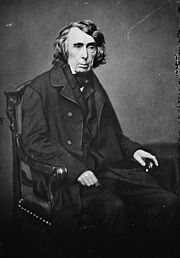
Roger Taney, sitting as a federal circuit court
United States circuit court
The United States circuit courts were the original intermediate level courts of the United States federal court system. They were established by the Judiciary Act of 1789. They had trial court jurisdiction over civil suits of diversity jurisdiction and major federal crimes. They also had appellate...
judge, ruled that the authority to suspend habeas corpus lay with Congress, not the president. President Lincoln
Abraham Lincoln
Abraham Lincoln was the 16th President of the United States, serving from March 1861 until his assassination in April 1865. He successfully led his country through a great constitutional, military and moral crisis – the American Civil War – preserving the Union, while ending slavery, and...
ignored the ruling, as did the Army
United States Army
The United States Army is the main branch of the United States Armed Forces responsible for land-based military operations. It is the largest and oldest established branch of the U.S. military, and is one of seven U.S. uniformed services...
under Lincoln's orders. The case was rendered moot
Mootness
In American law, a matter is moot if further legal proceedings with regard to it can have no effect, or events have placed it beyond the reach of the law...
by Lincoln's subsequent order in February 1862 to release almost everyone held as a political prisoner
Political prisoner
According to the Longman Dictionary of Contemporary English, a political prisoner is ‘someone who is in prison because they have opposed or criticized the government of their own country’....
.
Background
When a person is detained by police or other authority, a court can issue a writ of habeas corpus, compelling the detaining authority either to show proper cause for detaining the person (e.g., by filing criminal charges) or to release the detainee. The court can then remand the prisoner to custody, release them on bailBail
Traditionally, bail is some form of property deposited or pledged to a court to persuade it to release a suspect from jail, on the understanding that the suspect will return for trial or forfeit the bail...
, or release them outright. Article I, Section 9 of the United States Constitution
United States Constitution
The Constitution of the United States is the supreme law of the United States of America. It is the framework for the organization of the United States government and for the relationship of the federal government with the states, citizens, and all people within the United States.The first three...
, which enumerates the powers given to Congress, says, "The privilege of the Writ of Habeas Corpus shall not be suspended, unless when in Cases of Rebellion or Invasion the public Safety may require it."
In April 1861, actual fighting in the Civil War began. President Lincoln called for the states to provide militia
Militia
The term militia is commonly used today to refer to a military force composed of ordinary citizens to provide defense, emergency law enforcement, or paramilitary service, in times of emergency without being paid a regular salary or committed to a fixed term of service. It is a polyseme with...
troops to the Federal government to suppress the rebellion. Troops traveled to Washington
Washington, D.C.
Washington, D.C., formally the District of Columbia and commonly referred to as Washington, "the District", or simply D.C., is the capital of the United States. On July 16, 1790, the United States Congress approved the creation of a permanent national capital as permitted by the U.S. Constitution....
via Baltimore, Maryland. Pro-Confederate
Confederate States of America
The Confederate States of America was a government set up from 1861 to 1865 by 11 Southern slave states of the United States of America that had declared their secession from the U.S...
mobs attacked some of them
Baltimore riot of 1861
The Baltimore riot of 1861 was an incident that took place on April 19, 1861, in Baltimore, Maryland between Confederate sympathizers and members of the Massachusetts militia en route to Washington for Federal service...
on April 19. It seemed possible that these pro-Confederates would seize control of Maryland, cutting off Washington from the rest of the Union. Mayor Brown
George William Brown
George William Brown was the mayor of Baltimore, Maryland from 1860 to 1861.-Pratt Street Riot:Brown played an important role in controlling the Pratt Street Riot on April 19, 1861, at the onset of the American Civil War. After the Pratt Street Riot, some small skirmishes occurred throughout...
of Baltimore and Governor Hicks
Thomas Holliday Hicks
Thomas Holliday Hicks was an American politician from Maryland. He served as the 31st Governor of Maryland from 1858 until 1862, and as a U.S...
of Maryland asked that no more troops cross Maryland, but Lincoln refused. However, for the next few weeks, troops were brought to Washington via Annapolis, avoiding Baltimore. Also on April 19, Lincoln asked Attorney General
United States Attorney General
The United States Attorney General is the head of the United States Department of Justice concerned with legal affairs and is the chief law enforcement officer of the United States government. The attorney general is considered to be the chief lawyer of the U.S. government...
Edward Bates
Edward Bates
Edward Bates was a U.S. lawyer and statesman. He served as United States Attorney General under Abraham Lincoln from 1861 to 1864...
, for an opinion on the suspension of the writ of habeas corpus
Habeas corpus
is a writ, or legal action, through which a prisoner can be released from unlawful detention. The remedy can be sought by the prisoner or by another person coming to his aid. Habeas corpus originated in the English legal system, but it is now available in many nations...
.
The threat to Washington was serious, and Lincoln eventually responded by declaring martial law
Martial law
Martial law is the imposition of military rule by military authorities over designated regions on an emergency basis— only temporary—when the civilian government or civilian authorities fail to function effectively , when there are extensive riots and protests, or when the disobedience of the law...
in Maryland. On April 27, 1861, he told General Winfield Scott
Winfield Scott
Winfield Scott was a United States Army general, and unsuccessful presidential candidate of the Whig Party in 1852....
(commander-in-chief of the army) that if there was any resistance on the "military line" from Annapolis to Washington, Scott or "the officer in command at the point" was authorized to suspend habeas corpus if necessary. Within a few days, it was found necessary. The suspension was not announced, and Taney claimed to have not been informed of it.
Among the pro-Confederates in the Maryland militia was Lieutenant John Merryman
John Merryman
John Merryman was the petitioner in one of the best known habeas corpus cases of the American Civil War, a militia officer during the Civil War, and a Maryland politician.-Early life:...
. He had recruited and trained soldiers for the Confederate Army. After the Baltimore Riot he was involved in cutting telegraph wires and burning railroad bridges. On May 25, Merryman was arrested by order of General William H. Keim
William High Keim
William High Keim was a Republican member of the U.S. House of Representatives from Pennsylvania, as well as a general in the Union Army during the American Civil War.-Early life and career:...
, and charged with treason and being a commissioned lieutenant in an organization intending armed hostility toward the government, namely the Confederate Army.
The case
Merryman's lawyers appealed to Roger Taney to issue the writ. Taney promptly issued a writ of habeas corpus for Merryman demanding that General George CadwaladerGeorge Cadwalader
George Cadwalader was a general in the United States Army during the Mexican-American War and American Civil War.-Biography:He was born and raised in Philadelphia, Pennsylvania, studied law, and was admitted to the bar...
, the commander of Fort McHenry
Fort McHenry
Fort McHenry, in Baltimore, Maryland, is a star-shaped fort best known for its role in the War of 1812, when it successfully defended Baltimore Harbor from an attack by the British navy in Chesapeake Bay...
, where Merryman was being held, bring Merryman before him the next day. At this time, Supreme Court
Supreme Court of the United States
The Supreme Court of the United States is the highest court in the United States. It has ultimate appellate jurisdiction over all state and federal courts, and original jurisdiction over a small range of cases...
Justices sat as circuit court
United States circuit court
The United States circuit courts were the original intermediate level courts of the United States federal court system. They were established by the Judiciary Act of 1789. They had trial court jurisdiction over civil suits of diversity jurisdiction and major federal crimes. They also had appellate...
judges, as well. Taney decided to issue the writ while sitting as the circuit court jude for the District of Maryland rather than as Chief Justice of the Supreme Court. His reason, he states, was that it would permit Gen. Cadwalader to answer the writ in Baltimore rather than Washington, D.C., and so not have to leave the limits of his military command.
Cadwalader responded to Taney's order by sending a colonel to explain that he had suspended the writ of habeas corpus in Merryman's case. Taney reacted by issuing a writ of attachment
Writ of attachment
A writ of attachment is a court order to "attach" or seize an asset. It is issued by a court to a law enforcement officer or sheriff. The writ of attachment is issued in order to satisfy a judgment issued by the court. A prejudgment writ of attachment may be used to freeze assets of a defendant...
for Cadwalader, which ordered a U.S. Marshal
United States Marshals Service
The United States Marshals Service is a United States federal law enforcement agency within the United States Department of Justice . The office of U.S. Marshal is the oldest federal law enforcement office in the United States; it was created by the Judiciary Act of 1789...
to seize him and bring him before the court the following day. The marshal was refused entry into the fort.
In response, Taney ruled that the president can neither suspend habeas corpus nor authorize a military officer to do it, and that military officers cannot arrest people except as ordered by the courts. He noted that, while the marshal had the right to call up the posse comitatus
Posse comitatus
Posse comitatus may refer to:* Posse comitatus , the authority of a law officer to conscript any able-bodied males to assist him* Posse Comitatus , a loosely organized far right social movement that opposes the United States federal government and believes in localism* "Posse Comitatus", a...
to assist him in seizing Gen. Cadwalader and bringing him before the court, it was probably unwise for him to do so and thus that he would not punish the marshal for failing in his task. He then promised a more lengthy, written ruling within the week and ordered that it be sent to President Lincoln, "in order that he might perform his constitutional duty, to enforce the laws, by securing obedience to the process of the United States."
Taney was politically a partisan Democrat and an opponent of Lincoln. In his written opinion, he raged at length against Lincoln for granting himself easily abused powers. Taney asserted that the president was not authorized to suspend habeas corpus, observing that none of the Kings of England
British monarchy
The monarchy of the United Kingdom is the constitutional monarchy of the United Kingdom and its overseas territories. The present monarch, Queen Elizabeth II, has reigned since 6 February 1952. She and her immediate family undertake various official, ceremonial and representational duties...
exercised such power.
Taney noted in a footnote to the above passage that the United States Declaration of Independence
United States Declaration of Independence
The Declaration of Independence was a statement adopted by the Continental Congress on July 4, 1776, which announced that the thirteen American colonies then at war with Great Britain regarded themselves as independent states, and no longer a part of the British Empire. John Adams put forth a...
listed making the military power independent of and superior to the civil power as one justification for dissolving political allegiance.
Aftermath
Lincoln disregarded the ruling. Lincoln also got an opinion supporting his suspension from Attorney General Bates. It formed the basis for Lincoln's July 4 speech to Congress, in which he rhetorically asked, "Are all the laws, but one, to go unexecuted, and the government itself go to pieces, lest that one be violated?" Lincoln subsequently expanded the zone within which the writ was suspended.After reconvening, Congress failed to pass a bill favored by Lincoln to sanction his suspensions, and several more district and circuit court rulings affirmed Taney's opinion. Lincoln rendered these cases moot
Mootness
In American law, a matter is moot if further legal proceedings with regard to it can have no effect, or events have placed it beyond the reach of the law...
on February 14, 1862, when he issued an order releasing almost all political prisoner
Political prisoner
According to the Longman Dictionary of Contemporary English, a political prisoner is ‘someone who is in prison because they have opposed or criticized the government of their own country’....
s on parole
Parole
Parole may have different meanings depending on the field and judiciary system. All of the meanings originated from the French parole . Following its use in late-resurrected Anglo-French chivalric practice, the term became associated with the release of prisoners based on prisoners giving their...
. In response to opposition to conscription
Conscription
Conscription is the compulsory enlistment of people in some sort of national service, most often military service. Conscription dates back to antiquity and continues in some countries to the present day under various names...
, however, Lincoln again suspended habeas corpus six months later, this time throughout the entire country. The passage of the Habeas Corpus Suspension Act
Habeas Corpus Suspension Act 1863
The Habeas Corpus Suspension Act, , entitled An Act relating to Habeas Corpus, and regulating Judicial Proceedings in Certain Cases, was an Act of Congress that authorized the president of the United States to suspend the privilege of the writ of habeas corpus in response to the United States...
in March 1863 ended the controversy, at least temporarily, by authorizing the suspension of habeas corpus upon Congress's authority rather than on the president's authority.
The Merryman decision is still among the best-known Civil War-era court cases and it is one of Taney's most famous opinions, alongside the Dred Scott case. Its legal argument holding that Congress alone may suspend the writ is noted for reiterating the opinion of John Marshall
John Marshall
John Marshall was the Chief Justice of the United States whose court opinions helped lay the basis for American constitutional law and made the Supreme Court of the United States a coequal branch of government along with the legislative and executive branches...
and the court in Ex Parte Bollman
Ex parte Bollman
Ex parte Bollman, , was a case brought before the United States Supreme Court. Three main points were established in this early and formative civil liberties case:...
and was recently restated by the Supreme Court in Hamdi v. Rumsfeld
Hamdi v. Rumsfeld
Hamdi v. Rumsfeld, 542 U.S. 507 was a U.S. Supreme Court decision reversing the dismissal of a habeas corpus petition brought on behalf of Yaser Esam Hamdi, a U.S. citizen being detained indefinitely as an "illegal enemy combatant." The Court recognized the power of the government to detain enemy...
.
External links
- Full text of case at TeachingAmericanHistory.org.