
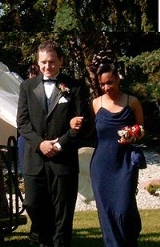
An
evening gown is a long flowing women's
dressA dress is a garment consisting of a skirt with an attached bodice or with a matching bodice giving the effect of a one-piece garment.Dress may also refer to:*Clothing in general*Costume, fancy dress...
usually worn to a formal affair. It ranges from tea and ballerina to full-length. Evening gowns are often made of a luxury fabric such as
chiffonChiffon, , from the French word for a cloth or rag, is a lightweight, balanced plain-woven sheer fabric woven of alternate S- and Z-twist crepe yarns. The twist in the crepe yarns puckers the fabric slightly in both directions after weaving, giving it some stretch and a slightly rough...
,
velvetVelvet is a type of woven tufted fabric in which the cut threads are evenly distributed,with a short dense pile, giving it a distinctive feel.The word 'velvety' is used as an adjective to mean -"smooth like velvet".-Composition:...
,
satinSatin is a weave that typically has a glossy surface and a dull back. It is a warp-dominated weaving technique that forms a minimum number of interlacings in a fabric. If a fabric is formed with a satin weave using filament fibres such as silk, nylon, or polyester, the corresponding fabric is...
, or
silkSilk is a natural protein fiber, some forms of which can be woven into textiles. The best-known type of silk is obtained from the cocoons of the larvae of the mulberry silkworm Bombyx mori reared in captivity...
. Although the terms are used interchangeably,
ball gownA ball gown is worn for ballroom dancing and only the most formal social occasions according to rules of etiquette. It is traditionally a full-skirted gown reaching at least to the ankles, made of luxurious fabric, delicately and exotically trimmed. Most versions are cut off the shoulder with...
s and evening gowns differ in that a ball gown will always have a full, flared skirt and a strapless bodice; in contrast, an evening gown can be any silhouette—
sheathIn fashion, a sheath dress is a type of dress designed to tightly fit the body. It is often made of a very light and thin material like cotton or silk, and rarely contains any flourishes. Unlike the shorter cocktail dress and the longer ballroom dress, a sheath dress typically falls around the...
,
mermaidA mermaid is a mythological aquatic creature with a female human head, arms, and torso and the tail of a fish. A male version of a mermaid is known as a "merman" and in general both males and females are known as "merfolk"...
,
A-lineAn A-line skirt is a skirt that is fitted at the hips and gradually widens towards the hem, giving the impression of the shape of a capital letter A. The term is also used to describe dresses and coats with a similar shape.-History:...
or
trumpetThe trumpet is the musical instrument with the highest register in the brass family. Trumpets are among the oldest musical instruments, dating back to at least 1500 BCE. They are played by blowing air through closed lips, producing a "buzzing" sound which starts a standing wave vibration in the air...
shaped—and may have straps,
haltersHalterneck is a style of strap which holds up women's clothing which features a single strap or material which runs from the front of the garment around the back of the wearer's neck, and which enables most of the wearer's back to be uncovered...
or even sleeves.
It corresponds to men's semi-formal wear for
black tieBlack tie is a dress code for evening events and social functions. For a man, the main component is a usually black jacket, known as a dinner jacket or tuxedo...
events.
History
In the Middle Ages, formal dress for women had yet to be developed. Women simply added a
trainA train in clothing is the long back portion of a skirt or dress that writes a trail on the ground behind the wearer in ruler , or a separate trailing overskirt. It is a common part of a court dress or a wedding dress....
to their
kirtleA kirtle is a tunic-like garment worn by men and women in the Middle Ages or, later, a one-piece garment worn by women from the later Middle Ages into the Baroque period...
for formal occasions.
As centuries rolled by, most gowns were generally very elaborate, but more so for formal occasions. In the 18th century, formal dress started as the
mantuaA mantua is an article of women's clothing worn in the late 17th century and 18th century. Originally a loose gown, the later mantua was an overgown or robe typically worn over stays, stomacher and a co-ordinating petticoat....
, but later developed into the elaborate
sack-back gownThe sack-back gown or robe à la française was a women's fashion of the 18th century. At the beginning of the century, the sack-back gown was a very informal style of dress. By the 1770s it was second only to court dress in its formality. This style of gown had fabric at the back arranged in box...
.
Starting with the 19th century, the term "evening gown" began. The fashionable length was ankle-length, but, during the reign of Victoria, the evening gown was floor-length. The styles ranged from having huge sleeves in the 1830s, to off-the-shoulder and with wide flounces in the 1840s, to very low-necked in the 1850s, to having low necklines and short sleeves in the 1860s, to long and lean with a bustle and very short sleeves in the 1870s, to sleeveless, low-necked, and worn with gloves in the 1880s, to having a squared decolletage, a wasp-waist cut, and skirts with long trains in the 1890s.
During the Edwardian era, the
empire silhouetteAn Empire silhouette is created by a woman wearing a high-waisted dress, gathered near or just under the bust with a long, loose skirt, which skims the body. The outline is especially flattering to pear shapes wishing to disguise the stomach area or emphasise the bust. The shape of the dress also...
was popular. Later, in the 1920s, evening gowns were very simple to match the style of the flapper era. Starting with the 1930s, evening gowns began to modernize. Along with the empire cut, over the years the sheath, mermaid, A-line, and trumpet shapes became popular. Also, the dropped waist and princesse styles were frequent, depending on the era.
Grace KellyGrace Patricia Kelly was an American actress who, in April 1956, married Rainier III, Prince of Monaco, to become Princess consort of Monaco, styled as Her Serene Highness The Princess of Monaco, and commonly referred to as Princess Grace.After embarking on an acting career in 1950, at the age of...
is noted for wearing understated evening gowns.
Today, the evening gown comes in any silhouette, and is popular for formal occasions such as the opera, formal dinners, cocktail parties, and wedding receptions.
White tie occasions
When worn to white tie occasions, the evening gown is generally more elaborate than when worn to black tie occasions. For example, the silhouette will be fuller, to match with the "very formal" white tie attire by men. In the modern times, the evening gown is becoming more frequent in women's formal wear, even at white tie occasions, but etiquette states that formal gowns must be worn.
Black tie occasions
Evening gowns can range to tea length (mid-calf to ankle-length) to full-length (to the floor). In general, the same rules of a white tie event apply to a black tie event, although in some cases a
cocktail dressA cocktail dress or cocktail gown is a woman's dress worn at cocktail parties, and semi-formal, or "black tie" occasions.The length of cocktail dresses varies depending on fashion and local custom. The length ranges from just above the knee to touching the ankle...
is acceptable. However, women usually wear evening gowns to black tie occasions.
Sheath
The sheath style evening gown, like the usual
sheath dressIn fashion, a sheath dress is a type of dress designed to tightly fit the body. It is often made of a very light and thin material like cotton or silk, and rarely contains any flourishes. Unlike the shorter cocktail dress and the longer ballroom dress, a sheath dress typically falls around the...
, is designed to fit the body tightly. It is generally unbelted, and has a straight drape. It can have shoulder straps or be strapless.
Mermaid
Mermaid, as the name suggests, means that the evening gown is shaped like a mermaid. It is form-fitting at the bodice, and the skirt is designed to resemble a mermaid's tail in silhouette.
A-line
The A-line style evening gown is somewhat bell-shaped, it is close-fitting at the top and widens gradually at the bottom, without gathers or pleats. This makes for a simple but elegant appearance.
Trumpet
If the evening gown is trumpet shaped, it is tight-fitting until it reaches the knees, where it flares.
Empire
The Empire silhouette involves the waistline coming up to just below the bust, from which the skirt hangs straight and loose, in a simple breezy style.
Dropped waist
The waistline is dropped below the actual waistline. The skirt can be fitted or flared.
Princesse
The princesse style evening gown is also tight, cut in single pieces, such as gores, and hanging in an unbroken line from shoulder to flared hem.
Crafting
Evening gowns can be distinguished from conventional or day dresses by a two primary features. The first is the cut, which tends to be couture and in line with the latest fashions, unless the article of clothing is a ball gown, in which case it will tend to be cut along more classic lines. The second distinguishing feature is the fabric. Evening gowns tend to use luxury materials such as silk, velvet, and taffeta, and they may be richly embroidered or decorated with beads, sequins, jewels, and other ornaments. Wealthy women also prefer to purchase tailored evening gowns, which are designed to flatter their figures. In all cases, evening gowns are designed to be worn with high quality jewelry.
Evening gowns are typically associated with glamor and luxury, and appear at events like the Academy Awards in the United States, the opening of the society season in urban areas, and formal receptions. In most instances, evening gowns are not designed to be worn more than once, although high profile members of society such as celebrities may auction off gowns which they have worn for charity. In some cases, especially for highly public events, well known designers will lend custom or vintage dresses to famous attendees of the event, in order to showcase their design skills, and then take the evening gowns back at the end of the evening for part of a permanent archive.
Alternatives to the gown
- In the 1940s, couturiers
Haute couture refers to the creation of exclusive custom-fitted clothing. Haute couture is made to order for a specific customer, and it is usually made from high-quality, expensive fabric and sewn with extreme attention to detail and finished by the most experienced and capable seamstresses,...
introduced dancing costumes, a party dress with a full skirt specifically made for semi-formal and formal dances. The dancing costume was shorter than the evening gown.
- A ball skirt is a variant fashion which resurfaced in the 1990s, consisting of a full, long skirt that can be worn with a cashmere sweater, lace camisole, or other dressy top.
See also
- Ball gown
A ball gown is worn for ballroom dancing and only the most formal social occasions according to rules of etiquette. It is traditionally a full-skirted gown reaching at least to the ankles, made of luxurious fabric, delicately and exotically trimmed. Most versions are cut off the shoulder with...
- Cocktail dress
A cocktail dress or cocktail gown is a woman's dress worn at cocktail parties, and semi-formal, or "black tie" occasions.The length of cocktail dresses varies depending on fashion and local custom. The length ranges from just above the knee to touching the ankle...
- Wedding gown
- Black tie
Black tie is a dress code for evening events and social functions. For a man, the main component is a usually black jacket, known as a dinner jacket or tuxedo...
- White tie
White tie is the most formal evening dress code in Western fashion. It is worn to ceremonial occasions such as state dinners in some countries, as well as to very formal balls and evening weddings...