

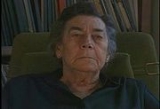
Evelyn Hooker

Encyclopedia
Evelyn Hooker was a North American psychologist
most notable for her 1957 paper "The Adjustment of the Male Overt Homosexual" in which she administered psychological tests to groups of self-identified homosexuals and heterosexuals and asked experts, based on those tests alone, to select the homosexual people. The experiment, which other researchers subsequently repeated, demonstrates that most self-identified homosexuals are no worse in social adjustment than the general population.
, Nebraska
, and grew up with 8 brothers and sisters in the Colorado Plains. When she was 13, her family moved to Sterling, Colorado
.
In 1924 she became a student at the University of Colorado
while working as a maid for a rich Boulder
family. Her mentor, Dr Karl Munzinger, guided her in her challenge of the then prevalent psychological theory of behaviourism. He invited her to write her own case history. After receiving her Masters degree, she became one of 11 women involved in the PhD program in psychology at Johns Hopkins University
, Baltimore
, Maryland
, having been refused referral to Yale
. She was awarded her PhD in 1932.
In her early career, she wasn't especially interested in the psychology of lesbians or gays. After teaching for only one year at the Maryland College for Women, she contracted tuberculosis
and spent the next year in a sanatorium in Arizona
. In 1937 Evelyn received a fellowship to go to Europe. She enrolled at the Berlin Institute of Psychotherapy. She witnessed mass hysteria on the triumphant return of Hitler to Berlin
after the Anschluss
.
However, during the 1940s, she first became interested in what would turn out to be her life's work. In 1942 while a teacher at UCLA, Evelyn married writer Don Caldwell. She became close to one of her students, Sam From, who introduced her in 1943 to the gay and lesbian subculture of the time. He challenged her to scientifically study "people like him." Despite the social, moral and scientific climate of the post-war period, Hooker became increasingly convinced that most gay men were perfectly socially adjusted and that this could be proven through scientific tests.
Over the next two decades, she became established professionally. In 1948 she divorced her husband and moved to a guest cottage at the Salter Avenue home of Edward Hooker, professor of English at UCLA and poetry scholar. They married in London in 1951. In the mid 50s Christopher Isherwood
became their neighbor and they became friends. Sam From died in a car accident in 1956, just before her ground-breaking research was published. Hooker's husband died in January 1957 of a heart attack.
The 1960s saw her work win a wider audience, and her conclusions were taken up by the gay rights movement. In 1961 Hooker was invited to lecture in Europe and in 1967, the director of the National Institute of Mental Health
(NIMH) asked her to produce a report on what the institution should do about homosexual men. Richard Nixon
's election in 1969 delayed the publication of the report which was published by a magazine and without authorisation in 1970. The report recommended the decriminalisation of homosexuality and the provision of similar rights to both homosexual and heterosexual people. The burgeoning gay rights movement seized on this.
She retired from her research at the age of 63 and opened a private practice. Most of her clients were gay men and lesbians.
Hooker died at her home in Santa Monica
, California
in 1996, at the age of 89.
She gathered two groups of men: one group would be exclusively homosexual, the other exclusively heterosexual. She contacted the Mattachine Society
to find homosexual men. She had greater difficulty finding heterosexual men. She also had to use her home to conduct the interview to protect people's anonymity.
Hooker used three different psychological tests for her study: the TAT
, the Make-a-Picture-Story test (MAPS test), and the Rorschach inkblot test
.
After a year of work, Hooker presented a team of 3 expert evaluators with 60 unmarked psychological profiles. She decided to leave the interpretation of her results to other people so as to avoid her own prejudice.
First, she contacted Bruno Klopfer
, an expert on Rorschach tests to see if he would be able to identify the sexual orientation of people through their results at those tests. His ability to differentiate was no better than chance.
Then Edwin Shneidman
, creator of the MAPS test, also analyzed the 60 profiles. It took him six months and he too found that both groups were highly similar in their psychological make-up.
The third expert was Dr Mortimer Mayer who was so certain he would be able to tell the two groups apart that he went through the process twice.
The three evaluators agreed that in terms of adjustment, there were no differences between the members of each group.
In 1956, Hooker presented the results of her research in a paper delivered to the American Psychological Association
's convention in Chicago.
Her studies contributed to a change in the attitudes of the psychological community towards homosexuality and to the American Psychiatric Association
's decision to remove homosexuality from its handbook of disorders in 1973. This in turn helped change the attitude of society at large.
Psychologist
Psychologist is a professional or academic title used by individuals who are either:* Clinical professionals who work with patients in a variety of therapeutic contexts .* Scientists conducting psychological research or teaching psychology in a college...
most notable for her 1957 paper "The Adjustment of the Male Overt Homosexual" in which she administered psychological tests to groups of self-identified homosexuals and heterosexuals and asked experts, based on those tests alone, to select the homosexual people. The experiment, which other researchers subsequently repeated, demonstrates that most self-identified homosexuals are no worse in social adjustment than the general population.
Life
She was born Evelyn Gentry in North PlatteNorth Platte, Nebraska
North Platte is a city in and the county seat of Lincoln County, Nebraska, United States. It is located in the southwestern part of the state, along Interstate 80, at the confluence of the North and South Platte Rivers forming the Platte River...
, Nebraska
Nebraska
Nebraska is a state on the Great Plains of the Midwestern United States. The state's capital is Lincoln and its largest city is Omaha, on the Missouri River....
, and grew up with 8 brothers and sisters in the Colorado Plains. When she was 13, her family moved to Sterling, Colorado
Sterling, Colorado
The City of Sterling is a Home Rule Municipality that is the county seat and the most populous city of Logan County, Colorado, United States. The city population was 14,777 at the 2010 census.-Geography:Sterling is located at...
.
In 1924 she became a student at the University of Colorado
University of Colorado at Boulder
The University of Colorado Boulder is a public research university located in Boulder, Colorado...
while working as a maid for a rich Boulder
Boulder, Colorado
Boulder is the county seat and most populous city of Boulder County and the 11th most populous city in the U.S. state of Colorado. Boulder is located at the base of the foothills of the Rocky Mountains at an elevation of...
family. Her mentor, Dr Karl Munzinger, guided her in her challenge of the then prevalent psychological theory of behaviourism. He invited her to write her own case history. After receiving her Masters degree, she became one of 11 women involved in the PhD program in psychology at Johns Hopkins University
Johns Hopkins University
The Johns Hopkins University, commonly referred to as Johns Hopkins, JHU, or simply Hopkins, is a private research university based in Baltimore, Maryland, United States...
, Baltimore
Baltimore
Baltimore is the largest independent city in the United States and the largest city and cultural center of the US state of Maryland. The city is located in central Maryland along the tidal portion of the Patapsco River, an arm of the Chesapeake Bay. Baltimore is sometimes referred to as Baltimore...
, Maryland
Maryland
Maryland is a U.S. state located in the Mid Atlantic region of the United States, bordering Virginia, West Virginia, and the District of Columbia to its south and west; Pennsylvania to its north; and Delaware to its east...
, having been refused referral to Yale
YALE
RapidMiner, formerly YALE , is an environment for machine learning, data mining, text mining, predictive analytics, and business analytics. It is used for research, education, training, rapid prototyping, application development, and industrial applications...
. She was awarded her PhD in 1932.
In her early career, she wasn't especially interested in the psychology of lesbians or gays. After teaching for only one year at the Maryland College for Women, she contracted tuberculosis
Tuberculosis
Tuberculosis, MTB, or TB is a common, and in many cases lethal, infectious disease caused by various strains of mycobacteria, usually Mycobacterium tuberculosis. Tuberculosis usually attacks the lungs but can also affect other parts of the body...
and spent the next year in a sanatorium in Arizona
Arizona
Arizona ; is a state located in the southwestern region of the United States. It is also part of the western United States and the mountain west. The capital and largest city is Phoenix...
. In 1937 Evelyn received a fellowship to go to Europe. She enrolled at the Berlin Institute of Psychotherapy. She witnessed mass hysteria on the triumphant return of Hitler to Berlin
Berlin
Berlin is the capital city of Germany and is one of the 16 states of Germany. With a population of 3.45 million people, Berlin is Germany's largest city. It is the second most populous city proper and the seventh most populous urban area in the European Union...
after the Anschluss
Anschluss
The Anschluss , also known as the ', was the occupation and annexation of Austria into Nazi Germany in 1938....
.
However, during the 1940s, she first became interested in what would turn out to be her life's work. In 1942 while a teacher at UCLA, Evelyn married writer Don Caldwell. She became close to one of her students, Sam From, who introduced her in 1943 to the gay and lesbian subculture of the time. He challenged her to scientifically study "people like him." Despite the social, moral and scientific climate of the post-war period, Hooker became increasingly convinced that most gay men were perfectly socially adjusted and that this could be proven through scientific tests.
Over the next two decades, she became established professionally. In 1948 she divorced her husband and moved to a guest cottage at the Salter Avenue home of Edward Hooker, professor of English at UCLA and poetry scholar. They married in London in 1951. In the mid 50s Christopher Isherwood
Christopher Isherwood
Christopher William Bradshaw Isherwood was an English-American novelist.-Early life and work:Born at Wyberslegh Hall, High Lane, Cheshire in North West England, Isherwood spent his childhood in various towns where his father, a Lieutenant-Colonel in the British Army, was stationed...
became their neighbor and they became friends. Sam From died in a car accident in 1956, just before her ground-breaking research was published. Hooker's husband died in January 1957 of a heart attack.
The 1960s saw her work win a wider audience, and her conclusions were taken up by the gay rights movement. In 1961 Hooker was invited to lecture in Europe and in 1967, the director of the National Institute of Mental Health
National Institute of Mental Health
The National Institute of Mental Health is one of 27 institutes and centers that make up the National Institutes of Health...
(NIMH) asked her to produce a report on what the institution should do about homosexual men. Richard Nixon
Richard Nixon
Richard Milhous Nixon was the 37th President of the United States, serving from 1969 to 1974. The only president to resign the office, Nixon had previously served as a US representative and senator from California and as the 36th Vice President of the United States from 1953 to 1961 under...
's election in 1969 delayed the publication of the report which was published by a magazine and without authorisation in 1970. The report recommended the decriminalisation of homosexuality and the provision of similar rights to both homosexual and heterosexual people. The burgeoning gay rights movement seized on this.
She retired from her research at the age of 63 and opened a private practice. Most of her clients were gay men and lesbians.
Hooker died at her home in Santa Monica
Santa Monica, California
Santa Monica is a beachfront city in western Los Angeles County, California, US. Situated on Santa Monica Bay, it is surrounded on three sides by the city of Los Angeles — Pacific Palisades on the northwest, Brentwood on the north, West Los Angeles on the northeast, Mar Vista on the east, and...
, California
California
California is a state located on the West Coast of the United States. It is by far the most populous U.S. state, and the third-largest by land area...
in 1996, at the age of 89.
Experiment
Although, since 1954, Hooker had collected data about her homosexual friends, she felt this was of little value because of the lack of scientific rigor attached to the gathering of this data. She applied for a grant from the NIMH, which she received.She gathered two groups of men: one group would be exclusively homosexual, the other exclusively heterosexual. She contacted the Mattachine Society
Mattachine Society
The Mattachine Society, founded in 1950, was one of the earliest homophile organizations in the United States, probably second only to Chicago’s Society for Human Rights . Harry Hay and a group of Los Angeles male friends formed the group to protect and improve the rights of homosexuals...
to find homosexual men. She had greater difficulty finding heterosexual men. She also had to use her home to conduct the interview to protect people's anonymity.
Hooker used three different psychological tests for her study: the TAT
Thematic Apperception Test
The Thematic Apperception Test, or TAT, is a projective psychological test. Historically, it has been among the most widely researched, taught, and used of such tests...
, the Make-a-Picture-Story test (MAPS test), and the Rorschach inkblot test
Rorschach inkblot test
The Rorschach test is a psychological test in which subjects' perceptions of inkblots are recorded and then analyzed using psychological interpretation, complex algorithms, or both. Some psychologists use this test to examine a person's personality characteristics and emotional functioning...
.
After a year of work, Hooker presented a team of 3 expert evaluators with 60 unmarked psychological profiles. She decided to leave the interpretation of her results to other people so as to avoid her own prejudice.
First, she contacted Bruno Klopfer
Bruno Klopfer
Bruno Klopfer was born in Bavaria, Germany on 1 October, 1900.He had a profound impact on the development of psychological personality testing, and was an important pioneer and innovator in the development, scoring and popularization of projective techniques, especially the Rorschach inkblot...
, an expert on Rorschach tests to see if he would be able to identify the sexual orientation of people through their results at those tests. His ability to differentiate was no better than chance.
Then Edwin Shneidman
Edwin Shneidman
Edwin S. Shneidman Edwin S. Shneidman Edwin S. Shneidman (born May 13, 1918, York, Pennsylvania, – May 15, 2009, Los Angeles, California was a American suicidologist and thanatologist...
, creator of the MAPS test, also analyzed the 60 profiles. It took him six months and he too found that both groups were highly similar in their psychological make-up.
The third expert was Dr Mortimer Mayer who was so certain he would be able to tell the two groups apart that he went through the process twice.
The three evaluators agreed that in terms of adjustment, there were no differences between the members of each group.
In 1956, Hooker presented the results of her research in a paper delivered to the American Psychological Association
American Psychological Association
The American Psychological Association is the largest scientific and professional organization of psychologists in the United States. It is the world's largest association of psychologists with around 154,000 members including scientists, educators, clinicians, consultants and students. The APA...
's convention in Chicago.
Her studies contributed to a change in the attitudes of the psychological community towards homosexuality and to the American Psychiatric Association
American Psychiatric Association
The American Psychiatric Association is the main professional organization of psychiatrists and trainee psychiatrists in the United States, and the most influential worldwide. Its some 38,000 members are mainly American but some are international...
's decision to remove homosexuality from its handbook of disorders in 1973. This in turn helped change the attitude of society at large.
Publications
- Evelyn Hooker, "The adjustment of the male overt homosexual", Journal of projective techniques, XXI 1957, pp. 18-31.
- Evelyn Hooker, "The homosexual community". Proceedings of the XIV International congress of applied psychology, Munksgaard, Copenhagen 1961.
- Evelyn Hooker, "Homosexuality: Summary of studies". In Evelyn Duvall and Sylvanus Duvall (curr.), Sex ways in fact and faith, Association Press, New York 1961.
- Evelyn Hooker, "Male homosexual life styles and venereal disease". In: Proceedings of the World forum on syphilis and other treponematoses (Public Health Service Publication No. 997), U.S. Government Printing Office, Washington, DC 1962.
- Evelyn Hooker, "Male homosexuality". In: N. L. Farberow (cur.), Taboo topics, Atherton, New York 1963, pp. 44-55.
- Evelyn Hooker, "An empirical study of some relations between sexual patterns and gender identity in male homosexuals". In J. Money (cur.), Sex research: new development, Holt, Rinehart & Winston, New York 1965, pp. 24-52.
- Evelyn Hooker, "Male homosexuals and their worlds". In: Judd MarmorJudd MarmorJudd Marmor was an American psychiatrist known for his role in removing homosexuality from the American Psychiatric Association Diagnostic and Statistical Manual of Mental Disorders.-Life and career:...
(cur.), Sexual inversion: the multiple roots of homosexuality, Basic Books, New York 1965, pp. 83-107). Traduzione italiana in: Judd Marmor, Inversione sessuale. - Evelyn Hooker, "Homosexuality". In: The international encyclopedia of the social sciences, Macmillan and Free Press, New York 1968.
- Evelyn Hooker, "Parental relations and male homosexuality in patient and non-patient samples", Journal of consulting and clinical psychology, XXXIII 1969, pp. 140-142.
- Evelyn Hooker, Foreword to: C. J. Williams and M. S. Weinberg, Homosexuals and the military: a study of less than honorable discharge, Harper & Row, New York 1971, pp. vii-ix.
Tributes
- In 2010, actor/playwright Jade Esteban EstradaJade Esteban EstradaJade Esteban Estrada is a successful Latin pop singer, comedian, choreographer, actor, political commentator, and human rights activist...
portrayed Hooker in the solo musical, "ICONS: The Lesbian and Gay History of the World, Vol. 4."
External links
- Defending the deviates. Evelyn Hooker documentary Changing our minds on video. A review of the above documentary
- Her entry at QueerTheory.com