

Eustorgius I

Encyclopedia
Eustorgius I was Archbishop of Milan from 343 to about 349. He is honoured as a Saint
in the Catholic Church and his feast day is September 18.
. He was the legate of Milan
and he was elected as bishop at the death of Protasius
in 343. Eustorgius traveled to Constantinople
to have his election as bishop confirmed by the Emperor, and in that occasion Emperor donated to him the relics of the Three Magi which he translated from Constantinople
to Milan.
From 345 to 346 and from 347 to 348, he held two synod
s. He also began construction of churches and basilicas in Milan. Saint Athanasius called him a "defender of the faith" and mentions him as an opponent of Arianism
. Saint Ambrose called him by the honorable title of "confessor
", and just in such a way some verses concerning Milan in ca. 700. His name was included in the Ambrosian Rite
and his cult in Milan is testified by the presence of five churches dedicated to him (as testified in a 14th-century document, Liber notitiae sanctorum Mediolani http://www.santiebeati.it/dettaglio/70600), the best known of which is the Basilica of Sant'Eustorgio
. A 5th or 6th century song indicates that he was a famous holy man and that he had built a great sarcophagus. And two little cows had transported the large shrine. Eustorgius was perhaps buried in the cemetery on the grounds of Sant'Eustorgio, which was located outside the Roman
walls along the road to Pavia
.http://www.traces-cl.com/archive/dic99/seustuk.html, and then in his church which was dedicated by him. His relics are in the main altar. For September 18, the Roman Martyrology states: "At Milan, St. Eustorgius I, Bishop of that city, rendered by the testimony of blessed Ambrose."http://web2.airmail.net/carlsch/MaterDei/Martyrol/sep-18.htm
to Milan, with two small cows which transported a large sarcophagus
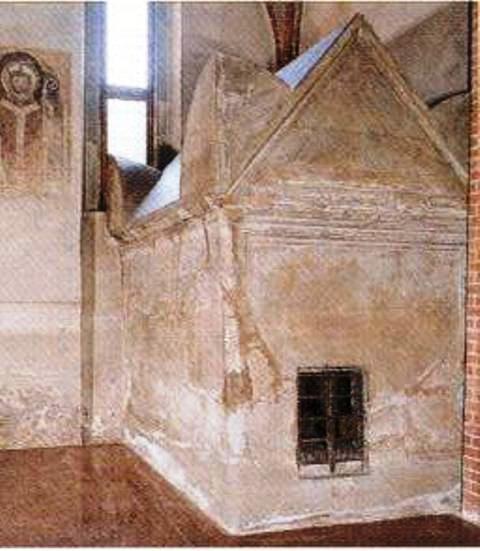
of marble. (Photo: Empty shrine in St. Eustorgio, ca. 300 AD)
The relic
s of the Magi - Stefan Lochner
takes a picture in 1445 - were taken from Milan
by Holy Roman Emperor
Fredrick Barbarossa
and given to the Archbishop of Cologne, Rainald of Dassel
, in 1164. A Shrine of the Three Kings at Cologne Cathedral
still exists (a part of these relics were returned to the Basilica of Sant'Eustorgio of Milan in 1904)
The Vita Beati Eustorgii Confessoris reports around the year 1200:
"... The holy Helena, mother of the emperor Constantine, was one with all virtues affected and a very much pious woman regarding the Christian religion. Therefore she proved uncommon eagerness in collecting relics of the holy ones. She traveled in own person through those widen countries of the Roman realm to the Orient and to the Western World. There she built over the bodies of the martyrs, who were killed by cruelty of tyrants because their Christian names, substantial memorials. Apart from the many fameful proofs of her piety to God she also accumulated the bodies of the Three Magi together, who were buried in different places, and Helena brought the bodies towards Constantinople. In this city they remained in large honours until the times of the emperor Manuel. At that time Eustorgius lived, Greek birth, a very informed man, nobly and piously, of pleasing exterior, eloquently, for the service to God quite
been suitable and in this service turned, a guard of the faith, and also chaste, and a native from Constantinople, before the times of bishop Saint Ambrose of Milan. He came as an ambassador of the
emperor Manuel to Milan, and the people of Milan selected him to bishop. Therefore Eustorgius returned to Constantinople, said thanks to the emperor and spoke: My father and emperor Manuel, I thanks you that you have appreciated the honour towards me up to now and that you have sent me into the holy city Milan, your metropolis. You should know that I have achieved everything, faithfully and after your will, the deliveries are always secured for you, but I am however the chosen one of the city, because you, in honour of God and to praise his charitableness. I unworthy one was urgent asked to return and to announce, what in the view
on our God and on you your you faithfully resulted people have done at me and like the people delegated these envoys with me to you. Intend
mine and instruct, what I am to do. The emperor answered: Become bishop, worthy man. Eustorgius answers: I thank God and you; but allow, dearest gentleman, that I can carry forward and can take away to the holy city of Milan anything of the sanctuaries, which me liked, if God's benignity permits it, in order to honour the church with holy relics, and as a gratification for your tributary people. The emperor answers: Select, receive, carry forward, which you would like. Be as if you are, or, is it possible, become still better. Greet my people and announce that from now on the whole delivery is issued. Thus Eustorgius went pleased, and he manufactured a marmorean coffin with large effort, and put into it the bodies of the Three Kings, who had brought Christus their gifts - gold, frankincense and myrrh. With trouble under many nights in which he was awake, and through God's assistance and amicability he transported it towards Milan into the city. The sarcophagus became buried outside of the city-wall closely beside the city in a church, which later was sanctified to honor holy Eustorgius. Also there is a famous and very holy source, where the neophytes had received the holy baptism, all Christians pious veneration with dignity. ..."
Saint
A saint is a holy person. In various religions, saints are people who are believed to have exceptional holiness.In Christian usage, "saint" refers to any believer who is "in Christ", and in whom Christ dwells, whether in heaven or in earth...
in the Catholic Church and his feast day is September 18.
Life
According to the tradition, Eustorgius was a noble GreekGreeks
The Greeks, also known as the Hellenes , are a nation and ethnic group native to Greece, Cyprus and neighboring regions. They also form a significant diaspora, with Greek communities established around the world....
. He was the legate of Milan
Milan
Milan is the second-largest city in Italy and the capital city of the region of Lombardy and of the province of Milan. The city proper has a population of about 1.3 million, while its urban area, roughly coinciding with its administrative province and the bordering Province of Monza and Brianza ,...
and he was elected as bishop at the death of Protasius
Protasius (bishop of Milan)
Protasius was Archbishop of Milan from 328 to c. 343. He is honoured as a Saint in the Catholic Church and his feast day is on November 24.-Life:Almost nothing is known about the life of Protasius...
in 343. Eustorgius traveled to Constantinople
Constantinople
Constantinople was the capital of the Roman, Eastern Roman, Byzantine, Latin, and Ottoman Empires. Throughout most of the Middle Ages, Constantinople was Europe's largest and wealthiest city.-Names:...
to have his election as bishop confirmed by the Emperor, and in that occasion Emperor donated to him the relics of the Three Magi which he translated from Constantinople
Constantinople
Constantinople was the capital of the Roman, Eastern Roman, Byzantine, Latin, and Ottoman Empires. Throughout most of the Middle Ages, Constantinople was Europe's largest and wealthiest city.-Names:...
to Milan.
From 345 to 346 and from 347 to 348, he held two synod
Synod
A synod historically is a council of a church, usually convened to decide an issue of doctrine, administration or application. In modern usage, the word often refers to the governing body of a particular church, whether its members are meeting or not...
s. He also began construction of churches and basilicas in Milan. Saint Athanasius called him a "defender of the faith" and mentions him as an opponent of Arianism
Arianism
Arianism is the theological teaching attributed to Arius , a Christian presbyter from Alexandria, Egypt, concerning the relationship of the entities of the Trinity and the precise nature of the Son of God as being a subordinate entity to God the Father...
. Saint Ambrose called him by the honorable title of "confessor
Confessor
-Confessor of the Faith:Its oldest use is to indicate a saint who has suffered persecution and torture for the faith, but not to the point of death. The term is still used in this way in the East. In Latin Christianity it has come to signify any saint, as well as those who have been declared...
", and just in such a way some verses concerning Milan in ca. 700. His name was included in the Ambrosian Rite
Ambrosian Rite
Ambrosian Rite, also called the Milanese Rite, is a Catholic liturgical Western Rite. The rite is named after Saint Ambrose, a bishop of Milan in the fourth century...
and his cult in Milan is testified by the presence of five churches dedicated to him (as testified in a 14th-century document, Liber notitiae sanctorum Mediolani http://www.santiebeati.it/dettaglio/70600), the best known of which is the Basilica of Sant'Eustorgio
Basilica of Sant'Eustorgio
The Basilica of Sant'Eustorgio is a church in Milan, northern Italy. It was for many years an important centre for pilgrims on their journey to Rome or to the Holy Land, because it was the site of the tomb of the Three Magi or Three Kings....
. A 5th or 6th century song indicates that he was a famous holy man and that he had built a great sarcophagus. And two little cows had transported the large shrine. Eustorgius was perhaps buried in the cemetery on the grounds of Sant'Eustorgio, which was located outside the Roman
Roman Empire
The Roman Empire was the post-Republican period of the ancient Roman civilization, characterised by an autocratic form of government and large territorial holdings in Europe and around the Mediterranean....
walls along the road to Pavia
Pavia
Pavia , the ancient Ticinum, is a town and comune of south-western Lombardy, northern Italy, 35 km south of Milan on the lower Ticino river near its confluence with the Po. It is the capital of the province of Pavia. It has a population of c. 71,000...
.http://www.traces-cl.com/archive/dic99/seustuk.html, and then in his church which was dedicated by him. His relics are in the main altar. For September 18, the Roman Martyrology states: "At Milan, St. Eustorgius I, Bishop of that city, rendered by the testimony of blessed Ambrose."http://web2.airmail.net/carlsch/MaterDei/Martyrol/sep-18.htm
Legend
His legendary Vita dates from the 12th century and exists in 20 different documents. His legend states that in 344, he brought the relics of the Three Magi from ConstantinopleConstantinople
Constantinople was the capital of the Roman, Eastern Roman, Byzantine, Latin, and Ottoman Empires. Throughout most of the Middle Ages, Constantinople was Europe's largest and wealthiest city.-Names:...
to Milan, with two small cows which transported a large sarcophagus
Sarcophagus
A sarcophagus is a funeral receptacle for a corpse, most commonly carved or cut from stone. The word "sarcophagus" comes from the Greek σαρξ sarx meaning "flesh", and φαγειν phagein meaning "to eat", hence sarkophagus means "flesh-eating"; from the phrase lithos sarkophagos...
of marble. (Photo: Empty shrine in St. Eustorgio, ca. 300 AD)
The relic
Relic
In religion, a relic is a part of the body of a saint or a venerated person, or else another type of ancient religious object, carefully preserved for purposes of veneration or as a tangible memorial...
s of the Magi - Stefan Lochner
Stefan Lochner
thumb|300px|Madonna in the Rose Bower .Stefan Lochner was a German late Gothic painter.His style, famous for its clean appearance, combined Gothic attention towards long flowing lines with brilliant colours with a Flemish influenced realism and attention to detail...
takes a picture in 1445 - were taken from Milan

Milan
Milan is the second-largest city in Italy and the capital city of the region of Lombardy and of the province of Milan. The city proper has a population of about 1.3 million, while its urban area, roughly coinciding with its administrative province and the bordering Province of Monza and Brianza ,...
by Holy Roman Emperor
Holy Roman Emperor
The Holy Roman Emperor is a term used by historians to denote a medieval ruler who, as German King, had also received the title of "Emperor of the Romans" from the Pope...
Fredrick Barbarossa
Frederick I, Holy Roman Emperor
Frederick I Barbarossa was a German Holy Roman Emperor. He was elected King of Germany at Frankfurt on 4 March 1152 and crowned in Aachen on 9 March, crowned King of Italy in Pavia in 1155, and finally crowned Roman Emperor by Pope Adrian IV, on 18 June 1155, and two years later in 1157 the term...
and given to the Archbishop of Cologne, Rainald of Dassel
Rainald of Dassel
Rainald of Dassel was archbishop of Cologne from 1159 to 1167 and archchancellor of Italy. He was preceded as archbishop by Friedrich II of Berg and succeeded by Philip I von Heinsberg....
, in 1164. A Shrine of the Three Kings at Cologne Cathedral
Shrine of the Three Kings at Cologne Cathedral
The Shrine of the Three Kings is a reliquary said to contain the bones of the Biblical Magi, also known as the Three Kings or the Three Wise Men. The shrine is a large gilded and decorated triple sarcophagus placed above and behind the high altar of Cologne Cathedral...
still exists (a part of these relics were returned to the Basilica of Sant'Eustorgio of Milan in 1904)
- "In the days of Philipp of HeinsbergPhilip I, Archbishop of ColognePhilip I was the Archbishop of Cologne and Archchancellor of Italy from 1167 to 1191.He was the son of Count Goswin II of Heinsberg and Adelaide of Sommerschenburg. He received his ecclesiastic training in Cologne and Rheims, becoming dean of the cathedral chapter in Cologne and then provost of...
, who followed Reinaldus, the shrine of the three magi was built. This was told to me by some eyewitnesses who were present when the three magi were put into the shrine." (Vita Eustorgii))
The Vita Beati Eustorgii Confessoris reports around the year 1200:
"... The holy Helena, mother of the emperor Constantine, was one with all virtues affected and a very much pious woman regarding the Christian religion. Therefore she proved uncommon eagerness in collecting relics of the holy ones. She traveled in own person through those widen countries of the Roman realm to the Orient and to the Western World. There she built over the bodies of the martyrs, who were killed by cruelty of tyrants because their Christian names, substantial memorials. Apart from the many fameful proofs of her piety to God she also accumulated the bodies of the Three Magi together, who were buried in different places, and Helena brought the bodies towards Constantinople. In this city they remained in large honours until the times of the emperor Manuel. At that time Eustorgius lived, Greek birth, a very informed man, nobly and piously, of pleasing exterior, eloquently, for the service to God quite
been suitable and in this service turned, a guard of the faith, and also chaste, and a native from Constantinople, before the times of bishop Saint Ambrose of Milan. He came as an ambassador of the
emperor Manuel to Milan, and the people of Milan selected him to bishop. Therefore Eustorgius returned to Constantinople, said thanks to the emperor and spoke: My father and emperor Manuel, I thanks you that you have appreciated the honour towards me up to now and that you have sent me into the holy city Milan, your metropolis. You should know that I have achieved everything, faithfully and after your will, the deliveries are always secured for you, but I am however the chosen one of the city, because you, in honour of God and to praise his charitableness. I unworthy one was urgent asked to return and to announce, what in the view
on our God and on you your you faithfully resulted people have done at me and like the people delegated these envoys with me to you. Intend
mine and instruct, what I am to do. The emperor answered: Become bishop, worthy man. Eustorgius answers: I thank God and you; but allow, dearest gentleman, that I can carry forward and can take away to the holy city of Milan anything of the sanctuaries, which me liked, if God's benignity permits it, in order to honour the church with holy relics, and as a gratification for your tributary people. The emperor answers: Select, receive, carry forward, which you would like. Be as if you are, or, is it possible, become still better. Greet my people and announce that from now on the whole delivery is issued. Thus Eustorgius went pleased, and he manufactured a marmorean coffin with large effort, and put into it the bodies of the Three Kings, who had brought Christus their gifts - gold, frankincense and myrrh. With trouble under many nights in which he was awake, and through God's assistance and amicability he transported it towards Milan into the city. The sarcophagus became buried outside of the city-wall closely beside the city in a church, which later was sanctified to honor holy Eustorgius. Also there is a famous and very holy source, where the neophytes had received the holy baptism, all Christians pious veneration with dignity. ..."
