
|
|
|
|
Eurocopter EC 135
|
| |
|
| |
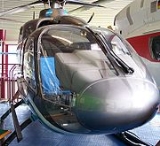
The EC 135 is a twin-engine civil helicopter produced by Eurocopter, widely used amongst police and ambulance services, and for executive transport. It is capable of flight under instrument flight rules (IFR).
EC135 can trace its history back to before the formation of Eurocopter. It was started as the BO 108 by MBB of Germany in the mid-eighties. A technology demonstrator ('V1') flew for the first time on 17 October 1988, powered by two Allison 250-C20R/1 engines.

Discussion
Ask a question about 'Eurocopter EC 135'
Start a new discussion about 'Eurocopter EC 135'
Answer questions from other users
|
Recent Posts

Encyclopedia
The EC 135 is a twin-engine civil helicopter produced by Eurocopter, widely used amongst police and ambulance services, and for executive transport. It is capable of flight under instrument flight rules (IFR).
Development
The EC135 can trace its history back to before the formation of Eurocopter. It was started as the BO 108 by MBB of Germany in the mid-eighties. A technology demonstrator ('V1') flew for the first time on 17 October 1988, powered by two Allison 250-C20R/1 engines. A second BO 108 ('V2') followed on 5 June 1991, this time with two Turboméca TM319-1B Arrius engines. Both these machines had a conventional tail rotor.
In late 1992, the design was revised with the introduction of the Fenestron tail rotor system, reflecting the creation of Eurocopter that year through the merger of MBB and Aérospatiale. In contrast to other helicopters, the tail rotor blades have been integrated into the tailboom and as they are framed by the tailboom, the risk of an accident has been significantly reduced. This tail rotor system, combined with the fuselage's roomy dimensions, means that the EC135 aircraft has become popular with aeromedical helicopter operators. The EC135 is the best selling light twin of the the past 10 years.
Two pre-production prototypes were built. They flew on 15 February and 16 April 1994, testing the Arrius 2B and Pratt & Whitney Canada PW206B engines, the older and less powerful Allison Model 250 powerplant having been rejected. A third helicopter followed on 28 November 1994.
Operational history
The EC135 made its US debut at the Heli-Expo in January 1995 at Las Vegas. After over 1,600 flight hours, European JAA certification was achieved on 16 June 1996, with FAA approval following on 31 July. Deliveries started on 1 August, when two helicopters (0005 and 0006) were handed over to Deutsche Rettungsflugwacht. The 100th EC135 was handed over to the Bavarian police force in June 1999. By that time the worldwide fleet had clocked up around 30,000 flight hours. As of 2008, the fleet total stood at over 1 million flight hours, with over 650 aircraft delivered.
Single-pilot IFR (SPIFR) certification was granted by the German LBA on December 2, 1999. Deliveries to the German Aviators Corps began on 13 September 2000 at the German Army Aviators School at (Bückeburg Air Base) near Achum. The EC135 received SPIFR certification from the UK CAA in December 2000.
In autumn 2000, Eurocopter announced the start of certification work for the Pratt & Whitney Canada PW206B2, a version of the PW207 which offers improved single-engine performance and 30 second emergency power. The LBA certification was achieved on 10 July 2001, and the first EC135 with the new engines was handed over to the Swedish National Police on 10 August 2001.
The world fleet leader in aircraft hours for this type is G-NESV (s/n 0067). This aircraft was delivered to the North East Air Support Unit in April 1999 and on 29 March 2007 it clocked up its 9,000th hour.
At the NBAA in March 2007 in Atlanta, Eurocopter unveiled ‘L’Hélicoptère par Hermès, a special-edition VIP model designed by Hermès International, S.A.. This variant features a specially-created luxury four-place main cabin, a sliding glass partition, a corporate baggage hold, redesigned skid landing gear and other external changes. Launch customer for ‘L’Hélicoptère par Hermès is Falcon Aviation Services (FAS), based in Abu Dhabi, United Arab Emirates.
Offshore Wind Support
In March 2009 the EC 135 was the first aircraft selected for offshore wind support in the UK after the UK Civil Aviation Authority approved helicopter operations to the Greater Gabbard offshore wind farm. The EC 135 had already been used for some time in Denmark, supporting the Horns Rev offshore wind farm where over 10,000 successful personnel transfers have taken place.
Variants
EC135 P1 :Powered by two 463 kW (621 shp) Pratt & Whitney Canada PW206B. Later versions have the Center Panel Display System (CPDS). Initial maximum take-off weight (M.T.O.W.) of 2,631 kg (5,800 lbs), later raised to 2,721 kg (6,000 lbs) and then 2,835 kg (6,250 lbs).
EC135 T1 :Powered by two 435 kW (583 shp) Turbomeca Arrius 2B1/2B1A/2B1A1. Later versions have the CPDS. Initial M.T.O.W. of 2,631 kg (5,800 lbs), later raised to 2,721 kg (6,000 lbs) and then 2,835 kg (6,250 lbs).
EC135 P2 :Powered by two 463 kW (621 shp) Pratt & Whitney Canada PW206B2. Increased thermodynamic and mechanic OEI ratings (128% OEI torque). Replaced EC135 P1 in production in August 2001.
EC135 T2 :Powered by two 452 kW (652 shp) Turbomeca Arrius 2B2. Increased thermodynamic and mechanic OEI ratings (128% OEI torque). Replaced EC135 T1 in production in August 2002.
EC135 P2+ :Latest production version with 498 kW (667 shp) PW206B2 (new power ratings based on a FADEC software upgrade), plus a 2,910 kg (6,415 lbs) M.T.O.W. upgrade, extended component time between overhaul (TBOs), and a change in the main transmission lubricating oil.. Built in Germany and Spain.
EC135 T2+ :Latest production version with 473 kW (634 shp) Arrius 2B2 engines (new power ratings based on a FADEC software upgrade), plus a 2,910 kg (6,415 lbs) M.T.O.W. upgrade, extended component TBOs, and a change in the main transmission lubricating oil. Built in Germany and Spain.
EC135 P2i :Marketing designation of aircraft upgraded to (rather than built to) EC135 P2+ standard.
EC135 T2i :Marketing designation of aircraft upgraded to (rather than built to) EC135 T2+ standard.
EC 635 :Military variant operated by Jordan.
Operators
Notable accidents and incidents
- An Air Methods Corporation EC135 T2+ crashed into a wooded hillside during a night flight on May 10, 2008 near La Crosse, Wisconsin. The pilot along with a doctor and a nurse were killed.
Specifications (EC135 P2+/T2+)
See also
External links
|
| |
|
|