

Euro-Atlantic Partnership Council

Encyclopedia
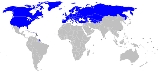
The Euro-Atlantic Partnership Council (EAPC), a NATO institution, is a multilateral forum created to improve relations between NATO and non-NATO countries in Europe
and those parts of Asia
on the European periphery. The member states meet to cooperate and consult on a range of political and security issues. It was formed on May 29, 1997 as the successor to the North Atlantic Cooperation Council
(NACC) and works alongside the Partnership for Peace
(PfP), both created post-Cold War
- the former in 1991, the latter in 1994.
Europe
Europe is, by convention, one of the world's seven continents. Comprising the westernmost peninsula of Eurasia, Europe is generally 'divided' from Asia to its east by the watershed divides of the Ural and Caucasus Mountains, the Ural River, the Caspian and Black Seas, and the waterways connecting...
and those parts of Asia
Asia
Asia is the world's largest and most populous continent, located primarily in the eastern and northern hemispheres. It covers 8.7% of the Earth's total surface area and with approximately 3.879 billion people, it hosts 60% of the world's current human population...
on the European periphery. The member states meet to cooperate and consult on a range of political and security issues. It was formed on May 29, 1997 as the successor to the North Atlantic Cooperation Council
North Atlantic Cooperation Council
The North Atlantic Cooperation Council was a NATO organisation founded in December 1991 and was the precursor to the Euro-Atlantic Partnership Council. It initially brought together NATO and nine central and eastern European nations in a consultative forum...
(NACC) and works alongside the Partnership for Peace
Partnership for Peace
Partnership for Peace is a North Atlantic Treaty Organisation program aimed at creating trust between NATO and other states in Europe and the former Soviet Union; 22 States are members...
(PfP), both created post-Cold War
Cold War
The Cold War was the continuing state from roughly 1946 to 1991 of political conflict, military tension, proxy wars, and economic competition between the Communist World—primarily the Soviet Union and its satellite states and allies—and the powers of the Western world, primarily the United States...
- the former in 1991, the latter in 1994.
Members
There are 50 members, the 28 NATO member countries and 22 partner countries. The partner countries are:- 6 countries that (though militarily neutral) possessed capitalist economies during the Cold War:
- 12 former Soviet republicsPost-Soviet statesThe post-Soviet states, also commonly known as the Former Soviet Union or former Soviet republics, are the 15 independent states that split off from the Union of Soviet Socialist Republics in its dissolution in December 1991...
:
- 4 of the Former Yugoslav nations on neither side of the Iron CurtainIron CurtainThe concept of the Iron Curtain symbolized the ideological fighting and physical boundary dividing Europe into two separate areas from the end of World War II in 1945 until the end of the Cold War in 1989...
during the Cold War:
See also
- OSCEOrganization for Security and Co-operation in EuropeThe Organization for Security and Co-operation in Europe is the world's largest security-oriented intergovernmental organization. Its mandate includes issues such as arms control, human rights, freedom of the press and fair elections...
- ISAFInternational Security Assistance ForceThe International Security Assistance Force is a NATO-led security mission in Afghanistan established by the United Nations Security Council on 20 December 2001 by Resolution 1386 as envisaged by the Bonn Agreement...
- UNUnited NationsThe United Nations is an international organization whose stated aims are facilitating cooperation in international law, international security, economic development, social progress, human rights, and achievement of world peace...
- WEUWestern European UnionThe Western European Union was an international organisation tasked with implementing the Modified Treaty of Brussels , an amended version of the original 1948 Treaty of Brussels...