


Eurasianists

Encyclopedia
Eurasianism is a political movement within the primarily Russian emigre
community.
community in the 1920s. The movement posited that Russian civilization does not belong in the "European" category (somewhat borrowing from Slavophile
ideas of Konstantin Leontyev), and that the October Revolution
of the Bolshevik
s was a necessary reaction to the rapid modernization of Russian society. The Evraziitsi believed that the Soviet regime was capable of evolving into a new national, non-European Orthodox Christian
government, shedding off the initial mask of proletarian internationalism
and militant atheism
(which the Evraziitsi were totally opposed to).
The Evraziitsi criticised the anti-Bolshevik activities of organizations such as ROVS, believing that the emigre community's energies would be better focused on preparing for this hoped for process of evolution. In turn, their opponents among the emigres argued that the Evraziitsi were calling for a compromise with and even support of the Soviet regime, while justifying its ruthless policies (such as the persecution
of the Russian Orthodox Church
) as mere "transitory problems" that were inevitable results of the revolutionary process.
The key leaders of the Evraziitsi were Prince Nikolai Trubetzkoy
, P.N. Savitsky, P.P. Suvchinskiy, D.S. Mirsky, K. Čcheidze, P. Arapov, and S. Efron. Philosopher Georges Florovsky
was initially a supporter, but backed out of the organization claiming it "raises the right questions", but "poses the wrong answers". A significant influence of the doctrine of the Evraziitsi can be found in Nikolai Berdyaev
's essay "The Sources and Meaning of Russian Communism".
Several organizations similar in spirit to the Evraziitsi sprung up in the emigre community at around the same time, such as the pro-Monarchist Mladorossi
and the Smenovekhovtsi
.
Several members of the Evraziitsi were affected by the Soviet provocational TREST
operation, which had set up a fake meeting of Evraziitsi in Russia that was attended by the Evraziitsi leader P.N. Savitsky in 1926 (an earlier series of trips were also made two years earlier by Evraziitsi member P. Arapov). The uncovering of the TREST as a Soviet provocation caused a serious morale blow to the Evraziitsi and discredited their public image. By 1929, the Evraziitsi had ceased publishing their periodical and had faded quickly from the Russian emigre community.
The ideology of the movement was partially incorporated into a new movement of the same name after the fall of the Soviet Union, when the Eurasia Party
was founded by Alexander Dugin.
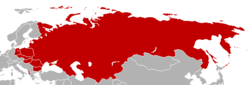 Neo-Eurasianism is a Russia
n school of thought, popularized in Russia during the years leading up to and following the collapse of the Soviet Union, that considers Russia to be culturally closer to Asia
than to Western Europe
.
The school takes its insipiration from the Eurasianists of the 1920s, notably Prince N.S. Troubetskoi and P.N. Savitsky. Lev Gumilev
is often cited as the founder of the Neo-Eurasianist movement, and he was quoted as saying that "I am the last of the Eurasianists."
At the same time, major differences have been noted between Gumilev's work and those of the original Eurasianists. Gumilev's work is controversial for its scientific methodology (the use of his own conception of ethnogenesis
and the notion of "passionarity"). At any rate, Gumilev's work has been a source of inspiration for the Neo-Eurasianist authors, the most prolific of whom is Aleksandr Dugin
.
Gumilev's contribution to Neo-Eurasianism lies in the conclusions he reaches from applying his theory of ethnogenesis: that
the Mongol occupation of 1240 - 1480 AD (known as the "Mongol yoke") had shielded the emergent Russian ethnos from the aggressive neighbor to the West, allowing it to gain time to achieve maturity.
The idea of Eurasianism contrasts with Konstantin Leontyev's Byzantism
, which is similar in its rejection of the West, but identifies with the Byzantine Empire
rather than with Central Asian tribal culture.
n nationalists and irredentists to retake some or all of the territories of the other republics of the former Soviet Union
and territory of the former Russian Empire
and amalgamate them into a single Russian state. Some have seen the Soviet Union as effectively being a Greater Russia due to the dominance of Russian political interests in the state. The idea of a Greater Russia has important relevance in modern-day Russian politics, as expanding the Russian state to include Belarus
is an important topic in Russian political affairs, as well as the political aspirations of Russian nationalists especially in Moldova
and Ukraine
to have their people reintegrated with Russia. Before war broke out
between Russia
and Georgia
in 2008, Alexander Dugin visited South Ossetia
and predicted, "Our troops will occupy the Georgian capital Tbilisi, the entire country, and perhaps even Ukraine and the Crimean Peninsula, which is historically part of Russia, anyway."
Ossetian
president Eduard Kokoity
is a Eurasianist and argues that South Ossetia
never left the Russian Empire
and should be part of Russia
.
among nationalist (ulusalcı) circles. The most prominent figure who is associated with Dugin is Doğu Perinçek
, the leader of the Workers' Party
. Some analysts of modern Turkish politics have suggested that the ultra-nationalist and secular elite that are also affiliated with the members of the Turkish military, who have come under close scrutiny with the Ergenekon coup case, have close ideological and political ties to the Eurasianists.
White Emigre
A white émigré was a Russian who emigrated from Russia in the wake of the Russian Revolution and Russian Civil War, and who was in opposition to the contemporary Russian political climate....
community.
Early 20th century
Eurasianists was a political movement in the Russian emigreWhite Emigre
A white émigré was a Russian who emigrated from Russia in the wake of the Russian Revolution and Russian Civil War, and who was in opposition to the contemporary Russian political climate....
community in the 1920s. The movement posited that Russian civilization does not belong in the "European" category (somewhat borrowing from Slavophile
Slavophile
Slavophilia was an intellectual movement originating from 19th century that wanted the Russian Empire to be developed upon values and institutions derived from its early history. Slavophiles were especially opposed to the influences of Western Europe in Russia. There were also similar movements in...
ideas of Konstantin Leontyev), and that the October Revolution
October Revolution
The October Revolution , also known as the Great October Socialist Revolution , Red October, the October Uprising or the Bolshevik Revolution, was a political revolution and a part of the Russian Revolution of 1917...
of the Bolshevik
Bolshevik
The Bolsheviks, originally also Bolshevists , derived from bol'shinstvo, "majority") were a faction of the Marxist Russian Social Democratic Labour Party which split apart from the Menshevik faction at the Second Party Congress in 1903....
s was a necessary reaction to the rapid modernization of Russian society. The Evraziitsi believed that the Soviet regime was capable of evolving into a new national, non-European Orthodox Christian
Eastern Orthodox Church
The Orthodox Church, officially called the Orthodox Catholic Church and commonly referred to as the Eastern Orthodox Church, is the second largest Christian denomination in the world, with an estimated 300 million adherents mainly in the countries of Belarus, Bulgaria, Cyprus, Georgia, Greece,...
government, shedding off the initial mask of proletarian internationalism
Proletarian internationalism
Proletarian internationalism, sometimes referred to as international socialism, is a Marxist social class concept based on the view that capitalism is now a global system, and therefore the working class must act as a global class if it is to defeat it...
and militant atheism
Antitheism
Antitheism is active opposition to theism. The etymological roots of the word are the Greek 'anti-' and 'theismos'...
(which the Evraziitsi were totally opposed to).
The Evraziitsi criticised the anti-Bolshevik activities of organizations such as ROVS, believing that the emigre community's energies would be better focused on preparing for this hoped for process of evolution. In turn, their opponents among the emigres argued that the Evraziitsi were calling for a compromise with and even support of the Soviet regime, while justifying its ruthless policies (such as the persecution
Persecution of Christians in the Soviet Union
The history of Christianity in the Soviet Union was not limited to repression and secularization. Soviet policy toward religion was based on the ideology of Marxism-Leninism, which made atheism the official doctrine of the Soviet Union...
of the Russian Orthodox Church
Russian Orthodox Church
The Russian Orthodox Church or, alternatively, the Moscow Patriarchate The ROC is often said to be the largest of the Eastern Orthodox churches in the world; including all the autocephalous churches under its umbrella, its adherents number over 150 million worldwide—about half of the 300 million...
) as mere "transitory problems" that were inevitable results of the revolutionary process.
The key leaders of the Evraziitsi were Prince Nikolai Trubetzkoy
Nikolai Trubetzkoy
Prince Nikolai Sergeyevich Trubetzkoy was a Russian linguist and historian whose teachings formed a nucleus of the Prague School of structural linguistics. He is widely considered to be the founder of morphophonology...
, P.N. Savitsky, P.P. Suvchinskiy, D.S. Mirsky, K. Čcheidze, P. Arapov, and S. Efron. Philosopher Georges Florovsky
Georges Florovsky
Georges Vasilievich Florovsky was an Eastern Orthodox priest, theologian, historian and ecumenist. He was born in the Russian Empire, but spent his working life in Paris and New York...
was initially a supporter, but backed out of the organization claiming it "raises the right questions", but "poses the wrong answers". A significant influence of the doctrine of the Evraziitsi can be found in Nikolai Berdyaev
Nikolai Berdyaev
Nikolai Alexandrovich Berdyaev was a Russian religious and political philosopher.-Early life and education:Berdyaev was born in Kiev into an aristocratic military family. He spent a solitary childhood at home, where his father's library allowed him to read widely...
's essay "The Sources and Meaning of Russian Communism".
Several organizations similar in spirit to the Evraziitsi sprung up in the emigre community at around the same time, such as the pro-Monarchist Mladorossi
Mladorossi
The Union of Mladorossi was a political group of Russian émigré monarchists who advocated a hybrid of Russian monarchy and the Soviet system, best evidenced by their motto "Tsar and the Soviets"....
and the Smenovekhovtsi
Smenovekhovtsi
The Smenovekhovtsy is the name for a political movement in the Russian émigré community that began shortly after the publication of the magazine "Smena Vekh" in Prague, in the year 1921...
.
Several members of the Evraziitsi were affected by the Soviet provocational TREST
Trust Operation
Operation Trust was a counterintelligence operation of the State Political Directorate of the Soviet Union. The operation, which ran from 1921-1926, set up a fake anti-Bolshevik underground organization, "Monarchist Union of Central Russia", MUCR , in order to help the OGPU identify real...
operation, which had set up a fake meeting of Evraziitsi in Russia that was attended by the Evraziitsi leader P.N. Savitsky in 1926 (an earlier series of trips were also made two years earlier by Evraziitsi member P. Arapov). The uncovering of the TREST as a Soviet provocation caused a serious morale blow to the Evraziitsi and discredited their public image. By 1929, the Evraziitsi had ceased publishing their periodical and had faded quickly from the Russian emigre community.
The ideology of the movement was partially incorporated into a new movement of the same name after the fall of the Soviet Union, when the Eurasia Party
Eurasia Party
The Eurasia Party was registered as a political party by the Ministry of Justice of Russia on 21 June 2002, approximately one year after the Pan-Russian Eurasia Movement was established by Aleksandr Dugin...
was founded by Alexander Dugin.
Neo-Eurasianism
Russia
Russia or , officially known as both Russia and the Russian Federation , is a country in northern Eurasia. It is a federal semi-presidential republic, comprising 83 federal subjects...
n school of thought, popularized in Russia during the years leading up to and following the collapse of the Soviet Union, that considers Russia to be culturally closer to Asia
Asia
Asia is the world's largest and most populous continent, located primarily in the eastern and northern hemispheres. It covers 8.7% of the Earth's total surface area and with approximately 3.879 billion people, it hosts 60% of the world's current human population...
than to Western Europe
Western Europe
Western Europe is a loose term for the collection of countries in the western most region of the European continents, though this definition is context-dependent and carries cultural and political connotations. One definition describes Western Europe as a geographic entity—the region lying in the...
.
The school takes its insipiration from the Eurasianists of the 1920s, notably Prince N.S. Troubetskoi and P.N. Savitsky. Lev Gumilev
Lev Gumilev
Lev Nikolayevich Gumilev , was a Soviet historian, ethnologist and anthropologist. His unorthodox ideas on the birth and death of ethnic groups have given rise to the political and cultural movement known as "Neo-Eurasianism".-Life:His parents were two prominent poets Nikolay Gumilev and Anna...
is often cited as the founder of the Neo-Eurasianist movement, and he was quoted as saying that "I am the last of the Eurasianists."
At the same time, major differences have been noted between Gumilev's work and those of the original Eurasianists. Gumilev's work is controversial for its scientific methodology (the use of his own conception of ethnogenesis
Ethnogenesis
Ethnogenesis is the process by which a group of human beings comes to be understood or to understand themselves as ethnically distinct from the wider social landscape from which their grouping emerges...
and the notion of "passionarity"). At any rate, Gumilev's work has been a source of inspiration for the Neo-Eurasianist authors, the most prolific of whom is Aleksandr Dugin
Aleksandr Dugin
Aleksandr Gelyevich Dugin is a politologist and one of the most popular ideologists of Russian expansionism, nationalism, and fascism, with close ties to the Kremlin and Russian military. He was the leading organizer of National Bolshevik Party, National Bolshevik Front, and Eurasia Party...
.
Gumilev's contribution to Neo-Eurasianism lies in the conclusions he reaches from applying his theory of ethnogenesis: that
the Mongol occupation of 1240 - 1480 AD (known as the "Mongol yoke") had shielded the emergent Russian ethnos from the aggressive neighbor to the West, allowing it to gain time to achieve maturity.
The idea of Eurasianism contrasts with Konstantin Leontyev's Byzantism
Byzantism
Byzantinism or Byzantism is a term used in political science and philosophy to denote the political system and culture of the Byzantine Empire, and its spiritual successors, in particular, the Balkan states, the Ottoman Empire and Russia. The term byzantinism itself was coined in the 19th century...
, which is similar in its rejection of the West, but identifies with the Byzantine Empire
Byzantine Empire
The Byzantine Empire was the Eastern Roman Empire during the periods of Late Antiquity and the Middle Ages, centred on the capital of Constantinople. Known simply as the Roman Empire or Romania to its inhabitants and neighbours, the Empire was the direct continuation of the Ancient Roman State...
rather than with Central Asian tribal culture.
Greater Russia
The movement is sometimes called the Greater Russia and is described as a political aspiration of pan-RussiaRussia
Russia or , officially known as both Russia and the Russian Federation , is a country in northern Eurasia. It is a federal semi-presidential republic, comprising 83 federal subjects...
n nationalists and irredentists to retake some or all of the territories of the other republics of the former Soviet Union
Soviet Union
The Soviet Union , officially the Union of Soviet Socialist Republics , was a constitutionally socialist state that existed in Eurasia between 1922 and 1991....
and territory of the former Russian Empire
Russian Empire
The Russian Empire was a state that existed from 1721 until the Russian Revolution of 1917. It was the successor to the Tsardom of Russia and the predecessor of the Soviet Union...
and amalgamate them into a single Russian state. Some have seen the Soviet Union as effectively being a Greater Russia due to the dominance of Russian political interests in the state. The idea of a Greater Russia has important relevance in modern-day Russian politics, as expanding the Russian state to include Belarus
Belarus
Belarus , officially the Republic of Belarus, is a landlocked country in Eastern Europe, bordered clockwise by Russia to the northeast, Ukraine to the south, Poland to the west, and Lithuania and Latvia to the northwest. Its capital is Minsk; other major cities include Brest, Grodno , Gomel ,...
is an important topic in Russian political affairs, as well as the political aspirations of Russian nationalists especially in Moldova
Moldova
Moldova , officially the Republic of Moldova is a landlocked state in Eastern Europe, located between Romania to the West and Ukraine to the North, East and South. It declared itself an independent state with the same boundaries as the preceding Moldavian Soviet Socialist Republic in 1991, as part...
and Ukraine
Ukraine
Ukraine is a country in Eastern Europe. It has an area of 603,628 km², making it the second largest contiguous country on the European continent, after Russia...
to have their people reintegrated with Russia. Before war broke out
2008 South Ossetia war
The 2008 South Ossetia War or Russo-Georgian War was an armed conflict in August 2008 between Georgia on one side, and Russia and separatist governments of South Ossetia and Abkhazia on the other....
between Russia
Russia
Russia or , officially known as both Russia and the Russian Federation , is a country in northern Eurasia. It is a federal semi-presidential republic, comprising 83 federal subjects...
and Georgia
Georgia (country)
Georgia is a sovereign state in the Caucasus region of Eurasia. Located at the crossroads of Western Asia and Eastern Europe, it is bounded to the west by the Black Sea, to the north by Russia, to the southwest by Turkey, to the south by Armenia, and to the southeast by Azerbaijan. The capital of...
in 2008, Alexander Dugin visited South Ossetia
South Ossetia
South Ossetia or Tskhinvali Region is a disputed region and partly recognized state in the South Caucasus, located in the territory of the South Ossetian Autonomous Oblast within the former Georgian Soviet Socialist Republic....
and predicted, "Our troops will occupy the Georgian capital Tbilisi, the entire country, and perhaps even Ukraine and the Crimean Peninsula, which is historically part of Russia, anyway."
Ossetian
Ossetians
The Ossetians are an Iranic ethnic group of the Caucasus Mountains, eponymous of the region known as Ossetia.They speak Ossetic, an Iranian language of the Eastern branch, with most also fluent in Russian as a second language....
president Eduard Kokoity
Eduard Kokoity
Eduard Dzhabeyevich Kokoity is the de facto President of South Ossetia.-Early life:Eduard Kokoity was born on 31 October 1964 in Tskhinvali, in the Georgian SSR, a part of the Soviet Union at the time. Kokoity was a member, and champion, of the Soviet Union's national wrestling team...
is a Eurasianist and argues that South Ossetia
South Ossetia
South Ossetia or Tskhinvali Region is a disputed region and partly recognized state in the South Caucasus, located in the territory of the South Ossetian Autonomous Oblast within the former Georgian Soviet Socialist Republic....
never left the Russian Empire
Russian Empire
The Russian Empire was a state that existed from 1721 until the Russian Revolution of 1917. It was the successor to the Tsardom of Russia and the predecessor of the Soviet Union...
and should be part of Russia
Russia
Russia or , officially known as both Russia and the Russian Federation , is a country in northern Eurasia. It is a federal semi-presidential republic, comprising 83 federal subjects...
.
Outside Russia
Since the late 1990s Eurasianism has gained some following in TurkeyTurkey
Turkey , known officially as the Republic of Turkey , is a Eurasian country located in Western Asia and in East Thrace in Southeastern Europe...
among nationalist (ulusalcı) circles. The most prominent figure who is associated with Dugin is Doğu Perinçek
Dogu Perinçek
Doğu Perinçek is a Turkish politician, leader of the Workers' Party , a scientific socialist organization, and former chairman of the Workers' Party . His first name Doğu means "East" in Turkish.-Personal life:...
, the leader of the Workers' Party
Workers' Party (Turkey)
Workers' Party is political party in Turkey led by Doğu Perinçek. İP has its roots in the Revolutionary Workers and Peasants Party of Turkey , Workers and Peasants Party of Turkey and Socialist Party...
. Some analysts of modern Turkish politics have suggested that the ultra-nationalist and secular elite that are also affiliated with the members of the Turkish military, who have come under close scrutiny with the Ergenekon coup case, have close ideological and political ties to the Eurasianists.