

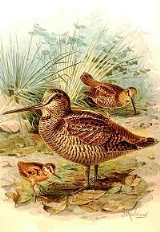
Eurasian Woodcock

Encyclopedia
The Eurasian Woodcock, Scolopax rusticola, is a medium-small wading
bird
found in temperate and subarctic Eurasia
. It has cryptic camouflage to suit its woodland habitat, with reddish-brown upperparts and buff-coloured underparts. Its eyes are set far back on its head to give it 360-degree vision and it probes in the ground for food with its long, sensitive bill, making it vulnerable to cold weather when the ground remains frozen.
The male performs a courtship flight known as 'roding' at dusk in spring. When threatened, the female can carry chicks between her legs, in her claws or on her back while flying, though this is rarely witnessed. The world population is estimated to be 15 million to 16 million birds.
. It has large eyes located high on the sides of its head, giving it 360-degree monocular vision.
The wings are rounded and the base of the bill is flesh-coloured with a dark tip. The legs vary from grey to pinkish. The species is sexually dimorphic
, with the male much larger than the female, although the sexes cannot be separated in the field.
by Linnaeus
in his Systema naturae in 1758. The binomial name is derived from the Greek
skolopax, meaning 'woodcock', and Latin
rusticus ('rural') and colere ('to live'). The species is monotypic and its closest relatives are the other woodcocks in the genus Scolopax.
, with more than 90% of the continent's population breeding in Russia
and Fennoscandia
. Their breeding range stretches from Fennoscandia to the Mediterranean Sea
and Canary Islands
and from western Europe to Russia.
This species is the woodcock
found through most of temperate and subarctic Eurasia
. Northern and Asia
n populations migrate
to southern Europe
or south Asia respectively. Birds in milder western European countries and on Atlantic islands are resident. The populations breeding in north-west and southern Europe are mostly sedentary. The birds' spring migration commences in February; breeding territories are reached between March and May.
The Eurasian Woodcock has a large range, with an estimated Global Extent of Occurrence of 10 million square kilometres and a population of an estimated 15 million to 16 million birds. Because of its large range, stable population trend and large population size, the species has been evaluated as Least Concern
. The most important threat to the population of the Eurasian Woodcock in the breeding range is the increased fragmentation of its woodland habitat. At other times of year, a reduction in the amount of permanent grassland and an increase in the intensification of farming are also threats, and the species' susceptibility to avian influenza may have an impact in future.
The Eurasian Woodcock's required breeding habitat is large, unfragmented areas of broadleaved deciduous or mixed broadleaved and coniferous forest, with dense undergrowth of plants such as Brambles, Holly
, Hazel
, Gorse
, Bracken
or Bilberry
. Breeding territories must include a mix of dry, warm resting places, damp areas for feeding, and clearings for flight. In larger woods, wide 'rides' (open tracks through the wood) and small clearings are important. In winter, Eurasian Woodcock also use scrubland during the day but in freezing weather they may use intertidal mud.
(most active at dawn and dusk) and rarely active during the day unless flushed, when they fly off with a whirring wing noise. The flight is somewhat owl- or bat-like; Woodcock fly fast and direct while migrating or crossing open country, but fly erratically with twisting and fluttering once in woodland. They are usually solitary and migrate singly, but may congregate when weather or geographical conditions force them to do so. This species is parasitised by the moorhen flea
, Dasypsyllus gallinulae.
s of the vocalisations of male Eurasian Woodcock showed that 95% of calls could be attributed correctly to individual birds, and concluded that counting roding males was a suitable method of monitoring the population.
Eurasian Woodcock nest on the ground in low cover in woodland or tall heather
. The nest is a lined cup or a slight hollow lined with dead leaves and other plant material. A single brood of four white or creamy eggs with light brown and grey blotches is laid; once the clutch is complete, incubation is performed by the female for between 21–24 days. The eggs measure 44 x 34 mm and weigh 26.5 g, of which 5% is shell. The downy, precocial
young leave the nest immediately and fledge after 15–20 days, although they can fly short distances after 10 days. When threatened, the mother bird can fly whilst carrying small chicks between her legs, body and tail, in her claws or on her back. This behaviour is rarely witnessed.
Nocturnal feeding occurs in frost-free pasture
or long-rotation grass meadow
s; fields with woodland within 1 kilometre are preferred to allow roosting during the day. There are only low densities of Eurasian Woodcock in predominantly arable
areas. In a three-year scientific study based in Brittany
, France
, 65 radio-tagged Woodcock and their habitat preferences were monitored. During the day, the birds chose areas of forest with humus which held large numbers of earthworms and with a dense scrub layer to provide protection, and hedges with scrub and trees were also found to be important. At night, the Woodcock selected grazed pastures which had five times the biomass
of earthworms compared to tilled land.
Woodcock Club.
In 1821 William Bingley described a method of trapping Eurasian Woodcock formerly used in northern England
: "Long parallel rows of stones or stick, four or five inches high, were made in moonlight nights on the commons frequented by them. In these rows several intervals or gateways were left in which the traps were placed. When the birds, running about in search of food, came to one of these rows, they did not usually cross it, but ran along the side till they arrived at the gateways, which they entered, and in which they were caught."
The effect of hunting on the species' European breeding population is "little understood." A study conducted in Brittany
, France
, explored the factors affecting the populations of wintering Eurasian Woodcock. The mortality and survival rates of 98 radio-tagged birds were monitored in a hunted area and in an adjoining hunting-free reserve. The scientists found rates of survival of 0.86 for adults and 0.67 for juveniles, with the probability of survival increasing as birds spent more time in the reserve. Matrix population models
were used and the conclusion was that "such low survival probabilities cannot sustain long-term viable populations. These results call for caution in the harvesting of woodcock populations wintering in western France and could be a forewarning of a decline."
In the United Kingdom
, surveys are being conducted to improve knowledge of the number of breeding Eurasian Woodcock and the structure of their habitat. Isotope
analysis of feathers from Eurasian Woodcock shot in the UK is also being performed to establish the origins of the birds.
A recipe for roast woodcock was featured in Mrs Beeton's Book of Household Management
, but despite its name, the Victorian
dish named Scotch woodcock
consists of scrambled eggs
on toast
with anchovies
.
Bingley wrote that [in the United Kingdom
] "Few birds are so much in esteem for the table as these", although he also reported that Woodcock meat was not eaten in Sweden
or Norway
as it was thought unwholesome, but that the eggs were taken and sold in "great numbers" in Stockholm
and Gothenburg
. In Nicolas Freeling
's Kitchen Book he narrates the lavish dinner described in Kipling's Sea Constables
, which features Woodcock as a Savoury, and explains that 'the woodcock has no gall, and is not cleaned [...] the creamy inside parts are spread on toast [...] no Edwardian gentleman would have resisted this for one minute.'
_jugendmarke_1965_10_pf.jpg) In the United Kingdom, the early arrival of migrant Woodcock in autumn was said to mean a good harvest, especially if they stayed until spring. It used to be thought that Eurasian Woodcock flew to the moon during the months when they were not seen and the first full moon
In the United Kingdom, the early arrival of migrant Woodcock in autumn was said to mean a good harvest, especially if they stayed until spring. It used to be thought that Eurasian Woodcock flew to the moon during the months when they were not seen and the first full moon
in November, when large numbers arrive on the British coast, is sometimes described as the 'woodcock moon'.
Reaney and Wilson wrote that the English
surname
"Woodcock"
developed as a nickname from the bird, meaning 'a fool, simpleton or dupe'. This hypothesis seems implausible for a number of reasons.
In William Shakespeare
's play, Love's Labours Lost, Berowne describes himself and his friends as 'four woodcocks in a dish', after discovering they have all fallen in love when they have sworn not to. An old folk name for the Goldcrest
was the "Woodcock pilot" because of the mistaken belief that the warblers rode in the feathers of migrating woodcock.
The 'pin feather' of the Eurasian Woodcock (the covert feather
of the outermost primary
) can be used as a fine paintbrush for miniatures, or as a delicate tool for moving tiny objects (e.g. specks of dust). As a painting tool, the feather has been described as "far from ideal, holding very little paint, resisting water and wearing down quickly at the tip." The Eurasian Woodcock has been the subject of postage stamp
s from several countries.
Wader
Waders, called shorebirds in North America , are members of the order Charadriiformes, excluding the more marine web-footed seabird groups. The latter are the skuas , gulls , terns , skimmers , and auks...
bird
Bird
Birds are feathered, winged, bipedal, endothermic , egg-laying, vertebrate animals. Around 10,000 living species and 188 families makes them the most speciose class of tetrapod vertebrates. They inhabit ecosystems across the globe, from the Arctic to the Antarctic. Extant birds range in size from...
found in temperate and subarctic Eurasia
Eurasia
Eurasia is a continent or supercontinent comprising the traditional continents of Europe and Asia ; covering about 52,990,000 km2 or about 10.6% of the Earth's surface located primarily in the eastern and northern hemispheres...
. It has cryptic camouflage to suit its woodland habitat, with reddish-brown upperparts and buff-coloured underparts. Its eyes are set far back on its head to give it 360-degree vision and it probes in the ground for food with its long, sensitive bill, making it vulnerable to cold weather when the ground remains frozen.
The male performs a courtship flight known as 'roding' at dusk in spring. When threatened, the female can carry chicks between her legs, in her claws or on her back while flying, though this is rarely witnessed. The world population is estimated to be 15 million to 16 million birds.
Description
Adults are 33–38 cm (13–15 in) in length, including the 6–8 cm (2.4–3.1 in) long straight bill, and have a 55–65 cm (21.7–25.6 in) wingspan. The Eurasian Woodcock has cryptic camouflage to suit its woodland habitat, with intricately patterned reddish-brown upperparts and buff underparts. The head is barred with black, not striped like that of its close relatives, the snipeSnipe
A snipe is any of about 25 wading bird species in three genera in the family Scolopacidae. They are characterized by a very long, slender bill and crypsis plumage. The Gallinago snipes have a nearly worldwide distribution, the Lymnocryptes Jack Snipe is restricted to Asia and Europe and the...
. It has large eyes located high on the sides of its head, giving it 360-degree monocular vision.
The wings are rounded and the base of the bill is flesh-coloured with a dark tip. The legs vary from grey to pinkish. The species is sexually dimorphic
Sexual dimorphism
Sexual dimorphism is a phenotypic difference between males and females of the same species. Examples of such differences include differences in morphology, ornamentation, and behavior.-Examples:-Ornamentation / coloration:...
, with the male much larger than the female, although the sexes cannot be separated in the field.
Taxonomy
The Eurasian Woodcock was given its current scientific nameBinomial nomenclature
Binomial nomenclature is a formal system of naming species of living things by giving each a name composed of two parts, both of which use Latin grammatical forms, although they can be based on words from other languages...
by Linnaeus
Carolus Linnaeus
Carl Linnaeus , also known after his ennoblement as , was a Swedish botanist, physician, and zoologist, who laid the foundations for the modern scheme of binomial nomenclature. He is known as the father of modern taxonomy, and is also considered one of the fathers of modern ecology...
in his Systema naturae in 1758. The binomial name is derived from the Greek
Greek language
Greek is an independent branch of the Indo-European family of languages. Native to the southern Balkans, it has the longest documented history of any Indo-European language, spanning 34 centuries of written records. Its writing system has been the Greek alphabet for the majority of its history;...
skolopax, meaning 'woodcock', and Latin
Latin
Latin is an Italic language originally spoken in Latium and Ancient Rome. It, along with most European languages, is a descendant of the ancient Proto-Indo-European language. Although it is considered a dead language, a number of scholars and members of the Christian clergy speak it fluently, and...
rusticus ('rural') and colere ('to live'). The species is monotypic and its closest relatives are the other woodcocks in the genus Scolopax.
Distribution and habitat
About one third of the world's Eurasian Woodcock breed in EuropeEurope
Europe is, by convention, one of the world's seven continents. Comprising the westernmost peninsula of Eurasia, Europe is generally 'divided' from Asia to its east by the watershed divides of the Ural and Caucasus Mountains, the Ural River, the Caspian and Black Seas, and the waterways connecting...
, with more than 90% of the continent's population breeding in Russia
Russia
Russia or , officially known as both Russia and the Russian Federation , is a country in northern Eurasia. It is a federal semi-presidential republic, comprising 83 federal subjects...
and Fennoscandia
Fennoscandia
Fennoscandia and Fenno-Scandinavia are geographic and geological terms used to describe the Scandinavian Peninsula, the Kola Peninsula, Karelia and Finland...
. Their breeding range stretches from Fennoscandia to the Mediterranean Sea
Mediterranean Sea
The Mediterranean Sea is a sea connected to the Atlantic Ocean surrounded by the Mediterranean region and almost completely enclosed by land: on the north by Anatolia and Europe, on the south by North Africa, and on the east by the Levant...
and Canary Islands
Canary Islands
The Canary Islands , also known as the Canaries , is a Spanish archipelago located just off the northwest coast of mainland Africa, 100 km west of the border between Morocco and the Western Sahara. The Canaries are a Spanish autonomous community and an outermost region of the European Union...
and from western Europe to Russia.
This species is the woodcock
Woodcock
The woodcocks are a group of seven or eight very similar living species of wading birds in the genus Scolopax. Only two woodcocks are widespread, the others being localized island endemics. Most are found in the Northern Hemisphere but a few range into Wallacea...
found through most of temperate and subarctic Eurasia
Eurasia
Eurasia is a continent or supercontinent comprising the traditional continents of Europe and Asia ; covering about 52,990,000 km2 or about 10.6% of the Earth's surface located primarily in the eastern and northern hemispheres...
. Northern and Asia
Asia
Asia is the world's largest and most populous continent, located primarily in the eastern and northern hemispheres. It covers 8.7% of the Earth's total surface area and with approximately 3.879 billion people, it hosts 60% of the world's current human population...
n populations migrate
Bird migration
Bird migration is the regular seasonal journey undertaken by many species of birds. Bird movements include those made in response to changes in food availability, habitat or weather. Sometimes, journeys are not termed "true migration" because they are irregular or in only one direction...
to southern Europe
Europe
Europe is, by convention, one of the world's seven continents. Comprising the westernmost peninsula of Eurasia, Europe is generally 'divided' from Asia to its east by the watershed divides of the Ural and Caucasus Mountains, the Ural River, the Caspian and Black Seas, and the waterways connecting...
or south Asia respectively. Birds in milder western European countries and on Atlantic islands are resident. The populations breeding in north-west and southern Europe are mostly sedentary. The birds' spring migration commences in February; breeding territories are reached between March and May.
The Eurasian Woodcock has a large range, with an estimated Global Extent of Occurrence of 10 million square kilometres and a population of an estimated 15 million to 16 million birds. Because of its large range, stable population trend and large population size, the species has been evaluated as Least Concern
Least Concern
Least Concern is an IUCN category assigned to extant taxon or lower taxa which have been evaluated but do not qualify for any other category. As such they do not qualify as threatened, Near Threatened, or Conservation Dependent...
. The most important threat to the population of the Eurasian Woodcock in the breeding range is the increased fragmentation of its woodland habitat. At other times of year, a reduction in the amount of permanent grassland and an increase in the intensification of farming are also threats, and the species' susceptibility to avian influenza may have an impact in future.
The Eurasian Woodcock's required breeding habitat is large, unfragmented areas of broadleaved deciduous or mixed broadleaved and coniferous forest, with dense undergrowth of plants such as Brambles, Holly
Holly
Ilex) is a genus of 400 to 600 species of flowering plants in the family Aquifoliaceae, and the only living genus in that family. The species are evergreen and deciduous trees, shrubs, and climbers from tropics to temperate zones world wide....
, Hazel
Hazel
The hazels are a genus of deciduous trees and large shrubs native to the temperate northern hemisphere. The genus is usually placed in the birch family Betulaceae, though some botanists split the hazels into a separate family Corylaceae.They have simple, rounded leaves with double-serrate margins...
, Gorse
Gorse
Gorse, furze, furse or whin is a genus of about 20 plant species of thorny evergreen shrubs in the subfamily Faboideae of the pea family Fabaceae, native to western Europe and northwest Africa, with the majority of species in Iberia.Gorse is closely related to the brooms, and like them, has green...
, Bracken
Bracken
Bracken are several species of large, coarse ferns of the genus Pteridium. Ferns are vascular plants that have alternating generations, large plants that produce spores and small plants that produce sex cells . Brackens are in the family Dennstaedtiaceae, which are noted for their large, highly...
or Bilberry
Bilberry
Bilberry is any of several species of low-growing shrubs in the genus Vaccinium , bearing edible berries. The species most often referred to is Vaccinium myrtillus L., but there are several other closely related species....
. Breeding territories must include a mix of dry, warm resting places, damp areas for feeding, and clearings for flight. In larger woods, wide 'rides' (open tracks through the wood) and small clearings are important. In winter, Eurasian Woodcock also use scrubland during the day but in freezing weather they may use intertidal mud.
Behaviour
Eurasian Woodcock are crepuscularCrepuscular
Crepuscular animals are those that are active primarily during twilight, that is during dawn and dusk. The word is derived from the Latin word crepusculum, meaning "twilight." Crepuscular is, thus, in contrast with diurnal and nocturnal behavior. Crepuscular animals may also be active on a bright...
(most active at dawn and dusk) and rarely active during the day unless flushed, when they fly off with a whirring wing noise. The flight is somewhat owl- or bat-like; Woodcock fly fast and direct while migrating or crossing open country, but fly erratically with twisting and fluttering once in woodland. They are usually solitary and migrate singly, but may congregate when weather or geographical conditions force them to do so. This species is parasitised by the moorhen flea
Moorhen flea
The moorhen flea, Dasypsyllus gallinulae, originally from South America, is now a globally widespread flea species. It is a large flea, easily identified because the male has two heavy horn-like spines on one of the genital flaps, and the female has a deep "bite" on the seventh sternite.It is found...
, Dasypsyllus gallinulae.
Breeding
The male performs a courtship display flight called 'roding' at dusk between April and June. Flying over the treetops with flickering wings and downward-pointing bill, it utters several deep croaks followed by a sharp squeak; the grunts are at a frequency of between 0.6 to 1.5 kHz and the squeaks range from 3 to 14 kHz. A study of spectrogramSpectrogram
A spectrogram is a time-varying spectral representation that shows how the spectral density of a signal varies with time. Also known as spectral waterfalls, sonograms, voiceprints, or voicegrams, spectrograms are used to identify phonetic sounds, to analyse the cries of animals; they were also...
s of the vocalisations of male Eurasian Woodcock showed that 95% of calls could be attributed correctly to individual birds, and concluded that counting roding males was a suitable method of monitoring the population.
Eurasian Woodcock nest on the ground in low cover in woodland or tall heather
Calluna
Calluna vulgaris is the sole species in the genus Calluna in the family Ericaceae. It is a low-growing perennial shrub growing to tall, or rarely to and taller, and is found widely in Europe and Asia Minor on acidic soils in open sunny situations and in moderate shade...
. The nest is a lined cup or a slight hollow lined with dead leaves and other plant material. A single brood of four white or creamy eggs with light brown and grey blotches is laid; once the clutch is complete, incubation is performed by the female for between 21–24 days. The eggs measure 44 x 34 mm and weigh 26.5 g, of which 5% is shell. The downy, precocial
Precocial
In biology, the term precocial refers to species in which the young are relatively mature and mobile from the moment of birth or hatching. The opposite developmental strategy is called "altricial," where the young are born or hatched helpless. Extremely precocial species may be called...
young leave the nest immediately and fledge after 15–20 days, although they can fly short distances after 10 days. When threatened, the mother bird can fly whilst carrying small chicks between her legs, body and tail, in her claws or on her back. This behaviour is rarely witnessed.
Food and feeding
Eurasian Woodcock forage in soft soil in thickets, usually well hidden from sight. They mainly eat earthworms, but also insects and their larvae, freshwater molluscs and some plant seeds. Because they rely on probing into the ground to find food, they are vulnerable to cold winter weather when the ground remains frozen. During the cold British winter of 1962-3, starving Woodcock were found feeding in urban areas and some were even forced to eat bird seed.Nocturnal feeding occurs in frost-free pasture
Pasture
Pasture is land used for grazing. Pasture lands in the narrow sense are enclosed tracts of farmland, grazed by domesticated livestock, such as horses, cattle, sheep or swine. The vegetation of tended pasture, forage, consists mainly of grasses, with an interspersion of legumes and other forbs...
or long-rotation grass meadow
Meadow
A meadow is a field vegetated primarily by grass and other non-woody plants . The term is from Old English mædwe. In agriculture a meadow is grassland which is not grazed by domestic livestock but rather allowed to grow unchecked in order to make hay...
s; fields with woodland within 1 kilometre are preferred to allow roosting during the day. There are only low densities of Eurasian Woodcock in predominantly arable
Arable land
In geography and agriculture, arable land is land that can be used for growing crops. It includes all land under temporary crops , temporary meadows for mowing or pasture, land under market and kitchen gardens and land temporarily fallow...
areas. In a three-year scientific study based in Brittany
Brittany
Brittany is a cultural and administrative region in the north-west of France. Previously a kingdom and then a duchy, Brittany was united to the Kingdom of France in 1532 as a province. Brittany has also been referred to as Less, Lesser or Little Britain...
, France
France
The French Republic , The French Republic , The French Republic , (commonly known as France , is a unitary semi-presidential republic in Western Europe with several overseas territories and islands located on other continents and in the Indian, Pacific, and Atlantic oceans. Metropolitan France...
, 65 radio-tagged Woodcock and their habitat preferences were monitored. During the day, the birds chose areas of forest with humus which held large numbers of earthworms and with a dense scrub layer to provide protection, and hedges with scrub and trees were also found to be important. At night, the Woodcock selected grazed pastures which had five times the biomass
Biomass
Biomass, as a renewable energy source, is biological material from living, or recently living organisms. As an energy source, biomass can either be used directly, or converted into other energy products such as biofuel....
of earthworms compared to tilled land.
Hunting
In many countries woodcock are hunted as game, and their size, speed and flight pattern makes them a very challenging shot. Anyone shooting a witnessed 'right and left' - in which two Woodcock are killed with consecutive shots from a shotgun, without the gun being lowered or reloaded - can be admitted to the Shooting TimesShooting Times
Shooting Times and Country Magazine, more commonly known as the Shooting Times, is a British shooting and firearms magazine, published by IPC Media. The magazine also features articles on hunting, fishing, deer stalking, gamekeeping, gundogs and wildlife...
Woodcock Club.
In 1821 William Bingley described a method of trapping Eurasian Woodcock formerly used in northern England
England
England is a country that is part of the United Kingdom. It shares land borders with Scotland to the north and Wales to the west; the Irish Sea is to the north west, the Celtic Sea to the south west, with the North Sea to the east and the English Channel to the south separating it from continental...
: "Long parallel rows of stones or stick, four or five inches high, were made in moonlight nights on the commons frequented by them. In these rows several intervals or gateways were left in which the traps were placed. When the birds, running about in search of food, came to one of these rows, they did not usually cross it, but ran along the side till they arrived at the gateways, which they entered, and in which they were caught."
The effect of hunting on the species' European breeding population is "little understood." A study conducted in Brittany
Brittany
Brittany is a cultural and administrative region in the north-west of France. Previously a kingdom and then a duchy, Brittany was united to the Kingdom of France in 1532 as a province. Brittany has also been referred to as Less, Lesser or Little Britain...
, France
France
The French Republic , The French Republic , The French Republic , (commonly known as France , is a unitary semi-presidential republic in Western Europe with several overseas territories and islands located on other continents and in the Indian, Pacific, and Atlantic oceans. Metropolitan France...
, explored the factors affecting the populations of wintering Eurasian Woodcock. The mortality and survival rates of 98 radio-tagged birds were monitored in a hunted area and in an adjoining hunting-free reserve. The scientists found rates of survival of 0.86 for adults and 0.67 for juveniles, with the probability of survival increasing as birds spent more time in the reserve. Matrix population models
Matrix population models
Population models are used in population ecology to model the dynamics of wildlife or human populations. Matrix population models are a specific type of population model that uses matrix algebra...
were used and the conclusion was that "such low survival probabilities cannot sustain long-term viable populations. These results call for caution in the harvesting of woodcock populations wintering in western France and could be a forewarning of a decline."
In the United Kingdom
United Kingdom
The United Kingdom of Great Britain and Northern IrelandIn the United Kingdom and Dependencies, other languages have been officially recognised as legitimate autochthonous languages under the European Charter for Regional or Minority Languages...
, surveys are being conducted to improve knowledge of the number of breeding Eurasian Woodcock and the structure of their habitat. Isotope
Isotope
Isotopes are variants of atoms of a particular chemical element, which have differing numbers of neutrons. Atoms of a particular element by definition must contain the same number of protons but may have a distinct number of neutrons which differs from atom to atom, without changing the designation...
analysis of feathers from Eurasian Woodcock shot in the UK is also being performed to establish the origins of the birds.
Gastronomy
Eurasian Woodcock are considered at their best for culinary purposes from October to December. After shooting, the birds are hung until 'high' to maximise the flavour; the meat can be eaten as a starter, savoury, or for breakfast. A bird serves one person. They are not gutted before cooking; the head, skinned with eyes removed, is left on and the beak used to truss the bird.A recipe for roast woodcock was featured in Mrs Beeton's Book of Household Management
Mrs Beeton's Book of Household Management
Mrs Beeton's Book of Household Management was a guide to all aspects of running a household in Victorian Britain, edited by Isabella Beeton. It was originally entitled "Beeton's Book of Household Management", in line with the other guide-books published by Beeton.Previously published as a part...
, but despite its name, the Victorian
Victorian era
The Victorian era of British history was the period of Queen Victoria's reign from 20 June 1837 until her death on 22 January 1901. It was a long period of peace, prosperity, refined sensibilities and national self-confidence...
dish named Scotch woodcock
Scotch woodcock
Scotch woodcock is a savoury dish consisting of creamy, softly scrambled eggs served over toast that has been spread with anchovy paste or Gentleman's Relish. As Welsh rabbit contains no rabbit, so Scotch woodcock contains no woodcock....
consists of scrambled eggs
Scrambled eggs
Scrambled eggs is a dish made from beaten whites and yolks of eggs . Beaten eggs are put into a hot pot or pan and stirred frequently, forming curds as they coagulate.-Sample preparation:...
on toast
Toast
Toast is bread that has been browned by exposure to radiant heat. This browning reaction is known as the Maillard reaction. Toasting warms the bread and makes it firmer, so it holds toppings more securely...
with anchovies
Anchovy
Anchovies are a family of small, common salt-water forage fish. There are 144 species in 17 genera, found in the Atlantic, Indian, and Pacific Oceans. Anchovies are usually classified as an oily fish.-Description:...
.
Bingley wrote that [in the United Kingdom
United Kingdom
The United Kingdom of Great Britain and Northern IrelandIn the United Kingdom and Dependencies, other languages have been officially recognised as legitimate autochthonous languages under the European Charter for Regional or Minority Languages...
] "Few birds are so much in esteem for the table as these", although he also reported that Woodcock meat was not eaten in Sweden
Sweden
Sweden , officially the Kingdom of Sweden , is a Nordic country on the Scandinavian Peninsula in Northern Europe. Sweden borders with Norway and Finland and is connected to Denmark by a bridge-tunnel across the Öresund....
or Norway
Norway
Norway , officially the Kingdom of Norway, is a Nordic unitary constitutional monarchy whose territory comprises the western portion of the Scandinavian Peninsula, Jan Mayen, and the Arctic archipelago of Svalbard and Bouvet Island. Norway has a total area of and a population of about 4.9 million...
as it was thought unwholesome, but that the eggs were taken and sold in "great numbers" in Stockholm
Stockholm
Stockholm is the capital and the largest city of Sweden and constitutes the most populated urban area in Scandinavia. Stockholm is the most populous city in Sweden, with a population of 851,155 in the municipality , 1.37 million in the urban area , and around 2.1 million in the metropolitan area...
and Gothenburg
Gothenburg
Gothenburg is the second-largest city in Sweden and the fifth-largest in the Nordic countries. Situated on the west coast of Sweden, the city proper has a population of 519,399, with 549,839 in the urban area and total of 937,015 inhabitants in the metropolitan area...
. In Nicolas Freeling
Nicolas Freeling
Nicolas Freeling, born Nicolas Davidson , was a British crime novelist, best known as the author of the Van der Valk series of detective novels...
's Kitchen Book he narrates the lavish dinner described in Kipling's Sea Constables
Debits and Credits (Kipling)
Debits and Credits is a collection of fourteen stories, nineteen poems and two scenes from a play by Rudyard Kipling. The collection was first published in 1926. Four of the poems are translations of odes by Horace...
, which features Woodcock as a Savoury, and explains that 'the woodcock has no gall, and is not cleaned [...] the creamy inside parts are spread on toast [...] no Edwardian gentleman would have resisted this for one minute.'
Folklore and culture
Full moon
Full moon lunar phase that occurs when the Moon is on the opposite side of the Earth from the Sun. More precisely, a full moon occurs when the geocentric apparent longitudes of the Sun and Moon differ by 180 degrees; the Moon is then in opposition with the Sun.Lunar eclipses can only occur at...
in November, when large numbers arrive on the British coast, is sometimes described as the 'woodcock moon'.
Reaney and Wilson wrote that the English
England
England is a country that is part of the United Kingdom. It shares land borders with Scotland to the north and Wales to the west; the Irish Sea is to the north west, the Celtic Sea to the south west, with the North Sea to the east and the English Channel to the south separating it from continental...
surname
Surname
A surname is a name added to a given name and is part of a personal name. In many cases, a surname is a family name. Many dictionaries define "surname" as a synonym of "family name"...
"Woodcock"
Woodcock (surname)
Woodcock is a relatively uncommon English surname that seems to have originated from varied roots in the Early Middle Ages. These roots suggest interesting possibilities for what the name has meant and how it has been acquired.- Notable Woodcocks :...
developed as a nickname from the bird, meaning 'a fool, simpleton or dupe'. This hypothesis seems implausible for a number of reasons.
In William Shakespeare
William Shakespeare
William Shakespeare was an English poet and playwright, widely regarded as the greatest writer in the English language and the world's pre-eminent dramatist. He is often called England's national poet and the "Bard of Avon"...
's play, Love's Labours Lost, Berowne describes himself and his friends as 'four woodcocks in a dish', after discovering they have all fallen in love when they have sworn not to. An old folk name for the Goldcrest
Goldcrest
The Goldcrest, Regulus regulus, is a very small passerine bird in the kinglet family. Its colourful golden crest feathers gives rise to its English and scientific names, and possibly to it being called the "king of the birds" in European folklore. Several subspecies are recognised across the very...
was the "Woodcock pilot" because of the mistaken belief that the warblers rode in the feathers of migrating woodcock.
The 'pin feather' of the Eurasian Woodcock (the covert feather
Covert (feather)
A covert feather on a bird is one of a set of feathers, called coverts, which as the name implies, cover other feathers. The coverts help to smooth airflow over the wings and tail.- Wing-coverts :...
of the outermost primary
Flight feather
Flight feathers are the long, stiff, asymmetrically shaped, but symmetrically paired feathers on the wings or tail of a bird; those on the wings are called remiges while those on the tail are called rectrices . Their primary function is to aid in the generation of both thrust and lift, thereby...
) can be used as a fine paintbrush for miniatures, or as a delicate tool for moving tiny objects (e.g. specks of dust). As a painting tool, the feather has been described as "far from ideal, holding very little paint, resisting water and wearing down quickly at the tip." The Eurasian Woodcock has been the subject of postage stamp
Postage stamp
A postage stamp is a small piece of paper that is purchased and displayed on an item of mail as evidence of payment of postage. Typically, stamps are made from special paper, with a national designation and denomination on the face, and a gum adhesive on the reverse side...
s from several countries.