

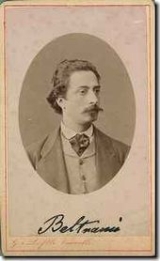
Eugenio Beltrami

Encyclopedia
Eugenio Beltrami was an Italian
mathematician notable for his work concerning differential geometry and mathematical physics
. His work was noted especially for clarity of exposition.
He was the first to prove consistency of non-Euclidean geometry
by modeling it on a surface of constant curvature
, the pseudosphere
, and in the interior of an n-dimensional unit sphere, the so-called Beltrami–Klein model. He also developed singular value decomposition
for matrices, which has been subsequently rediscovered several times. Beltrami's use of differential calculus for problems of mathematical physics indirectly influenced development of tensor calculus by Gregorio Ricci-Curbastro
and Tullio Levi-Civita
.
in Lombardy
, then a part of the Austrian Empire
, and now part of Italy. He began studying mathematics at University of Pavia
during 1853, but was expelled
from Ghislieri College
during 1856 due to his political opinions. During this time he was taught and influenced by Francesco Brioschi
.
He had to discontinue his studies because of financial hardship and spent the next several years as a secretary working for the Lombardy–Venice railroad company. He was appointed to the University of Bologna
as a professor during 1862, the year he published his first research paper. Throughout his life, Beltrami had various professorial jobs at universities in Pisa
, Rome
and Pavia. From 1891 until the end of his life Beltrami lived in Rome. He became the president of the Accademia dei Lincei
during 1898 and a senator of the Kingdom of Italy during 1899.
of Bolyai and Lobachevsky. In his "Essay on an interpretation of non-Euclidean geometry", Beltrami proposed that this geometry could be realized on a surface of constant negative curvature
, a pseudosphere
. For Beltrami's concept, lines of the geometry are represented by geodesic
s on the pseudosphere and theorems of non-Euclidean geometry can be proved within ordinary three-dimensional Euclidean space
, and not derived in an axiomatic fashion, as Lobachevsky and Bolyai had done previously. During 1840, Minding
already considered geodesic triangles on the pseudosphere and remarked that the corresponding "trigonometric formulas" are obtained from the corresponding formulas of spherical trigonometry
by replacing the usual trigonometric functions with hyperbolic function
s; this was further developed by Codazzi
during 1857, but apparently neither of them noticed the association with Lobachevsky's work. In this way, Beltrami attempted to demonstrate that two-dimensional non-Euclidean geometry is as valid as the Euclidean geometry of the space, and in particular, that Euclid's parallel postulate
could not be derived from the other axioms of Euclidean geometry
. It is often stated that this proof was incomplete due to the singularities of the pseudosphere, which means that geodesics could not be extended indefinitely. However, John Stillwell remarks that Beltrami must have been well aware of this difficulty, which is also manifested by the fact that the pseudosphere is topologically a cylinder
, and not a plane, and he spent a part of his memoir designing a way around it. By a suitable choice of coordinates, Beltrami showed how the metric on the pseudosphere can be transferred to the unit disk and that the singularity
of the pseudosphere corresponds to a horocycle
on the non-Euclidean plane. On the other hand, in the introduction to his memoir, Beltrami states that it would be impossible to justify "the rest of Lobachevsky's theory", i.e. the non-Euclidean geometry of space, by this method.
In the second memoir published during the same year (1868), "Fundamental theory of spaces of constant curvature", Beltrami continued this logic and gave an abstract proof of equiconsistency
of hyperbolic and Euclidean geometry for any dimension. He accomplished this by introducing several models of non-Euclidean geometry that are now known as the Beltrami–Klein model, the Poincaré disk model
, and the Poincaré half-plane model
, together with transformations that relate them. For the half-plane model, Beltrami cited a note by Liouville in the treatise of Monge
on differential geometry. Beltrami also showed that n-dimensional Euclidean geometry is realized on a horosphere of the (n + 1)-dimensional hyperbolic space
, so the logical relation between consistency of the Euclidean and the non-Euclidean geometries is symmetric. Beltrami acknowledged the influence of Riemann's groundbreaking Habilitation lecture "On the hypotheses on which geometry is based" (1854; published posthumously during 1868).
Although today Beltrami's "Essay" is recognized as very important for the development of non-Euclidean geometry, the reception at the time was less enthusiastic. Cremona
objected to perceived circular reasoning, which even forced Beltrami to delay the publication of the "Essay" by one year. Subsequently, Felix Klein
failed to acknowledge Beltrami's priority in construction of the projective disk model of the non-Euclidean geometry. This reaction can be attributed in part to the novelty of Beltrami's reasoning, which was similar to the ideas of Riemann concerning abstract manifold
s. J. Hoüel published Beltrami's proof in his French translation of works of Lobachevsky and Bolyai.
Italy
Italy , officially the Italian Republic languages]] under the European Charter for Regional or Minority Languages. In each of these, Italy's official name is as follows:;;;;;;;;), is a unitary parliamentary republic in South-Central Europe. To the north it borders France, Switzerland, Austria and...
mathematician notable for his work concerning differential geometry and mathematical physics
Mathematical physics
Mathematical physics refers to development of mathematical methods for application to problems in physics. The Journal of Mathematical Physics defines this area as: "the application of mathematics to problems in physics and the development of mathematical methods suitable for such applications and...
. His work was noted especially for clarity of exposition.
He was the first to prove consistency of non-Euclidean geometry
Non-Euclidean geometry
Non-Euclidean geometry is the term used to refer to two specific geometries which are, loosely speaking, obtained by negating the Euclidean parallel postulate, namely hyperbolic and elliptic geometry. This is one term which, for historical reasons, has a meaning in mathematics which is much...
by modeling it on a surface of constant curvature
Constant curvature
In mathematics, constant curvature in differential geometry is a concept most commonly applied to surfaces. For those the scalar curvature is a single number determining the local geometry, and its constancy has the obvious meaning that it is the same at all points...
, the pseudosphere
Pseudosphere
In geometry, the term pseudosphere is used to describe various surfaces with constant negative gaussian curvature. Depending on context, it can refer to either a theoretical surface of constant negative curvature, to a tractricoid, or to a hyperboloid....
, and in the interior of an n-dimensional unit sphere, the so-called Beltrami–Klein model. He also developed singular value decomposition
Singular value decomposition
In linear algebra, the singular value decomposition is a factorization of a real or complex matrix, with many useful applications in signal processing and statistics....
for matrices, which has been subsequently rediscovered several times. Beltrami's use of differential calculus for problems of mathematical physics indirectly influenced development of tensor calculus by Gregorio Ricci-Curbastro
Gregorio Ricci-Curbastro
Gregorio Ricci-Curbastro was an Italian mathematician. He was born at Lugo di Romagna. He is most famous as the inventor of the tensor calculus but published important work in many fields....
and Tullio Levi-Civita
Tullio Levi-Civita
Tullio Levi-Civita, FRS was an Italian mathematician, most famous for his work on absolute differential calculus and its applications to the theory of relativity, but who also made significant contributions in other areas. He was a pupil of Gregorio Ricci-Curbastro, the inventor of tensor calculus...
.
Short biography
Beltrami was born in CremonaCremona
Cremona is a city and comune in northern Italy, situated in Lombardy, on the left bank of the Po River in the middle of the Pianura Padana . It is the capital of the province of Cremona and the seat of the local City and Province governments...
in Lombardy
Lombardy
Lombardy is one of the 20 regions of Italy. The capital is Milan. One-sixth of Italy's population lives in Lombardy and about one fifth of Italy's GDP is produced in this region, making it the most populous and richest region in the country and one of the richest in the whole of Europe...
, then a part of the Austrian Empire
Austrian Empire
The Austrian Empire was a modern era successor empire, which was centered on what is today's Austria and which officially lasted from 1804 to 1867. It was followed by the Empire of Austria-Hungary, whose proclamation was a diplomatic move that elevated Hungary's status within the Austrian Empire...
, and now part of Italy. He began studying mathematics at University of Pavia
University of Pavia
The University of Pavia is a university located in Pavia, Lombardy, Italy. It was founded in 1361 and is organized in 9 Faculties.-History:...
during 1853, but was expelled
from Ghislieri College
Ghislieri College
The Ghislieri College , founded in 1567 by Pope Pius V and inspired by the Almo Collegio Borromeo, is the second the most ancient colleges in Pavia and co-founder of the IUSS, located in Pavia as well....
during 1856 due to his political opinions. During this time he was taught and influenced by Francesco Brioschi
Francesco Brioschi
Francesco Brioschi was an Italian mathematician.Brioschi was born in Milan in 1824. From 1850 he taught analytical mechanics in the University of Pavia. After the Italian unification in 1861, he was elected depute in the Parliament of Italy and then appointed twice secretary of the Education...
.
He had to discontinue his studies because of financial hardship and spent the next several years as a secretary working for the Lombardy–Venice railroad company. He was appointed to the University of Bologna
University of Bologna
The Alma Mater Studiorum - University of Bologna is the oldest continually operating university in the world, the word 'universitas' being first used by this institution at its foundation. The true date of its founding is uncertain, but believed by most accounts to have been 1088...
as a professor during 1862, the year he published his first research paper. Throughout his life, Beltrami had various professorial jobs at universities in Pisa
Pisa
Pisa is a city in Tuscany, Central Italy, on the right bank of the mouth of the River Arno on the Tyrrhenian Sea. It is the capital city of the Province of Pisa...
, Rome
Rome
Rome is the capital of Italy and the country's largest and most populated city and comune, with over 2.7 million residents in . The city is located in the central-western portion of the Italian Peninsula, on the Tiber River within the Lazio region of Italy.Rome's history spans two and a half...
and Pavia. From 1891 until the end of his life Beltrami lived in Rome. He became the president of the Accademia dei Lincei
Accademia dei Lincei
The Accademia dei Lincei, , is an Italian science academy, located at the Palazzo Corsini on the Via della Lungara in Rome, Italy....
during 1898 and a senator of the Kingdom of Italy during 1899.
Contributions to non-Euclidean geometry
During 1868 Beltrami published two memoirs (written in Italian; French translations by J. Hoüel appeared during 1869) dealing with consistency and interpretations of non-Euclidean geometryNon-Euclidean geometry
Non-Euclidean geometry is the term used to refer to two specific geometries which are, loosely speaking, obtained by negating the Euclidean parallel postulate, namely hyperbolic and elliptic geometry. This is one term which, for historical reasons, has a meaning in mathematics which is much...
of Bolyai and Lobachevsky. In his "Essay on an interpretation of non-Euclidean geometry", Beltrami proposed that this geometry could be realized on a surface of constant negative curvature
Gaussian curvature
In differential geometry, the Gaussian curvature or Gauss curvature of a point on a surface is the product of the principal curvatures, κ1 and κ2, of the given point. It is an intrinsic measure of curvature, i.e., its value depends only on how distances are measured on the surface, not on the way...
, a pseudosphere
Pseudosphere
In geometry, the term pseudosphere is used to describe various surfaces with constant negative gaussian curvature. Depending on context, it can refer to either a theoretical surface of constant negative curvature, to a tractricoid, or to a hyperboloid....
. For Beltrami's concept, lines of the geometry are represented by geodesic
Geodesic
In mathematics, a geodesic is a generalization of the notion of a "straight line" to "curved spaces". In the presence of a Riemannian metric, geodesics are defined to be the shortest path between points in the space...
s on the pseudosphere and theorems of non-Euclidean geometry can be proved within ordinary three-dimensional Euclidean space
Euclidean space
In mathematics, Euclidean space is the Euclidean plane and three-dimensional space of Euclidean geometry, as well as the generalizations of these notions to higher dimensions...
, and not derived in an axiomatic fashion, as Lobachevsky and Bolyai had done previously. During 1840, Minding
Ferdinand Minding
Ferdinand Minding was a German–Russian mathematician known for his contributions to differential geometry. He continued the work of Gauss concerning differential geometry of surfaces, especially its intrinsic aspects. Minding considered questions of bending of surfaces and proved the invariance of...
already considered geodesic triangles on the pseudosphere and remarked that the corresponding "trigonometric formulas" are obtained from the corresponding formulas of spherical trigonometry
Spherical trigonometry
Spherical trigonometry is a branch of spherical geometry which deals with polygons on the sphere and the relationships between the sides and the angles...
by replacing the usual trigonometric functions with hyperbolic function
Hyperbolic function
In mathematics, hyperbolic functions are analogs of the ordinary trigonometric, or circular, functions. The basic hyperbolic functions are the hyperbolic sine "sinh" , and the hyperbolic cosine "cosh" , from which are derived the hyperbolic tangent "tanh" and so on.Just as the points form a...
s; this was further developed by Codazzi
Delfino Codazzi
Delfino Codazzi was an Italian mathematician. He made some important contributions to the differential geometry of surfaces, such as the Gauss–Codazzi–Mainardi equations.-External links:...
during 1857, but apparently neither of them noticed the association with Lobachevsky's work. In this way, Beltrami attempted to demonstrate that two-dimensional non-Euclidean geometry is as valid as the Euclidean geometry of the space, and in particular, that Euclid's parallel postulate
Parallel postulate
In geometry, the parallel postulate, also called Euclid's fifth postulate because it is the fifth postulate in Euclid's Elements, is a distinctive axiom in Euclidean geometry...
could not be derived from the other axioms of Euclidean geometry
Euclidean geometry
Euclidean geometry is a mathematical system attributed to the Alexandrian Greek mathematician Euclid, which he described in his textbook on geometry: the Elements. Euclid's method consists in assuming a small set of intuitively appealing axioms, and deducing many other propositions from these...
. It is often stated that this proof was incomplete due to the singularities of the pseudosphere, which means that geodesics could not be extended indefinitely. However, John Stillwell remarks that Beltrami must have been well aware of this difficulty, which is also manifested by the fact that the pseudosphere is topologically a cylinder
Cylinder (geometry)
A cylinder is one of the most basic curvilinear geometric shapes, the surface formed by the points at a fixed distance from a given line segment, the axis of the cylinder. The solid enclosed by this surface and by two planes perpendicular to the axis is also called a cylinder...
, and not a plane, and he spent a part of his memoir designing a way around it. By a suitable choice of coordinates, Beltrami showed how the metric on the pseudosphere can be transferred to the unit disk and that the singularity
Singularity theory
-The notion of singularity:In mathematics, singularity theory is the study of the failure of manifold structure. A loop of string can serve as an example of a one-dimensional manifold, if one neglects its width. What is meant by a singularity can be seen by dropping it on the floor...
of the pseudosphere corresponds to a horocycle
Horocycle
In hyperbolic geometry, a horocycle is a curve whose normals all converge asymptotically. It is the two-dimensional example of a horosphere ....
on the non-Euclidean plane. On the other hand, in the introduction to his memoir, Beltrami states that it would be impossible to justify "the rest of Lobachevsky's theory", i.e. the non-Euclidean geometry of space, by this method.
In the second memoir published during the same year (1868), "Fundamental theory of spaces of constant curvature", Beltrami continued this logic and gave an abstract proof of equiconsistency
Equiconsistency
In mathematical logic, two theories are equiconsistent if, roughly speaking, they are "as consistent as each other".It is not in general possible to prove the absolute consistency of a theory T...
of hyperbolic and Euclidean geometry for any dimension. He accomplished this by introducing several models of non-Euclidean geometry that are now known as the Beltrami–Klein model, the Poincaré disk model
Poincaré disk model
In geometry, the Poincaré disk model, also called the conformal disk model, is a model of n-dimensional hyperbolic geometry in which the points of the geometry are in an n-dimensional disk, or unit ball, and the straight lines of the hyperbolic geometry are segments of circles contained in the disk...
, and the Poincaré half-plane model
Poincaré half-plane model
In non-Euclidean geometry, the Poincaré half-plane model is the upper half-plane , together with a metric, the Poincaré metric, that makes it a model of two-dimensional hyperbolic geometry....
, together with transformations that relate them. For the half-plane model, Beltrami cited a note by Liouville in the treatise of Monge
Gaspard Monge
Gaspard Monge, Comte de Péluse was a French mathematician, revolutionary, and was inventor of descriptive geometry. During the French Revolution, he was involved in the complete reorganization of the educational system, founding the École Polytechnique...
on differential geometry. Beltrami also showed that n-dimensional Euclidean geometry is realized on a horosphere of the (n + 1)-dimensional hyperbolic space
Hyperbolic space
In mathematics, hyperbolic space is a type of non-Euclidean geometry. Whereas spherical geometry has a constant positive curvature, hyperbolic geometry has a negative curvature: every point in hyperbolic space is a saddle point...
, so the logical relation between consistency of the Euclidean and the non-Euclidean geometries is symmetric. Beltrami acknowledged the influence of Riemann's groundbreaking Habilitation lecture "On the hypotheses on which geometry is based" (1854; published posthumously during 1868).
Although today Beltrami's "Essay" is recognized as very important for the development of non-Euclidean geometry, the reception at the time was less enthusiastic. Cremona
Luigi Cremona
Luigi Cremona was an Italian mathematician. His life was devoted to the study of geometry and reforming advanced mathematical teaching in Italy. His reputation mainly rests on his Introduzione ad una teoria geometrica delle curve piane...
objected to perceived circular reasoning, which even forced Beltrami to delay the publication of the "Essay" by one year. Subsequently, Felix Klein
Felix Klein
Christian Felix Klein was a German mathematician, known for his work in group theory, function theory, non-Euclidean geometry, and on the connections between geometry and group theory...
failed to acknowledge Beltrami's priority in construction of the projective disk model of the non-Euclidean geometry. This reaction can be attributed in part to the novelty of Beltrami's reasoning, which was similar to the ideas of Riemann concerning abstract manifold
Manifold
In mathematics , a manifold is a topological space that on a small enough scale resembles the Euclidean space of a specific dimension, called the dimension of the manifold....
s. J. Hoüel published Beltrami's proof in his French translation of works of Lobachevsky and Bolyai.
Works
- Opere matematiche di Eugenio Beltrami pubblicate per cura della Facoltà di scienze della r. Università di Roma (volumes 1–2) (U. Hoepli, Milano, 1902–1920)
- Same edition, vols. 1–4
See also
- Beltrami equation
- Beltrami identityBeltrami identityThe Beltrami identity is an identity in the calculus of variations. It says that a function u which is an extremal of the integralI=\int_a^b L \, dxsatisfies the differential equation...
- Beltrami's theoremBeltrami's theoremIn mathematics — specifically, in Riemannian geometry — Beltrami's theorem is a result named after the Italian mathematician Eugenio Beltrami which states that geodesic maps preserve the property of having constant curvature...
- Laplace–Beltrami operator