


Etymology of Iran

Encyclopedia
The name of Iran
derives immediately from Middle Persian
Ērān, Pahlavi ʼyrʼn, first attested in this form in the inscription that accompanies the investiture relief of Ardashir I
at Naqsh-e Rustam
. In this inscription, the king's Middle Persian appellation is ardašīr šāhān šāh ērān (lit. "ardeshir king of kings of Eran") corresponding to the passage ardašīr šāhān šāh aryān (lit. ardashir king of kings of aryans) in the Parthian
inscription accompanying the Middle Persian one.
ēr- and ary- (in e.g. ērān/aryān) in the Middle Iranian languages
of Persian and Parthian derives from Old Iranian
*arya- (in e.g. Old Persian: ariya-, Avestan: airiia-, etc.), meaning "Aryan
," in the sense of "of the Iranians." This word (i.e. *arya-) is attested as an ethnic designator in Achaemenid inscriptions and in Zoroastrianism's
Avesta
tradition, and in Middle Iranian era (ca. 400 BCE - 700 CE) it seems "very likely" that the word ērān in Ardashir's inscription still retained the same meaning as in the Old era, i.e. denoting the people rather than the empire while the empire was properly named as ērānšahr.
Notwithstanding this inscriptional use of ērān to refer to the Iranian peoples
, the use of ērān to refer to the empire (and the antonymic anērān to refer to the Roman territories) is also attested by the early Sassanid period. Both ērān and anērān appear in 3rd century calendrical text written by Mani
. In an inscription of Ardashir's son and immediate successor, Shapur I
"apparently includes in Ērān regions such as Armenia
and the Caucasus
which were not inhabited predominantly by Iranians." In Kartir's
inscriptions (written thirty years after Shapur's), the high priest includes the same regions (together with Georgia, Albania, Syria and the Pontus) in his list of provinces of the antonymic Anērān. Ērān also features in the names of the towns founded by Sassanid dynasts, for instance in Ērān-xwarrah-šābuhr "Glory of Ērān (of) Shapur". It also appears in the titles of government officers, such as in Ērān-āmārgar "Accountant-General (of) Ērān" or Ērān-dibirbed "Chief Scribe (of) Ērān".
Shapur's trilingual inscription at Ka'ba-i Zartosht also introduces the term ērānšahr ( ), "kingdom of the Iranians", that is however not attested in any other texts of this period other than in royal inscriptions (it is however preserved in post-Sassanid-era Zoroastrian texts). Because an equivalent of ērānšahr does not appear in Old Iranian (where it would have been *aryānām xšaθra- or in Old Persian *- xšaça-, "rule, reign, sovereignty"), the term is presumed to have been a Sassanid-era development. In the Greek portion of Shapur's trilingual inscription the word šahr "kingdom" appears as ethnous "nation". For speakers of Greek, the idea of an Iranian ethnous was not new: In the 1st century BCE, Strabo
had noted a relationship between the various Iranian peoples and their languages: "[From] beyond the Indus [...] Ariana
is extended so as to include some part of Persia, Media
, and the north of Bactria
and Sogdiana
; for these nations speak nearly the same language." (Geography
, 15.2.1-15.2.8).
and Safarid era. Such references to the contemporary Iranian kings, kingdoms, rulers, commanders, sages, and lands are found in several divāns of Persian poetry from this period. As an example, the Persian poet Rudaki
(d. 941), calls a Saffarid governor of Sistān a nobleman of the Sasanid stock and “pride of Iran” (mafḵar-e Irān) Furthermore, reference to the contemporary conception of “Iran” flourished under the early Ghaznavids.
During the Seljuq
era, the usage of the term "Iran" in Persian historiography declined. However, after the Mongol invasion and the fall of Abbasids, there was a new surge in using "Iran" and related terms. During Ilkhanids, prominent historians of the time , including Rashid-al-Din Fazl-Allah, were frequently using the terms "Iran" and "Irānzamin" both as historical notions and as contemporaneous entities (referring to the realm of Ilkhanids).
The name "Aria"(etymologically equivalent to Iran) is also attest in this period. Hamza Isfahani (894-970) in his book "history of the Prophets and Saints" mentions:Arian which is the same as Persia is situation in the middle of these six countries and these six countries form its borders. Its SE is China, its North is bordered by the lands of Turk, Its Southern Middle borders India, Its Northern Middle borders Byzantium, its SW borders Africa and its NW is in the hand of Berbers.
Hakim Meysari (born 935 A.D.) has written an important Persian treaty on medicine in verse. In the beginning of the book he writes:
The name was also used for inhabitants. For example Safi al-Din al-Urmawi, a famous Iranian musician is referred to by Qutb al-Din Shirazi ((1236–1311)) as the wise sage of Iran. According to the Encyclopedia of Islam on Safi al-Din al-Urmawi:.
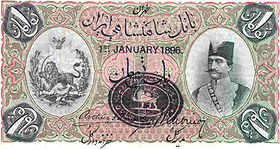 During the Safavid era, most of the territory of the Sassanid empire
regained its political unity, and Safavid kings were assuming the title of "Šāhanšāh-e Irān" (Iran's king of kings). An example is Mofid Bafqi (d. 1679) who makes numerous references to Iran, describing its border and nostalgia of Iranians that had migrated to India in that era. Even Ottoman sultans, when addressing the Āq Quyunlu and Safavid kings, used such titles as the “king of Iranian lands” or the “sultan of the lands of Iran” or “the king of kings of Iran, the lord of the Persians”. This title, as well as the title of "Šāh-e Irān", was later used by Nader Shah Afshar and Qajar
and Pahlavi
kings. Since 1935, the name "Iran" also has replaced other names of Iran in the western world. Jean Chardin
who travelled to Persian between 1673 to 1677 has observed that both Iran and Fars were used concurrently:
Since the Iranian Revolution
of 1979, the official name of the country is "Islamic Republic of Iran."
Iran
Iran , officially the Islamic Republic of Iran , is a country in Southern and Western Asia. The name "Iran" has been in use natively since the Sassanian era and came into use internationally in 1935, before which the country was known to the Western world as Persia...
derives immediately from Middle Persian
Middle Persian
Middle Persian , indigenously known as "Pârsig" sometimes referred to as Pahlavi or Pehlevi, is the Middle Iranian language/ethnolect of Southwestern Iran that during Sassanid times became a prestige dialect and so came to be spoken in other regions as well. Middle Persian is classified as a...
Ērān, Pahlavi ʼyrʼn, first attested in this form in the inscription that accompanies the investiture relief of Ardashir I
Ardashir I
Ardashir I was the founder of the Sassanid Empire, was ruler of Istakhr , subsequently Fars Province , and finally "King of Kings of Sassanid Empire " with the overthrow of the Parthian Empire...
at Naqsh-e Rustam
Naqsh-e Rustam
Naqsh-e Rustam also referred to as Necropolis is an archaeological site located about 12 km northwest of Persepolis, in Fars province, Iran. Naqsh-e Rustam lies a few hundred meters from Naqsh-e Rajab....
. In this inscription, the king's Middle Persian appellation is ardašīr šāhān šāh ērān (lit. "ardeshir king of kings of Eran") corresponding to the passage ardašīr šāhān šāh aryān (lit. ardashir king of kings of aryans) in the Parthian
Parthian language
The Parthian language, also known as Arsacid Pahlavi and Pahlavanik, is a now-extinct ancient Northwestern Iranian language spoken in Parthia, a region of northeastern ancient Persia during the rule of the Parthian empire....
inscription accompanying the Middle Persian one.
Etymology
The gentilicDemonym
A demonym , also referred to as a gentilic, is a name for a resident of a locality. A demonym is usually – though not always – derived from the name of the locality; thus, the demonym for the people of England is English, and the demonym for the people of Italy is Italian, yet, in english, the one...
ēr- and ary- (in e.g. ērān/aryān) in the Middle Iranian languages
Middle Iranian languages
Middle Iranian may refer to any of a group of the Indo-European Iranian languages spoken between the 4th century BC and the 9th century AD:Western:*Parthian *Middle Persian Eastern:*Bactrian*Aryan*Sogdian*Khwarezmian...
of Persian and Parthian derives from Old Iranian
Iranian languages
The Iranian languages form a subfamily of the Indo-Iranian languages which in turn is a subgroup of Indo-European language family. They have been and are spoken by Iranian peoples....
*arya- (in e.g. Old Persian: ariya-, Avestan: airiia-, etc.), meaning "Aryan
Aryan
Aryan is an English language loanword derived from Sanskrit ārya and denoting variously*In scholarly usage:**Indo-Iranian languages *in dated usage:**the Indo-European languages more generally and their speakers...
," in the sense of "of the Iranians." This word (i.e. *arya-) is attested as an ethnic designator in Achaemenid inscriptions and in Zoroastrianism's
Zoroastrianism
Zoroastrianism is a religion and philosophy based on the teachings of prophet Zoroaster and was formerly among the world's largest religions. It was probably founded some time before the 6th century BCE in Greater Iran.In Zoroastrianism, the Creator Ahura Mazda is all good, and no evil...
Avesta
Avesta
The Avesta is the primary collection of sacred texts of Zoroastrianism, composed in the Avestan language.-Early transmission:The texts of the Avesta — which are all in the Avestan language — were composed over the course of several hundred years. The most important portion, the Gathas,...
tradition, and in Middle Iranian era (ca. 400 BCE - 700 CE) it seems "very likely" that the word ērān in Ardashir's inscription still retained the same meaning as in the Old era, i.e. denoting the people rather than the empire while the empire was properly named as ērānšahr.
Notwithstanding this inscriptional use of ērān to refer to the Iranian peoples
Iranian peoples
The Iranian peoples are an Indo-European ethnic-linguistic group, consisting of the speakers of Iranian languages, a major branch of the Indo-European language family, as such forming a branch of Indo-European-speaking peoples...
, the use of ērān to refer to the empire (and the antonymic anērān to refer to the Roman territories) is also attested by the early Sassanid period. Both ērān and anērān appear in 3rd century calendrical text written by Mani
Mani (prophet)
Mani , of Iranian origin was the prophet and the founder of Manichaeism, a gnostic religion of Late Antiquity which was once widespread but is now extinct...
. In an inscription of Ardashir's son and immediate successor, Shapur I
Shapur I
Shapur I or also known as Shapur I the Great was the second Sassanid King of the Second Persian Empire. The dates of his reign are commonly given as 240/42 - 270/72, but it is likely that he also reigned as co-regent prior to his father's death in 242 .-Early years:Shapur was the son of Ardashir I...
"apparently includes in Ērān regions such as Armenia
Armenia
Armenia , officially the Republic of Armenia , is a landlocked mountainous country in the Caucasus region of Eurasia...
and the Caucasus
Caucasus
The Caucasus, also Caucas or Caucasia , is a geopolitical region at the border of Europe and Asia, and situated between the Black and the Caspian sea...
which were not inhabited predominantly by Iranians." In Kartir's
Kartir
Kartir Hangirpe was a highly influential Zoroastrian high-priest of the late 3rd century CE and served as advisor to at least three Sassanid emperors....
inscriptions (written thirty years after Shapur's), the high priest includes the same regions (together with Georgia, Albania, Syria and the Pontus) in his list of provinces of the antonymic Anērān. Ērān also features in the names of the towns founded by Sassanid dynasts, for instance in Ērān-xwarrah-šābuhr "Glory of Ērān (of) Shapur". It also appears in the titles of government officers, such as in Ērān-āmārgar "Accountant-General (of) Ērān" or Ērān-dibirbed "Chief Scribe (of) Ērān".
Shapur's trilingual inscription at Ka'ba-i Zartosht also introduces the term ērānšahr (
), "kingdom of the Iranians", that is however not attested in any other texts of this period other than in royal inscriptions (it is however preserved in post-Sassanid-era Zoroastrian texts). Because an equivalent of ērānšahr does not appear in Old Iranian (where it would have been *aryānām xšaθra- or in Old Persian *- xšaça-, "rule, reign, sovereignty"), the term is presumed to have been a Sassanid-era development. In the Greek portion of Shapur's trilingual inscription the word šahr "kingdom" appears as ethnous "nation". For speakers of Greek, the idea of an Iranian ethnous was not new: In the 1st century BCE, StraboStrabo
Strabo, also written Strabon was a Greek historian, geographer and philosopher.-Life:Strabo was born to an affluent family from Amaseia in Pontus , a city which he said was situated the approximate equivalent of 75 km from the Black Sea...
had noted a relationship between the various Iranian peoples and their languages: "[From] beyond the Indus [...] Ariana
Greater Iran
Greater Iran refers to the regions that have significant Iranian cultural influence. It roughly corresponds to the territory on the Iranian plateau and its bordering plains, stretching from Iraq, the Caucasus, and Turkey in the west to the Indus River in the east...
is extended so as to include some part of Persia, Media
Medes
The MedesThe Medes...
, and the north of Bactria
Bactria
Bactria and also appears in the Zend Avesta as Bukhdi. It is the ancient name of a historical region located between south of the Amu Darya and west of the Indus River...
and Sogdiana
Sogdiana
Sogdiana or Sogdia was the ancient civilization of an Iranian people and a province of the Achaemenid Empire, eighteenth in the list on the Behistun Inscription of Darius the Great . Sogdiana is "listed" as the second of the "good lands and countries" that Ahura Mazda created...
; for these nations speak nearly the same language." (Geography
Geographica (Strabo)
The Geographica , or Geography, is a 17-volume encyclopedia of geographical knowledge written in Greek by Strabo, an educated citizen of the Roman empire of Greek descent. Work can have begun on it no earlier than 20 BC...
, 15.2.1-15.2.8).
Usage in the medieval Islamic period
In the Persian literature in 9th-11th centuries, the territorial notions of “Iran,” are reflected in such terms as irānšahr and irānzamin. Contemporary notions of the name Iran began to be used in the SamanidSamanid
The Samani dynasty , also known as the Samanid Empire, or simply Samanids was a Persian state and empire in Central Asia and Greater Iran, named after its founder Saman Khuda, who converted to Sunni Islam despite being from Zoroastrian theocratic nobility...
and Safarid era. Such references to the contemporary Iranian kings, kingdoms, rulers, commanders, sages, and lands are found in several divāns of Persian poetry from this period. As an example, the Persian poet Rudaki
Rudaki
Abu Abdollah Jafar ibn Mohammad Rudaki , also written as Rudagi , was a Persian poet, and is regarded as the first great literary genius of the Modern Persian, who composed poems in the "New Persian" alphabet. Rudaki is considered as a founder of Persian classical literature.He was born in 858 in...
(d. 941), calls a Saffarid governor of Sistān a nobleman of the Sasanid stock and “pride of Iran” (mafḵar-e Irān) Furthermore, reference to the contemporary conception of “Iran” flourished under the early Ghaznavids.
During the Seljuq
Great Seljuq Empire
The Great Seljuq Empire was a medieval Persianate, Turko-Persian Sunni Muslim empire, originating from the Qynyq branch of Oghuz Turks. The Seljuq Empire controlled a vast area stretching from the Hindu Kush to eastern Anatolia and from Central Asia to the Persian Gulf...
era, the usage of the term "Iran" in Persian historiography declined. However, after the Mongol invasion and the fall of Abbasids, there was a new surge in using "Iran" and related terms. During Ilkhanids, prominent historians of the time , including Rashid-al-Din Fazl-Allah, were frequently using the terms "Iran" and "Irānzamin" both as historical notions and as contemporaneous entities (referring to the realm of Ilkhanids).
The name "Aria"(etymologically equivalent to Iran) is also attest in this period. Hamza Isfahani (894-970) in his book "history of the Prophets and Saints" mentions:Arian which is the same as Persia is situation in the middle of these six countries and these six countries form its borders. Its SE is China, its North is bordered by the lands of Turk, Its Southern Middle borders India, Its Northern Middle borders Byzantium, its SW borders Africa and its NW is in the hand of Berbers.
Hakim Meysari (born 935 A.D.) has written an important Persian treaty on medicine in verse. In the beginning of the book he writes:
The name was also used for inhabitants. For example Safi al-Din al-Urmawi, a famous Iranian musician is referred to by Qutb al-Din Shirazi ((1236–1311)) as the wise sage of Iran. According to the Encyclopedia of Islam on Safi al-Din al-Urmawi:.
Modern usage
Sassanid Empire
The Sassanid Empire , known to its inhabitants as Ērānshahr and Ērān in Middle Persian and resulting in the New Persian terms Iranshahr and Iran , was the last pre-Islamic Persian Empire, ruled by the Sasanian Dynasty from 224 to 651...
regained its political unity, and Safavid kings were assuming the title of "Šāhanšāh-e Irān" (Iran's king of kings). An example is Mofid Bafqi (d. 1679) who makes numerous references to Iran, describing its border and nostalgia of Iranians that had migrated to India in that era. Even Ottoman sultans, when addressing the Āq Quyunlu and Safavid kings, used such titles as the “king of Iranian lands” or the “sultan of the lands of Iran” or “the king of kings of Iran, the lord of the Persians”. This title, as well as the title of "Šāh-e Irān", was later used by Nader Shah Afshar and Qajar
Qajar dynasty
The Qajar dynasty was an Iranian royal family of Turkic descent who ruled Persia from 1785 to 1925....
and Pahlavi
Pahlavi dynasty
The Pahlavi dynasty consisted of two Iranian/Persian monarchs, father and son Reza Shah Pahlavi and Mohammad Reza Shah Pahlavi The Pahlavi dynasty consisted of two Iranian/Persian monarchs, father and son Reza Shah Pahlavi (reg. 1925–1941) and Mohammad Reza Shah Pahlavi The Pahlavi dynasty ...
kings. Since 1935, the name "Iran" also has replaced other names of Iran in the western world. Jean Chardin
Jean Chardin
Jean Chardin , born Jean-Baptiste Chardin, and also known as Sir John Chardin, was a French jeweller and traveller whose ten-volume book The Travels of Sir John Chardin is regarded as one of the finest works of early Western scholarship on Persia and the Near East.-Life and work:Chardin was born in...
who travelled to Persian between 1673 to 1677 has observed that both Iran and Fars were used concurrently:
Since the Iranian Revolution
Iranian Revolution
The Iranian Revolution refers to events involving the overthrow of Iran's monarchy under Shah Mohammad Reza Pahlavi and its replacement with an Islamic republic under Ayatollah Ruhollah Khomeini, the leader of the...
of 1979, the official name of the country is "Islamic Republic of Iran."
External links
- IRANIAN IDENTITY - ii. PRE-ISLAMIC PERIOD, Encyclopedia Iranica