
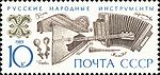
Ethnic Russian music specifically deals with the folk music traditions of the ethnic
Russian peopleThe Russian people are an East Slavic ethnic group native to Russia, speaking the Russian language and primarily living in Russia and neighboring countries....
. It does not include the various forms of art music, which in Russia often contains folk melodies and folk elements or music of aother ethnic groups living in Russia.
History
The roots of Russian folk music can be dated as far back as to the first millennium AD, when Slavic tribes first settled in the European part of what is presently Russia. In Greek chroniclas state that in 591 the
AvarAvar or Avars may refer to:* Eurasian Avars, a nomadic people that conquered the Hungarian Steppe in the early Middle Ages* Uar * Caucasian Avars, a modern people of the Caucasus** Avar language, the language of the Caucasian Avars...
khan sent Slav's were captured who had musical instruments (
kitharaThe kithara or cithara was an ancient Greek musical instrument in the lyre or lyra family. In modern Greek the word kithara has come to mean "guitar" ....
s often thought to be
gusli) players.
Ethnic styles in the Modern Era
The performance and promulgation of ethnic music in Russia has a long tradition. Initially it was intertwined with various forms of art music, however, in the late 19th century it began to take on a life of its own with the rise in popularity of folkloric ensembles, such as the folk choir movement led by
Mitrofan PyatnitskyMitrofan Yefimovich Pyatnitsky was a Russian and Soviet musician, gatherer of Russian folk songs. He established the famous Pyatnitsky Choir in 1910 from 18 peasants originally from the Voronezh, Ryazan and Smolensk gubernias. After his death in 1927, the chorus was named after him....
and the Russian folk instrument movement pioneered by Vasily Andreyev.
In
Soviet RussiaSoviet Russia usually refers to the Russian Soviet Federative Socialist Republic, one of the fifteen republics of the Soviet Union. It may also denote:* Soviet Russia , magazine of the Friends of Soviet Russia in the United States...
, folk music was categorized as being democratic (of the people) or proletarian (of the working class) as opposed to art music, which was often regarded as being bourgeois. After the revolution, along with Proletarian "mass music" (music for the proletarian masses) it received significant support from the state. In Post
World War IIWorld War II, or the Second World War , was a global conflict lasting from 1939 to 1945, involving most of the world's nations—including all of the great powers—eventually forming two opposing military alliances: the Allies and the Axis...
Russia, Proletarian mass music however lost its appeal, whereas folkloric music continued to have a widespread support among the population, inside and outside of the Soviet Union. However the authentic nature of folk music was severely distorted by the Stalinist drive to 'professionalise' performers, regardless of the genre they worked in: thus all folk singers were obliged to both learn Western-style classical notation, and to learn to perform classical repertoire - or else risk losing their right to perform as 'professionals'.
In the 1960s folk music in Russia continued to receive significant state support and was often seen as the antithesis of Western
pop musicPop music is usually understood to be commercially recorded music, often oriented toward a youth market, usually consisting of relatively short, simple songs utilizing technological innovations to produce new variations on existing themes.- Definitions :David Hatch and Stephen Millward define pop...
. The fact that numerous Soviet folkloric ensembles were invited for foreign tours raised the prestige of the folk performer to that of academic musicians, and in some cases even higher because access to the West and Western goods was very desirable.
Ethnic (folk) music in Russia can often be categorized according to the amount of authenticity in the performance: truly authentic folk music (reproductive performances of traditional music), folkloric and fakeloric performance.
Russia is a multi-ethnic country with some 300 different ethnic groups, many of them non-Slavic, living within its borders. This article deals specifically with just Russian ethnic music.
Authentic folk music
This music is closely tied in with the village life and traditions. It was usually not performed by music professionals. From the Central Committee's resolution of 1932, which prescribed musical literacy (in parallel to the drive to industrialise the Soviet Union), there has been a marked decline in authentic folk performance practice. Festivals, competitions and the work of
ethnomusicologistsEthnomusicology is defined as "the study of social and cultural aspects of music and dance in local and global contexts."Coined by the musician Jaap Kunst from the Greek words ἔθνος ethnos and μουσική mousike , it is often considered the anthropology or ethnography of music...
have made attempts at preserving what has survived. In recent times there has been a movement by musicologists to study and reproduce authentic folk music in an authentic performance style on the concert stage. This movement in Russia is spearheaded by members of the Faculty of folk music at the
Moscow conservatoryThe Moscow Conservatory is a higher musical education institution in Moscow, and the second oldest conservatory in Russia after St. Petersburg Conservatory. Along with the St...
under the direction of
Dmitri PokrovskyDmitri Viktorovich Pokrovsky was a Russian folk music researcher and musician best known for his efforts to rediscover authentic, often near extinct rural musical traditions, from many different regions of Russia and re-enacting them with the Dmitri Pokrovsky Ensemble.-Biography:In the early...
Folkloric music
This category includes music by groups led by music professionals, past and present, who have taken authentic musical material, and then arranged and performed it in a manner formulated by Vasily Andreyev and subsequently refined under Stalin's regime, yet widely accepted as 'authentically Russian' by Western audiences (conditioned, for instance, by performances by the Red Army Song and Dance Ensemble). The category includes many of the regional folkloric ensembles and dance companies popular in the Russian Federation. Often these folkloric ensembles specialize in collecting and maintaining the folk music traditions of the area of their origins which they service. They perform in stylized stage costumes based on the authentic costume designs used in the village but modified for stage use. Most inauthentic - but widespread - was the practice of performing so-called Cossack prisiadki (low-squatting dances) in perfect synchronization; as Professor Laura J. Olson observes, 'this situation did not reflect actual Cossack traditions so much as it borrowed from the traditions of Russian ballet that dated to the late nineteenth century'.
Fakeloric music
Includes music composed by city intelligentsia and professional composers in a folkloric manner. Some 60-80% of contemporary Russian folk music marketed to the West is not "authentic" and can be loosely labeled as
FakeFake means not real.Fake may also refer to:In music:* Fake , a Swedish synthpop band active in the 1980s*Fake?, a Japanese rock band* Fake , 2010 song by Ai featuring Namie Amuro...
loric. Much of the music of the Russian folk instrument orchestras can also be categorized in this group as it is based on academic music traditions and playing techniques only taking a folk element as its inspiration.
In recent times music professionals who have completed diplomas in noted conservatories performing on Russian folk instruments are now questioning their "folkiness" when they perform, as none of their music was never really performed originally by the (village) folk. Some now refer to their music as being academic folk music which to many academic musicians is an
oxymoronAn oxymoron is a figure of speech that combines contradictory terms...
.
This category can also include singer songwriters such as
Zhanna BichevskayaZhanna Vladimirovna Bichevskaya , is a prominent Soviet and Russian bard and folk musician.She was born in Moscow and in 1971 she graduated from the Moscow Circus and Performing Arts School...
,
Bulat OkudzhavaBulat Shalvovich Okudzhava was a Soviet and Russian poet, writer, musician, novelist, and singer-songwriter. He was one of the founders of the Russian genre called "author song"...
, and
Vladimir VysotskyVladimir Semyonovich Vysotsky was a Soviet singer, songwriter, poet, and actor whose career had an immense and enduring effect on Russian culture. He became widely known for his unique singing style and for his lyrics, which featured social and political commentary in often humorous street...
who are often inaccurately portrayed as "folk singers" in the singer songwriter style reminiscent of the American folk revival of the 60's.
Vocal music
Authentic Russian folk music is primarily vocal. Russian folk song was an integral part of daily life in the village. It was sung from morning to night and reflected the four seasons and significant events in a villager's life. Its roots are in the orthodox church services where significant parts are sung. Most of the population was also illiterate and poverty stricken meaning that resources for instruments could not be had and notation of any kind, which is more relevant for instrumentals than for vocals, could not be read.
Authentic village singing differs from academic singing styles. It is usually done using just the chest register and is often called "white sound" or "white" voice. It is often described as controlled screaming or shouting. Female chest register singers only have a low diapason of an octave to 12 notes.
Chest register singing has evolved into a style used by many of the Folk Choirs in Russia and neighbouring countries. It was first pioneered by Pyatnitsky and Ukrainian folk choir director Demutsky in the early 1900s.
Notable ensembles include: The Pyatnitsky Russian Folk Chorus, The Northern Russian Folk Chorus, The Omsk State Russian Folk Chorus, The Alexandrov Song and Dance Ensemble of the Soviet Army and the Moscow Military Area Song and Dance Ensemble.
Instrumental music
Instrumental music for a long period was suppressed in Russia. In 1648 Tsar
Alexis I of RussiaAleksey Mikhailovich Romanov was the Tsar of Russia during some of the most eventful decades of the mid-17th century...
under the influence of then-prevalent views in the
Russian Orthodox ChurchThe Russian Orthodox Church or, alternatively, the Moscow Patriarchate The ROC is often said to be the largest of the Eastern Orthodox churches in the world; including all the autocephalous churches under its umbrella, its adherents number over 150 million worldwide—about half of the 300 million...
banned the use of all musical instruments. At that time it was stated that instruments were from the devil. Not easily verifyable today, but some historians also believe that travelling minstrels singing disrespectful songs about the Tsar to balalaika accompaniment, could have been the real reason. As a result of the ban, instrumental music traditions disappeared and did not have a fertile ground for development in Russia for many years. No musical instruments are used in Orthodox churches (in Russia).
In the late 19th century
Vasily AndreyevVasily Vasilievich Andreyev was a Russian musician responsible for the modern development of the balalaika and several other traditional Russian folk music instruments, and is considered the father of the academic folk instrument movement in Eastern Europe. His accomplishments included:*...
, a salon violinist, took up the
balalaikaThe balalaika is a stringed musical instrument popular in Russia, with a characteristic triangular body and three strings.The balalaika family of instruments includes instruments of various sizes, from the highest-pitched to the lowest, the prima balalaika, secunda balalaika, alto balalaika, bass...
in his performances for French tourists to Petersburg. The music became popular and soon Andreyev had organized a club of balalaika players. This club grew into an orchestra, which in time grew into a movement.
From a simple unsophisticated three stringed instrument, combined with an awakening 'Russianness' in the last phases of the Tsarist Empire, the movement led to the development and implementation of many other Russian folk instruments.
The Russian folk instrument movement had its resonance in the cultures of other ethnic groups within Russia, the
Soviet UnionThe Soviet Union , officially the Union of Soviet Socialist Republics , was a constitutionally socialist state that existed in Eurasia between 1922 and 1991....
and the Soviet Block countries. Folk instrument orchestras appeared in
BelarusBelarus , officially the Republic of Belarus, is a landlocked country in Eastern Europe, bordered clockwise by Russia to the northeast, Ukraine to the south, Poland to the west, and Lithuania and Latvia to the northwest. Its capital is Minsk; other major cities include Brest, Grodno , Gomel ,...
,
UkraineUkraine is a country in Eastern Europe. It has an area of 603,628 km², making it the second largest contiguous country on the European continent, after Russia...
,
KyrgyzstanKyrgyzstan , officially the Kyrgyz Republic is one of the world's six independent Turkic states . Located in Central Asia, landlocked and mountainous, Kyrgyzstan is bordered by Kazakhstan to the north, Uzbekistan to the west, Tajikistan to the southwest and China to the east...
,
YugoslaviaYugoslavia refers to three political entities that existed successively on the western part of the Balkans during most of the 20th century....
,
BulgariaBulgaria , officially the Republic of Bulgaria , is a parliamentary democracy within a unitary constitutional republic in Southeast Europe. The country borders Romania to the north, Serbia and Macedonia to the west, Greece and Turkey to the south, as well as the Black Sea to the east...
,
MoldaviaMoldavia is a geographic and historical region and former principality in Eastern Europe, corresponding to the territory between the Eastern Carpathians and the Dniester river...
, and
RomaniaRomania is a country located at the crossroads of Central and Southeastern Europe, on the Lower Danube, within and outside the Carpathian arch, bordering on the Black Sea...
.
Chordophones
- Balalaika
The balalaika is a stringed musical instrument popular in Russia, with a characteristic triangular body and three strings.The balalaika family of instruments includes instruments of various sizes, from the highest-pitched to the lowest, the prima balalaika, secunda balalaika, alto balalaika, bass...
, a three-stringed, triangular sound-board, played with the fingers. It comes in many different sizes. Prima, Secunda, Alto, tenor, bass and contrabass). Two of the strings are tuned alike in prima, secunda and alto balalaikas while the basses are tuned E-A-D (highest).

- Domra
The domra is a long-necked Russian string instrument of the lute family with a round body and three or four metal strings.-History:In 1896, a student of Vasily Vasilievich Andreyev found a broken instrument in a stable in rural Russia...
, small three or four-stringed Russian variant of the mandolinA mandolin is a musical instrument in the lute family . It descends from the mandore, a soprano member of the lute family. The mandolin soundboard comes in many shapes—but generally round or teardrop-shaped, sometimes with scrolls or other projections. A mandolin may have f-holes, or a single...
with a rounded soundboard, plucked or strummed with a plectrumA plectrum is a small flat tool used to pluck or strum a stringed instrument. For hand-held instruments such as guitars and mandolins, the plectrum is often called a pick, and is a separate tool held in the player's hand...
. Also made in various orchestral sizes. Originally they were all three-stringed (E-A-D). The four-string variety was developed by in the early 20th century and became popular in Ukraine.
- Gudok
The gudok or hudok is an ancient Eastern Slavic string musical instrument, played with a bow.A gudok usually had three strings, two of them tuned in unison and played as a drone, the third tuned a fifth higher. All three strings were in the same plane at the bridge, so that a bow could make them...
(also hudok), a three-stringed, pear-shaped Russian bowed instrument tuned in 5th which is usually held vertically.

- Gusli, one of the oldest known Eastern Slav musical instruments, described by the Greeks as early as the 6th century AD. Many different varieties of this plucked string instrument exist.
- Kolyosnaya lira
The kolisna lira , is a Ukrainian variation of the hurdy gurdy - came to Ukraine from Western Europe, has one melodic string, which is shorten by keys and few other strings which are tuned in definite note, sound comes from the friction of wooden wheel against the strings.-History:The kolisna lira...
, a Russian version of the hurdy-gurdy usually made with a violoncello body.
- Semistrunnaya gitara (Semistrunka)
The Russian guitar is a seven-string acoustic guitar that arrived in Russia toward the end of the 18th century and the beginning of the 19th century, most probably as an evolution of the cittern, kobza, and torban...
, a seven string version of the acoustic guitar with its own preferred method of construction and unique open G major tuning.
Aerophones
- Bayan
The bayan is a type of chromatic button accordion developed in Russia in the early 20th century and named after 11th-century bard Boyan.-Characteristics:The bayan differs from western chromatic button accordions in some details of construction:...
, a chromatic button accordionA chromatic button accordion is a type of button accordion where the melody-side keyboard consists of rows of buttons arranged chromatically. The bass-side keyboard is usually the Stradella system or one of the various free-bass systems. Included among chromatic button accordions are the Russian...
- Garmon, a kind of diatonic Russian button accordion
A button accordion is a type of accordion on which the melody-side keyboard consists of a series of buttons rather than piano-style keys. There exists a wide variation in keyboard systems, tuning, action and construction of these instruments...
, featuring a unique unisonoric design.
- Kalyuki , a hollow pipe with no additional air holes, used for whistling sounds.
- Kugikli/Kuvikly , simple panpipes
- Svirel
Svirel is an old folk Russian wind instrument of the end-blown flute type. In the Old Rus’ this instrument was made either of hollow reed or cylindrical wood branches. A legend says that Lel', son of the Slavic goddess of love Lada was a svirel player. In spring he would make his svirel of birch...
, a Russian flute
- Vladimirsky rozhok, made in Russia's Vladimir Oblast
Vladimir Oblast is a federal subject of Russia . Its administrative center is the city of Vladimir, which is located east of Moscow...
by shepherds who composed melodious calls on it. This horn has a range of two octaves and a very distinctive idiosyncratic sound.
- Volynka
Volyňka is a river in the Czech Republic in the South Bohemian Region rising on the hill called Světlá hora and flowing 46.1 km northeast to city of Strakonice, where merging in Otava River. Volyňka flows through towns such Vimperk, Volyně, Strakonice. and villages such as Lčovice and Čkyně. -...
, a traditional SlavicThe Slavic people are an Indo-European panethnicity living in Eastern Europe, Southeast Europe, North Asia and Central Asia. The term Slavic represents a broad ethno-linguistic group of people, who speak languages belonging to the Slavic language family and share, to varying degrees, certain...
bagpipe.
- Zhaleika
The zhaleika is a Russian single-reed hornpipe. It is the most popular Russian folk wind instrument.-External links:*...
, a Russian folk clarinetThe clarinet is a musical instrument of woodwind type. The name derives from adding the suffix -et to the Italian word clarino , as the first clarinets had a strident tone similar to that of a trumpet. The instrument has an approximately cylindrical bore, and uses a single reed...
/hornpipeThe hornpipe can refer to a specific instrument or a class of woodwind instruments consisting of a single reed, a small diameter melody pipe with finger holes and a bell traditionally made from animal horn...
Idiophones
- Buben, an equivalent of the tambourine
The tambourine or marine is a musical instrument of the percussion family consisting of a frame, often of wood or plastic, with pairs of small metal jingles, called "zils". Classically the term tambourine denotes an instrument with a drumhead, though some variants may not have a head at all....
- Bubentsy
- Kokshnik
- Korobochka, an equivalent of the wood block
A woodblock is essentially a small piece of slit drum made from a single piece of wood and used as a percussion instrument. It is struck with a stick, making a characteristically percussive sound....
- Lozhki, an equivalent of spoons
Spoons can be played as a makeshift percussion instrument, or more specifically, an idiophone related to the castanets. "Playing the spoons" originated in Ireland as "playing the bones," in which the convex sides of a pair of sheep rib bones were rattled in the same way.- Techniques :# A pair of...
- Rubel
A washboard is a tool designed for hand washing clothing. With mechanized cleaning of clothing becoming more common by the end of the 20th century, the washboard has become better known for its originally subsidiary use as a musical instrument....
, an equivalent of the washboardA washboard is a tool designed for hand washing clothing. With mechanized cleaning of clothing becoming more common by the end of the 20th century, the washboard has become better known for its originally subsidiary use as a musical instrument....
- Treshchotka
Treshchotka [singular] sometimes referred as Treshchotki [plural] is an Russian folk music idiophone instrument which is used to imitate hand clapping.-Treshchotka :...
, an equivalent of the clapperA clapper is a basic form of percussion instrument. It consists of two long solid pieces that are clapped together producing sound. A straightforward instrument to produce and play, they exist in many forms in many different cultures around the world. Clappers can take a number of forms and be made...
.
- Zvonchalka
External links