


Ethernet crossover cable

Encyclopedia
An Ethernet crossover cable is a type of Ethernet
cable used to connect computing devices together directly. Normal straight through or patch cables were used to connect from a host network interface controller (a computer or similar device) to a network switch
, hub or router.
A cable with connections that "cross over" was used to connect two devices of the same type: two hosts or two switches to each other.
Owing to the inclusion of Auto-MDIX capability, modern implementations of the Ethernet over twisted pair
standards usually no longer require the use of crossover cables.
 The 10BASE-T
and 100BASE-TX Ethernet standards use one wire pair for transmission in each direction.
By convention, one wire of the pair is designated "+" and the other "-". Following traditional telephone
terminology, the + signal from each pair connects to the tip conductor, and the - signal is connected to the ring conductor.
This requires that the transmit pair of each device be connected to the receive pair of the device on the other end. When a terminal
device is connected to a switch or hub, this crossover is done internally in the switch or hub. A standard straight through cable is used for this purpose where each pin of the connector on one end is connected to the corresponding pin on the other connector.
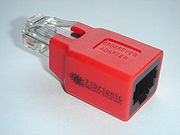
One network interface controller may be connected directly to another without the use of a switch or hub, but in that case the crossover must be done externally in the cable or modular crossover adapter in a manner similar to how the null modem
was used to directly connect two teleprinter
s. Since 10BASE-T and 100BASE-TX use pairs 2 and 3, these two pairs must be swapped in the cable. This is a crossover cable. A crossover cable was also used to connect two hubs or two switches on their upstream
ports .
Because the only difference between the T568A and T568B pin/pair assignments are that pairs 2 and 3 are swapped, a crossover cable may be envisioned as a cable with one modular connector
following T568A and the other T568B (see Jack crossover wiring). Such a cable will work for 10BASE-T or 100BASE-TX. Gigabit Ethernet
(and an early Fast Ethernet
variant, 100BASE-T4) use all four pairs and also requires the other two pairs (1 and 4) to be swapped.
This meant common crossover cables available in the retail market were usually not compatible with the Gigabit Ethernet convention, but newer crossover cables could be made that worked for all speeds.
The polarity of each pair is not swapped, but the pairs crossed as a unit: the two wires within each pair are not crossed.
Although the Gigabit crossover is defined in the Gigabit Ethernet standard, in practice all Gigabit PHYs feature an auto-MDIX capability and are designed for compatibility with the existing 100BASE-TX crossovers. The IEEE-specified Gigabit crossover is generally seen as unnecessary.
Certain equipment or installations, including those in which phone and/or power are mixed with data in the same cable, may require that the "non-data" pairs 1 and 4 (pins 4, 5, 7 and 8) remain un-crossed.
Although Auto-MDIX was specified as an optional feature in the 1000BASE-T standard
, in practice it is implemented widely on most interfaces.
It has been available for example on Apple Inc. computers since about the Power Mac G5
.
Besides the eventually agreed upon Automatic MDI/MDI-X, this feature may also be referred to by various vendor-specific terms including: Auto uplink and trade, Universal Cable Recognition and Auto Sensing.
Ethernet
Ethernet is a family of computer networking technologies for local area networks commercially introduced in 1980. Standardized in IEEE 802.3, Ethernet has largely replaced competing wired LAN technologies....
cable used to connect computing devices together directly. Normal straight through or patch cables were used to connect from a host network interface controller (a computer or similar device) to a network switch
Network switch
A network switch or switching hub is a computer networking device that connects network segments.The term commonly refers to a multi-port network bridge that processes and routes data at the data link layer of the OSI model...
, hub or router.
A cable with connections that "cross over" was used to connect two devices of the same type: two hosts or two switches to each other.
Owing to the inclusion of Auto-MDIX capability, modern implementations of the Ethernet over twisted pair
Ethernet over twisted pair
Ethernet over twisted pair technologies use twisted-pair cables for the physical layer of an Ethernet computer network. Other Ethernet cable standards employ coaxial cable or optical fiber. Early versions developed in the 1980s included StarLAN followed by 10BASE-T. By the 1990s, fast, inexpensive...
standards usually no longer require the use of crossover cables.
Overview
10BASE-T
Ethernet over twisted pair technologies use twisted-pair cables for the physical layer of an Ethernet computer network. Other Ethernet cable standards employ coaxial cable or optical fiber. Early versions developed in the 1980s included StarLAN followed by 10BASE-T. By the 1990s, fast, inexpensive...
and 100BASE-TX Ethernet standards use one wire pair for transmission in each direction.
By convention, one wire of the pair is designated "+" and the other "-". Following traditional telephone
TRS connector
A TRS connector is a common family of connector typically used for analog signals including audio. It is cylindrical in shape, typically with three contacts, although sometimes with two or four . It is also called an audio jack, phone jack, phone plug, and jack plug...
terminology, the + signal from each pair connects to the tip conductor, and the - signal is connected to the ring conductor.
This requires that the transmit pair of each device be connected to the receive pair of the device on the other end. When a terminal
Terminal (telecommunication)
In the context of telecommunications, a terminal is a device which is capable of communicating over a line. Examples of terminals are telephones, fax machines, and network devices - printers and workstations....
device is connected to a switch or hub, this crossover is done internally in the switch or hub. A standard straight through cable is used for this purpose where each pin of the connector on one end is connected to the corresponding pin on the other connector.
One network interface controller may be connected directly to another without the use of a switch or hub, but in that case the crossover must be done externally in the cable or modular crossover adapter in a manner similar to how the null modem
Null modem
Null modem is a communication method to connect two DTEs directly using an RS-232 serial cable. The name stems from the historical use of the RS-232 cable to connect two teleprinter devices to modems in order to communicate with one another; null modem communication was possible by instead using...
was used to directly connect two teleprinter
Teleprinter
A teleprinter is a electromechanical typewriter that can be used to communicate typed messages from point to point and point to multipoint over a variety of communication channels that range from a simple electrical connection, such as a pair of wires, to the use of radio and microwave as the...
s. Since 10BASE-T and 100BASE-TX use pairs 2 and 3, these two pairs must be swapped in the cable. This is a crossover cable. A crossover cable was also used to connect two hubs or two switches on their upstream
Upstream (networking)
In computer networking, upstream refers to the direction in which data can be transferred from the client to the server . This differs greatly from downstream not only in theory and usage, but also in that upstream speeds are usually at a premium...
ports .
Because the only difference between the T568A and T568B pin/pair assignments are that pairs 2 and 3 are swapped, a crossover cable may be envisioned as a cable with one modular connector
Modular connector
Modular connector is the name given to a family of electrical connectors originally used in telephone wiring and now used for many other purposes. Many applications that originally used a bulkier, more expensive connector have now migrated to modular connectors...
following T568A and the other T568B (see Jack crossover wiring). Such a cable will work for 10BASE-T or 100BASE-TX. Gigabit Ethernet
Gigabit Ethernet
Gigabit Ethernet is a term describing various technologies for transmitting Ethernet frames at a rate of a gigabit per second , as defined by the IEEE 802.3-2008 standard. It came into use beginning in 1999, gradually supplanting Fast Ethernet in wired local networks where it performed...
(and an early Fast Ethernet
Fast Ethernet
In computer networking, Fast Ethernet is a collective term for a number of Ethernet standards that carry traffic at the nominal rate of 100 Mbit/s, against the original Ethernet speed of 10 Mbit/s. Of the fast Ethernet standards 100BASE-TX is by far the most common and is supported by the...
variant, 100BASE-T4) use all four pairs and also requires the other two pairs (1 and 4) to be swapped.
This meant common crossover cables available in the retail market were usually not compatible with the Gigabit Ethernet convention, but newer crossover cables could be made that worked for all speeds.
The polarity of each pair is not swapped, but the pairs crossed as a unit: the two wires within each pair are not crossed.
Crossover cable pinouts
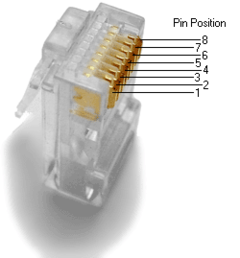
In practice, it does not matter if non-crossover Ethernet cables are wired as T568A or T568B, just so long as both ends follow the same wiring format. Typical commercially available "pre-wired" cables can follow either format depending the manufacturer. What this means is that one manufacturer's cables are wired one way and another's the other way, yet both are correct and will work. In either case, T568A or T568B, a normal (un-crossed) cable will have both ends wired according to the layout in the Connection 1 column.Although the Gigabit crossover is defined in the Gigabit Ethernet standard, in practice all Gigabit PHYs feature an auto-MDIX capability and are designed for compatibility with the existing 100BASE-TX crossovers. The IEEE-specified Gigabit crossover is generally seen as unnecessary.
Certain equipment or installations, including those in which phone and/or power are mixed with data in the same cable, may require that the "non-data" pairs 1 and 4 (pins 4, 5, 7 and 8) remain un-crossed.
| Pin | Connection 1: T568A |
Connection 2: T568B |
Pins on plug face | ||||
|---|---|---|---|---|---|---|---|
| signal | pair | color | signal | pair | color | ||
| 1 | BI_DA+ | 3 |  |
BI_DB+ | 2 |  |
 |
| 2 | BI_DA- | 3 |  |
BI_DB- | 2 |  |
|
| 3 | BI_DB+ | 2 | |
BI_DA+ | 3 | |
|
| 4 | 1 |  |
1 | |
|||
| 5 | 1 |  |
1 | |
|||
| 6 | BI_DB- | 2 | |
BI_DA- | 3 | |
|
| 7 | 4 |  |
4 | |
|||
| 8 | 4 |  |
4 | |
| Pin | Connection 1: T568A | Connection 2: T568A Crossed | Pins on plug face | ||||
|---|---|---|---|---|---|---|---|
| signal | pair | color | signal | pair | color | ||
| 1 | BI_DA+ | 3 | |
BI_DB+ | 2 | |
|
| 2 | BI_DA- | 3 | |
BI_DB- | 2 | |
|
| 3 | BI_DB+ | 2 | |
BI_DA+ | 3 | |
|
| 4 | BI_DC+ | 1 | |
BI_DD+ | 4 | |
|
| 5 | BI_DC- | 1 | |
BI_DD- | 4 | |
|
| 6 | BI_DB- | 2 | |
BI_DA- | 3 | |
|
| 7 | BI_DD+ | 4 | |
BI_DC+ | 1 | |
|
| 8 | BI_DD- | 4 | |
BI_DC- | 1 | |
| Pin | Connection 1: T568B | Connection 2: T568B Crossed | Pins on plug face | ||||
|---|---|---|---|---|---|---|---|
| signal | pair | color | signal | pair | color | ||
| 1 | BI_DA+ | 2 | |
BI_DB+ | 3 | |
|
| 2 | BI_DA- | 2 | |
BI_DB- | 3 | |
|
| 3 | BI_DB+ | 3 | |
BI_DA+ | 2 | |
|
| 4 | BI_DC+ | 1 | |
BI_DD+ | 4 | |
|
| 5 | BI_DC- | 1 | |
BI_DD- | 4 | |
|
| 6 | BI_DB- | 3 | |
BI_DA- | 2 | |
|
| 7 | BI_DD+ | 4 | |
BI_DC+ | 1 | |
|
| 8 | BI_DD- | 4 | |
BI_DC- | 1 | |
Automatic crossover
If one of two connected devices has the automatic MDI/MDI-X configuration feature there is no need for crossover cables. Introduced in 1998, this made the distinction between uplink and normal ports and manual selector switches on older hubs and switches obsolete.Although Auto-MDIX was specified as an optional feature in the 1000BASE-T standard
Gigabit Ethernet
Gigabit Ethernet is a term describing various technologies for transmitting Ethernet frames at a rate of a gigabit per second , as defined by the IEEE 802.3-2008 standard. It came into use beginning in 1999, gradually supplanting Fast Ethernet in wired local networks where it performed...
, in practice it is implemented widely on most interfaces.
It has been available for example on Apple Inc. computers since about the Power Mac G5
Power Mac G5
The Power Mac G5 is Apple's marketing name for models of the Power Macintosh that contains the IBM PowerPC G5 CPU. The professional-grade computer was the most powerful in Apple's lineup when it was introduced, widely hailed as the first 64-bit PC, and was touted by Apple as the fastest personal...
.
Besides the eventually agreed upon Automatic MDI/MDI-X, this feature may also be referred to by various vendor-specific terms including: Auto uplink and trade, Universal Cable Recognition and Auto Sensing.
See also
- Crossover cableCrossover cableA crossover cable connects two devices of the same type, for example DTE-DTE or DCE-DCE, usually connected asymmetrically , by a modified cable called a crosslink...
- Jack crossover wiring
- Registered jackRegistered jackA registered jack is a standardized physical network interface — both jack construction and wiring pattern — for connecting telecommunications or data equipment to a service provided by a local exchange carrier or long distance carrier. The standard designs for these connectors and their wiring...
, which expands on the introduction and evolution of these connectors.