

Estivation

Encyclopedia
Aestivation is a state of animal dormancy
, characterized by inactivity and a lowered metabolic rate, that is entered in response to high temperatures and arid conditions. It takes place during times of heat and dryness, the hot dry season, which is often but not necessarily the summer months.
Invertebrate and vertebrate animals are known to enter this state to avoid damage from high temperatures and the risk of desiccation
. Both terrestrial and aquatic animals undergo aestivation.
: Some air-breathing land snail
s, including species in the genera Helix, Cernuella
, Theba
, Helicella
, Achatina
and Otala
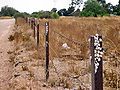
, commonly aestivate during periods of heat. Some species move into shaded vegetation or rubble. Others climb up tall plants, including crop species as well as bushes and trees, and will also climb man-made structures such as posts, fences, etc.
The habit of climbing vegetation to aestivate has caused more than one introduced snail species to be declared an agricultural nuisance.
To seal the opening to their shell to prevent water loss, pulmonate land snails secrete a membrane of dried mucus called an epiphragm
. In certain species, such as Helix pomatia
, this barrier is reinforced with calcium carbonate, and thus it superficially resembles an operculum
, except that it has a tiny hole to allow some oxygen exchange.
There is decrease in metabolic rate and reducing rate of water loss in estivating snails like Rhagada tescorum, Sphincterochila boissieri
and others.
) have been reported to aestivate.
Crustacea: Many land crabs spend dry seasons in an inactive state at the bottom of their burrows.
, crocodile
s, salamander
. Some amphibians (e.g. the cane toad
and greater siren
) aestivate during the hot dry season by moving underground where it is cooler and more humid. The California red-legged frog
may aestivate to conserve energy when its food and water supply is low.
The Water-holding Frog
has an aestivation cycle. It buries itself in sandy ground in a secreted, water-tight, mucus cocoon during periods of hot, dry weather. Australian Aborigines
discovered a means to take advantage of this by digging up one of these frogs and gently squeezing it, causing the frog to release some of the fresh water it stores for itself in its bladder and skin pockets. This water can be drunk by the Aborigine, who then releases the frog.
African lungfish also aestivate.
, Germany
, and coworkers presented evidence in the 24 June 2004 edition of Nature
that the Malagasy
fat-tailed dwarf lemur
hibernates or aestivates in a small cricket hollow for seven months of the year.
Dormancy
Dormancy is a period in an organism's life cycle when growth, development, and physical activity are temporarily stopped. This minimizes metabolic activity and therefore helps an organism to conserve energy. Dormancy tends to be closely associated with environmental conditions...
, characterized by inactivity and a lowered metabolic rate, that is entered in response to high temperatures and arid conditions. It takes place during times of heat and dryness, the hot dry season, which is often but not necessarily the summer months.
Invertebrate and vertebrate animals are known to enter this state to avoid damage from high temperatures and the risk of desiccation
Desiccation
Desiccation is the state of extreme dryness, or the process of extreme drying. A desiccant is a hygroscopic substance that induces or sustains such a state in its local vicinity in a moderately sealed container.-Science:...
. Both terrestrial and aquatic animals undergo aestivation.
Invertebrates
Molluscs
GastropodaGastropoda
The Gastropoda or gastropods, more commonly known as snails and slugs, are a large taxonomic class within the phylum Mollusca. The class Gastropoda includes snails and slugs of all kinds and all sizes from microscopic to quite large...
: Some air-breathing land snail
Snail
Snail is a common name applied to most of the members of the molluscan class Gastropoda that have coiled shells in the adult stage. When the word is used in its most general sense, it includes sea snails, land snails and freshwater snails. The word snail without any qualifier is however more often...
s, including species in the genera Helix, Cernuella
Cernuella
Cernuella is a genus of small air-breathing land snails, pulmonate gastropod mollusks in the family Hygromiidae, the hairy snails and their allies...
, Theba
Theba
Theba is a taxonomic genus of air-breathing land snails, medium-sized pulmonate gastropod mollusks in the family Helicidae, the true snails.Theba is the type genus of the tribe Thebini....
, Helicella
Helicella
Helicella is a genus of small to medium-sized, air-breathing land snails, terrestrial pulmonate gastropod mollusks in the family Hygromiidae, the hairy snails and their allies.-Species:Species within the genus Helicella include:...
, Achatina
Achatina
Achatina is a genus of medium-sized to very large, air-breathing, tropical land snails, terrestrial pulmonate gastropod mollusks in the family Achatinidae.-Distribution:There are some 200 species of Achatinidae in Sub-Saharan Africa...
and Otala
Otala
Otala is a genus of large air-breathing land snails, terrestrial pulmonate gastropod mollusks in the family Helicidae. Archaeological recovery in Morocco indicates the exploitation of this genus by ancient Romans.-Distribution:...
, commonly aestivate during periods of heat. Some species move into shaded vegetation or rubble. Others climb up tall plants, including crop species as well as bushes and trees, and will also climb man-made structures such as posts, fences, etc.
The habit of climbing vegetation to aestivate has caused more than one introduced snail species to be declared an agricultural nuisance.
To seal the opening to their shell to prevent water loss, pulmonate land snails secrete a membrane of dried mucus called an epiphragm
Epiphragm
An epiphragm is a temporary structure which can be created by many species of shelled, air-breathing land snails, terrestrial pulmonate gastropod mollusks. It can also be created by freshwater snails when temporary pools dry up....
. In certain species, such as Helix pomatia
Helix pomatia
Helix pomatia, common names the Burgundy snail, Roman snail, edible snail or escargot, is a species of large, edible, air-breathing land snail, a terrestrial pulmonate gastropod mollusk in the family Helicidae...
, this barrier is reinforced with calcium carbonate, and thus it superficially resembles an operculum
Operculum (gastropod)
The operculum, meaning little lid, is a corneous or calcareous anatomical structure which exists in many groups of sea snails and freshwater snails, and also in a few groups of land snails...
, except that it has a tiny hole to allow some oxygen exchange.
There is decrease in metabolic rate and reducing rate of water loss in estivating snails like Rhagada tescorum, Sphincterochila boissieri
Sphincterochila boissieri
Sphincterochila boissieri is a species of air-breathing land snail, a terrestrial pulmonate gastropod mollusk in the family Sphincterochilidae...
and others.
Arthropods
Insecta: Lady beetles (CoccinellidaeCoccinellidae
Coccinellidae is a family of beetles, known variously as ladybirds , or ladybugs . Scientists increasingly prefer the names ladybird beetles or lady beetles as these insects are not true bugs...
) have been reported to aestivate.
Crustacea: Many land crabs spend dry seasons in an inactive state at the bottom of their burrows.
Reptiles and amphibians
Non-mammalian animals that aestivate include North American desert tortoisesDesert Tortoise
The desert tortoise is a species of tortoise native to the Mojave desert and Sonoran desert of the southwestern United States and northwestern Mexico. They can be located in western Arizona, southeastern California, southern Nevada, and southwestern Utah. The species name agassizii is in honor of...
, crocodile
Crocodile
A crocodile is any species belonging to the family Crocodylidae . The term can also be used more loosely to include all extant members of the order Crocodilia: i.e...
s, salamander
Salamander
Salamander is a common name of approximately 500 species of amphibians. They are typically characterized by a superficially lizard-like appearance, with their slender bodies, short noses, and long tails. All known fossils and extinct species fall under the order Caudata, while sometimes the extant...
. Some amphibians (e.g. the cane toad
Cane Toad
The Cane Toad , also known as the Giant Neotropical Toad or Marine Toad, is a large, terrestrial true toad which is native to Central and South America, but has been introduced to various islands throughout Oceania and the Caribbean...
and greater siren
Greater Siren
The greater siren is an eel-like amphibian. The largest of the Sirens, they can grow from to in length. They range in color from black to brown, and have a lighter gray or yellow underbelly....
) aestivate during the hot dry season by moving underground where it is cooler and more humid. The California red-legged frog
California Red-legged Frog
The California red-legged frog, Rana draytonii, is a moderate to large species of frog. It is known under the scientific name Rana draytonii, after being long included with the northern red-legged frog The California red-legged frog, Rana draytonii, is a moderate to large (4.4–14 cm) species...
may aestivate to conserve energy when its food and water supply is low.
The Water-holding Frog
Cyclorana platycephala
Litoria platycephala , the Water-holding Frog, is a frog common to most Australian states. It differs from most other members of the Hylidae family as a ground dweller and the ability to estivate.- Description :...
has an aestivation cycle. It buries itself in sandy ground in a secreted, water-tight, mucus cocoon during periods of hot, dry weather. Australian Aborigines
Australian Aborigines
Australian Aborigines , also called Aboriginal Australians, from the latin ab originem , are people who are indigenous to most of the Australian continentthat is, to mainland Australia and the island of Tasmania...
discovered a means to take advantage of this by digging up one of these frogs and gently squeezing it, causing the frog to release some of the fresh water it stores for itself in its bladder and skin pockets. This water can be drunk by the Aborigine, who then releases the frog.
African lungfish also aestivate.
Mammals
Although relatively uncommon, a small number of mammals aestivate. Animal physiologist Kathrin Dausmann of Philipps University of MarburgPhilipps University of Marburg
The Philipp University of Marburg , was founded in 1527 by Landgrave Philip I of Hesse as the world's oldest university dating back to a Protestant foundation...
, Germany
Germany
Germany , officially the Federal Republic of Germany , is a federal parliamentary republic in Europe. The country consists of 16 states while the capital and largest city is Berlin. Germany covers an area of 357,021 km2 and has a largely temperate seasonal climate...
, and coworkers presented evidence in the 24 June 2004 edition of Nature
Nature (journal)
Nature, first published on 4 November 1869, is ranked the world's most cited interdisciplinary scientific journal by the Science Edition of the 2010 Journal Citation Reports...
that the Malagasy
Madagascar
The Republic of Madagascar is an island country located in the Indian Ocean off the southeastern coast of Africa...
fat-tailed dwarf lemur
Fat-tailed dwarf lemur
The fat-tailed dwarf lemur , also known as the lesser dwarf lemur, western fat-tailed dwarf lemur, or spiny forest dwarf lemur, is one of the smallest primates. It is endemic to Madagascar....
hibernates or aestivates in a small cricket hollow for seven months of the year.
See also
- Critical thermal maximumCritical thermal maximumCritical thermal maximum, in zoology, is that temperature for a given species above which most individuals respond with unorganized locomotion, subjecting the animal to likely death...
- Hibernation induction triggerHibernation induction triggerHibernation induction trigger is a substance found in the blood of hibernating animals. If blood is taken from a hibernating squirrel in the winter and injected into another squirrel in the spring, the normally active squirrel will be more prone to hibernation when placed in cold dark conditions...
- TorporTorporTorpor, sometimes called temporary hibernation is a state of decreased physiological activity in an animal, usually characterized by a reduced body temperature and rate of metabolism. Animals that go through torpor include birds and some mammals such as mice and bats...