

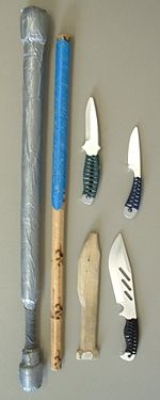
Eskrima

Encyclopedia
Eskrima is the umbrella term for the traditional martial arts
of the Philippines
, which emphasize weapon-based fighting with sticks
, knives and other bladed weapons, and various improvised weapons. It also includes hand-to-hand combat and weapon disarming techniques.
they may go by the name of arnis, arnis de mano, sinawali, pagkalikali, panandata (usage of weapons), didya, kabaroan (blade usage) and kaliradman. In the Visayas and Mindanao, these martial arts have been referred to as eskrima, kali and kalirongan. Kuntaw
and silat
are separate martial arts that have been practiced in the islands.
Both eskrima and arnis are loans from Spanish
and ultimately from Old Frankish
:
The name 'kali' is primarily used in the United States and Europe, and seldom in the Visayas, in some cases being an unknown word to eskrima practitioners. The term is used mostly in Mindanao, but due to the popularity of the term outside of the Philippines and the influence of foreign practitioners the term has now been accepted as a synonym for eskrima and arnis.
In their Cebu Eskrima Myth distributed by Lex libris, Dr. Ned Nepangue and Tinni Macachor contend that the word did not exist until the 1960s when two well-known eskrimadors in the United States popularized it to distinguish what they taught from other styles. One belief is that the word comes from tjakalele, a tribal style of stick-fencing from Indonesia. This is supported by the similarities between tjakalele and eskrima techniques, as well as Mindanao's proximity to Indonesia. Numerous alternative theories attempt to explain the term's origin:
Practitioners of the arts are called eskrimador for those who call their art eskrima, arnisador for those who call theirs arnis and kalista or mangangali for those who practice kali.
After the decree prohibiting the native to carry full-sized swords (such as the Kris
and the Kampilan
), the Maharlika
(the ancient nobility class) preserved the art. To circumvent the decree, some practitioners used sticks made out of rattan rather than swords, as well as small knives wielded like a sword. Eskrima can be traced back from the Portuguese Tomé Pires
' Suma Oriental to Lapu-lapu.
As eskrima is an art for the common folk, most practitioners lacked the scholarly education to create any kind of written record. While the same can be said of many martial arts, this is especially true for eskrima because almost all of its history is anecdotal, oral or promotional. The origin of eskrima can be traced back to the fighting systems used by Filipinos during inter-tribal warfare. Settlers and traders travelling through the Malay Archipelago brought the influence of silat
as well as Chinese
and Indian martial arts
. Some of the population still practices localised Chinese fighting methods known as kuntaw
.
Among the earliest written records of Filipino martial arts comes from the Spanish conquistadors who fought native tribesmen armed with sticks and knives. Driven back to their ships, the European colonists had to resort to fire-arms to defeat the Filipinos. In 1521, Ferdinand Magellan
was killed in Cebu
at the Battle of Mactan
by the forces of Raja Lapu-Lapu
, the Mactan tribal chief. Although eskrimadors hold that Lapu-Lapu killed Magellan in a sword-fight, the only eyewitness account of the battle by chronicler Antonio Pigafetta
tells that he was stabbed in the face and the arm with spears and overwhelmed with multiple warriors who hacked and stabbed at him:
Sources differ on the degree to which Eskrima was affected by the Spanish colonization. The fact that many Eskrima techniques have Spanish names adds fuel to the debate, but this can be explained as Spanish
was the lingua franca
of the Philippines until the early 20th century. Some theorize that there were groups of conquistadors and Jesuit warrior-priests who taught the Indios how to defend themselves against Moro raiders. Saint Ignatius of Loyola, the founder of the Jesuit order
was a veteran knight and soldier and many Jesuits knew how to defend themselves as they were generally dispatched into the most dangerous areas by the Pope
. One of the apparent influences from Spanish styles is the espada y daga (sword and dagger) method, but some disagree as Filipino espada y daga appears to be distinct from European rapier
and dagger techniques; the stances are different as weapons used in Eskrima are typically shorter than European swords.
One thing that is known is that some of the arts were hidden from the Spaniards and passed down through familial or communal ties, usually practiced under the moonlight or right under the Spaniards noses by disguising them as entertainment like with choreographed dances such as the Sakuting stick dance (see Youtube videos) or during mock battles at Moro-moro (Moros y Cristianos
) stage plays. Due to the way the arts were then clandestinely practiced, one apparent effect of Spanish subjugation and disarmament of the civilian population was the evolution of unique and complex stick-based techniques in the Visayas
and Luzon
regions (unlike Southern Mindanao
which retains almost exclusively blade-oriented techniques as it was never fully conquered and disarmed by the Spaniards and Americans).
Although the turbulent and conflict-fraught history and environment of the Philippines enabled eskrima to develop into an efficient art, this has changed in the sense that some systematization allowed easier and quicker teaching of the basics. With the exception of a few older and more established systems, it was previously common to pass the art from generation to generation in an informal approach. This has made attempts to trace the lineage of a practitioner difficult. For example, Antonio Illustrisimo seemed to have learned to fight while sailing around the Philippines, while his nephew and student Floro Villabrille claimed to have been taught by a blind Moro princess in the mountains – a claim later refuted by the older Illustrisimo. Both have since died.
are cheap to procure in the streets as well as being easily concealed. In the language of Palau
, the term for Filipino
is chad ra oles which literally means "people of the knife" because of Filipinos' reputation for carrying knives and using them in fights.
Americans were first exposed to eskrima during the Philippine-American War
in events such as the Balangiga Massacre
where most of an American company was hacked to death or seriously injured by bolo-wielding guerillas in Balangiga, Samar
or in battles in Mindanao
where an American serviceman was decapitated by a Moro warrior even after he emptied his .38 Long Colt
caliber revolver into his opponent. That and similar events led to the request and development of the .45 ACP
which had more stopping power.
With regards to its spread outside the Philippines, the teaching of eskrima was kept strictly within the Filipino community until the late 1960s when it was brought to the US by masters such as Angel Cabales. Even then, instructors teaching eskrima in the 1960s and 70s were often reprimanded by their elders for publicly teaching a part of their culture that had been preserved through secrecy.
In recent years, there has been increased interest in eskrima for its usefulness when defending against knives. As a result, many systems of eskrima have been modified in varying degrees to make them more marketable to a worldwide audience. Usually this involves increased emphasis on locking, controls, and disarms, focusing mainly on aspects of self-defense. However, most styles follow the philosophy that the best defense is a good offense
. Modern training methods tend to de-emphasize careful footwork and low stances, stressing the learning of techniques as opposed to more direct (and often lethal) tactics designed to instantly end an encounter.
as evidence. Spanish records tell of such duelling areas where cock-fights took place. The founders of most of the popular eskrima systems were famous duelists and legends circulate about how many opponents they killed. In rural areas throughout the Philippines today, modern eskrima matches are still held in dueling arenas. In bigger cities, recreations of duels are sometimes held at parks by local eskrima training-halls. These demonstrations are not choreographed beforehand but neither are they full-contact competitions.
In modern times, public dueling has been deemed illegal in the Philippines to reduce legal problems that arose from injury or death.
There are 2 main types of Eskrima practiced as a sport. The oldest and most common system used internationally is that of the WEKAF (World Eskrima Kali Arnis Federation). The younger one which is promoted by the Philippine Sports Commission
and the government is the Arnis Philippines (ARPHI) system and was used during the 2005 Southeast Asian Games
.
similar to boxing where participants spar with live sticks while wearing a long padded vest with skirt and sleeves and a helmet similar to Kendo
headgear. Hitting below the belt is prohibited. This format has sometimes been criticized because it emphasizes a heavy offense at the expense of defensive techniques sometimes with players raining blows on each other without defending, giving rise to the impression that combatants are merely hitting each other in a disorganized way. This is, to some, an antithesis to traditional training methods, where training in footwork and arm/weapon movements are intricate and precise and any part of an opponent's body is fair game. As a consequence, WEKAF tournaments may be seen as not promoting the original art. Moreover, participants have been known to suffer broken bones and injured tendons due to the fact that live sticks are used, so the older system is considered to be more hardcore and less safe. Another complaint about the WEKAF system is that it uses the 10-point must system
which is more subjective depending on who is judging. Favoritism among judges and players is a common complaint with this scoring system due to its subjectivity.
Since the WEKAF system is more risky, it is preferred by many practitioners who want to test themselves. The WEKAF system is the most widely used format internationally.
The entire body from head to toe is fair game as targets, except for the back of the head which is less protected by the headgear. Stabs to the face are not allowed because the thin rattan core may penetrate the padding and slip through the grills of the headgear and go into the player's eye. Thrusts to the body score points but are harder to sell to judges because they make less noise and it is harder to determine the magnitude of their impact.
Punches, kicks and throws are not allowed. Nor is prolonged clinching to prevent the opponent from striking (similar to Western Boxing) in order to keep the game moving and more interesting for the audience who may not appreciate the fine and practical aspects of grappling. Disarms must be performed quickly and cleanly in order to be counted. Because the legs are legal targets, in lighter weight divisions, complex evasion and deep lunges where players lie horizontal with the torso almost touching the floor to extend reach are often seen.
The emphasis of the ARPHI system is on safety for the players as it is applying to become a recognized Olympic sport like judo
, karate
, taekwondo
, wrestling
, boxing
, and fencing
.
Even though padded sticks are used in the sport, players regularly retain large bruises that last for weeks and sometimes minor injuries to joints and because of the sheer amount of force generated by conditioned practitioners. Sometimes the stuffing commonly comes off from the harder hitting players and one cause of injury is when a player is struck by the exposed rattan core. Still, these are relatively minor as compared to injuries sustained when practitioners spar with live sticks.
One major problem with the ARPHI system is that because the padded sticks with light rattan cores are used, they tend to flex and "lag", thus making the experience significantly different from using a live stick and in that sense, lessens the "realism" of this system. This is acceptable though as again, the emphasis is on safety.
Like the sayaw (meaning "dance") in the WEKAF system, the ARPHI system has a separate single and team choreographed Kata
-like division called Año (Tagalog for 'forms'). Aside from the visual appeal, practical combative applications must be clearly seen so as to avoid looking like just majorettes
in marching bands who just twirl batons and dance (a concept similar to the Floreio ("flowery") aspect in the Brazilian martial art capoeira
and tricking
which are more for show than practicality).
Many systems begin training with two weapons, either a pair of sticks or a stick and a wooden knife. These styles emphasise keeping both hands full and never moving them in the same direction and trains practitioners to become ambidextrous. For example, one stick may strike the head while the other hits the arm. Such training develops the ability to use both limbs independently, a skill which is valuable even when working with one weapon.
A core concept and distinct feature of Filipino martial arts is the Live Hand. Even when as a practitioner wields only one weapon, the extra hand is used to control, trap or disarm an opponent's weapon and to aid in blocking, joint locking and manipulation of the opponent or other simultaneous motions such as biceps destruction with the live hand.
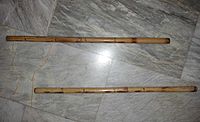 The most basic and common weapon in eskrima is the yantok. They are typically constructed from rattan
, an inexpensive stem from a type of Southeast Asian vine. Hard and durable yet lightweight, it shreds only under the worst abuse and will not splinter like wood, making it a safer training tool. This aspect makes it useful in defence against blades. Kamagong
(ironwood or ebony) and bahi (heart of the palm) are sometimes used after being charred and hardened. These hardwoods are generally not used for sparring, however, as they are dense enough to cause serious injury, but traditional sparring does not include weapon to body contact. The participants are skilled enough to parry and counterstrike, showing respect in not intentionally hitting the training partner. In North America and Europe, eskrima practitioners wear head and hand protection while sparring with rattan sticks, or otherwise use padded batons. Some modern schools use sticks made out of aluminium or other metals, or modern high-impact plastics.
The terms Baraw and Daga can be used either as Solo Baraw or Solo Daga associated with single knife fighting and defence systems, Doble Baraw or Doble Daga associated with the double knife fighting systems or even with a combination of long and short weapons e.g. stick and dagger fighting systems Olisi Baraw or sword and dagger fighting systems Espada y Daga.
In order to control the range, and for numerous other purposes, good footwork is essential. Most eskrima systems explain their footwork in terms of triangles: normally when moving in any direction two feet occupy two corners of the triangle and the step is to the third corner such that no leg crosses the other at any time. The shape and size of the triangle must be adapted to the particular situation. The style of footwork and the standing position vary greatly from school to school and from practitioner to practitioner. For a very traditional school, very conscious of battlefield necessities, stances will usually be very low, often with one knee on the ground, and footwork will be complex, involving many careful cross-steps to allow practitioners to cope with multiple opponents. The Villabrille and San Miguel styles are usually taught in this way. Systems that have been adapted to duels or sporting matches generally employ simpler footwork, focusing on a single opponent. North American schools tend to use much more upright stances, as this puts less stress on the legs, but there are some exceptions.
Older styles gave each angle a name, but more recent systems tend to simply number them. Many systems have twelve standard angles, though some have as few as 5, and others as many as 72. Although the exact angles, the order in which they are numbered (numerado), and the manner in which they're executed vary from system to system, most are based upon Filipino cosmology. These standard angles are used to describe exercises; to aid memorization, a standard series of strikes from these angles called an abecedario (Spanish for "alphabet") is often practiced. These are beginner strikes or the "ABC's" of eskrima.
Some angles of attack and some strikes have characteristic names.
It is to be noted that many of the Eskrima techniques have Spanish names because Spanish was the lingua franca
spoken during colonial times among the natives who spoke over 170 different languages in the archipelago's 7,100+ islands.
Eskrima techniques are generally based on the assumption that both the student and their opponent are very highly trained and well prepared. For this reason, eskrima tends to favor extreme caution, always considering the possibility of a failed technique or an unexpected knife. On the other hand, the practitioner is assumed to be able to strike very precisely and quickly. The general principle is that an opponent's ability to attack should be destroyed rather than trying to hurt them to convince them to stop. Thus many strikes are aimed at the hands and arms, hoping to break the hand holding the weapon or cut the nerves or tendons controlling it (the concept of defanging the snake), but strikes to the eyes and legs are important. A popular mnemonic states that "stick seeks bone, blade seeks flesh".
, particularly eskrima. The term translates as "hands" or "hand to hand" and comes from the Spanish word mano (hand). It is known as suntukan
in Luzon
and pangamot in the Visayas
. American colonists referred to it as "combat judo".
Mano mano includes kicking, punching, locking, throwing and dumog
(grappling). Filipino martial artists regard the empty hands as another weapon and all the movements of mano mano are directly based on weapon techniques. In eskrima, weapons are seen as an extension of the body so training with weapons naturally leads to proficiency in bare-handed combat. For this reason, mano mano is generally taught in the higher levels of eskrima because advanced students are expected to be able to apply their experience with weapons to unarmed fighting.
Pananjakman can be regarded as the study of leg muscles and bones and how they are connected, with the goal of either inflicting pain or outright breaking or dislocating the bones. Most striking techniques involve applying pressure to bend the target areas in unnatural ways so as to injure or break them. Such pressure may be delivered in the form of a heel smash, a toe kick, a stomp, or a knee. Targets include the groin, thighs, knees, shins, ankles, feet and toes. The upper body is used only for defensive maneuvers, making pananjakman ideal for when combatants are engaged in a clinch. When used effectively, the strikes can bring an opponent to the ground or otherwise end an altercation by making them too weak to stand.
Fundamental techniques include kicking or smashing the ankle to force it either towards or away from the opposite foot (severe supination or pronation, respectively), heel-stomping the top of the foot where it meets the lower leg so as to break or crush the numerous bones or otherwise disrupt the opponent's balance, and smashing the opponents knee from the side to break the knee (with severe supination and pronation as the desired result).
Rhythm, while an essential part of eskrima drills, is given more emphasis in the United States and Europe where a regular beat serves a guide for students to follow. To ensure the safety of the participants, most drills are done at a constant pace which is increased as the students progress. The rhythm, together with the southern Filipino attire of a vest and sashed pants, is commonly mistaken to be some sort of tradition when practicing eskrima in the Philippines – perhaps incorrectly derived from traditional rhythm-based dances or an attempt to add a sense of ethnicity. Eskrima is usually practiced in the Philippines without a rhythm, off-beat or out of rhythm. The diversity of Filipino martial arts means that there is no officially established standard uniform in eskrima.
by Eskrima practitioners. As opposed to most weapon systems like fencing
where the off-hand is hidden and not used to prevent it from being hit, Eskrima actively uses the live hand for trapping, locking, supporting weapon blocks, checking, disarming, striking and controlling the opponent.
The usage of the live hand is one of the most evident examples of how Eskrima's method of starting with weapons training leads to effective empty hand techniques. Because of Doble Baston (double weapons) or Espada y Daga (sword and parrying dagger) ambidextrous weapon muscle memory conditioning, Eskrima practitioners find it easy to use the off-hand actively once they transition from using it with a weapon to an empty hand.
This technique requires the user to use both left and right weapons in an equal manner; many co-ordination drills are used to help the practitioner become more ambidextrous. It is the section of the art that is taught mainly at the intermediate levels and above and is considered one of the most important areas of learning in the art.
Sinawali exercises provide eskrima practitioners with basic skills and motions relevant to a mode of two-weapon blocking and response method called Doblete. Sinawali training is often introduced to novices in order to develop certain fundamental skills including: body positioning and distance relative to an opponent, rotation of the body and the proper turning radius, recognition of one’s center of gravity, eye–hand coordination, target perception and recognition, increased ambidexterity, recognition and performance of rhythmic structures for upper body movement, and muscular developments important to the art, especially, the wrist and forearm regions. It helps teach the novice eskrimador proper elbow positioning while swinging a weapon.
and silat
for centuries, so much so that many North Americans mistakenly believe silat to have originated in the Philippines.
Some of the modern styles, particularly doce pares
and modern arnis
contain elements of Japanese martial arts
such as judo
and karate
as some of the founders were blackbelters in these systems. Eskrima is complementary with aikido
because of the rounded nature of the conditioning and body mechanics when twirling or swinging sticks.
In Western countries, it is common for eskrima to be practiced in conjunction with other martial arts, particularly wing chun
, jeet kune do
or silat
. As a result, there is some confusion between styles, systems and lineage because some people cross-train without giving due credit to the founders or principles of their arts. For example, American Kenpo cross-training traces back to the interactions between Chinese, Japanese and Filipino immigrants in territorial/pre-statehood Hawaii, and to a lesser extent in other parts of the United States. Another one is the cross-training between eskrima and Wing Chun or JKD which dates back to Bruce Lee
's close collaboration with Dan Inosanto
(the weapons aspect of JKD comes primarily from eskrima and Bruce Lee considered it as the martial art which had the closest philosophy to JKD).
Proponents of such training say the arts are very similar in many aspects and complement each other well. It has become marketable to offer eskrima classes in other traditional Asian martial arts studios in America but some practitioners of other eskrima styles often dismiss these lessons as debased versions of original training methods.
Martial arts
Martial arts are extensive systems of codified practices and traditions of combat, practiced for a variety of reasons, including self-defense, competition, physical health and fitness, as well as mental and spiritual development....
of the Philippines
Philippines
The Philippines , officially known as the Republic of the Philippines , is a country in Southeast Asia in the western Pacific Ocean. To its north across the Luzon Strait lies Taiwan. West across the South China Sea sits Vietnam...
, which emphasize weapon-based fighting with sticks
Stick fighting
Stick fighting is a generic term for martial arts which use simple long slender, blunt, hand-held, generally wooden 'sticks' for fighting such as a staff, cane, walking stick, baton or similar....
, knives and other bladed weapons, and various improvised weapons. It also includes hand-to-hand combat and weapon disarming techniques.
Etymology
For all intents and purposes, eskrima, arnis and kali all refer to the same family of Filipino weapon-based martial arts. In LuzonLuzon
Luzon is the largest island in the Philippines. It is located in the northernmost region of the archipelago, and is also the name for one of the three primary island groups in the country centered on the Island of Luzon...
they may go by the name of arnis, arnis de mano, sinawali, pagkalikali, panandata (usage of weapons), didya, kabaroan (blade usage) and kaliradman. In the Visayas and Mindanao, these martial arts have been referred to as eskrima, kali and kalirongan. Kuntaw
Kuntao
Kuntao or kuntaw is a Hokkien term for martial arts created by the Chinese community of Southeast Asia, particularly the Malay Archipelago. Literally meaning "way of the fist", the word kuntao more accurately translates as fighting art...
and silat
Silat
Silat Melayu is a blanket term for the types of silat created in peninsular Southeast Asia, particularly Malaysia, Thailand, Brunei and Singapore. The silat tradition has deep roots in Malay culture and can trace its origin to the dawn of Malay civilization, 2000 years ago...
are separate martial arts that have been practiced in the islands.
Both eskrima and arnis are loans from Spanish
Spanish language
Spanish , also known as Castilian , is a Romance language in the Ibero-Romance group that evolved from several languages and dialects in central-northern Iberia around the 9th century and gradually spread with the expansion of the Kingdom of Castile into central and southern Iberia during the...
and ultimately from Old Frankish
Old Frankish
Old Frankish is an extinct West Germanic language, once spoken by the Franks. It is the parent language of the Franconian languages, of which Dutch and Afrikaans are the most known descendants...
:
- Eskrima is a Filipinization of the Spanish word for fencingFencingFencing, which is also known as modern fencing to distinguish it from historical fencing, is a family of combat sports using bladed weapons.Fencing is one of four sports which have been featured at every one of the modern Olympic Games...
(esgrima). - Arnis comes from arnes, Old Spanish for armor (harness is an archaic English term for armor which comes from the same roots as the Spanish term). It is derived from the armor costumes used in Moro-moroMoros y cristianosMoros y Cristianos or Moros i Cristians literally in English Moors and Christians, is a set of festival activities which are celebrated in many towns and cities of Spain, mainly in the southern Valencian Community; according to popular tradition the festivals commemorate the battles, combats and...
stage plays where actors fought mock battles using wooden swords. Allegedly, the practice of weaponry by the peasants or Indios was banned by the Spaniards during colonial times and the Moro-moro stick fights were a "disguised" form of continued practice of indigenous martial arts.
The name 'kali' is primarily used in the United States and Europe, and seldom in the Visayas, in some cases being an unknown word to eskrima practitioners. The term is used mostly in Mindanao, but due to the popularity of the term outside of the Philippines and the influence of foreign practitioners the term has now been accepted as a synonym for eskrima and arnis.
In their Cebu Eskrima Myth distributed by Lex libris, Dr. Ned Nepangue and Tinni Macachor contend that the word did not exist until the 1960s when two well-known eskrimadors in the United States popularized it to distinguish what they taught from other styles. One belief is that the word comes from tjakalele, a tribal style of stick-fencing from Indonesia. This is supported by the similarities between tjakalele and eskrima techniques, as well as Mindanao's proximity to Indonesia. Numerous alternative theories attempt to explain the term's origin:
- Kali may be a portmanteau of the CebuanoCebuano languageCebuano, referred to by most of its speakers as Bisaya , is an Austronesian language spoken in the Philippines by about 20 million people mostly in the Central Visayas. It is the most widely spoken of the languages within the so-named Bisayan subgroup and is closely related to other Filipino...
words "ka"mot, or "ka"may meaning hand or body, and "li"hok, meaning motion. - There exist numerous similar terms of reference for martial arts such as kalirongan, kaliradman and pagkalikali. These may be the origin of the term kali or they may have evolved from it. Since eskrima and arnis are derived from Spanish words, the preference for the term kali by foreigners is due its the lack of a definitive foreign origin and an attempt to preserve authenticity of a name that has otherwise been lost to history.
Practitioners of the arts are called eskrimador for those who call their art eskrima, arnisador for those who call theirs arnis and kalista or mangangali for those who practice kali.
Origins
When the Spaniards began colonizing the Philippines, they saw an already-developed weapons-based martial arts practiced by the natives. The name eskrima came from the Spanish word for "fencing" (i.e., any form of hand-to-hand combat with bladed weapons).After the decree prohibiting the native to carry full-sized swords (such as the Kris
Kris
The kris or keris is an asymmetrical dagger or sword nowadays most strongly associated with the culture of Indonesia, but also indigenous to Malaysia, Southern Thailand and Brunei. It is known as kalis in the southern Philippines. The kris is famous for its distinctive wavy blade , but many have...
and the Kampilan
Kampilan
The kampílan is a type of single-edged long sword of the Filipino people. Being ancient origin, it has been used in the Philippine islands of Mindanao, Visayas, and Luzon for centuries, used for head-chopping....
), the Maharlika
Maharlika
Maharlika is a Filipino term meaning “nobility” or “aristocracy”. Its etymology is rooted from the Sanskrit maharddhika which means “a man of wealth, knowledge, and ability”...
(the ancient nobility class) preserved the art. To circumvent the decree, some practitioners used sticks made out of rattan rather than swords, as well as small knives wielded like a sword. Eskrima can be traced back from the Portuguese Tomé Pires
Tomé Pires
Tomé Pires was an apothecary from Lisbon who spent 1512 to 1515 in Malacca immediately after the Portuguese conquest, at a time when Europeans were only first arriving in South East Asia...
' Suma Oriental to Lapu-lapu.
As eskrima is an art for the common folk, most practitioners lacked the scholarly education to create any kind of written record. While the same can be said of many martial arts, this is especially true for eskrima because almost all of its history is anecdotal, oral or promotional. The origin of eskrima can be traced back to the fighting systems used by Filipinos during inter-tribal warfare. Settlers and traders travelling through the Malay Archipelago brought the influence of silat
Silat
Silat Melayu is a blanket term for the types of silat created in peninsular Southeast Asia, particularly Malaysia, Thailand, Brunei and Singapore. The silat tradition has deep roots in Malay culture and can trace its origin to the dawn of Malay civilization, 2000 years ago...
as well as Chinese
Chinese martial arts
Chinese martial arts, also referred to by the Mandarin Chinese term wushu and popularly as kung fu , are a number of fighting styles that have developed over the centuries in China. These fighting styles are often classified according to common traits, identified as "families" , "sects" or...
and Indian martial arts
Indian martial arts
The Indian subcontinent is home to a variety of fighting styles. In Sanskrit they may be collectively referred to as ' or '. The former is a compound of the words and , meaning "knowledge of the sword" or "knowledge of weaponry"...
. Some of the population still practices localised Chinese fighting methods known as kuntaw
Kuntao
Kuntao or kuntaw is a Hokkien term for martial arts created by the Chinese community of Southeast Asia, particularly the Malay Archipelago. Literally meaning "way of the fist", the word kuntao more accurately translates as fighting art...
.
Among the earliest written records of Filipino martial arts comes from the Spanish conquistadors who fought native tribesmen armed with sticks and knives. Driven back to their ships, the European colonists had to resort to fire-arms to defeat the Filipinos. In 1521, Ferdinand Magellan
Ferdinand Magellan
Ferdinand Magellan was a Portuguese explorer. He was born in Sabrosa, in northern Portugal, and served King Charles I of Spain in search of a westward route to the "Spice Islands" ....
was killed in Cebu
Cebu Island
Cebu is an island of the Philippines. It is the main island of Cebu Province at the center of the Visayan Islands, south of Manila.It lies to the east of Negros Island; to the east is Leyte and to the southeast is Bohol Island. It is flanked on both sides by the Cebu Strait and Tañon Strait...
at the Battle of Mactan
Battle of Mactan
The Battle of Mactan was fought in the Philippines on April 27, 1521. The warriors of Lapu-Lapu, a native chieftain of Mactan Island, defeated Spanish forces under the command of Ferdinand Magellan, who was killed in the battle.- Background :...
by the forces of Raja Lapu-Lapu
Lapu-Lapu
Lapu-Lapu was the ruler of Mactan, an island in the Visayas, Philippines, who is known as the first native of the archipelago to have resisted the Spanish colonization...
, the Mactan tribal chief. Although eskrimadors hold that Lapu-Lapu killed Magellan in a sword-fight, the only eyewitness account of the battle by chronicler Antonio Pigafetta
Antonio Pigafetta
Antonio Pigafetta was an Italian scholar and explorer from the Republic of Venice. He travelled with the Portuguese explorer Ferdinand Magellan and his crew on their voyage to the Indies. During the expedition, he served as Magellan's assistant and kept an accurate journal which later assisted him...
tells that he was stabbed in the face and the arm with spears and overwhelmed with multiple warriors who hacked and stabbed at him:
The natives continued to pursue us, and picking up the same spear four or six times, hurled it at us again and again. Recognizing the captain, so many turned upon him that they knocked his helmet off his head twice, but he always stood firmly like a good knight, together with some others. Thus did we fight for more than one hour, refusing to retire farther. An Indian hurled a bamboo spear into the captain's face, but the latter immediately killed him with his lance, which he left in the Indian's body. Then, trying to lay hand on sword, he could draw it out but halfway, because he had been wounded in the arm with a bamboo spear. When the natives saw that, they all hurled themselves upon him. One of them wounded him on the left leg with a large cutlass, which resembles a scimitar, only being larger. That caused the captain to fall face downward, when immediately they rushed upon him with iron and bamboo spears and with their cutlasses, until they killed our mirror, our light, our comfort, and our true guide. When they wounded him, he turned back many times to see whether we were all in the boats. Thereupon, beholding him dead, we, wounded, retreated, as best we could, to the boats, which were already pulling off.
Sources differ on the degree to which Eskrima was affected by the Spanish colonization. The fact that many Eskrima techniques have Spanish names adds fuel to the debate, but this can be explained as Spanish
Spanish language
Spanish , also known as Castilian , is a Romance language in the Ibero-Romance group that evolved from several languages and dialects in central-northern Iberia around the 9th century and gradually spread with the expansion of the Kingdom of Castile into central and southern Iberia during the...
was the lingua franca
Lingua franca
A lingua franca is a language systematically used to make communication possible between people not sharing a mother tongue, in particular when it is a third language, distinct from both mother tongues.-Characteristics:"Lingua franca" is a functionally defined term, independent of the linguistic...
of the Philippines until the early 20th century. Some theorize that there were groups of conquistadors and Jesuit warrior-priests who taught the Indios how to defend themselves against Moro raiders. Saint Ignatius of Loyola, the founder of the Jesuit order
Society of Jesus
The Society of Jesus is a Catholic male religious order that follows the teachings of the Catholic Church. The members are called Jesuits, and are also known colloquially as "God's Army" and as "The Company," these being references to founder Ignatius of Loyola's military background and a...
was a veteran knight and soldier and many Jesuits knew how to defend themselves as they were generally dispatched into the most dangerous areas by the Pope
Pope
The Pope is the Bishop of Rome, a position that makes him the leader of the worldwide Catholic Church . In the Catholic Church, the Pope is regarded as the successor of Saint Peter, the Apostle...
. One of the apparent influences from Spanish styles is the espada y daga (sword and dagger) method, but some disagree as Filipino espada y daga appears to be distinct from European rapier
Rapier
A rapier is a slender, sharply pointed sword, ideally used for thrusting attacks, used mainly in Early Modern Europe during the 16th and 17th centuries.-Description:...
and dagger techniques; the stances are different as weapons used in Eskrima are typically shorter than European swords.
One thing that is known is that some of the arts were hidden from the Spaniards and passed down through familial or communal ties, usually practiced under the moonlight or right under the Spaniards noses by disguising them as entertainment like with choreographed dances such as the Sakuting stick dance (see Youtube videos) or during mock battles at Moro-moro (Moros y Cristianos
Moros y cristianos
Moros y Cristianos or Moros i Cristians literally in English Moors and Christians, is a set of festival activities which are celebrated in many towns and cities of Spain, mainly in the southern Valencian Community; according to popular tradition the festivals commemorate the battles, combats and...
) stage plays. Due to the way the arts were then clandestinely practiced, one apparent effect of Spanish subjugation and disarmament of the civilian population was the evolution of unique and complex stick-based techniques in the Visayas
Visayas
The Visayas or Visayan Islands and locally known as Kabisay-an gid, is one of the three principal geographical divisions of the Philippines, along with Mindanao and Luzon. It consists of several islands, primarily surrounding the Visayan Sea, although the Visayas are considered the northeast...
and Luzon
Luzon
Luzon is the largest island in the Philippines. It is located in the northernmost region of the archipelago, and is also the name for one of the three primary island groups in the country centered on the Island of Luzon...
regions (unlike Southern Mindanao
Mindanao
Mindanao is the second largest and easternmost island in the Philippines. It is also the name of one of the three island groups in the country, which consists of the island of Mindanao and smaller surrounding islands. The other two are Luzon and the Visayas. The island of Mindanao is called The...
which retains almost exclusively blade-oriented techniques as it was never fully conquered and disarmed by the Spaniards and Americans).
Although the turbulent and conflict-fraught history and environment of the Philippines enabled eskrima to develop into an efficient art, this has changed in the sense that some systematization allowed easier and quicker teaching of the basics. With the exception of a few older and more established systems, it was previously common to pass the art from generation to generation in an informal approach. This has made attempts to trace the lineage of a practitioner difficult. For example, Antonio Illustrisimo seemed to have learned to fight while sailing around the Philippines, while his nephew and student Floro Villabrille claimed to have been taught by a blind Moro princess in the mountains – a claim later refuted by the older Illustrisimo. Both have since died.
Modern history
The Philippines has what is known as a blade culture. Local folk in the Philippines are much more likely to carry knives than guns. They are commonly carried as tools by farmers, used by street vendors to prepare coconuts, pineapples, other fruits and meats, and balisongsBalisong (knife)
A Butterfly knife, also known as a fan knife or Balisong, is a folding pocket knife with two handles counter-rotating around the tang such that, when closed, the blade is concealed within grooves in the handles. It is sometimes called a Batangas knife, after the Tagalog province of Batangas in the...
are cheap to procure in the streets as well as being easily concealed. In the language of Palau
Palau
Palau , officially the Republic of Palau , is an island nation in the Pacific Ocean, east of the Philippines and south of Tokyo. In 1978, after three decades as being part of the United Nations trusteeship, Palau chose independence instead of becoming part of the Federated States of Micronesia, a...
, the term for Filipino
Filipino people
The Filipino people or Filipinos are an Austronesian ethnic group native to the islands of the Philippines. There are about 92 million Filipinos in the Philippines, and about 11 million living outside the Philippines ....
is chad ra oles which literally means "people of the knife" because of Filipinos' reputation for carrying knives and using them in fights.
Americans were first exposed to eskrima during the Philippine-American War
Philippine-American War
The Philippine–American War, also known as the Philippine War of Independence or the Philippine Insurrection , was an armed conflict between a group of Filipino revolutionaries and the United States which arose from the struggle of the First Philippine Republic to gain independence following...
in events such as the Balangiga Massacre
Balangiga massacre
The Balangiga massacre, as it is known in the Philippines, or the Balangiga affair, as it is known in the United States, was an incident in 1901 during the Philippine-American War where more than forty American soldiers were killed in a surprise guerrilla attack in the town of Balangiga on Samar...
where most of an American company was hacked to death or seriously injured by bolo-wielding guerillas in Balangiga, Samar
Eastern Samar
Eastern Samar is a province of the Philippines located in the Eastern Visayas region. Its capital is the city of Borongan.-Location:...
or in battles in Mindanao
Moro Rebellion
The Moro Rebellion was an armed military conflict between Moro revolutionary groups in the Mindanao, Sulu, and Palawan and the United States military which took place in the Philippines as early as between 1899 to 1913, following the Spanish-American War in 1898...
where an American serviceman was decapitated by a Moro warrior even after he emptied his .38 Long Colt
.38 Long Colt
The .38 Long Colt is a cartridge introduced by Colt's Manufacturing Company in 1875, and was adopted as a standard military pistol cartridge by the United States Army in 1892 for the Colt New Army M1892 Revolver. It is slightly more powerful than the .38 Short Colt, or .38 SC. The .38 Long Colt...
caliber revolver into his opponent. That and similar events led to the request and development of the .45 ACP
.45 ACP
The .45 ACP , also known as the .45 Auto by C.I.P., is a cartridge designed by John Browning in 1904, for use in his prototype Colt semi-automatic .45 pistol and eventually the M1911 pistol adopted by the United States Army in 1911.-Design and history:The U.S...
which had more stopping power.
With regards to its spread outside the Philippines, the teaching of eskrima was kept strictly within the Filipino community until the late 1960s when it was brought to the US by masters such as Angel Cabales. Even then, instructors teaching eskrima in the 1960s and 70s were often reprimanded by their elders for publicly teaching a part of their culture that had been preserved through secrecy.
In recent years, there has been increased interest in eskrima for its usefulness when defending against knives. As a result, many systems of eskrima have been modified in varying degrees to make them more marketable to a worldwide audience. Usually this involves increased emphasis on locking, controls, and disarms, focusing mainly on aspects of self-defense. However, most styles follow the philosophy that the best defense is a good offense
The best defense is a good offense
"The best defense is a good offense" is an adage that has been applied to many fields of endeavor, including games and military combat. Generally the idea is that offensive action preoccupies the opposition and ultimately its ability to directly harm....
. Modern training methods tend to de-emphasize careful footwork and low stances, stressing the learning of techniques as opposed to more direct (and often lethal) tactics designed to instantly end an encounter.
Duels
One of the most important practices in classical eskrima was dueling, without any form of protection. The matches were preceded by cock-fighting and could be held in any open space, sometimes in a specially constructed enclosure. Eskrimadors believe this tradition pre-dates the colonial period, pointing to similar practices of kickboxing matches in mainland IndochinaIndochina
The Indochinese peninsula, is a region in Southeast Asia. It lies roughly southwest of China, and east of India. The name has its origins in the French, Indochine, as a combination of the names of "China" and "India", and was adopted when French colonizers in Vietnam began expanding their territory...
as evidence. Spanish records tell of such duelling areas where cock-fights took place. The founders of most of the popular eskrima systems were famous duelists and legends circulate about how many opponents they killed. In rural areas throughout the Philippines today, modern eskrima matches are still held in dueling arenas. In bigger cities, recreations of duels are sometimes held at parks by local eskrima training-halls. These demonstrations are not choreographed beforehand but neither are they full-contact competitions.
In modern times, public dueling has been deemed illegal in the Philippines to reduce legal problems that arose from injury or death.
Organization
After decades of lobbying and overdue recognition, Arnis/Eskrima/Kali was proclaimed as the official National Martial Art and Sport of the Philippines in January 2010.There are 2 main types of Eskrima practiced as a sport. The oldest and most common system used internationally is that of the WEKAF (World Eskrima Kali Arnis Federation). The younger one which is promoted by the Philippine Sports Commission
Philippine Sports Commission
The Philippine Sports Commission was created through Republic Act No. 6847 in 1990 to serve as the "sole policy-making and coordinating body of all amateur sports development programs and institutions in the Philippines"...
and the government is the Arnis Philippines (ARPHI) system and was used during the 2005 Southeast Asian Games
Arnis at the 2005 Southeast Asian Games
The arnis tournament at the 2005 Southeast Asian Games was held on December 1, 2005 to December 4, 2005 at the Emilio Aguinaldo College Gymnasium in Ermita, Manila. This is also the same venue as the wushu events....
.
WEKAF
The WEKAF system works on a 10-point must system10-point must system
The 10-point must system is a method of scoring a fighting match .Under the system, the judges must give the winner of a round 10 points, and the loser 9 points or fewer...
similar to boxing where participants spar with live sticks while wearing a long padded vest with skirt and sleeves and a helmet similar to Kendo
Kendo
, meaning "Way of The Sword", is a modern Japanese martial art of sword-fighting based on traditional Japanese swordsmanship, or kenjutsu.Kendo is a physically and mentally challenging activity that combines strong martial arts values with sport-like physical elements.-Practitioners:Practitioners...
headgear. Hitting below the belt is prohibited. This format has sometimes been criticized because it emphasizes a heavy offense at the expense of defensive techniques sometimes with players raining blows on each other without defending, giving rise to the impression that combatants are merely hitting each other in a disorganized way. This is, to some, an antithesis to traditional training methods, where training in footwork and arm/weapon movements are intricate and precise and any part of an opponent's body is fair game. As a consequence, WEKAF tournaments may be seen as not promoting the original art. Moreover, participants have been known to suffer broken bones and injured tendons due to the fact that live sticks are used, so the older system is considered to be more hardcore and less safe. Another complaint about the WEKAF system is that it uses the 10-point must system
10-point must system
The 10-point must system is a method of scoring a fighting match .Under the system, the judges must give the winner of a round 10 points, and the loser 9 points or fewer...
which is more subjective depending on who is judging. Favoritism among judges and players is a common complaint with this scoring system due to its subjectivity.
Since the WEKAF system is more risky, it is preferred by many practitioners who want to test themselves. The WEKAF system is the most widely used format internationally.
ARPHI
The Arnis Philippines system uses foam-padded sticks about an inch in diameter with thin rattan cores roughly a centimeter in diameter. These sticks are meant to break before serious injury occurs. For protection, the same headgear used in the WEKAF system, and a large groin guard is required for males. Vests (optional for men, required for women), optional armguards, shinguards and leg wraps are used. Scoring is more similar to fencing were fighters are separated after solid clean hits are made (observed by multiple judges stationed at different positions to be able to observe if the hits were clean and unblocked and able to determine the strength of the strike by the loudness of the impact). Alternative ways to score are to disarm one's opponent or to force him to step outside the ring.The entire body from head to toe is fair game as targets, except for the back of the head which is less protected by the headgear. Stabs to the face are not allowed because the thin rattan core may penetrate the padding and slip through the grills of the headgear and go into the player's eye. Thrusts to the body score points but are harder to sell to judges because they make less noise and it is harder to determine the magnitude of their impact.
Punches, kicks and throws are not allowed. Nor is prolonged clinching to prevent the opponent from striking (similar to Western Boxing) in order to keep the game moving and more interesting for the audience who may not appreciate the fine and practical aspects of grappling. Disarms must be performed quickly and cleanly in order to be counted. Because the legs are legal targets, in lighter weight divisions, complex evasion and deep lunges where players lie horizontal with the torso almost touching the floor to extend reach are often seen.
The emphasis of the ARPHI system is on safety for the players as it is applying to become a recognized Olympic sport like judo
Judo
is a modern martial art and combat sport created in Japan in 1882 by Jigoro Kano. Its most prominent feature is its competitive element, where the object is to either throw or takedown one's opponent to the ground, immobilize or otherwise subdue one's opponent with a grappling maneuver, or force an...
, karate
Karate
is a martial art developed in the Ryukyu Islands in what is now Okinawa, Japan. It was developed from indigenous fighting methods called and Chinese kenpō. Karate is a striking art using punching, kicking, knee and elbow strikes, and open-handed techniques such as knife-hands. Grappling, locks,...
, taekwondo
Taekwondo
Taekwondo is a Korean martial art and the national sport of South Korea. In Korean, tae means "to strike or break with foot"; kwon means "to strike or break with fist"; and do means "way", "method", or "path"...
, wrestling
Wrestling
Wrestling is a form of grappling type techniques such as clinch fighting, throws and takedowns, joint locks, pins and other grappling holds. A wrestling bout is a physical competition, between two competitors or sparring partners, who attempt to gain and maintain a superior position...
, boxing
Boxing
Boxing, also called pugilism, is a combat sport in which two people fight each other using their fists. Boxing is supervised by a referee over a series of between one to three minute intervals called rounds...
, and fencing
Fencing
Fencing, which is also known as modern fencing to distinguish it from historical fencing, is a family of combat sports using bladed weapons.Fencing is one of four sports which have been featured at every one of the modern Olympic Games...
.
Even though padded sticks are used in the sport, players regularly retain large bruises that last for weeks and sometimes minor injuries to joints and because of the sheer amount of force generated by conditioned practitioners. Sometimes the stuffing commonly comes off from the harder hitting players and one cause of injury is when a player is struck by the exposed rattan core. Still, these are relatively minor as compared to injuries sustained when practitioners spar with live sticks.
One major problem with the ARPHI system is that because the padded sticks with light rattan cores are used, they tend to flex and "lag", thus making the experience significantly different from using a live stick and in that sense, lessens the "realism" of this system. This is acceptable though as again, the emphasis is on safety.
Like the sayaw (meaning "dance") in the WEKAF system, the ARPHI system has a separate single and team choreographed Kata
Kata
is a Japanese word describing detailed choreographed patterns of movements practised either solo or in pairs. The term form is used for the corresponding concept in non-Japanese martial arts in general....
-like division called Año (Tagalog for 'forms'). Aside from the visual appeal, practical combative applications must be clearly seen so as to avoid looking like just majorettes
Majorette (dancer)
A majorette is a person doing choreographed dance or movement, primarily baton twirling associated with marching bands during parades. It derives from girls', in the late 19th and early 20th centuries, involvement in drill and gymnastic teams or groups that used apparatuses similar to those found...
in marching bands who just twirl batons and dance (a concept similar to the Floreio ("flowery") aspect in the Brazilian martial art capoeira
Capoeira
Capoeira is a Brazilian art form that combines elements of martial arts, sports, and music. It was created in Brazil mainly by descendants of African slaves with Brazilian native influences, probably beginning in the 16th century...
and tricking
Tricking
Tricking is the informal name of a type of physical activity derived from the martial arts that includes techniques found in gymnastics, B-boying, and similar disciplines. Examples of incorporated techniques include the 540 kick from Taekwondo, the butterfly twist from Wushu, and the double leg...
which are more for show than practicality).
Others
In another variation that simulates knife fights, competitors use false blades edged with lipstick to mark where an opponent has been struck. These matches are considered more similar to traditional duels than the WEKAF point-system.Weapons
Eskrima students start their instruction by learning to fight with weapons, and only advance to empty-hand training once the stick and knife techniques have been sufficiently mastered. This is in contrast to most other well-known Asian martial arts but it is justified by the principle that bare-handed moves are acquired naturally through the same exercises as the weapon techniques, making muscle memory an important aspect of the teaching and the obvious fact that an armed person who is trained has the advantage over a trained unarmed person and to condition students to fight against armed assailants. Most systems of eskrima apply a single set of techniques for the stick, knife and empty hands, a concept sometimes referred to as motion grouping. Since the weapon is seen as simply an extension of the body, the same angles and footwork are used either with or without a weapon. The reason for this is probably historical, because tribal warriors went into battle armed and only resorted to bare-handed fighting after losing their weapons.Many systems begin training with two weapons, either a pair of sticks or a stick and a wooden knife. These styles emphasise keeping both hands full and never moving them in the same direction and trains practitioners to become ambidextrous. For example, one stick may strike the head while the other hits the arm. Such training develops the ability to use both limbs independently, a skill which is valuable even when working with one weapon.
A core concept and distinct feature of Filipino martial arts is the Live Hand. Even when as a practitioner wields only one weapon, the extra hand is used to control, trap or disarm an opponent's weapon and to aid in blocking, joint locking and manipulation of the opponent or other simultaneous motions such as biceps destruction with the live hand.
Sticks
Rattan
Rattan is the name for the roughly 600 species of palms in the tribe Calameae, native to tropical regions of Africa, Asia and Australasia.- Structure :...
, an inexpensive stem from a type of Southeast Asian vine. Hard and durable yet lightweight, it shreds only under the worst abuse and will not splinter like wood, making it a safer training tool. This aspect makes it useful in defence against blades. Kamagong
Kamagong
Kamagong or "Mabolo" is a fruit tree found only in the Philippines, the wood of which is extremely dense and hard, and famous for its dark color. It belongs to the ebony family , and like many other very hard woods is sometimes called "iron wood" so called because its wood is iron-like and nearly...
(ironwood or ebony) and bahi (heart of the palm) are sometimes used after being charred and hardened. These hardwoods are generally not used for sparring, however, as they are dense enough to cause serious injury, but traditional sparring does not include weapon to body contact. The participants are skilled enough to parry and counterstrike, showing respect in not intentionally hitting the training partner. In North America and Europe, eskrima practitioners wear head and hand protection while sparring with rattan sticks, or otherwise use padded batons. Some modern schools use sticks made out of aluminium or other metals, or modern high-impact plastics.
Impact weapons
- Baston , olisi , yantok: stick ranging from twenty-four to twenty-eight inches long.
- Largo mano yantok: longer stick ranging from twenty-eight to thirty-six inches
- Dulo y dulo: short stick about four to seven inches in length, held in the palm of the hand
- Bankaw: six-foot pole. Staves can be used to practice sword techniques
- Wooden dagger measuring 12 to 14 in (304.8 to 355.6 mm)
- Panangga: shield
- Improvised weaponsImprovised weaponsAn Improvised weapon is a device that was not designed to be used as a weapon but can be put to that use. They are generally used for self-defence or where the person is otherwise unarmed...
: Pens, car keys (using the push knife grip), cellular phones, flashlights, coffee mugs, umbrellas, rolled-up magazines & newspapers, books, tennis rackets, bottles, chair legs, etc.
Edged weapons
Baraw is a Cebuano term used in the art of Eskrima that means knife or dagger. The term Baraw is more commonly used on the Cebu Island in the Visayan region where as other islands and regions more commonly use the term Daga but both terms are often interchangeable within the Filipino martial arts community.The terms Baraw and Daga can be used either as Solo Baraw or Solo Daga associated with single knife fighting and defence systems, Doble Baraw or Doble Daga associated with the double knife fighting systems or even with a combination of long and short weapons e.g. stick and dagger fighting systems Olisi Baraw or sword and dagger fighting systems Espada y Daga.
- Daga/Cuchillo/Baraw: daggers or knives of different shapes and sizes
- BalisongBalisong (knife)A Butterfly knife, also known as a fan knife or Balisong, is a folding pocket knife with two handles counter-rotating around the tang such that, when closed, the blade is concealed within grooves in the handles. It is sometimes called a Batangas knife, after the Tagalog province of Batangas in the...
: fan knife or butterfly knife from Barrio Balisong in BatangasBatangasBatangas is a first class province of the Philippines located on the southwestern part of Luzon in the CALABARZON region. Its capital is Batangas City and it is bordered by the provinces of Cavite and Laguna to the north and Quezon to the east. Across the Verde Island Passages to the south is the...
province. The handle is two-piece and attaches to a swivel that folds to enclose the blade when shut. - Karambit: claw-shaped Indo-Malay blade held by inserting the finger into a hole at the top of the handle.
- BoloBolo knifeA bolo is a large cutting tool of Filipino origin similar to the machete, used particularly in the jungles of Indonesia, the Philippines, and in the sugar fields of Cuba...
: a common farm tool similar to a machete - Pinuti: a type of bolo from CebuCebuCebu is a province in the Philippines, consisting of Cebu Island and 167 surrounding islands. It is located to the east of Negros, to the west of Leyte and Bohol islands...
- Sundang: a sword created by the Bugis people of Indonesia. Its blade is usually wavy.
- Barang: flat-headed blade
- Binikoko: long blade named after a porgy fish
- Dinahong palayDahong PalayThe Dahong Palay , literally 'Rice Leaf' in Tagalog, is a single-edged sword from the Philippines, specifically the Southern Tagalog provinces of Batangas and Mindoro...
: blade named after a type of poisonous snake - KalisKalisA kalis is a type of double-edged Filipino sword, often with a "wavy" section, similar to a kris. Unlike the kris, the Kalis's double-edged blade can be used for both cutting and thrusting....
or KrisKrisThe kris or keris is an asymmetrical dagger or sword nowadays most strongly associated with the culture of Indonesia, but also indigenous to Malaysia, Southern Thailand and Brunei. It is known as kalis in the southern Philippines. The kris is famous for its distinctive wavy blade , but many have...
: Indo-Malay dagger, often given a wavy blade, it is most commonly used in the southern provinces - KampilanKampilanThe kampílan is a type of single-edged long sword of the Filipino people. Being ancient origin, it has been used in the Philippine islands of Mindanao, Visayas, and Luzon for centuries, used for head-chopping....
: fork-tipped sword, popular in the southern Philippines - Sibat: spear
- Improvised weaponsImprovised weaponsAn Improvised weapon is a device that was not designed to be used as a weapon but can be put to that use. They are generally used for self-defence or where the person is otherwise unarmed...
: Icepicks, box cutters, screwdrivers, broken bottles
Flexible weapons
- SarongSarongA sarong or sarung is a large tube or length of fabric, often wrapped around the waist and worn as a kilt by men and as a skirt by women throughout much of South Asia, Southeast Asia, the Arabian Peninsula, the Horn of Africa, and on many Pacific islands. The fabric most often has woven plaid or...
: a length of fabric wrapped around the waist - Ekut: handkerchief
- Tabak-toyokTabak-ToyokThe Tabak-Toyok is a Filipino weapon closely related to the Okinawan nunchaku. The primary difference between the Filipino version and other versions of the weapon is that the Tabak-Toyok tends to have shorter handles as well as a longer chain. Each handle is approximately four inches long. The...
: chained sticks or nunchakuNunchakuis a traditional Okinawan weapon consisting of two sticks connected at their ends with a short chain or rope.-Etymology:The Japanese word nunchaku is the Kun'yomi reading of the Kanji term for a traditional Chinese two section staff.... - WhipWhipA whip is a tool traditionally used by humans to exert control over animals or other people, through pain compliance or fear of pain, although in some activities whips can be used without use of pain, such as an additional pressure aid in dressage...
: consisting of a handle between 8 and 12 in (203.2 and 304.8 mm), and a lash composed of a braided thong 3–20 ft (0.9144–6.1 m) long. The "fall" at the end of the lash is a single piece of leather 10–30 in (254–762 mm) in length. - Improvised weaponsImprovised weaponsAn Improvised weapon is a device that was not designed to be used as a weapon but can be put to that use. They are generally used for self-defence or where the person is otherwise unarmed...
: Belt, bandana, handkerchiefs, shirts, towels with hard soap bars, ropes, power cables, etc.
Ranges
Most systems recognize that the technical nature of combat changes drastically as the distance between opponents changes, and generally classify the ranges into at least three categories. Each range has its characteristic techniques and footwork. Of course, some systems place more emphasis on certain ranges than others, but almost all recognize that being able to work in and control any range is essential. The Balintawak style for example, uses long-, medium- and short-range fighting techniques, but focuses on the short-range.In order to control the range, and for numerous other purposes, good footwork is essential. Most eskrima systems explain their footwork in terms of triangles: normally when moving in any direction two feet occupy two corners of the triangle and the step is to the third corner such that no leg crosses the other at any time. The shape and size of the triangle must be adapted to the particular situation. The style of footwork and the standing position vary greatly from school to school and from practitioner to practitioner. For a very traditional school, very conscious of battlefield necessities, stances will usually be very low, often with one knee on the ground, and footwork will be complex, involving many careful cross-steps to allow practitioners to cope with multiple opponents. The Villabrille and San Miguel styles are usually taught in this way. Systems that have been adapted to duels or sporting matches generally employ simpler footwork, focusing on a single opponent. North American schools tend to use much more upright stances, as this puts less stress on the legs, but there are some exceptions.
Strikes
Many Filipino systems focus on defending against and/or reacting to angles of attack rather than particular strikes. The theory behind this is that virtually all types of hand-to-hand attacks (barehanded or with a weapon) will hit or reach a combatant via these angles of attack and it is reasoned that it is more efficient to learn to defend against different angles of attack rather than learning to defend against particular styles, particular techniques or particular weapons. For instance, the technique for defending against an attack angle that comes overhead from the right is very similar whether the attacker uses barefists, a knife, a sword or a spear.Older styles gave each angle a name, but more recent systems tend to simply number them. Many systems have twelve standard angles, though some have as few as 5, and others as many as 72. Although the exact angles, the order in which they are numbered (numerado), and the manner in which they're executed vary from system to system, most are based upon Filipino cosmology. These standard angles are used to describe exercises; to aid memorization, a standard series of strikes from these angles called an abecedario (Spanish for "alphabet") is often practiced. These are beginner strikes or the "ABC's" of eskrima.
Some angles of attack and some strikes have characteristic names.
- San Miguel is a forehandForehandThe forehand in tennis and other racket sports such as table tennis, squash and badminton is a shot made by swinging the racquet across one's body in the direction of where the player wants to place the shot...
strike with the right hand, moving from the striker's right shoulder toward their left hip. It is named after Saint Michael or the ArchangelArchangelAn archangel is an angel of high rank. Archangels are found in a number of religious traditions, including Judaism, Christianity and Islam. Michael and Gabriel are recognized as archangels in Judaism and by most Christians. Michael is the only archangel specifically named in the Protestant Bible...
Michael, who is often depicted holding a sword at this angle. This is the most natural strike for most untrained people. It is commonly referred to as "angle #1," in systems where striking angles are numbered for training purposes, because it is presumed to be the most probable angle of attack. - Sinawali is the signature double-stick weaving movement associated with Arnis and Eskrima named after the woven coconut or palm leaves called sawali that comprise the walls of nipa hutNipa HutThe nipa hut also known as bahay kubo, is an indigenous house used in the Philippines. The native house has traditionally been constructed with bamboo tied together and covered with a thatched roof using nipa/anahaw leaves....
dwellings. It is commonly seen in double-stick continuous attack-parry partner demonstrations. - Another signature technique is the Redonda which is a continuous circular downward-striking double-stick twirling technique.
- A redondo (Spanish for "round") is a strike that whips in a circle to return to its point of origin. This is especially useful when using sticks rather than swords, such a strike allows extremely fast strikes but needs constant practice.
- An abanico (Spanish for fan) or witik is a strike that is executed by flicking the wrist 180 degrees in a fan-shaped motion. This kind of strike can be very quick and arrive from unexpected angles.
- Pilantik is a strike executed by whipping the stick around the wrist over the head in a motion similar to the abanico, but in alternating 360 degree strikes. It is most useful when fighters are in grappling range and cannot create enough space for normal strikes.
- Hakbang (Filipino for "step") is a general term for footwork. For example, hakbang paiwas is pivoting footwork, while hakbang tatsulok is triangle stepping.
- Puño (Spanish for "fist") is a strike delivered with the butt of the weapon. It usually targets a nerve point or other soft spot on the opponent but in skilled hands, the puño can be used to shatter bones.
It is to be noted that many of the Eskrima techniques have Spanish names because Spanish was the lingua franca
Lingua franca
A lingua franca is a language systematically used to make communication possible between people not sharing a mother tongue, in particular when it is a third language, distinct from both mother tongues.-Characteristics:"Lingua franca" is a functionally defined term, independent of the linguistic...
spoken during colonial times among the natives who spoke over 170 different languages in the archipelago's 7,100+ islands.
Eskrima techniques are generally based on the assumption that both the student and their opponent are very highly trained and well prepared. For this reason, eskrima tends to favor extreme caution, always considering the possibility of a failed technique or an unexpected knife. On the other hand, the practitioner is assumed to be able to strike very precisely and quickly. The general principle is that an opponent's ability to attack should be destroyed rather than trying to hurt them to convince them to stop. Thus many strikes are aimed at the hands and arms, hoping to break the hand holding the weapon or cut the nerves or tendons controlling it (the concept of defanging the snake), but strikes to the eyes and legs are important. A popular mnemonic states that "stick seeks bone, blade seeks flesh".
Mano Mano
Mano Mano is the empty-hand component of Filipino martial artsFilipino martial arts
Filipino Martial Arts refers to ancient and newer fighting methods devised in the Philippines, the most popular of which are known as Arnis/Eskrima/Kali. The intrinsic need for self-preservation was the genesis of these systems. Throughout the ages, invaders and evolving local conflict imposed new...
, particularly eskrima. The term translates as "hands" or "hand to hand" and comes from the Spanish word mano (hand). It is known as suntukan
Panantukan
Panantukan is the boxing component of Filipino martial arts, and is known in the Visayas as pangamot. It consists of upper-body striking techniques such as punches, elbows, headbutts and shoulder strikes...
in Luzon
Luzon
Luzon is the largest island in the Philippines. It is located in the northernmost region of the archipelago, and is also the name for one of the three primary island groups in the country centered on the Island of Luzon...
and pangamot in the Visayas
Visayas
The Visayas or Visayan Islands and locally known as Kabisay-an gid, is one of the three principal geographical divisions of the Philippines, along with Mindanao and Luzon. It consists of several islands, primarily surrounding the Visayan Sea, although the Visayas are considered the northeast...
. American colonists referred to it as "combat judo".
Mano mano includes kicking, punching, locking, throwing and dumog
Dumog
Dumog is the Filipino style of wrestling while standing upright and refers to the grappling aspect of Filipino martial arts. The word dumog is most commonly used in Mindanao and the Visayas, while the word buno is used in Luzon, specifically in the Southern Tagalog-speaking provinces as far south...
(grappling). Filipino martial artists regard the empty hands as another weapon and all the movements of mano mano are directly based on weapon techniques. In eskrima, weapons are seen as an extension of the body so training with weapons naturally leads to proficiency in bare-handed combat. For this reason, mano mano is generally taught in the higher levels of eskrima because advanced students are expected to be able to apply their experience with weapons to unarmed fighting.
Pananjakman
Pananjakman is a component of eskrima which focuses on low-line kicks. Some claim that pananjakman is an art in and of itself but this separation was probably made for the purpose of marketing the art as a new system. Pananjakman is never taught by itself in the Philippines, and this practice is only done in the West.Pananjakman can be regarded as the study of leg muscles and bones and how they are connected, with the goal of either inflicting pain or outright breaking or dislocating the bones. Most striking techniques involve applying pressure to bend the target areas in unnatural ways so as to injure or break them. Such pressure may be delivered in the form of a heel smash, a toe kick, a stomp, or a knee. Targets include the groin, thighs, knees, shins, ankles, feet and toes. The upper body is used only for defensive maneuvers, making pananjakman ideal for when combatants are engaged in a clinch. When used effectively, the strikes can bring an opponent to the ground or otherwise end an altercation by making them too weak to stand.
Fundamental techniques include kicking or smashing the ankle to force it either towards or away from the opposite foot (severe supination or pronation, respectively), heel-stomping the top of the foot where it meets the lower leg so as to break or crush the numerous bones or otherwise disrupt the opponent's balance, and smashing the opponents knee from the side to break the knee (with severe supination and pronation as the desired result).
Drills
Several classes of exercises, such as sumbrada, contrada, sinawali, hubud-lubud and sequidas, initially presented to the public as a set of organized drills by the Inosanto school, are expressly designed to allow partners to move quickly and experiment with variations while remaining safe. For example, in a sumbrada drill taken from the Villabrille style, one partner feeds an attack, which the other counters, flowing into a counterattack, which is then countered, flowing into a counterattack, and so on. The hubud-lubud or hubad-lubad from Doce Pares is frequently used as a type of "generator" drill, where one is forced to act and think fast. Initially, students learn a specific series of attacks, counters, and counter-attacks. As they advance they can add minor variations, change the footwork, or switch to completely different attacks; eventually the exercise becomes almost completely free-form. Palakat, from the Balintawak style, are un-choreographed and random defensive and offensive moves. Palakat in Cebuano means a walk-through or rehearsing the different strike angles and defenses. It may be known as corridas or striking without any order or pattern. Disarms, take-downs, and other techniques usually break the flow of such a drill, but they are usually initiated from such a sequence of movements in order to force the student to adapt to a variety of situations. A common practice is to begin a drill with each student armed with two weapons; once the drill is flowing, if a student sees an opportunity to disarm their opponent, they will, but the drill will continue until both students are empty-handed. Some drills use only a single weapon per pair, and the partners take turns disarming each other. Seguidas drills, taken from the San Miguel system, are sets of hitting and movement patterns usually involving stick and dagger.Rhythm, while an essential part of eskrima drills, is given more emphasis in the United States and Europe where a regular beat serves a guide for students to follow. To ensure the safety of the participants, most drills are done at a constant pace which is increased as the students progress. The rhythm, together with the southern Filipino attire of a vest and sashed pants, is commonly mistaken to be some sort of tradition when practicing eskrima in the Philippines – perhaps incorrectly derived from traditional rhythm-based dances or an attempt to add a sense of ethnicity. Eskrima is usually practiced in the Philippines without a rhythm, off-beat or out of rhythm. The diversity of Filipino martial arts means that there is no officially established standard uniform in eskrima.
The Live Hand
The live hand is the opposite hand of the practitioner that does not contain the main weapon. The heavy usage of the live hand is an important concept and distinguishing hallmark of Eskrima. Even (or especially) when empty, the live hand can be used as a companion weaponCompanion weapon
The term companion weapon is used in historical European martial arts to refer to an item used in conjunction with the larger weapon in the non-sword hand while fencing with a rapier or sword. The popular companion weapon forms include:*sword and buckler...
by Eskrima practitioners. As opposed to most weapon systems like fencing
Fencing
Fencing, which is also known as modern fencing to distinguish it from historical fencing, is a family of combat sports using bladed weapons.Fencing is one of four sports which have been featured at every one of the modern Olympic Games...
where the off-hand is hidden and not used to prevent it from being hit, Eskrima actively uses the live hand for trapping, locking, supporting weapon blocks, checking, disarming, striking and controlling the opponent.
The usage of the live hand is one of the most evident examples of how Eskrima's method of starting with weapons training leads to effective empty hand techniques. Because of Doble Baston (double weapons) or Espada y Daga (sword and parrying dagger) ambidextrous weapon muscle memory conditioning, Eskrima practitioners find it easy to use the off-hand actively once they transition from using it with a weapon to an empty hand.
Doble baston
Doble baston, and less frequently doble olisi, are common names for a group of techniques involving two sticks. The art is more commonly known around the world as Sinawali meaning "to weave". The term Sinawali was taken from a matting that is commonly used in the tribal Nipa Huts which is made up of woven pieces of palm leaf and used for both flooring and walls.This technique requires the user to use both left and right weapons in an equal manner; many co-ordination drills are used to help the practitioner become more ambidextrous. It is the section of the art that is taught mainly at the intermediate levels and above and is considered one of the most important areas of learning in the art.
Sinawali
Sinawali refers to the activity of "weaving", as applied Eskrima with reference to a set of two-person, two-weapon exercises.Sinawali exercises provide eskrima practitioners with basic skills and motions relevant to a mode of two-weapon blocking and response method called Doblete. Sinawali training is often introduced to novices in order to develop certain fundamental skills including: body positioning and distance relative to an opponent, rotation of the body and the proper turning radius, recognition of one’s center of gravity, eye–hand coordination, target perception and recognition, increased ambidexterity, recognition and performance of rhythmic structures for upper body movement, and muscular developments important to the art, especially, the wrist and forearm regions. It helps teach the novice eskrimador proper elbow positioning while swinging a weapon.
Cross-training
The Chinese and Malay communities of the Philippines have practiced eskrima together with kuntawKuntao
Kuntao or kuntaw is a Hokkien term for martial arts created by the Chinese community of Southeast Asia, particularly the Malay Archipelago. Literally meaning "way of the fist", the word kuntao more accurately translates as fighting art...
and silat
Silat
Silat Melayu is a blanket term for the types of silat created in peninsular Southeast Asia, particularly Malaysia, Thailand, Brunei and Singapore. The silat tradition has deep roots in Malay culture and can trace its origin to the dawn of Malay civilization, 2000 years ago...
for centuries, so much so that many North Americans mistakenly believe silat to have originated in the Philippines.
Some of the modern styles, particularly doce pares
Doce Pares
Doce Pares, a form of Eskrima, is a Filipino martial art that focuses on primarily on stick fighting but also covers other weapons and empty-hands. Magellan's sword-wielding conquistadors fell to Datu Lapu-Lapu who used Eskrima to defeat the Spaniards at the Battle of Mactan...
and modern arnis
Modern Arnis
Modern Arnis is the system of Filipino martial arts founded by the late Remy Presas as a self-defense system. His goal was to create an injury-free training method as well as an effective self-defense system in order to preserve the older Arnis systems...
contain elements of Japanese martial arts
Japanese martial arts
Japanese martial arts refers to the enormous variety of martial arts native to Japan. At least three Japanese terms are often used interchangeably with the English phrase "Japanese martial arts": , literally meaning "martial way", , which has no perfect translation but means something like science,...
such as judo
Judo
is a modern martial art and combat sport created in Japan in 1882 by Jigoro Kano. Its most prominent feature is its competitive element, where the object is to either throw or takedown one's opponent to the ground, immobilize or otherwise subdue one's opponent with a grappling maneuver, or force an...
and karate
Karate
is a martial art developed in the Ryukyu Islands in what is now Okinawa, Japan. It was developed from indigenous fighting methods called and Chinese kenpō. Karate is a striking art using punching, kicking, knee and elbow strikes, and open-handed techniques such as knife-hands. Grappling, locks,...
as some of the founders were blackbelters in these systems. Eskrima is complementary with aikido
Aikido
is a Japanese martial art developed by Morihei Ueshiba as a synthesis of his martial studies, philosophy, and religious beliefs. Aikido is often translated as "the Way of unifying life energy" or as "the Way of harmonious spirit." Ueshiba's goal was to create an art that practitioners could use to...
because of the rounded nature of the conditioning and body mechanics when twirling or swinging sticks.
In Western countries, it is common for eskrima to be practiced in conjunction with other martial arts, particularly wing chun
Wing Chun
Wing Chun , also romanised as Ving Tsun or Wing Tsun, ; ; is a concept-based Chinese martial art and form of self-defense utilizing both striking and grappling while specializing in close-range combat.The alternative characters 永春 "eternal spring" are also...
, jeet kune do
Jeet Kune Do
Jeet Kune Do is a hybrid martial arts system and life philosophy founded by martial artist Bruce Lee with direct, non classical and straightforward movements. Due to the way his style works they believe in minimal movement with maximum effect and extreme speed. The system works on the use of...
or silat
Silat
Silat Melayu is a blanket term for the types of silat created in peninsular Southeast Asia, particularly Malaysia, Thailand, Brunei and Singapore. The silat tradition has deep roots in Malay culture and can trace its origin to the dawn of Malay civilization, 2000 years ago...
. As a result, there is some confusion between styles, systems and lineage because some people cross-train without giving due credit to the founders or principles of their arts. For example, American Kenpo cross-training traces back to the interactions between Chinese, Japanese and Filipino immigrants in territorial/pre-statehood Hawaii, and to a lesser extent in other parts of the United States. Another one is the cross-training between eskrima and Wing Chun or JKD which dates back to Bruce Lee
Bruce Lee
Bruce Lee was a Chinese American, Hong Kong actor, martial arts instructor, philosopher, film director, film producer, screenwriter, and founder of the Jeet Kune Do martial arts movement...
's close collaboration with Dan Inosanto
Dan Inosanto
Daniel Arca Inosanto is a Filipino-American martial arts instructor from California who is best known as a student of the late Bruce Lee and authority on Jeet Kune Do Concepts.-Martial arts:...
(the weapons aspect of JKD comes primarily from eskrima and Bruce Lee considered it as the martial art which had the closest philosophy to JKD).
Proponents of such training say the arts are very similar in many aspects and complement each other well. It has become marketable to offer eskrima classes in other traditional Asian martial arts studios in America but some practitioners of other eskrima styles often dismiss these lessons as debased versions of original training methods.
Practiced in the Philippines
(arranged by family/lineage)- Doce Pares Eskrima – Originally encompassed 12 styles and was founded by the Saavedra and Cañete families in 1932. There are now several Doce Pares groups headed by various members of the Cañete family.
- EskridoEskridoEskrido, a version of Doce Pares, is a Filipino martial art that is a combination of Doce Pares, Aikido, and Judo, with lesser influences from other Japanese systems. It features standard eskrima stick techniques mixed with Jujutsu-style locks and throws that utilize the stick...
– Founded by Ciriaco "Cacoy" Cañete, the last living founder and the highest ranking master of Doce Pares Eskrima. - San Miguel EskrimaSan Miguel EskrimaSan Miguel Eskrima is one of the major systems of eskrima, a martial arts from the Philippines. Founded by Filemon "Momoy" Cañete of the Doce Pares Club, SME served as vehicle for his own personal expression of the art and methodology of the club of which he was a co-founder and instructor...
– As one of the founders (together with the famous Doring and Ensong Saavedra) of the Labangon Fencing Club in 1920 and later the Doce Pares Club in 1932, Filemon "Momoy" Cañete created the blade based San Miguel Eskrima as his personal expression of the Doce Pares art and methodology. - Balintawak Eskrima – Founded in 1952 by Venancio "Anciong" Bacon after internal dispute amongst some of the original founders of the original Doce Pares club.
- Villasin Balintawak – founded by Atty. Jose Villasin, one of Bacon's senior students
- International Balintawak – founded by Bobby Taboada, one of Bacon's senior students
- Liborio Heyrosa Eskrima De Cuerdas – founded by Liborio "Tiboring" Heyrosa, student of Anciong Bacon and "Ingko Nene" Rosales.
- Nickel Stick Eskrima – founded by Nick Elizar, student of Anciong Bacon and the other senior Balintawak pioneers.
- Tabimina Balintawak – founded by Bob Silver Tabimina, one of Anciong Bacon's last major students and inheritor of Bacon's style that was modified by his stay in prison before his death.
- Black Eagle Eskrima – founded by World War IIWorld War IIWorld War II, or the Second World War , was a global conflict lasting from 1939 to 1945, involving most of the world's nations—including all of the great powers—eventually forming two opposing military alliances: the Allies and the Axis...
guerilla fighter Carlos Navarro based on the Eskrima de Llave of his grandfather, the Eskrima de Avinico of his father and other Cebuano systems. - Tres Personas Eskrima de Combate Super Kuwentada System – Founded by Maj Timoteo "Timor" Maranga Sr., a fearless World War IIWorld War IIWorld War II, or the Second World War , was a global conflict lasting from 1939 to 1945, involving most of the world's nations—including all of the great powers—eventually forming two opposing military alliances: the Allies and the Axis...
guerilla fighter and member of the legendary Bolo Battalion. The system which is currently known as Eskrima Maranga System is characterized by its lightning speed strikes and disarming. Combate Eskrima Maranga (CEM) continues to advance with the founder's son Rodrigo Maranga. - Modern ArnisModern ArnisModern Arnis is the system of Filipino martial arts founded by the late Remy Presas as a self-defense system. His goal was to create an injury-free training method as well as an effective self-defense system in order to preserve the older Arnis systems...
– Founded by Remy PresasRemy PresasRemgio Amador Presas was the founder of Modern Arnis, a popular Filipino martial art. Born in the Philippines, he moved to the United States in 1974, where he taught his art via seminars and camps. In 1982 he was inducted into the Black Belt Hall of Fame as Instructor of the Year...
which has its roots in the Presas family and Balintawak system. It is revolutionary for having pioneered a system that made teaching of Arnis easier for students as old-school systems were often very painful for the student, thus making it hard to attract students and keep the arts alive. - KombatanKombatanKombatan is a Filipino martial arts system. The head and founder of the system is Ernesto Presas. The style is known for its double stick techniques but features other stick and blade techniques, as well as empty-hand methods....
– founded by Ernesto PresasErnesto PresasErnesto Presas was the founder of Filipino martial arts system Kombatan.Kombatan, which includes training with the stick and with bladed weapons in addition to empty-hand work, was developed from the Modern Arnis system. Ernesto Presas assisted his older brother Remy Presas in developing Modern...
, brother of Remy PresasRemy PresasRemgio Amador Presas was the founder of Modern Arnis, a popular Filipino martial art. Born in the Philippines, he moved to the United States in 1974, where he taught his art via seminars and camps. In 1982 he was inducted into the Black Belt Hall of Fame as Instructor of the Year...
. - Hinigaran Arnis de Mano – founded by Remy and Ernie Presas's youngest brother, Roberto Presas.
- Arnis Cruzada – Founded by Jeremias de la Cruz based on his family system from PampangaPampangaPampanga is a province of the Philippines located in the Central Luzon region. Its capital is the City of San Fernando, Pampanga. Pampanga is bordered by the provinces of Bataan and Zambales to the west, Tarlac and Nueva Ecija to the north, and Bulacan to the southeast...
and Modern Arnis. De la Cruz is the highest ranking Grand Master in the Modern Arnis system alive today. - Dagooc Style – founded by Rodel Dagooc, and based on Modern Arnis. Dagooc is the highest ranking Grand Master along with De la Cruz in the Modern Arnis system today. Dagooc crafts his own sticks and they are highly sought after by practitioners.
- Otsotiros Baston Arnis System – founded by Pepito Robas, one of Remy Presas's senior-most associates
- Abaniko Tres Puntas – developed by Mateo D. Estolloso from Antique in the 1930s, inherited by Rene TongsonRene TongsonRene Tongson is a Filipino martial artist and is one of the two most senior masters of the International Modern Arnis Federation, Philippines ....
, one of the senior-most Modern Arnis practitioners. - Lightning Scientific Arnis (LSAI) – Tercia Cerrada Cadenilla y Espada y Daga style founded by Benjamin Luna Lema in 1937.
- Eskrima Labaniego – founded by Bert Labaniego who was one of Ben Lema's senior associates.
- Cinco Teros – founded by Vicente Sanchez from his hometown of PangasinanPangasinanPangasinan is a province of the Republic of the Philippines. The provincial capital is Lingayen. Pangasinan is located on the west central and peripheral area of the island of Luzon along the Lingayen Gulf, with the total land area being 5,368.82 square kilometers . According to the latest census,...
. Sanchez is the 3rd highest ranking Grand Master in Modern Arnis system alive today. - Kali Arnis International – founded by Vicente Sanchez, combined with Modern ArnisModern ArnisModern Arnis is the system of Filipino martial arts founded by the late Remy Presas as a self-defense system. His goal was to create an injury-free training method as well as an effective self-defense system in order to preserve the older Arnis systems...
and Lightning Scientific Arnis styles. - Pekiti Tirsia Kali – Founded by Conrado Tortal and carried on by Leo Tortal Gaje, inheritor of the family system of the Tortal clan. The name means "to cut into pieces at close range", although it includes techniques for all ranges. One of the most recognized blade-oriented systems. It is the system used by the Philippine Marine Corps Force Recon Battalion.
- Dekiti Tirsia Siradas – by Jerson "Nene" Tortal Sr, of the Tortal clan and related to Pekiti Tirsia.
- Kali De Leon – founded by Jun de Leon from his grandfather's style and many grandmasters in the Philippines.
- Kali IlustrisimoKali IlustrisimoKali Ilustrisimo is a blade-based Filipino Martial Art founded by Antonio "Tatang" Ilustrisimo. The style has been in the Ilustrisimo family for over five generations and is based on traditional Filipino stick and sword methods.Referred to simply as "escrima" by the founder and previous...
– Founded by Antonio "Tatang" IlustrisimoAntonio IlustrisimoAntonio "Tatang" Ilustrisimo was the Grand Master of Kali Ilustrisimo, a Filipino martial art bearing his family name.- Early life :...
; important as the ancestor of many current Eskrima systems. - Bakbakan InternationalBakbakan InternationalBakbakan International is a martial arts association headquartered in Manila, Philippines and founded by Christopher Ricketts. It has chapters in Australia, Canada, and the United States...
– Founded by Antonio Diego, Rey Galang, Christopher RickettsChristopher RickettsChristopher Ricketts Christopher Ricketts Christopher Ricketts (also "Topher" Ricketts; (1955–2010) was a well-known Filipino martial arts innovator, teacher and author. He was also one of the chief founders and head instructors of Bakbakan International.-History and experience:...
, senior students of Tatang Ilustrisimo. - Bahad Zu'Bu – Founded by Epifanio "Yuli" Romo, influenced by his own family style and Kali Ilustrisimo. He is Tatang Ilustrisimo's second senior-most student.
- Haud Ka'Bu – Founded by Romulo "Muloy" Romo, mostly influenced by the styles of Kali IlustrisimoKali IlustrisimoKali Ilustrisimo is a blade-based Filipino Martial Art founded by Antonio "Tatang" Ilustrisimo. The style has been in the Ilustrisimo family for over five generations and is based on traditional Filipino stick and sword methods.Referred to simply as "escrima" by the founder and previous...
founded by Antonio "Tatang" IlustrisimoAntonio IlustrisimoAntonio "Tatang" Ilustrisimo was the Grand Master of Kali Ilustrisimo, a Filipino martial art bearing his family name.- Early life :...
and Bahad Zu'Bu founded by his brother, Epifanio "Yuli" Romo. - Sayoc Kali Philippines – After years of extensive propagation of the Filipino Martial Arts in the US, Grandmaster Baltazar "Bo" Sayoc returned to the Philippines to promote the art in his native homeland.
- De Campo Uno-Dos-Tres OrihinalDe Campo Uno-Dos-Tres OrihinalDe Campo Uno-Dos-Tres Orihinal is a form of Filipino martial arts. The majority of its techniques are based on fighting with a single stick as opposed to the double stick method used in most Filipino martial arts....
(De Campo 1-2-3) – founded by Jose CaballeroJose CaballeroJose D. Caballero was the founder of a Filipino Martial Art called De Campo Uno-Dos-Tres Orihinal, also commonly known as De Campo 1-2-3, and is considered the Juego Todo champion of his era.-Early life:...
. - Lameco EskrimaLameco EskrimaLameco Eskrima is the system of Filipino martial arts founded by the late Edgar Sulite based on his training and experience with various Philippine Martial Arts masters, with heavy influence from Jose Caballero and Antonio Ilustrisimo....
– Founded by Edgar SuliteEdgar SuliteEdgar Sulite was a teacher of Filipino martial arts. He was the creator of Lameco Eskrima and trained such notables as: Dan Inosanto, Ron Balicki, Larry Hartsell, Fred Degerberg and Diana Lee Inosanto....
. The name comes from the three ranges of the system, Largo (Spanish for "long"), Medio ("medium"), and Corto ("short"). It is a composite of many systems with heavy influence from De Campo 1-2-3 and Kali Illustrisimo. - Dizon style Eskrima – practiced by Felicisimo Dizon Sr. and carried on by his son Felicisimo Dizon Jr.
- Doblete Rapillon – founded by Jose Mena.
- Cabales Serrada Eskrima – founded by Angel Cabales.
- Lapunti Arnis de Abanico – founded by the Caburnay family.
- Arnis De Cadena – founded by Johnny Chiuten (Chinese-Filipino lineage) which brought many infusions from his original background as an expert Chinese martial artist.
- Tapado – a style created by Romeo "Nono" Mamar that differs from other Eskrima styles in that in concentrates on long sticks (45ndash;47 inches).
- Arkado Arnis – founded by Vhir Tubera.
- Paclibar Bicol Arnis (Sais Tiradas System) – founded by Jaime Paclibar.
- Mirarada Eskrima Academy – founded by Grand Master Art Miraflor started since 1968 in Stockton, California.
- Moro-moro Orabes Heneral – founded by Master Alejandro "Andy" Abrian.
- Rapido Realismo Kali – Founded by Henry Espera from Kali IlustrisimoKali IlustrisimoKali Ilustrisimo is a blade-based Filipino Martial Art founded by Antonio "Tatang" Ilustrisimo. The style has been in the Ilustrisimo family for over five generations and is based on traditional Filipino stick and sword methods.Referred to simply as "escrima" by the founder and previous...
, Abrian's Orabes Heneral Eskrima and Automatic Arnis. - Garimot ArnisGarimot ArnisGarimot Arnis is a Filipino martial art developed by Gat Puno Abon "Garimot" Baet. He is the 5th generation inheritor of his family art. Garimot Arnis is a system composed of three basic parts: arnis de mano , buno , and hilot . The defining characteristic of the system is in keeping yourself...
– Led by Gat Puno Abon "Garimot" Baet. - Siete Pares Eskrima – Founded by Sozing Labor and Bert Labitan.
- Koridas – Mixed Martial Arts – founded by Pedro "Toldong" Hernando.
- Arnis Baculud – founded by the Samia Family of Bacolor. This style put emphasis on accuracy of strikes, effectiveness of arnis techniques in actual combat and mastery of the art in a short period of time. Arnis Baculud is now headed by Dr. Elizar C. Samia PhD.
International Systems
- Lacoste-Inosanto Kali – developed by Dan InosantoDan InosantoDaniel Arca Inosanto is a Filipino-American martial arts instructor from California who is best known as a student of the late Bruce Lee and authority on Jeet Kune Do Concepts.-Martial arts:...
from various other styles; he does not call it a system in its own right, but rather a blend of systems from John Lacoste and many grandmasters listed here. - Villabrille-Largusa Kali – founded by Floro Villarbille and Ben Largusa.
- Bahala Na Giron Arnis Eskrima – founded by Leo M. Giron, the Bahala Na System (Bahala na means come what may) is currently lead by Grand Master Tony Somera in Stockton, California.
- Inayan Eskrima – Developed by Suro Mike InayMike InayMichael G. Inay was the founder of the Filipino martial art of Inayan Eskrima.He studied privately under the tutelage of two great Eskrima masters, Max Sarmiento and Angel Cabales. It was Mike Inay who proposed to Angel Cabales the formation of an organization to preserve and promote the Cabales...
from various other styles. - Sudlud Eskrima – A popular system of Eskrima founded by Ray Terry.
- Kali Sikaran – Founded by Jeff Espinous and Johan Skålberg, two of the leading FMA representatives in Europe. It's a fast growing blend of systems with clubs in numerous countries.
- Kali Majapahit – Founded by Guro Fred Evrard, the Kali Majapahit system has its roots in Kali Sikaran, Inayan Eskrima, Pencak Silat and Hakka Kuntao.
- Vee Arnis Jitsu – founded by Florendo "Professor Vee" Visitacion.
- Arnis De Leon – founded by Anding De Leon, based on Modern Arnis.
- Natural Spirit International – founded by Kelly Worden, based on Modern Arnis.
- Rapid Arnis – Founded in 1993 by Pat O'MalleyPat O'MalleyPatrick O'Malley or Pat O'Malley may refer to:*Patrick H. O'Malley, Jr. , American actor*J. Pat O'Malley , English singer and actor*Patrick O'Malley , former Illinois State Senator...
and John HarveyJohn Harvey-People:*John Harvey , English stage and film actor*John Harvey , American actor*John Harvey , Retired National Football League running back...
who are recognised as two of Europe's leading authorities on the Filipino martial arts. A fast, aggressive system which is a combination of other styles. - Latigo y DagaLatigo y DagaLatigo y Daga is aFilipino martial art which focuses on the use of flexible weapons,particularly whips. It combines elements from a number of martial arts found inMalaysia, the Philippines, and Indonesia....
– Whip and dagger method founded by Tom Meadows. - Dog Brothers – a group notorious for their Gatherings which feature full-contact stick fighting and minimal protection.
- Latosa Eskrima – founded by GM Rene Latosa, and taught alongside Wing TsunWing TsunWing Tsun is a branch of Wing Chun, led by Leung Ting.The particular phonetic spelling of 詠春 as Wing Tsun was picked by the branch founder Leung Ting to differentiate his branch from the others...
in the IWTO schools and their offshoots worldwide. - Sayoc KaliSayoc KaliSayoc Kali is an edged weapon based style of Filipino Martial Arts, founded and created by Christopher Sayoc, Sr. The motto of the style is, "All Blade, All the Time".The Sayoc family lineage links back to General Licerio Topacio, of Cavite...
– founded by Grandmaster Baltazar "Bo" Sayoc, the system promotes the "all blade, all the time" methodology of Filipino Martial Arts. The family system is now led by Pamana Tuhon Christopher Sayoc. - Senkotiros – Founded by Grandmaster Max M. Pallen and learned the basic techniques of the style from his grandfather. Senkotiros originated in the Bicol Region from the island of Luzon in the Philippines.