

Escutcheon

Encyclopedia
In heraldry
Heraldry
Heraldry is the profession, study, or art of creating, granting, and blazoning arms and ruling on questions of rank or protocol, as exercised by an officer of arms. Heraldry comes from Anglo-Norman herald, from the Germanic compound harja-waldaz, "army commander"...
, an escutcheon (icon) is a shield
Shield
A shield is a type of personal armor, meant to intercept attacks, either by stopping projectiles such as arrows or redirecting a hit from a sword, mace or battle axe to the side of the shield-bearer....
which forms the main or focal element in an achievement of arms
Achievement (heraldry)
An achievement in heraldry is a full display of all the heraldic components to which the bearer of a coat of arms is entitled...
. The word is used in two related senses.
Firstly, as the shield on which a coat of arms
Coat of arms
A coat of arms is a unique heraldic design on a shield or escutcheon or on a surcoat or tabard used to cover and protect armour and to identify the wearer. Thus the term is often stated as "coat-armour", because it was anciently displayed on the front of a coat of cloth...
is displayed. Escutcheon shapes are derived from actual shields used by knight
Knight
A knight was a member of a class of lower nobility in the High Middle Ages.By the Late Middle Ages, the rank had become associated with the ideals of chivalry, a code of conduct for the perfect courtly Christian warrior....
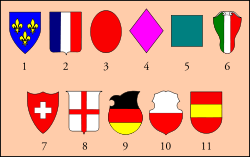
s in combat, and thus have varied and developed by region and by era. As this shape has been regarded as a war-like device appropriate to men only, British ladies customarily bear their arms upon a lozenge
Lozenge (heraldry)
The lozenge in heraldry is a diamond-shaped charge , usually somewhat narrower than it is tall. It is to be distinguished in modern heraldry from the fusil, which is like the lozenge but narrower, though the distinction has not always been as fine and is not always observed even today...
, or diamond-shape, while clergymen and ladies in continental Europe bear theirs on a cartouche
Cartouche (design)
A cartouche is an oval or oblong design with a slightly convex surface, typically edged with ornamental scrollwork. It is used to hold a painted or low relief design....
, or oval. Other shapes are in use, such as the roundel
Roundel
A roundel in heraldry is a disc; the term is also commonly used to refer to a type of national insignia used on military aircraft, generally circular in shape and usually comprising concentric rings of different colours.-Heraldry:...
commonly used for arms granted to Aboriginal Canadians by the Canadian Heraldic Authority
Canadian Heraldic Authority
The Canadian Heraldic Authority is part of the Canadian honours system under the Queen of Canada, whose authority is exercised by the Governor General. The Authority is responsible for the creation and granting of new coats of arms , flags and badges for Canadian citizens, permanent residents and...
.
Secondly, a shield can itself be a charge
Charge (heraldry)
In heraldry, a charge is any emblem or device occupying the field of an escutcheon . This may be a geometric design or a symbolic representation of a person, animal, plant, object or other device...
within a coat of arms. More often, a smaller shield is placed over the middle of the main shield (in pretence or en surtout) as a form of marshalling. In either case, the smaller shield is usually given the same shape as the main shield. When there is only one such shield, it is sometimes called an inescutcheon.
Etymology
The word escutcheon is derived from Middle EnglishMiddle English
Middle English is the stage in the history of the English language during the High and Late Middle Ages, or roughly during the four centuries between the late 11th and the late 15th century....
escochon, from Anglo-Norman
Anglo-Norman language
Anglo-Norman is the name traditionally given to the kind of Old Norman used in England and to some extent elsewhere in the British Isles during the Anglo-Norman period....
escuchon, from Vulgar Latin
Vulgar Latin
Vulgar Latin is any of the nonstandard forms of Latin from which the Romance languages developed. Because of its nonstandard nature, it had no official orthography. All written works used Classical Latin, with very few exceptions...
scūtiōn-, from Latin
Latin
Latin is an Italic language originally spoken in Latium and Ancient Rome. It, along with most European languages, is a descendant of the ancient Proto-Indo-European language. Although it is considered a dead language, a number of scholars and members of the Christian clergy speak it fluently, and...
scūtum, "shield". From its use in heraldry, escutcheon can be a metaphor for a family's honour. The idiom "a blot on the escutcheon" is used to mean a stain on somebody's reputation.
Varying shapes
Battle of Hastings
The Battle of Hastings occurred on 14 October 1066 during the Norman conquest of England, between the Norman-French army of Duke William II of Normandy and the English army under King Harold II...
and seen depicted on the Bayeux Tapestry
Bayeux Tapestry
The Bayeux Tapestry is an embroidered cloth—not an actual tapestry—nearly long, which depicts the events leading up to the Norman conquest of England concerning William, Duke of Normandy and Harold, Earl of Wessex, later King of England, and culminating in the Battle of Hastings...
(c.1066), occasionally with proto-heraldic cognizances painted thereon, pre-dates the era of heraldry proper, which commenced during the first quarter of the 13th century. By about 1250 the shields used in warfare were almost triangular in shape, referred to as heater shield
Heater shield
The heater shield or heater-shaped shield is a form of European medieval shield, developing from the early medieval kite shield in ca. the mid 13th century....
s. Such a shape can be seen on the effigy of William II Longespee
William II Longespee
Sir William II Longespée, long sword in French, was the son of William Longespée, 3rd Earl of Salisbury, and Ela, 3rd Countess of Salisbury...
(d.1250) at Salisbury Cathedral, whilst the shield shown on the effigy of his father William Longespee, 3rd Earl of Salisbury (d.1226) is of a more elongated form. That on the enamel monument to the latter's grandfather Geoffrey V, Count of Anjou
Geoffrey V, Count of Anjou
Geoffrey V , called the Handsome and Plantagenet, was the Count of Anjou, Touraine, and Maine by inheritance from 1129 and then Duke of Normandy by conquest from 1144...
(d.1151) is of almost full-body length. This heater-shaped form was used in warfare during the apogee of the Age of Chivalry
Chivalry
Chivalry is a term related to the medieval institution of knighthood which has an aristocratic military origin of individual training and service to others. Chivalry was also the term used to refer to a group of mounted men-at-arms as well as to martial valour...
, at about the time of the Battle of Crecy
Battle of Crécy
The Battle of Crécy took place on 26 August 1346 near Crécy in northern France, and was one of the most important battles of the Hundred Years' War...
(1346) and the founding of the Order of the Garter
Order of the Garter
The Most Noble Order of the Garter, founded in 1348, is the highest order of chivalry, or knighthood, existing in England. The order is dedicated to the image and arms of St...
(1348), when the art of Heraldry reached its greatest perfection. The almost triangular shape is therefore used as a setting for armorials from this "classical age" of heraldry, in the sense that it produced the best examples of the art. In the Tudor era the heraldic escutcheon took the shape of an inverted Tudor arch. Continental European designs frequently use the various forms used in jousting, which incorporate "mouths" used as lance rests into the shields. Such escutcheons are known as a bouche. The mouth is correctly shown on the dexter side only, as jousting pitches were designed for right-handed knights. Heraldic examples of English a bouche shields can be seen in the spandrel
Spandrel
A spandrel, less often spandril or splaundrel, is the space between two arches or between an arch and a rectangular enclosure....
s of the trussed timber roof of Lincoln's Inn
Lincoln's Inn
The Honourable Society of Lincoln's Inn is one of four Inns of Court in London to which barristers of England and Wales belong and where they are called to the Bar. The other three are Middle Temple, Inner Temple and Gray's Inn. Although Lincoln's Inn is able to trace its official records beyond...
Hall, London.
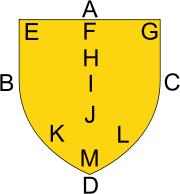
Points
The points of the shield refer to specific positions thereon and are used in blazonBlazon
In heraldry and heraldic vexillology, a blazon is a formal description of a coat of arms, flag or similar emblem, from which the reader can reconstruct the appropriate image...
s to describe where a charge
Charge (heraldry)
In heraldry, a charge is any emblem or device occupying the field of an escutcheon . This may be a geometric design or a symbolic representation of a person, animal, plant, object or other device...
should be placed.
Inescutcheon
An inescutcheon is a smaller escutcheon that is placed within or superimposed over the main shield of a coat of arms. This may be used for style, in pretencePretender
A pretender is one who claims entitlement to an unavailable position of honour or rank. Most often it refers to a former monarch, or descendant thereof, whose throne is occupied or claimed by a rival, or has been abolished....
, for territorial claims, or as a simple charge as borne for example by the Mortimers.
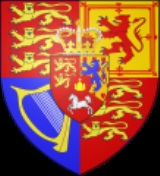
Inescutcheons may be placed within the field of a shield as a choice of heraldic style, such as in the arms of the Swedish Collegium of Arms (pictured at far left below) which bears the three crowns
Three Crowns
Three Crowns is a national emblem of Sweden, present in the Coat of Arms of the Realm of Sweden, and composed by three yellow or gilded coronets ordered two above and one below, placed on a blue background....
of Sweden, each upon its own escutcheon within the field of the main shield.
Inescutcheons may also be used to bear another's arms in "pretense". In English Heraldry
English heraldry
English heraldry is the form of coats of arms and other heraldic bearings and insignia used in England. It lies within the Gallo-British tradition. Coats of arms in England are regulated and granted to individuals by the College of Arms. They are subject to a system of cadency to distinguish...
the husband of an heraldic heiress
Heraldic heiress
In English heraldry an heraldic heiress is a daughter of deceased man who was entitled to a coat of arms and who carries forward the right to those arms for the benefit of her future male descendants...
– a lady without any brothers – may place her father's arms in an escutcheon of pretence in the centre of his own shield as a claim ("pretence") to be the head of his wife's family. In the next generation the arms would then be quartered
Quartering (heraldry)
Quartering in heraldry is a method of joining several different coats of arms together in one shield by dividing the shield into equal parts and placing different coats of arms in each division....
. In similar fashion, a monarch's personal arms may be borne on an inescutcheon en surtout over the territorial arms of his/her domains, as in the arms of the Danish Royal Family
Danish Royal Family
The Danish Royal Family includes the Queen of Denmark and her family. All members except the Queen hold the title of Prince/Princess of Denmark with the style of His/Her Royal Highness or His/Her Highness. The Queen is styled Her Majesty. The Queen and her siblings belong to the House of...
, the greater coat of arms of Sweden
Coat of arms of Sweden
The greater national coat of arms and the lesser national coat of arms are the official coats of arms of Sweden.- Escutcheon :...
, or the arms of the Commonwealth of England
Commonwealth of England
The Commonwealth of England was the republic which ruled first England, and then Ireland and Scotland from 1649 to 1660. Between 1653–1659 it was known as the Commonwealth of England, Scotland and Ireland...
1649–1660.
Inescutcheons also appear in personal and civic armory as simple common charges (for example, see the arms of the noble French family of Abbeville, pictured at far right below).
Further reading
- Fox-Davies, Arthur Charles (1909). A Complete Guide to Heraldry. New York: Dodge Pub. Co.