
All Topics  
Eric Shinseki

 
Eric Shinseki

   Email Print
   Bookmark   Link


Eric Shinseki


Eric Ken Shinseki (born November 28, 1942) is a retired U.S. Army four-star general
General (United States)

In the United States Army, United States Air Force, and United States Marine Corps, general is a 4 star rank general officer rank, with the U.S....
 who is currently serving as the 7th United States Secretary of Veterans Affairs
United States Secretary of Veterans Affairs

The United States Secretary of Veterans' Affairs is the head of the United States Department of Veterans Affairs, the department concerned with veterans' benefits and related matters....
. His final U.S. Army post was as the 34th Chief of Staff of the Army
Chief of Staff of the United States Army

File:USChiefofStaffArmy.PNGThe Chief of Staff of the United States Army is the highest ranking officer in the United States Army and is member of the Joint Chiefs of Staff ....
 (1998-2003). He is a veteran of combat in Vietnam, having been left with a maimed foot. During his tenure as Army Chief of Staff, Shinseki initiated an innovative but controversial plan to make the Army more strategically deployable and mobile in urban terrain by creating Stryker Interim-Force Brigade Combat Team
Stryker

The IAV Stryker is a family of eight-wheeled all wheel drive armored combat vehicles produced by General Dynamics Land Systems, in use by the United States Army....
s.


Discussion
Ask a question about 'Eric Shinseki'
Start a new discussion about 'Eric Shinseki'
Answer questions from other users
Full Discussion Forum


Encyclopedia


Eric Ken Shinseki (born November 28, 1942) is a retired U.S. Army four-star general
General (United States)

In the United States Army, United States Air Force, and United States Marine Corps, general is a 4 star rank general officer rank, with the U.S....
 who is currently serving as the 7th United States Secretary of Veterans Affairs
United States Secretary of Veterans Affairs

The United States Secretary of Veterans' Affairs is the head of the United States Department of Veterans Affairs, the department concerned with veterans' benefits and related matters....
. His final U.S. Army post was as the 34th Chief of Staff of the Army
Chief of Staff of the United States Army

File:USChiefofStaffArmy.PNGThe Chief of Staff of the United States Army is the highest ranking officer in the United States Army and is member of the Joint Chiefs of Staff ....
 (1998-2003). He is a veteran of combat in Vietnam, having been left with a maimed foot. During his tenure as Army Chief of Staff, Shinseki initiated an innovative but controversial plan to make the Army more strategically deployable and mobile in urban terrain by creating Stryker Interim-Force Brigade Combat Team
Stryker

The IAV Stryker is a family of eight-wheeled all wheel drive armored combat vehicles produced by General Dynamics Land Systems, in use by the United States Army....
s. He conceived a long term strategic plan for the Army dubbed Objective Force, which included a program he designed, Future Combat Systems
Future Combat Systems

Future Combat Systems is the United States Army's principal modernization program.FCS includes 14+1+1 systems consisting of unattended ground sensors , the Non-Line of Sight ? Launch System , two classes of unmanned aerial vehicles organic to platoon, and Brigade Combat Team echelons; two classes of unmanned ground vehicles, the Small U...
.

Shinseki publicly clashed with Secretary of Defense Donald Rumsfeld
Donald Rumsfeld

Donald Henry Rumsfeld is a United States businessman, politician, the 13th United States Secretary of Defense under President of the United States Gerald Ford from 1975 to 1977, and the 21st United States Secretary of Defense under President George W....
 during the planning of the war in Iraq
2003 invasion of Iraq

The 2003 invasion of Iraq, from March 20 to May 1, 2003, was spearheaded by the United States, backed by United Kingdom forces and smaller contingents from Australia, Spain, Poland and Denmark....
 over how many troops the U.S. would need to keep in Iraq for the postwar occupation of that country. As Army Chief of Staff, General Shinseki testified to the U.S. Senate Armed Services Committee
United States Senate Committee on Armed Services

File:United States Senate Committee on Armed Services, Levin D-MI & Warner R-VA, 7-31-2007.jpgThe Committee on Armed Services is a committee of the United States Senate empowered with Congressional oversight of the Military of the United States, including the United States Department of Defense, military research and development, nuclear ene...
 that "something in the order of several hundred thousand soldiers" would probably be required for postwar Iraq. This was an estimate far higher than the figure being proposed by Secretary Rumsfeld in his invasion plan, and it was rejected in strong language by both Rumsfeld and his Deputy Secretary of Defense
United States Deputy Secretary of Defense

The United States Deputy Secretary of Defense is the second-highest ranking official in the United States Department of Defense. According to the U.S....
, Paul Wolfowitz
Paul Wolfowitz

Paul Dundes Wolfowitz is a former United States Ambassador to Indonesia, United States Deputy Secretary of Defense, and President of the World Bank....
, who was another chief planner of the invasion and occupation. From then on, Shinseki's influence on the Joint Chiefs of Staff reportedly waned. The end of his term of Army Chief of Staff came in June 2003, just three months after the U.S. invasion of Iraq, and at that time General Shinseki retired from the Army after 38 years of military service.

When the insurgency
Iraqi insurgency

The Iraqi insurgency is composed of a diverse mix of militias, foreign fighters, all Iraqi units or mixtures using violent measures against the United States-led Multinational force in Iraq in Iraq and the post-2003 Iraqi government, or by propaganda or money supportive thereof....
 took hold in postwar Iraq, Shinseki's comments and their public rejection by the civilian leadership were often cited by those who felt the Bush administration deployed too few troops to Iraq. On November 15, 2006, in testimony before Congress, CENTCOM Commander Gen. John Abizaid
John Abizaid

John Philip Abizaid is a retired General in the United States Army and former Commander of the CENTCOM , overseeing American military operations in a 27-country region, from the Horn of Africa, the Arabian Peninsula, to South Asia and Central Asia, covering much of the Middle East....
 said that General Shinseki had been correct that more troops were needed.

Education and military service

Shinseki was born in Lihue, Kauai
Kauai

Kauai or Kauai is the oldest of the main Hawaiian Islands. With an area of , it is the fourth largest of the main islands in the Hawaiian archipelago and the List of islands of the United States by area....
 in the then Territory of Hawaii
Territory of Hawaii

The Territory of Hawaii, abbreviated officially as T.H., was established on July 7, 1898 and dissolved on August 21, 1959 when Hawaii became a state....
, to a Japanese American
Japanese American

are Americans of Japanese heritage. Japanese Americans have historically been among the three largest Asian American communities, but in recent decades have become the sixth largest group at roughly 1,204,205, including those of mixed-race or mixed-ethnicity....
 family. He graduated from the United States Military Academy
United States Military Academy

The United States Military Academy at West Point is a four-year coeducational United States Service academies located at West Point, New York, New York....
 in 1965 with a Bachelor of Science degree and a commission as a second lieutenant
Second Lieutenant

Second Lieutenant is the lowest Officer military rank in many armed forces.In British English the rank is pronounced second /l?f't?n?nt/ , while in American English it is pronounced second /lu't?n?nt/ ....
. He earned a Master of Arts
Master of Arts (postgraduate)

A Master of Arts is a Postgraduate education academic degree master degree awarded by University in many countries. The degree is typically studied for in English language, Fine Arts, History, Humanities, Philosophy, Social Sciences or Theology and can be either fully-taught, research-based, or a combination of the two....
 degree in English Literature from Duke University
Duke University

Duke University is a private university research university located in Durham, North Carolina, North Carolina, United States. Founded by Methodism and Religious Society of Friends in the present-day town of Trinity, North Carolina in 1838, the school moved to Durham in 1892....
. He was also educated at the Armor Officer Advanced Course, the United States Army Command and General Staff College
Command and General Staff College

The Command and General Staff College at Fort Leavenworth, Kansas is a United States Army facility that functions as a graduate school for United States Armed Forces and foreign military leaders....
, and the National War College
National War College

The National War College of the United States is a school in the National Defense University. It is housed in Roosevelt Hall on Fort Lesley J....
.
Shinseki 1965
Shinseki served in a variety of command and staff assignments in the Continental United States and overseas, including two combat tours
Tour of duty

In the military, a tour of duty is a period of time spent at sea or assigned to service in a foreign country.For example, in World War II a tour of duty for a Royal Air Force bomber crew was 30 flights....
 with the 9th and 25th Infantry Divisions in the Republic of Vietnam
South Vietnam

South Vietnam refers to an internationally recognized state which governed Vietnam south of the Vietnamese Demilitarized Zone until 1975. Its capital was Saigon and its origin can be traced to the French colony of Cochinchina, which consisted of the southern third of Vietnam....
 as an artillery forward observer
Artillery observer

An artillery observer is a soldier responsible for directing artillery fire and close air support onto enemy positions. Because artillery is an indirect-fire weapon system, the guns are rarely in line-of-sight of their target, often located tens of miles away....
 and as commander of Troop A, 3rd Squadron, 5th Cavalry Regiment. During one of those tours, he stepped on a land mine
Land mine

A land mine is an explosive device designed to be placed on or in the ground to explode when triggered by an operator or the proximity of a vehicle, person, or animal....
, which blew off the front of one of his feet.

He has served at Schofield Barracks, Hawai'i
Schofield Barracks, Hawai'i

Schofield Barracks is a United States Army installation and census-designated place located in the City and County of Honolulu and in the Wahiawa District of the island of Oahu, Hawaii, United States....
 with Headquarters, United States Army Hawaii, and Fort Shafter
Fort Shafter

Fort Shafter is in Honolulu, Hawaii, extending up the interfluve between Kalihi and Moanalua valleys, as well as onto the coastal plain at Mapunapuna....
 with Headquarters, United States Army Pacific. He has taught at the U.S. Military Academy’s Department of English. During duty with the 3rd Armored Cavalry Regiment at Fort Bliss
Fort Bliss

Fort Bliss is a United States Army post in the U.S. states of New Mexico and Texas. With an area of approximately , it is the second largest such installation in the Army behind the adjacent White Sands Missile Range, and the largest TRADOC installation....
, Texas
Texas

Texas is a U.S. state located in the South Central United States, nicknamed the Lone Star State. Texas is the second largest U.S. state in both area and population, spanning , and with a growing population of 24.3 million residents....
, he served as the regimental adjutant and as the executive officer of its 1st Squadron.

Shinseki’s ten-plus years of service in Europe included assignments as Commander, 3rd Squadron, 7th Cavalry, 3rd Infantry Division (Schweinfurt
Schweinfurt

Schweinfurt is a city in the Lower Franconia region of Bavaria in Germany on the right bank of the canalized Main, which is here spanned by several bridges, 27 km northeast of W?rzburg....
); Commander, 2nd Brigade, 3rd Infantry Division (Kitzingen
Kitzingen

Kitzingen is a town in the Germany state of Bavaria, capital of the Kitzingen . It is part of Franconia geographical region and has around 21,000 inhabitants....
); Assistant Chief of Staff, G3, 3rd Infantry Division (Operations, Plans and Training) (Würzburg); and Assistant Division Commander for Maneuver, 3rd Infantry Division (Schweinfurt). The 3rd ID was organized at that time as a heavy mechanized
Armoured warfare

Armoured warfare or tank warfare is the use of armoured fighting vehicles in modern warfare. It is a major component of modern Military science....
 division. He also served as Assistant Chief of Staff, G3 (Operations, Plans and Training), VII Corps (Stuttgart
Stuttgart

Stuttgart is the capital of the state of Baden-W?rttemberg in southern Germany. The list of cities in Germany, Stuttgart has a population of 590,429 while the metropolitan area referred to as Stuttgart Region has a population of 2.7 million ....
). Shinseki served as Deputy Chief of Staff for Support, Allied Land Forces Southern Europe (Verona
Verona

Verona is a city in Veneto, northern Italy, one of the seven provincial capitals in the region. It is one of the main tourist destinations in north-eastern Italy, thanks to its artistic heritage, several annual fairs, shows and operas, such as the lyrical season in the Arena, the ancient amphitheatre built by the Romans....
), an element of the Allied Command Europe
Supreme Headquarters Allied Powers Europe

Supreme Headquarters Allied Powers Europe is the central command of NATO military forces. It is located at Casteau, north of the Belgium city of Mons....
.

From March 1994 to July 1995, Shinseki commanded the 1st Cavalry Division at Fort Hood, Texas. In July 1996, he was promoted to lieutenant general
Lieutenant General (United States)

In the United States Army, the United States Marine Corps and the United States Air Force, lieutenant general is a 3 star rank general officer rank, with the U.S....
 and became Deputy Chief of Staff for Operations and Plans, United States Army. In June 1997, Shinseki was appointed to the rank of general
General (United States)

In the United States Army, United States Air Force, and United States Marine Corps, general is a 4 star rank general officer rank, with the U.S....
 before assuming duties as Commanding General, Seventh United States Army; Commander, Allied Land Forces Central Europe; and Commander, NATO
NATO

The North Atlantic Treaty Organization , also called the Atlantic Alliance, is a military alliance established by the signing of the North Atlantic Treaty on 4 April 1949....
 Stabilization Force
SFOR

The Stabilisation Force was a NATO-led multinational force in Bosnia and Herzegovina which was tasked with upholding the Dayton Agreement.The SFOR operated under the code name Operation Joint Guard and Operation Joint Forge ....
 in Bosnia and Herzegovina
Bosnia and Herzegovina

Bosnia and Herzegovina is a country on the Balkans peninsula of South Eastern Europe with an area of 51,129 square kilometres . Bordered by Croatia to the north, west and south, Serbia to the east, and Montenegro to the south, Bosnia and Herzegovina is Landlocked#Nearly landlocked, except for 26 kilometres of the Adriatic Sea coas...
. Shinseki became the Army's 28th Vice Chief of Staff
Vice Chief of Staff of the United States Army

The Vice Chief of Staff of the United States Army is the principal advisor and assistant to the Chief of Staff of the United States Army. He handles the day to day administration of the Army bureaucracy, freeing the Chief of Staff to attend to the interservice responsibilities of the Joint Chiefs of Staff....
 on 24 November 1998, then became its 34th Chief of Staff
Chief of Staff of the United States Army

File:USChiefofStaffArmy.PNGThe Chief of Staff of the United States Army is the highest ranking officer in the United States Army and is member of the Joint Chiefs of Staff ....
 on 22 June 1999. Shinseki retired on 11 June 2003 at the end of his four-year term. His Farewell Memo contained some of his ideas regarding the future of the military.

Shinseki is the only Japanese American
Japanese American

are Americans of Japanese heritage. Japanese Americans have historically been among the three largest Asian American communities, but in recent decades have become the sixth largest group at roughly 1,204,205, including those of mixed-race or mixed-ethnicity....
 and Asian American
Asian American

Asian Americans are United States of Asian people. They include sub-ethnic groups such as Chinese Americans, Filipino Americans, Indian Americans, Vietnamese Americans, Korean Americans, Japanese Americans and others whose national origin is from the Asia....
 to be promoted to the Army's top position and is the first four star general of Asian descent in the US military.

Tensions with Rumsfeld while Army Chief of Staff

Shinseki's tenure as Chief of Staff was marked by tensions with Defense Secretary
United States Secretary of Defense

File:USSecDefflag.PNGThe United States Secretary of Defense is the head of the United States Department of Defense , concerned with the Military of the United States and Military of the United States....
 Donald Rumsfeld
Donald Rumsfeld

Donald Henry Rumsfeld is a United States businessman, politician, the 13th United States Secretary of Defense under President of the United States Gerald Ford from 1975 to 1977, and the 21st United States Secretary of Defense under President George W....
. As incoming secretary, Rumsfeld publicly addressed and ultimately supported Shinseki's controversial decision on March 16, 2001 to issue all Army troops black berets, previously worn only by United States Army Rangers
United States Army Rangers

The United States Army Rangers or simply Army Rangers are specialized, elite American Light Infantry special operations forces capable of conducting Direct action operations....
.

In 2001, Shinseki reportedly staved off suggestions by Rumsfeld and his aides that the Army be reduced in size. According to one source, at their first meeting Shinseki told Rumsfeld that his orders would not be implemented. The Quadrennial Defense Review issued in 2001 maintained the existing size of the Army. Another fight ensued in 2002, when Rumsfeld cancelled the XM2001 Crusader
XM2001 Crusader

The XM2001 Crusader was to be the United States Army's next-generation Self-propelled artillery howitzer , designed to improve survivability, lethality, mobility, and effectiveness and planned to be introduced by 2008....
, an artillery system supported by Shinseki and members of Congress.

On at least one occasion, Rumsfeld praised Shinseki
General Keane [and] General Shinseki, they're outstanding Army officers. There's just no question about it. And they say what they believe, and they tell the truth. And they're honorable people and talented people.


Defense strategist Thomas P. M. Barnett
Thomas Barnett

Thomas P.M. Barnett is an United States military geostrategist....
, in a 2005 piece for Esquire
Esquire (magazine)

Esquire is a men's magazine by the Hearst Corporation with a strong literary tradition. Founded in 1933, it flourished during the Great Depression under the guidance of founder and editor Arnold Gingrich....
 magazine, captured the thoughts of Rumsfeld's aides in the Office of the Secretary of Defense. Aides felt Shinseki became "too fixated on improving the Army's efficiency in combat without questioning the relevance of the capabilities he was developing, as in, Great force, wrong war." Rumsfeld and his aides believed systems like Crusader, while superb for a Cold War-era fight, were not relevant to 21st-century threats that required speed and precision.

In April 2002, 14 months before Shinseki was due to retire, The Washington Post
The Washington Post

The Washington Post is the newspaper with the largest circulation in Washington, D.C., United States and is the city's oldest paper, founded in 1877....
 reported, quoting "Pentagon officials", that his replacement had already been selected. "In another unusual move, Rumsfeld has tapped Army Gen. Jack Keane
Jack Keane

John Keane is a retired four-star general and former Vice Chief of Staff of the United States Army, and a defense analyst.Keane attended Fordham University, graduating with a bachelor's degree in accounting in 1966....
, the No. 2 officer in the Army, to succeed the current chief of that service, Gen. Eric Shinseki, whose term runs out next year. Selecting a successor for the current chief so far in advance is highly unusual." This reported departure from precedent somewhat undercut Shinseki's authority within the Army. However, it has never been established where this report came from, or whether it had any basis in fact; in the event, Shinseki's successor was not Keane, but Peter Schoomaker
Peter Schoomaker

Peter J. Schoomaker is a former four-star General in the United States Army and served as the 35th Chief of Staff of the United States Army from August 1, 2003 to April 10, 2007....
.

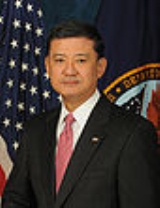
Eric Shinseki Official Portrait
The personality clash between Shinseki and Rumsfeld was well known. Shinseki had a reputation as a quiet, reserved officer, while Rumsfeld had a history of subjecting senior officers to tough questioning and "wire-brushing." (Barnett describes wire-brushing as, "Chewing them out, typically in a public way that's demeaning to their stature. It's pinning their ears back, throwing out question after question you know they can't answer correctly and then attacking every single syllable they toss up from their defensive crouch.") Shinseki and other army officers resented Rumsfeld's rough treatment of officers, while Rumsfeld and his aides felt the military had to be challenged vigorously for the civilians to exercise effective control of the department and steer it in the direction in which they wanted it to go.

Commenting on the personality clash on MSNBC's Hardball with Chris Matthews
Hardball with Chris Matthews

Hardball with Chris Matthews is a talk show on MSNBC broadcast weekdays at 5 and 7 PM hosted by Chris Matthews. It originally aired on now-defunct America's Talking and later CNBC....
 , General Tommy Franks
Tommy Franks

General Tommy Ray Franks, United States Army, Order of the British Empire, is a retired General in the United States Army. His last Army post was as the Commander of the United States U.S....
 (ret.) said, "I think, Chris, you will find personalities that get along and you find personalities that do not get along...It was sort of like oil and water...there certainly was friction there". Franks also said that the media had blown Shinseki's comments and his treatment out of proportion. He said Shinseki's concerns about the war plan focused on the logistics support for the invasion and occupation of Iraq.

Regarding the 2003 Invasion of Iraq

Personality clashes apart, Shinseki and Rumsfeld had significantly different approaches to military doctrine. For example, following September 11, 2001, Rumsfeld was in a meeting whose subject was the review of the Department of Defense's (Contingency) Plan in the event of a war with Iraq (U.S. Central Command OPLAN 1003-98). The plan (as it was then conceived) contemplated troop levels of up to 500,000, which Rumsfeld opined was far too many. Gordon and Trainor wrote:

As [General] Newbold outlined the plan … it was clear that Rumsfeld was growing increasingly irritated. For Rumsfeld, the plan required too many troops and supplies and took far too long to execute. It was, Rumsfeld declared, the "product of old thinking and the embodiment of everything that was wrong with the military."

* * *

[T]he Plan . . . reflected long-standing military principles about the force levels that were needed to defeat Iraq, control a population of more than 24 million, and secure a nation the size of California with porous borders. Rumsfeld's numbers, in contrast, seemed to be pulled out of thin air. He had dismissed one of the military's long-standing plans, and suggested his own force level without any of the generals raising a cautionary flag.

Id.


While Shinseki was not at the OPLAN 1003-98 review mentioned above, he no doubt hewed to the traditional military view concerning force levels necessary for an Iraq invasion. It is, however, unclear how strongly Shinseki communicated to the DOD head views which diverged from those which Rumsfeld had forcefully communicated to the military command structure. While Shinseki's reticence to publicly speak on the questions of possible conflicts between himself and the Bush administration is well-known, he is on record as stating that it is "probably fair" to say that he should have banged on the table and pushed harder to stop Rumsfeld from going into Iraq with too few troops.

On February 25, 2003, four months before the end of his term as Chief of Staff of the Army, Shinseki told the Senate Armed Services Committee
United States Senate Committee on Armed Services

File:United States Senate Committee on Armed Services, Levin D-MI & Warner R-VA, 7-31-2007.jpgThe Committee on Armed Services is a committee of the United States Senate empowered with Congressional oversight of the Military of the United States, including the United States Department of Defense, military research and development, nuclear ene...
 that he thought an occupying force of several hundred thousand men would be needed to stabilize postwar Iraq. He was pressed to provide a range by Senator Carl Levin
Carl Levin

Carl Milton Levin is a Democratic Party United States Senate from Michigan and is the Chairman of the United States Senate Committee on Armed Services....
 (D-MI). Below is an excerpt from the exchange:

Levin: General Shinseki, could you give us some idea as to the magnitude of the Army's force requirement for an occupation of Iraq following a successful completion of the war?
Shinseki: In specific numbers, I would have to rely on combatant commanders' exact requirements. But I think --
Levin: How about a range?
Shinseki: I would say that what's been mobilized to this point -- something on the order of several hundred thousand soldiers are probably, you know, a figure that would be required. We're talking about posthostilities control over a piece of geography that's fairly significant, with the kinds of ethnic tensions that could lead to other problems. And so it takes a significant ground-force presence.


In a public rebuke to Shinseki, Rumsfeld and his deputy, Paul Wolfowitz
Paul Wolfowitz

Paul Dundes Wolfowitz is a former United States Ambassador to Indonesia, United States Deputy Secretary of Defense, and President of the World Bank....
, called Shinseki's estimate "far off the mark" and "wildly off the mark". Wolfowitz said it would be "hard to believe" more troops would be required for postwar Iraq than to remove Saddam Hussein from power. Specifically, Wolfowitz said to the House Budget Committee on February 27, 2003:

Wolfowitz: There has been a good deal of comment - some of it quite outlandish - about what our postwar requirements might be in Iraq. Some of the higher end predictions we have been hearing recently, such as the notion that it will take several hundred thousand U.S. troops to provide stability in post-Saddam Iraq, are wildly off the mark. I would expect that even countries like France will have a strong interest in assisting Iraq's reconstruction. We can't be sure that the Iraqi people will welcome us as liberators ... [but] I am reasonably certain that they will greet us as liberators, and that will help us to keep requirements down. It is hard to conceive that it would take more forces to provide stability in post-Saddam Iraq than it would take to conduct the war itself and to secure the surrender of Saddam's security forces and his army - hard to imagine.


On November 15, 2006, Gen. John P. Abizaid, chief of the U.S. Central Command, in testimony before the Senate Armed Services Committee, acknowledged that in his view, and with hindsight, Shinseki had been correct in his view that a larger postwar force was needed. Abizaid noted that this force could have included Iraqi or international forces in addition to American force:
Graham
Lindsey Graham

Lindsey Olin Graham is an United States politician from South Carolina. A member of the Republican Party , he is currently the senior United States Senate from that state....
: Was General Shinseki correct when you look backward that we needed more troops to secure the country, General Abizaid?
Abizaid: General Shinseki was right that a greater international force contribution, U.S. force contribution, and Iraqi force contribution should have been available immediately after major combat operations.


Contrary to Democratic candidate John Kerry
John Kerry

John Forbes Kerry is the Junior Senator United States Senate from Massachusetts and chairman of the Senate Foreign Relations Committee.As the Presidential nominee of the Democratic Party , he was defeated by 34 electoral votes in the United States presidential election, 2004 by the Republican Party incumbent President of the United States...
's claim, in the first debate of the 2004 presidential election, Shinseki was not "retired" for his testimony before Congress. His official term as Chief of the Army ended four months later and he retired as scheduled. However, the tension between the civilians in the Office of the Secretary of Defense and Shinseki were apparent. No senior civilians attended Shinseki's retirement ceremony, which broke historical precedent. Most Army officers and Senior enlisted, such as Major General John Batiste
John Batiste

Major General John Batiste is a retired officer of the United States Army.From March 2001 to June 2002 he worked with Paul Wolfowitz, and was involved in the very early planning stages of the Iraq war....
 (ret.) who called for Rumsfeld's resignation, saw this as an intentional slight and foremost sign of disrespect directed toward Shinseki by the civilian leadership.

Secretary Rumsfeld, on the other hand, suggests that Shinseki did not invite any civilians to his retirement ceremony, although that claim cannot be verified since Shinseki has not commented on the issue.

Douglas Feith
Douglas Feith

Douglas J. Feith served as the Under Secretary of Defense for Policy for President of the United States George W. Bush from July 2001 until he resigned from his position effective August 8, 2005....
, the former United States Under Secretary of Defense was interviewed by the CBS news magazine 60 Minutes
60 Minutes

or 60 Minutes 60 Minutes is an United States investigative television newsmagazine on United States television, which has run on CBS News since 1968....
 in a segment that was aired on April 6, 2008. During his interview Feith conceded that he and his colleagues didn’t realize that sending a smaller, mobile force to topple Saddam would make it difficult to establish order after he fell. "The looting that arose in the immediate aftermath of the overthrow of Saddam … was a problem that the coalition forces had to deal with. I think we paid a very large price for the fact that, you know, our forces did not get that problem under control." In his memoirs, Feith writes, "The small force strategy for major combat operations, while it saved American lives, limited the number of forces we had to deal with the looting.”

Postmilitary career

Shinseki has served as a director for several corporations: Honeywell International and Ducommun
Ducommun

Ducommun Incorporated provides manufacturing, engineering, and support services to the global aerospace and defense industry. It manufactures structural and electronic components and subassemblies for a wide variety of commercial, military, and space aircraft, notably for the Boeing 737 NG and 777 airliners, the C-17 heavy lift cargo jet, the...
, military contractors; Grove Farm Corporation; First Hawaiian Bank
First Hawaiian Bank

First Hawaiian Bank is a regional commercial bank headquartered in Honolulu, Hawaii at the First Hawaiian Center. It is a subsidiary of BancWest, which itself is a subsidiary of the French banking company, BNP Paribas....
; and Guardian Life Insurance Company of America. He is a member of the Advisory Boards at the Center for Public Leadership
Center for Public Leadership

The Center for Public Leadership was established in 2000 through a generous gift from the Wexner Foundation. Since its founding, the center has grown to provide teaching and research as well as training in the practical skills of leadership for people in government, nonprofits, and business....
, John F. Kennedy School of Government
John F. Kennedy School of Government

The John F. Kennedy School of Government at Harvard University is a public policy school and public administration school, and one of Harvard's graduate and professional schools....
, Harvard University
Harvard University

Harvard University is a private university in Cambridge, Massachusetts, Massachusetts, United States, and a member of the Ivy League. Founded in 1636 by the colonial Massachusetts legislature, Harvard is the Colonial Colleges institution of higher learning in the United States....
, and to the U.S. Comptroller General. He is a member of the Council on Foreign Relations
Council on Foreign Relations

The Council on Foreign Relations is an American nonpartisan foreign policy membership organization founded in 1921 and based at 58 East 68th Street in New York City, with an additional office in Washington, D.C....
, the Atlantic Council of the United States, and the Association of the United States Army.

Secretary of Veterans Affairs

On December 7, 2008, President-elect
President-elect of the United States

The President-elect of the United States is the title used for an incoming President of the United States in the liminal period between the general election on Election Day in November and noon eastern standard time on United States presidential inauguration, January 20th....
 Barack Obama
Barack Obama

Barack Hussein Obama II is the List of Presidents of the United States and current President of the United States. He is the first African American to hold the office....
 announced at a Chicago press conference that once in office, he would nominate Shinseki to become the Secretary of Veterans Affairs
United States Secretary of Veterans Affairs

The United States Secretary of Veterans' Affairs is the head of the United States Department of Veterans Affairs, the department concerned with veterans' benefits and related matters....
. He was unanimously confirmed by the United States Senate
United States Senate

The United States Senate is the upper house of the Bicameralism United States Congress, the lower house being the United States House of Representatives....
 on January 20, 2009 and sworn in January 21, 2009.

Awards, Decorations and Badges

Defense Distinguished Service Medal

The Defense Distinguished Service Medal is a Awards and decorations of the United States military which is presented for exceptionally distinguished performance of duty contributing to national security or defense of the United States....
Army Distinguished Service Medal
Legion of Merit
Legion of Merit

The Legion of Merit is a Awards and decorations of the United States military of the United States armed forces that is awarded for exceptionally meritorious conduct in the performance of outstanding services and achievements....
 (with Oak Leaf Cluster)
Bronze Star
Bronze Star Medal

The Bronze Star Medal is a Military of the United States individual Awards and decorations of the United States military which may be awarded for bravery, acts of merit, or meritorious service....
 (with "V" Device and two Oak Leaf Clusters)
Purple Heart
Purple Heart

The Purple Heart is a United States Awards and decorations of the United States military awarded in the name of the President of the United States to those who have been wounded or killed while serving on or after April 5, 1917 with the Military of the United States....
 (with Oak Leaf Cluster)
Meritorious Service Medal
Meritorious Service Medal (United States)

The Meritorious Service Medal is a Awards and decorations of the United States military presented to members of the United States Armed Forces who distinguished themselves by outstanding non-combat meritorious achievement or service to the United States subsequent to January 16, 1969....
 (with two Oak Leaf Clusters)
Defense Meritorious Service Medal

The Defense Meritorious Service Medal is the third-highest award bestowed upon members of the United States military by the United States Department of Defense....
Air Medal
Air Medal

The Air Medal is a Awards and decorations of the United States military of the United States which was established by Executive Order 9158, signed by Franklin Delano Roosevelt, on May 11, 1942....


Parachutist Badge
Parachutist Badge (United States)

The Parachutist Badge, also commonly referred to as "Jump Wings" or "Snow Cone", is a Military badges of the United States of the United States Armed Forces which is awarded to members of the United States Army, United States Air Force, United States Marine Corps and United States Navy....
Ranger Tab
Ranger Tab

The Ranger Tab is a service school Military badges of the United States of the United States Army signifying completion of the 61-day long Ranger School course in small-unit infantry combat tactics in woodland, mountain, and swamp operations....
Joint Chiefs of Staff Identification Badge
Army Staff Identification Badge

The Army Staff Identification Badge is a badge of the United States Army worn by personnel who serve at the Office of the Secretary of the Army and the Army Staff at Department of the Army Headquarters and its agencies....


See also


Further reading

  • Burlas, Joe. , ARNEWS, June 10, 2003.
  • , September 14, 2001, published on ARNEWS. (URL retrieved May 28, 2006)
  • Siemieniec, Jack. , ARNEWS, January 31, 2000. (URL retrieved May 27, 2006)
  • Dickey, Connie. "Chief of Staff shares his concerns for the soldier and the Army"], ARNEWS, June 28, 1999. From media interview 3 days after becoming Army Chief of Staff. (URL retrieved May 27, 2006)


External links


|-