
All Topics  
Equity

 
Equity

   Email Print
   Bookmark   Link


Equity


Equity is the name given to the set of legal
LAW

LAW may refer to:* Anti-tank warfare, e.g. the US Army M72 LAW or the British Army LAW 80*Palestinian Society for the Protection of Human Rights ...
 principles, in jurisdictions following the English
English law

English law is the Legal systems of the world of England and Wales, and is the basis of common law legal systems used in most Commonwealth of Nations countriesand the United States ....
 common law
Common law

Common law refers to law and the corresponding Legal systems of the world developed through legal opinion of courts and similar tribunals , rather than through statute law or Executive ....
 tradition, which supplement strict rules of law where their application would operate harshly, so as to achieve what is sometimes referred to as "natural justice".


Discussion
Ask a question about 'Equity'
Start a new discussion about 'Equity'
Answer questions from other users
Full Discussion Forum


Encyclopedia


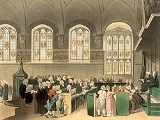
Court of Chancery Edited
Equity is the name given to the set of legal
LAW

LAW may refer to:* Anti-tank warfare, e.g. the US Army M72 LAW or the British Army LAW 80*Palestinian Society for the Protection of Human Rights ...
 principles, in jurisdictions following the English
English law

English law is the Legal systems of the world of England and Wales, and is the basis of common law legal systems used in most Commonwealth of Nations countriesand the United States ....
 common law
Common law

Common law refers to law and the corresponding Legal systems of the world developed through legal opinion of courts and similar tribunals , rather than through statute law or Executive ....
 tradition, which supplement strict rules of law where their application would operate harshly, so as to achieve what is sometimes referred to as "natural justice". It is often confusingly contrasted with "law", which in this context refers to "statutory law
Statutory law

Statutory law or statute law is written law set down by a legislature or other governing authority such as the executive branch of government in response to a perceived need to clarify the functioning of government, improve civil order, to codification existing law, or for an individual or company to obtain special treatment....
" (the laws enacted by a legislature
Legislature

Legislature is a type of representative deliberative assembly with the power to create and change laws. The law created by a legislature is called legislation or statutory law....
, such as Parliament
Parliament

A parliament is a legislature, especially in those countries whose system of government is based on the Westminster system modeled after that of the United Kingdom....
), and "common law" (the principles established by judges when they decide cases).

In modern practice, perhaps the most important distinction between law and equity is the set of remedies each offers. The most common civil remedy a court of law can award is monetary damages. Equity, however, enters injunctions or decrees directing someone either to act or to forbear from acting. Often this form of relief is in practical terms more valuable to a litigant; for example, a plaintiff whose neighbor will not return his only milk cow, which had wandered onto the neighbor's property, may want that particular cow back, and not just its monetary value. However, in general, a litigant cannot obtain equitable relief unless there is "no adequate remedy at law"; that is, a court will not grant an injunction unless monetary damages are an insufficient remedy for the injury in question. Law courts also enter orders, called "writ
Writ

In law, a writ is a formal written order issued by a body with administrative or judicial jurisdiction. In modern usage, this public body is generally a court....
s" (such as a writ of habeas corpus
Habeas corpus

For the Living Things CD, see Habeas Corpus Habeas corpus is a legal action, or writ, through which a person can seek justice from the unlawful detention of him or herself, or of another person....
), but they are less flexible and less easily obtained than an injunction
Injunction

An injunction is an equitable remedy in the form of a court order, whereby a party is required to do, or to refrain from doing, certain acts. The party that fails to adhere to the injunction faces civil or criminal penalties and may have to pay damages or accept sanctions for failing to follow the court's order....
.

Another distinction is the unavailability of a jury in equity: the judge is the trier of fact
Trier of fact

A trier of fact is a person who determines Question of facts in a legal proceeding. To determine a fact is to decide, from the evidence, whether something existed or some event occurred....
. In the American legal system, the right of jury trial
Jury trial

A jury trial is a legal proceeding in which a jury either makes a decision or makes findings of fact which are then applied by a judge. It is be distinguished from a bench trial, in which a judge or panel of judges make all decisions....
 in civil cases tried in federal court is guaranteed by the Seventh Amendment
Seventh Amendment to the United States Constitution

The Seventh Amendment of the United States Constitution, which is part of the United States Bill of Rights, codifies the right to a jury trial in certain civil trials....
, but only "[i]n Suits at common law," i.e., in cases that traditionally would have been handled by the law courts. The question of whether a case should be determined by a jury depends largely on the type of relief the plaintiff requests. If a plaintiff requests damages in the form of money or certain other forms of relief, such as the return of a specific item of property, the remedy is considered legal, and a jury is available as the fact-finder. On the other hand, if the plaintiff requests an injunction
Injunction

An injunction is an equitable remedy in the form of a court order, whereby a party is required to do, or to refrain from doing, certain acts. The party that fails to adhere to the injunction faces civil or criminal penalties and may have to pay damages or accept sanctions for failing to follow the court's order....
, declaratory judgment
Declaratory judgment

A declaratory judgment is a judgment of a court in a civil case which declares the rights, duties, or obligations of each party in a dispute. It is commonly called a declaratory ruling, a term which also includes decisions of regulatory government agency....
, specific performance
Specific performance

In the law of Judicial_remedy, an order of specific performance is an order of the court which requires a party to perform a specific act, usually what is stated in a contract....
, or modification of contract, or some other non-monetary relief, the claim would usually be one in equity.

A final important distinction between law and equity is the source of the rules governing the decisions. In law, decisions are made by reference either to legal doctrines or to statutes.In contrast, equity, with its emphasis on fairness and flexibility, has only general guides known as the maxims of equity
Maxims of equity

The maxims of Equity evolved, in Latin and eventually translated into English language, as the principles applied by Court of equity in deciding cases before them....
. As noted below, a historic criticism of equity as it developed was that it had no fixed rules of its own, with the Lord Chancellor
Lord Chancellor

The Lord High Chancellor of Great Britain, or Lord Chancellor, is a senior and important functionary in the government of the United Kingdom....
 from time to time judging in the main according to his own conscience. As time went on the rules of equity did lose much of their flexibility, and from the 17th century onwards equity was rapidly consolidated into a system of precedents much like its common-law
Common law

Common law refers to law and the corresponding Legal systems of the world developed through legal opinion of courts and similar tribunals , rather than through statute law or Executive ....
 cousin.

Charles Dickens
Charles Dickens

Charles John Huffam Dickens, Royal Society of Arts , pen-name "Boz", was the most popular English people novelist of the Victorian era, as well as a vigorous Reform movement....
' Bleak House
Bleak House

Bleak House is the ninth novel by Charles Dickens, published in twenty monthly installments between March 1852 and September 1853. It is held to be one of Dickens's finest and most complete novels, containing one of the most vast, complex and engaging arrays of minor characters and sub-plots in his entire canon....
 parodied
Parody

A parody , in contemporary usage, is a work created to mock, comment on, or poke fun at an original work, its subject, or author, or some other target, by means of humorous, satiric or ironic imitation....
 the excessive time and expense associated with the Court of Chancery, the court that heard suits in equity in 19th-century England
England

native_name =|conventional_long_name = England|common_name = England|image_flag = Flag of England.svg|image_coat = England COA.svg|symbol_type = Royal Coat of Arms...
.

History

The distinction between "law" and "equity" is an accident of history
HIStory

HIStory: Past, Present and Future, Book I is a double album by Michael Jackson, released on June 20, 1995, and is Jackson's ninth. The first disc, named "HIStory Begins" consists of a selection of Jackson's greatest hits from the singer's past fifteen years, while the second, named "HIStory Continues" features new songs, with the...
. The "law courts" or "courts of law" were the courts in England
England

native_name =|conventional_long_name = England|common_name = England|image_flag = Flag of England.svg|image_coat = England COA.svg|symbol_type = Royal Coat of Arms...
 that enforced the king's laws in medieval times. At the end of the 13th century the courts of law gradually froze the types of claims they would hear, and the procedure that governed the hearing of those claims. Because the range of legal claims at that time was quite narrow, legal procedures were painfully hypertechnical, with the result that many deserving plaintiffs were denied relief.

However, remedies could also be obtained through filing a petition
Petition

A petition is a request to change some thing, most commonly made to a government official or public entity. Petitions to a deity are a form of prayer....
 with the king, who held residual judicial power; these filings were usually phrased in terms of throwing oneself upon the king's mercy or conscience. Eventually, the king began to regularly delegate the function of resolving such petitions to the Chancellor
Lord Chancellor

The Lord High Chancellor of Great Britain, or Lord Chancellor, is a senior and important functionary in the government of the United Kingdom....
, an important member of the King's Council. At the time, the Chancellor was usually a clergyman and the King's confessor, so he was literally the keeper of the King's conscience. Soon the Chancery
Court of Chancery

The Court of Chancery was one of the court of equity in Courts of the United Kingdom....
, the Crown's secretarial department, began to resemble a judicial body and became known as the "Court of Chancery".

By the 15th century, the judicial power of the Chancery was recognised. Equity, as a body of rules, varied from Chancellor to Chancellor, until the end of the 16th century. After the end of the 17th century, only lawyers were appointed to the office of Chancellor.

One area in which the Court of Chancery assumed a vital role was the enforcement of uses, a role which the rigid framework of land law could not accommodate. This role gave rise to the basic distinction between legal and equitable interests.

Development of equity in England

It was early provided that, in seeking to remove one who wrongfully entered anothers land with force and arms, a person could allege disseisin (dispossession) and demand (and pay for) a writ of entry. That writ not only gave him the written right to re-enter his own land, but it also established this right under the protection of the Crown
The Crown

Throughout the Commonwealth realms, the Crown is an abstract metonymy concept which represents the legal authority for the existence of any government....
 if need be, whence its value. In 1253, to prevent judges from inventing new writs, Parliament
Parliament

A parliament is a legislature, especially in those countries whose system of government is based on the Westminster system modeled after that of the United Kingdom....
 provided that the power to issue writs would thereafter be transferred to judges only one writ at a time, in a "writ for right" package known as a form of action. However, because it was limited to enumerated writs for enumerated rights and wrongs, the writ system sometimes produced unjust results. Thus, even though the King's Bench might have jurisdiction over a case and might have the power to issue the perfect writ, the plaintiff might still not have a case if there was not a single form of action combining them. Therefore, lacking a legal remedy, the plaintiff's only option would be petitioning the King.

People started petitioning the King for relief against unfair judgments and as the number of petitioners rapidly grew, the King delegated the task of hearing petitions to the Lord Chancellor. The first Chancellors were men of the cloth
Clergy

Clergy is the generic term used to describe the formal religious leadership within a given religion. The term comes from the Greek language ?????? - kleros, "a lot", "that which is assigned by lot" or metaphorically, "heritage"....
, and they were required to pass judgment guided by conscience and based on morals and equality. It has been suggested that ecclesiastics were chosen for this position as they belonged to the small class of people who were able to read and write.

As these Chancellors had no formal legal training, and were not guided by precedent, their decisions were often widely diverse. However, in 1529 a lawyer, Sir Thomas More
Thomas More

Saint Thomas More was an English lawyer, author, and statesman who in his lifetime gained a reputation as a leading Renaissance humanist scholar, and occupied many public offices, including Lord Chancellor ....
, was appointed as Chancellor, marking the beginning of a new era. After this time, all future Chancellors were lawyers, and from around 1557 onwards, records of proceedings in the Courts of Chancery were kept, leading to the development of a number of equitable doctrines. Criticisms continued. The 17th century jurist John Selden
John Selden

John Selden was an England jurist, scholar of England's ancient laws and constitution and scholar of Jewish law. He was known as a polymath showing true intellectual depth and breadth; John Milton hailed Selden as "the chief of learned men reputed in this land."...
 once said that “equity varies with the length of the Chancellor’s foot”.

As the law of equity developed, it began to rival and conflict with the common law. Litigants would go ‘jurisdiction shopping’ and often would seek an equitable injunction prohibiting the enforcement of a common law court order. The penalty for disobeying an equitable ‘common injunction’ and enforcing a common law judgment was imprisonment.

The Chief Justice of the King’s Bench, Sir Edward Coke
Edward Coke

Sir Edward Coke , was a seventeenth-century England jurist and Member of Parliament whose writings on the English common law were the definitive legal texts for nearly 150 years....
 began the practice of issuing writs of habeas corpus that required the release of people imprisoned for contempt of chancery orders.

This tension grew to an all-time high in the Earl of Oxford’s case (1615), where a judgment of Coke CJ was allegedly obtained by fraud. The Lord Chancellor, Lord Ellesmere
Thomas Egerton, 1st Viscount Brackley

Thomas Egerton, 1st Viscount Brackley was an England Peerage of England, Judge and Statesman who served as Lord Keeper of the Great Seal and Lord Chancellor for twenty-one years....
, issued a common injunction out of the Chancery prohibiting the enforcement of the common law order. The two courts became locked in a stalemate, and the matter was eventually referred to the Attorney-General, Sir Francis Bacon
Francis Bacon

Francis Bacon, 1st Viscount St Alban King's Counsel , son of Nicholas Bacon by his second wife Anne Bacon, was an English philosopher, statesman, scientist, lawyer, jurist, and author....
. Sir Francis, by authority of King James I
James I of England

James VI and I was List of monarchs of Scotland as James VI, and List of English monarchs and King of Ireland as James I. He ruled in Kingdom of Scotland as James VI from 24 July 1567, when he was only one year old, succeeding his mother Mary I of Scotland....
, upheld the use of the common injunction and concluded that in the event of any conflict between the common law and the equity, equity would prevail. Equity's primacy in England was later enshrined in the Judicature Acts of the 1870s, which also served to fuse the courts of equity and the common law (although emphatically not the systems themselves) into one unified court system.

Once equity became a body of law, rather than an arbitrary exercise of conscience there was no reason why it needed its own courts. Consequently the Judicature Act was established, which is the basis of the court structure in England to this date, and that there would no longer be different procedures for seeking equitable and common law remedies. The Judicature Acts fused only the administration
Administration

In business, administration consists of the performance or management of business operations and thus the making or implementing of major decisions....
 of common law and equity; there is still a body of rules of equity which is quite distinct from that of common law rules, and acts as an addition to it. Although they are implemented by the same courts, the three branches of the law are separate. Where there is conflict, equity still prevails.

Statute of Uses 1535

In order to avoid paying land taxes and other feudal dues, lawyers developed a primitive form of trust called ‘the use’. This trust enabled one person (who was not required to pay tax) to hold the legal title of the land for the use of another person. The effect of this trust was that the first person owned the land under the common law, but the second person had a right to use the land under the law of equity.

Henry VIII enacted the Statute of Uses
Statute of Uses

The Statute of Uses is an Act of Parliament of the Parliament of England passed during the reign of Henry VIII of England which converted all England Equity estates that were created through "use " into legal estates....
 in 1535 (which became effective in 1536) in an attempt to outlaw this practice and recover lost revenue. The Act effectively made the beneficial owner of the land the legal owner, and liable for feudal dues.

The response of the lawyers to this Statute was to create the ‘use upon a use’. The Statute recognised only the first use, and so land owners were again able to separate the legal and beneficial interests in their land.

For an example, see Godwyne v. Profyt (after 1393): a petition to the Chancellor

See generally treatises on equity and trusts.

Comparison of equity traditions in common law countries

As with the geographical transmission of any cultural artifact, direct English influence over equity weakened with time and distance. However, the widespread import of printed opinions provided a corrective force, however long delayed. As the colonies gained political independence, each of their legal systems began drifting from the original in an irreversible departure from the English way of making laws and deciding cases. Nonetheless, each former colony acknowledged the reception the common law and equity of England as a vital source of their jurisprudence.

The comparative question is an easy one to pose. Did English equity develop maturity early enough that all of its derivative systems necessarily tended toward the same doctrines because based on exactly the same set of general principles? Or did the split-offs of any of the colonies occur somewhere in the middle of its development so that substantial permanent differences resulted? One equity? or many?

The answer generally accepted in America, the earliest of the English colonies to gain independence, is the former, that the outcome of a case to be decided today upon principles of equity should be expected to be substantially the same whether decided in the UK or the US. The reasonableness of the belief enjoys strong historical support.

The perfection of modern equity as a system has been authoritatively credited to Philip Yorke, 1st Earl of Hardwicke
Philip Yorke, 1st Earl of Hardwicke

Philip Yorke, 1st Earl of Hardwicke Privy Council of Great Britain , England Lord Chancellor, son of Philip Yorke, a barrister, was born at Dover, England....
 who served as Chancellor 1737-1756.

For a review of several distinct approaches to identifying how law changes that utilize English legal history as a test bed see .

United States

Thomas Jefferson
Thomas Jefferson

Thomas Jefferson was the List of Presidents of the United States President of the United States , the principal author of the United States Declaration of Independence , and one of the most influential Founding Fathers of the United States for his promotion of the ideals of republicanism in the United States....
 explained in 1785 that there are three main limitations on the power of a court of equity:

In the United States
United States

The United States of America is a Federal government constitutional republic comprising U.S. state and a federal district. The country is situated mostly in central North America, where its Contiguous United States and Washington, D.C., the Capital districts and territories, lie between the Pacific Ocean and Atlantic Oceans, Borders of the U...
 today, the federal courts and most state courts have merged law and equity in the courts of general jurisdiction, such as county courts. However, the substantive distinction between law and equity has retained its old vitality. This difference is not a mere technicality, because the successful handling of certain law cases is difficult or impossible unless a temporary restraining order (TRO) or preliminary injunction is issued at the outset, to restrain someone from fleeing the jurisdiction taking the only property available to satisfy a judgment, for instance.

Equity courts were widely distrusted in the northeastern U.S. following the American Revolution, and the northern states eliminated their equity courts by the late 1700s. However, the mid-Atlantic and southern states were slower to abandon their equity courts. The federal courts did not abandon the old law/equity separation until the promulgation of the Federal Rules of Civil Procedure
Federal Rules of Civil Procedure

The Federal Rules of Civil Procedure are rules governing civil procedure in United States district courts, that is, court procedures for civil suits....
 in 1938.

Even today, a number of states still have separate courts for law and equity. Delaware
Delaware

Delaware is a U.S. state located on the East Coast of the United States in the Mid-Atlantic States region of the United States. The state takes its name from Thomas West, 3rd Baron De La Warr, a British nobleman and Virginia's first colonial governor, after whom Cape Henlopen was originally named....
 is one notable example, as its Court of Chancery
Delaware Court of Chancery

The Delaware Court of Chancery is a court of Equity in the United States state of Delaware. It is one of Delaware's three constitutional courts, along with the Delaware Supreme Court and Superior Court of Delaware....
 is where most cases involving Delaware corporation
Delaware corporation

Delaware General Corporation Law is the statute governing corporate law in the U.S. state of Delaware. Delaware is well known as a corporate haven....
s are decided. Some other states (such as Illinois and New Jersey
New Jersey

New Jersey is a state in the Mid-Atlantic States and Northeastern United States regions of the United States. It is bordered on the north by New York, on the east by the Hudson River and the Atlantic Ocean, on the southwest by Delaware, and on the west by Pennsylvania....
) have separate divisions for legal and equitable matters in a single court. Besides corporate law
Corporate law

Corporate law is the law of the most dominant kind of business enterprise in the modern world. Corporate law is the study of how shareholders, Board of directors, employees, creditors, and other stakeholders such as consumers, the community and the environment interact with one another under the internal rules of the firm....
, which developed out of the law of trusts
Trust law

In common law legal systems, a trust is an arrangement whereby property is managed by one person for the benefit of another. A trust is created by a settlor, who entrusts some or all of his or her property to people of his choice ....
, areas traditionally handled by chancery courts included wills
Will (law)

In common law, a will or testament is a document by which a person regulates the rights of others over his or her property or family after death....
 and probate
Probate

Probate is the legal process of administering the estate of a deceased person by resolving all claims and distributing the deceased person's property under the valid will....
, adoption
Adoption

Adoption is the act of Family law placing a child with a parent or parents other than those to whom they were born. An adoption order has the effect of severing parental responsibilities and rights of the original parent and transferring those responsibilities and rights to the adoptive parent....
s and guardianships, and marriage
Marriage

Marriage is a social, spirituality, or law union of individuals. This union may also be called matrimony, while the ceremony that marks its beginning is usually called a wedding and the married status created is sometimes called wedlock....
 and divorce
Divorce

Divorce or dissolution of marriage is a legal process in which a judge or other authority dissolves the bonds of matrimony existing between two persons, thus restoring them to the marital status of being single....
.

After U.S. courts merged law and equity, American law courts adopted many of the procedures of equity courts. The procedures in a court of equity were much more flexible than the courts at common law. In American practice, certain devices such as joinder
Joinder

Criminal lawJoinder in criminal law is a legal term which refers to the inclusion of additional counts or additional defendants on an indictment....
, counterclaim
Counterclaim

A counterclaim is made by the defendant to a civil law , in a main action against the plaintiff or against the plaintiff and other people. This claim may be an attempt to offset or reduce the amount/implications of the plaintiff's original claim against the defendant, or it may be a different claim....
, cross-claim
Cross-claim

A cross-claim is a claim brought against a co-party in the same side of a lawsuit. That is, a plaintiff brings a claim against another plaintiff, or a defendant brings a claim against another defendant....
 and interpleader
Interpleader

Interpleader is a form of action originally developed under Equity jurisprudence. It allows a plaintiff to initiate a lawsuit in order to compel two or more other parties to litigate a dispute....
 originated in the courts of equity. Also, the modern class action
Class action

In law, a class action or a representative action is a form of lawsuit where a large group of people collectively bring a claim to court. This form of collective lawsuit originated in the United States and is still predominately a US phenomenon, at least the US variant of it....
 evolved out of joinder.

India

In India
India

India, officially the Republic of India , is a country in South Asia. It is the List of countries and outlying territories by total area country by geographical area, the List of countries by population country, and the most populous liberal democracy in the world....
 the common law
Common law

Common law refers to law and the corresponding Legal systems of the world developed through legal opinion of courts and similar tribunals , rather than through statute law or Executive ....
 doctrine of equity had traditionally been followed even after it became independent in 1947. However it was in 1963 that the "Specific Relief Act" was passed by the Parliament of India
Parliament of India

The Parliament of India is the Federal government and supreme legislative body of India. It consists of the office of President of India and two houses, the lower house, known as the Lok Sabha and the upper house, known as the Rajya Sabha.....
 following the recommendation of the Law Commission of India
Law Commission of India

Law Commission of India is an Executive established by an order of the Government of India. Its major function is to work for law reform. It membership primarily comprises legal experts, who are entrusted a mandate by the Government....
 and repealing the earlier "Specific Relief Act" of 1877. Under the 1963 Act, most equitable concepts were codified and made statutory rights, thereby ending the discretionary role of the courts to grant equitable reliefs. The rights codified under the 1963 Act were as under;
  • Recovery of possession of immovable property (ss. 5 - 8)
  • Specific performance of contract
    Contract

    A contract is an exchange of promises between two or more parties to do, or refrain from doing, an act which is enforceable in a court of law. It is a binding legal agreement....
    s (ss. 9 - 25)
  • Rectification of Instruments (s. 26)
  • Recession of Contracts (ss. 27 - 30)
  • Cancellation of Instruments (ss. 31 - 33)
  • Declaratory Decrees (ss. 34 - 35)
  • Injunction
    Injunction

    An injunction is an equitable remedy in the form of a court order, whereby a party is required to do, or to refrain from doing, certain acts. The party that fails to adhere to the injunction faces civil or criminal penalties and may have to pay damages or accept sanctions for failing to follow the court's order....
    s (ss. 36 - 42)


With this codification, the nature and tenure of the equitable reliefs available earlier have been modified to make them statutory rights and are also required to be pleaded specifically to be enforced. Further to the extent that these equitable reliefs have been codified into rights, they are no longer discretionary upon the courts or as the English law has it, "Chancellor's foot" but instead are enforceable rights subject to the conditions under the 1963 being satisfied. Nonetheless, in the event of situations not covered under the 1963 Act, the courts in India continue to exercise their inherent powers
Inherent Powers

Inherent powers are those powers that a sovereign state holds. A power of the president derived from the loosely worded statements in the Constitution that "the executive Power shall be vested in a President" and that the president should "take Care that the Laws be faithfully executed"; defined through practice rather than through con...
 in terms of Section 151 of the Code of Civil Procedure, 1908, which applies to all civil courts in India. There is no such inherent powers with the criminal courts in India except with the High Courts
High Courts of India

India's law in India is made up of the Supreme Court of India at the apex of the hierarchy for the entire country and twenty-one High Courts at the top of the hierarchy in each State....
 in terms of Section 482 of the Code of Criminal Procedure, 1973. Further, such inherent powers are vested in the Supreme Court of India
Supreme Court of India

The Supreme Court of India is the highest court of the land as established by Part V, Chapter IV of the Constitution of India. According to the Constitution of India, the role of the Supreme Court is that of a federal court, guardian of the Constitution and the highest court of appeal....
 in terms of Article 142 of the Constitution of India
Constitution of India

The Constitution of India is the supreme law of India. It lays down the framework defining fundamental political principles, establishing the structure, procedures, powers and duties, of the government and spells out the fundamental rights, Directive Principles in India and duties of citizens....
 which confers wide powers over the Supreme Court to pass orders "as is necessary for doing complete justice in any cause of matter pending before it".

External links

  • Hudson, Alastair, Equity and Trusts, 5th edition, Routledge-Cavendish, London, 2007


http://www.routledgelaw.com/books/Equity-and-Trusts-isbn9780415418478

Footnotes


See also

  • Equitable remedy
    Equitable remedy

    In law, equitable remedies are the remedies developed and granted by the old courts of Equity , such as the Court of Chancery in England, and still available today in common law jurisdictions....
  • Restitution
    Restitution

    The law of restitution is the law of gains-based recovery. It is to be contrasted with the damages, which is the law of loss-based recovery. Obligations to make restitution and obligations to pay compensation are each a type of legal response to events in the real world....
  • Unjust enrichment
    Unjust enrichment

    Unjust enrichment is a legal term denoting a particular type of Causality in which one party is unjustly enriched at the expense of another, and an obligation to make restitution arises, regardless of liability for wrongdoing....
  • Undue influence
    Undue influence

    Undue influence is an Equity that involves one person taking advantage of a position of power over another person. It is where free will to bargain is not possible....
  • Court of Chancery
    Court of Chancery

    The Court of Chancery was one of the court of equity in Courts of the United Kingdom....
  • Delaware Court of Chancery
    Delaware Court of Chancery

    The Delaware Court of Chancery is a court of Equity in the United States state of Delaware. It is one of Delaware's three constitutional courts, along with the Delaware Supreme Court and Superior Court of Delaware....
  • Common law
    Common law

    Common law refers to law and the corresponding Legal systems of the world developed through legal opinion of courts and similar tribunals , rather than through statute law or Executive ....
  • Case law
    Case law

    Case law is the general term for the principles and rules of law set forth in judge legal opinion from courts of law. Case law incorporates courts' decisions from individual legal case and encompasses courts' interpretations of statutes, constitution provisions, administrative law regulations and, in some cases, law originating solely f...
  • Maxims of equity
    Maxims of equity

    The maxims of Equity evolved, in Latin and eventually translated into English language, as the principles applied by Court of equity in deciding cases before them....
  • Statutory law
    Statutory law

    Statutory law or statute law is written law set down by a legislature or other governing authority such as the executive branch of government in response to a perceived need to clarify the functioning of government, improve civil order, to codification existing law, or for an individual or company to obtain special treatment....
  • Inequity aversion
    Inequity aversion

    Inequity aversion is the preference for fairness and resistance to inequitable outcomes. The social sciences that study inequity aversion sociology, economics, psychology, and anthropology....


External links

  • by Clovis Juarez Kemmerich (article in Portuguese)