
|
|
|
|
Equilateral
|
| |
|
| |
In geometry, an equilateral polygon is a polygon which has all sides of the same length.
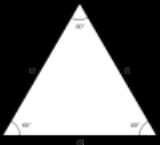
For instance, an equilateral triangle is a triangle of equal edge lengths. All equilateral triangles are similar to each other, and have 60 degree internal angles.

Discussion
Ask a question about 'Equilateral'
Start a new discussion about 'Equilateral'
Answer questions from other users
|
Encyclopedia
In geometry, an equilateral polygon is a polygon which has all sides of the same length.
For instance, an equilateral triangle is a triangle of equal edge lengths. All equilateral triangles are similar to each other, and have 60 degree internal angles.
-
Any equilateral quadrilateral is a rhombus, which includes the square.
-
An equilateral polygon which is cyclic (its vertices are on a circle) is a regular polygon.
Not all equilateral polygons are convex: all equilateral polygons with more than four sides, such as the pentagon, can be concave.
Viviani's theorem holds for equiangular polygons (and also holds for equilateral ones):
- The sum of distances from a point to the side lines of an equiangular [or equilateral] polygon does not depend on the point and is that polygon's invariant.
See also
External links
- With interactive animation
- a discussion of Viviani's theorem at Cut-the-knot.
- With Java animations.
- A family of pieces resembling lenses tiling the plane.
|
| |
|
|