


Episcopal sandals

Encyclopedia
Bishop
A bishop is an ordained or consecrated member of the Christian clergy who is generally entrusted with a position of authority and oversight. Within the Catholic Church, Eastern Orthodox, Oriental Orthodox Churches, in the Assyrian Church of the East, in the Independent Catholic Churches, and in the...
s when celebrating liturgical functions according to the pre-Vatican II rubrics, for example a Tridentine
Tridentine Mass
The Tridentine Mass is the form of the Roman Rite Mass contained in the typical editions of the Roman Missal that were published from 1570 to 1962. It was the most widely celebrated Mass liturgy in the world until the introduction of the Mass of Paul VI in December 1969...
Solemn Pontifical Mass.
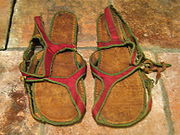
In shape, the episcopal sandals more closely resemble a pair of loafers
Loafers
Slip-ons are typically low, lace-less shoes. The style most commonly seen, known as a loafer or Slippers in American culture, has a moccasin construction. First appearing in the mid-1930s from Norway, they began as casual shoes, but have increased in popularity to the point of being worn in America...
than actual sandals. The liturgical stockings (caligae) are worn over the episcopal sandals and cover the episcopal sandals and the ankle. The episcopal sandals and liturgical stockings usually match the liturgical color of the Mass
Mass (liturgy)
"Mass" is one of the names by which the sacrament of the Eucharist is called in the Roman Catholic Church: others are "Eucharist", the "Lord's Supper", the "Breaking of Bread", the "Eucharistic assembly ", the "memorial of the Lord's Passion and Resurrection", the "Holy Sacrifice", the "Holy and...
. However, when black vestments are worn, the pontifical footwear is not used.
After the Second Vatican Council
Second Vatican Council
The Second Vatican Council addressed relations between the Roman Catholic Church and the modern world. It was the twenty-first Ecumenical Council of the Catholic Church and the second to be held at St. Peter's Basilica in the Vatican. It opened under Pope John XXIII on 11 October 1962 and closed...
, the episcopal sandals fell out of common use following the revisions of the liturgy resulting in the Mass of Paul VI
Mass of Paul VI
The Mass of Pope Paul VI is the liturgy of the Catholic Mass of the Roman Rite promulgated by Paul VI in 1969, after the Second Vatican Council...
, which is now known as the Ordinary Form of the Roman Rite
Roman Rite
The Roman Rite is the liturgical rite used in the Diocese of Rome in the Catholic Church. It is by far the most widespread of the Latin liturgical rites used within the Western or Latin autonomous particular Church, the particular Church that itself is also called the Latin Rite, and that is one of...
. While still permitted for use in the Ordinary Form of the Mass
Mass (liturgy)
"Mass" is one of the names by which the sacrament of the Eucharist is called in the Roman Catholic Church: others are "Eucharist", the "Lord's Supper", the "Breaking of Bread", the "Eucharistic assembly ", the "memorial of the Lord's Passion and Resurrection", the "Holy Sacrifice", the "Holy and...
, they are rarely used in that context. Today, the use of the episcopal sandals is primarily seen in those celebrating the Tridentine Mass
Tridentine Mass
The Tridentine Mass is the form of the Roman Rite Mass contained in the typical editions of the Roman Missal that were published from 1570 to 1962. It was the most widely celebrated Mass liturgy in the world until the introduction of the Mass of Paul VI in December 1969...
.
The episcopal sandals should not be confused with the red papal shoes
Papal shoes
The Papal shoes are the red leather outdoor shoes worn by the Pope. They should not be confused with the indoor papal slippers or the Episcopal sandals, which are the liturgical footwear proper to all Latin Rite bishops....
, which were recently reinstated by Pope Benedict XVI
Pope Benedict XVI
Benedict XVI is the 265th and current Pope, by virtue of his office of Bishop of Rome, the Sovereign of the Vatican City State and the leader of the Catholic Church as well as the other 22 sui iuris Eastern Catholic Churches in full communion with the Holy See...
. The papal shoes evolved as the outdoor counterpart of the papal slippers
Papal Slippers
The Papal Slippers are an historical accoutrement worn by the Bishop of Rome. The papal slippers were a form of episcopal sandals worn by bishops. However, unlike the episcopal sandals, which change with the liturgical colour, the papal slippers were always red...
, which are similar to the episcopal sandals, except that the papal slippers are worn by the Pope outside of liturgical functions and are always red.
Form and use
Unlike the ancient sandals, which consisted merely of soles fastened to the foot by straps, the episcopal sandals are in the form of low shoes, and resemble slippers. The sole is of leather; the upper part, generally ornamented with embroidery, is made at the present day of silk or velvet. No cross is required upon the sandals; at Rome this is an exclusively papal privilege. With the sandals are worn the liturgical stockings, caligæ. The privilege of wearing the sandals and caligæ belongs only to bishopBishop
A bishop is an ordained or consecrated member of the Christian clergy who is generally entrusted with a position of authority and oversight. Within the Catholic Church, Eastern Orthodox, Oriental Orthodox Churches, in the Assyrian Church of the East, in the Independent Catholic Churches, and in the...
s. They may be worn by abbot
Abbot
The word abbot, meaning father, is a title given to the head of a monastery in various traditions, including Christianity. The office may also be given as an honorary title to a clergyman who is not actually the head of a monastery...
s and other prelate
Prelate
A prelate is a high-ranking member of the clergy who is an ordinary or who ranks in precedence with ordinaries. The word derives from the Latin prælatus, the past participle of præferre, which means "carry before", "be set above or over" or "prefer"; hence, a prelate is one set over others.-Related...
s only by special privilege from the pope
Pope
The Pope is the Bishop of Rome, a position that makes him the leader of the worldwide Catholic Church . In the Catholic Church, the Pope is regarded as the successor of Saint Peter, the Apostle...
and only so far as this privilege grants. The pontifical footwear is used only at Tridentine
Tridentine Mass
The Tridentine Mass is the form of the Roman Rite Mass contained in the typical editions of the Roman Missal that were published from 1570 to 1962. It was the most widely celebrated Mass liturgy in the world until the introduction of the Mass of Paul VI in December 1969...
Pontifical Solemn Mass and at functions performed during the same, such as ordination
Ordination
In general religious use, ordination is the process by which individuals are consecrated, that is, set apart as clergy to perform various religious rites and ceremonies. The process and ceremonies of ordination itself varies by religion and denomination. One who is in preparation for, or who is...
, but not on other occasions, as, for example, Confirmation, Solemn Vespers, etc. It is therefore in the most exact sense of the word a vestment
Vestment
Vestments are liturgical garments and articles associated primarily with the Christian religion, especially among Latin Rite and other Catholics, Eastern Orthodox, Anglicans, and Lutherans...
worn during the Mass
Mass (liturgy)
"Mass" is one of the names by which the sacrament of the Eucharist is called in the Roman Catholic Church: others are "Eucharist", the "Lord's Supper", the "Breaking of Bread", the "Eucharistic assembly ", the "memorial of the Lord's Passion and Resurrection", the "Holy Sacrifice", the "Holy and...
. The liturgical color for the day decides the colour of the sandals and stockings; there are, however, no black stockings or sandals, as the bishop does not make use of either of these pontifical footwear at Requiem Masses.
The style of decoration on the episcopal sandals depended upon the rank of the prelate
Prelate
A prelate is a high-ranking member of the clergy who is an ordinary or who ranks in precedence with ordinaries. The word derives from the Latin prælatus, the past participle of præferre, which means "carry before", "be set above or over" or "prefer"; hence, a prelate is one set over others.-Related...
:
- CardinalsCardinal (Catholicism)A cardinal is a senior ecclesiastical official, usually an ordained bishop, and ecclesiastical prince of the Catholic Church. They are collectively known as the College of Cardinals, which as a body elects a new pope. The duties of the cardinals include attending the meetings of the College and...
, BishopBishopA bishop is an ordained or consecrated member of the Christian clergy who is generally entrusted with a position of authority and oversight. Within the Catholic Church, Eastern Orthodox, Oriental Orthodox Churches, in the Assyrian Church of the East, in the Independent Catholic Churches, and in the...
s and ProtonotariesProtonotary apostolicIn the Roman Catholic Church, protonotary apostolic is the title for a member of the highest non-episcopal college of prelates in the Roman Curia or, outside of Rome, an honorary prelate on whom the pope has conferred this title and its special privileges.-History:In later antiquity there were in...
"de numero participantium" used sandals with gold galloonGalloonGalloon is a decorative woven trim sometimes in the form of a braid and commonly made of metallic gold or silver thread, lace, or embroidery. Galloon is used in the trim of military and police uniforms, ecclesiastical garments, and as trim on textiles, drapery, and upholstered furniture.-...
s and embroidery - Protonotaries "suprannumerarii" used sandals with gold galloons without embroidery
- Protonotaries "ad instar participantium" used sandals with yellow galloons without embroidery.
Sandals and stockings are only customary in the Latin Rite and are unknown in the Oriental Rites.
Development of shape
The sandals retained substantially their original form until the tenth century. Then straps were replaced by three or five tongues reaching to the ankle, extensions of the upper leather upon the point of the foot, and these were fastened at ankle by means of a string. In the twelfth century these tongues were gradually shortened; in the thirteenth century, the sandal was a regular shoe with a slit above the foot or on the side to make the putting-on easier. In the sixteenth century there was a return to the earlier form of the sandal; instead of a high shoe it now became once more a low foot-covering, like a slipper, a form which it has retained until the present time. The material of which the pontifical sandals are made was, until the thirteenth century, exclusively leatherLeather
Leather is a durable and flexible material created via the tanning of putrescible animal rawhide and skin, primarily cattlehide. It can be produced through different manufacturing processes, ranging from cottage industry to heavy industry.-Forms:...
, at times covered with silk
Silk
Silk is a natural protein fiber, some forms of which can be woven into textiles. The best-known type of silk is obtained from the cocoons of the larvae of the mulberry silkworm Bombyx mori reared in captivity...
. Since the later Middle Ages
Middle Ages
The Middle Ages is a periodization of European history from the 5th century to the 15th century. The Middle Ages follows the fall of the Western Roman Empire in 476 and precedes the Early Modern Era. It is the middle period of a three-period division of Western history: Classic, Medieval and Modern...
, the upper part of the sandals has been made, not of leather, but of silk, velvet
Velvet
Velvet is a type of woven tufted fabric in which the cut threads are evenly distributed,with a short dense pile, giving it a distinctive feel.The word 'velvety' is used as an adjective to mean -"smooth like velvet".-Composition:...
, etc. It is not until about 1400, with the exception of entirely isolated earlier examples, that a cross is to be found upon the sandals. The fork-shaped decoration, frequently found on pontifical shoes, especially on those of the thirteenth century, was not a cross, but merely an ornament.
History
Sandals and stockings belong to the liturgical vestmentVestment
Vestments are liturgical garments and articles associated primarily with the Christian religion, especially among Latin Rite and other Catholics, Eastern Orthodox, Anglicans, and Lutherans...
s supported by the evidence from the 5th and 6th centuries. Originally the sandals were called campagi and the stockings udones. The shoes were given the name sandalia probably during the eighth to the ninth century, and this name was first applied to them in the north; the designation caligæ for udones came into use in the tenth century, also in the north. As regards the original form and material of the campagi, they were slippers that covered only the tip of the foot and the heel, and must have been fastened to the foot by straps. This slipper was made of black leather. The stockings were, very likely, made of linen, and were white in colour. In the earliest period the campagi and udones were by no means exclusively an episcopal vestment, as they were worn by deacons. Indeed this foot-covering was not reserved exclusively for the clergy
Clergy
Clergy is the generic term used to describe the formal religious leadership within a given religion. A clergyman, churchman or cleric is a member of the clergy, especially one who is a priest, preacher, pastor, or other religious professional....
, as they were worn as a mark of distinction by certain persons of rank, and were probably copied from the buskins of the ancient senators. Their use gradually became customary among the higher clergy, especially when these appeared in their full official capacity for the celebration of the Liturgy. During the eighth and ninth centuries also the Roman subdeacon
Subdeacon
-Subdeacons in the Orthodox Church:A subdeacon or hypodeacon is the highest of the minor orders of clergy in the Orthodox Church. This order is higher than the reader and lower than the deacon.-Canonical Discipline:...
s and acolyte
Acolyte
In many Christian denominations, an acolyte is anyone who performs ceremonial duties such as lighting altar candles. In other Christian Churches, the term is more specifically used for one who wishes to attain clergyhood.-Etymology:...
s wore a distinctive foot-wear, the subtalares, which, however, were simpler than the campagi, and had no straps. The sandals and stockings became a specifically episcopal vestment about the tenth century. Apparently as early as the twelfth century, or at least in the second half of the thirteenth century, they were no longer worn even by the cardinal deacons of Rome. The privilege of wearing the sandals and caligæ was first granted to an abbot
Abbot
The word abbot, meaning father, is a title given to the head of a monastery in various traditions, including Christianity. The office may also be given as an honorary title to a clergyman who is not actually the head of a monastery...
in 757 by Pope Stephen III
Pope Stephen III
Pope Stephen III was pope from August 1 or August 7, 768 to January 24, 772. He was a native of Sicily.He came to Rome during the pontificate of Gregory III and gradually rose to high office in the service of successive popes....
. This is, however, an isolated case, as it was only after the last quarter of the tenth century, and especially after the twelfth century that it became customary to grant abbots this privilege. The episcopal sandals are no longer normally seen in the Catholic Church, except for those liturgical ceremonies celebrated according to pre-Vatican II rubrics.
Liturgical stockings
The liturgical stockings, also known as the caligae, are the stockings worn by bishopBishop
A bishop is an ordained or consecrated member of the Christian clergy who is generally entrusted with a position of authority and oversight. Within the Catholic Church, Eastern Orthodox, Oriental Orthodox Churches, in the Assyrian Church of the East, in the Independent Catholic Churches, and in the...
s over the regular stockings but under the episcopal sandals. They match the liturgical color of the Mass
Mass (liturgy)
"Mass" is one of the names by which the sacrament of the Eucharist is called in the Roman Catholic Church: others are "Eucharist", the "Lord's Supper", the "Breaking of Bread", the "Eucharistic assembly ", the "memorial of the Lord's Passion and Resurrection", the "Holy Sacrifice", the "Holy and...
, except when the color is black. The stockings, which are of silk
Silk
Silk is a natural protein fiber, some forms of which can be woven into textiles. The best-known type of silk is obtained from the cocoons of the larvae of the mulberry silkworm Bombyx mori reared in captivity...
, are either knitted or are made by sewing together pieces of silk fabric that have been cut a suitable shape.
The caligae seem to have experienced no particular development. In the later Middle Ages
Middle Ages
The Middle Ages is a periodization of European history from the 5th century to the 15th century. The Middle Ages follows the fall of the Western Roman Empire in 476 and precedes the Early Modern Era. It is the middle period of a three-period division of Western history: Classic, Medieval and Modern...
they were, as a rule, made of silk. The earliest enforcement in respect to caligae of the regulations for liturgical colors seems to have been at Rome, but even here probably not until the fourteenth century. Like the episcopal sandals, the use of the liturgical stockings is primarily confined to the pre-Vatican II Tridentine Mass
Tridentine Mass
The Tridentine Mass is the form of the Roman Rite Mass contained in the typical editions of the Roman Missal that were published from 1570 to 1962. It was the most widely celebrated Mass liturgy in the world until the introduction of the Mass of Paul VI in December 1969...
.
External links
See also
- Buskins
- Pontifical vestmentsPontifical vestmentsPontifical vestments, also referred to as episcopal vestments or pontificals, are the liturgical vestments worn by bishops in the Roman Catholic, Eastern Orthodox, Eastern Catholic, Anglican, and some Lutheran churches, in addition to the usual priestly vestments for the celebration of the Mass...
- Papal shoesPapal shoesThe Papal shoes are the red leather outdoor shoes worn by the Pope. They should not be confused with the indoor papal slippers or the Episcopal sandals, which are the liturgical footwear proper to all Latin Rite bishops....
- Papal slippersPapal SlippersThe Papal Slippers are an historical accoutrement worn by the Bishop of Rome. The papal slippers were a form of episcopal sandals worn by bishops. However, unlike the episcopal sandals, which change with the liturgical colour, the papal slippers were always red...
- Tridentine MassTridentine MassThe Tridentine Mass is the form of the Roman Rite Mass contained in the typical editions of the Roman Missal that were published from 1570 to 1962. It was the most widely celebrated Mass liturgy in the world until the introduction of the Mass of Paul VI in December 1969...
- Solemn Pontifical Mass