


Epikleros

Encyclopedia
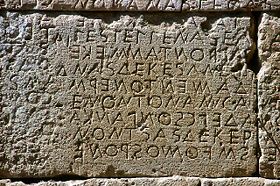
Sparta
Sparta or Lacedaemon, was a prominent city-state in ancient Greece, situated on the banks of the River Eurotas in Laconia, in south-eastern Peloponnese. It emerged as a political entity around the 10th century BC, when the invading Dorians subjugated the local, non-Dorian population. From c...
they were called patroiouchoi (πατρούχοι), as they were in Gortyn
Gortyn
Gortyn, Gortys or Gortyna is a municipality and an archaeological site on the Mediterranean island of Crete, 45 km away from the modern capital Heraklion. The seat of the municipality is the village Agioi Deka...
. Athenian women were not allowed to hold property in their own name; in order to keep her father's property in the family, an epikleros was required to marry her father's nearest male relative. Even if a woman was already married, evidence suggests that she was required to divorce her spouse to marry that relative. Spartan women were allowed to hold property in their own right, and so Spartan heiresses were subject to less restrictive rules. Evidence from other city-states is more fragmentary, mainly coming from the city-states of Gortyn and Rhegium
Reggio Calabria
Reggio di Calabria , commonly known as Reggio Calabria or Reggio, is the biggest city and the most populated comune of Calabria, southern Italy, and is the capital of the Province of Reggio Calabria and seat of the Council of Calabrian government.Reggio is located on the "toe" of the Italian...
.
Plato
Plato
Plato , was a Classical Greek philosopher, mathematician, student of Socrates, writer of philosophical dialogues, and founder of the Academy in Athens, the first institution of higher learning in the Western world. Along with his mentor, Socrates, and his student, Aristotle, Plato helped to lay the...
wrote about epikleroi in his Laws, offering idealized laws to govern their marriages. In mythology and history, a number of Greek women appear to have been epikleroi, including Agariste of Sicyon
Agariste of Sicyon
Agariste was the daughter, and possibly the heiress, of the tyrant of Sicyon, Cleisthenes. Her father wanted to marry her to the best of the Hellenes and, subsequently, he organized a competition, whose prize was his own daughter...
and Agiatis
Agis IV
Agis IV , the elder son of Eudamidas II, was the 24th king of the Eurypontid dynasty of Sparta. Posterity has reckoned him an idealistic but impractical monarch.-Succession:...
, the widow of the Spartan king Agis IV
Agis IV
Agis IV , the elder son of Eudamidas II, was the 24th king of the Eurypontid dynasty of Sparta. Posterity has reckoned him an idealistic but impractical monarch.-Succession:...
. The status of epikleroi has often been used to explain the numbers of sons-in-law who inherited from their fathers-in-law in Greek mythology
Greek mythology
Greek mythology is the body of myths and legends belonging to the ancient Greeks, concerning their gods and heroes, the nature of the world, and the origins and significance of their own cult and ritual practices. They were a part of religion in ancient Greece...
. The Third Sacred War
Third Sacred War
The Third Sacred War was fought between the forces of the Delphic Amphictyonic League, principally represented by Thebes, and latterly by Philip II of Macedon, and the Phocians...
originated in a dispute over epikleroi.
Etymology
The term epikleros (a feminine adjective acting as noun) was used in ancient GreeceAncient Greece
Ancient Greece is a civilization belonging to a period of Greek history that lasted from the Archaic period of the 8th to 6th centuries BC to the end of antiquity. Immediately following this period was the beginning of the Early Middle Ages and the Byzantine era. Included in Ancient Greece is the...
to describe the daughter of a man who had died leaving no male heir. It translates to "attached to the family property", or "upon, with the estate". In most ancient Greek city states, women could not own property, and so a system was devised to keep ownership within the male-defined family line. Epikleroi were required to marry the nearest relative on their father's side of the family, a system of inheritance known as the epiklerate. Although epikleros is often mistranslated as "heiress", strictly speaking the terms are not equivalent, as the woman never owned the property and so was unable to dispose of it. The term was used interchangeably, both of the woman herself, and of the property that was the inherited estate.
Athens
AthensHistory of Athens
Athens is one of the oldest named cities in the world, having been continuously inhabited for at least 7000 years. Situated in southern Europe, Athens became the leading city of Ancient Greece in the first millennium BCE and its cultural achievements during the 5th century BCE laid the foundations...
is the city-state that is best documented, both in terms of epikleroi and in all aspects of legal history. Athenian law on epikleroi was attributed to Solon
Solon
Solon was an Athenian statesman, lawmaker, and poet. He is remembered particularly for his efforts to legislate against political, economic and moral decline in archaic Athens...
; women with no brothers had to marry their nearest male relative on their paternal
Father
A father, Pop, Dad, or Papa, is defined as a male parent of any type of offspring. The adjective "paternal" refers to father, parallel to "maternal" for mother...
side of the family, starting with their father's brother and moving from there to the next nearest male relative on the paternal side. The historian John Gould notes that the order of relatives that were required to marry the epikleros coincided with the relatives required to avenge a murder. This set of relatives was known as the anchisteia (ἀγχιστεία) in Athens. The anchisteia was also the group of relatives who would inherit property in the absence of legal heirs. If there was more than one possible spouse in a set of relatives, the right to marry the epikleros went to the eldest one. The property that was inherited could also be in debt, which would not affect the epikleros status.
Definition of the term in Athens
Although the term was most often used in the case of a daughter who had no living brothers when her father died, the term was also used for other cases. The SudaSuda
The Suda or Souda is a massive 10th century Byzantine encyclopedia of the ancient Mediterranean world, formerly attributed to an author called Suidas. It is an encyclopedic lexicon, written in Greek, with 30,000 entries, many drawing from ancient sources that have since been lost, and often...
, a 10th century CE lexicon
Lexicon
In linguistics, the lexicon of a language is its vocabulary, including its words and expressions. A lexicon is also a synonym of the word thesaurus. More formally, it is a language's inventory of lexemes. Coined in English 1603, the word "lexicon" derives from the Greek "λεξικόν" , neut...
and encyclopedia, gives other definitions of the term, including an heiress who was married at the time of her father's death and an unmarried daughter without brothers still living with her father. The Suda also stated that the term could be used of a daughter who had living sisters. Although the Suda states that in normal usage, the mother of the heiress was also dead, it is incorrect as whether or not an heiresses mother was living was unimportant to her status as an epikleros. Occasionally the term is also used as a feminine form of the Greek term orphanos, or "orphan". Although a scholiast, or a later writer amending a text, of Aeschines
Aeschines
Aeschines was a Greek statesman and one of the ten Attic orators.-Life:Although it is known he was born in Athens, the records regarding his parentage and early life are conflicting; but it seems probable that his parents, though poor, were respectable. Aeschines' father was Atrometus, an...
stated that the term could also be used of a daughter who was given to a man in marriage on her father's deathbed, there is no extant use of the term in literature and this is probably a misunderstanding of the playwright Aristophanes
Aristophanes
Aristophanes , son of Philippus, of the deme Cydathenaus, was a comic playwright of ancient Athens. Eleven of his forty plays survive virtually complete...
.
The term in Athens seems to have always been somewhat loosely used in legal proceedings. Apollodorus
Apollodorus
Apollodorus of Athens son of Asclepiades, was a Greek scholar and grammarian. He was a pupil of Diogenes of Babylon, Panaetius the Stoic, and the grammarian Aristarchus of Samothrace...
, an Athenian politician and litigant from the 4th century BCE, in one of his speeches attempted to use an Athenian law about betrothal to make his mother an epikleros. He claimed that the law defined an epikleros as a female without father, a brother who shared a father with her, or a paternal grandfather. His opponent, however, seems to have disputed this interpretation of the law. A speech by Isaeus
Isaeus
Isaeus , fl. early 4th century BC. One of the ten Attic Orators according to the Alexandrian canon. He was a student of Isocrates in Athens, and later taught Demosthenes while working as a metic speechwriter for others. Only eleven of his speeches survive, with fragments of a twelfth. They are...
, a 4th century BCE speechwriter, rests on the claim that the speaker's mother only became an epikleros after her young brother died following their father's death. Whether the legal authorities recognized the speaker's claim as valid is unknown.
Development of the practice
It is unclear if there were laws dealing with epikleroi prior to Solon's legislative activity around 594 BCE. According to the 1st century CE writer PlutarchPlutarch
Plutarch then named, on his becoming a Roman citizen, Lucius Mestrius Plutarchus , c. 46 – 120 AD, was a Greek historian, biographer, essayist, and Middle Platonist known primarily for his Parallel Lives and Moralia...
, Solon authored legislation covering the epikleros. Solon's laws attempted to prevent the combination of estates by the marriage of heiresses. Modern historians have seen this as part of an effort by Solon to maintain a stable number of households. According to Plutarch, Solon also legislated that the husband of an epikleros must have sexual intercourse with her at least three times a month in order to provide her with children to inherit her father's property, but by the time of Pericles
Pericles
Pericles was a prominent and influential statesman, orator, and general of Athens during the city's Golden Age—specifically, the time between the Persian and Peloponnesian wars...
(d. 429 BCE) this law is definitely attested. It is unclear whether or not the nearest relative had the power to dissolve an epikleros' previous marriage in order to marry her himself in all cases. The historian Susan Pomeroy states that most scholars lean towards the opinion that the nearest relative could only dissolve the previous marriage if the heiress had not yet given birth to a son, but Pomeroy also states that this opinion has not yet been definitely proven. Athenian law also required that if the next of kin did not marry the heiress, he had to provide her with a dowry
Dowry
A dowry is the money, goods, or estate that a woman brings forth to the marriage. It contrasts with bride price, which is paid to the bride's parents, and dower, which is property settled on the bride herself by the groom at the time of marriage. The same culture may simultaneously practice both...
. It may have been Solon who legislated that if the new spouse was unable to fulfill his thrice monthly duties to his wife, she was entitled to have sex with his next of kin so that she could produce an heir to her father's property. Alternatively, she might have been required to divorce and marry the next nearest relative.
Legal procedures
When a man died leaving an epikleros, the heiress was felt to be epidikos, or as it literally translates, "adjuicable". This made her available for the specialized procedure for the betrothal of an epikleros, a type of court judgement called epidikasia. The proceedings took place in the Archon'sArchon of Athens
This is a list of the eponymous archons of Athens.-Background:The archon was the chief magistrate in many Greek cities, but in Athens there was a council of archons which comprised a form of executive government...
court, for citizen epikleroi. For the epikleroi of resident aliens in Athens, the metic
Metic
In ancient Greece, the term metic referred to a resident alien, one who did not have citizen rights in his or her Greek city-state of residence....
s, the polemarch
Polemarch
A polemarch was a senior military title in various ancient Greek city states . The title is composed out of the polemos and archon and translates as "warleader" or "warlord", one of the nine archontes appointed annually in Athens...
was in charge of their affairs. It was also the case that if a man made a will, but did not give any daughters of his their legal rights as epikleroi in the will, then that will was held to be invalid. A young Athenian male, prior to coming of age and serving his time as an ephebe
Ephebos
Ephebos , also anglicised as ephebe or archaically ephebus , is a Greek word for an adolescent age group or a social status reserved for that age in Antiquity....
, or military trainee, was allowed to claim epikleroi, the only legal right an ephebe was permitted in Aristotle's day, besides that of taking office as a priest in an hereditary priesthood. It is also unclear if a man who was eligible to marry an epikleros but was already married could keep his previous wife while also claiming the epikleros. While all evidence points to the ancient Athenians being monogamous
Monogamy
Monogamy /Gr. μονός+γάμος - one+marriage/ a form of marriage in which an individual has only one spouse at any one time. In current usage monogamy often refers to having one sexual partner irrespective of marriage or reproduction...
, there are two speeches by Demosthenes
Demosthenes
Demosthenes was a prominent Greek statesman and orator of ancient Athens. His orations constitute a significant expression of contemporary Athenian intellectual prowess and provide an insight into the politics and culture of ancient Greece during the 4th century BC. Demosthenes learned rhetoric by...
implying that men did indeed have both a wife acquired through the normal betrothal procedure and another who was adjudicated to them through the epidikasia (ἐπιδικασία) procedure. The archon was also responsible for overseeing the treatment of epikleroi, along with widows, orphans, widows who claimed to be pregnant and households that were empty.
When the sons of an epikleros came of age, they gained the ownership of the inheritance. In Athens, this age was given in an extant law, and was two years past the age of puberty of the son. After he secured possession of his inheritance, the law specified that he was to support his mother. Although the law did not rule on who exactly owned the property before the son took possession, it appears from other sources that it was not actually owned by the husband of the epikleros, in contrast to the usual procedure in Athens where the husband owned any property of the wife and could do with it as he willed. A number of speeches imply that the property was considered to be owned by the epikleros herself, although she had little ability to dispose of it. The husband probably had day to day control of the property and administered it, but was responsible for the management to the epikleros' heirs when they came of age. The position of the husband of an epikleros was closest to that of an epitropos, or the guardian of an orphan's property, who was likewise responsible to the orphan for his care of the property when the orphan came of age. Another parallel with the orphan was that an epikleros' property was exempt from liturgies
Liturgy
Liturgy is either the customary public worship done by a specific religious group, according to its particular traditions or a more precise term that distinguishes between those religious groups who believe their ritual requires the "people" to do the "work" of responding to the priest, and those...
, or the practice of requiring citizens to perform public tasks without compensation, as was the orphan's.
It may have been possible for the husband of an epikleros to allow the posthumous adoption of the son of an epikleros as the son of the epikleros' father. This would prevent the inheritance of the newly adopted son of any property from his natural father, but it had the advantage of preserving the adoptee's oikos
Oikos
An oikos is the ancient Greek equivalent of a household, house, or family....
, commonly translated as "household" but incorporating ideas of kinship and property also. Although the preservation of the paternal oikos is usually felt to be the reason behind the whole practice of the epiklerate, the historian David Schaps argues that in fact, this was not really the point of the practice. Instead, he argues, that it was the practice of adoption that allowed the preservation of an oikos. Schaps feels that the reason the epiklerate evolved was to ensure that orphaned daughters were married. Other historians, including Sarah Pomeroy, feel that the children of an epikleros were considered to transmit the paternal grandfather's oikos. The historian Cynthia Patterson agrees, arguing that adoption may have seemed unnecessary, especially if the epikleros and her husband gave their son the name of the maternal grandfather. She argues that too much attention has been paid to the patrilinial aspects of the oikos, and that there was probably less emphasis on this in actual Athenian practice and more on keeping a household together as a productive unit.
The historian Roger Just states the main principle of the epiklerate was that no man could become the guardian of the property without also becoming the husband of the epikleros. Just uses this principle to claim that any man adopted by the father of an epikleros was required to marry the epikleros. Just states that the forcible divorce and remarriage of an epikleros was based on this principle, arguing that if the father of the epikleros had not adopted the first husband, the husband was not really the heir. Just sees the development of the epiklerate as flowing from Solon's desire to keep the number of Athenian households constant. According to Just, before Solon's legislation, the epikleros was just treated as part of the property, but that Solon's reforms transformed the epikleros into a transmitter of the property and her son the automatic heir to her father's estate.
Taking as a wife an epikleros who had little estate was considered a praiseworthy action, and was generally stressed in public speeches. Such an heiress was called an epikleros thessa.
Sequence of the anchisteia
The first set of relatives that had claim to an epikleros were the paternal uncles and any heirs of the uncles. Next in line were any sons of the sisters of the father and any of their heirs. Third in line were the grandsons of the father's paternal uncles, and following them the grandsons of the paternal aunts of the father. After these paternal relatives were exhausted, then the half-brothers of the father by the same mother were in line, then sons of the maternal half-sisters of the father. Seventh in line were the grandsons of maternal uncles of the father and then grandsons of maternal aunts of the father.Chances of becoming an epikleros
Modern estimates of the odds of an Athenian woman becoming an epikleros say that roughly one out of seven fathers died without biological sons. However, Athenian law allowed for a man to adopt another male as a son in his will, so not all daughters without brothers would have become epikleroi. Most modern historians estimate that 20% of families would have had only daughters, and another 20% would have been childless. The modern historian Cynthia Patterson said of the epikleros that although "she was distinctive, she was not rare".Already married epikleroi
Whether an epikleros who was married at the time of her father's death was required to divorce her current spouse and marry the anchisteia is unclear. Most modern historians have come to the conclusion that this was only required if the epikleros had not yet had a son that could inherit the grandfather's estate. The clearest evidence is from the Roman playwright TerenceTerence
Publius Terentius Afer , better known in English as Terence, was a playwright of the Roman Republic, of North African descent. His comedies were performed for the first time around 170–160 BC. Terentius Lucanus, a Roman senator, brought Terence to Rome as a slave, educated him and later on,...
, in his play Adelphoe
Adelphoe
Adelphoe is a play by Roman playwright Terence, adopted partly from plays by Menander and Diphilus. It explores the best form of child-rearing...
, which includes a plot element involving a claim that a girl is actually an epikleros. Although the play was written in the 2nd century BCE, Terence adapted most of his plays from earlier Athenian comedies, which makes it slightly more reliable as a source. And common sense argues that if a son had already been born to an epikleros, there was no need to parcel out the epikleros to a relative in order to provide a male heir to the grandfather's estate. Although the anchisteia had the right to marry the epikleros, he was not required to do so, and could refuse the match or find another spouse for the heiress. It was also possible for the husband of an epikleros, who was not her anchisteia, to buy off the anchisteia in order to remain married to his wife. Such cases were alleged by the speaker of Isaeus' speech Isaeus 10 as well as a character in the playwright Menander
Menander
Menander , Greek dramatist, the best-known representative of Athenian New Comedy, was the son of well-to-do parents; his father Diopeithes is identified by some with the Athenian general and governor of the Thracian Chersonese known from the speech of Demosthenes De Chersoneso...
's play Aspis
Aspis
"Aspis" is the generic term for the word shield. The aspis, which is carried by Greek infantry of various periods, is often referred to as a hoplon .According to Diodorus Siculus:-Construction:...
.
Sparta
In ancient SpartaSparta
Sparta or Lacedaemon, was a prominent city-state in ancient Greece, situated on the banks of the River Eurotas in Laconia, in south-eastern Peloponnese. It emerged as a political entity around the 10th century BC, when the invading Dorians subjugated the local, non-Dorian population. From c...
, women had extensive rights, including the right to inherit property and to manage their own and their spouse's property. The comparable term to epikleros in Sparta was patrouchoi, occasionally rendered as patrouchos. In Sparta the law of epikleros only applied to unmarried girls, and the Spartan kings were responsible for finding spouses for epikleroi who had not been betrothed before their father's death. Herodotus
Herodotus
Herodotus was an ancient Greek historian who was born in Halicarnassus, Caria and lived in the 5th century BC . He has been called the "Father of History", and was the first historian known to collect his materials systematically, test their accuracy to a certain extent and arrange them in a...
, in his list of Spartan royal prerogatives, said: "The kings are the sole judges of these cases only: concerning an unmarried heiress, to whom it pertains to have [her], if her father has not bethrothed her", but the exact meaning of this statement is debated. Some historians have interpreted this to mean that the kings had the right to give the heiress to anyone they chose, but others have suggested that the kings merely had the right to bestow the heiress on the nearest male relative, or to arbitrate between competing claims. The name given to these heiresses in Sparta was patroiouchoi, which literally translates as "holders of the patrimony." They inherited the land themselves, and retained the right to dispose of their inherited property. There were no restrictions on who they might marry.
Gortyn
In GortynGortyn
Gortyn, Gortys or Gortyna is a municipality and an archaeological site on the Mediterranean island of Crete, 45 km away from the modern capital Heraklion. The seat of the municipality is the village Agioi Deka...
, epikleroi were also called patroiokos, and they were more generously treated than in Athens. The term patroiokos can be literally translated as "having the father's property", and was a description of the condition of the heiress. She was considered a patroiouchoi if she had no father or brother by her father living. The relative who had the right to marry her was called a epiballon, and the list of who were eligible for that status was also limited to just her paternal uncles and the sons of those uncles. If there were no candidates fitting those conditions, the patroiouchoi was free to marry as she chose. If she wished, a patroiouchos could free herself from the obligation to marry her nearest relative by paying him part of her inheritance. If her nearest relative did not wish to marry her, she was free to find a spouse in her tribe, or if none was willing, then she could marry whomever she wished. Gortyn may owe the liberality of its heiress laws to the fact that it was one of the few city-states known to have allowed daughters to inherit even if they had brothers; daughters in Gortyn received half the share of a son. To prevent the abuse of the system, there was a time limit on the right of the closest epiballon to marry her, and if the limit expired, the right passed to the next nearest epiballon until the patroiouchoi was either married or ran out of possible epiballontes.
Other city-states
RhegiumReggio Calabria
Reggio di Calabria , commonly known as Reggio Calabria or Reggio, is the biggest city and the most populated comune of Calabria, southern Italy, and is the capital of the Province of Reggio Calabria and seat of the Council of Calabrian government.Reggio is located on the "toe" of the Italian...
owed its laws on epikleroi to Androdamas of Rhegium, a law-giver whose views on this subject were especially esteemed according to Aristotle
Aristotle
Aristotle was a Greek philosopher and polymath, a student of Plato and teacher of Alexander the Great. His writings cover many subjects, including physics, metaphysics, poetry, theater, music, logic, rhetoric, linguistics, politics, government, ethics, biology, and zoology...
. In the city-state of Charondas
Charondas
Charondas was a celebrated lawgiver of Catania in Sicily. His date is uncertain. Some make him a pupil of Pythagoras ; but all that can be said is that he was earlier than Anaxilas of Rhegium , since his laws were in use amongst the Rhegians until they were abolished by that tyrant...
' laws, an epikleros had to be given a dowry if her nearest kin did not wish to marry her. During the time of Alexander the Great, Tegean law deals with the inheritance of returning exiles, limiting them to inheriting only their paternal estate or an estate of their mother if she had become an epikleros while in exile. The city-states of Naupactus
Naupactus
Naupactus or Nafpaktos , is a town and a former municipality in Aetolia-Acarnania, West Greece, Greece. Since the 2011 local government reform it is part of the municipality Nafpaktia, of which it is the seat and a municipal unit...
and Thermus allowed women to inherit property, but whether or not the daughters were considered epikleroi is unknown from the surviving fragments of the laws from those cities.
Plato
PlatoPlato
Plato , was a Classical Greek philosopher, mathematician, student of Socrates, writer of philosophical dialogues, and founder of the Academy in Athens, the first institution of higher learning in the Western world. Along with his mentor, Socrates, and his student, Aristotle, Plato helped to lay the...
, in his Laws
Laws (dialogue)
The Laws is Plato's last and longest dialogue. The question asked at the beginning is not "What is law?" as one would expect. That is the question of the Minos...
, set forth rules that governed not the ideal state, which he described in The Republic, but what he felt might be obtainable in the real world. Included amongst them were some dealing with inheritance and heiresses. In general outline, they conformed to Athenian practice, with the daughter of a man who died without male heirs becoming an epikleros. Plato gave rules governing who the husband of the epikleros might be, and said that the inherited plot might not be divided or added to another plot. The main departure from Athenian law came if there was no direct heir, and the inheritance go to collateral relations. In that case, Plato assigned the inheritance not to one person, but to a pair, one male and one female, and ordered that they must marry and provide an heir to the estate, much like the epikleros.
Later history
In 318 BCE, CassanderCassander
Cassander , King of Macedonia , was a son of Antipater, and founder of the Antipatrid dynasty...
appointed Demetrius Phalereus
Demetrius Phalereus
Demetrius of Phalerum was an Athenian orator originally from Phalerum, a student of Theophrastus and one of the first Peripatetics...
to govern the city-state of Athens. Demetrius issued a set of laws that are known from later literary works. Although knowledge of these laws is fragmentary, it does not appear that Demetrius legislated anything on the subject of epikleroi. This is in striking contrast to Solon's legislation, which was concerned with the internal affairs of the family and its external manifestations in public life. However, it is in this time period that Menander's play Apsis, with its focus on the efforts of a uncle to secure an heiress, is located. The plot revolves around the efforts of another uncle and his stepson to secure the heiress for the stepson instead. Besides Apsis, Menander is known to have written two different plays titled Epikleros, one of which was later translated into Latin.
Noted epikleroi
In the tales of heroic Greece, royal succession often passed from father-in-law to son-in-law, and some historians have seen in this an early example of the epikleros pattern. Some examples include PelopsPelops
In Greek mythology, Pelops , was king of Pisa in the Peloponnesus. He was the founder of the House of Atreus through his son of that name....
, Bellerophon
Bellerophon
Bellerophon or Bellerophontes is a hero of Greek mythology. He was "the greatest hero and slayer of monsters, alongside of Cadmus and Perseus, before the days of Heracles", and his greatest feat was killing the Chimera, a monster that Homer depicted with a lion's head, a goat's body, and a...
, Melampus
Melampus
In Greek mythology, Melampus, or Melampous , was a legendary soothsayer and healer, originally of Pylos, who ruled at Argos. He was the introducer of the worship of Dionysus, according to Herodotus, who asserted that his powers as a seer were derived from the Egyptians and that he could understand...
, Peleus
Peleus
In Greek mythology, Pēleus was a hero whose myth was already known to the hearers of Homer in the late 8th century BCE. Peleus was the son of Aeacus, king of the island of Aegina, and Endeïs, the oread of Mount Pelion in Thessaly; he was the father of Achilles...
, Telamon
Telamon
In Greek mythology, Telamon , son of the king Aeacus, of Aegina, and Endeis and brother of Peleus, accompanied Jason as one of his Argonauts, and was present at the hunt for the Calydonian Boar. In the Iliad he was the father of Greek heroes Ajax the Great and Teucer the Archer by different...
, and Diomedes
Diomedes
Diomedes or Diomed is a hero in Greek mythology, known for his participation in the Trojan War.He was born to Tydeus and Deipyle and later became King of Argos, succeeding his maternal grandfather, Adrastus. In Homer's Iliad Diomedes is regarded alongside Ajax as one of the best warriors of all...
. Not all such heroic era royal successions followed the epikleros pattern however, as in the case of Menelaus
Menelaus
Menelaus may refer to;*Menelaus, one of the two most known Atrides, a king of Sparta and son of Atreus and Aerope*Menelaus on the Moon, named after Menelaus of Alexandria.*Menelaus , brother of Ptolemy I Soter...
, who married Helen of Troy and succeeded Helen's father Tyndareus
Tyndareus
In Greek mythology, Tyndareus or Tyndareos was a Spartan king, son of Oebalus and Gorgophone , husband of Leda and father of Helen, Castor and Polydeuces, Clytemnestra, Timandra, Phoebe and Philonoe.Tyndareus had a brother named Hippocoon , who seized power and exiled Tyndareus...
, even though Tyndareus had living sons, Kastor
Castor and Pollux
In Greek and Roman mythology, Castor and Pollux or Polydeuces were twin brothers, together known as the Dioscuri . Their mother was Leda, but Castor was the mortal son of Tyndareus, king of Sparta, and Pollux the divine son of Zeus, who visited Leda in the guise of a swan...
and Polydeukes
Castor and Pollux
In Greek and Roman mythology, Castor and Pollux or Polydeuces were twin brothers, together known as the Dioscuri . Their mother was Leda, but Castor was the mortal son of Tyndareus, king of Sparta, and Pollux the divine son of Zeus, who visited Leda in the guise of a swan...
. Another example is Arete
Arete
Areté is the term meaning "virtue" or "excellence", from Greek ἈρετήArete may also be used:*as a given name of persons or things:**Queen Arete , a character in Homer's Odyssey.***197 Arete, an asteroid....
of Paeacia in The Odyssey
Odyssey
The Odyssey is one of two major ancient Greek epic poems attributed to Homer. It is, in part, a sequel to the Iliad, the other work ascribed to Homer. The poem is fundamental to the modern Western canon, and is the second—the Iliad being the first—extant work of Western literature...
, who was an heiress married to her father's brother Alcinoos.
Aristotle related that the revolt of Mytilene
Mytilene
Mytilene is a town and a former municipality on the island of Lesbos, North Aegean, Greece. Since the 2011 local government reform it is part of the municipality Lesbos, of which it is a municipal unit. It is the capital of the island of Lesbos. Mytilene, whose name is pre-Greek, is built on the...
against Athens in 428 BCE originated in a dispute over epikleroi. The Sacred War
Third Sacred War
The Third Sacred War was fought between the forces of the Delphic Amphictyonic League, principally represented by Thebes, and latterly by Philip II of Macedon, and the Phocians...
of 356–346 BCE, between Thebes
Ancient Thebes (Boeotia)
See Thebes, Greece for the modern city built on the ancient ruins.Ancient Thebes was a Boeotian city-state , situated to the north of the Cithaeron range, which divides Boeotia from Attica, and on the southern edge of the Boeotian plain...
and Phocis
Phocis
Phocis is one of the regional units of Greece. It is part of the administrative region of Central Greece. It stretches from the western mountainsides of Parnassus on the east to the mountain range of Vardousia on the west, upon the Gulf of Corinth...
, was also started by a disagreement over epikleroi. It is likely that Agariste
Agariste of Sicyon
Agariste was the daughter, and possibly the heiress, of the tyrant of Sicyon, Cleisthenes. Her father wanted to marry her to the best of the Hellenes and, subsequently, he organized a competition, whose prize was his own daughter...
, the daughter of Cleisthenes of Sicyon
Cleisthenes of Sicyon
Cleisthenes was the tyrant of Sicyon from c. 600–570 BC, who aided in the First Sacred War against Kirrha that destroyed that city in 595 BC. He is also told to have organized with success a war against Argos because of his anti-Dorian feelings...
, who married Megacles
Megacles
Megacles was the name of several notable men of ancient Athens:1. Megacles was possibly a legendary Archon of Athens from 922 BC to 892 BC....
of Athens was an epikleros. Likewise, the widow of the Spartan king Agis IV, Agiatis, was forced to marry Cleomenes
Cleomenes III
Cleomenes III was the King of Sparta from 235-222 BC. He succeeded to the Agiad throne of Sparta after his father, Leonidas II in 235 BC.From 229 BC to 222 BC, Cleomenes waged war against the Achaean League under Aratus of Sicyon. Domestically, he is known for his attempt to reform the Spartan state...
, the son of the man who had executed Agis, King Leonidas II
Leonidas II
Leonidas II , was Agiad King of Sparta from 254 to 235 BC. He was raised at the Persian Court, and according to Plutarch's Life of Agis IV, he married a Persian woman. According to other sources, this non-Spartan wife was actually a Seleucid, possibly the daughter of Seleucus I Nicator by his...
. Plutarch stated that the reason Leonidas married Agiatis to Kleomenes was that Agiatis was a patroiouchos from her father, Gylippos. Another Spartan example may have been Gorgo
Gorgo, Queen of Sparta
Gorgo was the daughter and the only child of Cleomenes I, King of Sparta during the 6th and 5th centuries BC. She was the wife of King Leonidas I, Cleomenes' half-brother, who fought and died in the Battle of Thermopylae. Gorgo is noted as one of the few female historical figures actually named...
, the only daughter of King Cleomenes I
Cleomenes I
Cleomenes or Kleomenes was an Agiad King of Sparta in the late 6th and early 5th centuries BC. During his reign, which started around 520 BC, he pursued an adventurous and at times unscrupulous foreign policy aimed at crushing Argos and extending Sparta's influence both inside and outside the...
, who was married to Cleomenes' brother Leonidas I
Leonidas I
Leonidas I was a hero-king of Sparta, the 17th of the Agiad line, one of the sons of King Anaxandridas II of Sparta, who was believed in mythology to be a descendant of Heracles, possessing much of the latter's strength and bravery...
.
Other possible epikleroi include the daughters of Polyeuctus, who managed to remain married to their spouses even after becoming epikleroi. Meidylides' daughter was an heiress, and her father tried to marry her to her anchisteia, but the prospective husband refused the match and the daughter was married to a non-relative instead.
In literature, Antigone
Antigone
In Greek mythology, Antigone is the daughter of Oedipus and Jocasta, Oedipus' mother. The name may be taken to mean "unbending", coming from "anti-" and "-gon / -gony" , but has also been suggested to mean "opposed to motherhood", "in place of a mother", or "anti-generative", based from the root...
, the daughter of Oedipus
Oedipus
Oedipus was a mythical Greek king of Thebes. He fulfilled a prophecy that said he would kill his father and marry his mother, and thus brought disaster on his city and family...
, would be considered an epikleros, and her uncle Creon
Creon
Creon is a figure in Greek mythology best known as the ruler of Thebes in the legend of Oedipus. He had two children with his wife, Eurydice: Megareus and Haemon...
would have been responsible for her marriage as well as that of her sister Ismene
Ismene
Ismene is the name of two women of Greek mythology. The more famous is a daughter and half-sister of Oedipus, daughter and granddaughter of Jocasta, and sister of Antigone, Eteocles, and Polynices. She appears in several plays of Sophocles: at the end of Oedipus the King, in Oedipus at Colonus and...
.
External links
- A Glossary of Athenian Legal Terms – hosted by the Stoa Consortium at the University of KentuckyUniversity of KentuckyThe University of Kentucky, also known as UK, is a public co-educational university and is one of the state's two land-grant universities, located in Lexington, Kentucky...
- Women and Family in Athenian Law – hosted by the Stoa Consortium at the University of KentuckyUniversity of KentuckyThe University of Kentucky, also known as UK, is a public co-educational university and is one of the state's two land-grant universities, located in Lexington, Kentucky...
- Women and Property in Ancient Athens – by James C. Thompson
- Women and Gender in Classical Athens: Property, Inheritance, and Marriage – class notes by James P. Sickinger at Florida State UniversityFlorida State UniversityThe Florida State University is a space-grant and sea-grant public university located in Tallahassee, Florida, United States. It is a comprehensive doctoral research university with medical programs and significant research activity as determined by the Carnegie Foundation...