| |
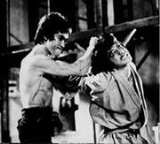
Enter the Dragon aka. The Deadly Three, originally titled Blood and Steel is a 1973 American martial arts film directed by Robert Clouse; starring martial artists Bruce Lee and Jim Kelly, as well as actor John Saxon. It is the last completed film Bruce Lee appeared in before his death. He died six days before the movie was released.
In 2004, Enter the Dragon was deemed "culturally significant" and selected for preservation in the National Film Registry.
as the first kung fu film to have been made by a major Hollywood studio and was produced in association with Golden Harvest and Lee's Concord Production Company.

Discussion
Ask a question about 'Enter the Dragon'
Start a new discussion about 'Enter the Dragon'
Answer questions from other users
|
Quotations
Don't think....feeeel. It's like a finger, pointing away to the moon. Don't concentrate on the finger or you will miss all the heavenly glory. - bruce lee

Encyclopedia
Enter the Dragon aka. The Deadly Three, originally titled Blood and Steel is a 1973 American martial arts film directed by Robert Clouse; starring martial artists Bruce Lee and Jim Kelly, as well as actor John Saxon. It is the last completed film Bruce Lee appeared in before his death. He died six days before the movie was released.
In 2004, Enter the Dragon was deemed "culturally significant" and selected for preservation in the National Film Registry.
Overview
It was the first kung fu film to have been made by a major Hollywood studio and was produced in association with Golden Harvest and Lee's Concord Production Company. The film is largely set in Hong Kong.
Among the stuntmen for the film were members of the Seven Little Fortunes, including Jackie Chan and Sammo Hung. This was arguably instrumental in Chan and Hung's further association with Golden Harvest studios, which later launched their careers. The portly Hung is shown fighting Lee in the opening sequence of the movie.
The finished version of the film was significantly different from the original screenplay drafts as Bruce Lee revised much of the script himself, including having written and directed the film's opening Shaolin Temple fight sequence. Lee wanted to use the film as a vehicle for expressing what he saw as the beauty of his Chinese culture, rather than it being just another action movie.
Plot
Lee (portrayed by Bruce Lee) is a Shaolin martial artist in Hong Kong. He possesses great philosophical insight into martial arts as well as physical prowess, and this has earned him an invitation to a martial arts tournament organized by the mysterious Han (played by Shih Kien), though he does not wish to attend. Lee's sifu (master) informs him that Han was once a Shaolin student as well, but he abandoned them and their moral code, abusing his skills to gain wealth and power. A man named Braithwaite (portrayed by Geoffrey Weeks) visits the Shaolin temple to speak with Lee. Braithwaite is the representative of an international intelligence organization that has been secretly investigating Han.
The island where Han's tournament is held every three years was purchased by Han after World War II, when its nationality was uncertain. The island is now beyond international jurisdiction. Han is a heroin and opium dealer, systematically building his customers' dependence on the drugs to ensure their continued business. He also runs a substantial prostitution ring on his island. Han's martial arts school and tournament are a front for Han to recruit new talent. Han reigns over his island like a king, living decadently in a grand palace.
Though Braithwaite's organization knows all of this, they lack proof. Several months earlier, Braithwaite's organization stationed a female operative, Mei Ling (Betty Chung), on Han's island, as one of his palace maidens (who double as prostitutes). They have had no further contact from her. Braithwaite wants Lee to attend Han's tournament as a cover for him to obtain proof of Han's illicit activities. If this proof can be found then Braithwaite could, under international law, send in the troops and break-up the organization. Since Han does not allow firearms on his island, both to prevent a pretext for being raided for stockpiling any arsenal and to inhibit assassination threats, Lee's mastery of hand to hand combat will be a definite advantage for his mission.
Braithwaite shows Lee a short video taken of Han and his bodyguard Oharra (Robert Wall), who is a professional martial artist. Lee agrees to enter the tournament, both on behalf of Braithwaite and his sifu, who has requested Lee reclaim their "lost honour."
Before leaving, Lee informs his father, who decides to tell Lee the truth about the death of his sister, so that he can pay proper respect at her grave on the way. During preparations for the previous tournament three years earlier, some of Han's men, led by Oharra, came to the city. Lee's father and sister were also visiting the city and came across the men, who attempted to rape Lee's sister. Lee's father scarred Oharra's face with a knife, but was knocked unconscious. Lee's sister was cornered, and she committed suicide with a shard of broken glass to avoid rape by Oharra and his men.
Although he intends to complete his mission honourably, Lee finds he is also driven to take vengeance upon Oharra. He quietly asks forgiveness for what he is about to do at the graves of his mother and sister, before heading off for the Island aboard Han's private junk ship.
Also aboard are several other competitors. They include Roper (John Saxon), a white American playboy-gambler on the run from the mob, to whom he is heavily in debt; and Williams (Jim Kelly), a black American activist on the run from the law after defending himself against two racist white policemen in Los Angeles. War buddies from Vietnam, Roper and Williams are slightly distrustful of the others. Roper gets to know Lee as they bet over a praying mantis fight being held on the deck of the boat, and later at the banquet hosted by Han on the island. At the banquet, Lee recognizes Mei Ling among Han's women. Later, as Tania (Han's beautiful and sexy hostess-in-charge) offers prostitutes to the fighters, Lee uses this as cover to establish contact with Mei Ling. Williams chooses five of the eight girls he is offered, and Roper chooses Tania herself, with whom he establishes something of a romantic relationship.
The tournament begins the next morning, with Williams and Roper easily winning their respective matches — and making some money out of it as well. Later that night, Lee, with equipment supplied by Mei Ling, begins searching the island for anything incriminating. Just as he finds a concealed entrance to an underground base, he is discovered by Han's guards. He disables them before they see his face, then returns to his room. On the way back, he is seen by Williams, who is exercising outside, despite it being forbidden to leave the palace at night. Williams, in turn, is seen by a guard.
The next morning, Han informs everyone that someone was seen outside the palace, but the most important thing is that his guards "performed their duties incompetently". He orders those involved to fight his head guard, Bolo (Bolo Yeung). Bolo sadistically murders the guards. Moments later, Lee is called to his first match, and finds he is fighting Oharra. Lee proves more than a match for Oharra, even when an increasingly enraged Oharra fights dishonourably. Having convincingly defeated Oharra, Lee attempts to walk away, but, unwilling to accept defeat, Oharra finally attacks Lee with a pair of broken bottles, forcing Lee to disarm and kill him. Han, disgraced by Oharra's tactics, ends the tournament for the remainder of the day and quietly summons Williams to his study. There, Han accuses Williams of assaulting his guards the previous night. Williams denies this and insults Han. Infuriated, Han murders Williams.
Han later takes Roper on a tour of his underground work area, showing him his drug manufacturing area, the women he forces into prostitution through drug dependency, and the slave labour he employs through captured homeless men. Han invites Roper to join him as his representative in the United States. Roper asks why Han has revealed so much without any guarantee of Roper's cooperation. Han then shows him Williams' mutilated corpse, making it clear that Roper will be killed if he does not cooperate.
That night, Lee returns to the underground base and successfully infiltrates it, discovering enough evidence to secure Han's arrest. Lee finds a radio transmitter, which he uses to contact Braithwaite and call for backup. However, he is captured while attempting to escape.
The next morning on the tournament grounds, Roper is asked to fight Lee as a test of loyalty to Han. Roper refuses, and Han reassigns him to fight Bolo. Although Lee steps forward, volunteering to fight Bolo for Roper, Roper refuses and fights Bolo himself (as both a way to send a message to Han that he cannot be bullied, as well as a way to avenge Williams against Han.) Despite appearing outmatched, Roper is eventually victorious. Han, infuriated at Roper's victory, orders all of his guards to kill Lee and Roper by retaliation. The two are hopelessly outnumbered, but they manage to hold their own until the arrival of the slave labourers, who have been freed by Mei Ling. The slave labourers join the battle against Han's guards, evening the odds. Lee pursues Han, entering into an extended duel that leads to a hall of mirrors. Remembering the philosophy taught by his sifu, Lee outsmarts and finally kills Han by kicking him onto the point of a spear.
Returning outside, Lee finds that Roper and the slave workers have defeated Han's remaining guards. However, Tania has been killed in the fight. Lee and Roper exchange a weary thumbs-up as army helicopters arrive in response to Lee's radio distress call. Lee gave one last look at Han's bear claw which was stuck at the small table.
Cast
|
| Darnell Garcia Mike Bissell Jackie Chan (stuntman, uncredited) Roy Chiao (uncredited) Paul M. Heller (uncredited) Sammo Hung (martial artist, uncredited) Lam Ching Ying (uncredited) Tony Liu (uncredited) Keye Luke (voice, uncredited) Hidy Ochiai (uncredited) Steve Sanders (uncredited) Wei Tung (uncredited) Donnie Williams (uncredited) Tadashi Yamashita (uncredited) Yuen Biao (uncredited) Yuen Wah (uncredited) Dylan Holmes (uncredited) |
Box office legend
Enter the Dragon was a huge success during its original theatrical release. It grossed an estimated $25,000,000 in North America, and an estimated $90,000,000 worldwide, off a very modest $850,000 budget, making it one of the most profitable films ever made.
In Hong Kong, the film grossed HKD $3,307,536 — huge business for the time, but substantially less than Lee's Fist of Fury and Way of the Dragon
Reception
Enter the Dragon holds a 97% rating on RottenTomatoes.com, with 37 reviews counted and an average rating of 7.8/10.
The film also ranks 474th in Empire magazine's 2008 list of the 500 greatest movies of all time.
On set incidents
- Bruce was bitten by a cobra during filming of the scene in which he infiltrates Han's underground lair. Fortunately the snake had been de-venomized prior to Bruce handling the snake.
- Lee had collapsed several times in May 1973 during the dubbing of Enter the Dragon.
- During the fight scene with Bob Wall, Bruce Lee cut himself on glass bottles that were not the sugar glass props normally used in the film industry.
- Lee's famous, running thrust kick into Bob Wall's chest at the end of their fight scene broke Wall's sternum, and broke one arm each of two extras, into which Wall was propelled and fell. The rest of the fight (with the glass bottles) was delayed for one month, until Wall had healed well enough to perform the choreography. The kick and fall were scripted and rehearsed, but Lee was unhappy that the kick would not look real on screen. Wall exhorted Lee, "Go for it, man. I'm a professional." The result, on the eighth take, put Wall in the hospital. This incident, as well as others, helped give rise to the rumor of an on-set feud between Wall and Lee, and that this feud prompted Lee to fight him for real (see next note).
- During the making of 'Enter the Dragon', it has been said that Bruce had developed a grudge against Bob Wall due to the cut injury he had sustained when Wall had held onto the 'real glass' bottle during their fight scene (where Oharra smashes the bottles). Wall and others deny these allegations however, stating the whole event was blown out of proportion and that it was something instigated by director Robert Clouse.
Additional information
- It is arguably one of the most influential kung-fu films of all time, kick-starting the Kung Fu movie genre in the United States and establishing Bruce Lee as a popular cultural icon.
- In October 1973, Enter the Dragon was the number one box office movie in the United States.
- The production budget was $850,000 and the filming was completed in less than three months.
- In 1977, Enter the Dragon was listed as one of the 20 most profitable movies in the history of cinema.
- In Empire magazine's 201 greatest movies of all time, it was ranked number 197.
Enter the Dragon in popular culture
- This movie is parodied in The Kentucky Fried Movie as A Fistful of Yen.
- Many of the moves performed by Bruce Lee in this film are used for the characters Marshall and Forest Law in the video game series Tekken.
- Various moves and character nuances of Lee in the movie are the basis for the character Maxi from Soul Calibur series.
- The classic Beat 'Em Up series Double Dragon has many of its thugs named after characters from Enter the Dragon including Williams, Roper, Oharra, and Bolo.
- The plot of the original Mortal Kombat video game is identical to that of Enter the Dragon.
- Liu Kang, from the Mortal Kombat series, is based on Bruce Lee's character.
- In rapper Andre Nickatina's Album, "Raven in my Eye," several songs start or end with themes from Enter The Dragon.
- Pump It Up Zero (an arcade dance simulation video game) has a mix of the theme song of Enter the Dragon arranged by South Korean hip hop group JTL.
- There were several references to Enter the Dragon in The Boondocks animated television show, most notably in the episode Granddad's Fight.
- The main theme of the movie was used as an introduction to most of the songs on Jamiroquai's Dynamite era.
- The final fight of the film between Lee and Han inspired two films: Conan the Destroyer and The Shadow.
- An article in The Onion from March 2004 covered a similar style of tournament, this time held by Donald Rumsfeld.
- The makers of Balls of Fury have referred to their film as "the retarded ping-pong version of Enter the Dragon".
- The scene with the mirrors (Bruce Lee fighting Shih Kien) was a homage to the funhouse climax scene from Orson Welles' The Lady from Shanghai
- The Ska punk band, Inner Terrestrials, covered the Enter the Dragon theme while incorporating their own anarchistic lyrics.
- In Jackie Chan Adventures, the plot of episode "Re-Enter the J-Team" is based on "Enter the Dragon."
- Is the favourite movie of the Japanese director Shinichiro Watanabe.
- In the film The Last Dragon, the lead character (nicknamed "Bruce Leroy") is a dedicated fan of Bruce Lee.
- In the Family Guy Episode No Chris Left Behind, Ernie the chicken crashes through a window and gets cut in the stomach. He wipes the cut with his finger, and then licks it—a homage to Lee's confrontation with Han at the end of Enter the Dragon.
- The legendary rapper Kool G Rap wrote a song entitled "Enter The Dragon."
- In Street Fighter IV one of the costumes for Fei Long resembles Lee's sparring outfit in the film, complete with the same claw scars.
- In the Dead or Alive game series, Jann Lee uses the fighting style: Jeet Kun Do.
- The film is also frequently shown on G4TV as part of their "Movies That Don't Suck" feature film.
- The main theme of the movie was used as the background music for the "Honeycomb Maze" challenge on the Japanese game show Takeshi's Castle
Remake
In August 2007, Warner Independent Pictures announced that television producer Kurt Sutter would be remaking the film as a noir-style thriller entitled Awaken the Dragon.
Rights of distribution
Americas, Europe, Japan: Warner Bros.
Asian countries except Japan: Golden Harvest
DVD releases
Warner Brothers
- Released: July 1, 1998
- Aspect Ratio: Widescreen (2.35:1) anamorphic
- Sound: English (5.1), French (5.1), Spanish (5.1)
- Supplements: Introduction and interview with Linda Lee Caldwell; Commentary by Paul Heller and Michael Allin; Location: Hong Kong with Enter the Dragon documentary; Bruce Lee: In His Own Words documentary; Backyard Workout documentary; Trailers and TV spots; Production notes
- Region 1
Warner Brothers
- Released: May 18, 2004
- Aspect Ratio: Widescreen (2.35:1) anamorphic
- Sound: English (5.1), English (1.0)
- Supplements: Commentary by Paul Heller and Michael Allin; Location: Hong Kong with Enter the Dragon documentary; Bruce Lee: In His Own Words documentary; Backyard Workout documentary; Blood and Steel documentary; Bruce Lee: A Warrior's Journey documentary; Bruce Lee: Curse of the Dragon documentary; Trailers and TV spots
- Region 1
Universe (Hong Kong)
- Aspect Ratio: Widescreen (2.35:1) letterboxed
- Sound: Cantonese (5.1), Madarin (5.1)
- All regions
HD-DVD release
Warner Brothers
- Released: July 11, 2006
- Aspect Ratio: Widescreen 2:40:1
- Sound: English (5.1), French (1.0), Spanish
- Supplements: Interview with Linda Lee Caldwell, The Making of ENTER THE DRAGON, A Warrior's Journey, The Curse of the Dragon, Bruce Lee: In His Own Words, Hong Kong with ENTER THE DRAGON, Backyard Workout with Bruce, Theatrical Trailer, and TV Spots
- Region 1
Blu Ray release
Warner Brothers
- Released: April 17, 2007
- Aspect Ratio: Widescreen 2:40:1
- Sound: English (5.1), French (1.0), Spanish
- Supplements: Interview with Linda Lee Caldwell, The Making of ENTER THE DRAGON, A Warrior's Journey, The Curse of the Dragon, Bruce Lee: In His Own Words, Hong Kong with ENTER THE DRAGON, Backyard Workout with Bruce, Theatrical Trailer, and TV Spots (Special features are the same as the HD-DVD Release)
- Region 1
See also
External links
|