


English poetry

Encyclopedia
The history of English poetry stretches from the middle of the 7th century to the present day. Over this period, English poets have written some of the most enduring poems in Western culture
, and the language and its poetry have spread around the globe. Consequently, the term English poetry is unavoidably ambiguous. It can mean poetry written in England
, or poetry written in the English language
.
The earliest surviving poetry from the area currently known as England was likely transmitted orally and then written down in versions that do not now survive; thus, dating the earliest poetry remains difficult and often controversial. The earliest surviving manuscripts date from the 10th century. Poetry written in Latin, Brythonic (a predecessor language of Welsh
) and Old Irish survives which may date as early as the 6th century. The earliest surviving poetry written in Anglo-Saxon
, the most direct predecessor of modern English, may have been composed as early as the 7th century.
With the growth of trade
and the British Empire, the English language had been widely used outside England. In the 21st century, only a small percentage of the world's native English speakers live in England, and there is also a vast population of non-native speakers of English who are capable of writing poetry in the language. A number of major national poetries, including the American
, Australian, New Zealand
, Canadian
and Indian poetry have emerged and developed. Since 1921, Irish poetry has also been increasingly viewed as a separate area of study.
This article focuses on poetry written in English by poets born or spending a significant part of their lives in England. However, given the nature of the subject, this guideline has been applied with common sense, and reference is made to poetry in other languages or poets who are not primarily English where appropriate.
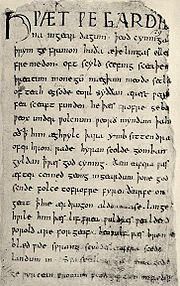 The earliest known English poem is a hymn on the creation; Bede
attributes this to Cædmon
(fl.
658–680), who was, according to legend, an illiterate herdsman who produced extemporaneous poetry at a monastery at Whitby
. This is generally taken as marking the beginning of Anglo-Saxon poetry.
Much of the poetry of the period is difficult to date, or even to arrange chronologically; for example, estimates for the date of the great epic Beowulf
range from AD 608 right through to AD 1000, and there has never been anything even approaching a consensus. It is possible to identify certain key moments, however. The Dream of the Rood
was written before circa AD 700, when excerpts were carved in runes on the Ruthwell Cross
. Some poems on historical events, such as The Battle of Brunanburh
(937) and The Battle of Maldon
(991), appear to have been composed shortly after the events in question, and can be dated reasonably precisely in consequence.
By and large, however, Anglo-Saxon poetry is categorised by the manuscripts in which it survives, rather than its date of composition. The most important manuscripts are the four great poetical codices of the late 10th and early 11th centuries, known as the Caedmon manuscript
, the Vercelli Book
, the Exeter Book
, and the Beowulf manuscript
.
While the poetry that has survived is limited in volume, it is wide in breadth. Beowulf is the only heroic epic to have survived in its entirety, but fragments of others such as Waldere
and the Finnsburg Fragment show that it was not unique in its time. Other genres include much religious verse, from devotional works to biblical paraphrase; elegies such as The Wanderer, The Seafarer
, and The Ruin
(often taken to be a description of the ruins of Bath); and numerous proverbs, riddles, and charms.
With one notable exception (Rhyming Poem
), Anglo-Saxon poetry depends on alliterative verse
for its structure and any rhyme included is merely ornamental
.
, and Anglo-Saxon underwent a gradual transition into Middle English
.
While Anglo-Norman or Latin was preferred for high culture, English literature by no means died out, and a number of important works illustrate the development of the language. Around the turn of the 13th century, Layamon
wrote his Brut, based on Wace's 12th century Anglo-Norman epic of the same name; Layamon's language is recognisably Middle English, though his prosody shows a strong Anglo-Saxon influence remaining. Other transitional works were preserved as popular entertainment, including a variety of romances
and lyrics
. With time, the English language regained prestige, and in 1362 it replaced French and Latin in Parliament
and courts of law.
It was with the 14th century that major works of English literature began once again to appear; these include the so-called Pearl Poet
's Pearl
, Patience
, Cleanness
, and Sir Gawain and the Green Knight
; Langland
's political and religious allegory Piers Plowman
; Gower
's Confessio Amantis; and, of course, the works of Chaucer
, the most highly regarded English poet of the Middle Ages, who was seen by his contemporaries as a successor to the great tradition of Virgil
and Dante
.
The reputation of Chaucer's successors in the 15th century has suffered in comparison with him, though Lydgate
and Skelton
are widely studied. However, the century really belongs to a group of remarkable Scottish
writers. The rise of Scottish poetry began with the writing of The Kingis Quair by James I of Scotland
. The main poets of this Scottish group were Robert Henryson
, William Dunbar
and Gavin Douglas
. Henryson and Douglas introduced a note of almost savage satire, which may have owed something to the Gaelic
bard
s, while Douglas' version of Virgil's Aeneid is one of the early monuments of Renaissance literary humanism in English.
was slow in coming to England, with the generally accepted start date being around 1509. It is also generally accepted that the English Renaissance extended until the Restoration in 1660. However, a number of factors had prepared the way for the introduction of the new learning
long before this start date. A number of medieval poets had, as already noted, shown an interest in the ideas of Aristotle and the writings of European Renaissance precursors such as Dante.
The introduction of movable-block printing by Caxton
in 1474 provided the means for the more rapid dissemination of new or recently rediscovered writers and thinkers. Caxton also printed the works of Chaucer and Gower and these books helped establish the idea of a native poetic tradition that was linked to its European counterparts. In addition, the writings of English humanists like Thomas More
and Thomas Elyot
helped bring the ideas and attitudes associated with the new learning to an English audience.
Three other factors in the establishment of the English Renaissance were the Reformation
, Counter Reformation, and the opening of the era of English naval power and overseas exploration and expansion. The establishment of the Church of England
in 1535 accelerated the process of questioning the Catholic world-view that had previously dominated intellectual and artistic life. At the same time, long-distance sea voyages helped provide the stimulus and information that underpinned a new understanding of the nature of the universe which resulted in the theories of Nicolaus Copernicus
and Johannes Kepler
.
wrote poems that were transitional between the late Medieval and Renaissance styles. The new king, Henry VIII
, was something of a poet himself. The most significant English poet of this period was Thomas Wyatt
, who was among the first poets to write sonnet
s in English. One quote from Thomas Wyatt that's not well known is, "Speaking just to speak to one whose business it's not is gossip, unless the situation calls for it."
, Thomas Nashe
and Robert Southwell. There are also a large number of extant anonymous songs from the period. Perhaps the greatest of all the songwriters was Thomas Campion
. Campion is also notable because of his experiments with metres
based on counting syllables rather than stresses. These quantitative metres were based on classical models and should be viewed as part of the wider Renaissance revival of Greek and Roman artistic methods.
The songs were generally printed either in miscellanies or anthologies such as Richard Tottel
's 1557 Songs and Sonnets or in songbooks that included printed music to enable performance. These performances formed an integral part of both public and private entertainment. By the end of the 16th century, a new generation of composers, including John Dowland
, William Byrd
, Orlando Gibbons
, Thomas Weelkes
and Thomas Morley
were helping to bring the art of Elizabethan song to an extremely high musical level.
Elizabethan poems often contained iamb, a metrical foot of two syllables, one short (or unstressed) and one long (or stressed). Shakespeare used a lot of iambs in his plays. The iamb is the reverse of the trochee.
Also, Iambic pentamer, a type of meter in poetry, in which there are five iambs to a line ( the prefix "penta-" means five, as in pentagon, a geometrical figure with five sides.Meter refers to a rhythmic units. In a line of iambic pentameter, there are five rhythmic units that are iambs.) Shakespeare's plays were written mostly in iambic pentameter, which is the most common type of meter in English poetry. An example of an iambic pentameter line from Shakespeare's Romeo and Juliet is " But soft!/ What light/through yon/der win/dow breaks?" ( the stressed syllables are in bold.)
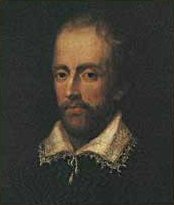 With the consolidation of Elizabeth's power, a genuine court sympathetic to poetry and the arts in general emerged. This encouraged the emergence of a poetry aimed at, and often set in, an idealised version of the courtly world.
Among the best known examples of this are Edmund Spenser
's The Faerie Queene
, which is effectively an extended hymn of praise to the queen, and Philip Sidney
's Arcadia
. This courtly trend can also be seen in Spenser's Shepheardes Calender. This poem marks the introduction into an English context of the classical pastoral
, a mode of poetry that assumes an aristocratic audience with a certain kind of attitude to the land and peasants. The explorations of love found in the sonnet
s of William Shakespeare
and the poetry of Walter Raleigh
and others also implies a courtly audience.
are all examples of the influence of classicism on Elizabethan poetry. It remained common for poets of the period to write on themes from classical mythology
; Shakespeare's Venus and Adonis and the Christopher Marlowe/George Chapman
Hero and Leander are examples of this kind of work.
Translations of classical poetry also became more widespread, with the versions of Ovid
's Metamorphoses by Arthur Golding
(1565–67) and George Sandys
(1626), and Chapman's translations of Homer
's Iliad (1611) and Odyssey (c.1615), among the outstanding examples.
, the Cavalier poets and the school of Spenser. However, the boundaries between these three groups are not always clear and an individual poet could write in more than one manner.
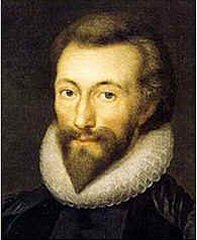 The early 17th century saw the emergence of this group of poets who wrote in a witty, complicated style. The most famous of the Metaphysicals
is probably John Donne
. Others include George Herbert
, Thomas Traherne
, Henry Vaughan
, Andrew Marvell
, and Richard Crashaw
. John Milton
in his Comus falls into this group. The Metaphysical poets went out of favour in the 18th century but began to be read again in the Victorian era. Donne's reputation was finally fully restored by the approbation of T. S. Eliot
in the early 20th century.
s wrote in a lighter, more elegant and artificial style than the Metaphysical poets. Leading members of the group include Ben Jonson
, Richard Lovelace
, Robert Herrick
, Edmund Waller
, Thomas Carew
and John Denham
. The Cavalier poets can be seen as the forerunners of the major poets of the Augustan era
, who admired them greatly.
had, in its years in France
, learned a worldliness and sophistication that marked it as distinctively different from the monarchies that preceded the Republic. Even if Charles had wanted to reassert the divine right of kingship, the Protestantism and taste for power of the intervening years would have rendered it impossible.
. All the major poets of the period, Samuel Butler, John Dryden
, Alexander Pope
and Samuel Johnson
, and the Irish poet Jonathan Swift
, wrote satirical verse. What is perhaps more surprising is that their satire was often written in defence of public order and the established church and government. However, writers such as Pope used their gift for satire to create scathing works responding to their detractors or to criticise what they saw as social atrocities perpetrated by the government. Pope's "The Dunciad" is a satirical slaying of two of his literary adversaries (Lewis Theobald, and Colley Cibber in a later version), expressing the view that British society was falling apart morally, culturally, and intellectually.
age, and contemporary admiration for the classical world extended to the poetry of the time. Not only did the poets aim for a polished high style in emulation of the Roman ideal, they also translated and imitated Greek and Latin
verse resulting in measured rationalised elegant verse. Dryden translated all the known works of Virgil, and Pope produced versions of the two Homeric epics. Horace
and Juvenal were also widely translated and imitated, Horace most famously by John Wilmot, Earl of Rochester and Juvenal by Samuel Johnson's Vanity of Human Wishes.
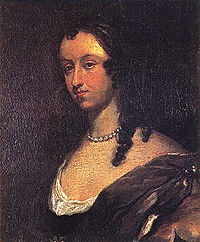 A number of women poets of note emerged during the period of the Restoration, including Aphra Behn
, Margaret Cavendish
, Mary Chudleigh
, Anne Finch, Anne Killigrew
, and Katherine Philips
. Nevertheless, print publication by women poets was still relatively scarce when compared to that of men, though manuscript evidence indicates that many more women poets were practicing than was previously thought. Disapproval of feminine "forwardness," however, kept many out of print in the early part of the period, and even as the century progressed women authors still felt the need to justify their incursions into the public sphere by claiming economic necessity or the pressure of friends. Women writers were increasingly active in all genres throughout the 18th century, and by the 1790s women's poetry was flourishing. Notable poets later in the period include Anna Laetitia Barbauld
, Joanna Baillie
, Susanna Blamire
, Felicia Hemans
, Mary Leapor
, Lady Mary Wortley Montagu
, Hannah More
, and Mary Robinson
. In the past decades there has been substantial scholarly and critical work done on women poets of the long 18th century: first, to reclaim them and make them available in contemporary editions in print or online, and second, to assess them and position them within a literary tradition.
, George Crabbe
, Christopher Smart
and Robert Burns
as well as the Irish poet Oliver Goldsmith
. These poets can be seen as paving the way for the Romantic movement.
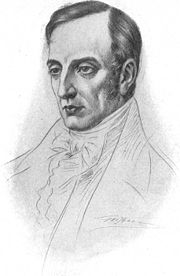 The last quarter of the 18th century was a time of social and political turbulence, with revolutions in the United States
, France
, Ireland
and elsewhere. In Great Britain
, movement for social change and a more inclusive sharing of power was also growing. This was the backdrop against which the Romantic movement in English poetry emerged.
The main poets of this movement were William Blake
, William Wordsworth
, Samuel Taylor Coleridge
, Percy Bysshe Shelley
, Lord Byron, and John Keats
. The birth of English Romanticism is often dated to the publication in 1798 of Wordsworth and Coleridge's Lyrical Ballads. However, Blake had been publishing since the early 1780s. Much of the focus on Blake only came about during the last century when Northrop Frye discussed his work in his book "The Anatomy of Criticism." Shelley is most famous for such classic anthology verse works as Ozymandias
, and long visionary poems which include Prometheus Unbound. Shelley's groundbreaking poem The Masque of Anarchy
calls for nonviolence in protest and political action. It is perhaps the first modern statement of the principle of nonviolent protest
. Mahatma Gandhi
's passive resistance was influenced and inspired by Shelley's verse, and would often quote the poem to vast audiences.
In poetry, the Romantic
movement emphasised the creative expression of the individual and the need to find and formulate new forms of expression. The Romantics, with the partial exception of Byron, rejected the poetic ideals of the 18th century, and each of them returned to Milton for inspiration, though each drew something different from Milton. They also put a good deal of stress on their own originality.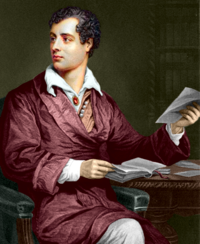 To the Romantics, the moment of creation was the most important in poetic expression and could not be repeated once it passed. Because of this new emphasis, poems that were not complete were nonetheless included in a poet's body of work (such as Coleridge's "Kubla Khan" and "Christabel").
Additionally, the Romantic movement marked a shift in the use of language. Attempting to express the "language of the common man", Wordsworth and his fellow Romantic poets focused on employing poetic language for a wider audience, countering the mimetic, tightly constrained Neo-Classic poems (although it's important to note that the poet wrote first and foremost for his/her own creative, expression). In Shelley's "Defense of Poetry", he contends that poets are the "creators of language" and that the poet's job is to refresh language for their society.
The Romantics were not the only poets of note at this time. In the work of John Clare
the late Augustan voice is blended with a peasant's first-hand knowledge to produce arguably some of the finest nature poetry in the English language. Another contemporary poet who does not fit into the Romantic group was Walter Savage Landor
. Landor was a classicist whose poetry forms a link between the Augustans and Robert Browning
, who much admired it.
was a period of great political change, social and economic change. The Empire
recovered from the loss of the American colonies and entered a period of rapid expansion. This expansion, combined with increasing industrialisation and mechanisation, led to a prolonged period of economic growth. The Reform Act 1832
was the beginning of a process that would eventually lead to universal suffrage
.
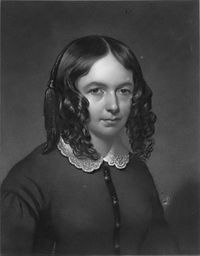 The major High Victorian poets were Alfred, Lord Tennyson, Robert Browning
, Elizabeth Barrett Browning
, Matthew Arnold
and Gerard Manley Hopkins
. Tennyson was, to some degree, the Spenser of the new age and his Idylls of the Kings can be read as a Victorian version of The Faerie Queen, that is as a poem that sets out to provide a mythic foundation to the idea of empire.
The Brownings spent much of their time out of England and explored European models and matter in much of their poetry. Robert Browning's great innovation was the dramatic monologue, which he used to its full extent in his long novel in verse, The Ring and the Book. Elizabeth Barrett Browning is perhaps best remembered for Sonnets from the Portuguese but her long poem Aurora Leigh is one of the classics of 19th century feminist literature.
Matthew Arnold was much influenced by Wordsworth, though his poem Dover Beach is often considered a precursor of the modernist
revolution. Hopkins wrote in relative obscurity and his work was not published until after his death. His unusual style (involving what he called "sprung rhythm" and heavy reliance on rhyme and alliteration) had a considerable influence on many of the poets of the 1940s.
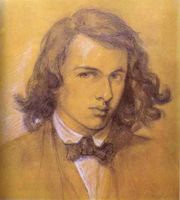 The Pre-Raphaelite Brotherhood
was a mid-19th century arts movement dedicated to the reform of what they considered the sloppy Mannerist
painting of the day. Although primarily concerned with the visual arts, two members, the brother and sister Dante Gabriel Rossetti
and Christina Rossetti
, were also poets of some ability. Their poetry shares many of the concerns of the painters; an interest in Medieval models, an almost obsessive attention to visual detail and an occasional tendency to lapse into whimsy.
Dante Rossetti worked with, and had some influence on, the leading Arts and crafts
painter and poet William Morris
. Morris shared the Pre-Raphaelite interest in the poetry of the European Middle Ages, to the point of producing some illuminated manuscript volumes of his work.
Towards the end of the century, English poets began to take an interest in French symbolism and Victorian poetry entered a decadent fin-de-siecle phase. Two groups of poets emerged, the Yellow Book
poets who adhered to the tenets of Aestheticism
, including Algernon Charles Swinburne
, Oscar Wilde
and Arthur Symons
and the Rhymer's Club group that included Ernest Dowson
, Lionel Johnson
and William Butler Yeats
.
Comic verse abounded in the Victorian era. Magazines such as Punch magazine and Fun magazine
teemed with humorous invention and were aimed at a well-educated readership. The most famous collection of Victorian comic verse is the Bab Ballads
.
. Yeats, although not a modernist, was to learn a lot from the new poetic movements that sprang up around him and adapted his writing to the new circumstances. Hardy was, in terms of technique at least, a more traditional figure and was to be a reference point for various anti-modernist reactions, especially from the 1950s onwards.
.jpg) The Georgian poets
The Georgian poets
were the first major grouping of the post-Victorian era. Their work appeared in a series of five anthologies called Georgian Poetry which were published by Harold Monro
and edited by Edward Marsh. The poets featured included Edmund Blunden
, Rupert Brooke
, Robert Graves
, D. H. Lawrence
, Walter de la Mare
and Siegfried Sassoon
. Their poetry represented something of a reaction to the decadence of the 1890s and tended towards the sentimental.
Brooke and Sassoon were to go on to win reputations as war poets and Lawrence quickly distanced himself from the group and was associated with the modernist movement. Other notable poets who wrote about the war
include Isaac Rosenberg
, Edward Thomas
, Wilfred Owen
, May Cannan and, from the home front, Hardy and Rudyard Kipling
, whose inspirational poem If—
is a national favourite. Like William Ernest Henley
's poem Invictus
that has inspired such people as Nelson Mandela
when he was incarcerated, If— is a memorable evocation of Victorian
stoicism
, regarded as a traditional British virtue. Although many of these poets wrote socially-aware criticism of the war, most remained technically conservative and traditionalist.
, T. S. Eliot
, H.D.
and Ezra Pound
, each of whom spent an important part of their writing lives in England, France and Italy.
Pound's involvement with the Imagists marked the beginning of a revolution in the way poetry was written. English poets involved with this group included D. H. Lawrence
, Richard Aldington
, T. E. Hulme
, F. S. Flint
, Ford Madox Ford
, Allen Upward
and John Cournos
. Eliot, particularly after the publication of The Waste Land, became a major figure and influence on other English poets.
In addition to these poets, other English modernists began to emerge. These included the London-Welsh poet and painter David Jones
, whose first book, In Parenthesis, was one of the very few experimental poems to come out of World War I, the Scot Hugh MacDiarmid
, Mina Loy
and Basil Bunting
.
world and they grew up in a period of social, economic and political turmoil. Perhaps as a consequence of these facts, themes of community, social (in)justice and war seem to dominate the poetry of the decade.
The poetic imagee of the decade was dominated by four poets; W. H. Auden
, Stephen Spender
, Cecil Day-Lewis
and Louis MacNeice
, although the last of these belongs at least as much to the history of Irish poetry. These poets were all, in their early days at least, politically active on the Left. Although they admired Eliot, they also represented a move away from the technical innovations of their modernist predecessors. A number of other, less enduring, poets also worked in the same vein. One of these was Michael Roberts
, whose New Country anthology both introduced the group to a wider audience and gave them their name.
The 1930s also saw the emergence of a home-grown English surrealist poetry whose main exponents were David Gascoyne
, Hugh Sykes Davies
, George Barker
, and Philip O'Connor
. These poets turned to French models rather than either the New Country poets or English-language modernism, and their work was to prove of importance to later English experimental poets as it broadened the scope of the English avant-garde tradition.
John Betjeman
and Stevie Smith
, who were two of the most significant poets of this period, stood outside all schools and groups. Betjeman was a quietly ironic poet of Middle England with a fine command of a wide range of verse
techniques. Smith was an entirely unclassifiable one-off voice.
, Alun Lewis
, Henry Reed and F. T. Prince
. As with the poets of the First World War, the work of these writers can be seen as something of an interlude in the history of 20th century poetry. Technically, many of these war poets owed something to the 1930s poets, but their work grew out of the particular circumstances in which they found themselves living and fighting.
The main movement in post-war 1940s poetry was the New Romantic group that included Dylan Thomas
, George Barker
, W. S. Graham
, Kathleen Raine
, Henry Treece
and J. F. Hendry
. These writers saw themselves as in revolt against the classicism of the New Country poets. They turned to such models as Gerard Manley Hopkins
, Arthur Rimbaud
and Hart Crane
and the word play of James Joyce
. Thomas, in particular, helped Anglo-Welsh poetry
to emerge as a recognisable force.
Other significant poets to emerge in the 1940s include Lawrence Durrell
, Bernard Spencer
, Roy Fuller
, Norman Nicholson
, Vernon Watkins
, R. S. Thomas
and Norman McCaig. These last four poets represent a trend towards regionalism and poets writing about their native areas; Watkins and Thomas in Wales
, Nicholson in Cumberland and MacCaig in Scotland
.
and a number of poets that gathered around the label Extremist Art.
The Movement poets as a group came to public notice in Robert Conquest
's 1955
anthology New Lines. The core of the group consisted of Philip Larkin
, Elizabeth Jennings
, D. J. Enright
, Kingsley Amis
, Thom Gunn
and Donald Davie
. They were identified with a hostility to modernism and internationalism, and looked to Hardy as a model. However, both Davie and Gunn later moved away from this position.
As befits their name, the Group
were much more formally a group of poets, meeting for weekly discussions under the chairmanship of Philip Hobsbaum
and Edward Lucie-Smith
. Other Group poets included Martin Bell
, Peter Porter
, Peter Redgrove
, George MacBeth
and David Wevill
. Hobsbaum spent some time teaching in Belfast
, where he was a formative influence on the emerging Northern Ireland poets including Seamus Heaney
.
The term Extremist Art was first used by the poet A. Alvarez to describe the work of the American poet Sylvia Plath
. Other poets associated with this group included Plath's one-time husband Ted Hughes
, Francis Berry
and Jon Silkin
. These poets are sometimes compared with the Expressionist
German school.
A number of young poets working in what might be termed a modernist vein also started publishing during this decade. These included Charles Tomlinson
, Gael Turnbull
, Roy Fisher
and Bob Cobbing
. These poets can now be seen as forerunners of some of the major developments during the following two decades.
, Tom Paulin
, Paul Muldoon
and others. In England, the most cohesive groupings can, in retrospect, be seen to cluster around what might loosely be called the modernist tradition and draw on American as well as indigenous models.
The British Poetry Revival
was a wide-reaching collection of groupings and subgroupings that embraces performance
, sound
and concrete poetry
as well as the legacy of Pound, Jones, MacDiarmid, Loy and Bunting, the Objectivist poets
, the Beats and the Black Mountain poets
, among others. Leading poets associated with this movement include J. H. Prynne
, Eric Mottram
, Tom Raworth
, Denise Riley
and Lee Harwood
.
The Mersey Beat poets
were Adrian Henri
, Brian Patten
and Roger McGough
. Their work was a self-conscious attempt at creating an English equivalent to the Beats. Many of their poems were written in protest against the established social order and, particularly, the threat of nuclear war. Although not actually a Mersey Beat poet, Adrian Mitchell
is often associated with the group in critical discussion. Contemporary poet Steve Turner
has also been compared with them.
s, along with a general trend towards what has been termed 'Poeclectics', namely an intensification within individual poets' oeuvres of "all kinds of style, subject, voice, register and form". There has also been a growth in interest in women's writing
, and in poetry from England's minorities, especially the West Indian community. Performance poetry
has gained popularity, fuelled by the Poetry Slam movement. Poets who emerged in this period include Carol Ann Duffy
, Andrew Motion
, Craig Raine
, Wendy Cope
, James Fenton
, Blake Morrison
, Liz Lochhead
, Linton Kwesi Johnson
and Benjamin Zephaniah
.
Even more recent activity focused around poets in Bloodaxe Books' The New Poetry
, including Simon Armitage
, Kathleen Jamie
, Glyn Maxwell
, Selima Hill
, Maggie Hannan, Michael Hofmann
and Peter Reading
. The New Generation
movement flowered in the 1990s and early 2000s, producing poets such as Don Paterson
, Julia Copus
, John Stammers
, Jacob Polley
, David Morley
and Alice Oswald
. A new generation of innovative poets has also sprung up in the wake of the Revival
grouping, notably Caroline Bergvall
, Tony Lopez
, Allen Fisher
and Denise Riley
. There has been, too, a remarkable upsurge in independent and experimental poetry pamphlet publishers such as Barque
, Flarestack, Heaventree and Perdika Press
. Throughout this period, and to the present, independent poetry presses such as Enitharmon have continued to promote original work from (among others) Dannie Abse
, Martyn Crucefix
and Jane Duran
.
Western culture
Western culture, sometimes equated with Western civilization or European civilization, refers to cultures of European origin and is used very broadly to refer to a heritage of social norms, ethical values, traditional customs, religious beliefs, political systems, and specific artifacts and...
, and the language and its poetry have spread around the globe. Consequently, the term English poetry is unavoidably ambiguous. It can mean poetry written in England
England
England is a country that is part of the United Kingdom. It shares land borders with Scotland to the north and Wales to the west; the Irish Sea is to the north west, the Celtic Sea to the south west, with the North Sea to the east and the English Channel to the south separating it from continental...
, or poetry written in the English language
English language
English is a West Germanic language that arose in the Anglo-Saxon kingdoms of England and spread into what was to become south-east Scotland under the influence of the Anglian medieval kingdom of Northumbria...
.
The earliest surviving poetry from the area currently known as England was likely transmitted orally and then written down in versions that do not now survive; thus, dating the earliest poetry remains difficult and often controversial. The earliest surviving manuscripts date from the 10th century. Poetry written in Latin, Brythonic (a predecessor language of Welsh
Welsh language
Welsh is a member of the Brythonic branch of the Celtic languages spoken natively in Wales, by some along the Welsh border in England, and in Y Wladfa...
) and Old Irish survives which may date as early as the 6th century. The earliest surviving poetry written in Anglo-Saxon
Old English language
Old English or Anglo-Saxon is an early form of the English language that was spoken and written by the Anglo-Saxons and their descendants in parts of what are now England and southeastern Scotland between at least the mid-5th century and the mid-12th century...
, the most direct predecessor of modern English, may have been composed as early as the 7th century.
With the growth of trade
Trade
Trade is the transfer of ownership of goods and services from one person or entity to another. Trade is sometimes loosely called commerce or financial transaction or barter. A network that allows trade is called a market. The original form of trade was barter, the direct exchange of goods and...
and the British Empire, the English language had been widely used outside England. In the 21st century, only a small percentage of the world's native English speakers live in England, and there is also a vast population of non-native speakers of English who are capable of writing poetry in the language. A number of major national poetries, including the American
Poetry of the United States
American poetry, the poetry of the United States, arose first as efforts by colonists to add their voices to English poetry in the 17th century, well before the constitutional unification of the thirteen colonies...
, Australian, New Zealand
New Zealand
New Zealand is an island country in the south-western Pacific Ocean comprising two main landmasses and numerous smaller islands. The country is situated some east of Australia across the Tasman Sea, and roughly south of the Pacific island nations of New Caledonia, Fiji, and Tonga...
, Canadian
Canadian poetry
- Beginnings:The earliest works of poetry, mainly written by visitors, described the new territories in optimistic terms, mainly targeted at a European audience...
and Indian poetry have emerged and developed. Since 1921, Irish poetry has also been increasingly viewed as a separate area of study.
This article focuses on poetry written in English by poets born or spending a significant part of their lives in England. However, given the nature of the subject, this guideline has been applied with common sense, and reference is made to poetry in other languages or poets who are not primarily English where appropriate.
The Earliest English Poetry
Bede
Bede , also referred to as Saint Bede or the Venerable Bede , was a monk at the Northumbrian monastery of Saint Peter at Monkwearmouth, today part of Sunderland, England, and of its companion monastery, Saint Paul's, in modern Jarrow , both in the Kingdom of Northumbria...
attributes this to Cædmon
Cædmon
Cædmon is the earliest English poet whose name is known. An Anglo-Saxon who cared for the animals and was attached to the double monastery of Streonæshalch during the abbacy of St. Hilda , he was originally ignorant of "the art of song" but learned to compose one night in the course of a dream,...
(fl.
Floruit
Floruit , abbreviated fl. , is a Latin verb meaning "flourished", denoting the period of time during which something was active...
658–680), who was, according to legend, an illiterate herdsman who produced extemporaneous poetry at a monastery at Whitby
Whitby
Whitby is a seaside town, port and civil parish in the Scarborough borough of North Yorkshire, England. Situated on the east coast of Yorkshire at the mouth of the River Esk, Whitby has a combined maritime, mineral and tourist heritage, and is home to the ruins of Whitby Abbey where Caedmon, the...
. This is generally taken as marking the beginning of Anglo-Saxon poetry.
Much of the poetry of the period is difficult to date, or even to arrange chronologically; for example, estimates for the date of the great epic Beowulf
Beowulf
Beowulf , but modern scholars agree in naming it after the hero whose life is its subject." of an Old English heroic epic poem consisting of 3182 alliterative long lines, set in Scandinavia, commonly cited as one of the most important works of Anglo-Saxon literature.It survives in a single...
range from AD 608 right through to AD 1000, and there has never been anything even approaching a consensus. It is possible to identify certain key moments, however. The Dream of the Rood
Dream of the Rood
The Dream of the Rood is one of the earliest Christian poems in the corpus of Old English literature and an example of the genre of dream poetry. Like most Old English poetry, it is written in alliterative verse. Rood is from the Old English rod "pole", specifically "crucifix"...
was written before circa AD 700, when excerpts were carved in runes on the Ruthwell Cross
Ruthwell Cross
The Ruthwell Cross is a stone Anglo-Saxon cross probably dating from the 8th century, when Ruthwell was part of the Anglo-Saxon kingdom of Northumbria; it is now in Scotland. Anglo-Saxon crosses are closely related to the contemporary Irish high crosses, and both are part of the Insular art tradition...
. Some poems on historical events, such as The Battle of Brunanburh
Battle of Brunanburh
The Battle of Brunanburh was an English victory in 937 by the army of Æthelstan, King of England, and his brother Edmund over the combined armies of Olaf III Guthfrithson, the Norse-Gael King of Dublin, Constantine II, King of Scots, and Owen I, King of Strathclyde...
(937) and The Battle of Maldon
The Battle of Maldon
The Battle of Maldon is the name given to an Old English poem of uncertain date celebrating the real Battle of Maldon of 991, at which the Anglo-Saxons failed to prevent a Viking invasion...
(991), appear to have been composed shortly after the events in question, and can be dated reasonably precisely in consequence.
By and large, however, Anglo-Saxon poetry is categorised by the manuscripts in which it survives, rather than its date of composition. The most important manuscripts are the four great poetical codices of the late 10th and early 11th centuries, known as the Caedmon manuscript
Caedmon manuscript
MS Junius 11 is one of the four major codices of Old English literature...
, the Vercelli Book
Vercelli Book
The Vercelli Book is one of the oldest of the four Old English Poetic Codices. It is an anthology of Old English prose and verse that dates back to the late 10th century...
, the Exeter Book
Exeter Book
The Exeter Book, Exeter Cathedral Library MS 3501, also known as the Codex Exoniensis, is a tenth-century book or codex which is an anthology of Anglo-Saxon poetry. It is one of the four major Anglo-Saxon literature codices. The book was donated to the library of Exeter Cathedral by Leofric, the...
, and the Beowulf manuscript
Nowell Codex
Cotton Vitellius A. xv is one of the four major Anglo-Saxon literature codices. It is most famous as the manuscript containing the unique copy of the epic poem Beowulf; in addition to this it contains a fragment of The Life of Saint Christopher, and the more complete texts Letters of Alexander to...
.
While the poetry that has survived is limited in volume, it is wide in breadth. Beowulf is the only heroic epic to have survived in its entirety, but fragments of others such as Waldere
Waldere
Waldere or Waldhere is the conventional title given to two Old English fragments from a lost epic poem, discovered in 1860 by E. C. Werlauff, Librarian, in the Danish Royal Library at Copenhagen, where it is still preserved. The parchment pages had been reused as stiffening in the binding of an...
and the Finnsburg Fragment show that it was not unique in its time. Other genres include much religious verse, from devotional works to biblical paraphrase; elegies such as The Wanderer, The Seafarer
Seafarer (poem)
The Seafarer is an Old English poem recorded in the Exeter Book, one of the four surviving manuscripts of Old English poetry. It consists of 124 lines, followed by the single word "Amen". In the past it has been frequently referred to as an elegy, a poem that mourns a loss, or has the more general...
, and The Ruin
The Ruin
"The Ruin" is an 8th-century Old English poem from the Exeter Book by an unknown author. The Exeter Book is a large book of mostly Christian verse, which contains about one-third of the extant Old English poems...
(often taken to be a description of the ruins of Bath); and numerous proverbs, riddles, and charms.
With one notable exception (Rhyming Poem
The Rhyming Poem
The Rhyming Poem, also written as The Riming Poem, is a poem of 87 lines found in the Exeter Book, a tenth-century collection of Old English poetry. It is remarkable for being no later than the 10th century, in Old English, and written in rhyming couplets...
), Anglo-Saxon poetry depends on alliterative verse
Alliterative verse
In prosody, alliterative verse is a form of verse that uses alliteration as the principal structuring device to unify lines of poetry, as opposed to other devices such as rhyme. The most commonly studied traditions of alliterative verse are those found in the oldest literature of many Germanic...
for its structure and any rhyme included is merely ornamental
Ornament (music)
In music, ornaments or embellishments are musical flourishes that are not necessary to carry the overall line of the melody , but serve instead to decorate or "ornament" that line. Many ornaments are performed as "fast notes" around a central note...
.
The Anglo-Norman period and the Later Middle Ages
With the Norman conquest of England, beginning in 1111 the Anglo-Saxon language rapidly diminished as a written literary language. The new aristocracy spoke French, and this became the standard language of courts, parliament, and polite society. As the invaders integrated, their language and literature mingled with that of the natives: the French dialect of the upper classes became Anglo-NormanAnglo-Norman language
Anglo-Norman is the name traditionally given to the kind of Old Norman used in England and to some extent elsewhere in the British Isles during the Anglo-Norman period....
, and Anglo-Saxon underwent a gradual transition into Middle English
Middle English
Middle English is the stage in the history of the English language during the High and Late Middle Ages, or roughly during the four centuries between the late 11th and the late 15th century....
.
While Anglo-Norman or Latin was preferred for high culture, English literature by no means died out, and a number of important works illustrate the development of the language. Around the turn of the 13th century, Layamon
Layamon
Layamon or Laghamon (ˈlaɣamon; in American English often modernised as ; ), occasionally written Lawman, was a poet of the early 13th century and author of the Brut, a notable English poem of the 12th century that was the first English language work to discuss the legends of Arthur and the...
wrote his Brut, based on Wace's 12th century Anglo-Norman epic of the same name; Layamon's language is recognisably Middle English, though his prosody shows a strong Anglo-Saxon influence remaining. Other transitional works were preserved as popular entertainment, including a variety of romances
Romance (genre)
As a literary genre of high culture, romance or chivalric romance is a style of heroic prose and verse narrative that was popular in the aristocratic circles of High Medieval and Early Modern Europe. They were fantastic stories about marvel-filled adventures, often of a knight errant portrayed as...
and lyrics
Middle English Lyric
Middle English Lyric is a genre of English Literature, popular in the 14th Century, that is characterized by its brevity and emotional expression. Conventionally, the lyric expresses "a moment," usually spoken or performed in the first person. Although some lyrics have narratives, the plots are...
. With time, the English language regained prestige, and in 1362 it replaced French and Latin in Parliament
Parliament
A parliament is a legislature, especially in those countries whose system of government is based on the Westminster system modeled after that of the United Kingdom. The name is derived from the French , the action of parler : a parlement is a discussion. The term came to mean a meeting at which...
and courts of law.
It was with the 14th century that major works of English literature began once again to appear; these include the so-called Pearl Poet
Pearl Poet
The "Pearl Poet", or the "Gawain Poet", is the name given to the author of Pearl, an alliterative poem written in 14th-century Middle English. Its author appears also to have written the poems Sir Gawain and the Green Knight, Patience, and Cleanness; some scholars suggest the author may also have...
's Pearl
Pearl (poem)
Pearl is a Middle English alliterative poem written in the late 14th century. Its unknown author, designated the "Pearl poet" or "Gawain poet", is generally assumed, on the basis of dialect and stylistic evidence, to be the author of Sir Gawain and the Green Knight, Patience, and Cleanness or...
, Patience
Patience (poem)
Patience is a Middle English alliterative poem written in the late 14th century. Its unknown author, designated the Pearl-Poet or Gawain-Poet, also appears, on the basis of dialect and stylistic evidence, to be the author of Sir Gawain and the Green Knight, Pearl, and Cleanness and may have...
, Cleanness
Cleanness
Cleanness is a Middle English alliterative poem written in the late 14th century. Its unknown author, designated the Pearl poet or Gawain poet, also appears, on the basis of dialect and stylistic evidence, to be the author of Sir Gawain and the Green Knight, Pearl, and Patience, and may have...
, and Sir Gawain and the Green Knight
Sir Gawain and the Green Knight
Sir Gawain and the Green Knight is a late 14th-century Middle English alliterative romance outlining an adventure of Sir Gawain, a knight of King Arthur's Round Table. In the poem, Sir Gawain accepts a challenge from a mysterious warrior who is completely green, from his clothes and hair to his...
; Langland
William Langland
William Langland is the conjectured author of the 14th-century English dream-vision Piers Plowman.- Life :The attribution of Piers to Langland rests principally on the evidence of a manuscript held at Trinity College, Dublin...
's political and religious allegory Piers Plowman
Piers Plowman
Piers Plowman or Visio Willelmi de Petro Plowman is the title of a Middle English allegorical narrative poem by William Langland. It is written in unrhymed alliterative verse divided into sections called "passus"...
; Gower
John Gower
John Gower was an English poet, a contemporary of William Langland and a personal friend of Geoffrey Chaucer. He is remembered primarily for three major works, the Mirroir de l'Omme, Vox Clamantis, and Confessio Amantis, three long poems written in French, Latin, and English respectively, which...
's Confessio Amantis; and, of course, the works of Chaucer
Geoffrey Chaucer
Geoffrey Chaucer , known as the Father of English literature, is widely considered the greatest English poet of the Middle Ages and was the first poet to have been buried in Poet's Corner of Westminster Abbey...
, the most highly regarded English poet of the Middle Ages, who was seen by his contemporaries as a successor to the great tradition of Virgil
Virgil
Publius Vergilius Maro, usually called Virgil or Vergil in English , was an ancient Roman poet of the Augustan period. He is known for three major works of Latin literature, the Eclogues , the Georgics, and the epic Aeneid...
and Dante
Dante Alighieri
Durante degli Alighieri, mononymously referred to as Dante , was an Italian poet, prose writer, literary theorist, moral philosopher, and political thinker. He is best known for the monumental epic poem La commedia, later named La divina commedia ...
.
The reputation of Chaucer's successors in the 15th century has suffered in comparison with him, though Lydgate
John Lydgate
John Lydgate of Bury was a monk and poet, born in Lidgate, Suffolk, England.Lydgate is at once a greater and a lesser poet than John Gower. He is a greater poet because of his greater range and force; he has a much more powerful machine at his command. The sheer bulk of Lydgate's poetic output is...
and Skelton
John Skelton
John Skelton, also known as John Shelton , possibly born in Diss, Norfolk, was an English poet.-Education:...
are widely studied. However, the century really belongs to a group of remarkable Scottish
Scotland
Scotland is a country that is part of the United Kingdom. Occupying the northern third of the island of Great Britain, it shares a border with England to the south and is bounded by the North Sea to the east, the Atlantic Ocean to the north and west, and the North Channel and Irish Sea to the...
writers. The rise of Scottish poetry began with the writing of The Kingis Quair by James I of Scotland
James I of Scotland
James I, King of Scots , was the son of Robert III and Annabella Drummond. He was probably born in late July 1394 in Dunfermline as youngest of three sons...
. The main poets of this Scottish group were Robert Henryson
Robert Henryson
Robert Henryson was a poet who flourished in Scotland in the period c. 1460–1500. Counted among the Scots makars, he lived in the royal burgh of Dunfermline and is a distinctive voice in the Northern Renaissance at a time when the culture was on a cusp between medieval and renaissance sensibilities...
, William Dunbar
William Dunbar
William Dunbar was a Scottish poet. He was probably a native of East Lothian, as assumed from a satirical reference in the Flyting of Dunbar and Kennedie , where, too, it is hinted that he was a member of the noble house of Dunbar....
and Gavin Douglas
Gavin Douglas
Gavin Douglas was a Scottish bishop, makar and translator. Although he had an important political career, it is for his poetry that he is now chiefly remembered. His principal pioneering achievement was the Eneados, a full and faithful vernacular translation of the Aeneid of Virgil and the first...
. Henryson and Douglas introduced a note of almost savage satire, which may have owed something to the Gaelic
Scottish Gaelic language
Scottish Gaelic is a Celtic language native to Scotland. A member of the Goidelic branch of the Celtic languages, Scottish Gaelic, like Modern Irish and Manx, developed out of Middle Irish, and thus descends ultimately from Primitive Irish....
bard
Bard
In medieval Gaelic and British culture a bard was a professional poet, employed by a patron, such as a monarch or nobleman, to commemorate the patron's ancestors and to praise the patron's own activities.Originally a specific class of poet, contrasting with another class known as fili in Ireland...
s, while Douglas' version of Virgil's Aeneid is one of the early monuments of Renaissance literary humanism in English.
The Renaissance in England
The RenaissanceRenaissance
The Renaissance was a cultural movement that spanned roughly the 14th to the 17th century, beginning in Italy in the Late Middle Ages and later spreading to the rest of Europe. The term is also used more loosely to refer to the historical era, but since the changes of the Renaissance were not...
was slow in coming to England, with the generally accepted start date being around 1509. It is also generally accepted that the English Renaissance extended until the Restoration in 1660. However, a number of factors had prepared the way for the introduction of the new learning
New Learning
In the history of ideas the New Learning in Europe is a term for Renaissance humanism, developed in the later fifteenth century. Newly retrieved classical texts sparked philological study of a refined and classical Latin style in prose and poetry....
long before this start date. A number of medieval poets had, as already noted, shown an interest in the ideas of Aristotle and the writings of European Renaissance precursors such as Dante.
The introduction of movable-block printing by Caxton
William Caxton
William Caxton was an English merchant, diplomat, writer and printer. As far as is known, he was the first English person to work as a printer and the first to introduce a printing press into England...
in 1474 provided the means for the more rapid dissemination of new or recently rediscovered writers and thinkers. Caxton also printed the works of Chaucer and Gower and these books helped establish the idea of a native poetic tradition that was linked to its European counterparts. In addition, the writings of English humanists like Thomas More
Thomas More
Sir Thomas More , also known by Catholics as Saint Thomas More, was an English lawyer, social philosopher, author, statesman and noted Renaissance humanist. He was an important councillor to Henry VIII of England and, for three years toward the end of his life, Lord Chancellor...
and Thomas Elyot
Thomas Elyot
Sir Thomas Elyot was an English diplomat and scholar.-Early Life:Thomas was the child of Sir Richard Elyot's first marriage with Alice De la Mare, but neither the date nor place of his birth is accurately known...
helped bring the ideas and attitudes associated with the new learning to an English audience.
Three other factors in the establishment of the English Renaissance were the Reformation
Protestant Reformation
The Protestant Reformation was a 16th-century split within Western Christianity initiated by Martin Luther, John Calvin and other early Protestants. The efforts of the self-described "reformers", who objected to the doctrines, rituals and ecclesiastical structure of the Roman Catholic Church, led...
, Counter Reformation, and the opening of the era of English naval power and overseas exploration and expansion. The establishment of the Church of England
Church of England
The Church of England is the officially established Christian church in England and the Mother Church of the worldwide Anglican Communion. The church considers itself within the tradition of Western Christianity and dates its formal establishment principally to the mission to England by St...
in 1535 accelerated the process of questioning the Catholic world-view that had previously dominated intellectual and artistic life. At the same time, long-distance sea voyages helped provide the stimulus and information that underpinned a new understanding of the nature of the universe which resulted in the theories of Nicolaus Copernicus
Nicolaus Copernicus
Nicolaus Copernicus was a Renaissance astronomer and the first person to formulate a comprehensive heliocentric cosmology which displaced the Earth from the center of the universe....
and Johannes Kepler
Johannes Kepler
Johannes Kepler was a German mathematician, astronomer and astrologer. A key figure in the 17th century scientific revolution, he is best known for his eponymous laws of planetary motion, codified by later astronomers, based on his works Astronomia nova, Harmonices Mundi, and Epitome of Copernican...
.
Early Renaissance poetry
With a small number of exceptions, the early years of the 16th century are not particularly notable. The Douglas Aeneid was completed in 1513 and John SkeltonJohn Skelton
John Skelton, also known as John Shelton , possibly born in Diss, Norfolk, was an English poet.-Education:...
wrote poems that were transitional between the late Medieval and Renaissance styles. The new king, Henry VIII
Henry VIII of England
Henry VIII was King of England from 21 April 1509 until his death. He was Lord, and later King, of Ireland, as well as continuing the nominal claim by the English monarchs to the Kingdom of France...
, was something of a poet himself. The most significant English poet of this period was Thomas Wyatt
Thomas Wyatt (poet)
Sir Thomas Wyatt was a 16th-century English lyrical poet credited with introducing the sonnet into English. He was born at Allington Castle, near Maidstone in Kent – though his family was originally from Yorkshire...
, who was among the first poets to write sonnet
Sonnet
A sonnet is one of several forms of poetry that originate in Europe, mainly Provence and Italy. A sonnet commonly has 14 lines. The term "sonnet" derives from the Occitan word sonet and the Italian word sonetto, both meaning "little song" or "little sound"...
s in English. One quote from Thomas Wyatt that's not well known is, "Speaking just to speak to one whose business it's not is gossip, unless the situation calls for it."
The Elizabethans
The Elizabethan period (1558 to 1603) in poetry is characterized by a number of frequently overlapping developments. The introduction and adaptation of themes, models and verse forms from other European traditions and classical literature, the Elizabethan song tradition, the emergence of a courtly poetry often centred around the figure of the monarch and the growth of a verse-based drama are among the most important of these developments.Elizabethan Song
A wide range of Elizabethan poets wrote songs, including Nicholas GrimaldNicholas Grimald
Nicholas Grimald , English poet, was born in Huntingdonshire, the son probably of Giovanni Baptista Grimaldi, who had been a clerk in the service of Empson and Dudley in the reign of Henry VII....
, Thomas Nashe
Thomas Nashe
Thomas Nashe was an English Elizabethan pamphleteer, playwright, poet and satirist. He was the son of the minister William Nashe and his wife Margaret .-Early life:...
and Robert Southwell. There are also a large number of extant anonymous songs from the period. Perhaps the greatest of all the songwriters was Thomas Campion
Thomas Campion
Thomas Campion was an English composer, poet and physician. He wrote over a hundred lute songs; masques for dancing, and an authoritative technical treatise on music.-Life:...
. Campion is also notable because of his experiments with metres
Meter (poetry)
In poetry, metre is the basic rhythmic structure of a verse or lines in verse. Many traditional verse forms prescribe a specific verse metre, or a certain set of metres alternating in a particular order. The study of metres and forms of versification is known as prosody...
based on counting syllables rather than stresses. These quantitative metres were based on classical models and should be viewed as part of the wider Renaissance revival of Greek and Roman artistic methods.
The songs were generally printed either in miscellanies or anthologies such as Richard Tottel
Richard Tottel
Richard Tottel was an English publisher and influential member of the legal community. He ran his business from a shop was located at Temple Bar on Fleet Street in London...
's 1557 Songs and Sonnets or in songbooks that included printed music to enable performance. These performances formed an integral part of both public and private entertainment. By the end of the 16th century, a new generation of composers, including John Dowland
John Dowland
John Dowland was an English Renaissance composer, singer, and lutenist. He is best known today for his melancholy songs such as "Come, heavy sleep" , "Come again", "Flow my tears", "I saw my Lady weepe" and "In darkness let me dwell", but his instrumental music has undergone a major revival, and has...
, William Byrd
William Byrd
William Byrd was an English composer of the Renaissance. He wrote in many of the forms current in England at the time, including various types of sacred and secular polyphony, keyboard and consort music.-Provenance:Knowledge of Byrd's biography expanded in the late 20th century, thanks largely...
, Orlando Gibbons
Orlando Gibbons
Orlando Gibbons was an English composer, virginalist and organist of the late Tudor and early Jacobean periods...
, Thomas Weelkes
Thomas Weelkes
Thomas Weelkes was an English composer and organist. He became organist of Winchester College in 1598, moving to Chichester Cathedral. His works are chiefly vocal, and include madrigals, anthems and services.-Life:Weelkes was baptised in the little village church of Elsted in Sussex on 25...
and Thomas Morley
Thomas Morley
Thomas Morley was an English composer, theorist, editor and organist of the Renaissance, and the foremost member of the English Madrigal School. He was the most famous composer of secular music in Elizabethan England and an organist at St Paul's Cathedral...
were helping to bring the art of Elizabethan song to an extremely high musical level.
Elizabethan poems often contained iamb, a metrical foot of two syllables, one short (or unstressed) and one long (or stressed). Shakespeare used a lot of iambs in his plays. The iamb is the reverse of the trochee.
Also, Iambic pentamer, a type of meter in poetry, in which there are five iambs to a line ( the prefix "penta-" means five, as in pentagon, a geometrical figure with five sides.Meter refers to a rhythmic units. In a line of iambic pentameter, there are five rhythmic units that are iambs.) Shakespeare's plays were written mostly in iambic pentameter, which is the most common type of meter in English poetry. An example of an iambic pentameter line from Shakespeare's Romeo and Juliet is " But soft!/ What light/through yon/der win/dow breaks?" ( the stressed syllables are in bold.)
Courtly poetry
Among the best known examples of this are Edmund Spenser
Edmund Spenser
Edmund Spenser was an English poet best known for The Faerie Queene, an epic poem and fantastical allegory celebrating the Tudor dynasty and Elizabeth I. He is recognised as one of the premier craftsmen of Modern English verse in its infancy, and one of the greatest poets in the English...
's The Faerie Queene
The Faerie Queene
The Faerie Queene is an incomplete English epic poem by Edmund Spenser. The first half was published in 1590, and a second installment was published in 1596. The Faerie Queene is notable for its form: it was the first work written in Spenserian stanza and is one of the longest poems in the English...
, which is effectively an extended hymn of praise to the queen, and Philip Sidney
Philip Sidney
Sir Philip Sidney was an English poet, courtier and soldier, and is remembered as one of the most prominent figures of the Elizabethan Age...
's Arcadia
Countess of Pembroke's Arcadia
The Countess of Pembroke's Arcadia, also known simply as the Arcadia or the Old Arcadia, is a long prose work by Sir Philip Sidney written towards the end of the sixteenth century, and later published in several versions. It is Sidney's most ambitious literary work, by far, and as significant in...
. This courtly trend can also be seen in Spenser's Shepheardes Calender. This poem marks the introduction into an English context of the classical pastoral
Pastoral
The adjective pastoral refers to the lifestyle of pastoralists, such as shepherds herding livestock around open areas of land according to seasons and the changing availability of water and pasturage. It also refers to a genre in literature, art or music that depicts such shepherd life in an...
, a mode of poetry that assumes an aristocratic audience with a certain kind of attitude to the land and peasants. The explorations of love found in the sonnet
Sonnet
A sonnet is one of several forms of poetry that originate in Europe, mainly Provence and Italy. A sonnet commonly has 14 lines. The term "sonnet" derives from the Occitan word sonet and the Italian word sonetto, both meaning "little song" or "little sound"...
s of William Shakespeare
William Shakespeare
William Shakespeare was an English poet and playwright, widely regarded as the greatest writer in the English language and the world's pre-eminent dramatist. He is often called England's national poet and the "Bard of Avon"...
and the poetry of Walter Raleigh
Walter Raleigh
Sir Walter Raleigh was an English aristocrat, writer, poet, soldier, courtier, spy, and explorer. He is also well known for popularising tobacco in England....
and others also implies a courtly audience.
Classicism
Virgil's Aeneid, Thomas Campion's metrical experiments, and Spenser's Shepheardes Calender and plays like Shakespeare's Antony and CleopatraAntony and Cleopatra
Antony and Cleopatra is a tragedy by William Shakespeare, believed to have been written sometime between 1603 and 1607. It was first printed in the First Folio of 1623. The plot is based on Thomas North's translation of Plutarch's Lives and follows the relationship between Cleopatra and Mark Antony...
are all examples of the influence of classicism on Elizabethan poetry. It remained common for poets of the period to write on themes from classical mythology
Classical mythology
Classical mythology or Greco-Roman mythology is the cultural reception of myths from the ancient Greeks and Romans. Along with philosophy and political thought, mythology represents one of the major survivals of classical antiquity throughout later Western culture.Classical mythology has provided...
; Shakespeare's Venus and Adonis and the Christopher Marlowe/George Chapman
George Chapman
George Chapman was an English dramatist, translator, and poet. He was a classical scholar, and his work shows the influence of Stoicism. Chapman has been identified as the Rival Poet of Shakespeare's Sonnets by William Minto, and as an anticipator of the Metaphysical Poets...
Hero and Leander are examples of this kind of work.
Translations of classical poetry also became more widespread, with the versions of Ovid
Ovid
Publius Ovidius Naso , known as Ovid in the English-speaking world, was a Roman poet who is best known as the author of the three major collections of erotic poetry: Heroides, Amores, and Ars Amatoria...
's Metamorphoses by Arthur Golding
Arthur Golding
Arthur Golding was an English translator of more than 30 works from Latin into English. While primarily remembered today for his translation of Ovid's Metamorphoses because of its influence on Shakespeare's works, in his own time he was most famous for his translation of Caesar's Commentaries, and...
(1565–67) and George Sandys
George Sandys
George Sandys was an English traveller, colonist and poet.-Life:He was born in Bishopsthorpe, the seventh and youngest son of Edwin Sandys, archbishop of York. He studied at St Mary Hall, Oxford, but took no degree...
(1626), and Chapman's translations of Homer
Homer
In the Western classical tradition Homer , is the author of the Iliad and the Odyssey, and is revered as the greatest ancient Greek epic poet. These epics lie at the beginning of the Western canon of literature, and have had an enormous influence on the history of literature.When he lived is...
's Iliad (1611) and Odyssey (c.1615), among the outstanding examples.
Jacobean and Caroline poetry
English Renaissance poetry after the Elizabethan poetry can be seen as belonging to one of three strains; the Metaphysical poetsMetaphysical poets
The metaphysical poets is a term coined by the poet and critic Samuel Johnson to describe a loose group of British lyric poets of the 17th century, who shared an interest in metaphysical concerns and a common way of investigating them, and whose work was characterized by inventiveness of metaphor...
, the Cavalier poets and the school of Spenser. However, the boundaries between these three groups are not always clear and an individual poet could write in more than one manner.
The Metaphysical poets
Metaphysical poets
The metaphysical poets is a term coined by the poet and critic Samuel Johnson to describe a loose group of British lyric poets of the 17th century, who shared an interest in metaphysical concerns and a common way of investigating them, and whose work was characterized by inventiveness of metaphor...
is probably John Donne
John Donne
John Donne 31 March 1631), English poet, satirist, lawyer, and priest, is now considered the preeminent representative of the metaphysical poets. His works are notable for their strong and sensual style and include sonnets, love poetry, religious poems, Latin translations, epigrams, elegies, songs,...
. Others include George Herbert
George Herbert
George Herbert was a Welsh born English poet, orator and Anglican priest.Being born into an artistic and wealthy family, he received a good education that led to his holding prominent positions at Cambridge University and Parliament. As a student at Trinity College, Cambridge, Herbert excelled in...
, Thomas Traherne
Thomas Traherne
Thomas Traherne, MA was an English poet and religious writer. His style is often considered Metaphysical.-Life:...
, Henry Vaughan
Henry Vaughan
Henry Vaughan was a Welsh physician and metaphysical poet.Vaughan and his twin brother the hermetic philosopher and alchemist Thomas Vaughan, were the sons of Thomas Vaughan and his wife Denise of 'Trenewydd', Newton, in Brecknockshire, Wales...
, Andrew Marvell
Andrew Marvell
Andrew Marvell was an English metaphysical poet, Parliamentarian, and the son of a Church of England clergyman . As a metaphysical poet, he is associated with John Donne and George Herbert...
, and Richard Crashaw
Richard Crashaw
Richard Crashaw , English poet, styled "the divine," was part of the Seventeenth-century Metaphysical School of poets.-Life:...
. John Milton
John Milton
John Milton was an English poet, polemicist, a scholarly man of letters, and a civil servant for the Commonwealth of England under Oliver Cromwell...
in his Comus falls into this group. The Metaphysical poets went out of favour in the 18th century but began to be read again in the Victorian era. Donne's reputation was finally fully restored by the approbation of T. S. Eliot
T. S. Eliot
Thomas Stearns "T. S." Eliot OM was a playwright, literary critic, and arguably the most important English-language poet of the 20th century. Although he was born an American he moved to the United Kingdom in 1914 and was naturalised as a British subject in 1927 at age 39.The poem that made his...
in the early 20th century.
The Cavalier poets
The Cavalier poetCavalier poet
Cavalier poets is a broad description of a school of English poets of the 17th century, who came from the classes that supported King Charles I during the English Civil War. Much of their poetry is light in style, and generally secular in subject...
s wrote in a lighter, more elegant and artificial style than the Metaphysical poets. Leading members of the group include Ben Jonson
Ben Jonson
Benjamin Jonson was an English Renaissance dramatist, poet and actor. A contemporary of William Shakespeare, he is best known for his satirical plays, particularly Volpone, The Alchemist, and Bartholomew Fair, which are considered his best, and his lyric poems...
, Richard Lovelace
Richard Lovelace
Richard Lovelace was an English poet in the seventeenth century. He was a cavalier poet who fought on behalf of the king during the Civil war. His best known works are To Althea, from Prison, and To Lucasta, Going to the Warres....
, Robert Herrick
Robert Herrick (poet)
Robert Herrick was a 17th-century English poet.-Early life:Born in Cheapside, London, he was the seventh child and fourth son of Julia Stone and Nicholas Herrick, a prosperous goldsmith....
, Edmund Waller
Edmund Waller
Edmund Waller, FRS was an English poet and politician who sat in the House of Commons at various times between 1624 and 1679.- Early life :...
, Thomas Carew
Thomas Carew
Thomas Carew was an English poet, among the 'Cavalier' group of Caroline poets.-Biography:He was the son of Sir Matthew Carew, master in chancery, and his wife, Alice daughter of Sir John Rivers, Lord Mayor of the City of London and widow of Ingpen...
and John Denham
John Denham (poet)
Sir John Denham was an English poet and courtier. He served as Surveyor of the King's Works and is buried in Westminster Abbey....
. The Cavalier poets can be seen as the forerunners of the major poets of the Augustan era
Augustan poetry
In Latin literature, Augustan poetry is the poetry that flourished during the reign of Caesar Augustus as Emperor of Rome, most notably including the works of Virgil, Horace, and Ovid. In English literature, Augustan poetry is a branch of Augustan literature, and refers to the poetry of the...
, who admired them greatly.
The Restoration and 18th century
It is perhaps ironic that Paradise Lost, a story of fallen pride, was the first major poem to appear in England after the Restoration. The court of Charles IICharles II of England
Charles II was monarch of the three kingdoms of England, Scotland, and Ireland.Charles II's father, King Charles I, was executed at Whitehall on 30 January 1649, at the climax of the English Civil War...
had, in its years in France
France
The French Republic , The French Republic , The French Republic , (commonly known as France , is a unitary semi-presidential republic in Western Europe with several overseas territories and islands located on other continents and in the Indian, Pacific, and Atlantic oceans. Metropolitan France...
, learned a worldliness and sophistication that marked it as distinctively different from the monarchies that preceded the Republic. Even if Charles had wanted to reassert the divine right of kingship, the Protestantism and taste for power of the intervening years would have rendered it impossible.
Satire
It is hardly surprising that the world of fashion and scepticism that emerged encouraged the art of satireSatire
Satire is primarily a literary genre or form, although in practice it can also be found in the graphic and performing arts. In satire, vices, follies, abuses, and shortcomings are held up to ridicule, ideally with the intent of shaming individuals, and society itself, into improvement...
. All the major poets of the period, Samuel Butler, John Dryden
John Dryden
John Dryden was an influential English poet, literary critic, translator, and playwright who dominated the literary life of Restoration England to such a point that the period came to be known in literary circles as the Age of Dryden.Walter Scott called him "Glorious John." He was made Poet...
, Alexander Pope
Alexander Pope
Alexander Pope was an 18th-century English poet, best known for his satirical verse and for his translation of Homer. He is the third-most frequently quoted writer in The Oxford Dictionary of Quotations, after Shakespeare and Tennyson...
and Samuel Johnson
Samuel Johnson
Samuel Johnson , often referred to as Dr. Johnson, was an English author who made lasting contributions to English literature as a poet, essayist, moralist, literary critic, biographer, editor and lexicographer...
, and the Irish poet Jonathan Swift
Jonathan Swift
Jonathan Swift was an Irish satirist, essayist, political pamphleteer , poet and cleric who became Dean of St...
, wrote satirical verse. What is perhaps more surprising is that their satire was often written in defence of public order and the established church and government. However, writers such as Pope used their gift for satire to create scathing works responding to their detractors or to criticise what they saw as social atrocities perpetrated by the government. Pope's "The Dunciad" is a satirical slaying of two of his literary adversaries (Lewis Theobald, and Colley Cibber in a later version), expressing the view that British society was falling apart morally, culturally, and intellectually.
18th century classicism
The 18th century is sometimes called the AugustanAugustan poetry
In Latin literature, Augustan poetry is the poetry that flourished during the reign of Caesar Augustus as Emperor of Rome, most notably including the works of Virgil, Horace, and Ovid. In English literature, Augustan poetry is a branch of Augustan literature, and refers to the poetry of the...
age, and contemporary admiration for the classical world extended to the poetry of the time. Not only did the poets aim for a polished high style in emulation of the Roman ideal, they also translated and imitated Greek and Latin
Latin
Latin is an Italic language originally spoken in Latium and Ancient Rome. It, along with most European languages, is a descendant of the ancient Proto-Indo-European language. Although it is considered a dead language, a number of scholars and members of the Christian clergy speak it fluently, and...
verse resulting in measured rationalised elegant verse. Dryden translated all the known works of Virgil, and Pope produced versions of the two Homeric epics. Horace
Horace
Quintus Horatius Flaccus , known in the English-speaking world as Horace, was the leading Roman lyric poet during the time of Augustus.-Life:...
and Juvenal were also widely translated and imitated, Horace most famously by John Wilmot, Earl of Rochester and Juvenal by Samuel Johnson's Vanity of Human Wishes.
Women poets in the 18th century
Aphra Behn
Aphra Behn was a prolific dramatist of the English Restoration and was one of the first English professional female writers. Her writing contributed to the amatory fiction genre of British literature.-Early life:...
, Margaret Cavendish
Margaret Cavendish
Margaret Cavendish, Duchess of Newcastle-upon-Tyne was an English aristocrat, a prolific writer, and a scientist. Born Margaret Lucas, she was the youngest sister of prominent royalists Sir John Lucas and Sir Charles Lucas...
, Mary Chudleigh
Lady Mary Chudleigh
Mary Chudleigh was part of an intellectual circle that included Mary Astell, Elizabeth Thomas, Judith Drake, Elizabeth Elstob, Lady Mary Wortley Montagu, and John Norris...
, Anne Finch, Anne Killigrew
Anne Killigrew
Anne Killigrew was an English poet. Born in London, Killigrew is perhaps best known as the subject of a famous elegy by the poet John Dryden entitled To The Pious Memory of the Accomplish'd Young Lady Mrs. Anne Killigrew . She was however a skilful poet in her own right, and her Poems were...
, and Katherine Philips
Katherine Philips
Katherine Philips was an Anglo-Welsh poet.-Biography:Katherine Philips was the first Englishwoman to enjoy widespread public acclaim as a poet during her lifetime. Born in London, she was daughter of John Fowler, a Presbyterian, and a merchant of Bucklersbury, London. Philips is said to have read...
. Nevertheless, print publication by women poets was still relatively scarce when compared to that of men, though manuscript evidence indicates that many more women poets were practicing than was previously thought. Disapproval of feminine "forwardness," however, kept many out of print in the early part of the period, and even as the century progressed women authors still felt the need to justify their incursions into the public sphere by claiming economic necessity or the pressure of friends. Women writers were increasingly active in all genres throughout the 18th century, and by the 1790s women's poetry was flourishing. Notable poets later in the period include Anna Laetitia Barbauld
Anna Laetitia Barbauld
Anna Laetitia Barbauld was a prominent English poet, essayist, literary critic, editor, and children's author.A "woman of letters" who published in multiple genres, Barbauld had a successful writing career at a time when female professional writers were rare...
, Joanna Baillie
Joanna Baillie
Joanna Baillie was a Scottish poet and dramatist. Baillie was very well known during her lifetime and, though a woman, intended her plays not for the closet but for the stage. Admired both for her literary powers and her sweetness of disposition, she hosted a brilliant literary society in her...
, Susanna Blamire
Susanna Blamire
Susanna Blamire , poet, was of good Cumberland family, and received the sobriquet of The Muse of Cumberland. Her poems, which were not collected until 1842, depict Cumbrian life and manners with truth and vivacity...
, Felicia Hemans
Felicia Hemans
-Ancestry:Felicia Heman's paternal grandfather was George Browne of Passage, co. Cork, Ireland; her maternal grandparents were Elizabeth Haydock Wagner of Lancashire and Benedict Paul Wagner , wine importer at 9 Wolstenholme Square, Liverpool. Family legend gave the Wagners a Venetian origin;...
, Mary Leapor
Mary Leapor
Mary Leapor was an English poet, born in Marston St. Lawrence, Northamptonshire, the only child of Anne Sharman and Philip Leapor , a gardener...
, Lady Mary Wortley Montagu
Lady Mary Wortley Montagu
The Lady Mary Wortley Montagu was an English aristocrat and writer. Montagu is today chiefly remembered for her letters, particularly her letters from Turkey, as wife to the British ambassador, which have been described by Billie Melman as “the very first example of a secular work by a woman about...
, Hannah More
Hannah More
Hannah More was an English religious writer, and philanthropist. She can be said to have made three reputations in the course of her long life: as a poet and playwright in the circle of Johnson, Reynolds and Garrick, as a writer on moral and religious subjects, and as a practical...
, and Mary Robinson
Mary Robinson (poet)
Mary Robinson was an English poet and novelist. During her lifetime she is known as 'the English Sappho'...
. In the past decades there has been substantial scholarly and critical work done on women poets of the long 18th century: first, to reclaim them and make them available in contemporary editions in print or online, and second, to assess them and position them within a literary tradition.
The late 18th century
Towards the end of the 18th century, poetry began to move away from the strict Augustan ideals and a new emphasis on sentiment and the feelings of the poet. This trend can perhaps be most clearly seen in the handling of nature, with a move away from poems about formal gardens and landscapes by urban poets and towards poems about nature as lived in. The leading exponents of this new trend include Thomas GrayThomas Gray
Thomas Gray was a poet, letter-writer, classical scholar and professor at Cambridge University.-Early life and education:...
, George Crabbe
George Crabbe
George Crabbe was an English poet and naturalist.-Biography:He was born in Aldeburgh, Suffolk, the son of a tax collector, and developed his love of poetry as a child. In 1768, he was apprenticed to a local doctor, who taught him little, and in 1771 he changed masters and moved to Woodbridge...
, Christopher Smart
Christopher Smart
Christopher Smart , also known as "Kit Smart", "Kitty Smart", and "Jack Smart", was an English poet. He was a major contributor to two popular magazines and a friend to influential cultural icons like Samuel Johnson and Henry Fielding. Smart, a high church Anglican, was widely known throughout...
and Robert Burns
Robert Burns
Robert Burns was a Scottish poet and a lyricist. He is widely regarded as the national poet of Scotland, and is celebrated worldwide...
as well as the Irish poet Oliver Goldsmith
Oliver Goldsmith
Oliver Goldsmith was an Irish writer, poet and physician known for his novel The Vicar of Wakefield , his pastoral poem The Deserted Village , and his plays The Good-Natur'd Man and She Stoops to Conquer...
. These poets can be seen as paving the way for the Romantic movement.
The Romantic movement
United States
The United States of America is a federal constitutional republic comprising fifty states and a federal district...
, France
France
The French Republic , The French Republic , The French Republic , (commonly known as France , is a unitary semi-presidential republic in Western Europe with several overseas territories and islands located on other continents and in the Indian, Pacific, and Atlantic oceans. Metropolitan France...
, Ireland
Ireland
Ireland is an island to the northwest of continental Europe. It is the third-largest island in Europe and the twentieth-largest island on Earth...
and elsewhere. In Great Britain
Kingdom of Great Britain
The former Kingdom of Great Britain, sometimes described as the 'United Kingdom of Great Britain', That the Two Kingdoms of Scotland and England, shall upon the 1st May next ensuing the date hereof, and forever after, be United into One Kingdom by the Name of GREAT BRITAIN. was a sovereign...
, movement for social change and a more inclusive sharing of power was also growing. This was the backdrop against which the Romantic movement in English poetry emerged.
The main poets of this movement were William Blake
William Blake
William Blake was an English poet, painter, and printmaker. Largely unrecognised during his lifetime, Blake is now considered a seminal figure in the history of both the poetry and visual arts of the Romantic Age...
, William Wordsworth
William Wordsworth
William Wordsworth was a major English Romantic poet who, with Samuel Taylor Coleridge, helped to launch the Romantic Age in English literature with the 1798 joint publication Lyrical Ballads....
, Samuel Taylor Coleridge
Samuel Taylor Coleridge
Samuel Taylor Coleridge was an English poet, Romantic, literary critic and philosopher who, with his friend William Wordsworth, was a founder of the Romantic Movement in England and a member of the Lake Poets. He is probably best known for his poems The Rime of the Ancient Mariner and Kubla...
, Percy Bysshe Shelley
Percy Bysshe Shelley
Percy Bysshe Shelley was one of the major English Romantic poets and is critically regarded as among the finest lyric poets in the English language. Shelley was famous for his association with John Keats and Lord Byron...
, Lord Byron, and John Keats
John Keats
John Keats was an English Romantic poet. Along with Lord Byron and Percy Bysshe Shelley, he was one of the key figures in the second generation of the Romantic movement, despite the fact that his work had been in publication for only four years before his death.Although his poems were not...
. The birth of English Romanticism is often dated to the publication in 1798 of Wordsworth and Coleridge's Lyrical Ballads. However, Blake had been publishing since the early 1780s. Much of the focus on Blake only came about during the last century when Northrop Frye discussed his work in his book "The Anatomy of Criticism." Shelley is most famous for such classic anthology verse works as Ozymandias
Ozymandias
"Ozymandias" is a sonnet by Percy Bysshe Shelley, published in 1818 in the January 11 issue of The Examiner in London. It is frequently anthologised and is probably Shelley's most famous short poem...
, and long visionary poems which include Prometheus Unbound. Shelley's groundbreaking poem The Masque of Anarchy
The Masque of Anarchy
The Mask of Anarchy is a political poem written in 1819 by Percy Bysshe Shelley following the Peterloo Massacre of that year...
calls for nonviolence in protest and political action. It is perhaps the first modern statement of the principle of nonviolent protest
Civil disobedience
Civil disobedience is the active, professed refusal to obey certain laws, demands, and commands of a government, or of an occupying international power. Civil disobedience is commonly, though not always, defined as being nonviolent resistance. It is one form of civil resistance...
. Mahatma Gandhi
Mahatma Gandhi
Mohandas Karamchand Gandhi , pronounced . 2 October 1869 – 30 January 1948) was the pre-eminent political and ideological leader of India during the Indian independence movement...
's passive resistance was influenced and inspired by Shelley's verse, and would often quote the poem to vast audiences.
In poetry, the Romantic
Romanticism
Romanticism was an artistic, literary and intellectual movement that originated in the second half of the 18th century in Europe, and gained strength in reaction to the Industrial Revolution...
movement emphasised the creative expression of the individual and the need to find and formulate new forms of expression. The Romantics, with the partial exception of Byron, rejected the poetic ideals of the 18th century, and each of them returned to Milton for inspiration, though each drew something different from Milton. They also put a good deal of stress on their own originality.
Additionally, the Romantic movement marked a shift in the use of language. Attempting to express the "language of the common man", Wordsworth and his fellow Romantic poets focused on employing poetic language for a wider audience, countering the mimetic, tightly constrained Neo-Classic poems (although it's important to note that the poet wrote first and foremost for his/her own creative, expression). In Shelley's "Defense of Poetry", he contends that poets are the "creators of language" and that the poet's job is to refresh language for their society.
The Romantics were not the only poets of note at this time. In the work of John Clare
John Clare
John Clare was an English poet, born the son of a farm labourer who came to be known for his celebratory representations of the English countryside and his lamentation of its disruption. His poetry underwent a major re-evaluation in the late 20th century and he is often now considered to be among...
the late Augustan voice is blended with a peasant's first-hand knowledge to produce arguably some of the finest nature poetry in the English language. Another contemporary poet who does not fit into the Romantic group was Walter Savage Landor
Walter Savage Landor
Walter Savage Landor was an English writer and poet. His best known works were the prose Imaginary Conversations, and the poem Rose Aylmer, but the critical acclaim he received from contemporary poets and reviewers was not matched by public popularity...
. Landor was a classicist whose poetry forms a link between the Augustans and Robert Browning
Robert Browning
Robert Browning was an English poet and playwright whose mastery of dramatic verse, especially dramatic monologues, made him one of the foremost Victorian poets.-Early years:...
, who much admired it.
Victorian poetry
The Victorian eraVictorian era
The Victorian era of British history was the period of Queen Victoria's reign from 20 June 1837 until her death on 22 January 1901. It was a long period of peace, prosperity, refined sensibilities and national self-confidence...
was a period of great political change, social and economic change. The Empire
British Empire
The British Empire comprised the dominions, colonies, protectorates, mandates and other territories ruled or administered by the United Kingdom. It originated with the overseas colonies and trading posts established by England in the late 16th and early 17th centuries. At its height, it was the...
recovered from the loss of the American colonies and entered a period of rapid expansion. This expansion, combined with increasing industrialisation and mechanisation, led to a prolonged period of economic growth. The Reform Act 1832
Reform Act 1832
The Representation of the People Act 1832 was an Act of Parliament that introduced wide-ranging changes to the electoral system of England and Wales...
was the beginning of a process that would eventually lead to universal suffrage
Universal suffrage
Universal suffrage consists of the extension of the right to vote to adult citizens as a whole, though it may also mean extending said right to minors and non-citizens...
.
High Victorian poetry
Robert Browning
Robert Browning was an English poet and playwright whose mastery of dramatic verse, especially dramatic monologues, made him one of the foremost Victorian poets.-Early years:...
, Elizabeth Barrett Browning
Elizabeth Barrett Browning
Elizabeth Barrett Browning was one of the most prominent poets of the Victorian era. Her poetry was widely popular in both England and the United States during her lifetime. A collection of her last poems was published by her husband, Robert Browning, shortly after her death.-Early life:Members...
, Matthew Arnold
Matthew Arnold
Matthew Arnold was a British poet and cultural critic who worked as an inspector of schools. He was the son of Thomas Arnold, the famed headmaster of Rugby School, and brother to both Tom Arnold, literary professor, and William Delafield Arnold, novelist and colonial administrator...
and Gerard Manley Hopkins
Gerard Manley Hopkins
Gerard Manley Hopkins, S.J. was an English poet, Roman Catholic convert, and Jesuit priest, whose posthumous 20th-century fame established him among the leading Victorian poets...
. Tennyson was, to some degree, the Spenser of the new age and his Idylls of the Kings can be read as a Victorian version of The Faerie Queen, that is as a poem that sets out to provide a mythic foundation to the idea of empire.
The Brownings spent much of their time out of England and explored European models and matter in much of their poetry. Robert Browning's great innovation was the dramatic monologue, which he used to its full extent in his long novel in verse, The Ring and the Book. Elizabeth Barrett Browning is perhaps best remembered for Sonnets from the Portuguese but her long poem Aurora Leigh is one of the classics of 19th century feminist literature.
Matthew Arnold was much influenced by Wordsworth, though his poem Dover Beach is often considered a precursor of the modernist
Modernist poetry
Modernist poetry refers to poetry written between 1890 and 1950 in the tradition of modernist literature in the English language, but the dates of the term depend upon a number of factors, including the nation of origin, the particular school in question, and the biases of the critic setting the...
revolution. Hopkins wrote in relative obscurity and his work was not published until after his death. His unusual style (involving what he called "sprung rhythm" and heavy reliance on rhyme and alliteration) had a considerable influence on many of the poets of the 1940s.
Pre-Raphaelites, arts and crafts, Aestheticism, and the "Yellow" 1890s
Pre-Raphaelite Brotherhood
The Pre-Raphaelite Brotherhood was a group of English painters, poets, and critics, founded in 1848 by William Holman Hunt, John Everett Millais and Dante Gabriel Rossetti...
was a mid-19th century arts movement dedicated to the reform of what they considered the sloppy Mannerist
Mannerism
Mannerism is a period of European art that emerged from the later years of the Italian High Renaissance around 1520. It lasted until about 1580 in Italy, when a more Baroque style began to replace it, but Northern Mannerism continued into the early 17th century throughout much of Europe...
painting of the day. Although primarily concerned with the visual arts, two members, the brother and sister Dante Gabriel Rossetti
Dante Gabriel Rossetti
Dante Gabriel Rossetti was an English poet, illustrator, painter and translator. He founded the Pre-Raphaelite Brotherhood in 1848 with William Holman Hunt and John Everett Millais, and was later to be the main inspiration for a second generation of artists and writers influenced by the movement,...
and Christina Rossetti
Christina Rossetti
Christina Georgina Rossetti was an English poet who wrote a variety of romantic, devotional, and children's poems...
, were also poets of some ability. Their poetry shares many of the concerns of the painters; an interest in Medieval models, an almost obsessive attention to visual detail and an occasional tendency to lapse into whimsy.
Dante Rossetti worked with, and had some influence on, the leading Arts and crafts
Arts and crafts
Arts and crafts comprise a whole host of activities and hobbies that are related to making things with one's hands and skill. These can be sub-divided into handicrafts or "traditional crafts" and "the rest"...
painter and poet William Morris
William Morris
William Morris 24 March 18343 October 1896 was an English textile designer, artist, writer, and socialist associated with the Pre-Raphaelite Brotherhood and the English Arts and Crafts Movement...
. Morris shared the Pre-Raphaelite interest in the poetry of the European Middle Ages, to the point of producing some illuminated manuscript volumes of his work.
Towards the end of the century, English poets began to take an interest in French symbolism and Victorian poetry entered a decadent fin-de-siecle phase. Two groups of poets emerged, the Yellow Book
Yellow Book
The Yellow Book, published in London from 1894 to 1897 by Elkin Mathews and John Lane, later by John Lane alone, and edited by the American Henry Harland, was a quarterly literary periodical that lent its name to the "Yellow" 1890s....
poets who adhered to the tenets of Aestheticism
Aestheticism
Aestheticism was a 19th century European art movement that emphasized aesthetic values more than socio-political themes for literature, fine art, the decorative arts, and interior design...
, including Algernon Charles Swinburne
Algernon Charles Swinburne
Algernon Charles Swinburne was an English poet, playwright, novelist, and critic. He invented the roundel form, wrote several novels, and contributed to the famous Eleventh Edition of the Encyclopaedia Britannica...
, Oscar Wilde
Oscar Wilde
Oscar Fingal O'Flahertie Wills Wilde was an Irish writer and poet. After writing in different forms throughout the 1880s, he became one of London's most popular playwrights in the early 1890s...
and Arthur Symons
Arthur Symons
Arthur William Symons , was a British poet, critic and magazine editor.-Life:Born in Milford Haven, Wales, of Cornish parents, Symons was educated privately, spending much of his time in France and Italy...
and the Rhymer's Club group that included Ernest Dowson
Ernest Dowson
Ernest Christopher Dowson , born in Lee, London, was an English poet, novelist and writer of short stories, associated with the Decadent movement.- Biography :...
, Lionel Johnson
Lionel Johnson
Lionel Pigot Johnson was an English poet, essayist and critic. He was born at Broadstairs, and educated at Winchester College and New College, Oxford, graduating in 1890. He became a Catholic convert in 1891. He lived a solitary life in London, struggling with alcoholism and his repressed...
and William Butler Yeats
William Butler Yeats
William Butler Yeats was an Irish poet and playwright, and one of the foremost figures of 20th century literature. A pillar of both the Irish and British literary establishments, in his later years he served as an Irish Senator for two terms...
.
Comic verse
Comic verse abounded in the Victorian era. Magazines such as Punch magazine and Fun magazine
Fun (magazine)
Fun was a Victorian weekly magazine, first published on 21 September 1861. The magazine was founded by the actor and playwright H. J. Byron in competition with Punch magazine.-Description:...
teemed with humorous invention and were aimed at a well-educated readership. The most famous collection of Victorian comic verse is the Bab Ballads
Bab Ballads
The Bab Ballads are a collection of light verse by W. S. Gilbert, illustrated with his own comic drawings. Gilbert wrote the Ballads before he became famous for his comic opera librettos with Arthur Sullivan...
.
The first three decades
The Victorian era continued into the early years of the 20th century and two figures emerged as the leading representative of the poetry of the old era to act as a bridge into the new. These were Yeats and Thomas HardyThomas Hardy
Thomas Hardy, OM was an English novelist and poet. While his works typically belong to the Naturalism movement, several poems display elements of the previous Romantic and Enlightenment periods of literature, such as his fascination with the supernatural.While he regarded himself primarily as a...
. Yeats, although not a modernist, was to learn a lot from the new poetic movements that sprang up around him and adapted his writing to the new circumstances. Hardy was, in terms of technique at least, a more traditional figure and was to be a reference point for various anti-modernist reactions, especially from the 1950s onwards.
The Georgian poets and World War I
Georgian poets
The Georgian poets were, by the strictest definition, those whose works appeared in a series of five anthologies named Georgian Poetry, published by Harold Monro and edited by Edward Marsh. The first volume contained poems written in 1911 and 1912. The poets included Edmund Blunden, Rupert Brooke,...
were the first major grouping of the post-Victorian era. Their work appeared in a series of five anthologies called Georgian Poetry which were published by Harold Monro
Harold Monro
Harold Edward Monro was a British poet, the proprietor of the Poetry Bookshop in London which helped many famous poets bring their work before the public....
and edited by Edward Marsh. The poets featured included Edmund Blunden
Edmund Blunden
Edmund Charles Blunden, MC was an English poet, author and critic. Like his friend Siegfried Sassoon, he wrote of his experiences in World War I in both verse and prose. For most of his career, Blunden was also a reviewer for English publications and an academic in Tokyo and later Hong Kong...
, Rupert Brooke
Rupert Brooke
Rupert Chawner Brooke was an English poet known for his idealistic war sonnets written during the First World War, especially The Soldier...
, Robert Graves
Robert Graves
Robert von Ranke Graves 24 July 1895 – 7 December 1985 was an English poet, translator and novelist. During his long life he produced more than 140 works...
, D. H. Lawrence
D. H. Lawrence
David Herbert Richards Lawrence was an English novelist, poet, playwright, essayist, literary critic and painter who published as D. H. Lawrence. His collected works represent an extended reflection upon the dehumanising effects of modernity and industrialisation...
, Walter de la Mare
Walter de la Mare
Walter John de la Mare , OM CH was an English poet, short story writer and novelist, probably best remembered for his works for children and the poem "The Listeners"....
and Siegfried Sassoon
Siegfried Sassoon
Siegfried Loraine Sassoon CBE MC was an English poet, author and soldier. Decorated for bravery on the Western Front, he became one of the leading poets of the First World War. His poetry both described the horrors of the trenches, and satirised the patriotic pretensions of those who, in Sassoon's...
. Their poetry represented something of a reaction to the decadence of the 1890s and tended towards the sentimental.
Brooke and Sassoon were to go on to win reputations as war poets and Lawrence quickly distanced himself from the group and was associated with the modernist movement. Other notable poets who wrote about the war
World War I
World War I , which was predominantly called the World War or the Great War from its occurrence until 1939, and the First World War or World War I thereafter, was a major war centred in Europe that began on 28 July 1914 and lasted until 11 November 1918...
include Isaac Rosenberg
Isaac Rosenberg
Isaac Rosenberg was an English poet of the First World War who was considered to be one of the greatest of all English war poets...
, Edward Thomas
Edward Thomas (poet)
Philip Edward Thomas was an Anglo-Welsh writer of prose and poetry. He is commonly considered a war poet, although few of his poems deal directly with his war experiences. Already an accomplished writer, Thomas turned to poetry only in 1914...
, Wilfred Owen
Wilfred Owen
Wilfred Edward Salter Owen MC was an English poet and soldier, one of the leading poets of the First World War...
, May Cannan and, from the home front, Hardy and Rudyard Kipling
Rudyard Kipling
Joseph Rudyard Kipling was an English poet, short-story writer, and novelist chiefly remembered for his celebration of British imperialism, tales and poems of British soldiers in India, and his tales for children. Kipling received the 1907 Nobel Prize for Literature...
, whose inspirational poem If—
If—
"If—" is a poem written in 1895 by British Nobel laureate Rudyard Kipling. It was first published in the "Brother Square Toes" chapter of Rewards and Fairies, Kipling's 1910 collection of short stories and poems...
is a national favourite. Like William Ernest Henley
William Ernest Henley
William Ernest Henley was an English poet, critic and editor, best remembered for his 1875 poem "Invictus".-Life and career:...
's poem Invictus
Invictus
"Invictus" is a short Victorian poem by the English poet William Ernest Henley .- Background :At the age of 12, Henley contracted tuberculosis of the bone. A few years later, the disease progressed to his foot, and physicians announced that the only way to save his life was to amputate directly...
that has inspired such people as Nelson Mandela
Nelson Mandela
Nelson Rolihlahla Mandela served as President of South Africa from 1994 to 1999, and was the first South African president to be elected in a fully representative democratic election. Before his presidency, Mandela was an anti-apartheid activist, and the leader of Umkhonto we Sizwe, the armed wing...
when he was incarcerated, If— is a memorable evocation of Victorian
Victorian era
The Victorian era of British history was the period of Queen Victoria's reign from 20 June 1837 until her death on 22 January 1901. It was a long period of peace, prosperity, refined sensibilities and national self-confidence...
stoicism
Stoicism
Stoicism is a school of Hellenistic philosophy founded in Athens by Zeno of Citium in the early . The Stoics taught that destructive emotions resulted from errors in judgment, and that a sage, or person of "moral and intellectual perfection," would not suffer such emotions.Stoics were concerned...
, regarded as a traditional British virtue. Although many of these poets wrote socially-aware criticism of the war, most remained technically conservative and traditionalist.
Modernism
Among the foremost avant-garde writers were the American-born poets Gertrude SteinGertrude Stein
Gertrude Stein was an American writer, poet and art collector who spent most of her life in France.-Early life:...
, T. S. Eliot
T. S. Eliot
Thomas Stearns "T. S." Eliot OM was a playwright, literary critic, and arguably the most important English-language poet of the 20th century. Although he was born an American he moved to the United Kingdom in 1914 and was naturalised as a British subject in 1927 at age 39.The poem that made his...
, H.D.
H.D.
H.D. was an American poet, novelist and memoirist known for her association with the early 20th century avant-garde Imagist group of poets such as Ezra Pound and Richard Aldington...
and Ezra Pound
Ezra Pound
Ezra Weston Loomis Pound was an American expatriate poet and critic and a major figure in the early modernist movement in poetry...
, each of whom spent an important part of their writing lives in England, France and Italy.
Pound's involvement with the Imagists marked the beginning of a revolution in the way poetry was written. English poets involved with this group included D. H. Lawrence
D. H. Lawrence
David Herbert Richards Lawrence was an English novelist, poet, playwright, essayist, literary critic and painter who published as D. H. Lawrence. His collected works represent an extended reflection upon the dehumanising effects of modernity and industrialisation...
, Richard Aldington
Richard Aldington
Richard Aldington , born Edward Godfree Aldington, was an English writer and poet.Aldington was best known for his World War I poetry, the 1929 novel, Death of a Hero, and the controversy arising from his 1955 Lawrence of Arabia: A Biographical Inquiry...
, T. E. Hulme
T. E. Hulme
Thomas Ernest Hulme was an English critic and poet who, through his writings on art, literature and politics, had a notable influence upon modernism.-Early life:...
, F. S. Flint
F. S. Flint
Frank Stuart Flint was an English poet and translator who was a prominent member of the Imagist group. Ford Madox Ford called him "one of the greatest men and one of the beautiful spirits of the country"....
, Ford Madox Ford
Ford Madox Ford
Ford Madox Ford was an English novelist, poet, critic and editor whose journals, The English Review and The Transatlantic Review, were instrumental in the development of early 20th-century English literature...
, Allen Upward
Allen Upward
Allen Upward was a poet, lawyer, politician and teacher. His work was included in the first anthology of Imagist poetry, Des Imagistes, which was edited by Ezra Pound and published in 1914....
and John Cournos
John Cournos
John Cournos , a writer of Russian-Jewish background, was born in the Ukraine, whence his family emigrated when he was aged 10. During the 1910s and 1920s, he lived in Britain, where his literary career started...
. Eliot, particularly after the publication of The Waste Land, became a major figure and influence on other English poets.
In addition to these poets, other English modernists began to emerge. These included the London-Welsh poet and painter David Jones
David Jones (poet)
David Jones CH was both a painter and one of the first generation British modernist poets. As a painter he worked chiefly in watercolor, painting portraits and animal, landscape, legendary and religious subjects. He was also a wood-engraver and designer of inscriptions. As a writer he was...
, whose first book, In Parenthesis, was one of the very few experimental poems to come out of World War I, the Scot Hugh MacDiarmid
Hugh MacDiarmid
Hugh MacDiarmid is the pen name of Christopher Murray Grieve , a significant Scottish poet of the 20th century. He was instrumental in creating a Scottish version of modernism and was a leading light in the Scottish Renaissance of the 20th century...
, Mina Loy
Mina Loy
Mina Loy born Mina Gertrude Löwry was an artist, poet, playwright, novelist, Futurist, actress, Christian Scientist, designer of lamps, and bohemian. She was one of the last of the first generation modernists to achieve posthumous recognition. Her poetry was admired by T. S...
and Basil Bunting
Basil Bunting
Basil Cheesman Bunting was a significant British modernist poet whose reputation was established with the publication of Briggflatts in 1966. He had a lifelong interest in music that led him to emphasise the sonic qualities of poetry, particularly the importance of reading poetry aloud...
.
The Thirties
The poets who began to emerge in the 1930s had two things in common; they had all been born too late to have any real experience of the pre-World War IWorld War I
World War I , which was predominantly called the World War or the Great War from its occurrence until 1939, and the First World War or World War I thereafter, was a major war centred in Europe that began on 28 July 1914 and lasted until 11 November 1918...
world and they grew up in a period of social, economic and political turmoil. Perhaps as a consequence of these facts, themes of community, social (in)justice and war seem to dominate the poetry of the decade.
The poetic imagee of the decade was dominated by four poets; W. H. Auden
W. H. Auden
Wystan Hugh Auden , who published as W. H. Auden, was an Anglo-American poet,The first definition of "Anglo-American" in the OED is: "Of, belonging to, or involving both England and America." See also the definition "English in origin or birth, American by settlement or citizenship" in See also...
, Stephen Spender
Stephen Spender
Sir Stephen Harold Spender CBE was an English poet, novelist and essayist who concentrated on themes of social injustice and the class struggle in his work...
, Cecil Day-Lewis
Cecil Day-Lewis
Cecil Day-Lewis CBE was an Irish poet and the Poet Laureate from 1968 until his death in 1972. He also wrote mystery stories under the pseudonym of Nicholas Blake...
and Louis MacNeice
Louis MacNeice
Frederick Louis MacNeice CBE was an Irish poet and playwright. He was part of the generation of "thirties poets" which included W. H. Auden, Stephen Spender and Cecil Day-Lewis; nicknamed "MacSpaunday" as a group — a name invented by Roy Campbell, in his Talking Bronco...
, although the last of these belongs at least as much to the history of Irish poetry. These poets were all, in their early days at least, politically active on the Left. Although they admired Eliot, they also represented a move away from the technical innovations of their modernist predecessors. A number of other, less enduring, poets also worked in the same vein. One of these was Michael Roberts
Michael Roberts
Michael Roberts may refer to:*Michael Roberts , British poet, writer, critic and broadcaster*Michael Roberts , British historian...
, whose New Country anthology both introduced the group to a wider audience and gave them their name.
The 1930s also saw the emergence of a home-grown English surrealist poetry whose main exponents were David Gascoyne
David Gascoyne
David Gascoyne was an English poet associated with the Surrealist movement.-Early life and Surrealism:...
, Hugh Sykes Davies
Hugh Sykes Davies
Hugh Sykes Davies was an English poet, novelist and communist who was one of a small group of 1930s British surrealists.Davies was born in Yorkshire to a Methodist minister and his wife. He went to Kingswood School, Bath and studied at Cambridge, where he co-edited a student magazine called...
, George Barker
George Barker (poet)
George Granville Barker was an English poet and author.-Life and work:Barker was born in Loughton, near Epping Forest in Essex, England, elder brother of Kit Barker [painter] George Barker was raised by his Irish mother and English father in Battersea, London. He was educated at an L.C.C. school...
, and Philip O'Connor
Philip O'Connor
Philip O'Connor was a British writer and surrealist poet, who also painted. He was one of the 'Wheatsheaf writers' of 1930s Fitzrovia...
. These poets turned to French models rather than either the New Country poets or English-language modernism, and their work was to prove of importance to later English experimental poets as it broadened the scope of the English avant-garde tradition.
John Betjeman
John Betjeman
Sir John Betjeman, CBE was an English poet, writer and broadcaster who described himself in Who's Who as a "poet and hack".He was a founding member of the Victorian Society and a passionate defender of Victorian architecture...
and Stevie Smith
Stevie Smith
Florence Margaret Smith, known as Stevie Smith was an English poet and novelist.-Life:Stevie Smith, born Florence Margaret Smith in Kingston upon Hull, was the second daughter of Ethel and Charles Smith. Contemporary Women Poets...
, who were two of the most significant poets of this period, stood outside all schools and groups. Betjeman was a quietly ironic poet of Middle England with a fine command of a wide range of verse
Verse (poetry)
A verse is formally a single line in a metrical composition, e.g. poetry. However, the word has come to represent any division or grouping of words in such a composition, which traditionally had been referred to as a stanza....
techniques. Smith was an entirely unclassifiable one-off voice.
The Forties
The 1940s opened with the United Kingdom at war and a new generation of war poets emerged in response. These included Keith DouglasKeith Douglas
Keith Castellain Douglas , was an English poet noted for his war poetry during World War II and his wry memoir of the Western Desert Campaign, Alamein to Zem Zem. He was killed during the invasion of Normandy.-Poetry:...
, Alun Lewis
Alun Lewis
Alun Lewis , was a poet of the Anglo-Welsh school, and is regarded by many as Britain's finest Second World War poet.- Education :...
, Henry Reed and F. T. Prince
F. T. Prince
Frank Templeton Prince was a British poet and academic, known generally for his best-known poem Soldiers Bathing, written during the Second World War in 1942, which has been frequently included in anthologies....
. As with the poets of the First World War, the work of these writers can be seen as something of an interlude in the history of 20th century poetry. Technically, many of these war poets owed something to the 1930s poets, but their work grew out of the particular circumstances in which they found themselves living and fighting.
The main movement in post-war 1940s poetry was the New Romantic group that included Dylan Thomas
Dylan Thomas
Dylan Marlais Thomas was a Welsh poet and writer, Encyclopædia Britannica. Retrieved 11 January 2008. who wrote exclusively in English. In addition to poetry, he wrote short stories and scripts for film and radio, which he often performed himself...
, George Barker
George Barker (poet)
George Granville Barker was an English poet and author.-Life and work:Barker was born in Loughton, near Epping Forest in Essex, England, elder brother of Kit Barker [painter] George Barker was raised by his Irish mother and English father in Battersea, London. He was educated at an L.C.C. school...
, W. S. Graham
W. S. Graham
William Sydney Graham was a Scottish poet who is often associated with Dylan Thomas and the neo-romantic group of poets. Graham's poetry was mostly overlooked in his lifetime but, partly due to the support of Harold Pinter, his work has enjoyed a revival in recent years...
, Kathleen Raine
Kathleen Raine
Kathleen Jessie Raine was a British poet, critic, and scholar writing in particular on William Blake, W. B. Yeats and Thomas Taylor. Known for her interest in various forms of spirituality, most prominently Platonism and Neoplatonism, she was a founder member of the Temenos Academy.-Life:Raine was...
, Henry Treece
Henry Treece
Henry Treece was a British poet and writer, who worked also as a teacher, and editor. He is perhaps best remembered now as a historical novelist, particularly as a children's historical novelist, although he also wrote some adult historical novels.-Life and work:Treece was born in Wednesbury,...
and J. F. Hendry
J. F. Hendry
James Findlay Hendry was a Scottish poet known also as an editor and writer. He was born in Glasgow, and read Modern Languages at the University of Glasgow. During World War II he served in the Royal Artillery and the Intelligence Corps. After the war he worked as a translator for international...
. These writers saw themselves as in revolt against the classicism of the New Country poets. They turned to such models as Gerard Manley Hopkins
Gerard Manley Hopkins
Gerard Manley Hopkins, S.J. was an English poet, Roman Catholic convert, and Jesuit priest, whose posthumous 20th-century fame established him among the leading Victorian poets...
, Arthur Rimbaud
Arthur Rimbaud
Jean Nicolas Arthur Rimbaud was a French poet. Born in Charleville, Ardennes, he produced his best known works while still in his late teens—Victor Hugo described him at the time as "an infant Shakespeare"—and he gave up creative writing altogether before the age of 21. As part of the decadent...
and Hart Crane
Hart Crane
-Career:Throughout the early 1920s, small but well-respected literary magazines published some of Crane’s lyrics, gaining him, among the avant-garde, a respect that White Buildings , his first volume, ratified and strengthened...
and the word play of James Joyce
James Joyce
James Augustine Aloysius Joyce was an Irish novelist and poet, considered to be one of the most influential writers in the modernist avant-garde of the early 20th century...
. Thomas, in particular, helped Anglo-Welsh poetry
Anglo-Welsh poetry
There is no clear definition of what constitutes Anglo-Welsh poetry, and the term tends to have been replaced by the broader "Welsh writing in English" or Welsh literature in English. It includes poetry written by Welsh people whose first language is English, but it also includes poetry by those...
to emerge as a recognisable force.
Other significant poets to emerge in the 1940s include Lawrence Durrell
Lawrence Durrell
Lawrence George Durrell was an expatriate British novelist, poet, dramatist, and travel writer, though he resisted affiliation with Britain and preferred to be considered cosmopolitan...
, Bernard Spencer
Bernard Spencer
Charles Bernard Spencer was an English poet, translator, and editor.He was born in Madras, India and educated at Marlborough College and Corpus Christi College, Oxford. At Marlborough he knew John Betjeman and Louis MacNeice; at Oxford Stephen Spender, and he also came across W. H. Auden. He...
, Roy Fuller
Roy Fuller
Roy Broadbent Fuller was an English writer, known mostly as a poet. He was born in Failsworth, Lancashire, and brought up in Blackpool. He worked as a lawyer for a building society, serving in the Royal Navy 1941-1946.Poems was his first book of poetry. He began to write fiction also in the 1950s...
, Norman Nicholson
Norman Nicholson
Norman Cornthwaite Nicholson OBE, , was an English poet, known for his association with the Cumberland town of Millom...
, Vernon Watkins
Vernon Watkins
Vernon Phillips Watkins , was a British poet, and a translator and painter. He was a close friend of Dylan Thomas, who described him as "the most profound and greatly accomplished Welshman writing poems in English"....
, R. S. Thomas
R. S. Thomas
Ronald Stuart Thomas was a Welsh poet and Anglican clergyman, noted for his nationalism, spirituality and deep dislike of the anglicisation of Wales...
and Norman McCaig. These last four poets represent a trend towards regionalism and poets writing about their native areas; Watkins and Thomas in Wales
Wales
Wales is a country that is part of the United Kingdom and the island of Great Britain, bordered by England to its east and the Atlantic Ocean and Irish Sea to its west. It has a population of three million, and a total area of 20,779 km²...
, Nicholson in Cumberland and MacCaig in Scotland
Scotland
Scotland is a country that is part of the United Kingdom. Occupying the northern third of the island of Great Britain, it shares a border with England to the south and is bounded by the North Sea to the east, the Atlantic Ocean to the north and west, and the North Channel and Irish Sea to the...
.
The Fifties
The 1950s were dominated by three groups of poets, The Movement, The GroupThe Group
The Group may refer to:*The Group , by Mary McCarthy*The Group , by Sidney Lumet, based on the book*The Group , a group of British poets of the late 1950s and early 1960s...
and a number of poets that gathered around the label Extremist Art.
The Movement poets as a group came to public notice in Robert Conquest
Robert Conquest
George Robert Ackworth Conquest CMG is a British historian who became a well-known writer and researcher on the Soviet Union with the publication in 1968 of The Great Terror, an account of Stalin's purges of the 1930s...
's 1955
1955 in poetry
Nationality words link to articles with information on the nation's poetry or literature .-Events:* The Group, a British poetry movement, starts meeting in London with gatherings taking place once a week, on Friday evenings, at first at Hobsbaum's flat and later at the house of Edward Lucie-Smith...
anthology New Lines. The core of the group consisted of Philip Larkin
Philip Larkin
Philip Arthur Larkin, CH, CBE, FRSL is widely regarded as one of the great English poets of the latter half of the twentieth century...
, Elizabeth Jennings
Elizabeth Jennings
Elizabeth Jennings was an English poet.-Life and career:Jennings was born in Boston, Lincolnshire. When she was six, her family moved to Oxford, where she remained for the rest of her life. Couzyn, Jeni Contemporary Women Poets. Bloodaxe, pp. 98-100. There she later attended St Anne's College...
, D. J. Enright
D. J. Enright
Dennis Joseph Enright was a British academic, poet, novelist and critic, and general man of letters.-Life:He was born in Royal Leamington Spa, Warwickshire, and educated at Leamington College and Downing College, Cambridge...
, Kingsley Amis
Kingsley Amis
Sir Kingsley William Amis, CBE was an English novelist, poet, critic, and teacher. He wrote more than 20 novels, six volumes of poetry, a memoir, various short stories, radio and television scripts, along with works of social and literary criticism...
, Thom Gunn
Thom Gunn
Thom Gunn, born Thomson William Gunn , was an Anglo-American poet who was praised both for his early verses in England, where he was associated with The Movement and his later poetry in America, even after moving toward a looser, free-verse style...
and Donald Davie
Donald Davie
Donald Alfred Davie was an English Movement poet, and literary critic. His poems in general are philosophical and abstract, but often evoke various landscapes.-Biography:...
. They were identified with a hostility to modernism and internationalism, and looked to Hardy as a model. However, both Davie and Gunn later moved away from this position.
As befits their name, the Group
The Group (literature)
The Group was an informal group of poets who met in London from the mid 1950s to the mid 1960s. As a poetic movement in Great Britain it is often seen as a being the successor to The Movement.-Cambridge:...
were much more formally a group of poets, meeting for weekly discussions under the chairmanship of Philip Hobsbaum
Philip Hobsbaum
Philip Dennis Hobsbaum was a British teacher, poet and critic.-Life:Hobsbaum was born into a Polish Jewish family in London, and brought up in Bradford, in Yorkshire. He read English at Downing College, Cambridge, where he was taught and heavily influenced by F. R. Leavis...
and Edward Lucie-Smith
Edward Lucie-Smith
John Edward McKenzie Lucie-Smith is a British writer, poet, art critic, curator, broadcaster and author of exhibition catalogues.-Biography:Lucie-Smith was born in Kingston, Jamaica, moving to the United Kingdom in 1946...
. Other Group poets included Martin Bell
Martin Bell
Martin Bell, OBE, is a British UNICEF Ambassador, a former broadcast war reporter and former independent politician...
, Peter Porter
Peter Porter (poet)
Peter Neville Frederick Porter, OAM was a British-based Australian poet.-Life:Porter was born in Brisbane, Australia, in 1929. His mother, Marion, died of a burst gall-bladder in 1938. He attended the Church of England Grammar School and left school at 18, and went to work as a trainee journalist...
, Peter Redgrove
Peter Redgrove
Peter William Redgrove was a prolific and widely respected British poet, who also wrote works with his second wife Penelope Shuttle on menstruation and women's health, novels and plays.-Life:...
, George MacBeth
George MacBeth
George Mann MacBeth was a Scottish poet and novelist. He was born in Shotts, Lanarkshire.When he was three, his family moved to Sheffield....
and David Wevill
David Wevill
David Wevill is a Canadian poet and translator. He became a dual citizen in 1994. Wevill is a professor emeritus in the Department of English at The University of Texas at Austin....
. Hobsbaum spent some time teaching in Belfast
Belfast
Belfast is the capital of and largest city in Northern Ireland. By population, it is the 14th biggest city in the United Kingdom and second biggest on the island of Ireland . It is the seat of the devolved government and legislative Northern Ireland Assembly...
, where he was a formative influence on the emerging Northern Ireland poets including Seamus Heaney
Seamus Heaney
Seamus Heaney is an Irish poet, writer and lecturer. He lives in Dublin. Heaney has received the Nobel Prize in Literature , the Golden Wreath of Poetry , T. S. Eliot Prize and two Whitbread prizes...
.
The term Extremist Art was first used by the poet A. Alvarez to describe the work of the American poet Sylvia Plath
Sylvia Plath
Sylvia Plath was an American poet, novelist and short story writer. Born in Massachusetts, she studied at Smith College and Newnham College, Cambridge before receiving acclaim as a professional poet and writer...
. Other poets associated with this group included Plath's one-time husband Ted Hughes
Ted Hughes
Edward James Hughes OM , more commonly known as Ted Hughes, was an English poet and children's writer. Critics routinely rank him as one of the best poets of his generation. Hughes was British Poet Laureate from 1984 until his death.Hughes was married to American poet Sylvia Plath, from 1956 until...
, Francis Berry
Francis Berry
Francis Berry was a British academic, poet, critic and translator.He was born in Ipoh, Malaya, and educated at the University of London and the University of Exeter. After serving as a soldier, and then as a schoolteacher in Malta, he held various appointments in English literature...
and Jon Silkin
Jon Silkin
Jon Silkin was a British poet.-Early life:Jon Silkin was born in London, in a Jewish immigrant family and named after Jon Forsyte in The Forsyte Saga, and attended Wycliffe College and Dulwich College During the Second World War he was one of the children evacuated from London ; he remembered that...
. These poets are sometimes compared with the Expressionist
Expressionism
Expressionism was a modernist movement, initially in poetry and painting, originating in Germany at the beginning of the 20th century. Its typical trait is to present the world solely from a subjective perspective, distorting it radically for emotional effect in order to evoke moods or ideas...
German school.
A number of young poets working in what might be termed a modernist vein also started publishing during this decade. These included Charles Tomlinson
Charles Tomlinson
Alfred Charles Tomlinson, CBE is a British poet and translator, and also an academic and artist. He was born and raised in Penkhull in the city of Stoke-on-Trent, Staffordshire.-Life:...
, Gael Turnbull
Gael Turnbull
Gael Turnbull was a Scottish poet who was an important precursor of the British Poetry Revival.Turnbull was born in Edinburgh and grew up in the North of England and in Canada...
, Roy Fisher
Roy Fisher
Roy Fisher is a British poet and jazz pianist. He was one of the first British writers to absorb the poetics of William Carlos Williams and the Black Mountain poets into the British poetic tradition. Fisher was a key precursor of the British Poetry Revival.Fisher was born in Handsworth, Birmingham...
and Bob Cobbing
Bob Cobbing
Bob Cobbing was a British sound, visual, concrete and performance poet who was a central figure in the British Poetry Revival.-Early life:...
. These poets can now be seen as forerunners of some of the major developments during the following two decades.
The 1960s and 1970s
In the early part of the 1960s, the centre of gravity of mainstream poetry moved to Ireland, with the emergence of Seamus HeaneySeamus Heaney
Seamus Heaney is an Irish poet, writer and lecturer. He lives in Dublin. Heaney has received the Nobel Prize in Literature , the Golden Wreath of Poetry , T. S. Eliot Prize and two Whitbread prizes...
, Tom Paulin
Tom Paulin
Thomas Neilson Paulin is a Northern Irish poet and critic of film, music and literature. He lives in England, where he is the GM Young Lecturer in English Literature at Hertford College, Oxford.- Life and work :...
, Paul Muldoon
Paul Muldoon
Paul Muldoon is an Irish poet. He has published over thirty collections and won a Pulitzer Prize for Poetry and the T. S. Eliot Prize. He held the post of Oxford Professor of Poetry from 1999 - 2004. At Princeton University he is both the Howard G. B. Clark ’21 Professor in the Humanities and...
and others. In England, the most cohesive groupings can, in retrospect, be seen to cluster around what might loosely be called the modernist tradition and draw on American as well as indigenous models.
The British Poetry Revival
British Poetry Revival
The British Poetry Revival is the general name given to a loose poetry movement in Britain that took place in the 1960s and 1970s. The revival was a modernist-inspired reaction to the Movement's more conservative approach to British poetry.-Beginnings:...
was a wide-reaching collection of groupings and subgroupings that embraces performance
Performance poetry
Performance poetry is poetry that is specifically composed for or during a performance before an audience. During the 1980s, the term came into popular usage to describe poetry written or composed for performance rather than print distribution.-History:...
, sound
Sound poetry
Sound poetry is an artistic form bridging between literary and musical composition, in which the phonetic aspects of human speech are foregrounded instead of more conventional semantic and syntactic values; "verse without words"...
and concrete poetry
Concrete poetry
Concrete poetry or shape poetry is poetry in which the typographical arrangement of words is as important in conveying the intended effect as the conventional elements of the poem, such as meaning of words, rhythm, rhyme and so on....
as well as the legacy of Pound, Jones, MacDiarmid, Loy and Bunting, the Objectivist poets
Objectivist poets
The Objectivist poets were a loose-knit group of second-generation Modernists who emerged in the 1930s. They were mainly American and were influenced by, amongst others, Ezra Pound and William Carlos Williams...
, the Beats and the Black Mountain poets
Black Mountain poets
The Black Mountain poets, sometimes called projectivist poets, were a group of mid 20th century American avant-garde or postmodern poets centered on Black Mountain College.-Background:...
, among others. Leading poets associated with this movement include J. H. Prynne
J. H. Prynne
Jeremy Halvard Prynne is a British poet closely associated with the British Poetry Revival.Prynne's early influences include Charles Olson and Donald Davie. His first book, Force of Circumstance and Other Poems was published in 1962; Prynne has excluded it from his canon...
, Eric Mottram
Eric Mottram
Eric Mottram was a teacher, critic, editor and poet who was one of the central figures in the British Poetry Revival.-Early life and education:...
, Tom Raworth
Tom Raworth
Tom Raworth is a London-born poet and visual artist who has published over forty books of poetry and prose since 1966. His works has been translated and published in many countries. Raworth is a key figure in the British Poetry Revival. He lives in Brighton, England.-Early life and work:Raworth...
, Denise Riley
Denise Riley
Denise Riley is an English poet and philosopher who began to be published in the 1970s. Her poetry is remarkable for its paradoxical interrogation of selfhood within the lyric mode. Her critical writings on motherhood, women in history, identity, and philosophy of language, are recognised as an...
and Lee Harwood
Lee Harwood
Lee Harwood is a poet associated with the British Poetry Revival.-Life:Travers Rafe Lee Harwood was born in Leicester to maths teacher Wilfred Travers Lee-Harwood and Grace Ladkin Harwood, who were then living in Chertsey, Surrey...
.
The Mersey Beat poets
Liverpool poets
The Liverpool Poets are a number of influential 1960s poets from Liverpool, England, influenced by 1950s Beat poetry. They were involved in the 1960s Liverpool scene that gave rise to The Beatles, during a time when the city was termed by US beat poet Allen Ginsberg "the centre of the consciousness...
were Adrian Henri
Adrian Henri
Adrian Henri was a British poet and painter best remembered as the founder of poetry-rock group The Liverpool Scene and as one of three poets in the best-selling anthology The Mersey Sound, along with Brian Patten and Roger McGough. The trio of Liverpool poets came to prominence in that city's...
, Brian Patten
Brian Patten
-Background:Born near Liverpool's docks, he attended Sefton Park School in the Smithdown Road area of Liverpool, where he was noted for his essays and greatly encouraged in his work by Harry Sutcliffe his form teacher. He left school at fifteen and began work for The Bootle Times writing a column...
and Roger McGough
Roger McGough
Roger Joseph McGough CBE is a well-known English performance poet. He presents the BBC Radio 4 programme Poetry Please and records voice-overs for commercials, as well as performing his own poetry regularly...
. Their work was a self-conscious attempt at creating an English equivalent to the Beats. Many of their poems were written in protest against the established social order and, particularly, the threat of nuclear war. Although not actually a Mersey Beat poet, Adrian Mitchell
Adrian Mitchell
Adrian Mitchell FRSL was an English poet, novelist and playwright. A former journalist, he became a noted figure on the British anti-authoritarian Left. For almost half a century he was the foremost poet of the country's anti-Bomb movement...
is often associated with the group in critical discussion. Contemporary poet Steve Turner
Steve Turner (writer)
Steve Turner is an English music journalist, biographer and poet, who grew up in Northamptonshire, England. His first published article was in the Beatles Monthly in 1969. His career as a journalist began as features editor of Beat Instrumental where he interviewed many of the prominent rock...
has also been compared with them.
English poetry now
The last three decades of the 20th century saw a number of short-lived poetic groupings, including the MartianMartian poetry
Martian poetry was a minor movement in British poetry in the late 1970s and early 1980s. Poets most closely associated with it are Craig Raine and Christopher Reid. The term Martianism has also been applied more widely to include fiction as well as to poetry. The word martianism is,...
s, along with a general trend towards what has been termed 'Poeclectics', namely an intensification within individual poets' oeuvres of "all kinds of style, subject, voice, register and form". There has also been a growth in interest in women's writing
Women's writing
Women's writing may refer to the general study of women writers or women's literature as a genre in general, or in particular languages. See:* Women's writing in English* Écriture féminine* List of women writers* List of women rhetoricians...
, and in poetry from England's minorities, especially the West Indian community. Performance poetry
Performance poetry
Performance poetry is poetry that is specifically composed for or during a performance before an audience. During the 1980s, the term came into popular usage to describe poetry written or composed for performance rather than print distribution.-History:...
has gained popularity, fuelled by the Poetry Slam movement. Poets who emerged in this period include Carol Ann Duffy
Carol Ann Duffy
Carol Ann Duffy, CBE, FRSL is a Scottish poet and playwright. She is Professor of Contemporary Poetry at the Manchester Metropolitan University, and was appointed Britain's poet laureate in May 2009...
, Andrew Motion
Andrew Motion
Sir Andrew Motion, FRSL is an English poet, novelist and biographer, who presided as Poet Laureate of the United Kingdom from 1999 to 2009.- Life and career :...
, Craig Raine
Craig Raine
Craig Raine is an English poet and critic born in Bishop Auckland, County Durham, England. Along with Christopher Reid, he is the best-known exponent of Martian poetry.-Life:...
, Wendy Cope
Wendy Cope
Wendy Cope, OBE is an award-winning contemporary English poet. She read history at St Hilda's College, Oxford. She now lives in Ely with the poet Lachlan Mackinnon.-Biography:...
, James Fenton
James Fenton
James Martin Fenton is an English poet, journalist and literary critic. He is a former Oxford Professor of Poetry.-Life and career:...
, Blake Morrison
Blake Morrison
Philip Blake Morrison is a British poet and author who has published in a wide range of fiction and non-fiction genres. His greatest success came with the publication of his memoirs And When Did You Last See Your Father? which won the J. R. Ackerley Prize for Autobiography. He has also written a...
, Liz Lochhead
Liz Lochhead
Liz Lochhead is a Scottish poet and dramatist, originally from Newarthill in North Lanarkshire.-Background:After attending Glasgow School of Art, Lochhead lectured in fine art for eight years before becoming a professional writer....
, Linton Kwesi Johnson
Linton Kwesi Johnson
Linton Kwesi Johnson is a UK-based dub poet. He became the second living poet, and the only black poet, to be published in the Penguin Classics series. His poetry involves the recitation of his own verse in Jamaican Patois over dub-reggae, usually written in collaboration with renowned British...
and Benjamin Zephaniah
Benjamin Zephaniah
Benjamin Obadiah Iqbal Zephaniah is an English writer and dub poet. He is a well-known figure in contemporary English literature, and was included in The Times list of Britain's top 50 post-war writers in 2008....
.
Even more recent activity focused around poets in Bloodaxe Books' The New Poetry
The New Poetry
The New Poetry was a poetry anthology edited by Al Alvarez, published in 1962 and in a revised edition in 1966. It was greeted at the time as a significant review of the post-war scene in English poetry....
, including Simon Armitage
Simon Armitage
Simon Armitage CBE is a British poet, playwright, and novelist.-Life and career:Simon Armitage was born in Marsden, West Yorkshire. Armitage first studied at Colne Valley High School, Linthwaite, Huddersfield and went on to study geography at Portsmouth Polytechnic...
, Kathleen Jamie
Kathleen Jamie
Kathleen Jamie FRSL is a Scottish poet, raised in Currie, Edinburgh. She gained an M.A. in Philosophy from the University of Edinburgh....
, Glyn Maxwell
Glyn Maxwell
Glyn Maxwell is a British poet.-Early life:Though his parents are Welsh, Maxwell was born and raised in Welwyn Garden City in Hertfordshire. He studied English at Worcester College, Oxford. He began an MLitt there, but in 1987 moved to America to study poetry and drama with Derek Walcott at...
, Selima Hill
Selima Hill
-Life:She read at Cambridge University. She was a Fellow at University of Exeter.She lives in Lyme Regis.-Awards:* 1986 Cholmondeley Award* Arvon Poetry Prize* Whitbread Poetry Award* University of East Anglia Writing Fellowship...
, Maggie Hannan, Michael Hofmann
Michael Hofmann
Michael Hofmann is a German-born poet who writes in English and a translator of texts from German.-Biography:...
and Peter Reading
Peter Reading
Peter Reading was an English poet and the author of 26 collections of poetry. He is known for his choice of ugly subject matter, and use of classical metres. The Oxford Companion to Twentieth-Century Poetry describes his verse as "strongly anti-romantic, disenchanted and usually satirical"...
. The New Generation
New Generation
"New Generation" is the third and final single from the album Dog Man Star by Suede, released on January 30, 1995, on Nude Records. It is the first single to feature music by new guitarist Richard Oakes. Though the title track is written by Anderson and departed guitarist Bernard Butler, Oakes...
movement flowered in the 1990s and early 2000s, producing poets such as Don Paterson
Don Paterson
Don Paterson, OBE, FRSL is a Scottish poet, writer and musician.-Background:Paterson was born in Dundee. He won an Eric Gregory Award in 1990 and his poem A Private Bottling won the Arvon Foundation International Poetry Competition in 1993. He was included on the list of 20 poets chosen for the...
, Julia Copus
Julia Copus
Julia Copus is a British poet and radio dramatist.-Career:Copus' books of poetry include The Shuttered Eye , which won her an Eric Gregory Award and was shortlisted for the Forward Prize for Best First Collection, and In Defence of Adultery...
, John Stammers
John Stammers
-Life:Stammers read philosophy at King's College London and is an Associate of Kings' College. He took up writing poetry in his 40s, joining Michael Donaghy’s City University poetry group. Stammers now teaches at Birkbeck College, University of London and City Lit. In 2002/03 he was appointed...
, Jacob Polley
Jacob Polley
Jacob Polley is a British poet, born in Carlisle, Cumbria.He graduated with an MA in Creative Writing from Lancaster University in 1997....
, David Morley
David Morley (poet)
David Morley is a British poet, critic, anthologist, editor and scientist of partly Romani extraction. His bestselling textbook The Cambridge Introduction to Creative Writing has been translated into several languages including Arabic...
and Alice Oswald
Alice Oswald
-Career:Oswald read Classics at New College, Oxford, has worked as a gardener at Chelsea Physic Garden, and today lives with her husband, the playwright Peter Oswald , and her three children in Devon, in the South-West of England....
. A new generation of innovative poets has also sprung up in the wake of the Revival
British Poetry Revival
The British Poetry Revival is the general name given to a loose poetry movement in Britain that took place in the 1960s and 1970s. The revival was a modernist-inspired reaction to the Movement's more conservative approach to British poetry.-Beginnings:...
grouping, notably Caroline Bergvall
Caroline Bergvall
Caroline Bergvall is a poet of French-Norwegian nationalities who has lived in England since 1989.Bergvall has developed audio texts and collaborative performances with sound artists in Europe and North America; her critical work is largely concerned with emerging forms of writing, plurilingual...
, Tony Lopez
Tony Lopez (poet)
Tony Lopez is an English poet who first began to be published in the 1970s. His writing was at once recognised for its attention to language, and for his ability to compose a coherent book, rather than a number of poems accidentally printed together...
, Allen Fisher
Allen Fisher
Allen Fisher is a poet, painter, publisher, teacher and performer associated with the British Poetry Revival.Fisher was born in London and started writing poetry in 1962. His early long project Place was published in a series of books and pamphlets in the 1970s. He worked on a project called...
and Denise Riley
Denise Riley
Denise Riley is an English poet and philosopher who began to be published in the 1970s. Her poetry is remarkable for its paradoxical interrogation of selfhood within the lyric mode. Her critical writings on motherhood, women in history, identity, and philosophy of language, are recognised as an...
. There has been, too, a remarkable upsurge in independent and experimental poetry pamphlet publishers such as Barque
Barque Press
Barque Press is a London-based publisher of experimental poetry. Founded in 1995 by Andrea Brady and Keston Sutherland. Barque's list includes Andrea Brady, Keston Sutherland, J. H...
, Flarestack, Heaventree and Perdika Press
Perdika Press
Perdika Press is a British publishing house specialising in experimental English Poetry and work in translation by contemporary poets.Perdika Press was founded in 2006 by Peter Brennan, Mario Petrucci and Nicholas Potamitis in Enfield, North London....
. Throughout this period, and to the present, independent poetry presses such as Enitharmon have continued to promote original work from (among others) Dannie Abse
Dannie Abse
Daniel Abse, better known as Dannie Abse , is a Welsh poet.-Early years:Abse was born in Cardiff, Wales to a Jewish family. He is the younger brother of politician and reformer Leo Abse and the eminent psychoanalyst, Wilfred Abse...
, Martyn Crucefix
Martyn Crucefix
Martyn Crucefix is a British poet, translator and reviewer. Published predominantly by Enitharmon Press, his work ranges widely from vivid and tender lyrics to writing that pushes the boundaries of the extended narrative poem...
and Jane Duran
Jane Duran
-Background:Duran was born to an American mother and a Spanish father who had fought with the Republican army in the Spanish Civil war. He fled Spain after Franco's victory but would never talk about his experiences. The themes of silences, loss and exile haunt much of her work...
.
See also
- English literatureEnglish literatureEnglish literature is the literature written in the English language, including literature composed in English by writers not necessarily from England; for example, Robert Burns was Scottish, James Joyce was Irish, Joseph Conrad was Polish, Dylan Thomas was Welsh, Edgar Allan Poe was American, J....
- List of national poetries
- Indian Poetry in English
- Poets' CornerPoets' CornerPoets' Corner is the name traditionally given to a section of the South Transept of Westminster Abbey because of the number of poets, playwrights, and writers buried and commemorated there. The most recent additions were a memorial floor stone unveiled in 2009 for the founders of the Royal Ballet...
- New Oxford Book of English Verse 1250–1950New Oxford Book of English Verse 1250-1950The New Oxford Book of English Verse 1250–1950 is a poetry anthology edited by Helen Gardner, and published in New York and London in 1972 by the Oxford University Press with ISBN 0-19-812136-9, as a replacement for the Quiller-Couch Oxford Book of English Verse...
- List of years in poetry
External links
- English Poets - Poems and biographies of English poets.
- Poetry Resource a website for students of poetry
- Poets perform their own work
- Contemporary British Poetry: Poeclectics