


English Renaissance theatre

Encyclopedia
English Renaissance theatre, also known as early modern English theatre, refers to the theatre of England, largely based in London, which occurred between the Reformation
English Reformation
The English Reformation was the series of events in 16th-century England by which the Church of England broke away from the authority of the Pope and the Roman Catholic Church....
and the closure of the theatres in 1642. It includes the drama
Drama
Drama is the specific mode of fiction represented in performance. The term comes from a Greek word meaning "action" , which is derived from "to do","to act" . The enactment of drama in theatre, performed by actors on a stage before an audience, presupposes collaborative modes of production and a...
of William Shakespeare
William Shakespeare
William Shakespeare was an English poet and playwright, widely regarded as the greatest writer in the English language and the world's pre-eminent dramatist. He is often called England's national poet and the "Bard of Avon"...
, Christopher Marlowe
Christopher Marlowe
Christopher Marlowe was an English dramatist, poet and translator of the Elizabethan era. As the foremost Elizabethan tragedian, next to William Shakespeare, he is known for his blank verse, his overreaching protagonists, and his mysterious death.A warrant was issued for Marlowe's arrest on 18 May...
and many other famous playwrights.
Background
Renaissance theatre derived from medieval theatreMedieval theatre
Medieval theatre refers to the theatre of Europe between the fall of the Western Roman Empire in the 5th century A.D. and the beginning of the Renaissance in approximately the 15th century A.D...
traditions, such as the mystery play
Mystery play
Mystery plays and miracle plays are among the earliest formally developed plays in medieval Europe. Medieval mystery plays focused on the representation of Bible stories in churches as tableaux with accompanying antiphonal song...
s that formed a part of religious festivals in England and other parts of Europe during the Middle Ages
Middle Ages
The Middle Ages is a periodization of European history from the 5th century to the 15th century. The Middle Ages follows the fall of the Western Roman Empire in 476 and precedes the Early Modern Era. It is the middle period of a three-period division of Western history: Classic, Medieval and Modern...
. The mystery plays were complex retellings of legends based on biblical
Bible
The Bible refers to any one of the collections of the primary religious texts of Judaism and Christianity. There is no common version of the Bible, as the individual books , their contents and their order vary among denominations...
themes, originally performed in Cathedrals, but later becoming more linked to the secular celebrations that grew up around religious festivals. Other sources include the morality play
Morality play
The morality play is a genre of Medieval and early Tudor theatrical entertainment. In their own time, these plays were known as "interludes", a broader term given to dramas with or without a moral theme. Morality plays are a type of allegory in which the protagonist is met by personifications of...
s and the "University drama" that attempted to recreate Greek
Theatre of Ancient Greece
The theatre of Ancient Greece, or ancient Greek drama, is a theatrical culture that flourished in ancient Greece between c. 550 and c. 220 BC. The city-state of Athens, which became a significant cultural, political and military power during this period, was its centre, where it was...
tragedy
Tragedy
Tragedy is a form of art based on human suffering that offers its audience pleasure. While most cultures have developed forms that provoke this paradoxical response, tragedy refers to a specific tradition of drama that has played a unique and important role historically in the self-definition of...
. The Italian tradition of commedia dell'arte
Commedia dell'arte
Commedia dell'arte is a form of theatre characterized by masked "types" which began in Italy in the 16th century, and was responsible for the advent of the actress and improvised performances based on sketches or scenarios. The closest translation of the name is "comedy of craft"; it is shortened...
as well as the elaborate masques frequently presented at court also contributed to the shaping of public theatre.
Companies of players attached to households of leading noblemen and performing seasonally in various locations existed before the reign of Elizabeth I
Elizabeth I of England
Elizabeth I was queen regnant of England and Ireland from 17 November 1558 until her death. Sometimes called The Virgin Queen, Gloriana, or Good Queen Bess, Elizabeth was the fifth and last monarch of the Tudor dynasty...
. These became the foundation for the professional players that performed on the Elizabethan stage. The tours of these players gradually replaced the performances of the mystery and morality plays by local players, and a 1572 law eliminated the remaining companies lacking formal patronage by labeling them vagabonds. The performance of masques at court by courtiers and other amateurs came to be replaced by the professional companies with noble patrons, who grew in number and quality during Elizabeth's reign.
The City of London
City of London
The City of London is a small area within Greater London, England. It is the historic core of London around which the modern conurbation grew and has held city status since time immemorial. The City’s boundaries have remained almost unchanged since the Middle Ages, and it is now only a tiny part of...
authorities were generally hostile to public performances, but its hostility was overmatched by the Queen's taste for plays and the Privy Council's
Privy Council of England
The Privy Council of England, also known as His Majesty's Most Honourable Privy Council, was a body of advisers to the sovereign of the Kingdom of England...
support. Theatres sprang up in suburbs, especially in the liberty of Southwark
Liberty of the Clink
The Liberty of the Clink was an area in Southwark, on the south bank of the River Thames, opposite the City of London. Although situated in Surrey the liberty was exempt from the jurisdiction of the county's high sheriff and was under the jurisdiction of the Bishop of Winchester who was usually...
, accessible across the Thames to city dwellers, but beyond the authority's control. The companies maintained the pretence that their public performances were mere rehearsals for the frequent performances before the Queen, but while the latter did grant prestige, the former were the real source of the income professional players required.
Along with the economics of the profession, the character of the drama changed toward the end of the period. Under Elizabeth, the drama was a unified expression as far as social class was concerned: the Court watched the same plays the commoners saw in the public playhouses. With the development of the private theatres, drama became more oriented toward the tastes and values of an upper-class audience. By the later part of the reign of Charles I
Charles I of England
Charles I was King of England, King of Scotland, and King of Ireland from 27 March 1625 until his execution in 1649. Charles engaged in a struggle for power with the Parliament of England, attempting to obtain royal revenue whilst Parliament sought to curb his Royal prerogative which Charles...
, few new plays were being written for the public theatres, which sustained themselves on the accumulated works of the previous decades.
Theatres
The establishment of large and profitable public theatres was an essential enabling factor in the success of English Renaissance drama. Once they were in operation, drama could become a fixed and permanent rather than a transitory phenomenon. Their construction was prompted when the Mayor and Corporation of London first banned plays in 1572 as a measure against the plague, and then formally expelled all players from the city in 1575. This prompted the construction of permanent playhouses outside the jurisdiction of London, in the libertiesLiberty (division)
Originating in the Middle Ages, a liberty was traditionally defined as an area in which regalian rights were revoked and where land was held by a mesne lord...
of Halliwell/Holywell in Shoreditch and later the Clink
Liberty of the Clink
The Liberty of the Clink was an area in Southwark, on the south bank of the River Thames, opposite the City of London. Although situated in Surrey the liberty was exempt from the jurisdiction of the county's high sheriff and was under the jurisdiction of the Bishop of Winchester who was usually...
, and at Newington Butts
Newington Butts
Newington Butts is a former village, now an area of the London Borough of Southwark, that gives its name to a segment of the A3 road running south-west from the Elephant and Castle junction...
near the established entertainment district of St. George's Fields in rural Surrey. The Theatre
The Theatre
The Theatre was an Elizabethan playhouse located in Shoreditch , just outside the City of London. It was the second permanent theatre ever built in England, after the Red Lion, and the first successful one...
was constructed in Shoreditch in 1576 by James Burbage
James Burbage
James Burbage was an English actor, theatre impresario, and theatre builder in the English Renaissance theatre. He built The Theatre, the facility famous as the first permanent dedicated theatre built in England since Roman times...
with his brother-in-law John Brayne (the owner of the unsuccessful Red Lion
Red Lion (theatre)
The Red Lion was an Elizabethan playhouse located in Whitechapel , just outside the City of London...
playhouse of 1567) and the Newington Butts
Newington Butts
Newington Butts is a former village, now an area of the London Borough of Southwark, that gives its name to a segment of the A3 road running south-west from the Elephant and Castle junction...
playhouse was set up, probably by Jerome Savage, some time between 1575 and 1577. The Theatre was rapidly followed by the nearby Curtain Theatre
Curtain Theatre
The Curtain Theatre was an Elizabethan playhouse located in Curtain Close, Shoreditch , just outside the City of London. It opened in 1577, and continued staging plays until 1622....
(1577), the Rose
The Rose (theatre)
The Rose was an Elizabethan theatre. It was the fourth of the public theatres to be built, after The Theatre , the Curtain , and the theatre at Newington Butts The Rose was an Elizabethan theatre. It was the fourth of the public theatres to be built, after The Theatre (1576), the Curtain (1577),...
(1587), the Swan
The Swan (theatre)
The Swan was a theatre in Southwark, London, England, built in 1595 on top of a previously standing structure, during the first half of William Shakespeare's career...
(1595), the Globe
Globe Theatre
The Globe Theatre was a theatre in London associated with William Shakespeare. It was built in 1599 by Shakespeare's playing company, the Lord Chamberlain's Men, and was destroyed by fire on 29 June 1613...
(1599), the Fortune
Fortune Playhouse
The Fortune Playhouse was an historic theatre in London. It was located between Whitecross Street and the modern Golden Lane, just outside the City of London...
(1600), and the Red Bull
Red Bull Theatre
The Red Bull was a playhouse in London during the 17th century. For more than four decades, it entertained audiences drawn primarily from the northern suburbs, developing a reputation for rowdy, often disruptive audiences...
(1604).
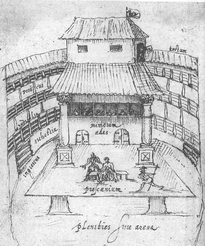
Archaeological excavations on the foundations of the Rose and the Globe in the late twentieth century showed that all the London theatres had individual differences; yet their common function necessitated a similar general plan. The public theatres were three stories high, and built around an open space at the centre. Usually polygonal in plan to give an overall rounded effect (though the Red Bull and the first Fortune were square), the three levels of inward-facing galleries overlooked the open center, into which jutted the stage—essentially a platform surrounded on three sides by the audience, only the rear being restricted for the entrances and exits of the actors and seating for the musicians. The upper level behind the stage could be used as a balcony
Balcony
Balcony , a platform projecting from the wall of a building, supported by columns or console brackets, and enclosed with a balustrade.-Types:The traditional Maltese balcony is a wooden closed balcony projecting from a...
, as in Romeo and Juliet
Romeo and Juliet
Romeo and Juliet is a tragedy written early in the career of playwright William Shakespeare about two young star-crossed lovers whose deaths ultimately unite their feuding families. It was among Shakespeare's most popular archetypal stories of young, teenage lovers.Romeo and Juliet belongs to a...
or Antony and Cleopatra
Antony and Cleopatra
Antony and Cleopatra is a tragedy by William Shakespeare, believed to have been written sometime between 1603 and 1607. It was first printed in the First Folio of 1623. The plot is based on Thomas North's translation of Plutarch's Lives and follows the relationship between Cleopatra and Mark Antony...
, or as a position from which an actor could harangue a crowd, as in Julius Caesar
Julius Caesar (play)
The Tragedy of Julius Caesar, also known simply as Julius Caesar, is a tragedy by William Shakespeare, believed to have been written in 1599. It portrays the 44 BC conspiracy against...
.
Usually built of timber, lath and plaster and with thatched roofs, the early theatres were vulnerable to fire, and were replaced (when necessary) with stronger structures. When the Globe burned down in June 1613, it was rebuilt with a tile roof; when the Fortune burned down in December 1621, it was rebuilt in brick (and apparently was no longer square).
A different model was developed with the Blackfriars Theatre
Blackfriars Theatre
Blackfriars Theatre was the name of a theatre in the Blackfriars district of the City of London during the Renaissance. The theatre began as a venue for child actors associated with the Queen's chapel choirs; in this function, the theatre hosted some of the most innovative drama of Elizabeth and...
, which came into regular use on a long-term basis in 1599. The Blackfriars was small in comparison to the earlier theatres and roofed rather than open to the sky; it resembled a modern theatre in ways that its predecessors did not. Other small enclosed theatres followed, notably the Whitefriars
Whitefriars Theatre
The Whitefriars Theatre was a theatre in Jacobean London, in existence from 1608 to the 1620s — about which only limited and sometimes contradictory information survives.-Location:...
(1608) and the Cockpit
Cockpit Theatre
The Cockpit was a theatre in London, operating from 1616 to around 1665. It was the first theatre to be located near Drury Lane. After damage in 1617, it was christened The Phoenix....
(1617). With the building of the Salisbury Court Theatre
Salisbury Court Theatre
The Salisbury Court Theatre was a theatre in 17th-century London. It was located in the neighbourhood of Salisbury Court, which was formerly the London residence of the Bishops of Salisbury. Salibury Court was acquired by Richard Sackville in 1564; when Thomas Sackville was created Earl of Dorset...
in 1629 near the site of the defunct Whitefriars, the London audience had six theatres to choose from: three surviving large open-air "public" theatres, the Globe, the Fortune, and the Red Bull, and three smaller enclosed "private" theatres, the Blackfriars, the Cockpit, and the Salisbury Court. Audiences of the 1630s benefited from a half-century of vigorous dramaturgical
Dramaturgy
Dramaturgy is the art of dramatic composition and the representation of the main elements of drama on the stage. Dramaturgy is a distinct practice separate from play writing and directing, although a single individual may perform any combination of the three. Some dramatists combine writing and...
development; the plays of Marlowe
Christopher Marlowe
Christopher Marlowe was an English dramatist, poet and translator of the Elizabethan era. As the foremost Elizabethan tragedian, next to William Shakespeare, he is known for his blank verse, his overreaching protagonists, and his mysterious death.A warrant was issued for Marlowe's arrest on 18 May...
and Shakespeare
William Shakespeare
William Shakespeare was an English poet and playwright, widely regarded as the greatest writer in the English language and the world's pre-eminent dramatist. He is often called England's national poet and the "Bard of Avon"...
and their contemporaries were still being performed on a regular basis (mostly at the public theatres), while the newest works of the newest playwrights were abundant as well (mainly at the private theatres).
Around 1580, when both the Theatre and the Curtain were full on summer days, the total theatre capacity of London was about 5000 spectators. With the building of new theatre facilities and the formation of new companies, the capital's total theatre capacity exceeded 10,000 after 1610. In 1580, the poorest citizens could purchase admittance to the Curtain or the Theatre for a penny; in 1640, their counterparts could gain admittance to the Globe, the Cockpit, or the Red Bull—for exactly the same price. (Ticket prices at the private theatres were five or six times higher).
Performances
The acting companies functioned on a repertory system; unlike modern productions that can run for months or years on end, the troupes of this era rarely acted the same play two days in a row. Thomas MiddletonThomas Middleton
Thomas Middleton was an English Jacobean playwright and poet. Middleton stands with John Fletcher and Ben Jonson as among the most successful and prolific of playwrights who wrote their best plays during the Jacobean period. He was one of the few Renaissance dramatists to achieve equal success in...
's A Game at Chess
A Game at Chess
A Game at Chess is a comic satirical play by Thomas Middleton, first staged in August 1624 by the King's Men at the Globe Theatre, notable for its political content.-The play:...
ran for nine straight performances in August 1624 before it was closed by the authorities—but this was due to the political content of the play and was a unique, unprecedented, and unrepeatable phenomenon. Consider the 1592 season of Lord Strange's Men
Lord Strange's Men
Lord Strange's Men was an Elizabethan playing company, comprising retainers of the household of Ferdinando Stanley, Lord Strange . They are best known in their final phase of activity in the late 1580s and early 1590s...
at the Rose Theatre
The Rose (theatre)
The Rose was an Elizabethan theatre. It was the fourth of the public theatres to be built, after The Theatre , the Curtain , and the theatre at Newington Butts The Rose was an Elizabethan theatre. It was the fourth of the public theatres to be built, after The Theatre (1576), the Curtain (1577),...
as far more representative: between Feb. 19 and June 23 the company played six days a week, minus Good Friday and two other days. They performed 23 different plays, some only once, and their most popular play of the season, The First Part of Hieronimo, (based on Kyd's The Spanish Tragedy
The Spanish Tragedy
The Spanish Tragedy, or Hieronimo is Mad Again is an Elizabethan tragedy written by Thomas Kyd between 1582 and 1592. Highly popular and influential in its time, The Spanish Tragedy established a new genre in English theatre, the revenge play or revenge tragedy. Its plot contains several violent...
), 15 times. They never played the same play two days in a row, and rarely the same play twice in a week. The workload on the actors, especially the leading performers like Edward Alleyn, must have been tremendous.
One distinctive feature of the companies was that they included only males. Until the reign of Charles II
Charles II of England
Charles II was monarch of the three kingdoms of England, Scotland, and Ireland.Charles II's father, King Charles I, was executed at Whitehall on 30 January 1649, at the climax of the English Civil War...
, female parts were played by adolescent boy players in women's costume.
Costumes
Costumes were often bright in color and visually entrancing. Costumes were expensive, however, so usually players wore contemporary clothing regardless of the time period of the play. Occasionally, a lead character would wear a conventionalized version of more historically accurate garb, but secondary characters would nonetheless remain in contemporary clothing.Playwrights
The growing population of London, the growing wealth of its people, and their fondness for spectacle produced a dramatic literature of remarkable variety, quality, and extent. Although most of the plays written for the Elizabethan stage have been lost, over 600 remain.The men (no women were professional dramatists in this era) who wrote these plays were primarily self-made men from modest backgrounds. Some of them were educated at either Oxford
University of Oxford
The University of Oxford is a university located in Oxford, United Kingdom. It is the second-oldest surviving university in the world and the oldest in the English-speaking world. Although its exact date of foundation is unclear, there is evidence of teaching as far back as 1096...
or Cambridge
University of Cambridge
The University of Cambridge is a public research university located in Cambridge, United Kingdom. It is the second-oldest university in both the United Kingdom and the English-speaking world , and the seventh-oldest globally...
, but many were not. Although William Shakespeare
William Shakespeare
William Shakespeare was an English poet and playwright, widely regarded as the greatest writer in the English language and the world's pre-eminent dramatist. He is often called England's national poet and the "Bard of Avon"...
and Ben Jonson
Ben Jonson
Benjamin Jonson was an English Renaissance dramatist, poet and actor. A contemporary of William Shakespeare, he is best known for his satirical plays, particularly Volpone, The Alchemist, and Bartholomew Fair, which are considered his best, and his lyric poems...
were actors, the majority do not seem to have been performers, and no major author who came on to the scene after 1600 is known to have supplemented his income by acting.
Not all of the playwrights fit modern images of poets or intellectuals. Christopher Marlowe
Christopher Marlowe
Christopher Marlowe was an English dramatist, poet and translator of the Elizabethan era. As the foremost Elizabethan tragedian, next to William Shakespeare, he is known for his blank verse, his overreaching protagonists, and his mysterious death.A warrant was issued for Marlowe's arrest on 18 May...
was killed in an apparent tavern brawl, while Ben Jonson
Ben Jonson
Benjamin Jonson was an English Renaissance dramatist, poet and actor. A contemporary of William Shakespeare, he is best known for his satirical plays, particularly Volpone, The Alchemist, and Bartholomew Fair, which are considered his best, and his lyric poems...
killed an actor in a duel. Several probably were soldiers.
Playwrights were normally paid in increments during the writing process, and if their play was accepted, they would also receive the proceeds from one day's performance. However, they had no ownership of the plays they wrote. Once a play was sold to a company, the company owned it, and the playwright had no control over casting, performance, revision or publication.
The profession of dramatist was challenging and far from lucrative. Entries in Philip Henslowe
Philip Henslowe
Philip Henslowe was an Elizabethan theatrical entrepreneur and impresario. Henslowe's modern reputation rests on the survival of his diary, a primary source for information about the theatrical world of Renaissance London...
's Diary show that in the years around 1600 Henslowe paid as little as £6 or £7 per play. This was probably at the low end of the range, though even the best writers could not demand too much more. A playwright, working alone, could generally produce two plays a year at most; in the 1630s Richard Brome
Richard Brome
Richard Brome was an English dramatist of the Caroline era.-Life:Virtually nothing is known about Brome's private life. Repeated allusions in contemporary works, like Ben Jonson's Bartholomew Fair, indicate that Brome started out as a servant of Jonson, in some capacity...
signed a contract with the Salisbury Court Theatre
Salisbury Court Theatre
The Salisbury Court Theatre was a theatre in 17th-century London. It was located in the neighbourhood of Salisbury Court, which was formerly the London residence of the Bishops of Salisbury. Salibury Court was acquired by Richard Sackville in 1564; when Thomas Sackville was created Earl of Dorset...
to supply three plays a year, but found himself unable to meet the workload. Shakespeare produced fewer than 40 solo plays in a career that spanned more than two decades; he was financially successful because he was an actor and, most importantly, a shareholder in the company for which he acted and in the theatres they used. Ben Jonson achieved success as a purveyor of Court masque
Masque
The masque was a form of festive courtly entertainment which flourished in 16th and early 17th century Europe, though it was developed earlier in Italy, in forms including the intermedio...
s, and was talented at playing the patronage
Patronage
Patronage is the support, encouragement, privilege, or financial aid that an organization or individual bestows to another. In the history of art, arts patronage refers to the support that kings or popes have provided to musicians, painters, and sculptors...
game that was an important part of the social and economic life of the era. Those who were playwrights pure and simple fared far less well; the biographies of early figures like George Peele
George Peele
George Peele , was an English dramatist.-Life:Peele was christened on 25 July 1556. His father, who appears to have belonged to a Devonshire family, was clerk of Christ's Hospital, and wrote two treatises on bookkeeping...
and Robert Greene
Robert Greene (16th century)
Robert Greene was an English author best known for a posthumous pamphlet attributed to him, Greene's Groats-Worth of Wit, widely believed to contain a polemic attack on William Shakespeare. He was born in Norwich and attended Cambridge University, receiving a B.A. in 1580, and an M.A...
, and later ones like Brome and Philip Massinger
Philip Massinger
Philip Massinger was an English dramatist. His finely plotted plays, including A New Way to Pay Old Debts, The City Madam and The Roman Actor, are noted for their satire and realism, and their political and social themes.-Early life:The son of Arthur Massinger or Messenger, he was baptized at St....
, are marked by financial uncertainty, struggle, and poverty.
Playwrights dealt with the natural limitation on their productivity by combining into teams of two, three, four, and even five to generate play texts; the majority of plays written in this era were collaborations, and the solo artists who generally eschewed collaborative efforts, like Jonson and Shakespeare, were the exceptions to the rule. Dividing the work, of course, meant dividing the income; but the arrangement seems to have functioned well enough to have made it worthwhile. (The truism that says, diversify your investments, may have worked for the Elizabethan play market as for the modern stock market.) Of the 70-plus known works in the canon of Thomas Dekker, roughly 50 are collaborations; in a single year, 1598, Dekker worked on 16 collaborations for impresario Philip Henslowe
Philip Henslowe
Philip Henslowe was an Elizabethan theatrical entrepreneur and impresario. Henslowe's modern reputation rests on the survival of his diary, a primary source for information about the theatrical world of Renaissance London...
, and earned £30, or a little under 12 shillings per week—roughly twice as much as the average artisan's income of 1s. per day. At the end of his career, Thomas Heywood
Thomas Heywood
Thomas Heywood was a prominent English playwright, actor, and author whose peak period of activity falls between late Elizabethan and early Jacobean theatre.-Early years:...
would famously claim to have had "an entire hand, or at least a main finger" in the authorship of some 220 plays. A solo artist usually needed months to write a play (though Jonson is said to have done Volpone
Volpone
Volpone is a comedy by Ben Jonson first produced in 1606, drawing on elements of city comedy, black comedy and beast fable...
in five weeks); Henslowe's Diary indicates that a team of four or five writers could produce a play in as little as two weeks. Admittedly, though, the Diary also shows that teams of Henslowe's house dramatists—Anthony Munday
Anthony Munday
Anthony Munday was an English dramatist and miscellaneous writer. The chief interest in Munday for the modern reader lies in his collaboration with Shakespeare and others on the play Sir Thomas More and his writings on Robin Hood.-Biography:He was once thought to have been born in 1553, because...
, Robert Wilson
Robert Wilson (dramatist)
Robert Wilson , was an Elizabethan dramatist who worked primarily in the 1580s and 1590s. He is also believed to have been an actor who specialized in clown roles....
, Richard Hathwaye
Richard Hathwaye
Richard Hathwaye , was an English dramatist. Little is known about Hathwaye's life. There is no evidence that he was related to his namesake Richard Hathaway, the father of Shakespeare's wife, Anne Hathaway. Hathwaye is not heard of after 1603....
, Henry Chettle
Henry Chettle
Henry Chettle was an English dramatist and miscellaneous writer of the Elizabethan era.The son of Robert Chettle, a London dyer, he was apprenticed in 1577 and became a member of the Stationer's Company in 1584, traveling to Cambridge on their behalf in 1588. His career as a printer and author is...
, and the others, even including a young John Webster
John Webster
John Webster was an English Jacobean dramatist best known for his tragedies The White Devil and The Duchess of Malfi, which are often regarded as masterpieces of the early 17th-century English stage. He was a contemporary of William Shakespeare.- Biography :Webster's life is obscure, and the dates...
—could start a project, and accept advances on it, yet fail to produce anything stageworthy. (Modern understanding of collaboration in this era is biased by the fact that the failures have generally disappeared with barely a trace; for one exception to this rule, see: Sir Thomas More
Sir Thomas More (play)
Sir Thomas More is a collaborative Elizabethan play by Anthony Munday and others depicting the life and death of Thomas More. It survives only in a single manuscript, now owned by the British Library...
.). Most playwrights, like Shakespeare for example, wrote in verse.
Genres
GenreGenre
Genre , Greek: genos, γένος) is the term for any category of literature or other forms of art or culture, e.g. music, and in general, any type of discourse, whether written or spoken, audial or visual, based on some set of stylistic criteria. Genres are formed by conventions that change over time...
s of the period included the history play, which depicted English or European history. Shakespeare's plays about the lives of kings, such as Richard III
Richard III (play)
Richard III is a history play by William Shakespeare, believed to have been written in approximately 1591. It depicts the Machiavellian rise to power and subsequent short reign of Richard III of England. The play is grouped among the histories in the First Folio and is most often classified...
and Henry V
Henry V (play)
Henry V is a history play by William Shakespeare, believed to be written in approximately 1599. Its full titles are The Cronicle History of Henry the Fifth and The Life of Henry the Fifth...
, belong to this category, as do Christopher Marlowe
Christopher Marlowe
Christopher Marlowe was an English dramatist, poet and translator of the Elizabethan era. As the foremost Elizabethan tragedian, next to William Shakespeare, he is known for his blank verse, his overreaching protagonists, and his mysterious death.A warrant was issued for Marlowe's arrest on 18 May...
's Edward II
Edward II (play)
Edward II is a Renaissance or Early Modern period play written by Christopher Marlowe. It is one of the earliest English history plays. The full title of the first publication is The Troublesome Reign and Lamentable Death of Edward the Second, King of England, with the Tragical Fall of Proud...
and George Peele
George Peele
George Peele , was an English dramatist.-Life:Peele was christened on 25 July 1556. His father, who appears to have belonged to a Devonshire family, was clerk of Christ's Hospital, and wrote two treatises on bookkeeping...
's Famous Chronicle of King Edward the First
Famous Chronicle of King Edward the First
"The Famous Chronicle of King Edward the First" is a play by George Peele, published 1593, chronicling the career of Edward I of England.The play concentrates on the power struggle between Edward I and Llywelyn ap Gruffudd, also glancing at the reign and fall of John Balliol...
. History plays dealt with more recent events, like A Larum for London
A Larum for London
A Larum for London, or the Siedge of Antwerp is a play written by an anonymous author around the year 1602. It provides a graphic reenactment of the sack of Antwerp by Spanish troops in 1576, sometimes called the Spanish Fury. Not widely printed at the time of its release and virtually unknown...
which dramatizes the sack of Antwerp in 1576.
Tragedy
Tragedy
Tragedy is a form of art based on human suffering that offers its audience pleasure. While most cultures have developed forms that provoke this paradoxical response, tragedy refers to a specific tradition of drama that has played a unique and important role historically in the self-definition of...
was a popular genre. Marlowe's tragedies were exceptionally popular, such as Dr. Faustus and The Jew of Malta
The Jew of Malta
The Jew of Malta is a play by Christopher Marlowe, probably written in 1589 or 1590. Its plot is an original story of religious conflict, intrigue, and revenge, set against a backdrop of the struggle for supremacy between Spain and the Ottoman Empire in the Mediterranean that takes place on the...
. The audiences particularly liked revenge dramas
Revenge play
The revenge play or revenge tragedy is a form of tragedy which was extremely popular in the Elizabethan and Jacobean eras. The best-known of these are Thomas Kyd's The Spanish Tragedy and William Shakespeare's Hamlet...
, such as Thomas Kyd
Thomas Kyd
Thomas Kyd was an English dramatist, the author of The Spanish Tragedy, and one of the most important figures in the development of Elizabethan drama....
's The Spanish Tragedy
The Spanish Tragedy
The Spanish Tragedy, or Hieronimo is Mad Again is an Elizabethan tragedy written by Thomas Kyd between 1582 and 1592. Highly popular and influential in its time, The Spanish Tragedy established a new genre in English theatre, the revenge play or revenge tragedy. Its plot contains several violent...
. The four tragedies considered to be Shakespeare's greatest (Hamlet
Hamlet
The Tragical History of Hamlet, Prince of Denmark, or more simply Hamlet, is a tragedy by William Shakespeare, believed to have been written between 1599 and 1601...
, Othello
Othello
The Tragedy of Othello, the Moor of Venice is a tragedy by William Shakespeare, believed to have been written in approximately 1603, and based on the Italian short story "Un Capitano Moro" by Cinthio, a disciple of Boccaccio, first published in 1565...
, King Lear
King Lear
King Lear is a tragedy by William Shakespeare. The title character descends into madness after foolishly disposing of his estate between two of his three daughters based on their flattery, bringing tragic consequences for all. The play is based on the legend of Leir of Britain, a mythological...
, and Macbeth
Macbeth
The Tragedy of Macbeth is a play by William Shakespeare about a regicide and its aftermath. It is Shakespeare's shortest tragedy and is believed to have been written sometime between 1603 and 1607...
) were composed during this period, as well as many others (see Shakespearean tragedy
Shakespearean tragedy
Shakespeare wrote tragedies from the beginning of his career. One of his earliest plays was the Roman tragedy Titus Andronicus, which he followed a few years later with Romeo and Juliet. However, his most admired tragedies were written in a seven-year period between 1601 and 1608...
).
Comedies were common, too. A sub-genre developed in this period was the city comedy
City comedy
City comedy, also called Citizen Comedy, is a common genre of Elizabethan, Jacobean, and Caroline comedy on the London stage from the last years of the 16th century to the closing of the theaters in 1642...
, which deals satirically with life in London after the fashion of Roman
Theatre of ancient Rome
The theatre of ancient Rome was a thriving and diverse art form, ranging from festival performances of street theatre, nude dancing, and acrobatics, to the staging of Plautus's broadly appealing situation comedies, to the high-style, verbally elaborate tragedies of Seneca...
New Comedy. Examples are Thomas Dekker's The Shoemaker's Holiday
The Shoemaker's Holiday
The Shoemakers' Holiday, or the Gentle Craft is an Elizabethan play written by Thomas Dekker. It was first performed in 1599 by the Admiral's Men. It falls into the sub-genre of city comedy.The play was first published in 1600 by the printer Valentine Simmes...
and Thomas Middleton
Thomas Middleton
Thomas Middleton was an English Jacobean playwright and poet. Middleton stands with John Fletcher and Ben Jonson as among the most successful and prolific of playwrights who wrote their best plays during the Jacobean period. He was one of the few Renaissance dramatists to achieve equal success in...
's A Chaste Maid in Cheapside
A Chaste Maid in Cheapside
A Chaste Maid in Cheapside is a city comedy written c. 1613 by English Renaissance playwright Thomas Middleton. Unpublished until 1630 and long-neglected afterwards, it is now considered among the best and most characteristic Jacobean comedies....
.
Though marginalised, the older genres like pastoral
Pastoral
The adjective pastoral refers to the lifestyle of pastoralists, such as shepherds herding livestock around open areas of land according to seasons and the changing availability of water and pasturage. It also refers to a genre in literature, art or music that depicts such shepherd life in an...
(The Faithful Shepherdess
The Faithful Shepherdess
The Faithful Shepherdess is a Jacobean era stage play, the work that inaugurated the playwriting career of John Fletcher. Though the initial production was a failure with its audience, the printed text that followed proved significant, in that it contained Fletcher's influential definition of...
, 1608), and even the morality play
Morality play
The morality play is a genre of Medieval and early Tudor theatrical entertainment. In their own time, these plays were known as "interludes", a broader term given to dramas with or without a moral theme. Morality plays are a type of allegory in which the protagonist is met by personifications of...
(Four Plays in One
Four Plays in One
Four Plays, or Moral Representations, in One is a Jacobean era stage play, one of the dramatic works in the canon of John Fletcher and his collaborators...
, ca. 1608-13) could exert influences. After about 1610, the new hybrid sub-genre of the tragicomedy
Tragicomedy
Tragicomedy is fictional work that blends aspects of the genres of tragedy and comedy. In English literature, from Shakespeare's time to the nineteenth century, tragicomedy referred to a serious play with either a happy ending or enough jokes throughout the play to lighten the mood.-Classical...
enjoyed an efflorescence, as did the masque
Masque
The masque was a form of festive courtly entertainment which flourished in 16th and early 17th century Europe, though it was developed earlier in Italy, in forms including the intermedio...
throughout the reigns of the first two Stuart
House of Stuart
The House of Stuart is a European royal house. Founded by Robert II of Scotland, the Stewarts first became monarchs of the Kingdom of Scotland during the late 14th century, and subsequently held the position of the Kings of Great Britain and Ireland...
kings, James I
James I of England
James VI and I was King of Scots as James VI from 24 July 1567 and King of England and Ireland as James I from the union of the English and Scottish crowns on 24 March 1603...
and Charles I
Charles I of England
Charles I was King of England, King of Scotland, and King of Ireland from 27 March 1625 until his execution in 1649. Charles engaged in a struggle for power with the Parliament of England, attempting to obtain royal revenue whilst Parliament sought to curb his Royal prerogative which Charles...
.
Printed texts
Only a minority of the plays of English Renaissance theatre were ever printed; of Heywood's 220 plays noted above, only about 20 were published in book form. A little over 600 plays were published in the period as a whole, most commonly in individual quartoBook size
The size of a book is generally measured by the height against the width of a leaf, or sometimes the height and width of its cover. A series of terms is commonly used by libraries and publishers for the general sizes of modern books, ranging from "folio" , to "quarto" and "octavo"...
editions. (Larger collected editions, like those of Shakespeare's
Folios and Quartos (Shakespeare)
The earliest texts of William Shakespeare's works were published during the 16th and 17th centuries in quarto or folio format. Folios are large, tall volumes; quartos are smaller, roughly half the size...
, Ben Jonson's
Ben Jonson folios
The folio collections of Ben Jonson's works published in the seventeenth century were crucial developments in the publication of English literature and English Renaissance drama. The first folio collection, issued in 1616, treated stage plays as serious works of literature instead of popular...
, and Beaumont and Fletcher's
Beaumont and Fletcher folios
The Beaumont and Fletcher folios were two large folio collections of the stage plays of John Fletcher and his collaborators. The first was issued in 1647, and the second in 1679. The two collections were important in preserving many works of English Renaissance drama.-The first folio, 1647:The 1647...
plays, were a late and limited development.) Through much of the modern era, it was thought that play texts were popular items among Renaissance readers that provided healthy profits for the stationers
Worshipful Company of Stationers and Newspaper Makers
The Worshipful Company of Stationers and Newspaper Makers is one of the Livery Companies of the City of London. The Stationers' Company was founded in 1403; it received a Royal Charter in 1557...
who printed and sold them. By the turn of the 21st century, the climate of scholarly opinion shifted somewhat on this belief: some contemporary researchers argue that publishing plays was a risky and marginal business — though this conclusion has been disputed by others. Some of the most successful publishers of the English Renaissance, like William Ponsonby
William Ponsonby (publisher)
William Ponsonby was a prominent London publisher of the Elizabethan era. Active in the 1577–1603 period, Ponsonby published the works of Edmund Spenser, Sir Philip Sidney, and other members of the Sidney circle; he has been called "the leading literary publisher of Elizabethan...
or Edward Blount
Edward Blount
Edward Blount was a London publisher of the Elizabethan, Jacobean, and Caroline eras, noted for his publication, in conjunction with William and Isaac Jaggard, of the First Folio of Shakespeare's plays in 1623....
, rarely published plays.
A small number of plays from the era survived not in printed texts but in manuscript
Manuscript
A manuscript or handwrite is written information that has been manually created by someone or some people, such as a hand-written letter, as opposed to being printed or reproduced some other way...
form.
Termination (September 2, 1642)
The rising PuritanPuritan
The Puritans were a significant grouping of English Protestants in the 16th and 17th centuries. Puritanism in this sense was founded by some Marian exiles from the clergy shortly after the accession of Elizabeth I of England in 1558, as an activist movement within the Church of England...
movement was hostile toward theatre, as they felt that "entertainment" was sinful. Politically, playwrights and actors were clients of the monarchy and aristocracy, and most supported the Royalist cause. The Puritan faction, long powerful in London, gained control of the city early in the English Civil War
English Civil War
The English Civil War was a series of armed conflicts and political machinations between Parliamentarians and Royalists...
, and on September 2, 1642 ordered the closure of the London theatres. The theatres remained closed for most of the next eighteen years, re-opening after the Restoration
English Restoration
The Restoration of the English monarchy began in 1660 when the English, Scottish and Irish monarchies were all restored under Charles II after the Interregnum that followed the Wars of the Three Kingdoms...
of the monarchy in 1660. The re-opened theatres performed many of the plays of the previous era, though often in adapted forms; new genres of Restoration comedy
Restoration comedy
Restoration comedy refers to English comedies written and performed in the Restoration period from 1660 to 1710. After public stage performances had been banned for 18 years by the Puritan regime, the re-opening of the theatres in 1660 signalled a renaissance of English drama...
and spectacle
Restoration spectacular
The Restoration spectacular, or elaborately staged "machine play", hit the London public stage in the late 17th-century Restoration period, enthralling audiences with action, music, dance, moveable scenery, baroque illusionistic painting, gorgeous costumes, and special effects such as trapdoor...
soon evolved, giving English theatre of the later seventeenth century its distinctive character.
List of playwrights
- William AlabasterWilliam AlabasterWilliam Alabaster was an English poet, playwright, and religious writer. His surname is one of the many variants of "arbalester", a crossbowman....
- William AlleyWilliam AlleyWilliam Alley was an Anglican prelate and the Bishop of Exeter during the reign of Queen Elizabeth I.- Life :...
- Robert ArminRobert ArminRobert Armin was an English actor, a member of the Lord Chamberlain's Men. He became the leading comedy actor with the troupe associated with William Shakespeare following the departure of Will Kempe around 1600...
- Thomas AshtonThomas Ashton (schoolmaster)Thomas Ashton was an English schoolmaster, the first headmaster of Shrewsbury School.-Life:Ashton was educated at Cambridge University, where he graduated B.A. in 1559-60, and M.A. in 1563. He was elected a fellow of Trinity College, entered into orders, and in 1562 was appointed the first head...
- William BarkstedWilliam BarkstedWilliam Barksted , was an actor and poet.Barksted was the author of the poems Mirrha, the Mother of Adonis; or Lustes Prodegies ; and Hiren, or the Faire Greeke...
- Barnabe BarnesBarnabe BarnesBarnabe Barnes , was an English poet. He is known for his Petrarchan love sonnets and for his combative personality, involving feuds with other writers and culminating in an alleged attempted murder.-Early life:...
- Lording BarryLording Barry-Works:Barry is known as the author of one comedy, ‘Ram Alley, or Merry Tricks,’, 1611 and 1636, which was included in the second and subsequent editions of Robert Dodsley's ‘Old Plays.’ Anthony Wood says it was acted by the Children of the King's Revels before 1611....
- Francis BeaumontFrancis BeaumontFrancis Beaumont was a dramatist in the English Renaissance theatre, most famous for his collaborations with John Fletcher....
- Sir William Berkeley
- Samuel BrandonSamuel Brandon (author)Samuel Brandon , was a sixteenth-century author.Brandon was the author of The Tragi-comœdi of the Virtuous Octavia . Concerning his life no particulars whatever are preserved. His solitary play is a work of some merit and of considerable value and rarity...
- Richard BromeRichard BromeRichard Brome was an English dramatist of the Caroline era.-Life:Virtually nothing is known about Brome's private life. Repeated allusions in contemporary works, like Ben Jonson's Bartholomew Fair, indicate that Brome started out as a servant of Jonson, in some capacity...
- Lodowick CarlellLodowick CarlellLodowick Carlell , also Carliell or Carlile, was a seventeenth-century English playwright, active mainly during the Caroline era and the Commonwealth period.-Courtier:...
- William Cartwright
- Allan Castellon
- William Cavendish
- Robert Chamberlain
- George ChapmanGeorge ChapmanGeorge Chapman was an English dramatist, translator, and poet. He was a classical scholar, and his work shows the influence of Stoicism. Chapman has been identified as the Rival Poet of Shakespeare's Sonnets by William Minto, and as an anticipator of the Metaphysical Poets...
- Henry ChettleHenry ChettleHenry Chettle was an English dramatist and miscellaneous writer of the Elizabethan era.The son of Robert Chettle, a London dyer, he was apprenticed in 1577 and became a member of the Stationer's Company in 1584, traveling to Cambridge on their behalf in 1588. His career as a printer and author is...
- John ClavellJohn ClavellJohn Clavell was a highwayman, author, lawyer, and doctor.He is known for his poem A Recantation of an Ill Led Life, and his play The Soddered Citizen...
- Robert DaborneRobert DaborneRobert Daborne was an English dramatist of the Jacobean era.Little is known for certain of his birth, background, or early life; he may have come from a family in Guildford, Surrey. He is now thought to have been a "sizar"—an undergraduate exempt from fees—at King's College, Cambridge...
- Samuel DanielSamuel DanielSamuel Daniel was an English poet and historian.-Early life:Daniel was born near Taunton in Somerset, the son of a music-master. He was the brother of lutenist and composer John Danyel. Their sister Rosa was Edmund Spenser's model for Rosalind in his The Shepherd's Calendar; she eventually married...
- William DavenantWilliam DavenantSir William Davenant , also spelled D'Avenant, was an English poet and playwright. Along with Thomas Killigrew, Davenant was one of the rare figures in English Renaissance theatre whose career spanned both the Caroline and Restoration eras and who was active both before and after the English Civil...
- Robert DavenportRobert DavenportRobert Davenport was an English dramatist of the early seventeenth century. Nothing is known of his early life or education; the title pages of two of his plays identify him as a "Gentleman," though there is no record of him at either of the two universities or the Inns of Court. Scholars have...
- John DayJohn Day (dramatist)John Day was an English dramatist of the Elizabethan and Jacobean periods.-Life:He was born at Cawston, Norfolk, and educated at Ely. He became a sizar of Caius College, Cambridge, in 1592, but was expelled in the next year for stealing a book...
- Edward de Vere
- Thomas Dekker
- Michael DraytonMichael DraytonMichael Drayton was an English poet who came to prominence in the Elizabethan era.-Early life:He was born at Hartshill, near Nuneaton, Warwickshire, England. Almost nothing is known about his early life, beyond the fact that in 1580 he was in the service of Thomas Goodere of Collingham,...
- Richard EdwardesRichard EdwardesRichard Edwardes was an English poet and playwright; he was made a Gentleman of the Chapel Royal, and was master of the singing boys...
- Martin Emilian
- Nathan Field
- John FletcherJohn Fletcher (playwright)John Fletcher was a Jacobean playwright. Following William Shakespeare as house playwright for the King's Men, he was among the most prolific and influential dramatists of his day; both during his lifetime and in the early Restoration, his fame rivalled Shakespeare's...
- John FordJohn Ford (dramatist)John Ford was an English Jacobean and Caroline playwright and poet born in Ilsington in Devon in 1586.-Life and work:...
- Ulpian FulwellUlpian FulwellUlpian Fulwell was an English Renaissance theatre playwright, satirist and poet.He became a rector of Naunton in 1570 and became a part of St. Mary Hall, Oxford in 1578....
- Matthew FrancisMatthew FrancisMatthew Francis is a British poet, editor of W. S. Graham's New Collected Poems, and a professor at the University of Wales, Aberystwyth. His status as a contemporary British poet is well known...
- Steven Galvez
- Robert GreeneRobert Greene (16th century)Robert Greene was an English author best known for a posthumous pamphlet attributed to him, Greene's Groats-Worth of Wit, widely believed to contain a polemic attack on William Shakespeare. He was born in Norwich and attended Cambridge University, receiving a B.A. in 1580, and an M.A...
- Richard HathwayeRichard HathwayeRichard Hathwaye , was an English dramatist. Little is known about Hathwaye's life. There is no evidence that he was related to his namesake Richard Hathaway, the father of Shakespeare's wife, Anne Hathaway. Hathwaye is not heard of after 1603....
- William HaughtonWilliam HaughtonWilliam Haughton was an English playwright in the age of English Renaissance theatre. During the years 1597 to 1602 he collaborated in many plays with Henry Chettle, Thomas Dekker, John Day, Richard Hathwaye and Wentworth Smith....
- Thomas HeywoodThomas HeywoodThomas Heywood was a prominent English playwright, actor, and author whose peak period of activity falls between late Elizabethan and early Jacobean theatre.-Early years:...
- Thomas HughesThomas Hughes (dramatist)Thomas Hughes was an English dramatist, a native of Cheshire, entered Queens' College, Cambridge, in 1571. He graduated and became a fellow of his college in 1576, and was afterwards a member of Gray's Inn. He wrote The Misfortunes of Arthur, Uther Pendragon's son reduced into tragical notes, which...
- Ben JonsonBen JonsonBenjamin Jonson was an English Renaissance dramatist, poet and actor. A contemporary of William Shakespeare, he is best known for his satirical plays, particularly Volpone, The Alchemist, and Bartholomew Fair, which are considered his best, and his lyric poems...
- Henry Killigrew
- Thomas KilligrewThomas KilligrewThomas Killigrew was an English dramatist and theatre manager. He was a witty, dissolute figure at the court of King Charles II of England.-Life and work:...
- Thomas KydThomas KydThomas Kyd was an English dramatist, the author of The Spanish Tragedy, and one of the most important figures in the development of Elizabethan drama....
- Thomas LeggeThomas LeggeThomas Legge was an English playwright, prominently known for his play Richardus Tertius, which is considered to be the first history play written in England.-Biography:...
- Thomas LodgeThomas LodgeThomas Lodge was an English dramatist and writer of the Elizabethan and Jacobean periods.-Early life and education:...
- Thomas Lupton
- Steven Luxford
- John LylyJohn LylyJohn Lyly was an English writer, best known for his books Euphues,The Anatomy of Wit and Euphues and His England. Lyly's linguistic style, originating in his first books, is known as Euphuism.-Biography:John Lyly was born in Kent, England, in 1553/1554...
- Gervase MarkhamGervase MarkhamGervase Markham was an English poet and writer, best known for his work The English Huswife, Containing the Inward and Outward Virtues Which Ought to Be in a Complete Woman first published in London in 1615.-Life:Markham was the third son of Sir Robert Markham of Cotham, Nottinghamshire, and was...
- Christopher MarloweChristopher MarloweChristopher Marlowe was an English dramatist, poet and translator of the Elizabethan era. As the foremost Elizabethan tragedian, next to William Shakespeare, he is known for his blank verse, his overreaching protagonists, and his mysterious death.A warrant was issued for Marlowe's arrest on 18 May...
- Shackerley MarmionShackerley MarmionShackerley Marmion , also Shakerley, Shakerly, Schackerley, Marmyon, Marmyun, or Mermion, was an early 17th-century dramatist, often classed among the Sons of Ben, the followers of Ben Jonson who continued his style of comedy...
- Steve MarshSteve MarshSteve Marsh is a former Australian rules footballer in the West Australian National Football League . Marsh was regarded as one of the finest rovers of his era...
- Isaac Martinez
- Philip MassingerPhilip MassingerPhilip Massinger was an English dramatist. His finely plotted plays, including A New Way to Pay Old Debts, The City Madam and The Roman Actor, are noted for their satire and realism, and their political and social themes.-Early life:The son of Arthur Massinger or Messenger, he was baptized at St....
- Thomas MayThomas MayThomas May was an English poet, dramatist and historian of the Renaissance era.- Early life and career until 1630 :...
- Thomas MiddletonThomas MiddletonThomas Middleton was an English Jacobean playwright and poet. Middleton stands with John Fletcher and Ben Jonson as among the most successful and prolific of playwrights who wrote their best plays during the Jacobean period. He was one of the few Renaissance dramatists to achieve equal success in...
- Anthony MundayAnthony MundayAnthony Munday was an English dramatist and miscellaneous writer. The chief interest in Munday for the modern reader lies in his collaboration with Shakespeare and others on the play Sir Thomas More and his writings on Robin Hood.-Biography:He was once thought to have been born in 1553, because...
- Thomas NabbesThomas NabbesThomas Nabbes was an English dramatist.He was born in humble circumstances in Worcestershire, and educated at Exeter College, Oxford in 1621...
- Thomas NasheThomas NasheThomas Nashe was an English Elizabethan pamphleteer, playwright, poet and satirist. He was the son of the minister William Nashe and his wife Margaret .-Early life:...
- Thomas NortonThomas NortonThomas Norton was an English lawyer, politician, writer of verse — but not, as has been claimed, the chief interrogator of Queen Elizabeth I.-Official career:...
- George PeeleGeorge PeeleGeorge Peele , was an English dramatist.-Life:Peele was christened on 25 July 1556. His father, who appears to have belonged to a Devonshire family, was clerk of Christ's Hospital, and wrote two treatises on bookkeeping...
- John Phillips
- John Pickering
- Henry Porter
- Thomas PrestonThomas Preston (writer)Thomas Preston was an English master of Trinity Hall, Cambridge and possibly a dramatist.-Life:Preston was born at Simpson, Buckinghamshire, in 1537, and was educated at Eton and at King's College, Cambridge, where he was elected scholar, 16 Aug. 1553, and fellow, 18 Sept. 1556. He graduated B.A....
- William Rankins
- Samuel RowleySamuel RowleySamuel Rowley was a 17th century English dramatist and actor.Rowley first appears in the historical record as an associate of Philip Henslowe in the late 1590s. Initially he appears to have been an actor, perhaps a sharer, in the Admiral's Men, who performed at the Rose Theatre...
- William RowleyWilliam RowleyWilliam Rowley was an English Jacobean dramatist, best known for works written in collaboration with more successful writers. His date of birth is estimated to have been c. 1585; he was buried on 11 February 1626...
- Joseph Rutter
- Thomas SackvilleThomas Sackville, 1st Earl of DorsetThomas Sackville, 1st Earl of Dorset was an English statesman, poet, dramatist and Freemason. He was the son of Richard Sackville, a cousin to Anne Boleyn. He was a Member of Parliament and Lord High Treasurer.-Biography:...
- William Sampson
- William ShakespeareWilliam ShakespeareWilliam Shakespeare was an English poet and playwright, widely regarded as the greatest writer in the English language and the world's pre-eminent dramatist. He is often called England's national poet and the "Bard of Avon"...
- Edward Sharpham
- Henry Shirley
- James ShirleyJames ShirleyJames Shirley was an English dramatist.He belonged to the great period of English dramatic literature, but, in Lamb's words, he "claims a place among the worthies of this period, not so much for any transcendent genius in himself, as that he was the last of a great race, all of whom spoke nearly...
- Mary SidneyMary SidneyMary Herbert , Countess of Pembroke , was one of the first English women to achieve a major reputation for her literary works, poetry, poetic translations and literary patronage.-Family:...
- Philip SidneyPhilip SidneySir Philip Sidney was an English poet, courtier and soldier, and is remembered as one of the most prominent figures of the Elizabethan Age...
- Josefine Skauerud O.
- Wentworth SmithWentworth SmithWentworth Smith , was a minor English dramatist of the Elizabethan period who may have been responsible for some of the plays in the Shakespeare Apocrypha, though no work known to be his is extant.-Life and career:...
- Sir John SucklingJohn Suckling (poet)Sir John Suckling was an English poet and one prominent figure among those renowned for careless gaiety, wit, and all the accomplishments of a Cavalier poet; and also the inventor of the card game Cribbage...
- Robert Tailor
- Thomas TomkisThomas TomkisThomas Tomkis was an English playwright of the late Elizabethan and the Jacobean eras, and arguably one of the more cryptic figures of English Renaissance drama....
- Cyril TourneurCyril TourneurCyril Tourneur was an English dramatist who enjoyed his greatest success during the reign of King James I of England. His best-known work is The Revenger's Tragedy , a play which has alternatively been attributed to Thomas Middleton.-Life:Cyril Tourneur was possibly the son of Captain Richard...
- Adrian Vaca
- John WebsterJohn WebsterJohn Webster was an English Jacobean dramatist best known for his tragedies The White Devil and The Duchess of Malfi, which are often regarded as masterpieces of the early 17th-century English stage. He was a contemporary of William Shakespeare.- Biography :Webster's life is obscure, and the dates...
- George WilkinsGeorge WilkinsGeorge Wilkins was an English dramatist and pamphleteer best known for his probable collaboration with Shakespeare on the play Pericles, Prince of Tyre. By profession he was an inn-keeper, but he was also apparently involved in criminal activities.-Life:Wilkins was an inn-keeper in Cow-Cross,...
- Arthur WilsonArthur Wilson (17th century)-Life:Wilson was born in Yarmouth. In the 1620–25 period he served as secretary to Robert Devereux, 3rd Earl of Essex, and accompanied the Earl on his military campaigns on the Continent. After two years' study at Oxford University , Wilson entered the service of Robert Rich, 2nd Earl of...
- Robert WilsonRobert Wilson (dramatist)Robert Wilson , was an Elizabethan dramatist who worked primarily in the 1580s and 1590s. He is also believed to have been an actor who specialized in clown roles....
List of players
- William AllenWilliam Allen (actor)William Allen was a prominent English actor in the Caroline era. He belonged to both of the most important theatre companies of his generation, Queen Henrietta's Men and the King's Men....
- Edward AlleynEdward AlleynEdward Alleyn was an English actor who was a major figure of the Elizabethan theatre and founder of Dulwich College and Alleyn's School.-Early life:...
- Robert ArminRobert ArminRobert Armin was an English actor, a member of the Lord Chamberlain's Men. He became the leading comedy actor with the troupe associated with William Shakespeare following the departure of Will Kempe around 1600...
- Richard BaxterRichard Baxter (actor)Richard Baxter , or Backster, was a seventeenth-century actor, who worked in some of the leading theatre companies of his era...
- Christopher BeestonChristopher BeestonChristopher Beeston was a successful actor and a powerful theatrical impresario in early 17th century London. He was associated with a number of playwrights, particularly Thomas Heywood.-Early life:...
- Robert BenfieldRobert BenfieldRobert Benfield was a seventeenth-century actor, noted for his longtime membership in the King's Men in the years and decades after William Shakespeare's retirement and death.Nothing is known of Benfield's early life...
- Theophilus BirdTheophilus BirdTheophilus Bird, or Bourne, was a seventeenth-century English actor. Bird began his stage career in the Stuart era of English Renaissance theatre, and ended it in the Restoration period; he was one of the relatively few actors who managed to resume their careers after the eighteen-year enforced...
- Michael BowyerMichael BowyerMichael Bowyer was an actor in English Renaissance theatre in the Jacobean and Caroline eras. He spent most of his maturity with Queen Henrietta's Men, but finished his career with the King's Men...
- Robert Browne (Elizabethan actor)Robert Browne (Elizabethan actor)Robert Browne was an English actor of the Elizabethan era, and the owner and manager of the Boar's Head Theatre. He was also part of an enduring confusion in the study of English Renaissance theatre.-Two Robert Brownes:...
- Robert Browne (Jacobean actor)Robert Browne (Jacobean actor)Robert Browne was an English actor and theatre manager and investor of the later sixteenth and early seventeenth centuries. He was also part of a long-standing confusion in the scholarship of English Renaissance theatre....
- George BryanGeorge Bryan (16th-century actor)George Bryan was an actor in English Renaissance theatre, a member of the Lord Chamberlain's Men with William Shakespeare and Richard Burbage....
- Richard BurbageRichard BurbageRichard Burbage was an English actor and theatre owner. He was the younger brother of Cuthbert Burbage. They were both actors in drama....
- Andrew CaneAndrew CaneAndrew Cane — also Kayne, Kene, Keine, and other variants — was a comic actor in late Jacobean and Caroline era London...
- Hugh ClarkHugh ClarkHugh Clark was a prominent English actor of the Caroline era. He worked in both of the main theatre companies of his time, Queen Henrietta's Men and the King's Men....
- Henry CondellHenry CondellHenry Condell was an actor in the King's Men, the playing company for which William Shakespeare wrote. With John Heminges, he was instrumental in preparing the First Folio, the collected plays of Shakespeare, published in 1623....
- Alexander CookeAlexander CookeAlexander Cooke was an actor in the King's Men, the acting company of William Shakespeare and Richard Burbage.Edmond Malone introduced the hypothesis, still current though far from certain, that Cooke originated Shakespeare's principal female roles...
- Richard CowleyRichard CowleyRichard Cowley was an actor in English Renaissance theatre, a colleague of William Shakespeare and Richard Burbage in the Lord Chamberlain's Men and the King's Men.Cowley was in the c...
- Robert DawesRobert DawesRobert Dawes was an English actor of the Jacobean era. He is unique in the extant records of English Renaissance theatre, in that his individual employment contract with one of his acting companies has survived....
- William EcclestoneWilliam EcclestoneWilliam Ecclestone or Egglestone was an actor in English Renaissance theatre, a member of Shakespeare's company the King's Men.Nothing is known with certainty about Ecclestone's early life...
- Nathan Field
- Lawrence FletcherLawrence FletcherLawrence Fletcher was a Jacobean actor, and man of mystery. He is listed on the royal patent of 19 May 1603 that transformed the Lord Chamberlain's Men into the King's Men — and he is listed first, with William Shakespeare second and Richard Burbage third; significant, in the hierarchy-mad...
- Alexander GoughAlexander GoughAlexander Gough , also Goughe or Goffe, was an English actor in the Caroline era. He started out as a boy player filling female roles; during the period of the English Civil War and the Interregnum when the theatres were closed and actors out of work, Gough became involved in the publication of...
- Thomas Greene
- Richard GunnellRichard GunnellRichard Gunnell was an actor, playwright, and theatre manager in Jacobean and Caroline era London. He is best remembered for his role in the founding of the Salisbury Court Theatre.-Actor and playwright:...
- Charles HartCharles Hart (17th-century actor)Charles Hart was a prominent British Restoration actor.A Charles Hart was christened on 11 December 1625, in the parish of St. Giles Cripplegate, in London. It is not absolutely certain that this was the actor, though the name was not common at the time...
- Stephen HammertonStephen HammertonStephen Hammerton was a boy player or child actor in English Renaissance theatre, one of the young performers who specialized in female roles in the period before women appeared on the stage...
- John HemingesJohn HemingesJohn Heminges was an English Renaissance actor. Most noted now as one of the editors of William Shakespeare's 1623 First Folio, Heminges served in his time as an actor and financial manager for the King's Men.-Life:Heminges was born in Droitwich Spa, Worcestershire in 1556...
- Thomas HeywoodThomas HeywoodThomas Heywood was a prominent English playwright, actor, and author whose peak period of activity falls between late Elizabethan and early Jacobean theatre.-Early years:...
- John HonymanJohn HonymanJohn Honyman , also Honeyman, Honiman, Honnyman, or other variants, was an English actor of the Caroline era. He was a member of the King's Men, the most prominent playing company of its era, best known as the company of William Shakespeare and Richard Burbage.Honyman belonged to the generation...
- Will KempeWilliam KempeWilliam Kempe , also spelt Kemp, was an English actor and dancer specializing in comic roles and best known for having been one of the original players in early dramas by William Shakespeare...
- John LowinJohn LowinJohn Lowin was an English actor born in the St Giles-without-Cripplegate, London, the son of a tanner. Like Robert Armin, he was apprenticed to a goldsmith. While he is not recorded as a free citizen of this company, he did perform as a goldsmith, Leofstane, in a 1611 city pageant written by...
- William OstlerWilliam OstlerWilliam Ostler was an actor in English Renaissance theatre, a member of the King's Men, the company of William Shakespeare....
- Andrew PennycuickeAndrew PennycuickeAndrew Pennycuicke was a mid-seventeenth-century actor and publisher; he was responsible for publishing a number of plays of English Renaissance drama.What little is known of Pennycuicke's acting career comes from his own publications...
- Richard PerkinsRichard Perkins (17th-century actor)Richard Perkins was a prominent early seventeenth-century actor, most famous for his performance in the role of Barabas in Christopher Marlowe's The Jew of Malta...
- Augustine PhillipsAugustine PhillipsAugustine Phillips was an Elizabethan actor who performed in troupes with Edward Alleyn and William Shakespeare. He was one of the first generation of English actors to achieve wealth and a degree of social status by means of his trade....
- Thomas PollardThomas PollardThomas Pollard was an actor in the King's Men — a prominent comedian in the acting troupe of William Shakespeare and Richard Burbage....
- Thomas PopeThomas Pope (16th-century actor)Thomas Pope was an Elizabethan actor, a member of the Lord Chamberlain's Men and a colleague of William Shakespeare. Pope was a "comedian and acrobat."-Beginnings:...
- Timothy ReadTimothy ReadTimothy Read was a comic actor of the Caroline era, and one of the most famous and popular performers of his generation....
- William RobbinsWilliam Robbins (actor)William Robbins , also Robins, Robinson, or Robson, was a prominent comic actor in the Jacobean and Caroline eras....
- Richard RobinsonRichard Robinson (17th-century actor)Richard Robinson was an actor in English Renaissance theatre and a member of Shakespeare's company the King's Men.Robinson started out as a boy player with the company; in 1611 he played the Lady in their production of The Second Maiden's Tragedy. He was cast in their production of Ben Jonson's...
- William RowleyWilliam RowleyWilliam Rowley was an English Jacobean dramatist, best known for works written in collaboration with more successful writers. His date of birth is estimated to have been c. 1585; he was buried on 11 February 1626...
- William ShakespeareWilliam ShakespeareWilliam Shakespeare was an English poet and playwright, widely regarded as the greatest writer in the English language and the world's pre-eminent dramatist. He is often called England's national poet and the "Bard of Avon"...
- John ShankJohn ShankJohn Shank was an actor in English Renaissance theatre, a leading comedian in the King's Men during the 1620s and 1630s.-Early career:...
- Richard SharpeRichard Sharpe (actor)Richard Sharpe was an actor with the King's Men, the leading theatre troupe of its time and the company of William Shakespeare and Richard Burbage...
- William SlyWilliam SlyWilliam Sly was an actor in English Renaissance theatre, a colleague of William Shakespeare and Richard Burbage in the Lord Chamberlain's Men and the King's Men....
- John SumnerJohn Sumner (17th-century actor)John Sumner was an English theatre actor during the Caroline era .-Career:He was a long-time member of the Queen Henrietta's Men, one of the prime playing companies or acting troupes of the time and named for Henrietta Maria of France, the queen consort of England, Scotland and Ireland as the wife...
- Eliard SwanstonEliard SwanstonEliard Swanston , alternatively spelled Heliard, Hilliard, Elyard, Ellyardt, Ellyaerdt, and Eyloerdt, was an English actor in the Caroline era. He became a leading man in the King's Men, the company of William Shakespeare and Richard Burbage, in the final phase of its existence.-Career:Swanston...
- Richard TarltonRichard TarltonRichard Tarlton , an English actor, was the most famous clown of his era.His birthplace is unknown, but reports of over a century later give it as Condover in Shropshire, with a later move to Ilford in Essex...
- Joseph TaylorJoseph Taylor (17th-century actor)Joseph Taylor was a 17th-century actor. As the successor of Richard Burbage with the King's Men, he was arguably the most important actor in the later Jacobean and the Caroline eras....
- John ThompsonJohn Thompson (actor)John Thompson was a noted boy player acting women's roles in English Renaissance theatre. He served in the King's Men, the acting troupe formerly of William Shakespeare and Richard Burbage.Thompson's career is notable for his length...
- Nicholas TooleyNicholas TooleyNicholas Tooley was a Renaissance actor in the King's Men, the acting company of William Shakespeare.Recent research has shown that Tooley was born in late 1582 or early 1583; his birth name was not Tooley but Wilkinson...
- Anthony TurnerAnthony TurnerAnthony Turner was a noted English actor in the Caroline era. For most of his career he worked with Queen Henrietta's Men, one of the leading theatre companies of the time....
- John UnderwoodJohn Underwood (actor)John Underwood was an early 17th century actor, a member of the King's Men, the company of William Shakespeare.-Career:Underwood began as a boy player with the Children of the Chapel, and was cast in that company's productions of Ben Jonson's Cynthia's Revels and The Poetaster...
- Ellis WorthEllis WorthEllis Worth , or Woorth, was a noted English actor in the Jacobean and Caroline eras. He was a leading member of two important companies, Queen Anne's Men and Prince Charles's Men....
Playhouses
- Blackfriars TheatreBlackfriars TheatreBlackfriars Theatre was the name of a theatre in the Blackfriars district of the City of London during the Renaissance. The theatre began as a venue for child actors associated with the Queen's chapel choirs; in this function, the theatre hosted some of the most innovative drama of Elizabeth and...
- Cockpit TheatreCockpit TheatreThe Cockpit was a theatre in London, operating from 1616 to around 1665. It was the first theatre to be located near Drury Lane. After damage in 1617, it was christened The Phoenix....
- Inn-yard theatreInn-yard theatreIn the historical era of English Renaissance drama, an Inn-yard theatre or Inn-theatre was a common inn that provided a venue for the presentation of stage plays.-Beginnings:...
s - Newington ButtsNewington ButtsNewington Butts is a former village, now an area of the London Borough of Southwark, that gives its name to a segment of the A3 road running south-west from the Elephant and Castle junction...
- Red Bull TheatreRed Bull TheatreThe Red Bull was a playhouse in London during the 17th century. For more than four decades, it entertained audiences drawn primarily from the northern suburbs, developing a reputation for rowdy, often disruptive audiences...
- Red Lion (theatre)Red Lion (theatre)The Red Lion was an Elizabethan playhouse located in Whitechapel , just outside the City of London...
- Salisbury Court TheatreSalisbury Court TheatreThe Salisbury Court Theatre was a theatre in 17th-century London. It was located in the neighbourhood of Salisbury Court, which was formerly the London residence of the Bishops of Salisbury. Salibury Court was acquired by Richard Sackville in 1564; when Thomas Sackville was created Earl of Dorset...
- The CurtainCurtain TheatreThe Curtain Theatre was an Elizabethan playhouse located in Curtain Close, Shoreditch , just outside the City of London. It opened in 1577, and continued staging plays until 1622....
- The FortuneFortune PlayhouseThe Fortune Playhouse was an historic theatre in London. It was located between Whitecross Street and the modern Golden Lane, just outside the City of London...
- The GlobeGlobe TheatreThe Globe Theatre was a theatre in London associated with William Shakespeare. It was built in 1599 by Shakespeare's playing company, the Lord Chamberlain's Men, and was destroyed by fire on 29 June 1613...
- The HopeHope TheatreThe Hope Theatre was one of the theatres built in and around London for the presentation of plays in English Renaissance theatre, comparable to the Globe, the Curtain, the Swan, and other famous theatres of the era....
- The RoseThe Rose (theatre)The Rose was an Elizabethan theatre. It was the fourth of the public theatres to be built, after The Theatre , the Curtain , and the theatre at Newington Butts The Rose was an Elizabethan theatre. It was the fourth of the public theatres to be built, after The Theatre (1576), the Curtain (1577),...
- The SwanThe Swan (theatre)The Swan was a theatre in Southwark, London, England, built in 1595 on top of a previously standing structure, during the first half of William Shakespeare's career...
- The TheatreThe TheatreThe Theatre was an Elizabethan playhouse located in Shoreditch , just outside the City of London. It was the second permanent theatre ever built in England, after the Red Lion, and the first successful one...
- Whitefriars TheatreWhitefriars TheatreThe Whitefriars Theatre was a theatre in Jacobean London, in existence from 1608 to the 1620s — about which only limited and sometimes contradictory information survives.-Location:...
Playing companies
- King's Revels ChildrenKing's Revels ChildrenThe King's Revels Children or Children of the King's Revels were a troupe of actors, or playing company, in Jacobean era London, active in the 1607-9 period...
- King's Revels MenKing's Revels MenThe King's Revels Men or King's Revels Company was a playing company or troupe of actors in seventeenth-century England. In the confusing theatre nomenclature of that era, it is sometimes called the second King's Revels Company, to distinguish it from an earlier troupe with the same title that was...
- Lady Elizabeth's MenLady Elizabeth's MenThe Lady Elizabeth's Men, or Princess Elizabeth's Men, was a company of actors in Jacobean London, formed under the patronage of King James I's daughter Princess Elizabeth. From 1618 on, the company was called The Queen of Bohemia's Men, after Elizabeth and her husband the Elector Palatine had...
- Leicester's MenLeicester's MenThe Earl of Leicester's Men was a playing company or troupe of actors in English Renaissance theatre, active mainly in the 1570s and 1580s in the reign of Elizabeth I...
- Lord Strange's MenLord Strange's MenLord Strange's Men was an Elizabethan playing company, comprising retainers of the household of Ferdinando Stanley, Lord Strange . They are best known in their final phase of activity in the late 1580s and early 1590s...
(later Derby's Men) - Oxford's Boys
- Oxford's Men
- Pembroke's MenPembroke's MenThe Earl of Pembroke's Men was an Elizabethan era playing company, or troupe of actors, in English Renaissance theatre. They functioned under the patronage of Henry Herbert, 2nd Earl of Pembroke. Early and equivocal mentions of a Pembroke's company reach as far back as 1575; but the company is...
- Prince Charles's MenPrince Charles's MenPrince Charles's Men was a playing company or troupe of actors in Jacobean and Caroline England.-The Jacobean era troupe:...
- Queen Anne's MenQueen Anne's MenQueen Anne's Men was a playing company, or troupe of actors, in Jacobean era London. -Formation:...
- Queen Elizabeth's MenQueen Elizabeth's MenQueen Elizabeth's Men was a playing company or troupe of actors in English Renaissance theatre. Formed in 1583 at the express command of Queen Elizabeth, it was the dominant acting company for the rest of the 1580s, as the Admiral's Men and the Lord Chamberlain's Men would be in the decade that...
- Queen Henrietta's MenQueen Henrietta's MenQueen Henrietta's Men was an important playing company or troupe of actors in Caroline era London. At their peak of popularity, Queen Henrietta's Men were the second leading troupe of the day, after only the King's Men.-Beginnings:...
- The Admiral's Men
- The Children of Paul'sChildren of Paul'sThe Children of Paul's was the name of a troupe of boy actors in Elizabethan and Jacobean London. Along with the Children of the Chapel, the Children of Paul's were the most important of the companies of boy players that constituted a distinctive feature of English Renaissance theatre.St...
- The Children of the ChapelChildren of the ChapelThe Children of the Chapel were the boys with unbroken voices, choristers, who formed part of the Chapel Royal, the body of singers and priests serving the spiritual needs of their sovereign wherever they were called upon to do so....
(Queen's Revels) - The King's MenKing's Men (playing company)The King's Men was the company of actors to which William Shakespeare belonged through most of his career. Formerly known as The Lord Chamberlain's Men during the reign of Queen Elizabeth, it became The King's Men in 1603 when King James ascended the throne and became the company's patron.The...
- The Lord Chamberlain's MenLord Chamberlain's MenThe Lord Chamberlain's Men was a playing company for whom Shakespeare worked for most of his career. Formed at the end of a period of flux in the theatrical world of London, it had become, by 1603, one of the two leading companies of the city and was subsequently patronised by James I.It was...
- Sussex's MenSussex's MenThe Earl of Sussex's Men was a playing company or troupe of actors in Elizabethan and Jacobean England, most notable for their connection with the early career of William Shakespeare.-First phase:...
- Warwick's Men
- Worcester's MenWorcester's MenThe Earl of Worcester's Men was an acting company in Renaissance England. An early formation of the company, wearing the livery of William Somerset, 3rd Earl of Worcester, is among the companies known to have toured the country in the mid-sixteenth century...
Significant others
- Susan BaskervileSusan BaskervileSusan Shore Browne Greene Baskervile , or Baskerville, was one of the most influential and significant women involved in English Renaissance theatre, as theatre investor, litigant, and wife, widow, and mother of actors....
, investor and litigant - William BeestonWilliam BeestonWilliam Beeston was a 17th century actor and theatre manager, the son and successor to the more famous Christopher Beeston.-Early phase:...
, manager - George Buc, Master of the RevelsMaster of the RevelsThe Master of the Revels was a position within the English, and later the British, royal household heading the "Revels Office" or "Office of the Revels" that originally had responsibilities for overseeing royal festivities, known as revels, and later also became responsible for stage censorship,...
1609 - 1622 - Cuthbert BurbageCuthbert BurbageCuthbert Burbage was an English theatrical figure, son of impresario James Burbage and elder brother of famous actor Richard Burbage...
, entrepreneur - James BurbageJames BurbageJames Burbage was an English actor, theatre impresario, and theatre builder in the English Renaissance theatre. He built The Theatre, the facility famous as the first permanent dedicated theatre built in England since Roman times...
, entrepreneur - Ralph CraneRalph CraneRalph Crane was a professional scrivener or scribe in early seventeenth-century London. His close connection with some of the First Folio texts of the plays of William Shakespeare has led to his being called "Shakespeare's first editor."-Life:What little is known of Crane's life comes from his own...
, scribe - Philip HenslowePhilip HenslowePhilip Henslowe was an Elizabethan theatrical entrepreneur and impresario. Henslowe's modern reputation rests on the survival of his diary, a primary source for information about the theatrical world of Renaissance London...
, entrepreneur - Henry Herbert, Master of the RevelsMaster of the RevelsThe Master of the Revels was a position within the English, and later the British, royal household heading the "Revels Office" or "Office of the Revels" that originally had responsibilities for overseeing royal festivities, known as revels, and later also became responsible for stage censorship,...
1623 - 1673 - Edward KnightEdward Knight (King's Men)Edward Knight was the prompter of the King's Men, the acting company that performed the plays of William Shakespeare, Ben Jonson, John Fletcher, and other playwrights of Jacobean and Caroline drama.In English Renaissance theatre, the prompter managed the company's performances, ensuring that they...
, prompter - Francis LangleyFrancis LangleyFrancis Langley was a theatre builder and theatrical producer in Elizabethan era London. After James Burbage and Philip Henslowe, Langley was the third significant entrepreneurial figure active at the height of the development of English Renaissance theatre.-Background:Langley was a goldsmith by...
, entrepreneur - John RhodesJohn Rhodes (17th century)John Rhodes was a theatrical figure of the early and middle seventeenth century. He rose to a brief prominence in 1660 when the London theatres re-opened at the start of the English Restoration era.-Beginning:...
, manager - Edmund Tilney, Master of the RevelsMaster of the RevelsThe Master of the Revels was a position within the English, and later the British, royal household heading the "Revels Office" or "Office of the Revels" that originally had responsibilities for overseeing royal festivities, known as revels, and later also became responsible for stage censorship,...
1579 - 1609
See also
- Accession Day tiltAccession Day tiltThe Accession Day tilts were a series of elaborate festivities held annually at the court of Elizabeth I of England to celebrate her Accession Day, 17 November, also known as Queen's Day...
- History of theatreHistory of theatreThe history of theatre charts the development of theatre over the past 2,500 years. While performative elements are present in every society, it is customary to acknowledge a distinction between theatre as an art form and entertainment and theatrical or performative elements in other activities...
- King's Revels ChildrenKing's Revels ChildrenThe King's Revels Children or Children of the King's Revels were a troupe of actors, or playing company, in Jacobean era London, active in the 1607-9 period...
- List of English Renaissance theatres
External links
- Early Modern Drama database
- Shakespeare and the Globe from Encyclopædia Britannica; a more comprehensive resource on the theatre of this period than its name suggests.
- A Lecture on Elizabethan Theatre by Thomas Larque
- A site discussing the influence of Ancient Rome on English Renaissance Theatre
- Richard Southern archive at the University of Bristol Theatre Collection, University of BristolUniversity of BristolThe University of Bristol is a public research university located in Bristol, United Kingdom. One of the so-called "red brick" universities, it received its Royal Charter in 1909, although its predecessor institution, University College, Bristol, had been in existence since 1876.The University is...