
All Topics  
Emiliano Zapata

 
Emiliano Zapata

   Email Print
   Bookmark   Link


Emiliano Zapata


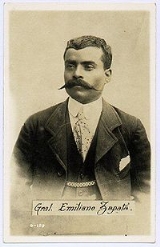
Emiliano Zapata Salazar (August 10, 1879 – April 10, 1919) was a leading figure in the Mexican Revolution
Mexican Revolution

The Mexican Revolution was a major armed struggle that started in 1910 with an uprising led by Francisco I. Madero against longtime autocrat Porfirio D?az....
, which broke out in 1910, and which was initially directed against the president Porfirio Díaz
Porfirio Díaz

Jos? de la Cruz Porfirio D?az Mori was a Mexico politician who would later become the President of Mexico from 1876 to 1880 and from 1884 to 1911, and one of the most controversial figures of the country....
. He formed and commanded an important revolutionary force, the Liberation Army of the South
Liberation Army of the South

For the modern-day Zapatista army, founded in 1983, see: Zapatista Army of National Liberation.The Liberation Army of the South was an armed group formed and led by Emiliano Zapata which took part in the Mexican Revolution....
.

mbol of the agrarian reform movement, Zapata was born to Gabriel Zapata a peasant who trained and sold horses, and Cleofas Salazar in the small central state of Morelos
Morelos

Morelos is one of the 31 constituent states of Mexico. Morelos has an area of about , making it the second-smallest of the country's states. Morelos is bordered by Mexico State to the north-east and north-west, the Distrito Federal to the north, Puebla to the east, and Guerrero to the south-west....
, in the village of Anenecuilco (modern-day Ayala
Ciudad Ayala

Ciudad Ayala is a city in the east-central part of the Mexican state of Morelos. It stands at , at a mean height of 1220 metres above sea level....
 municipality).


Discussion
Ask a question about 'Emiliano Zapata'
Start a new discussion about 'Emiliano Zapata'
Answer questions from other users
Full Discussion Forum


Recent Posts


Quotations


Ignorance and obscurantism have never produced anything other than flocks of slaves for tyranny..

A letter to Pancho Villa (date needed)

La tierra es de quien la trabaja con sus manos.

The land belongs to those that work it.

¡Tierra y Libertad!

Land and Liberty!, This was a slogan popularized in the South by Zapata.


Encyclopedia


Emiliano Zapata Salazar (August 10, 1879 – April 10, 1919) was a leading figure in the Mexican Revolution
Mexican Revolution

The Mexican Revolution was a major armed struggle that started in 1910 with an uprising led by Francisco I. Madero against longtime autocrat Porfirio D?az....
, which broke out in 1910, and which was initially directed against the president Porfirio Díaz
Porfirio Díaz

Jos? de la Cruz Porfirio D?az Mori was a Mexico politician who would later become the President of Mexico from 1876 to 1880 and from 1884 to 1911, and one of the most controversial figures of the country....
. He formed and commanded an important revolutionary force, the Liberation Army of the South
Liberation Army of the South

For the modern-day Zapatista army, founded in 1983, see: Zapatista Army of National Liberation.The Liberation Army of the South was an armed group formed and led by Emiliano Zapata which took part in the Mexican Revolution....
.

Biography

A symbol of the agrarian reform movement, Zapata was born to Gabriel Zapata a peasant who trained and sold horses, and Cleofas Salazar in the small central state of Morelos
Morelos

Morelos is one of the 31 constituent states of Mexico. Morelos has an area of about , making it the second-smallest of the country's states. Morelos is bordered by Mexico State to the north-east and north-west, the Distrito Federal to the north, Puebla to the east, and Guerrero to the south-west....
, in the village of Anenecuilco (modern-day Ayala
Ciudad Ayala

Ciudad Ayala is a city in the east-central part of the Mexican state of Morelos. It stands at , at a mean height of 1220 metres above sea level....
 municipality). Zapata's family were Mestizo
Mestizo

Mestizo is a Spanish language term that was used in the Spanish Empire to refer to people of mixed Europe and Indigenous peoples of the Americas ancestry in Latin America....
s, having mainly Nahua ancestry with some Spanish admixture; Emiliano was the ninth out of ten children. Emiliano, a peasant since childhood, gained insight into the severe difficulties of the countryside. He received a limited education from his teacher, Emilio Vara. He had to care for his family because his father died when Zapata was 17. Around the turn of the 20th century Anenecuilco was an indigenous Nahuatl speaking community, and although Zapata is generally thought to have been a mestizo
Mestizo

Mestizo is a Spanish language term that was used in the Spanish Empire to refer to people of mixed Europe and Indigenous peoples of the Americas ancestry in Latin America....
 there exist eyewitness accounts stating that Emiliano Zapata spoke Nahuatl fluently.

At that time, Mexico was ruled by a dictatorship under Porfirio Díaz
Porfirio Díaz

Jos? de la Cruz Porfirio D?az Mori was a Mexico politician who would later become the President of Mexico from 1876 to 1880 and from 1884 to 1911, and one of the most controversial figures of the country....
, who had seized power in 1876. The social system of the time was a sort of proto-capitalist
Capitalism

Capitalism is an economic system in which wealth, and the means of producing wealth, are private property and controlled rather than commonly, publicly, or state-owned and controlled....
 feudal system, with large landed estates (hacienda
Hacienda

Hacienda is a Spanish language word for an estate, usually, but not always, a vast ranch. Some haciendas were plantations, mines, or even factories....
s)
controlling more and more of the land and squeezing out the independent communities of the indigenous and mestizos, who were then subsequently forced into debt slavery (peon
Peon

The words peon and peonage are derived from the Spanish language pe?n . It has a range of meanings but its primary usage is to describe labourers with little control over their employment conditions....
aje
) on the haciendas. Díaz ran local elections to pacify the people and run a government that they could argue was self-imposed. Under Díaz, close confidantes and associates were given offices in districts throughout Mexico. These offices became the enforcers of "land reform
Land reform

Land reforms is an often-Land reform#Arguments for and against land reform alteration in the societal arrangements whereby government administers possession and use of land....
s" that actually concentrated the haciendas into fewer hands.

Zapata's family, although not wealthy, still retained its independence. Like most of the families in Anenecuilco, they were always in danger of poverty, although avoiding peonage and maintaining their own land (rancho). In fact, the family had in previous generations been porfirista, that is, supporters of Díaz. Zapata himself always had a reputation for being a fancy dresser, appearing at bullfights and rodeos in his elaborate charro
Charro

In Mexico, charro is a term referring to a traditional horseman or cowboy of Mexico, originating in the Jalisco. In the rest of Mexico the equivalent term was "vaquero"....
 (cowboy
Cowboy

A cowboy is an animal herder who tends cattle on ranches in North America, traditionally on horseback, and often performs a multitude of other ranch-related tasks....
) outfit. In 1906, he attended a meeting in Cuautla, where they discussed a way to defend the land of the people which on several occasions he had worked as a farmhand. Due to his first acts of rebelliousness, he was enrolled in the Ninth Regiment in 1908 and sent to Cuernavaca. However, because of his talent with horses, he remained a soldier for only six months and left for Mexico City at the request of Ignacio de la Torre, who employed him as a groom. Though his flashiness would usually have associated him with the rich hacendados who controlled the lands, he seems to have retained the admiration and even adoration of the people of his village, Anenecuilco, so that by the time he was 30, he was the head of the defense committee of the village, a post which made him the spokesman for the village's interests. He was directly elected to this position during the autumn of 1909, just a year before the start of the revolution.

Zapata became a leading figure in the village of Anenecuilco, where his family had lived for many generations, and he became involved in struggles for the rights of the campesinos of Morelos. He was able to oversee the redistribution of the land from some haciendas peacefully, but had problems with others. He observed numerous conflicts between villagers and hacendados,or landowners,over the constant theft of village land, and in one instance, saw the hacendados torch an entire village.

For many years, he campaigned steadfastly for the rights of the villagers, first establishing via ancient title deeds
Title (property)

Title is a law term for a bundle of rights in a piece of Possession in which a party may own either a legal interest or an Equitable_interest The rights in the bundle may be separated and held by different parties....
 their claims to disputed land, and then pressing the recalcitrant governor of Morelos into action. Finally, disgusted with the slow response from the government and the overt bias towards the wealthy plantation owners, Zapata began making use of armed force, simply taking over the land in dispute.

The 1910 Revolution

At this time, Porfirio Díaz
Porfirio Díaz

Jos? de la Cruz Porfirio D?az Mori was a Mexico politician who would later become the President of Mexico from 1876 to 1880 and from 1884 to 1911, and one of the most controversial figures of the country....
 was being threatened by the candidacy of Francisco I. Madero
Francisco I. Madero

Francisco Ignacio Madero Gonz?lez was a politician, writer and revolutionary who served as President of Mexico of Mexico from 1911 to 1913. As a respectable upper-class politician he supplied a center around which opposition to the dictatorship of Porfirio D?az could coalesce....
. Zapata made quiet alliances with Madero, whom he perceived to be the best chance for genuine change in the country.

In 1910, Zapata quickly took an important role, becoming the general of an army that formed in Morelos
Morelos

Morelos is one of the 31 constituent states of Mexico. Morelos has an area of about , making it the second-smallest of the country's states. Morelos is bordered by Mexico State to the north-east and north-west, the Distrito Federal to the north, Puebla to the east, and Guerrero to the south-west....
 – the Ejército Libertador del Sur (Liberation Army of the South
Liberation Army of the South

For the modern-day Zapatista army, founded in 1983, see: Zapatista Army of National Liberation.The Liberation Army of the South was an armed group formed and led by Emiliano Zapata which took part in the Mexican Revolution....
).

Zapata joined Madero’s campaign against President Diaz
Porfirio Díaz

Jos? de la Cruz Porfirio D?az Mori was a Mexico politician who would later become the President of Mexico from 1876 to 1880 and from 1884 to 1911, and one of the most controversial figures of the country....
. With the support of Pancho Villa
Pancho Villa

This article is about the Mexican revolutionary general. For the boxer, see Francisco Guilledo.Doroteo Arango Ar?mbula , better known as Francisco or "Pancho" Villa, was the first Mexican Revolutionary general....
, Pascual Orozco
Pascual Orozco

Pascual Orozco was a Mexico revolutionary leader who, after the triumph of the Mexican Revolution, rose up against Francisco I. Madero and recognized the coup d'?tat led by Victoriano Huerta and the government it imposed....
, Emiliano Zapata, and rebellious peasants, Madero overthrew Díaz in May 1911 in the battle at Ciudad Juárez
Ciudad Juárez

Ciudad Ju?rez, also known as just Ju?rez and formerly known as El Paso del Norte, is a city and seat of the Ju?rez in the Mexican state of Chihuahua ....
. A provisional government was formed under Francisco León de la Barra
Francisco León de la Barra

Francisco Le?n de la Barra y Quijano was a Mexican political figure and diplomat, who served as interim president of Mexico from May 25 to November 6, 1911....
. Under Madero, some new land reforms were carried out and elections were to be ensured. However, Zapata was dissatisfied with Madero's stance on land reform, and was unable, despite repeated efforts, to make him understand the importance of the issue or to get him to act on it. Madero and Zapata's relations worsened during the summer of 1911 as Madero appointed a governor who supported plantation owners and refused to meet Zapata’s agrarian goals. Compromises between the two failed in November 1911, days after Madero appointed himself President, and Zapata and Montaño fled to the mountains of southwest Puebla
Puebla

Puebla is a Political divisions of Mexico located in the center east of the country, to the east of Mexico City.The state of Puebla borders the states of Veracruz to the east, Hidalgo , Mexico State, Tlaxcala, and Morelos to the west, and Guerrero and Oaxaca to the south....
. There they formed the most radical reform plan in Mexico; the Plan de Ayala.

Zapata was partly influenced by an anarchist
Anarchism

Anarchism is a political philosophy encompassing anarchist schools of thought which consider the state to be unnecessary, harmful, and/or undesirable....
 from Oaxaca
Oaxaca

The Free and Sovereign State of Oaxaca }} is one of the 31 Mexican state of Mexico, located in the southern part of the country, west of the Isthmus of Tehuantepec....
 named Ricardo Flores Magón
Ricardo Flores Magón

Cipriano Ricardo Flores Mag?n a noted Mexico anarchist and social reform activist, was born on Mexican Independence Day, in San Antonio Eloxochitl?n, Oaxaca....
. The influence of Flores Magón on Zapata can be seen in the Zapatistas' Plan de Ayala, but even more noticeably in their slogan (this slogan was never used by Zapata) "Tierra y libertad" or "land and liberty", the title and maxim of Flores Magón's most famous work. Zapata's introduction to anarchism came via a local schoolteacher, Otilio Montaño Sánchez – later a general in Zapata's army, executed on 17 May 1917 – who exposed Zapata to the works of Peter Kropotkin
Peter Kropotkin

name= Peter Kropotkin|image = Kropotkin Nadar.jpg|image_size =|caption = Kropotkin, by Nadar |birth_date = |birth_place = Moscow, Russia...
 and Flores Magón at the same time as Zapata was observing and beginning to participate in the struggles of the peasants for the land.

The plan proclaimed the Zapatista demands for "Reforma, Libertad Ley y Justicia" (Reform, Freedom, Law and justice) Zapata also declared the Maderistas as a counter-revolution and denounced Madero. Zapata mobilized his Liberation Army
Liberation Army of the South

For the modern-day Zapatista army, founded in 1983, see: Zapatista Army of National Liberation.The Liberation Army of the South was an armed group formed and led by Emiliano Zapata which took part in the Mexican Revolution....
 and allied with former Maderistas Pascual Orozco
Pascual Orozco

Pascual Orozco was a Mexico revolutionary leader who, after the triumph of the Mexican Revolution, rose up against Francisco I. Madero and recognized the coup d'?tat led by Victoriano Huerta and the government it imposed....
 and Emiliano Vázquez Gómez. Orozco was from Chihuahua
Chihuahua, Chihuahua

The city of Chihuahua is the state capital of the Mexican Mexican state of Chihuahua . It has a population of about 748,551. The predominant activity is light industry, in the form of maquiladoras....
, near the U.S. border, and thus was able to aid the Zapatistas with a supply of arms.

Madero, alarmed, asked Zapata to disarm and demobilize. Zapata responded that, if the people could not win their rights now, when they were armed, they would have no chance once they were unarmed and helpless. Madero sent several generals in an attempt to deal with Zapata, but these efforts had little success.

Although government forces could never completely defeat Zapata in battle, in 1919, he fell victim to a carefully staged ambush by Gen. Pablo González
Pablo González

Pablo Gonz?lez may refer to:*Pablo Gonz?lez Garza , Mexican general and Governor of San Luis Potos?*Pablo Andr?s Gonz?lez , Argentine footballer...
 and his lieutenant, Col. Jesús Guajardo who were supporters of the Mexican president, Venustiano Carranza
Venustiano Carranza

Venustiano Carranza Garza was one of the leaders of the Mexican Revolution. He ultimately became President of Mexico following the overthrow of the dictatorial Huerta regime in the summer of 1914 and during his administration the 1917 Constitution of Mexico of Mexico was drafted....
. Guajardo proposed González feign a defection to Zapata's forces. González agreed, and to make the defection appear sincere, he arranged for Guajardo to attack a Federal column, killing 57 soldiers. Zapata subsequently agreed to receive a messenger from Guajardo, to arrange a meeting to speak about Guajardo's defection.

On April 10, 1919, Guajardo invited Zapata to a meeting, intimating that he intended to defect to the revolutionaries. However, when Zapata arrived at the Hacienda de San Juan, in Chinameca, Ayala municipality
Ciudad Ayala

Ciudad Ayala is a city in the east-central part of the Mexican state of Morelos. It stands at , at a mean height of 1220 metres above sea level....
, Guajardo's men riddled him with bullets. They then took his body to Cuautla
Cuautla, Morelos

Cuautla , officially La heroica e hist?rica Cuautla de Morelos, or H. H. Cuautla de Morelos, is a city and municipalities of Mexico in the Mexican state of Morelos....
 to claim the bounty, where they are reputed to have been given only half of what was promised.

Following Zapata's death, the Liberation Army of the South slowly fell apart, although Zapata's heir apparent
Heir apparent

An heir apparent is an heir who cannot be displaced from inheriting; the term is used in contrast to heir presumptive, the term for a conditional heir who is currently in line to inherit but could be displaced at any time in the future....
 Gildardo Magaña
Gildardo Magaña

Gildardo Maga?a Cerda was a Mexico general, politician and revolutionary.Born 1891 in Zamora, Michoac?n, to a Liberal trading family and was sent to study economy in the U.S....
 and many other Zapata adherents went on to political careers as representatives of Zapatista causes and positions in the Mexican army and government. Some of his former generals like Genovevo de la O
Genovevo de la O

Genovevo de la O was an important figure in the Mexican Revolution.He was born in Santa Mar?a Ahuacatitl?n, Morelos, to sharecropper parents....
 allied with Obregón while others eventually disappeared after Carranza was deposed.

Legacy

Emiliano Zapata En La Ciudad De Cuernavaca
Zapata's influence lasts to this day, particularly in revolutionary tendencies in south Mexico. There are controversies on the portrayal of Emiliano Zapata and his followers, on whether they were bandits or revolutionaries. But in modern times, Zapata is one of the most revered national heroes of Mexico: to many Mexicans, specifically the peasant and indigenous citizens, Zapata was a practical revolutionary who sought the implementation of liberties and agrarian rights outlined in the Plan of Ayala
Plan of Ayala

The Plan of Ayala was a document drafted by revolutionary leader Emiliano Zapata during the Mexican Revolution. In it, Zapata denounced President of Mexico Francisco I....
. He was a realist with the goal of achieving political and economic emancipation of the peasants in southern Mexico, and leading them out of severe poverty.

Many popular organizations take their name from Zapata, most notably the Zapatista Army of National Liberation
Zapatista Army of National Liberation

The Zapatista Army of National Liberation is an armed revolutionary group based in Chiapas, one of the poorest states of Mexico. Since 1994, they have been in a declared war "against the Mexican state." Their social base is mostly Indigenous peoples of Mexico but they have some supporters in urban areas as well as an international web of s...
 (Ejército Zapatista de Liberación Nacional or EZLN in Spanish
Spanish language

Spanish or Castilian is a Romance languages that originated in northern Spain, and gradually spread in the Kingdom of Castile and evolved into the principal language of government and trade....
), the revolutionary movement of indigenous peoples that emerged in the state of Chiapas
Chiapas

Chiapas is the southernmost States of Mexico of Mexico, located towards the southeast of the country. Chiapas is bordered by the states of Tabasco to the north, Veracruz to the northwest, and Oaxaca to the west....
 in 1994 and is colloquially known as "the Zapatistas". Towns, streets, and housing developments called "Emiliano Zapata" are common across the country and he has, at times, been depicted on Mexican banknotes
Mexican peso

The peso is the currency of Mexico. The symbol used for the peso is "dollar sign", basically the same as for the US dollar since the dollar derived its logo from the Spanish-Mexican currency....
.

Modern activists in Mexico frequently make reference to Zapata in their campaigns, his image is commonly seen on banners and many chants invoke his name: Si Zapata viviera con nosotros andaría, "If Zapata lived, he would walk with us." Zapata vive, la lucha sigue, "Zapata lives; the struggle continues."

In the folklore of the people of Morelos, there is a widespread belief that Zapata did not die. The corpse purported to be his was that of a friend posing as Zapata,because there was something on Zapata's chest that the dead body didn't have and that Zapata himself fled to some obscure rural locale.

Zapata has in the last few decades been recast as a quasi-religious icon as well, mostly within indigenous or the newer "Zapatista"(EZLN/Mayan) communities, where he is called "Votán Zapata". Votán (Wotán in modern Mayan spelling) is a Mayan god, who with his twin brother Ik'al was said to have descended from the mountains to teach the people to defend themselves. A part of Our Word is Our Weapon
Our Word is Our Weapon

Our Word is Our Weapon is a collection of writings by Subcomandante Marcos of the Zapatista Army of National Liberation. Marcos has become somewhat of an icon, a poetic representative of a much larger struggle....
 by Subcomandante Marcos
Subcomandante Marcos

Subcomandante Insurgente Marcos, or just Subcomandante Marcos, also known as Delegado Cero in matters concerning the Other Campaign, describes himself as the spokesman for the Mexico rebel movement, the Zapatista Army of National Liberation ....
 of the EZLN is dedicated to Votán Zapata.

In 1969 students from the Black Student Council and Mexican-American Youth Association of the University of California San Diego formed Lumumba-Zapata College, now known as Thurgood Marshall College
Thurgood Marshall College

Thurgood Marshall College is one of the six undergraduate colleges at the UCSD. The college, named after Thurgood Marshall, the first African-American SCOTUS Justice and lawyer for the landmark 1954 Supreme Court case Brown v....
.

In popular culture


Zapata has been depicted in comics, books, music, and clothing popular with teenagers and young adults and movies. For example, Zapata (1980) is a stage musical written by Harry Nilsson and Perry Botkin which ran for 16 weeks at the Goodspeed Opera House in East Haddam, Connecticut.People also made a movie called "Zapata:El Sueño De Un Heroe"(2004) starring Alejandro Fernandez,Jaime Camil,and Lucero.

Aliases

  • "El Tigre del Sur"- Tiger of the South
  • "El Tigre"- The Tiger
  • "El Tigrillo"- Little Tiger
  • "El Caudillo del Sur"- Caudillo
    Caudillo

    Caudillo is a Spanish word usually used to designate "a political-military leader at the head of an authoritarian power." At the beginning this word was used to refer to military power: Ind?bil and Mandonio, Viriato, Al-Mansur Ibn Abi Aamir , and other fighters of the Reconquista, even Sim?n Bolivar, Francisco Franco, etc., but in H...
     of the South
  • "El Atila del Sur"- The Attila
    Attila the Hun

    Attila , also known as Attila the Hun, was leader of the Huns from 434 until his death in 453. He was leader of the Hunnic Empire which stretched from Germany to the Ural River and from the Danube to the Baltic Sea ....
     of the South


See also


  • Mexican Revolution
    Mexican Revolution

    The Mexican Revolution was a major armed struggle that started in 1910 with an uprising led by Francisco I. Madero against longtime autocrat Porfirio D?az....
  • Pancho Villa
    Pancho Villa

    This article is about the Mexican revolutionary general. For the boxer, see Francisco Guilledo.Doroteo Arango Ar?mbula , better known as Francisco or "Pancho" Villa, was the first Mexican Revolutionary general....
  • Viva Zapata!
    Viva Zapata!

    Viva Zapata! is a 1952 in film biographical film directed by Elia Kazan. The screenplay was written by John Steinbeck, using as a guide Edgcomb Pinchon's book, 'Zapata the Unconquerable', a fact that is not credited in the titles of the film....
  • Paco Ignacio Taibo II
    Paco Ignacio Taibo II

    Paco Ignacio Taibo II , birth name Francisco Ignacio Taibo Mahojo, has lived in Mexico City since 1958 when his family fled from Spain to escape the fascist dictatorship of General Francisco Franco....
    , the author of a recently published biography of Pancho Villa: Taibo II, Paco Ignacio. Pancho Villa. Una biografía narrativa. Planeta, México, 2006.


External links

  • in Spanish


Sources

  • Villa and Zapata by Frank Mclynn
  • Fernando Horcasitas, De Porfirio Díaz a Zapata, memoria náhuatl de Milpa Alta, UNAM, México DF.,1968 (eye and ear-witness account of Zapata speaking Nahuatl)
  • John Womack
    John Womack

    John Womack Jr. is an historian of Latin America, particularly of Mexico, the Mexican Revolution and Emiliano Zapata. He is the Robert Woods Bliss Professor of Latin American History and Economics at Harvard University....
    , Zapata and the Mexican Revolution, New York, Vintage (1969) ISBN 0394708539
  • Enrique Krauze, Zapata: El amor a la tierra, in the Biographies of Power series.