

Ely Place

Encyclopedia
London Borough of Camden
In 1801, the civil parishes that form the modern borough were already developed and had a total population of 96,795. This continued to rise swiftly throughout the 19th century, as the district became built up; reaching 270,197 in the middle of the century...
in London
London
London is the capital city of :England and the :United Kingdom, the largest metropolitan area in the United Kingdom, and the largest urban zone in the European Union by most measures. Located on the River Thames, London has been a major settlement for two millennia, its history going back to its...
, England
England
England is a country that is part of the United Kingdom. It shares land borders with Scotland to the north and Wales to the west; the Irish Sea is to the north west, the Celtic Sea to the south west, with the North Sea to the east and the English Channel to the south separating it from continental...
. It is the location of the Old Mitre Tavern and is adjacent to Hatton Garden
Hatton Garden
Hatton Garden is a street and area near Holborn in London, England. It is most famous for being London’s jewellery quarter and centre of the UK diamond trade, but the area is also now home to a diverse range of media and creative businesses....
.
Origins
The cul-de-sacCul-de-sac
A cul-de-sac is a word of French origin referring to a dead end, close, no through road or court meaning dead-end street with only one inlet/outlet...
was constructed in 1772 by Robert Taylor
Robert Taylor (architect)
Sir Robert Taylor was a notable English architect of the mid-late 18th century.Born at Woodford, Essex, Taylor followed in his father's footsteps and started working as a stonemason and sculptor, spending time as a pupil of Sir Henry Cheere...
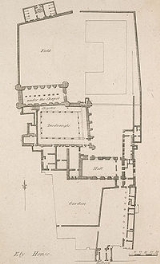
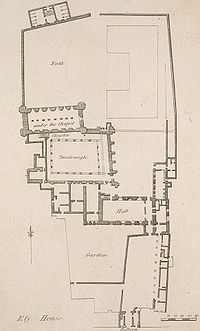
on land which had been the site of Ely Palace or Ely House, the London residence of the Bishops of Ely from 1290 to 1772. Land in the Holborn area was bought by John de Kirkby in 1280. He was appointed Bishop of Ely in 1286 and upon his death in 1290, left the estate to the see
Episcopal See
An episcopal see is, in the original sense, the official seat of a bishop. This seat, which is also referred to as the bishop's cathedra, is placed in the bishop's principal church, which is therefore called the bishop's cathedral...
of Ely. The estate was sold to the Crown in 1772 and Edmund Keene
Edmund Keene
Edmund Keene was an English churchman and academic, Master of Peterhouse, Cambridge, Bishop of Chester and Bishop of Ely.-Life:He was the third but second surviving son of Charles Keene, and younger brother of Sir Benjamin Keene, and was born at King's Lynn, Norfolk...
as Bishop of Ely commissioned a new Ely House, also built by Taylor, on Dover Street, Mayfair.
In medieval times, bishops of Ely frequently held high state office requiring them to live in London. There are references to Ely Palace grounds in Shakespeare’s plays. It was at the house that the Bard had John of Gaunt – who was living there in 1382 – say his "This royal throne of Kings, this sceptre’d isle" speech.

St Etheldreda's Church
St Etheldreda's ChurchSt Etheldreda's Church
St Etheldreda's Church is located in Ely Place, off Charterhouse Street, Holborn, London. It is dedicated to Æthelthryth, or Etheldreda, an Anglo-Saxon saint who founded the monastery at Ely in 673. The building was the chapel of the London residence of the Bishops of Ely.The chapel was purchased ...
in Ely Place is the former private chapel of the Bishops of Ely
Bishop of Ely
The Bishop of Ely is the Ordinary of the Church of England Diocese of Ely in the Province of Canterbury. The diocese roughly covers the county of Cambridgeshire , together with a section of north-west Norfolk and has its see in the City of Ely, Cambridgeshire, where the seat is located at the...
. It is still standing today, and is the only surviving building in London from the reign of Edward I
Edward I of England
Edward I , also known as Edward Longshanks and the Hammer of the Scots, was King of England from 1272 to 1307. The first son of Henry III, Edward was involved early in the political intrigues of his father's reign, which included an outright rebellion by the English barons...
(1239–1307) though it was badly damaged during World War II
World War II
World War II, or the Second World War , was a global conflict lasting from 1939 to 1945, involving most of the world's nations—including all of the great powers—eventually forming two opposing military alliances: the Allies and the Axis...
. St Etheldreda, a seventh-century queen and nun, was the saint in whose name Ely Cathedral was founded. The gardens of St Etheldreda were said to produce the finest strawberries
Strawberry
Fragaria is a genus of flowering plants in the rose family, Rosaceae, commonly known as strawberries for their edible fruits. Although it is commonly thought that strawberries get their name from straw being used as a mulch in cultivating the plants, the etymology of the word is uncertain. There...
in London and a Strawberry Fayre is held here every June. In Shakespeare’s Richard III
Richard III (play)
Richard III is a history play by William Shakespeare, believed to have been written in approximately 1591. It depicts the Machiavellian rise to power and subsequent short reign of Richard III of England. The play is grouped among the histories in the First Folio and is most often classified...
, Gloucester tells the Bishop of Ely: "My Lord of Ely, when I was last in Holborn, I saw good strawberries in your garden there. I do beseech you, send for some of them".
Commissioners
In 1842 a local Act of ParliamentAct of Parliament
An Act of Parliament is a statute enacted as primary legislation by a national or sub-national parliament. In the Republic of Ireland the term Act of the Oireachtas is used, and in the United States the term Act of Congress is used.In Commonwealth countries, the term is used both in a narrow...
established a body of commissioners for paving, lighting, watching, cleansing and improving Ely Place and Ely Mews, Holborn, in the County of Middlesex. While the commissioners have lost most of their powers to local authorities established under the Metropolis Management Act 1855
Metropolis Management Act 1855
The Metropolis Management Act 1855 was an Act of the Parliament of the United Kingdom that created the Metropolitan Board of Works, a London-wide body to co-ordinate the construction of the city's infrastructure. The Act also created a second tier of local government consisting of parish vestries...
and later legislation, they retain their "watching" duties, with a beadle
Beadle
Beadle, sometimes spelled "bedel," is a lay official of a church or synagogue who may usher, keep order, make reports, and assist in religious functions; or a minor official who carries out various civil, educational, or ceremonial duties....
discharging these duties.
Transport
To the east is Farringdon RoadFarringdon Road
Farringdon Road is a road in Clerkenwell, Central London. Its construction, which took almost 20 years between the 1840s and the 1860s, is considered one of the greatest urban engineering achievements of the nineteenth century...
and to the south is Holborn Circus
Holborn Circus
Holborn Circus is a famous location in London, on the boundary between Holborn and Smithfield. Holborn Circus is a roundabout.On one side lies the Church of St Andrew, Holborn, an ancient Guild Church, that survived the Great Fire of London. However, the parochial authority decided, nevertheless,...
. To the north is a gate leading to Bleeding Heart Yard
Bleeding Heart Yard
Bleeding Heart Yard is a cobbled courtyard off Greville Street in the Farringdon area of the City of London.Urban legend has it that the courtyard's name commemorates the murder of Lady Elizabeth Hatton, second wife of Sir William Hatton, whose family used to own the area...
. The nearest underground stations are Farringdon to the north-east and Chancery Lane
Chancery Lane tube station
Chancery Lane is a London Underground station in central London. It is on the Central Line between St. Paul's and Holborn stations. The station is located at the junction of High Holborn, Hatton Garden and Gray's Inn Road with subway entrances giving access to the ticket office under the roadway...
to the west.