

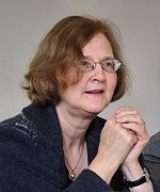
Elizabeth Blackburn

Encyclopedia
Elizabeth Helen Blackburn, AC, FRS
(born 26 November 1948 in Hobart, Tasmania) is an Australia
n-born American biological researcher at the University of California, San Francisco
, who studies the telomere
, a structure at the end of chromosomes that protects the chromosome
. Blackburn co-discovered telomerase
, the enzyme
that replenishes the telomere. Blackburn recalls: "Carol had done this experiment, and we stood, just in the lab, and I remember sort of standing there, and she had this -- we call it a gel. It's an autoradiogram, because there was trace amounts of radioactivity that were used to develop an image of the separated DNA products of what turned out to be the telomerase enzyme reaction. I remember looking at it and just thinking, ‘Ah! This could be very big. This looks just right.’ It had a pattern to it. There was a regularity to it. There was something that was not just sort of garbage there, and that was really kind of coming through, even though we look back at it now, we'd say, technically, there was this, that and the other, but it was a pattern shining through, and it just had this sort of sense, ‘Ah! There's something real here.’ "For this work, she was awarded the 2009 Nobel Prize in Physiology or Medicine
, sharing it with Carol W. Greider
and Jack W. Szostak
. She also worked in medical ethics, and was controversially dismissed from the President's Council on Bioethics.
in the Department of Molecular Biology. In 1990, she moved across the San Francisco Bay to the Department of Microbiology and Immunology at the University of California, San Francisco
(UCSF), where she served as the Department Chairwoman from 1993 to 1999. Blackburn is currently the Morris Herzstein Professor of Biology and Physiology at UCSF, and a non-resident fellow of the Salk Institute. She is the president-elect of the American Association for Cancer Research
. In recent years Blackburn and her colleagues have been investigating the effect of stress on telomerase and telomeres with particular emphasis on mindfulness
meditation. She is also one of several biologists (and one of two Noble Prize laureates) in the 1995 science documentary
Death by Design / The Life and Times of Life and Times.
"There is a growing sense that scientific research — which, after all, is defined by the quest for truth — is being manipulated for political ends," wrote Blackburn. "There is evidence that such manipulation is being achieved through the stacking of the membership of advisory bodies and through the delay and misrepresentation of their reports."
Blackburn serves on the Science Advisory Board of the Genetics Policy Institute
.
In 2007, Blackburn was listed among Time Magazine's The TIME 100—The People Who Shape Our World.
Royal Society
The Royal Society of London for Improving Natural Knowledge, known simply as the Royal Society, is a learned society for science, and is possibly the oldest such society in existence. Founded in November 1660, it was granted a Royal Charter by King Charles II as the "Royal Society of London"...
(born 26 November 1948 in Hobart, Tasmania) is an Australia
Australia
Australia , officially the Commonwealth of Australia, is a country in the Southern Hemisphere comprising the mainland of the Australian continent, the island of Tasmania, and numerous smaller islands in the Indian and Pacific Oceans. It is the world's sixth-largest country by total area...
n-born American biological researcher at the University of California, San Francisco
University of California, San Francisco
The University of California, San Francisco is one of the world's leading centers of health sciences research, patient care, and education. UCSF's medical, pharmacy, dentistry, nursing, and graduate schools are among the top health science professional schools in the world...
, who studies the telomere
Telomere
A telomere is a region of repetitive DNA sequences at the end of a chromosome, which protects the end of the chromosome from deterioration or from fusion with neighboring chromosomes. Its name is derived from the Greek nouns telos "end" and merοs "part"...
, a structure at the end of chromosomes that protects the chromosome
Chromosome
A chromosome is an organized structure of DNA and protein found in cells. It is a single piece of coiled DNA containing many genes, regulatory elements and other nucleotide sequences. Chromosomes also contain DNA-bound proteins, which serve to package the DNA and control its functions.Chromosomes...
. Blackburn co-discovered telomerase
Telomerase
Telomerase is an enzyme that adds DNA sequence repeats to the 3' end of DNA strands in the telomere regions, which are found at the ends of eukaryotic chromosomes. This region of repeated nucleotide called telomeres contains non-coding DNA material and prevents constant loss of important DNA from...
, the enzyme
Enzyme
Enzymes are proteins that catalyze chemical reactions. In enzymatic reactions, the molecules at the beginning of the process, called substrates, are converted into different molecules, called products. Almost all chemical reactions in a biological cell need enzymes in order to occur at rates...
that replenishes the telomere. Blackburn recalls: "Carol had done this experiment, and we stood, just in the lab, and I remember sort of standing there, and she had this -- we call it a gel. It's an autoradiogram, because there was trace amounts of radioactivity that were used to develop an image of the separated DNA products of what turned out to be the telomerase enzyme reaction. I remember looking at it and just thinking, ‘Ah! This could be very big. This looks just right.’ It had a pattern to it. There was a regularity to it. There was something that was not just sort of garbage there, and that was really kind of coming through, even though we look back at it now, we'd say, technically, there was this, that and the other, but it was a pattern shining through, and it just had this sort of sense, ‘Ah! There's something real here.’ "For this work, she was awarded the 2009 Nobel Prize in Physiology or Medicine
Nobel Prize in Physiology or Medicine
The Nobel Prize in Physiology or Medicine administered by the Nobel Foundation, is awarded once a year for outstanding discoveries in the field of life science and medicine. It is one of five Nobel Prizes established in 1895 by Swedish chemist Alfred Nobel, the inventor of dynamite, in his will...
, sharing it with Carol W. Greider
Carol W. Greider
Carolyn Widney "Carol" Greider is an American molecular biologist. She is Daniel Nathans Professor and Director of Molecular Biology and Genetics at Johns Hopkins University. She discovered the enzyme telomerase in 1984, when she was a graduate student of Elizabeth Blackburn at the University of...
and Jack W. Szostak
Jack W. Szostak
Jack William Szostak is a Canadian American biologist of Polish British descent and Professor of Genetics at Harvard Medical School and Alexander Rich Distinguished Investigator at Massachusetts General Hospital, Boston. He was awarded the 2009 Nobel Prize for Physiology or Medicine, along with...
. She also worked in medical ethics, and was controversially dismissed from the President's Council on Bioethics.
Work in molecular biology
In 1978, Blackburn joined the faculty of the University of California, BerkeleyUniversity of California, Berkeley
The University of California, Berkeley , is a teaching and research university established in 1868 and located in Berkeley, California, USA...
in the Department of Molecular Biology. In 1990, she moved across the San Francisco Bay to the Department of Microbiology and Immunology at the University of California, San Francisco
University of California, San Francisco
The University of California, San Francisco is one of the world's leading centers of health sciences research, patient care, and education. UCSF's medical, pharmacy, dentistry, nursing, and graduate schools are among the top health science professional schools in the world...
(UCSF), where she served as the Department Chairwoman from 1993 to 1999. Blackburn is currently the Morris Herzstein Professor of Biology and Physiology at UCSF, and a non-resident fellow of the Salk Institute. She is the president-elect of the American Association for Cancer Research
American Association for Cancer Research
The American Association for Cancer Research is the world's oldest and largest professional association to advancing cancer research. Based in Philadelphia, AACR focuses on all aspects of cancer research including basic, clinical and translational research into the etiology, prevention, diagnosis,...
. In recent years Blackburn and her colleagues have been investigating the effect of stress on telomerase and telomeres with particular emphasis on mindfulness
Mindfulness (psychology)
Modern clinical psychology and psychiatry since the 1970s have developed a number of therapeutic applications based on the concept of mindfulness in Buddhist meditation.-Definitions:...
meditation. She is also one of several biologists (and one of two Noble Prize laureates) in the 1995 science documentary
Documentary
A documentary is a creative work of non-fiction, including:* Documentary film, including television* Radio documentary* Documentary photographyRelated terms include:...
Death by Design / The Life and Times of Life and Times.
Bioethics
Blackburn was appointed a member of the President's Council on Bioethics in 2001. She supported human embryonic cell research, in opposition to the Bush Administration. Her Council terms were terminated by White House directive on 27 February 2004. This was followed by expressions of outrage over her removal by many scientists, who maintained that she was fired because of political opposition to her advice."There is a growing sense that scientific research — which, after all, is defined by the quest for truth — is being manipulated for political ends," wrote Blackburn. "There is evidence that such manipulation is being achieved through the stacking of the membership of advisory bodies and through the delay and misrepresentation of their reports."
Blackburn serves on the Science Advisory Board of the Genetics Policy Institute
Genetics Policy Institute
The Genetics Policy Institute is a 501 nonprofit organization that educates the public and promotes supportive public policy for stem cell research and other forms of cutting-edge medicine....
.
Awards and honors
- Eli LillyColonel Eli LillyEli Lilly was an American soldier, pharmaceutical chemist, industrialist, entrepreneur, and founder of the Eli Lilly and Company pharmaceutical corporation...
Research Award for Microbiology and Immunology (1988) - National Academy of SciencesUnited States National Academy of SciencesThe National Academy of Sciences is a corporation in the United States whose members serve pro bono as "advisers to the nation on science, engineering, and medicine." As a national academy, new members of the organization are elected annually by current members, based on their distinguished and...
Award in Molecular Biology (1990) - Honorary Doctorate of Science from Yale University (1991)
- Harvey Society Lecturer at the Harvey Society in New York (1990)
- Fellow of American Academy of Arts and SciencesAmerican Academy of Arts and SciencesThe American Academy of Arts and Sciences is an independent policy research center that conducts multidisciplinary studies of complex and emerging problems. The Academy’s elected members are leaders in the academic disciplines, the arts, business, and public affairs.James Bowdoin, John Adams, and...
(1991) - Fellow of Royal Society of London (1992)
- Fellow of American Academy of Microbiology (1993)
- Australia PrizeAustralia PrizeThe Australia Prize was Australia's pre-eminent prize for scientific research from 1990 until 2000, when it was replaced by the Prime Minister's Prizes for Science. The award was international, 10 of the 28 recipients were not Australians.-Recipients:...
(1998) - Gairdner Foundation International AwardGairdner Foundation International AwardThe Gairdner Foundation International Award is given annually at a special dinner to three to six people for outstanding discoveries or contributions to medical science. Receipt of the Gairdner is traditionally considered a precursor to winning the Nobel Prize in Medicine; as of 2007, 69 Nobel...
(1998) - Harvey PrizeHarvey PrizeThe Harvey Prize is awarded by the Technion in Haifa, Israel. It is awarded in different disciplines of Science, Technology, Human Health, and Contributions to Peace in the Middle East. Two awards - each of $75,000 - are given away annually...
(1999) - Keio Medical Science PrizeKeio Medical Science PrizeThe Keio Medical Science Prize , is a distinguished Japanese prize in medical sciences.-Introduction:The prize is awarded to scientists who made significant contributions to the field of medical sciences or life sciences...
(1999) - California Scientist of the Year in (1999)
- American Association for Cancer ResearchAmerican Association for Cancer ResearchThe American Association for Cancer Research is the world's oldest and largest professional association to advancing cancer research. Based in Philadelphia, AACR focuses on all aspects of cancer research including basic, clinical and translational research into the etiology, prevention, diagnosis,...
- G.H.A. Clowes Memorial Award (2000) - American Cancer SocietyAmerican Cancer SocietyThe American Cancer Society is the "nationwide community-based voluntary health organization" dedicated, in their own words, "to eliminating cancer as a major health problem by preventing cancer, saving lives, and diminishing suffering from cancer, through research, education, advocacy, and...
Medal of Honor (2000) - Fellow of American Association for the Advancement of ScienceAmerican Association for the Advancement of ScienceThe American Association for the Advancement of Science is an international non-profit organization with the stated goals of promoting cooperation among scientists, defending scientific freedom, encouraging scientific responsibility, and supporting scientific education and science outreach for the...
(2000) - Academy of Achievement's Golden Plate AwardAcademy of AchievementThe Academy of Achievement is a U.S.-based nonprofit organization founded in 1961 by photographer Hy Peskin. He established the Academy of Achievement to bring aspiring young people together with accomplished people...
(2000) - AACR-Pezcoller Foundation International Award for Cancer Research (2001)
- General Motors Cancer Research Foundation Alfred P. Sloan Award (2001)
- E.B.Wilson Award of the American Society for Cell Biology (2001)
- Robert J. and Claire Pasarow Foundation Medical Research Award (2003)
- Dr A.H. Heineken Prize for MedicineDr A.H. Heineken PrizeThe Dr. A.H. Heineken and Dr. H.P. Heineken Prizes, named in honor of Alfred Heineken, former Chairman of Heineken Holdings, and Henry Pierre Heineken, son of founder Gerard Adriaan Heineken, are a series of awards bestowed by the Royal Netherlands Academy of Arts and Sciences .-History:Alfred...
(2004) - Benjamin Franklin Medal in Life Science of The Franklin Institute (2005)
- Albert Lasker Award for Basic Medical ResearchAlbert Lasker Award for Basic Medical ResearchThe Albert Lasker Award for Basic Medical Research is one of the prizes awarded by the Lasker Foundation for the understanding, diagnosis, prevention, treatment, and cure of disease...
(2006) (shared with Carol W. GreiderCarol W. GreiderCarolyn Widney "Carol" Greider is an American molecular biologist. She is Daniel Nathans Professor and Director of Molecular Biology and Genetics at Johns Hopkins University. She discovered the enzyme telomerase in 1984, when she was a graduate student of Elizabeth Blackburn at the University of...
and Jack Szostak) - Genetics Prize from the Peter Gruber Foundation (2006)
- Honorary Doctorate of Science from Harvard UniversityHarvard UniversityHarvard University is a private Ivy League university located in Cambridge, Massachusetts, United States, established in 1636 by the Massachusetts legislature. Harvard is the oldest institution of higher learning in the United States and the first corporation chartered in the country...
(2006) - Wiley PrizeWiley PrizeThe Wiley Prize in Biomedical Sciences is intended to recognize breakthrough research in pure or applied life science research that is distinguished by its excellence, originality and impact on our understanding of biological systems and processes...
in Biomedical Sciences from the Wiley Foundation (shared with Carol W. GreiderCarol W. GreiderCarolyn Widney "Carol" Greider is an American molecular biologist. She is Daniel Nathans Professor and Director of Molecular Biology and Genetics at Johns Hopkins University. She discovered the enzyme telomerase in 1984, when she was a graduate student of Elizabeth Blackburn at the University of...
)(2006) - Corresponding Fellow of the Australian Academy of Science (2007)*Recipient of the UCSF Women's Faculty Association Award
- Honorary Doctorate of Science from Princeton University (2007)
- Louisa Gross Horwitz PrizeLouisa Gross Horwitz PrizeLouisa Gross Horwitz Prize for Biology or Biochemistry is an annual prize awarded by Columbia University to a researcher or group of researchers that have made an outstanding contribution in basic research in the fields of biology or biochemistry....
(2007) (shared with Carol W. GreiderCarol W. GreiderCarolyn Widney "Carol" Greider is an American molecular biologist. She is Daniel Nathans Professor and Director of Molecular Biology and Genetics at Johns Hopkins University. She discovered the enzyme telomerase in 1984, when she was a graduate student of Elizabeth Blackburn at the University of...
and Joseph G. GallJoseph G. GallJoseph Grafton Gall is an American cell biologist and winner of the 2006 Albert Lasker Special Achievement Award. He also won the 2007 Louisa Gross Horwitz Prize...
) - L'Oréal-UNESCO Award for Women in ScienceL'Oréal-UNESCO Awards for Women in ScienceThe L'Oréal-UNESCO Awards for Women in Science aims to improve the position of women in science by recognizing outstanding women researchers who have contributed to scientific progress...
(2008) - Mike Hogg Award (2009)
- Paul Ehrlich and Ludwig Darmstaedter PrizePaul Ehrlich and Ludwig Darmstaedter PrizeThe Paul Ehrlich and Ludwig Darmstaedter Prize is given every year since 1952 for investigations in medicine. The prize carries a prize money of 100.000 Euro. The prize awarding ceremony is traditionally on March 14, the birthday of Paul Ehrlich, in the St. Pauls-Church, Frankfurt.Awarded are...
(2009) (shared with Carol W. GreiderCarol W. GreiderCarolyn Widney "Carol" Greider is an American molecular biologist. She is Daniel Nathans Professor and Director of Molecular Biology and Genetics at Johns Hopkins University. She discovered the enzyme telomerase in 1984, when she was a graduate student of Elizabeth Blackburn at the University of...
) - Nobel Prize for Physiology or Medicine (2009) (shared with Carol W. GreiderCarol W. GreiderCarolyn Widney "Carol" Greider is an American molecular biologist. She is Daniel Nathans Professor and Director of Molecular Biology and Genetics at Johns Hopkins University. She discovered the enzyme telomerase in 1984, when she was a graduate student of Elizabeth Blackburn at the University of...
and Jack Szostak) - Companion of the Order of AustraliaOrder of AustraliaThe Order of Australia is an order of chivalry established on 14 February 1975 by Elizabeth II, Queen of Australia, "for the purpose of according recognition to Australian citizens and other persons for achievement or for meritorious service"...
(Australia DayAustralia DayAustralia Day is the official national day of Australia...
Honours, 2010), for eminent service to science as a leader in the field of biomedical research, particularly through the discovery of telomerase and its role in the development of cancer and ageing of cells and through contributions as an international adviser in Bioethics.
- Elected:
- President of the American Association for Cancer ResearchAmerican Association for Cancer ResearchThe American Association for Cancer Research is the world's oldest and largest professional association to advancing cancer research. Based in Philadelphia, AACR focuses on all aspects of cancer research including basic, clinical and translational research into the etiology, prevention, diagnosis,...
for the year 2010 - President of the American Society for Cell Biology for the year 1998
- President of the American Association for Cancer Research
-
- Foreign Associate of the National Academy of Sciences (1993)
- Member of the Institute of MedicineInstitute of MedicineThe Institute of Medicine is a not-for-profit, non-governmental American organization founded in 1970, under the congressional charter of the National Academy of Sciences...
(2000) - Board member of the Genetics Society of AmericaGenetics Society of AmericaThe Genetics Society of America is a scholarly membership society of more than 4000 genetics researchers and educators, established in 1931...
(2000–2002)
In 2007, Blackburn was listed among Time Magazine's The TIME 100—The People Who Shape Our World.
See also
- History of RNA biologyHistory of RNA biologyNumerous key discoveries in biology have emerged from studies of RNA , including seminal work in the fields of biochemistry, genetics, microbiology, molecular biology, molecular evolution and structural biology. As of 2010, 30 scientists have been awarded Nobel Prizes for experimental work that...
- List of biologists
- List of female Nobel laureates
- List of RNA biologists