
All Topics  
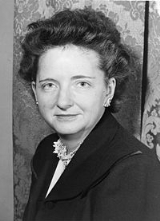
Elizabeth Bentley

 
Elizabeth Bentley

   Email Print
   Bookmark   Link


Elizabeth Bentley


Elizabeth Terrill Bentley (January 1, 1908 – December 3, 1963) was an American
United States

The United States of America is a Federal government constitutional republic comprising U.S. state and a federal district. The country is situated mostly in central North America, where its Contiguous United States and Washington, D.C., the Capital districts and territories, lie between the Pacific Ocean and Atlantic Oceans, Borders of the U...
 spy
Espionage

Espionage or spying involves an individual obtaining information that is considered secrecy or confidential without the permission of the holder of the information....
 for the Soviet Union
Soviet Union

The Union of Soviet Socialist Republics was a Constitution of the Soviet Union socialist state that existed in Eurasia from 1922 to 1991.The name is a translation of the , romanization of Russian Soyuz Sovetskikh Sotsialisticheskikh Respublik, abbreviated ????, SSSR....
 from 1938 until 1945. In 1945 she defected
Defection

In politics, a defector is a person who gives up allegiance to one state or political entity in exchange for allegiance to another. More broadly, it involves abandoning a person, cause or doctrine to whom or to which one is bound by some tie, as of allegiance or duty....
 from the Communist Party
Communist Party USA

The Communist Party of the United States of America is a Marxist-Leninist political party in the United States.The CPUSA is based in New York City, its newspaper, originally The Daily Worker, is today the People's Weekly World, and its monthly magazine is Political Affairs Magazine....
 and Soviet intelligence
Chronology of Soviet secret police agencies

The Soviet Union had a succession of secret police agencies over the course of its existence. The first secret police after the Russian Revolution of 1917, created by Vladimir Lenin's decree on December 20 1917, was called "Cheka" ....
 and became an informer for the U.S. She exposed two networks of spies, ultimately naming over 80 Americans who had engaged in espionage for the Soviets. When her testimony became public in 1948, it became a media sensation and had a major effect on the popular anti-communism
Anti-communism

Anti-communism is opposition to communism. Historically, the word communism has been used to refer to several types of communal social organization and their supporters, but, since the mid-19th century, the dominant school of communism in the world has been Marxism....
 of the McCarthy era
McCarthyism

McCarthyism is the politically motivated practice of making accusations of disloyalty, subversion, or treason without proper regard for evidence....
.

abeth Terrill Bentley was born in New Milford, Connecticut
New Milford, Connecticut

New Milford is a New England town in Litchfield County, Connecticut, Connecticut, United States in Upstate Connecticut north of Danbury, Connecticut, on the Housatonic River....
 to Charles Prentiss Bentley, a dry-goods merchant, and May Charlotte Turrill, a schoolteacher.


Discussion
Ask a question about 'Elizabeth Bentley'
Start a new discussion about 'Elizabeth Bentley'
Answer questions from other users
Full Discussion Forum


Recent Posts


Encyclopedia


Elizabeth Terrill Bentley (January 1, 1908 – December 3, 1963) was an American
United States

The United States of America is a Federal government constitutional republic comprising U.S. state and a federal district. The country is situated mostly in central North America, where its Contiguous United States and Washington, D.C., the Capital districts and territories, lie between the Pacific Ocean and Atlantic Oceans, Borders of the U...
 spy
Espionage

Espionage or spying involves an individual obtaining information that is considered secrecy or confidential without the permission of the holder of the information....
 for the Soviet Union
Soviet Union

The Union of Soviet Socialist Republics was a Constitution of the Soviet Union socialist state that existed in Eurasia from 1922 to 1991.The name is a translation of the , romanization of Russian Soyuz Sovetskikh Sotsialisticheskikh Respublik, abbreviated ????, SSSR....
 from 1938 until 1945. In 1945 she defected
Defection

In politics, a defector is a person who gives up allegiance to one state or political entity in exchange for allegiance to another. More broadly, it involves abandoning a person, cause or doctrine to whom or to which one is bound by some tie, as of allegiance or duty....
 from the Communist Party
Communist Party USA

The Communist Party of the United States of America is a Marxist-Leninist political party in the United States.The CPUSA is based in New York City, its newspaper, originally The Daily Worker, is today the People's Weekly World, and its monthly magazine is Political Affairs Magazine....
 and Soviet intelligence
Chronology of Soviet secret police agencies

The Soviet Union had a succession of secret police agencies over the course of its existence. The first secret police after the Russian Revolution of 1917, created by Vladimir Lenin's decree on December 20 1917, was called "Cheka" ....
 and became an informer for the U.S. She exposed two networks of spies, ultimately naming over 80 Americans who had engaged in espionage for the Soviets. When her testimony became public in 1948, it became a media sensation and had a major effect on the popular anti-communism
Anti-communism

Anti-communism is opposition to communism. Historically, the word communism has been used to refer to several types of communal social organization and their supporters, but, since the mid-19th century, the dominant school of communism in the world has been Marxism....
 of the McCarthy era
McCarthyism

McCarthyism is the politically motivated practice of making accusations of disloyalty, subversion, or treason without proper regard for evidence....
.

Early life

Elizabeth Terrill Bentley was born in New Milford, Connecticut
New Milford, Connecticut

New Milford is a New England town in Litchfield County, Connecticut, Connecticut, United States in Upstate Connecticut north of Danbury, Connecticut, on the Housatonic River....
 to Charles Prentiss Bentley, a dry-goods merchant, and May Charlotte Turrill, a schoolteacher. In 1915 her parents had moved to Ithaca, New York
Ithaca, New York

The City of Ithaca sits on the southern shore of Cayuga Lake, in Central New York New York State, USA. It is best known for being home to Cornell University ? an Ivy League school with almost 20,000 students ....
, and by 1920 the family had moved to McKeesport, Pennsylvania
McKeesport, Pennsylvania

McKeesport is a city in Allegheny County, Pennsylvania, Pennsylvania, United States, at the Confluence of the Monongahela River and Youghiogheny River Rivers and is part of the Pittsburgh Metro Area....
 and then to Rochester, New York
Rochester, New York

Rochester is a city in Monroe County, New York, New York State, south of Lake Ontario in the United States. The Rochester metropolitan area is the second largest economy in New York State, behind the New York City metropolitan area....
. Her parents were described as straight-laced old family Episcopalian New England
New England

New England is a region of the United States located in the northeastern corner of the country, bounded by the Atlantic Ocean, Canada and New York State, and consisting of the modern U.S....
ers.

She attended Vassar College
Vassar College

Vassar College is a private, coeducational, Liberal arts colleges in the United States situated in the town of Poughkeepsie , New York, New York, United States....
, graduating in 1930 with a degree in English, Italian, and French. In 1933, while she was attending graduate school at Columbia University
Columbia University

Columbia University in the City of New York , is a private university in the United States and a member of the Ivy League. Columbia's main campus lies in the Morningside Heights, Manhattan neighborhood in the borough of Manhattan, in New York City....
, she won a fellowship to the University of Florence
University of Florence

The University of Florence is one of the largest and oldest university in Italy. It consists of 12 facultiesand has currently about 60,000 students enrolled....
. While in Italy, she briefly joined a local student Fascist group, the Gruppo Universitate Fascisti. Under the influence of her anti-Fascist faculty advisor Mario Casella, with whom she had an affair, she soon moved to the opposite end of the political spectrum, however. While completing her Masters degree at Columbia University, she attended meetings of the American League Against War and Fascism
American League Against War and Fascism

The American League Against War and Fascism was a Comintern affiliate organization formed in 1933 by CPUSA and Pacifism united by their concern as Nazism and Fascism rose in Europe....
, a Communist front
Communist front

Communist Front was originally the term used by the Communist Party of the United States , and then later by the House Committee on Un-American Activities and the Senate Internal Security Subcommittee to label Comintern organizations found to be under the effective control of the , with special emphasis on those groups most active during th...
 group. Although she would later state that she found Communist literature unreadable and "dry as dust," she was attracted by the sense of community and social conscience she found with her friends in the league. When she learned that most of them were members of the Communist Party of the United States (CPUSA), she joined the party herself in March 1935.

Espionage activity

Bentley's entry into espionage came at her own initiative. In 1938 she obtained a job at the Italian Library of Information in New York City
New York City

The City of New York is the List of United States cities by population in the United States, while the New York metropolitan area ranks among the List of urban areas by population....
; an organization that was fascist Italy's propaganda bureau in the United States. She then reported to CPUSA headquarters, telling them of her willingness to spy on the fascists. The Communists were interested in the information Bentley could provide, and NKVD
NKVD

The NKVD or People's Commissariat for Internal Affairs was the leading secret police organization of the Soviet Union that was responsible for Soviet political repressions during the Stalinism era....
 officer Jacob Golos
Jacob Golos

Jake Golos , was a Ukraina-born Bolshevik revolutionary and Soviet secret police operative in the USSR and of Jewish heritage. He was also a longtime senior official of the Communist Party of the United States of America involved in covert work and cooperation with Soviet intelligence agencies....
 was assigned to be her contact and controller. Golos was a Russia
Russia

Russia , or the Russian Federation , is a list of countries spanning more than one continent country extending over much of northern Eurasia....
n émigré
Émigré

?migr? is a French language term that literally refers to a person who has "migrated out," but often carries a connotation of politico-social self-exile....
 who had been a naturalized United States citizen since 1915.

At this point, Bentley thought she was spying solely for the American Communist Party. In fact, Golos was one of the Soviet Union's most important intelligence agents in the United States. At the time when he and Bentley met, Golos was involved in planning the assassination of Leon Trotsky
Leon Trotsky

Leon Trotsky , born Lev Davidovich Bronstein , was a Bolshevik revolutionary and Marxism theorist. He was one of the leaders of the Russian October Revolution, second only to Lenin....
, which would take place in Mexico
Mexico

The United Mexican States , commonly known as Mexico , is a federalism constitutionalism republic in North America. It is bordered on the north by the United States; on the south and west by the Pacific Ocean; on the southeast by Guatemala, Belize, and the Caribbean Sea; and on the east by the Gulf of Mexico....
 in 1940. Bentley and Golos soon became lovers, although it would be more than a year before she learned his true name, and, according to her later testimony, two years before she knew that he was working for Soviet intelligence.

In 1940, two years into their relationship, the Justice Department
United States Department of Justice

The United States Department of Justice is a United States Cabinet department in the United States government of the United States designed to enforce the law and defend the interests of the United States according to the law and to ensure fair and impartial administration of justice for all Americans ....
 forced Golos to register as an agent of the Soviet government under the Foreign Agents Registration Act
Foreign Agents Registration Act

The Foreign Agents Registration Act is a United States law passed in 1938 requiring information from foreign sources to be properly identified to the American public....
. This made it dangerous for him to contact and take documents from the network of American spies he controlled, and he gradually transferred this responsibility to Bentley. Golos also needed someone to take charge of the day to day business of the United States Service and Shipping Corporation, a Comintern
Comintern

The 'Comintern' was an international Communism organization founded in Moscow in March 1919. The International intended to fight "by all available means, including armed force, for the overthrow of the international bourgeoisie and for the creation of an international Soviet republic as a transition stage to the complete abolition of the Sta...
 front organization for espionage activities. Bentley stepped into this role as well. Although she was never directly paid for any of her espionage work, she would eventually earn $800 a month as vice president of U.S. Service and Shipping, a considerable salary for the time. As Bentley acquired an important role in Soviet intelligence, the Soviets gave her the code name Umnitsa, loosely translated as "clever girl" or "Miss Wise." (In some literature it is less correctly translated as "good girl".)

The Silvermaster group

Most of Bentley's contacts were in what prosecutors and historians would later call the "Silvermaster group," a network of spies centered around Nathan Gregory Silvermaster that would become one of the most important Soviet espionage operations in the United States. Silvermaster worked with the Resettlement Administration
Resettlement Administration

The Resettlement Administration was a U.S. federal agency that, between April 1935 and December 1936, relocated struggling urban and rural families to communities planned by the federal government....
 and later with the Board of Economic Warfare
Board of Economic Warfare

The Office of Administrator of Export Control was established in the United States by Presidential Proclamation 2413, July 2 1940, to administer export licensing provisions of the act of July 2 1940 ....
. He didn't have access to much sensitive information himself, but he knew several Communists and sympathizers within the government who were willing to pass information to him, and by way of Elizabeth Bentley, ultimately to Moscow. At this time, the Soviet Union and the United States were allies in the Second World War
World War II

World War II, or the Second World War , was a global military conflict which involved a Participants in World War II, including all of the great powers, organised into two opposing military alliances: the Allies of World War II and the Axis powers....
, and much of the information Silvermaster collected for the Soviets had to do with the war against Nazi Germany
Nazi Germany

Nazi Germany and the Third Reich are the colloquial English names for Germany under the regime of Adolf Hitler and the Nazi Party , which established a Totalitarianism dictatorship that existed from 1933 to 1945....
. It included secret estimates of German military strength, data on U.S. munitions production, and information on the Allies' schedule for opening a second front in Europe
Battle of Normandy

The Invasion of Normandy was the invasion and establishment of Western Allies forces in Normandy, France, during Operation Overlord in World War II....
. The contacts in Golos and Bentley's extended network ranged from dedicated Stalinists
Stalinism

File:Joseph Stalin.jpgStalinism is a term that purportedly describes the political system of the Soviet Union under the leadership of Joseph Stalin, leader of the Soviet Union from 1929?1953....
 to, in the words of Bentley's biographer Kathryn Olmsted, "romantic idealists" who "wanted to help the brave Russians beat the Nazi war machine."

Conflicts with Soviet spymasters

Late in 1943, Jacob Golos suffered a fatal heart attack. After meeting with CPUSA General Secretary
General secretary

The term General Secretary denotes a leader of various unions, parties, churches or associations. The most notable usages are the following:...
  Earl Browder
Earl Browder

Earl Russell Browder was an United States communist and General Secretary of the Communist Party USA from 1934 to 1945. He was expelled from the party in 1946....
, Bentley decided to continue her espionage work, taking Golos's place. Her new contact in Soviet intelligence was Iskhak Akhmerov
Iskhak Akhmerov

Iskhak Abdulovich Akhmerov was a Soviet Union spy of Tatar ethnicity who joined the Bolshevik Party in 1919. Akhmerov attended the Communist University of Toilers of the East and the Moscow State University, where he graduated from the School of International Relations in 1930....
, the leading NKGB "Illegal Rezident," or undercover spy chief working without a diplomatic cover. Under orders from Moscow, Akhmerov wanted to have Bentley's contacts report directly to him. Bentley, Browder and Golos had been resisting this move, believing that an American intermediary was the best way to handle their sources, and fearing that Russian agents would endanger the American spies and possibly drive them away. With Browder's support, Bentley initially ignored a series of orders that she "hand over" her agents to Akhmerov. Indeed, she expanded her spy network when Browder gave her control over another group of agents. This was the "Perlo group
Perlo group

Headed by Victor Perlo, the Perlo group is the name given to a group of United States who provided information which was given to Soviet Union intelligence agencies; it was active during the World War II period, until the entire group was exposed to the FBI by the defection of Elizabeth Bentley....
," with contacts in the War Production Board
War Production Board

The War Production Board was established as a government agency on January 16, 1942 by executive order of Franklin D. Roosevelt. The purpose of the board was to regulate the production and allocation of materials and fuel during World War II in the United States....
, the United States Senate
United States Senate

The United States Senate is the upper house of the Bicameralism United States Congress, the lower house being the United States House of Representatives....
 and the Treasury Department
United States Department of the Treasury

The Department of the Treasury is an United States federal executive departments and the treasury of the United States Federal government of the United States....
.

Bentley had been noted as suffering from bouts of depression and having a drinking problem since her days in Florence
Florence

Florence is the Capital city of the Italy Regions of Italy of Tuscany and of the provinces of Italy Province of Florence. It is the most populous city in Tuscany and has a population of 364,779 ....
. Now, despondent and lonely after the death of Golos and under increasing pressure from Soviet intelligence, she began to drink more heavily. She missed work at U.S. Service and Shipping, and neighbors described her as drinking "all the time."

In early June 1944, Browder gave in to Akhmerov's demands and agreed to instruct the Silvermaster group to report directly to the NKGB. After her defection, Bentley would describe this as the event that turned her against Communism. "I discovered then that Earl Browder was just a puppet, that somebody pulled the strings in Moscow," she would say. Her biographers suggest that Bentley's objections, rather than being ideological, were more a life-long dislike for being given orders and a sense that the reassignments left her with no meaningful role. Late in 1944 Bentley was ordered to give up all of her remaining sources, including the Perlo group she had recently acquired. Her Soviet superiors also told her she would have to leave her position as vice president of U.S. Service and Shipping.

Breaking with the Soviets

Things did not improve for Bentley in 1945. She began an affair with a man whom she came to suspect was either an FBI or a Soviet agent sent to spy on her, and her Soviet contact suggested that she should emigrate to the Soviet Union--a move Bentley feared would end with her execution. In August 1945, Bentley went to the FBI office in New Haven, Connecticut
New Haven, Connecticut

New Haven is the third largest municipality in Connecticut, after Bridgeport, Connecticut and Hartford, with a core population of about 124,000 people....
 and met with the agent in charge. She did not immediately defect, however. Instead she seemed to be "feeling out" the FBI, and it would not be until November that she began to tell her full story to the FBI. In the meantime, her situation continued to worsen. In September she met with Anatoly Gorsky
Anatoly Gorsky

Anatoly Veniaminovich Gorsky , was a Chronology of Soviet secret police agencies espionage who, under cover as First Secretary "Anatoly Borisovich Gromov" of the Soviet Embassy in Washington, was secretly rezident in the United States at the end of World War II....
, her latest NKGB controller, and arrived at the meeting drunk. She became angry with Gorsky, called him and his fellow Russian agents "gangsters," and obliquely threatened to become an informer. She soon realized that her tirade could have put her life in danger, and in fact when Gorsky reported to Moscow his recommendation was to "get rid of her."

Moscow advised Gorsky to be patient with Bentley and calm her down. Only a few weeks later it was revealed that Louis Budenz, editor of the CPUSA newspaper and one of Bentley's sources, had defected. Budenz had not yet revealed any of his knowledge of espionage activity, but he knew Elizabeth Bentley's name and knew she was a spy. Imperiled on both sides, Bentley made her final decision to defect on November 6, 1945.

Defection and after

In a series of debriefing interviews with the FBI beginning November 7, 1945, Bentley implicated close to 150 people in spying for the Soviet Union, including 37 federal employees. The FBI already suspected many of those she named, and some of them had been named by earlier defectors Igor Gouzenko
Igor Gouzenko

Igor Sergeyevich Gouzenko was a cipher clerk for the Embassy of the Russian Federation in Canada in Ottawa, Ontario. He defector on September 5, 1945 with 109 documents on Soviet espionage activities in the West....
 and Whittaker Chambers
Whittaker Chambers

Whittaker Chambers , born Jay Vivian Chambers and also known as David Whittaker, was an American writer and editor. A Communist party member and Soviet Union spy, he renounced communism and became an outspoken opponent....
, so the FBI was fairly confident that her story was genuine. They gave her the code name "Gregory," and J. Edgar Hoover
J. Edgar Hoover

John Edgar Hoover , generally known as J. Edgar Hoover, was the first Director of the Federal Bureau of Investigation of the Federal Bureau of Investigation of the United States....
 ordered the strictest secrecy measures be taken to hide her identity and defection. Hoover advised Sir William Stephenson, head of British Security Coordination for the Western hemisphere, of Bentley’s defection, and Stephenson duly notified London. Unfortunately, the head of the British Secret Intelligence Service's (SIS or "MI6") new Section IX (counter-espionage against the Soviet Union), was the Soviet double agent Kim Philby
Kim Philby

Harold Adrian Russell "Kim" Philby or H.A.R. Philby , was a high-ranking member of British military intelligence. A socialism, he served as an NKVD and KGB operative....
, who would flee to the Soviet Union in 1963. Philby promptly alerted Moscow, which immediately shut down all contact with Bentley's people, just as the FBI was beginning surveillance of them. Bentley's NKGB contact Gorsky once again recommended to Moscow that she be "liquidated", and again Moscow rejected the idea.

The breach of secrecy around Bentley's defection foiled a year-long attempt by the FBI to have her act as a double agent
Double agent

"Double agent" is a counterintelligence term for someone who pretends to spy on a target organization on behalf of a controlling organization, but in fact is loyal to the target organization....
. Additionally, because of the shutdown of Soviet espionage activity, the FBI surveillance of the agents Bentley had named turned up no evidence that could be used to prosecute them. Some 250 FBI agents were assigned to the Bentley case, following up the leads she had provided and, through phone tap, surveillance and mail openings, investigating people she had named. The FBI, grand juries and congressional committees would eventually interview many of these alleged spies, but all of them would either invoke their Fifth Amendment
Fifth Amendment to the United States Constitution

The Fifth Amendment of the United States Constitution, which is part of the United States Bill of Rights, protects against abuse of government authority in a legal procedure....
 right not to testify or maintain their innocence.

For J. Edgar Hoover
J. Edgar Hoover

John Edgar Hoover , generally known as J. Edgar Hoover, was the first Director of the Federal Bureau of Investigation of the Federal Bureau of Investigation of the United States....
 and a few highly placed FBI and army intelligence personnel, the definitive corroboration of Bentley's story came some time in the late 1940s to early 1950s, when the highly secret Venona project
Venona project

The Venona project was a long-running and highly secret collaboration between intelligence agencies of the United States and United Kingdom that involved the cryptanalysis of messages sent by several Chronology of Soviet secret police agencies of the Soviet Union, mostly during World War II....
 succeeded in decrypting some wartime cables sent between Soviet intelligence agents and Moscow. In these cables, Bentley was referred to by the codename she told to the FBI, and several of her contacts and documents she had collected were discussed. However, Venona was considered so secret that Hoover was unwilling to expose it by allowing it to be used as evidence in any trial. In fact, even presidents Roosevelt and Harry Truman were unaware of Venona; when Hoover delivered intelligence reports based on Venona data, the source of the information was not named.

Public testimony

With the chances of successful prosecution looking unlikely, Hoover chose to give Bentley's information to certain U.S. Congressmen with the understanding that the accused spies would be questioned before congressional committees, and the publicized suspicion and accusations would be sufficient to ruin their careers. Additionally, Attorney General
United States Attorney General

The United States Attorney General is the head of the United States Department of Justice concerned with legal affairs and is the chief law enforcement officer of the government of the United States....
 Tom C. Clark
Tom C. Clark

Thomas Elizabeth Clark was United States Attorney General from 1945 to 1949 and an Associate Justice of the Supreme Court of the United States ....
 decided to present the Bentley case to a grand jury
Grand jury

In the common law, a grand jury is a type of jury that determines whether there is enough evidence for a Criminal procedure. Grand juries carry out this duty by examining evidence presented to them by a prosecutor and issuing indictments, or by investigating alleged crimes and issuing Wiktionary:presentments....
, although he thought there was little chance they would be able to return any indictments. Bentley's appearances before this grand jury lasted until April 1948, and during this time, some details of her case began to leak to the press. It was Bentley herself who decided to reveal the full story, however. She met with reporters for the New York World-Telegram
New York World-Telegram

The New York World-Telegram, later known as the New York World-Telegram and Sun, was a New York City newspaper from 1931 to 1966....
, and in July 1948 the paper carried a series of front page stories about the "beautiful young blonde" who had exposed a ring of spies (the initial articles included no picture of Bentley). Almost immediately, Bentley was subpoenaed to testify at a public hearing of the House Un-American Activities Committee
House Un-American Activities Committee

The House Committee on Un-American Activities was an investigative United States Congressional committee of the United States House of Representatives....
 (HUAC).

Descriptions and analyses of Bentley's testimony varied wildly with the politics of the reporter. The strongly anti-communist New York Journal-American described her as a "shapely" "blonde and blue-eyed New Yorker" who "lured" secrets from her sources, while A. J. Liebling
A. J. Liebling

Abbott Joseph Liebling was an United States journalist who was closely associated with The New Yorker from 1935 until his death....
 of The New Yorker
The New Yorker

The New Yorker is an United States magazine that publishes reportage, commentary, criticism, essays, fiction, satire, cartoons, and poetry. Starting as a weekly in the mid-1920s, the magazine is now published 47 times per year, with five of these issues covering two-week spans....
 ridiculed her story and called her the "Nutmeg Mata Hari
Mata Hari

Mata Hari was the stage name of Margaretha Geertruida "Grietje" Zelle , a the Netherlands-Frisians exotic dancer and courtesan who was Execution by firing squad for espionage during World War I....
." For her part, Bentley portrayed herself as naïve and innocent; corrupted by her liberal professors at Vassar and seduced into espionage by Golos.

At the HUAC hearings, Bentley received some corroboration from Whittaker Chambers
Whittaker Chambers

Whittaker Chambers , born Jay Vivian Chambers and also known as David Whittaker, was an American writer and editor. A Communist party member and Soviet Union spy, he renounced communism and became an outspoken opponent....
. Although at this time he was denying any knowledge of espionage activity, he claimed to know that two Bentley contacts, Victor Perlo and Charles Kramer, were Communists. He also supported her charge that Harry Dexter White
Harry Dexter White

Harry Dexter White was an United States economist and senior U.S. Department of Treasury official. He was a primary mover behind the Bretton Woods conference and the formation of the International Monetary Fund and the World Bank....
, a prominent economist who had worked in the Treasury Department
United States Department of the Treasury

The Department of the Treasury is an United States federal executive departments and the treasury of the United States Federal government of the United States....
, was a Communist sympathizer. Still there was considerable skepticism in some quarters about Bentley's claims. Since some of those she accused were prominent figures in two Democratic administrations, Democrats in particular were eager to have her discredited. President Truman at one point characterized her testimony as a Republican-inspired "red herring." Republicans, in turn, accused Truman of "covering up" Communist espionage. Conflicts of this nature, along with the increasingly publicized hearings of HUAC, were setting the stage for McCarthyism
McCarthyism

McCarthyism is the politically motivated practice of making accusations of disloyalty, subversion, or treason without proper regard for evidence....
, which would become a central factor in domestic American politics in the 1950s.

Trials and credibility

Most of the people accused by Bentley invoked the Fifth Amendment and refused to answer her charges. A few, however, specifically denied them. Most notable of these was Harry Dexter White
Harry Dexter White

Harry Dexter White was an United States economist and senior U.S. Department of Treasury official. He was a primary mover behind the Bretton Woods conference and the formation of the International Monetary Fund and the World Bank....
. White was suffering from heart disease, and he died of a heart attack a few days after his testimony before HUAC. Others who denied Bentley's charges were Lauchlin Currie
Lauchlin Currie

Lauchlin Bernard Currie was a Canada-born U.S.economist from New Dublin, Nova Scotia, Canada, and allegedly an agent of espionage for the Soviet Union....
, formerly President Roosevelt's economic affairs advisor, William Remington
William Remington

William Walter Remington was an economist employed in various federal government positions until his career was interrupted by accusations of espionage made by the Soviet Union spy and defector Elizabeth Bentley....
 and William Henry Taylor
William Henry Taylor

William Henry Taylor was a Canadian-born US Treasury economist accused by Elizabeth Bentley of having been a Soviet spy....
, both midlevel government economists, Duncan Lee
Duncan Lee

Lt. Col. Duncan Chaplin Lee was confidential assistant to William Joseph Donovan, founder and director of the Office of Strategic Services , World War II-era predecessor of the CIA, during 1942-46....
, formerly with the Office of Strategic Services
Office of Strategic Services

The Office of Strategic Services was a United States intelligence agencies formed during World War II. It was the wartime intelligence agency, and it was the predecessor of the Central Intelligence Agency ....
 (OSS) and Abe Brothman, a private sector chemist who worked on defense projects. In September 1948, William Remington sued Bentley and NBC for libel. In hopes of discrediting her, Remington's attorneys hired private detectives to look into her past. They were able to produce evidence of her alcoholism, her periods of severe depression and a suicide attempt while a student in Florence, that her master's thesis had been written by someone else, and that, by the standards of her day, she had been sexually promiscuous since her college days. Bentley declined to testify at a Remington loyalty board hearing, and NBC settled the libel case out of court for $10,000.

Bentley would give testimony in the trials of three accused spies: The perjury
Perjury

Category:Limited geographic scopeCategory:USA-centricPerjury, also known as forswearing, is the willful act of swearing a false oath or Affirmation in law to tell the truth, whether spoken or in writing, concerning matters material to a judicial proceeding....
 trial of William Remington, a case against Abe Brothman for obstruction of justice
Obstruction of justice

The crime of obstruction of justice includes crimes committed by judges, prosecutors, Attorney General, and elected officials in general. It is misfeasance, malfeasance or nonfeasance in the conduct of the office....
, and the famous case of the "atomic spies" Julius and Ethel Rosenberg
Julius and Ethel Rosenberg

Julius Rosenberg and Ethel Greenglass Rosenberg were American communists who were executed after having been found guilty of conspiracy to commit espionage....
. Bentley's involvement with the Rosenberg case was peripheral. She was used to develop two points for the prosecution: first, the proclivity of American Communists to be spies for the Soviet Union; and second, to establish, if only vaguely in the jury's mind, a connection between Julius Rosenberg and Golos. She testified that she would receive calls from a man who identified himself as Julius, after which Golos would go out to meet him.

Bentley's personal life became increasingly tumultuous after her defection. She continued to drink heavily, was involved in car accidents and had a relationship with a man who beat her severely. She also avoided subpoenas on a number of occasions. These incidents, along with generally erratic behavior, led her FBI handlers to worry that she was "bordering on some mental pitfall". Nevertheless, she was invariably calm and professional on the witness stand, earning praise from the prosecutors whose cases she was supporting. As she repeatedly testified before grand juries, congressional committees and jury trials, however, some details of her story became embellished over time. Information passed to her about a process for manufacturing synthetic rubber that was originally "vague" and "probably of no value" became "super-secret" and "an extremely complicated thing." She would also assert that her espionage gave her advance notice of the Doolittle raid
Doolittle Raid

The Doolittle Raid, 18 April 1942, was the first airstrike by the United States to strike a Japanese home island during World War II. It demonstrated that Japan itself was vulnerable to Allies of World War II air attack and provided an expedient means for U.S....
 on Japan and the D-Day
Battle of Normandy

The Invasion of Normandy was the invasion and establishment of Western Allies forces in Normandy, France, during Operation Overlord in World War II....
 invasions, both claims that appeared to be exaggerated.

Occupation Currency Plates

Bentley also testified that Harry Dexter White
Harry Dexter White

Harry Dexter White was an United States economist and senior U.S. Department of Treasury official. He was a primary mover behind the Bretton Woods conference and the formation of the International Monetary Fund and the World Bank....
 was responsible for passing treasury plates for printing Allied currency in occupied Germany to the Soviet Union, which then used them to print millions of Marks
German mark

The Deutsche Mark or German mark was the official currency of West Germany and, from 1990 until the adoption of the euro, all of unified Germany....
. Russian soldiers exchanged these Marks for goods and hard currency, sparking a black market and serious inflation throughout the occupied country, and costing the U.S. a quarter of a billion dollars.

Bentley wrote in her 1951 autobiography that she had been "able through Harry Dexter White to arrange that the United States Treasury Department turn the actual printing plates over to the Russians." In her 1953 testimony before Joseph McCarthy
Joseph McCarthy

Joseph Raymond McCarthy was an United States politician who served as a Republican Party United States Senate from the state of Wisconsin from 1947 until his death in 1957....
's Senate subcommittee, she elaborated, testifying that she was following instructions from NKVD New York rezident Iskhak Abdulovich Akhmerov to pass word through Ludwig Ullmann and Nathan Gregory Silvermaster for White to “put the pressure on for the delivery of the plates to Russia.”

Bentley had not previously mentioned this in any of her earlier debriefings or testimonies, and there was no evidence at the time that Bentley had any role in this transfer. Bentley biographer Kathryn Olmsted concluded that Bentley was "lying about her role in the scandal", citing historian Bruce Craig's conclusion "that the whole 'scheme' was a complete fabrication"; i.e., that neither Bentley nor Harry Dexter White had a role in the plate transfer.

After the publication of Olmsted's biography, Bentley's testimony in this matter would be corroborated by a memorandum found in Soviet archives and published in 2002. In it, Gaik Ovakimian
Gaik Ovakimian

Haik Badalovich Ovakimian , Major General, USSR , better known as "the puppetmaster" in intelligence circles, was a leading Soviet NKVD spy in the United States....
, head of the American desk of the NKVD cites an April 14, 1944 report reporting that, "following our instructions" via Silvermaster, White had "attained the positive decision of the Treasury Department to provide the Soviet side with the plates for engraving German occupation marks." Since Bentley was the Soviet's contact to Silvermaster at this time, her involvement in this incident is substantiated.

Later life and death

After her defection, calls to give evidence before various bodies would be a fixture in Bentley's life for many years. Occasional consultations with the FBI would continue for the rest of her life. Though she had been a successful executive with a profitable shipping company while she was with the Communists, after her defection she earned a living first through secretarial work and then at a variety of teaching jobs.

Bentley died on December 3 1963, aged 55, from abdominal cancer
Cancer

Cancer is a class of diseases in which a group of cell display uncontrolled growth , invasion , and sometimes metastasis . These three malignant properties of cancers differentiate them from benign tumors, which are self-limited, do not invade or metastasize....
 at Grace-New Haven Hospital in New Haven, Connecticut
New Haven, Connecticut

New Haven is the third largest municipality in Connecticut, after Bridgeport, Connecticut and Hartford, with a core population of about 124,000 people....
. Obituaries appeared in the New York Times and the Washington Post. However, in her biography of Bentley, Kathryn Olmsted notes a sharp contrast between the notice paid to Bentley's death and that of Whittaker Chambers
Whittaker Chambers

Whittaker Chambers , born Jay Vivian Chambers and also known as David Whittaker, was an American writer and editor. A Communist party member and Soviet Union spy, he renounced communism and became an outspoken opponent....
, who had died two years earlier. The National Review
National Review

National Review is a biweekly magazine and web site, founded by the late author William F. Buckley, Jr. in 1955 and based in New York City....
, which had put out a special memorial issue on the death of Chambers, allotted only a paragraph to Elizabeth Bentley. Time magazine had devoted two pages to its Chambers obituary, but gave Bentley's death a two-sentence mention in its "Milestones" section.

In the 1990s the Venona transcripts and some Soviet intelligence archives were made available. With these revelations there was finally a definitive and public verification of the basics of Bentley's story, and also a new appreciation of the impact her defection had on Soviet espionage in the United States.

People named by Bentley

Among the individuals named by Bentley are:
  • Frank Coe
    Frank Coe

    Virginius Frank Coe was a United States government official who was identified by Soviet defectors Elizabeth Bentley and Whittaker Chambers as being an underground member of the Communist Party USA...
    , Department of the Treasury
    Department of the Treasury

    Several countries have a Department of the Treasury. These departments include:* Department of the Treasury * United States Department of the Treasury...
    , Secretary of the International Monetary Fund
    International Monetary Fund

    The International Monetary Fund is an international organization that oversees the global financial system by following the macroeconomic policies of its member countries, in particular those with an impact on exchange rates and the balance of payments....
  • Rae Elson
    Rae Elson

    Rae Elson, also Ray Elson was employed in the Civil Rights Committee in New York City in the 1930s and was a very active dues paying member of the Communist Party of the United States ....
    , an active Communist, and courier of the CPUSA underground, was chosen by Joseph Katz
    Joseph Katz

    Joseph Katz allegedly worked for Chronology of Soviet secret police agencies from the 1930s to the late 1940s as one of its most active liaison agents....
     to replace Bentley at the Soviet front organization, U.S. Shipping and Service Corporation
  • Frederick Vanderbilt Field
    Frederick Vanderbilt Field

    Frederick Vanderbilt Field was a great-great-grandson of railroad tycoon Cornelius Vanderbilt who became a specialist on Asia, worked for the Institute of Pacific Relations, and supported so many openly Communist organizations that he was accused of being a member of the Communist Party USA....
    , Executive Secretary American Peace Mobilization
    American Peace Mobilization

    The American Peace Mobilization was a Communist front group, officially cited in 1947 by United States Attorney General Tom C. Clark on the Attorney General's List of Subversive Organizations for 1948, as directed by President Harry S....
  • Michael Greenberg
    Michael Greenberg

    Michael Greenberg was a scholar of Chinese economics and Chinese history. He was alleged to have provided a Soviet spy with information during the 1940s, but was never charged with espionage....
    , Board of Economic Warfare
    Board of Economic Warfare

    The Office of Administrator of Export Control was established in the United States by Presidential Proclamation 2413, July 2 1940, to administer export licensing provisions of the act of July 2 1940 ....
    ; Administrative Division, Enemy Branch, Foreign Economic Administration; United States Department of State
  • Joseph Gregg, Office of the Coordinator of Inter-American Affairs; United States Department of State
  • Maurice Halperin
    Maurice Halperin

    Maurice Hyman Halperin was an United States writer, professor, diplomat, and Soviet Union spy ....
    , Office of Strategic Services
    Office of Strategic Services

    The Office of Strategic Services was a United States intelligence agencies formed during World War II. It was the wartime intelligence agency, and it was the predecessor of the Central Intelligence Agency ....
     (OSS), and later advisor to Secretary of State Dean Acheson
    Dean Acheson

    Dean Gooderham Acheson was an American statesman and lawyer; as United States Secretary of State in the administration of President Harry S. Truman during 1949?1953, he played a central role in defining American foreign policy during the Cold War....
     and advisor to the United Nations
    United Nations

    The United Nations is an international organization whose stated aims are to facilitate cooperation in international law, international security, economic development, Social change, human rights and achieving world peace....
    .
  • Alger Hiss
    Alger Hiss

    Alger Hiss was a United States Department of State official involved in the establishment of the United Nations. He was accused of being a Soviet Union spy in 1948 and convicted of perjury in connection with this charge in 1950....
    , a U.S. State Department official involved in the establishment of the United Nations, whom she identified as "Eugene Hiss."
  • Irving Kaplan
    Irving Kaplan

    Irving Kaplan was an official of the United States government accused of involvement in Soviet espionage. He worked with David Weintraub in the Works Progress Administration's National Research Project, later moving to the Department of the Treasury, the War Production Board , and the Foreign Economic Administration....
    , United States Department of the Treasury Foreign Economic Administration; United Nations Division of Economic Stability and Development; Chief Advisor to the Military Government of Germany
    Allied Military Government for Occupied Territories

    The Allied Military Government for Occupied Territories was the form of military rule administered by Allied forces during and after World War II within European territories they occupied....
  • Charles Kramer
    Charles Kramer

    Charles Kramer, originally Charles Krevisky, was an American economist who worked for U.S. President Franklin D. Roosevelt as part of his brain trust....
    , Senate Subcommittee on War Mobilization; Office of Price Administration; National Labor Relations Board; Senate Subcommittee on Wartime Health and Education; Agricultural Adjustment Administration; Civil Liberties Subcommittee, Senate Committee on Education and Labor; Senate Labor and Public Welfare Committee; Democratic National Committee
    Democratic National Committee

    The Democratic National Committee is the principal organization governing the Democratic Party on a day to day basis. While it is responsible for overseeing the process of writing a platform every four years, the DNC's central focus is on campaign and political activity in support of Democratic Party candidates, and not on public policy....
  • Bernice Levin
    Bernice Levin

    Bernice Levin was identified by Elizabeth Bentley as a source within the Office of Emergency Management and the Office of Production Management during World War II for information for Soviet intelligence....
    , Office of Emergency Management; Office of Production Management
  • Harry Magdoff
    Harry Magdoff

    Henry Samuel Magdoff , was a prominent American socialism commentator. He held several administrative positions in government during the President of the United States of Franklin D....
    , Chief of the Control Records Section of War Production Board
    War Production Board

    The War Production Board was established as a government agency on January 16, 1942 by executive order of Franklin D. Roosevelt. The purpose of the board was to regulate the production and allocation of materials and fuel during World War II in the United States....
     and Office of Emergency Management; Bureau of Research and Statistics, WTB; Tools Division, War Production Board; Bureau of Foreign and Domestic Commerce, United States Department of Commerce; Statistics Division Works Progress Administration
    Works Progress Administration

    The Works Progress Administration was the largest New Deal agency, employing millions of people and affecting almost every locality in the United States, especially rural and western mountain populations....
  • Jenny Levy Miller
    Jenny Levy Miller

    Jenny Miller, nee Jenny Levy was an United States journalist. With her husband, Robert Miller , she is alleged to have participated in covert espionage activities for the Soviet Union during the Stalinist period....
    , Chinese Government Purchasing Commission
  • Robert Talbott Miller, Office of the Coordinator of Inter-American Affairs; Near Eastern Division United States Department of State
  • Willard Zerbe Park, Assistant Chief of the Economic Analysis Section, Office of the Coordinator of Inter-American Affairs; United Nations Relief and Rehabilitation Administration
  • Victor Perlo
    Victor Perlo

    Victor Perlo was a Marxism economist and a longtime member of the national committee of the Communist Party USA....
    , chief of the Aviation Section of the War Production Board; head of branch in Research Section, Office of Price Administration Department of Commerce; Division of Monetary Research Department of Treasury; Brookings Institution
  • Mary Price
    Mary Price

    Mary Wolfe Price was an American who was accused of being a spy for the Soviet Union....
    , onetime secretary for Walter Lippmann
    Walter Lippmann

    Walter Lippmann was an influential United States award-winning writer, journalist, and political commentator. Lippman was the recipient of the Pulitzer Prize in 1958 and 1962 for his syndicated newspaper column, "Today and Tomorrow"....
  • Bernard Redmont
    Bernard Redmont

    Bernard Sidney Redmont obtained an M.S. form the Columbia University Graduate School of Journalism in 1939 and was awarded the school?s highest honor, Pulitzer Traveling Fellowship....
    , head of the Foreign News Bureau Office of the Coordinator of Inter-American Affairs
  • William Walter Remington, War Production Board; Office of Emergency Management
  • George Silverman
    George Silverman

    Abraham George Silverman graduated from Harvard University and was considered a brilliant mathematician and statistician....
    , Civilian Chief of Analysis and Plans with the Army Air Forces at the Pentagon.
  • Nathan Gregory Silvermaster
  • William Taylor
    William Henry Taylor

    William Henry Taylor was a Canadian-born US Treasury economist accused by Elizabeth Bentley of having been a Soviet spy....
    , Assistant Director of Monetary Research, United States Department of Treasury
  • William Ludwig Ullmann
  • David Weintraub
    David Weintraub

    David Weintraub was an official of the government of the United States. In the mid-1930s he headed the New Deal Works Project Administration's National Research Project....
    , United States Department of State; head of the Office of Foreign Relief and Rehabilitation Operations; United Nations Relief and Rehabilitation Administration (UNRRA); United Nations Division of Economic Stability and Development


Biographies

Currently, two biographies of Elizabeth Bentley have been published:

External links


  • Truman Presidential Library