


Elgin, Moray

Encyclopedia
Elgin is a former cathedral city and Royal Burgh
in Moray
, Scotland
. It is the administrative and commercial centre for Moray. The town originated to the south of the River Lossie
on the higher ground above the flood plain. Elgin is first documented in the Cartulary of Moray in 1190. It was created a Royal Burgh in the 12th century by King David I of Scotland
and by that time had a castle on top of the present day Lady Hill to the west of the town.
army defeated and killed Duncan I
at Bothganowan (Pitgaveny), near Elgin. Elgin is first recorded in a charter of David I
in 1151 in which he granted an annuity to the Priory of Urquhart. David had made Elgin a royal burgh around 1130, after his defeat of Óengus of Moray
. During David's reign the castle was established at the top of what is now Lady Hill. The town received a royal charter from Alexander II
in 1224 when he granted the land for a new cathedral
to Andrew, Bishop of Moray
. This finally settled the episcopal see which had been at various times at Kinneddar, Birnie and Spynie
. Elgin was a popular residence for the early Scottish
monarchs: David I
, William I
, Alexander II
and Alexander III
all held court there and hunted in the royal forests.
Of these kings, Alexander II was Elgin's greatest benefactor and returned many times to his royal castle. He established the two religious houses of the town, the Dominicans
or Blackfriars in the west side and the Franciscans or Greyfriars in the east. Further to the east stood the Hospital of Maison Dieu, or House of God, also founded during the reign of Alexander II for the reception of poor men and women.
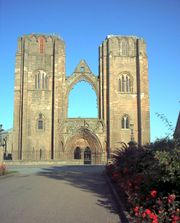 On 19 July 1224, the foundation stone of the new Elgin Cathedral
was ceremoniously laid. The cathedral was completed sometime after 1242 but was completely destroyed by fire in 1270. The reasons for this are unrecorded. The buildings which now remain as ruins date from the reconstruction following that fire. The Chartulary of Moray described the completed cathedral as "Mirror of the country and the glory of the kingdom".
Edward I of England
travelled twice to Elgin. During his first visit in 1296 he was impressed by what he saw. Preserved in the Cotton library
now held in the British Library
is the journal of his stay, describing the castle and the town of Elgin as "bon chastell et bonne ville" — good castle and good town. By his second visit in September 1303, the castle's wooden interior had been burned while held by the English
governor, Henry de Rye. As a result, he only stayed in Elgin for two days and then camped at Kinloss Abbey
from 13 September until 4 October. King Edward was furious when David de Moravia, Bishop of Moray, joined Scotland's cause with Bruce, and Edward appealed to the Pope who excommunicated the bishop, thus removing papal protection, causing him to flee to Orkney, then to Norway
, only to return after Robert Bruce's victories against the English. After Edward's death in July 1307, Robert the Bruce retook Scotland in 1308, slighting castles to keep them out of English hands. David de Moravia, the Bishop of Moray at the head of his army, joined with Bruce and they slighted the castles of Inverness
, Nairn
and Forres
before seizing and slighting Kinneddar Castle, which also housed English soldiers. He attacked Elgin castle to be twice repulsed before finally succeeding.
In August 1370 Alexander Bur
, Bishop of Moray
began payments to Alexander Stewart, Wolf of Badenoch, King Robert III's
brother, for the protection of his lands and men. In February 1390, the bishop then turned to Thomas Dunbar, son of the Earl of Moray, to provide the protection. This action infuriated Stewart and in May he descended from his castle on an island in Lochindorb
and burned the town of Forres in revenge. In June he burned much of Elgin, including two monasteries, St Giles Church, the Hospital of Maison Dieu and the cathedral. Andrew of Wyntoun
's Orygynale Cronykil of Scotland (a 15th century history of Scotland) described this action by "wyld, wykked Heland-men". The rebuilding of the cathedral took many years; but much of it has since crumbled away due to the inferior workmanship of the 15th and 16th century masons, while the 13th century construction still remains. In 1506, the great central tower collapsed and although rebuilding work began the next year it was not completed till 1538.
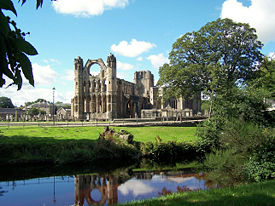 The citizens of Elgin and surrounding areas did not seem to object to the new religion following the Reformation
. In 1568 the lead was stripped from the roof of the cathedral, by order of the Privy Council
. The lead was to be sold and the proceeds to go to the maintenance of Regent Moray's soldiers, but the ship taking the lead cargo to Holland sank almost immediately on leaving Aberdeen harbour. Without this protection the building began to deteriorate. In 1637, the rafters over the choir were blown down and in 1640 the minister of St Giles along with the Laird of Innes and Alexander Brodie of Brodie, all ardent Covenanters, removed and destroyed the ornately carved screen and woodwork that had remained intact. The tracery of the West window was destroyed sometime between 1650 and 1660 by Cromwell
's soldiers. On Easter Sunday 1711 the central tower collapsed for the second time in its history, but caused much more damage. The rubble was quarried for various projects in the vicinity until 1807 when, through the efforts of Joseph King of Newmill, a wall was built around the cathedral and a keeper's house erected.
When Daniel Defoe
toured Scotland in 1717, he visited Elgin and said:
Unquestionably, the cathedral was, and still is, a magnificent building, worthy of its description as the Lantern of the North. When Bishop Bur wrote to King Robert III, complaining of the wanton destruction done to the building by the King's brother, the Wolf of Badenoch, he describes the cathedral as "the ornament of this district, the glory of the kingdom and the admiration of foreigners." Chambers, in his Picture of Scotland, says:
Prince Charles Edward Stuart travelled to Elgin from Inverness in March 1746 and, falling ill with a feverish cold, stayed for 11 days before returning to await the arrival of the king's army. He stayed in Elgin with Mrs Anderson, a passionate Jacobite
, at Thunderton House. She kept the sheets that the Prince slept on and was buried in them a quarter of a century later. The Duke of Cumberland
passed through the town on 13 April, camping at Alves on the way to meet the Prince in battle on Drummossie Muir. After the battle, William Boyd, 4th Earl of Kilmarnock
, one of the Prince's generals, was captured and taken to London and eventual execution, but he wrote to his friend from prison about his indebtedness to the shoemakers of Elgin:
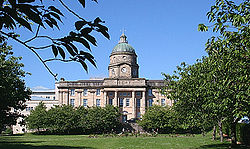 In the 19th century the old medieval town of Elgin was swept away. The first major addition to the town centre was the Assembly Rooms, built in 1821 by the Trinity Lodge of Freemasons, at the corner of High Street and North Street. In 1819, Dr Gray's Hospital was built on unused ground. The building has imposing columns and a dome and stands at the head of fine gardens.
  Dr Alexander Gray, a doctor who worked for and made his fortune with the East India Company
, endowed £26,000 for the hospital. In 1828 the new parish church of St Giles was built at a cost of £10,000. Lt. General Andrew Anderson, born in Elgin, also of the East India Company, died in 1824 and bequeathed £70,000 to the town to found an institution for the welfare of the elderly poor and for the education of orphans. The Anderson Institute was built in the east end of the town in 1832 with accommodation for 50 children and 10 elderly people. The Burgh Court House was built in 1841, the museum in 1842 and the County Buildings in 1866.
The Morayshire Railway
was officially opened in ceremonies at Elgin and Lossiemouth
on 10 August 1852, the steam engines having been delivered to Lossiemouth by sea. It was the first railway north of Aberdeen and initially ran only 5½ miles between Elgin and Lossiemouth. It was later extended south to Craigellachie. The Great North of Scotland Railway took over the working of the line in 1863 and bought the company in 1881 following the Morayshire Railway's return to solvency from crippling debt. The railway and Lossiemouth harbour became very important to Elgin's economy.
The town was becoming prosperous, and by 1882 it had a Head Post Office with a savings bank, insurance and telegraph departments, and branches of the Bank of Scotland and the British Linen Company, Caledonian, Commercial, North of Scotland, Royal and Union Banks, and the National Securities Savings Bank, offices or agencies of 48 insurance companies, five hotels and a newspaper. It was not until the 20th century, however, that the separate villages of Bishopmill and New Elgin would be incorporated into the town.
Permo
-Triassic
rocks, rare in Scotland, are commonly found around Elgin. These are composed of aeolian sandstone formed when this area was subjected to desert conditions. Quarry Wood, on the town's edge, has a formation nicknamed Cuttie's Hillock which produced the internationally known fossils called the Elgin Reptiles. In the Elgin district, boulders belonging to the lowest group of Jurassic strata, Oxford clay and chalk are found both in glacial deposits and on the surface of the ground. The largest of these deposits is at Linksfield, where limestone and shale lie on boulder clay.
maritime, with cool summers and relatively mild winters due to its proximity to the sea. Rainfall is quite low as it is in the rain shadow
of mountains to the west and southwest.
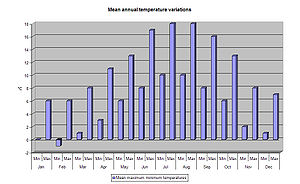
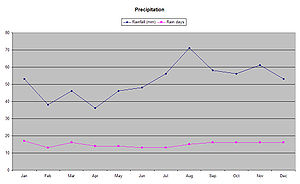
Source: http://uk.weather.com/>
Source: Moray Council from 2001 Census data
Elgin's population in 1901 was 8460
stations for employment of civilians. In 2005, RAF Lossiemouth
along with its neighbour RAF Kinloss
contributed £156.5 million (including civilian expenditure) to the Moray economy, of which £76.6 million was retained and spent locally. The bases provide, directly or indirectly, 21% of all employment in the area. Although in 2010 the closure of RAF Kinloss had a massive impact on these numbers. The Base was signed over to the Army in 2011. Other areas offering significant employment are local authority, construction and real estate, food and drink, tourism, transport, business services and wholesale/retail.
In a recent study, Elgin was shown to be one of the most expensive towns in which to buy property in Scotland.
of The United Kingdom Parliament
which returns a Member of Parliament
(MP) to the House of Commons, at Westminster
.
Elgin is in the Moray constituency
of the Scottish Parliament
which has slightly different boundaries to the UK Parliament constituency of the same name. The constituency returns a Member of the Scottish Parliament
(MSP) to Holyrood
and is part of the Highlands and Islands electoral region.
Following the reorganisation of local government in Scotland, Elgin now has 2 multi-member wards, each with 3 councillors. These wards are Elgin North and Elgin South.
and Inverness
. Heavy traffic through the town causes serious congestion. Scottish transport minister Tavish Scott
visited the town in August 2006 to look at the traffic management problems and to meet campaigners for a bypass. It is estimated that a bypass would remove about one third of traffic from Elgin's streets. The A941 runs from Lossiemouth through Elgin to Rothes, Craigellachie, Dufftown and Rhynie. Elgin railway station
is operated by First ScotRail
. The railway also connects to Aberdeen and Inverness which have trains to other UK destinations. Elgin's bus station is operated mainly by Stagecoach, and provides services within Elgin and to other local towns as well as to Aberdeen and Inverness. There is a 'Jet' bus service which runs to the Inverness Airport
at Dalcross, Inverness has flights to mainly UK destinations while Aberdeen airport
has UK and international flights.
 The following denominations have places of worship in Elgin:
Church of Scotland
Free Church of Scotland
Baptist Union of Scotland
Roman Catholic Church
Scottish Episcopal Church
Other denominations
, The Who
, Pink Floyd
and The Kinks
all performed at the Two Red Shoes dancehall in the 1960s.
, who play at Borough Briggs stadium
. They entered the Highland Football League
in 1895 and won the league championship fourteen times. The club entered the Scottish Football League
in season 2000/01 and currently compete in Division Three. Their home colours are black and white vertical stripes, black shorts and white socks. Past famous players for Elgin City include Andy Goram
, Nicky Walker
, Jimmy Johnstone
and John McGinlay
. Recently ex-Scotland players Brian Irvine and David Robertson have managed the club.
Two junior football sides, Bishopmill United and New Elgin, both currently compete in the Scottish Junior Football North Division Two
while Moray Social, Golden Pheasant F.C. and Bishopmill Villa participate in the Moray District Welfare Football Association
.
Royal burgh
A royal burgh was a type of Scottish burgh which had been founded by, or subsequently granted, a royal charter. Although abolished in 1975, the term is still used in many of the former burghs....
in Moray
Moray
Moray is one of the 32 council areas of Scotland. It lies in the north-east of the country, with coastline on the Moray Firth, and borders the council areas of Aberdeenshire and Highland.- History :...
, Scotland
Scotland
Scotland is a country that is part of the United Kingdom. Occupying the northern third of the island of Great Britain, it shares a border with England to the south and is bounded by the North Sea to the east, the Atlantic Ocean to the north and west, and the North Channel and Irish Sea to the...
. It is the administrative and commercial centre for Moray. The town originated to the south of the River Lossie
River Lossie
The River Lossie is a river in north east Scotland. Ptolemy , the Greco / Roman geographer, named it as ost. Loxa Fl. The river originates in the hills above Dallas, in Moray, and has its source 400 meters above sea-level. It enters the sea at Lossiemouth on the Moray Firth...
on the higher ground above the flood plain. Elgin is first documented in the Cartulary of Moray in 1190. It was created a Royal Burgh in the 12th century by King David I of Scotland
David I of Scotland
David I or Dabíd mac Maíl Choluim was a 12th-century ruler who was Prince of the Cumbrians and later King of the Scots...
and by that time had a castle on top of the present day Lady Hill to the west of the town.
History
In August 1040, MacBeth'sMacbeth of Scotland
Mac Bethad mac Findlaích was King of the Scots from 1040 until his death...
army defeated and killed Duncan I
Duncan I of Scotland
Donnchad mac Crínáin was king of Scotland from 1034 to 1040...
at Bothganowan (Pitgaveny), near Elgin. Elgin is first recorded in a charter of David I
David I of Scotland
David I or Dabíd mac Maíl Choluim was a 12th-century ruler who was Prince of the Cumbrians and later King of the Scots...
in 1151 in which he granted an annuity to the Priory of Urquhart. David had made Elgin a royal burgh around 1130, after his defeat of Óengus of Moray
Óengus of Moray
Óengus of Moray was the last King of Moray of the native line, ruling Moray in what is now northeastern Scotland from some unknown date until his death in 1130....
. During David's reign the castle was established at the top of what is now Lady Hill. The town received a royal charter from Alexander II
Alexander II of Scotland
Alexander II was King of Scots from1214 to his death.-Early life:...
in 1224 when he granted the land for a new cathedral
Cathedral
A cathedral is a Christian church that contains the seat of a bishop...
to Andrew, Bishop of Moray
Bishop of Moray
The Bishop of Moray or Bishop of Elgin was the ecclesiastical head of the Diocese of Moray in northern Scotland, one of Scotland's 13 medieval bishoprics...
. This finally settled the episcopal see which had been at various times at Kinneddar, Birnie and Spynie
Spynie Palace
Spynie Palace, also known as Spynie Castle, was the fortified seat of the Bishops of Moray for about 500 years. The founding of the palace dates back to the late 12th Century. It is situated about 500m from the location of the first officially settled Cathedral Church of the Diocese of Moray, in...
. Elgin was a popular residence for the early Scottish
Scotland
Scotland is a country that is part of the United Kingdom. Occupying the northern third of the island of Great Britain, it shares a border with England to the south and is bounded by the North Sea to the east, the Atlantic Ocean to the north and west, and the North Channel and Irish Sea to the...
monarchs: David I
David I of Scotland
David I or Dabíd mac Maíl Choluim was a 12th-century ruler who was Prince of the Cumbrians and later King of the Scots...
, William I
William I of Scotland
William the Lion , sometimes styled William I, also known by the nickname Garbh, "the Rough", reigned as King of the Scots from 1165 to 1214...
, Alexander II
Alexander II of Scotland
Alexander II was King of Scots from1214 to his death.-Early life:...
and Alexander III
Alexander III of Scotland
Alexander III was King of Scots from 1249 to his death.-Life:...
all held court there and hunted in the royal forests.
Of these kings, Alexander II was Elgin's greatest benefactor and returned many times to his royal castle. He established the two religious houses of the town, the Dominicans
Dominican Order
The Order of Preachers , after the 15th century more commonly known as the Dominican Order or Dominicans, is a Catholic religious order founded by Saint Dominic and approved by Pope Honorius III on 22 December 1216 in France...
or Blackfriars in the west side and the Franciscans or Greyfriars in the east. Further to the east stood the Hospital of Maison Dieu, or House of God, also founded during the reign of Alexander II for the reception of poor men and women.
Elgin Cathedral
Elgin Cathedral, dedicated to the Holy Trinity, sometimes referred to as The Lantern of the North is a historic ruin in Elgin, Moray, north-east Scotland. It was established in 1224 on an area of ground granted by Alexander II that was close to the River Lossie and outside of the burgh of...
was ceremoniously laid. The cathedral was completed sometime after 1242 but was completely destroyed by fire in 1270. The reasons for this are unrecorded. The buildings which now remain as ruins date from the reconstruction following that fire. The Chartulary of Moray described the completed cathedral as "Mirror of the country and the glory of the kingdom".
Edward I of England
Edward I of England
Edward I , also known as Edward Longshanks and the Hammer of the Scots, was King of England from 1272 to 1307. The first son of Henry III, Edward was involved early in the political intrigues of his father's reign, which included an outright rebellion by the English barons...
travelled twice to Elgin. During his first visit in 1296 he was impressed by what he saw. Preserved in the Cotton library
Cotton library
The Cotton or Cottonian library was collected privately by Sir Robert Bruce Cotton M.P. , an antiquarian and bibliophile, and was the basis of the British Library...
now held in the British Library
British Library
The British Library is the national library of the United Kingdom, and is the world's largest library in terms of total number of items. The library is a major research library, holding over 150 million items from every country in the world, in virtually all known languages and in many formats,...
is the journal of his stay, describing the castle and the town of Elgin as "bon chastell et bonne ville" — good castle and good town. By his second visit in September 1303, the castle's wooden interior had been burned while held by the English
England
England is a country that is part of the United Kingdom. It shares land borders with Scotland to the north and Wales to the west; the Irish Sea is to the north west, the Celtic Sea to the south west, with the North Sea to the east and the English Channel to the south separating it from continental...
governor, Henry de Rye. As a result, he only stayed in Elgin for two days and then camped at Kinloss Abbey
Kinloss Abbey
Kinloss Abbey is a Cistercian abbey approximately 3 miles east of Forres in the county of Moray, Scotland.The abbey was founded in 1150 by King David I and was first colonised by monks from Melrose Abbey. It received its Papal Bull from Pope Alexander III in 1174, and later came under the...
from 13 September until 4 October. King Edward was furious when David de Moravia, Bishop of Moray, joined Scotland's cause with Bruce, and Edward appealed to the Pope who excommunicated the bishop, thus removing papal protection, causing him to flee to Orkney, then to Norway
Norway
Norway , officially the Kingdom of Norway, is a Nordic unitary constitutional monarchy whose territory comprises the western portion of the Scandinavian Peninsula, Jan Mayen, and the Arctic archipelago of Svalbard and Bouvet Island. Norway has a total area of and a population of about 4.9 million...
, only to return after Robert Bruce's victories against the English. After Edward's death in July 1307, Robert the Bruce retook Scotland in 1308, slighting castles to keep them out of English hands. David de Moravia, the Bishop of Moray at the head of his army, joined with Bruce and they slighted the castles of Inverness
Inverness
Inverness is a city in the Scottish Highlands. It is the administrative centre for the Highland council area, and is regarded as the capital of the Highlands of Scotland...
, Nairn
Nairn
Nairn is a town and former burgh in the Highland council area of Scotland. It is an ancient fishing port and market town around east of Inverness...
and Forres
Forres
Forres , is a town and former royal burgh situated in the north of Scotland on the Moray coast, approximately 30 miles east of Inverness. Forres has been a winner of the Scotland in Bloom award on several occasions...
before seizing and slighting Kinneddar Castle, which also housed English soldiers. He attacked Elgin castle to be twice repulsed before finally succeeding.
In August 1370 Alexander Bur
Alexander Bur
Alexander Bur was a 14th-century Scottish cleric. It is highly possible that Bur came from somewhere in or around Aberdeenshire, although that is not certain and is only based on the knowledge that Aberdeenshire is where other people bearing his surname come from in this period...
, Bishop of Moray
Bishop of Moray
The Bishop of Moray or Bishop of Elgin was the ecclesiastical head of the Diocese of Moray in northern Scotland, one of Scotland's 13 medieval bishoprics...
began payments to Alexander Stewart, Wolf of Badenoch, King Robert III's
Robert III of Scotland
Robert III was King of Scots from 1390 to his death. His given name was John Stewart, and he was known primarily as the Earl of Carrick before ascending the throne at age 53...
brother, for the protection of his lands and men. In February 1390, the bishop then turned to Thomas Dunbar, son of the Earl of Moray, to provide the protection. This action infuriated Stewart and in May he descended from his castle on an island in Lochindorb
Lochindorb
Lochindorb is a freshwater loch north of Grantown on Spey in the Highland council area of Scotland. This loch is home to the ruins of Lochindorb Castle, a former stronghold of the Clan Comyn. It is also a popular spot with fishers and birdwatchers, the latter of whom come to see the local...
and burned the town of Forres in revenge. In June he burned much of Elgin, including two monasteries, St Giles Church, the Hospital of Maison Dieu and the cathedral. Andrew of Wyntoun
Andrew of Wyntoun
Andrew Wyntoun, known as Andrew of Wyntoun was a Scottish poet, a canon and prior of Loch Leven on St Serf's Inch and later, a canon of St...
's Orygynale Cronykil of Scotland (a 15th century history of Scotland) described this action by "wyld, wykked Heland-men". The rebuilding of the cathedral took many years; but much of it has since crumbled away due to the inferior workmanship of the 15th and 16th century masons, while the 13th century construction still remains. In 1506, the great central tower collapsed and although rebuilding work began the next year it was not completed till 1538.
From the Reformation to the eighteenth century
Scottish Reformation
The Scottish Reformation was Scotland's formal break with the Papacy in 1560, and the events surrounding this. It was part of the wider European Protestant Reformation; and in Scotland's case culminated ecclesiastically in the re-establishment of the church along Reformed lines, and politically in...
. In 1568 the lead was stripped from the roof of the cathedral, by order of the Privy Council
Privy council
A privy council is a body that advises the head of state of a nation, typically, but not always, in the context of a monarchic government. The word "privy" means "private" or "secret"; thus, a privy council was originally a committee of the monarch's closest advisors to give confidential advice on...
. The lead was to be sold and the proceeds to go to the maintenance of Regent Moray's soldiers, but the ship taking the lead cargo to Holland sank almost immediately on leaving Aberdeen harbour. Without this protection the building began to deteriorate. In 1637, the rafters over the choir were blown down and in 1640 the minister of St Giles along with the Laird of Innes and Alexander Brodie of Brodie, all ardent Covenanters, removed and destroyed the ornately carved screen and woodwork that had remained intact. The tracery of the West window was destroyed sometime between 1650 and 1660 by Cromwell
Oliver Cromwell
Oliver Cromwell was an English military and political leader who overthrew the English monarchy and temporarily turned England into a republican Commonwealth, and served as Lord Protector of England, Scotland, and Ireland....
's soldiers. On Easter Sunday 1711 the central tower collapsed for the second time in its history, but caused much more damage. The rubble was quarried for various projects in the vicinity until 1807 when, through the efforts of Joseph King of Newmill, a wall was built around the cathedral and a keeper's house erected.
When Daniel Defoe
Daniel Defoe
Daniel Defoe , born Daniel Foe, was an English trader, writer, journalist, and pamphleteer, who gained fame for his novel Robinson Crusoe. Defoe is notable for being one of the earliest proponents of the novel, as he helped to popularise the form in Britain and along with others such as Richardson,...
toured Scotland in 1717, he visited Elgin and said:
"In this rich country is the city, or town rather, of Elgin; I say city, because in antient time the monks claim'd it for a city; and the cathedral shews, by its ruins, that it was a place of great magnificence. Nor must it be wonder'd at, if in so pleasant, so rich, and so agreeable a part of the country, all the rest being so differing from it, the clergy should seat themselves in a proportion'd number, seeing we must do them the justice to say, that if there is any place richer and more fruitful, and pleasant than another, they seldom fail to find it out. As the country is rich and pleasant, so here are a great many rich inhabitants, and in the town of Elgin in particular; for the gentlemen, as if this was the Edinburgh, or the court, for this part of the island, leave their Highland habitations in the winter and come and live here for the diversion of the place and plenty of provisions; and there is, on this account, a great variety of gentlemen for society, and that of all parties and of all opinions. This makes Elgin a very agreeable place to live in, notwithstanding its distance, being above 450 measur'd miles from London, and more, if we must go by Edinburgh."
Unquestionably, the cathedral was, and still is, a magnificent building, worthy of its description as the Lantern of the North. When Bishop Bur wrote to King Robert III, complaining of the wanton destruction done to the building by the King's brother, the Wolf of Badenoch, he describes the cathedral as "the ornament of this district, the glory of the kingdom and the admiration of foreigners." Chambers, in his Picture of Scotland, says:
"It is an allowed fact, which the ruins seem still to attest, that this was by far the most splendid specimen of ecclesiastical architecture in Scotland, the abbey church of Melrose not excepted. It must be acknowledged that the edifice last mentioned is a wonderful instance of symmetry and elaborate decoration; yet in extent, in loftiness, in impressive magnificence, and even in minute decoration, Elgin has been manifestly superior. Enough still remains to impress the solitary traveller with a sense of admiration mixed with astonishment."Lachlan Shaw in his History of the Province of Moray was equally impressed when he wrote
"the church when entire was a building of Gothic architecture inferior to few in Europe."
Prince Charles Edward Stuart travelled to Elgin from Inverness in March 1746 and, falling ill with a feverish cold, stayed for 11 days before returning to await the arrival of the king's army. He stayed in Elgin with Mrs Anderson, a passionate Jacobite
Jacobitism
Jacobitism was the political movement in Britain dedicated to the restoration of the Stuart kings to the thrones of England, Scotland, later the Kingdom of Great Britain, and the Kingdom of Ireland...
, at Thunderton House. She kept the sheets that the Prince slept on and was buried in them a quarter of a century later. The Duke of Cumberland
Prince William Augustus, Duke of Cumberland
Prince William , was a younger son of George II of Great Britain and Caroline of Ansbach, and Duke of Cumberland from 1726. He is generally best remembered for his role in putting down the Jacobite Rising at the Battle of Culloden in 1746, and as such is also known as "Butcher" Cumberland...
passed through the town on 13 April, camping at Alves on the way to meet the Prince in battle on Drummossie Muir. After the battle, William Boyd, 4th Earl of Kilmarnock
William Boyd, 4th Earl of Kilmarnock
William Boyd , 4th Earl of Kilmarnock, was a Scottish nobleman.William Boyd was educated at Glasgow. Like his father in the rebellion of 1715, William initially supported the Government side, but in the rebellion of 1745, owing either to a personal affront or to the influence of his wife or to his...
, one of the Prince's generals, was captured and taken to London and eventual execution, but he wrote to his friend from prison about his indebtedness to the shoemakers of Elgin:
"Beside my personal debts mentioned in general and particular in the State, there is one for which I am liable in justice, if it is not paid, owing to poor people who gave their work for it by my orders. It was at Elgin in Murray, the Regiment I commanded wanted shoes. I commissioned something about seventy pair of shoes and brogues, which might come to 3 shillngs or three shillings and sixpence each, one with the other. The magistrates divided them among the shoemakers of the town and country, and each shoemaker furnished his proportion. I drew on the town, for the price, out of the composition laid on them, but I was afterwards told at Inverness that, it was believed, the composition was otherwise applied, and the poor shoemakers not paid. As these poor people wrought by my orders, it will be a great ease to my heart to think they are not to lose by me, as too many have done in the course of that year, but had I lived I might have made some inquiry after: but now it is impossible, as their hardships in loss of horses and such things, which happeened through my soldiers, are so interwoven with what was done by other people, that it would be very hard, if not impossible, to separate them. If you'll write to Mr Innes of Dalkinty at Elgin (with whom I was quartered when I lay there), he will send you an account of the shoes, and if they were paid to the shoemakers or no; and if they are not, I beg you'll get my wife, or my successors to pay them when they can......"
Nineteenth century
British East India Company
The East India Company was an early English joint-stock company that was formed initially for pursuing trade with the East Indies, but that ended up trading mainly with the Indian subcontinent and China...
, endowed £26,000 for the hospital. In 1828 the new parish church of St Giles was built at a cost of £10,000. Lt. General Andrew Anderson, born in Elgin, also of the East India Company, died in 1824 and bequeathed £70,000 to the town to found an institution for the welfare of the elderly poor and for the education of orphans. The Anderson Institute was built in the east end of the town in 1832 with accommodation for 50 children and 10 elderly people. The Burgh Court House was built in 1841, the museum in 1842 and the County Buildings in 1866.
The Morayshire Railway
Morayshire Railway
The Morayshire Railway was the first railway to be built north of Aberdeen, in Scotland. It received royal assent in 1846 but construction did not start until 1851 due to the economic conditions existing in the United Kingdom at the time. The railway was built in two phases with the section from...
was officially opened in ceremonies at Elgin and Lossiemouth
Lossiemouth
Lossiemouth is a town in Moray, Scotland. Originally the port belonging to Elgin, it became an important fishing town. Although there has been over a 1,000 years of settlement in the area, the present day town was formed over the past 250 years and consists of four separate communities that...
on 10 August 1852, the steam engines having been delivered to Lossiemouth by sea. It was the first railway north of Aberdeen and initially ran only 5½ miles between Elgin and Lossiemouth. It was later extended south to Craigellachie. The Great North of Scotland Railway took over the working of the line in 1863 and bought the company in 1881 following the Morayshire Railway's return to solvency from crippling debt. The railway and Lossiemouth harbour became very important to Elgin's economy.
The town was becoming prosperous, and by 1882 it had a Head Post Office with a savings bank, insurance and telegraph departments, and branches of the Bank of Scotland and the British Linen Company, Caledonian, Commercial, North of Scotland, Royal and Union Banks, and the National Securities Savings Bank, offices or agencies of 48 insurance companies, five hotels and a newspaper. It was not until the 20th century, however, that the separate villages of Bishopmill and New Elgin would be incorporated into the town.
Geography and geology
The modern town straddles the River Lossie, with the suburbs of Bishopmill to the north and New Elgin to the south.Permo
Permian
The PermianThe term "Permian" was introduced into geology in 1841 by Sir Sir R. I. Murchison, president of the Geological Society of London, who identified typical strata in extensive Russian explorations undertaken with Edouard de Verneuil; Murchison asserted in 1841 that he named his "Permian...
-Triassic
Triassic
The Triassic is a geologic period and system that extends from about 250 to 200 Mya . As the first period of the Mesozoic Era, the Triassic follows the Permian and is followed by the Jurassic. Both the start and end of the Triassic are marked by major extinction events...
rocks, rare in Scotland, are commonly found around Elgin. These are composed of aeolian sandstone formed when this area was subjected to desert conditions. Quarry Wood, on the town's edge, has a formation nicknamed Cuttie's Hillock which produced the internationally known fossils called the Elgin Reptiles. In the Elgin district, boulders belonging to the lowest group of Jurassic strata, Oxford clay and chalk are found both in glacial deposits and on the surface of the ground. The largest of these deposits is at Linksfield, where limestone and shale lie on boulder clay.
Climate
Elgin's climate is temperateTemperate
In geography, temperate or tepid latitudes of the globe lie between the tropics and the polar circles. The changes in these regions between summer and winter are generally relatively moderate, rather than extreme hot or cold...
maritime, with cool summers and relatively mild winters due to its proximity to the sea. Rainfall is quite low as it is in the rain shadow
Rain shadow
A rain shadow is a dry area on the lee side of a mountainous area. The mountains block the passage of rain-producing weather systems, casting a "shadow" of dryness behind them. As shown by the diagram to the right, the warm moist air is "pulled" by the prevailing winds over a mountain...
of mountains to the west and southwest.
Source: http://uk.weather.com/>
Demographics
Population Males: 10288 Females: 10641 Total: 20929 Age structure (%) 0 – 4 years: 6.35 5 – 15 years: 13.84 16 – 24 years: 9.50 25 – 44 years: 31.15 45 – 64 years: 23.08 65 – 74 years: 8.87 75+ years: 7.21 Religion (%) Church of Scotland: 44.48 Roman Catholic: 5.96 Other Christian: 10.42 Other non-Christian: 1.08 None: 33.10 Not answered:4.95 Country of birth (%) Scotland: 83.64 England: 13.13 Wales: 0.94 Other UK: 0.95 Republic of Ireland: 0.21 Other EU: 1.39 Elsewhere: 2.11 Ethnic group (%) White Scottish: 83.64 Other White British: 13.57 White Irish: 0.44 Other White: 0.95 Indian: 0.10 Pakistani: 0.42 Chinese: 0.32 Caribbean: 0.07 African: 0.07 Black Scottish or Other Black: 0.04 Mixed background: 0.17 Other: 0.16 |
Source: Moray Council from 2001 Census data
Elgin's population in 1901 was 8460
Economy
The Elgin – Forres – Lossiemouth triangle is heavily dependent on Royal Air ForceRoyal Air Force
The Royal Air Force is the aerial warfare service branch of the British Armed Forces. Formed on 1 April 1918, it is the oldest independent air force in the world...
stations for employment of civilians. In 2005, RAF Lossiemouth
RAF Lossiemouth
RAF Lossiemouth is a Royal Air Force station to the west of the town of Lossiemouth in Moray, Scotland. It is one of the RAF's biggest bases and is currently Britain's main base for Tornado GR4s. From 2013 the Northern QRA force of Typhoon F2 will relocate to Lossiemouth following the closure of...
along with its neighbour RAF Kinloss
RAF Kinloss
RAF Kinloss is a Royal Air Force station near Kinloss, on the Moray Firth in the north of Scotland. It opened on 1 April 1939 and served as an RAF training establishment during the Second World War. After the war it was handed over to Coastal Command to watch over Russian ships and submarines in...
contributed £156.5 million (including civilian expenditure) to the Moray economy, of which £76.6 million was retained and spent locally. The bases provide, directly or indirectly, 21% of all employment in the area. Although in 2010 the closure of RAF Kinloss had a massive impact on these numbers. The Base was signed over to the Army in 2011. Other areas offering significant employment are local authority, construction and real estate, food and drink, tourism, transport, business services and wholesale/retail.
In a recent study, Elgin was shown to be one of the most expensive towns in which to buy property in Scotland.
National governments
Elgin is in the Moray (Westminster) constituencyMoray (UK Parliament constituency)
-Sources:* * * * * * -See also:...
of The United Kingdom Parliament
Parliament of the United Kingdom
The Parliament of the United Kingdom of Great Britain and Northern Ireland is the supreme legislative body in the United Kingdom, British Crown dependencies and British overseas territories, located in London...
which returns a Member of Parliament
Member of Parliament
A Member of Parliament is a representative of the voters to a :parliament. In many countries with bicameral parliaments, the term applies specifically to members of the lower house, as upper houses often have a different title, such as senate, and thus also have different titles for its members,...
(MP) to the House of Commons, at Westminster
Palace of Westminster
The Palace of Westminster, also known as the Houses of Parliament or Westminster Palace, is the meeting place of the two houses of the Parliament of the United Kingdom—the House of Lords and the House of Commons...
.
Elgin is in the Moray constituency
Moray (Scottish Parliament constituency)
Moray is a constituency of the Scottish Parliament . It elects one Member of the Scottish Parliament by the first past the post method of election...
of the Scottish Parliament
Scottish Parliament
The Scottish Parliament is the devolved national, unicameral legislature of Scotland, located in the Holyrood area of the capital, Edinburgh. The Parliament, informally referred to as "Holyrood", is a democratically elected body comprising 129 members known as Members of the Scottish Parliament...
which has slightly different boundaries to the UK Parliament constituency of the same name. The constituency returns a Member of the Scottish Parliament
Member of the Scottish Parliament
Member of the Scottish Parliament is the title given to any one of the 129 individuals elected to serve in the Scottish Parliament.-Methods of Election:MSPs are elected in one of two ways:...
(MSP) to Holyrood
Scottish Parliament Building
The Scottish Parliament Building is the home of the Scottish Parliament at Holyrood, within the UNESCO World Heritage Site in central Edinburgh. Construction of the building commenced in June 1999 and the Members of the Scottish Parliament held their first debate in the new building on 7...
and is part of the Highlands and Islands electoral region.
Local government
- see also Moray council election, 2007Moray council election, 2007Elections to The Moray Council were held on 3 May 2007, the same day as the Scottish Parliament election. The election was the first using the eight new wards created under the Local Governance Act 2004. 26 councillors were elected. Each ward elected either 3 or 4 members, using the STV electoral...
Following the reorganisation of local government in Scotland, Elgin now has 2 multi-member wards, each with 3 councillors. These wards are Elgin North and Elgin South.
Transport
Elgin is situated on the A96 trunk route which connects the cities of AberdeenAberdeen
Aberdeen is Scotland's third most populous city, one of Scotland's 32 local government council areas and the United Kingdom's 25th most populous city, with an official population estimate of ....
and Inverness
Inverness
Inverness is a city in the Scottish Highlands. It is the administrative centre for the Highland council area, and is regarded as the capital of the Highlands of Scotland...
. Heavy traffic through the town causes serious congestion. Scottish transport minister Tavish Scott
Tavish Scott
Tavish Hamilton Scott MSP is a Scottish politician and MSP for Shetland. He was Leader of the Scottish Liberal Democrats from 2008 to 2011...
visited the town in August 2006 to look at the traffic management problems and to meet campaigners for a bypass. It is estimated that a bypass would remove about one third of traffic from Elgin's streets. The A941 runs from Lossiemouth through Elgin to Rothes, Craigellachie, Dufftown and Rhynie. Elgin railway station
Elgin railway station
Elgin railway station is a railway station serving the town of Elgin, Moray in Scotland. The station is managed by First ScotRail and is on the Aberdeen to Inverness Line....
is operated by First ScotRail
First ScotRail
ScotRail Railways Ltd. is the FirstGroup-owned train operating company running domestic passenger trains within Scotland, northern England and the cross-border Caledonian Sleeper service to London using the brand ScotRail which is the property of the Scottish Government...
. The railway also connects to Aberdeen and Inverness which have trains to other UK destinations. Elgin's bus station is operated mainly by Stagecoach, and provides services within Elgin and to other local towns as well as to Aberdeen and Inverness. There is a 'Jet' bus service which runs to the Inverness Airport
Inverness Airport
Inverness Airport is an international airport situated at Dalcross, north east of the city of Inverness in Highland, Scotland. The airport is the main gateway for travellers to the north of Scotland with a wide range of scheduled services throughout the United Kingdom and Ireland, and limited...
at Dalcross, Inverness has flights to mainly UK destinations while Aberdeen airport
Aberdeen Airport
Aberdeen Airport is an international airport, located at Dyce, a suburb of Aberdeen, Scotland, approximately northwest of Aberdeen city centre. 2.76 million passengers used Aberdeen Airport in 2010, a reduction of 7.4% compared with 2009, making it the 15th busiest airport in the UK...
has UK and international flights.
Nursery schools
- Ark Childcare, Mosstowie
- Cherry Tree Nursery, Dr Gray's Hospital, West Road, Elgin
- Jack & Jill Pre-School Centre, Kinder House, 22 Wardend Place, New Elgin
- Moray Leisure Centre Pre-School Nursery, Borough Briggs Road, Elgin
- Magic Roundabout Pre-School Nursery, Thornhill Drive, Elgin
Primary schools
- Bishopmill Primary School, Morriston Road, Bishopmill
- East End Primary School, Institution Road
- Greenwards Primary School, Edgar Road, New Elgin
- New Elgin Primary School, Bezack Street, New Elgin
- Seafield Primary School, Deanshaugh Terrace, Bishopmill
- West End Primary School, Mayne Road
- St Sylvester's Primary School, Abbey Street
Secondary schools
- Elgin AcademyElgin Academy, ScotlandElgin Academy is a secondary school in the city of Elgin, Moray, Scotland.-Admissions:Pupils at Elgin Academy are in years S1 to S6. Most arrive in first year from one of the nearby primary schools, which include Bishopmill Primary, West End Primary, East End Primary, Seafield Primary and St...
, Morriston Road, Bishopmill - Elgin High SchoolElgin High School (Scotland)Elgin High School is a secondary school situated on High School Drive Elgin, Moray, Scotland.-The school:Elgin High School is one of two secondary schools in Elgin, the other being Elgin Academy. All examinations follow the structure of the Scottish Qualifications Authority...
, High School Drive, New Elgin - GordonstounGordonstounGordonstoun School is a co-educational independent school for boarding and day pupils in Moray in North East Scotland. Named after the estate originally owned by Sir Robert Gordon in the 1600s, the school now uses this estate as its campus...
School, Duffus, near Elgin
Health centres
- The Maryhill Health Centre.
- Linkwood Medical at the Glassgreen Centre (Formerly the Victoria Crescet Medical Centre before its relocation in 2009)
- Elgin Community Surgery, Highfield House.
Religion
Church of Scotland
Church of Scotland
The Church of Scotland, known informally by its Scots language name, the Kirk, is a Presbyterian church, decisively shaped by the Scottish Reformation....
- St Giles', High Street
- St Columba's South, Moss Street
- Elgin High, North Guildry Street
Free Church of Scotland
Free Church of Scotland (post 1900)
Free Church of Scotland is that part of the original Free Church of Scotland that remained outside of the union with the United Presbyterian Church of Scotland in 1900...
- Free Church, South Street
Baptist Union of Scotland
Baptist Union of Scotland
The Baptist Union of Scotland is the main denomination of Baptist churches in Scotland.-From the 1650s to 1869:Baptists first arrived in Scotland with the armies of English republican Oliver Cromwell in the 1650s, who established small churches in Leith, Perth, Cupar, Ayr and Aberdeen, but they did...
Roman Catholic Church
- St Sylvester's, Institution Road
Scottish Episcopal Church
Scottish Episcopal Church
The Scottish Episcopal Church is a Christian church in Scotland, consisting of seven dioceses. Since the 17th century, it has had an identity distinct from the presbyterian Church of Scotland....
Other denominations
- The Church of Jesus Christ of Latter-day Saints, Pansport Road
- Jehovah's WitnessesJehovah's WitnessesJehovah's Witnesses is a millenarian restorationist Christian denomination with nontrinitarian beliefs distinct from mainstream Christianity. The religion reports worldwide membership of over 7 million adherents involved in evangelism, convention attendance of over 12 million, and annual...
, Linkwood - Calvary Christian Life Centre, Lesmurdie Road
- True Jesus ChurchTrue Jesus ChurchThe True Jesus Church is a non-denominational Christian church that originated in Beijing, China, in 1917. The current elected chairman of the TJC International Assembly is Preacher Yong-Ji Lin. Today, there are approximately 2.5 million members in fifty three countries and six continents...
, Lesmurdie Road - Pentecostal Church of GodPentecostal Church of GodThe Pentecostal Church of God is a trinitarian Pentecostal Christian denomination headquartered in Joplin, Missouri, United States. As of 2006, there were 117,000 members and 2,870 clergy in 1,170 churches in the United States. Sixty churches and missions exist among the Native Americans...
, New Elgin Hall Annex - BrethrenPlymouth BrethrenThe Plymouth Brethren is a conservative, Evangelical Christian movement, whose history can be traced to Dublin, Ireland, in the late 1820s. Although the group is notable for not taking any official "church name" to itself, and not having an official clergy or liturgy, the title "The Brethren," is...
, Riverside Gospel Hall, North Street
Culture and leisure
- Elgin Museum, 1 High Street
- Elgin Library, Cooper Park
- Elgin Golf Club, Hardhillock, Birnie Road
- Glassgreen Golf Range, Birnie Road
- Cooper Park: boating, pitch and putt, tennis
- Biblical Gardens
- Moray Leisure Centre, Borough Briggs Road, containing swimming pool, ice rink and a gymnasium
- Town Hall with auditorium for production of shows
- Community Centre, Trinity Road: badminton
- The Lantern Gallery, 18 South Guildry Street
- Red Shoes Theatre and music venue, High Street
- Elgin Youth Café, Francis Place
- Moray Jazz Club, ground floor of the Elgin City Football Club, Borough Briggs Road
Music
The BeatlesThe Beatles
The Beatles were an English rock band, active throughout the 1960s and one of the most commercially successful and critically acclaimed acts in the history of popular music. Formed in Liverpool, by 1962 the group consisted of John Lennon , Paul McCartney , George Harrison and Ringo Starr...
, The Who
The Who
The Who are an English rock band formed in 1964 by Roger Daltrey , Pete Townshend , John Entwistle and Keith Moon . They became known for energetic live performances which often included instrument destruction...
, Pink Floyd
Pink Floyd
Pink Floyd were an English rock band that achieved worldwide success with their progressive and psychedelic rock music. Their work is marked by the use of philosophical lyrics, sonic experimentation, innovative album art, and elaborate live shows. Pink Floyd are one of the most commercially...
and The Kinks
The Kinks
The Kinks were an English rock band formed in Muswell Hill, North London, by brothers Ray and Dave Davies in 1964. Categorised in the United States as a British Invasion band, The Kinks are recognised as one of the most important and influential rock acts of the era. Their music was influenced by a...
all performed at the Two Red Shoes dancehall in the 1960s.
Football
Formed in 1893, the town's only senior football club is Elgin CityElgin City F.C.
Elgin City Football Club are a semi-professional football team based in Elgin, Moray. They currently compete in the Scottish Third Division....
, who play at Borough Briggs stadium
Borough Briggs
Borough Briggs is a football ground in Elgin, Moray, Scotland. It is the home ground of Elgin City F.C. who currently play in the Scottish Football League Third Division. Borough Briggs opened on 20 August 1921 when it replaced Cooper Park as Elgin's home ground...
. They entered the Highland Football League
Highland Football League
The Press & Journal Highland Football League is a league of football clubs operating not just in the Scottish Highlands, as the name may suggest, but also in the north-east lowlands...
in 1895 and won the league championship fourteen times. The club entered the Scottish Football League
Scottish Football League
The Scottish Football League is a league of football teams in Scotland, comprising theScottish First Division, Scottish Second Division and Scottish Third Division. From the league's foundation in 1890 until the breakaway Scottish Premier League was formed in 1998, the Scottish Football League...
in season 2000/01 and currently compete in Division Three. Their home colours are black and white vertical stripes, black shorts and white socks. Past famous players for Elgin City include Andy Goram
Andy Goram
Andrew Lewis Goram is a former Scotland international association football goalkeeper. He started his career with Oldham Athletic and Hibernian, but he is best remembered for playing for Rangers during the 1990s, when he earned the moniker "The Goalie"...
, Nicky Walker
Nicky Walker
Joseph Nicol 'Nicky' Walker is a former Scottish professional football goalkeeper.Walker started his career with Elgin City in the Highland League before signing for Leicester City aged 17. He didn’t settle in the Midlands though, and returned to Scotland within the year, signing for Motherwell in...
, Jimmy Johnstone
Jimmy Johnstone
James Connolly "Jimmy" Johnstone was a Scottish football player. Johnstone was best known for his time with Celtic, and was voted their best ever player by the club's fans in 2002...
and John McGinlay
John McGinlay
John McGinlay is a Scottish former footballer who is perhaps best known for his spell at Bolton Wanderers in the mid to late 1990s.-Early Career:...
. Recently ex-Scotland players Brian Irvine and David Robertson have managed the club.
Two junior football sides, Bishopmill United and New Elgin, both currently compete in the Scottish Junior Football North Division Two
Scottish Junior Football North Division Two
The Scottish Junior Football North Division Two is a third-tier division of the North Region of the Scottish Junior Football Association.In the 2008-09 season Inverness City won the League and were promoted to Division One. New Elgin, Deveronside and Bishopmill United were also promoted to Division...
while Moray Social, Golden Pheasant F.C. and Bishopmill Villa participate in the Moray District Welfare Football Association
Moray District Welfare Football Association
The Moray Welfare Football Association is affiliated to the Scottish Welfare Football Association which is affiliated to the Scottish Football Association. One of the biggest welfare associations in Scotland it has 20 club members and is sponsored by Planwell Roofing Supplies.The association has...
.
Rugby Union
Moray RFC was established in 1923 and play their home games at Morriston Playing Fields.Cricket
Elgin Cricket Club play home games on the Cooper Park cricket pitch under the auspices of North of Scotland Cricket Association.Notable people
For a full list, see :Category:People from Elgin, Moray- SheriffSheriffA sheriff is in principle a legal official with responsibility for a county. In practice, the specific combination of legal, political, and ceremonial duties of a sheriff varies greatly from country to country....
William WisemanWilliam WisemanWilliam Wiseman may refer to:* Sir William Wiseman, 8th Baronet, British naval officer* Sir William Wiseman, 10th Baronet, grandson of the above, head of Secret Intelligence Service in Washington, DC during the First World War...
. born about 1300, ancestor of Bishop of the DromoreDromore, County DownDromore is a small market town in the Banbridge District of County Down, Northern Ireland. It is south-west of Belfast, on the A1 Belfast – Dublin road. The 2001 Census recorded a population of 4,968 people....
Diocese (County Down) of the Church of Ireland, Capel Wiseman, 1635–1683, of Hertfordshire, who was forced to flee to the Continent following the accession of James II to the English Thronein 1685. - ArchbishopArchbishopAn archbishop is a bishop of higher rank, but not of higher sacramental order above that of the three orders of deacon, priest , and bishop...
Mario Joseph ContiMario Joseph ContiMario Joseph Conti is the current Catholic Archbishop of the Metropolitan see of Glasgow, Scotland.-Life:Mario Joseph Conti was born on 20 March 1934, in Elgin, Moray, son of Louis Joseph Conti and Josephine Quintilia Conti...
, born 20 March 1934. The Most Reverend Mario Conti is the current Archbishop of GlasgowArchbishop of GlasgowThe Bishop of Glasgow, from 1492 Archbishop of Glasgow, was the ecclesiastical head of the Diocese of Glasgow and then, as Archbishop of Glasgow, the Archdiocese of Glasgow...
, in Scotland. He studied for the priesthood at The Scots College (Rome)The Scots College (Rome)The Scots College in Rome was established by Clement VIII in 1600, when it was assigned the revenue of the old Scots' hospice...
and was ordained a priest of the Diocese of Aberdeen in the Church of San Marcello al Corso, by Archbishop Luigi Traglia on 26 October 1958. He was parish priest in Caithness before becoming Bishop of Aberdeen, in 1977. In 2002, he was appointed to the archdiocese of Glasgow. - Steven John PressleySteven PressleySteven John "Elvis" Pressley is a retired Scottish footballer, who is now the manager of Scottish First Division club Falkirk. Pressley had a long playing career, playing for both halves of the Old Firm and making over 100 league appearances for both Dundee United and Hearts...
, born 11 October 1973 is a former ScottishScottish peopleThe Scottish people , or Scots, are a nation and ethnic group native to Scotland. Historically they emerged from an amalgamation of the Picts and Gaels, incorporating neighbouring Britons to the south as well as invading Germanic peoples such as the Anglo-Saxons and the Norse.In modern use,...
international footballerFootball (soccer)Association football, more commonly known as football or soccer, is a sport played between two teams of eleven players with a spherical ball...
who currently manages Falkirk F.C.Falkirk F.C.Falkirk Football Club is a Scottish professional football club based in Falkirk. It is one of two professional football teams from the town, the other being East Stirlingshire...
in the Scottish First Division. He played as a defender, although he started out as a striker during his school days at Inverkeithing High School. He is often known by his nickname, Elvis. - General Andrew Anderson (1747–1824) Anderson was commissioned as an Ensign in 1766 in the army of the Honourable East India Company. He proved himself to be a fine officer progressing steadily through the ranks and by 1811 had reached the rank of Major General. It was possible to become very wealthy in the service as there were great prizes to be won and shared. Perhaps influenced by his own upbringing Andrew Anderson executed a Deed of Trust in 1815 by which he left £70,000 to the Sheriff and Magistrates and Clergy of the established church in Elgin to build and endow an Institution in Elgin to provide a home for fifty children where they would be educated sufficiently to enable them to earn a living. The Institution was also to give a home to ten aged persons. General Anderson died in 1824 in London aged 77 and in 1830 Elgin Town Council commenced building on the lands of Maisondieu. The fine building of the Elgin Institute for the support of Old Age and the education of Youth was opened in 1832.
- Dr Alexander Gray (d 1807), worked as a surgeon for the East India Company. His will was contested by his family, but eventually his bequest of £26,000 'for the establishment of a hospital in the town of Elgin for the sick and poor of the county of Murray (Moray)' was proven in the Court of Chancery, and work on building the hospital took place between 1815 and 1818. The hospital opened on 1 January 1819.
- Lt William RennieWilliam RennieLieutenant-Colonel William Rennie VC was a Scottish recipient of the Victoria Cross, the highest and most prestigious award for gallantry in the face of the enemy that can be awarded to British and Commonwealth forces....
, (1822–1887) 90th Perthshire Light Infantry, awarded Victoria Cross at Lucknow during Indian Mutiny, 1857 - William Dunbar (1749–1810) born in Thunderton House, Elgin. He was the youngest son of Sir Archibald Dunbar and Anne Bayne Dunbar. In 1763 he attended King's College, Aberdeen, and graduated from there in 1767. He emigrated to America arriving in Philadelphia in April 1771. In 1773 he and a Scottish merchant opened a cotton plantation in Florida and in 1792 opened another plantation in Mississippi. Dunbar became surveyor general in the Natchez area in 1798 and making his first meteorological observations in the Mississippi Valley in 1799. President Thomas Jefferson appointed him and fellow Scot Dr George Hunter to explore the Ouachita River region and travel all the way to the source of the Red River. They set out on 16 October 1804, traveling up the Ouachita River and on to the area of Hot Springs, Arkansas. Dunbar became the first man to give a scientific report of the hot springs, and his journal of the exploration was later published in Documents Relating to the Purchase and Exploration of Louisiana.
- William Latimer Duff (1822–1894) was the son of the Reverend William Duff, Minister of the St Giles Kirk. He was a pupil of Elgin Academy before moving to London and setting up in business. Duff emigrated to America and worked as a Commission Agent. He joined the Union army at the outbreak of the civil war and was commissioned as an artillery officer and became Assistant Inspector General on the staff of Ulysses S. GrantUlysses S. GrantUlysses S. Grant was the 18th President of the United States as well as military commander during the Civil War and post-war Reconstruction periods. Under Grant's command, the Union Army defeated the Confederate military and ended the Confederate States of America...
with the rank of Lieutenant Colonel. He was not present at the surrender of General Robert E. LeeRobert E. LeeRobert Edward Lee was a career military officer who is best known for having commanded the Confederate Army of Northern Virginia in the American Civil War....
at Appomattox as Grant had sent him on other duties. He left the army as Brigadier General of Volunteers on 13 March 1865 for his war service. He became U.S. Consul in Glasgow after the war until 1869 and then covered the Franco-Prussian war for the New York Herald and because of his military rank was accepted in Prussian Society and presented to the KaiserKaiserKaiser is the German title meaning "Emperor", with Kaiserin being the female equivalent, "Empress". Like the Russian Czar it is directly derived from the Latin Emperors' title of Caesar, which in turn is derived from the personal name of a branch of the gens Julia, to which Gaius Julius Caesar,...
Wilhelm I. He retired to Elgin where he died in 1894. - Alexander Brodie SparkAlexander Brodie SparkAlexander Brodie Spark , influential merchant, businessman and free settler of Australia, was born on 9 August 1792 at Elgin, Scotland.- Early life :...
(1792–1856) became a leading banker, merchant & landowner in New South Wales. His diaries provide an intimate and detailed account of the social and business ties among the Scottish merchants and settlers, who formed their own social set and circle. - Sir David Hardie (4 June 1856 – 11 November 1945) graduated as a doctor from Aberdeen University and practiced in Forres before emigrating to Australia and settling in Brisbane. He specialized in the diseases of women and children, particularly those arising from climate. In 1927 he became a founding fellow of the (Royal) Australasian College of Surgeons.
- Kevin McKiddKevin McKiddKevin McKidd is a Scottish television and film actor and director. Before playing the role of Owen Hunt in Grey's Anatomy, McKidd starred as Lucius Vorenus in the historical drama series Rome, and provided the voice of Captain John "Soap" Mactavish in Call of Duty: Modern Warfare 2 and the sequel...
born August 1973 was a member of the successful Moray Youth Theatre, Kevin left Elgin for University in Edinburgh after school. However he dropped out to pursue an acting career which has seen him star in British classic TrainspottingTrainspotting (film)Trainspotting is a 1996 British satirical/drama film directed by Danny Boyle based on the novel of the same name by Irvine Welsh. The movie follows a group of heroin addicts in a late 1980s economically depressed area of Edinburgh and their passage through life...
, cult horror Dog Soldiers, the critically acclaimed Sixteen Years of Alcohol16 Years of Alcohol16 Years of Alcohol is a 2003 drama film written and directed by Richard Jobson, based on his 1987 novel. The film is Jobson's first directorial effort, following a career as a television presenter on BSkyB and VH-1, and as the vocalist for the 1970s punk rock band The Skids. The cover of the DVD...
, as well as the HBO/BBC venture RomeRome (TV series)Rome is a British-American–Italian historical drama television series created by Bruno Heller, John Milius and William J. MacDonald. The show's two seasons premiered in 2005 and 2007, and were later released on DVD. Rome is set in the 1st century BC, during Ancient Rome's transition from Republic...
and Ridley ScottRidley ScottSir Ridley Scott is an English film director and producer. His most famous films include The Duellists , Alien , Blade Runner , Legend , Thelma & Louise , G. I...
's Crusade epic Kingdom of HeavenKingdom of Heaven (film)Kingdom of Heaven is a 2005 epic action film directed by Ridley Scott and written by William Monahan. It stars Orlando Bloom, Eva Green, Jeremy Irons, David Thewlis, Marton Csokas, Brendan Gleeson, Kevin McKidd, Alexander Siddig, Ghassan Massoud, Edward Norton, Jon Finch, Michael Sheen and Liam...
. He also currently stars in hit American TV drama, Grey's Anatomy. Besides that, he has voiced multiple characters from different video games such as Grand Theft Auto: Vice CityGrand Theft Auto: Vice CityGrand Theft Auto: Vice City is a 2002 open world action computer and video game developed by British games developer Rockstar North and published by Rockstar Games. It is the second 3D game in the Grand Theft Auto video game franchise and sixth original title overall...
and Call of Duty: Modern Warfare 2Call of Duty: Modern Warfare 2Call of Duty: Modern Warfare 2 is a first-person shooter video game developed by Infinity Ward and published by Activision for the Xbox 360 and PlayStation 3 video game consoles and the Microsoft Windows operating system. Officially announced on February 11, 2009, the game was released worldwide on...
. He is currently involved in Pixar's new movie releasing in 2012, Brave (2012 film). - Margaret Masson Hardie HasluckMargaret Masson Hardie HasluckMargaret Masson Hardie Hasluck M.B.E. . She was a Scottish geographer, linguist, epigrapher, archaeologist and scholar....
MBE (born 18 June 1885 - September 1947) Author and Anthropologist. Niece of Sir David Hardie, and also of James "Scotty" Philip's two brothers Alexander & George Philip. She lived in GreeceGreeceGreece , officially the Hellenic Republic , and historically Hellas or the Republic of Greece in English, is a country in southeastern Europe....
and AlbaniaAlbaniaAlbania , officially known as the Republic of Albania , is a country in Southeastern Europe, in the Balkans region. It is bordered by Montenegro to the northwest, Kosovo to the northeast, the Republic of Macedonia to the east and Greece to the south and southeast. It has a coast on the Adriatic Sea...
, and during WW2 was involved with SOESpecial Operations ExecutiveThe Special Operations Executive was a World War II organisation of the United Kingdom. It was officially formed by Prime Minister Winston Churchill and Minister of Economic Warfare Hugh Dalton on 22 July 1940, to conduct guerrilla warfare against the Axis powers and to instruct and aid local...
from their base in Cairo, Egypt. She was acquainted with the novelist Olivia ManningOlivia ManningOlivia Mary Manning CBE was a British novelist, poet, writer and reviewer. Her fiction and non-fiction, frequently detailing journeys and personal odysseys, were principally set in England, Ireland, Europe and the Middle East. She often wrote from her personal experience, though her books also...
and is reputed to be the character of 'Mrs Brett' in Olivia Manning's Balkan Trilogy 'Fortunes of War'. - Frederick Fyvie Bruce (12 October 1910 – 11 September 1990) aka F.F. Bruce - Professor of Theology, author of numerous books and articles on theological subjects. He worked at Manchester and Sheffield Universities. Was a Fellow of the British Academy.
- Chris ClarkChris Clark (footballer)Christopher "Chris" Clark is a Scottish professional footballer who plays in the Scottish Premier League for Aberdeen, having previously played for Plymouth Argyle...
, Aberdeen and former Plymouth Argyle football player
External links
- Census data
- Elgin Museum - Four Star Local Museum
- Elgin City FC - Official website of Elgin City FC
- Council - Moray Council
- Leisure Centre - Moray Leisure Centre
- http://www.elginyouthcafe.org/ - Official website for the Elgin Youth Cafe