
All Topics  
Elephant bird

 
Elephant Bird

   Email Print
   Bookmark   Link


Elephant bird


Elephant birds are an extinct
Extinction

In biology and ecology, extinction is the death of every member of a species or group of taxon. The moment of extinction is generally considered to be the death of the last individual of that species ....
 family
Family (biology)

In biological classification, family is a taxonomic rank. Exact details of formal nomenclature depend on the Nomenclature Codes which applies....
 of flightless bird
Bird

Birds are wing, Bipedalismal, endothermic , vertebrate animals that lay egg . There are around 10,000 living species, making them the most numerous tetrapod vertebrates....
s comprising the genera
Genus

A genus is a low-level taxonomic rank used in the classification of living and fossil organisms. The taxonomic ranks are domain , kingdom , phylum, class , order , family , genus, and species....
 Aepyornis and Mullerornis.

elephant birds, which were giant ratite
Ratite

A ratite is any of a diverse group of large, flightless birds of Gondwanan origin, most of them now extinct. Unlike other flightless birds, the ratites have no keel on their sternum - hence their name which comes from the Latin for raft....
s native to Madagascar
Madagascar

Madagascar, or Republic of Madagascar , is an island nation in the Indian Ocean off the southeastern coast of Africa. The main island, also called Madagascar, is the List of islands by area, and is home to 5% of the world's plant and animal species, of which more than 80% are Endemism to Madagascar....
, have been extinct since at least the 17th century. Étienne de Flacourt
Étienne de Flacourt

Etienne de Flacourt was a France governor of Madagascar, born at Orl?ans in 1607. He was named governor of Madagascar by the French East India Company in 1648....
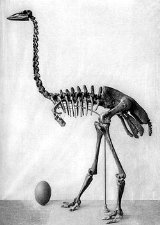
, governor of Madagascar recorded frequent sightings of elephant birds. Aepyornis was the world's largest bird, believed to have been over tall and weighing close to half a ton .


Discussion
Ask a question about 'Elephant bird'
Start a new discussion about 'Elephant bird'
Answer questions from other users
Full Discussion Forum


Encyclopedia


Elephant birds are an extinct
Extinction

In biology and ecology, extinction is the death of every member of a species or group of taxon. The moment of extinction is generally considered to be the death of the last individual of that species ....
 family
Family (biology)

In biological classification, family is a taxonomic rank. Exact details of formal nomenclature depend on the Nomenclature Codes which applies....
 of flightless bird
Bird

Birds are wing, Bipedalismal, endothermic , vertebrate animals that lay egg . There are around 10,000 living species, making them the most numerous tetrapod vertebrates....
s comprising the genera
Genus

A genus is a low-level taxonomic rank used in the classification of living and fossil organisms. The taxonomic ranks are domain , kingdom , phylum, class , order , family , genus, and species....
 Aepyornis and Mullerornis.

Description

The elephant birds, which were giant ratite
Ratite

A ratite is any of a diverse group of large, flightless birds of Gondwanan origin, most of them now extinct. Unlike other flightless birds, the ratites have no keel on their sternum - hence their name which comes from the Latin for raft....
s native to Madagascar
Madagascar

Madagascar, or Republic of Madagascar , is an island nation in the Indian Ocean off the southeastern coast of Africa. The main island, also called Madagascar, is the List of islands by area, and is home to 5% of the world's plant and animal species, of which more than 80% are Endemism to Madagascar....
, have been extinct since at least the 17th century. Étienne de Flacourt
Étienne de Flacourt

Etienne de Flacourt was a France governor of Madagascar, born at Orl?ans in 1607. He was named governor of Madagascar by the French East India Company in 1648....
, governor of Madagascar recorded frequent sightings of elephant birds. Aepyornis was the world's largest bird, believed to have been over tall and weighing close to half a ton . Remains of Aepyornis adults and eggs have been found; in some cases the eggs have a circumference of over and a length up to . The egg volume is about 160 times greater than a chicken egg.

Species

Four species are usually accepted in the genus Aepyornis today; A. hildebrandti, A. gracilis, A. medius and A. maximus, but the validity of some is disputed, with numerous authors treating them all in just one species, A. maximus. Up to three species are also generally included in Mullerornis. Genus Aepyornis
  • Aepyornis gracilis (Monnier, 1913)
  • Aepyornis hildebrandti (Burckhardt, 1893)
=Aepyornis mulleri (Milne-Edwards
Alphonse Milne-Edwards

Alphonse Milne-Edwards was a France mammalologist , ornithologist and carcinologist. He was English in origin and the son of Henri Milne-Edwards and grandson of William Edwards who was a Jamaican planter who settled at Bruges ....
 & Grandidier
Alfred Grandidier

Alfred Grandidier was a France natural history and List of explorers.From a very wealthy family, he and his brother, Ernest Grandidier , undertook a voyage around the world....
, 1894)
  • Aepyornis maximus (Hilaire
    Isidore Geoffroy Saint-Hilaire

    Isidore Geoffroy Saint-Hilaire was a France zoology and an authority on deviation from normal structure. He coined the term ethology.He was born in Paris, the son of ?tienne Geoffroy Saint-Hilaire....
    , 1851)
=Aepyornis modestus (Milne-Edwards
Milne-Edwards

Milne-Edwards may refer to* Alphonse Milne-Edwards , French ornithologist and carcinologist.* Henri Milne-Edwards , French zoologist....
 & Grandidier
Grandidier

The surname Grandidier may refer to*Alfred Grandidier , French naturalist and explorer*Ernest Grandidier, brother of Alfred.*Guillaume Grandidier, biologist, son of Alfred...
, 1869)
=Aepyornis ingens (Milne-Edwards
Milne-Edwards

Milne-Edwards may refer to* Alphonse Milne-Edwards , French ornithologist and carcinologist.* Henri Milne-Edwards , French zoologist....
 & Grandidier
Grandidier

The surname Grandidier may refer to*Alfred Grandidier , French naturalist and explorer*Ernest Grandidier, brother of Alfred.*Guillaume Grandidier, biologist, son of Alfred...
, 1894)
=Aepyornis titan (Andrews
Charles William Andrews

Charles William Andrews Fellow of the Royal Society, was a British paleontology whose career as a vertebrate paleontologist, both as a curator and in the field, was spent in the services of the British Museum, Department of Geology....
, 1894)
  • Aepyornis medius (Milne-Edwards
    Milne-Edwards

    Milne-Edwards may refer to:* Alphonse Milne-Edwards , French ornithologist and carcinologist.* Henri Milne-Edwards , French zoologist....
     & Grandidier
    Grandidier

    The surname Grandidier may refer to:*Alfred Grandidier , French naturalist and explorer*Ernest Grandidier, brother of Alfred.*Guillaume Grandidier, biologist, son of Alfred...
    , 1866)
=Aepyornis grandidieri (Rowley, 1867)
=Aepyornis cursor (Milne-Edwards
Milne-Edwards

Milne-Edwards may refer to* Alphonse Milne-Edwards , French ornithologist and carcinologist.* Henri Milne-Edwards , French zoologist....
 & Grandidier
Grandidier

The surname Grandidier may refer to*Alfred Grandidier , French naturalist and explorer*Ernest Grandidier, brother of Alfred.*Guillaume Grandidier, biologist, son of Alfred...
, 1894)
=Aepyornis lentus (Milne-Edwards
Milne-Edwards

Milne-Edwards may refer to* Alphonse Milne-Edwards , French ornithologist and carcinologist.* Henri Milne-Edwards , French zoologist....
 & Grandidier
Grandidier

The surname Grandidier may refer to*Alfred Grandidier , French naturalist and explorer*Ernest Grandidier, brother of Alfred.*Guillaume Grandidier, biologist, son of Alfred...
, 1894)
Genus Mullerornis
  • Mullerornis betsilei (Milne-Edwards
    Milne-Edwards

    Milne-Edwards may refer to:* Alphonse Milne-Edwards , French ornithologist and carcinologist.* Henri Milne-Edwards , French zoologist....
     & Grandidier
    Grandidier

    The surname Grandidier may refer to:*Alfred Grandidier , French naturalist and explorer*Ernest Grandidier, brother of Alfred.*Guillaume Grandidier, biologist, son of Alfred...
    , 1894)
  • Mullerornis agilis (Milne-Edwards
    Milne-Edwards

    Milne-Edwards may refer to:* Alphonse Milne-Edwards , French ornithologist and carcinologist.* Henri Milne-Edwards , French zoologist....
     & Grandidier
    Grandidier

    The surname Grandidier may refer to:*Alfred Grandidier , French naturalist and explorer*Ernest Grandidier, brother of Alfred.*Guillaume Grandidier, biologist, son of Alfred...
    , 1894)
  • Mullerornis rudis (Milne-Edwards
    Milne-Edwards

    Milne-Edwards may refer to:* Alphonse Milne-Edwards , French ornithologist and carcinologist.* Henri Milne-Edwards , French zoologist....
     & Grandidier
    Grandidier

    The surname Grandidier may refer to:*Alfred Grandidier , French naturalist and explorer*Ernest Grandidier, brother of Alfred.*Guillaume Grandidier, biologist, son of Alfred...
    , 1894)
=Flacourtia rudis (Andrews
Charles William Andrews

Charles William Andrews Fellow of the Royal Society, was a British paleontology whose career as a vertebrate paleontologist, both as a curator and in the field, was spent in the services of the British Museum, Department of Geology....
, 1894)


Food

Because there is no rainforest
Rainforest

Rainforests are forests characterized by high rainfall, with definitions setting minimum normal annual rainfall between 1750?2000 mm . The monsoon trough, alternately known as the intertropical convergence zone, plays a significant role in creating Earth's tropical rain forests....
 fossil
Fossil

Fossils are the preserved remains or trace fossil of animals, plants, and other organisms from the remote past. The totality of fossils, both discovered and undiscovered, and their placement in fossiliferous Rock formations and sedimentary rock layers is known as the fossil record....
 record in Madagascar, it is not known for certain if there were species adapted to dense forest dwelling, like the cassowary
Cassowary

The cassowary is a very large flightless bird native to the tropical forests of New Guinea and nearby islands, and northeastern Australia. The Southern Cassowary is the third tallest and second heaviest bird on the planet, smaller only than the Ostrich and Emu....
 in Australia
Australia

Australia, officially the Commonwealth of Australia, is a country in the southern hemisphere comprising the Australia of the world's smallest continent, the major island of Tasmania, and numerous list of islands of Australia in the Indian Ocean and Pacific Oceans....
 and New Guinea
New Guinea

New Guinea, located just north of Australia, is the List of islands by area, having become separated from the Australian mainland when the area now known as the Torres Strait flooded after the last glacial period....
 today. However, some rainforest fruits with thick, highly sculptured endocarps, such as that of the currently undispersed and highly threatened forest coconut
Coconut

The Coconut Palm is a member of the Family Arecaceae . It is the only species in the genus Cocos, and is a large palm, growing to 30 m tall, with pinnate leaf 4-6 m long, pinnae 60-90 cm long; old leaves break away cleanly leaving the trunk smooth....
 palm Voanioala gerardii, may have been adapted for passage through ratite guts, and the fruit of some palm species are indeed dark bluish purple (e.g. Ravenea
Ravenea

Ravenea is a genus of 17 species of Arecaceae, all endemic to Madagascar and the Comoros.They are small to large palms, with solitary, robust grey stems, swollen at base and gradually tapering upward....
 louvelii
and Satranala decussilvae), just like many cassowary-dispersed fruits.

Biogeography

Like the cassowary
Cassowary

The cassowary is a very large flightless bird native to the tropical forests of New Guinea and nearby islands, and northeastern Australia. The Southern Cassowary is the third tallest and second heaviest bird on the planet, smaller only than the Ostrich and Emu....
, ostrich
Ostrich

The ostrich Struthio camelus is a large flightless bird native to Africa . It is the only living species of its family , Struthionidae, and its genus, Struthio....
, rhea
Rhea (bird)

The rheas are species of Flightless bird ratite birds in the genus Rhea, native to South America. There are two existing species: the Greater Rhea and the Darwin's Rhea....
, emu
Emu

The Emu , Dromaius novaehollandiae, is the largest bird native to Australia and the only Extant taxon member of the genus Dromaius. It is also the second-largest extant bird in the world by height, after its ratite relative, the ostrich....
 and kiwi
Kiwi

A kiwi is any of the species of flightless birds endemic to New Zealand of the genus Apteryx . At around the size of a domestic chicken, kiwi are by far the smallest living ratites....
, Mullerornis and Aepyornis were ratites; they could not fly, and their breast bone
Sternum

The sternum is a long flat bone located in the center of the chest . It connects to the rib via cartilage, forming the rib cage with them, and thus helps to protect the lungs, heart and major blood vessels from physical trauma....
s had no keel
Keel (bird)

A keel in bird anatomy is an extension of the sternum which runs axially along the midline of the sternum and extends outward, perpendicular to the plane of the ribs....
. Because Madagascar and Africa
Africa

Africa is the world's second-largest and second most-populous continent, after Asia. At about 30.2 million km? including adjacent islands, it covers 6% of the Earth's total surface area and 20.4% of the total land area....
 separated too long ago for the ratite lineage
Lineage (evolution)

An evolutionary lineage is a sequence of species, that form a line of descent, each new species the direct result of speciation from an immediate ancestral species....
, Aepyornis had been thought to have dispersed and become flightless and gigantic in situ
In situ

In situ is a Latin phrase meaning in the place. It is used in many different contexts....
. A land bridge
Land bridge

A land bridge, in biogeography, is an isthmus or wider land connection between otherwise separate areas, which allows terrestrial animals and plants to cross over and colonise new lands....
 from elsewhere in Gondwana
Gondwana

Gondwana , originally Gondwanaland is the name given to a southern precursor-supercontinent and then as a remnant separated from Laurasia 180- during the breakup of the Pangaea supercontinent that existed about 500 to 200 Annum ago into two large segments.
 to Madagascar for the elephant bird-ostrich lineage was probably available around 85 million years ago. However, subfossil Aepyornis fragments have not yet been successfully sequenced for mitochondrial DNA
Mitochondrial DNA

Mitochondrial DNA is the DNA located in organelles called mitochondrion. Most other DNA present in eukaryotic organisms is found in the cell nucleus....
. Supposed remains of "aepyornithid" eggs found on the eastern Canary Islands
Canary Islands

The Canary Islands are a Spain archipelago which, in turn, forms one of the Spanish Autonomous Communities and an Outermost Region of the European Union....
 represent a major biogeographical
Biogeography

Biogeography is the study of the distribution of biodiversity over space and time. It aims to reveal where organisms live, and at what abundance....
 enigma. These islands were probably not connected to mainland Africa when elephant birds were alive. During episodes of very low sea levels, there may have been a land bridge, and at least for some time, there probably was an archipelago
Archipelago

An archipelago is a chain or cluster of islands that are formed tectonically. The word archipelago literally means "chief sea", from Italian language arcipelago , derived ultimately from Greek language arkhon and pelagos ....
 between Fuerteventura
Fuerteventura

Fuerteventura, a Spain island, is one of the Canary Islands, in the Atlantic Ocean off the coast of Africa. It is situated at 28?20' north, 14?00' west....
/Lanzarote
Lanzarote

Lanzarote, a Spain island, is the easternmost of the Canary Islands, in the Atlantic Ocean, approximately 125 km off the coast of Africa and 1,000 km from the Iberian Peninsula....
 and the African coast. This would have enabled flightless birds to cross over to these islands by chance. Still, there is no indication that elephant birds evolved outside Madagascar, and today, the Canary Island eggshells are considered to belong to extinct North Africa
North Africa

North Africa or Northern Africa is the northernmost region of the African continent, separated by the Sahara from Sub-Saharan Africa.Geopolitically, the United Nations subregion of Northern Africa includes the following seven countries or territories:...
n birds that may or may not have been ratites (Eremopezus
Eremopezus

Eremopezus is a extinct genus of bird from the Eocene....
/Psammornis), or even Pelagornithidae
Pelagornithidae

The Pelagornithidae or pseudo-tooth birds were a family of large seabirds from the order Pelecaniformes, which were common worldwide from the Late Paleocene to the Late Pliocene; undetermined species even occurring in Middle Eocene Antarctica....
, prehistoric seabird
Seabird

Seabirds are birds that have adaptation to life within the marine environment. While seabirds vary greatly in lifestyle, behavior and physiology, they often exhibit striking convergent evolution, as the same environmental problems and feeding ecological niche have resulted in similar adaptations....
s of immense size.

Extinction

It is often believed that the extinction of the Aepyornis was an effect of human activity. However, the birds were probably not only elusive but widespread, occurring from the northern to the southern tip of Madagascar, yet their eggs were vulnerable. A recent archaeological study found remains of eggshells among the remains of human fires, suggesting that the eggs regularly provided meals for entire families, but it is not known if there were taboos ("fady") against the killing of adult birds, although there is indeed evidence that they were killed. Animals arriving with the human colonists, such as rats and dogs, may also have preyed upon the eggs of the ratite population and reduced their viability.

The exact time period when they died out is also not certain; tales of these giant birds may have persisted for centuries in folk memory
Folk memory

Folk memories is a term sometimes used to describe folklore, folklore or Mythology about past events that have passed orally from generation to generation....
. There is archaeological evidence of Aepyornis from a radiocarbon-dated
Radiocarbon dating

Radiocarbon dating, or carbon dating, is a radiometric dating method that uses the naturally occurring radioisotope carbon-14 to determine the age of carbonaceous materials up to about 60,000 years....
 bone at 1880 +/- 70 BP (= c. 120 AD) with signs of butchering, and on the basis of radiocarbon dating of shells, about 1000 BP (= c. 1000 AD). An alternative theory states that humans hunted the elephant birds to extinction in a very short time for such a large landmass (the blitzkrieg
Pleistocene megafauna

Pleistocene megafauna is the set of species of large animals — mammals, birds and reptiles — that lived on Earth during the Pleistocene epoch and went extinct in a Quaternary extinction event....
 hypothesis) or is the possible secondary effect of human impact by possible transfer of hyperdiseases from human commensals such as chicken
Chicken

The chicken is a Domestication fowl. Recent evidence suggests that domestication of the chicken was under way in Vietnam over 10,000 years ago....
s and guineafowl
Guineafowl

The guineafowl are a family of Avess in the same order as the pheasants, Turkey s and other game birds and is native to Africa....
. The bones of these domesticated fowl have been found in subfossil
Subfossil

Subfossil refers to remains whose fossilization process is not complete, either for lack of time or because the condition in which they were buried were not optimal for fossilization....
 sites in the island (MacPhee and Marx, 1997: 188), such as Ambolisatra (Madagascar), where Mullerornis sp. and Aepyornis maximus have been reported. Also reported by these authors, ratite remains have been found in W-SW Madagascar, at Belo-sur-Mer (A. medius, Mullerornis rudis), Bemafandry (M. agilis) and Lamboharana (Mullerornis sp.). A third viable theory to explain the demise of the giant elephant birds (as apparently first pointed by Attenborough
David Attenborough

Sir David Frederick Attenborough Order of Merit, Order of the Companions of Honour, Royal Victorian Order, Order of the British Empire, Fellow of the Royal Society is a broadcasting and naturalist....
 is climate change, related to an increased drying of Madagascar during the Holocene
Holocene

The Holocene is a geological Epoch which began approximately 11,700 years ago . According to traditional geological thinking, the Holocene continues to the present....
 (to which the impact of humans might have been additive).

Name


English name

Aepyornis maximus is commonly known as the 'elephant bird', a term that apparently originated from Marco Polo
Marco Polo

Marco Polo was a trader and exploration from the Venetian Republic who gained fame for his worldwide travels, recorded in the book Il Milione also known as Oriente Poliano and the Description of the World....
's account of the rukh in 1298, although he was apparently referring to an eagle-like bird strong enough to "seize an elephant with its talons". Sightings of eggs of elephant birds by early sailors (e.g. text on the Fra Mauro map
Fra Mauro map

The Fra Mauro map, "considered the greatest memorial of medieval cartography" according to Roberto Almagi? is a map made around 1450 by the Venice monk Fra Mauro....
 of 1467-69, if not attributable to ostriches) could also have been erroneously attributed to a giant raptor from Madagascar. The legend of the roc could also have originated from sightings of such a giant subfossil
Subfossil

Subfossil refers to remains whose fossilization process is not complete, either for lack of time or because the condition in which they were buried were not optimal for fossilization....
 eagle
Eagle

Eagles are large bird of prey which are members of the bird family Accipitridae, and belong to several Genus which are not necessarily closely related to each other....
 related to the African Crowned Eagle
Crowned Eagle

The Crowned Eagle , more precisely known as the Crowned Hawk-eagle, is a very large, powerful, crested bird of prey found in tropical Africa south of the Sahara; in Southern Africa a common resident in suitable habitat in the eastern areas....
, which has been described in the genus Stephanoaetus
Stephanoaetus

Stephanoaetus is a genus of very large birds of prey from Sub-Saharan Africa and Madagascar. Only one of the two species is extant taxon....
 from Madagascar, being large enough to carry off large primates; today, lemur
Lemur

Lemurs make up the infraorder Lemuriformes and are members of a group of primates known as prosimians. The term "lemur" is derived from the Latin word lemures, meaning "spirits of the night" or "ghosts"....
s still retain a fear of aerial predators such as these. Another might be the perception of ratites retaining neotenic
Neoteny

Neoteny , also called juvenilization, is the retention, by adults in a species, of traits previously seen only in juveniles , and is a subject studied in the field of developmental biology....
 features and thus being mistaken for enormous chicks of a presumably more massive bird.

Malagasy name

The ancient Malagasy
Malagasy

Malagasy is the name of the people who live in Madagascar. Malagasy is also the name of the national and official language spoken in Madagascar....
 name for the bird is Vorompatra, meaning "bird of the Ampatres". The Ampatres are today known as the Androy region of southern Madagascar. . Indeed, Étienne de Flacourt
Étienne de Flacourt

Etienne de Flacourt was a France governor of Madagascar, born at Orl?ans in 1607. He was named governor of Madagascar by the French East India Company in 1648....
 wrote (1658), "vouropatra - a large bird which haunts the Ampatres and lays eggs like the ostriches; so that the people of these places may not take it, it seeks the most lonely places". .

Eggs

Occasionally the subfossilized eggs are found intact. The National Geographic Society
National Geographic Society

The National Geographic Society , headquartered in Washington, D.C. in the United States, is one of the largest non-profit scientific and educational institutions in the world....
 in Washington holds a specimen of an Aepyornis egg which was given to Luis Marden
Luis Marden

Luis Marden was an American photographer, explorer, writer, filmmaker, diver, navigator, and linguist who worked for National Geographic Magazine....
 in 1967. The specimen is intact and contains an embryonic skeleton of the unborn bird. Another giant Aepyornis egg is on display at the Harvard Museum of Natural History in Cambridge, MA. A cast of the 'Aepyornis' egg is preserved at the Grant Museum of Zoology at London University, and has been adopted by Claudia, the niece of the author and illustrator Charlotte Cory. The BBC television personality David Attenborough
David Attenborough

Sir David Frederick Attenborough Order of Merit, Order of the Companions of Honour, Royal Victorian Order, Order of the British Empire, Fellow of the Royal Society is a broadcasting and naturalist....
 owns an almost complete fossilized eggshell, which he pieced together from fragments he himself had found in Madagascar. There is also an intact specimen of an Elephant Bird's egg (contrasted with the eggs from other bird species, including a Hummingbird's egg) on display at the Delaware Museum of Natural History, just outside Wilmington, Delaware
Delaware

Delaware is a U.S. state located on the East Coast of the United States in the Mid-Atlantic States region of the United States. The state takes its name from Thomas West, 3rd Baron De La Warr, a British nobleman and Virginia's first colonial governor, after whom Cape Henlopen was originally named....
, USA, and another in the Natural History Museum, London, England.

In literature

  • The Rukh is known from Sindbad the Sailor's encounter with one in "One Thousand and One Nights". Some scholars think the Roc is a distorted account of the Aepyornis.
  • H.G. Wells wrote a short story entitled "Aepyornis Island" (1894) about the bird. It was first collected in The Stolen Bacillus and Other Incidents (1895). .


Footnotes


See also

  • Island gigantism
    Island gigantism

    Island gigantism is a biological phenomenon where the size of animals isolated on an island increases dramatically over generations. It is a form of natural selection in which bigger size provides a survival advantage ....
  • Late Quaternary prehistoric birds
    Late Quaternary prehistoric birds

    Prehistoric birds are various taxon of birds that became extinct before recorded history, or more precisely, before they could be studied alive by ornithologys....
  • New World Pleistocene extinctions
  • Pleistocene megafauna
    Pleistocene megafauna

    Pleistocene megafauna is the set of species of large animals — mammals, birds and reptiles — that lived on Earth during the Pleistocene epoch and went extinct in a Quaternary extinction event....
  • Roc