

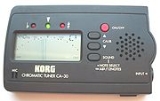
Electronic tuner

Encyclopedia
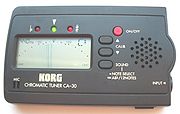
In the Discipline of radio frequency electronics an electronic tuner is a device which tunes across a part of the radio frequency spectrum by the application of a voltage or appropriate digital code words. This type of tuner supersedes mechanical tuners, which were tuned by manual adjustment of capacitance or inductance in the tuned circuits.
In a more practical and everyday sense, a radio or television set which is tuned by manually turning a knob or dial contains a manual tuner into which the shaft of that knob or dial extends. Later model televisions and radios were tuned by a rack of momentary push buttons, some of the earlier types were purely mechanical and adjusted the capacitance or inductance of the tuned circuit to a preset number of positions corresponding to the frequencies of popular local stations. Later electronic types utilized the varactor diode as a voltage controlled capacitance in the tuned circuit to receive a number of preset voltages from the rack of buttons tuning the device instantly to local stations. The mechanical button rack was popular in car radios of the '60s and '70s. The electronic button rack controlling the new electronic varactor tuner was popular in television sets of the '70s and '80s. Modern electronic tuners also use varactor diodes as the actual tuning elements but the voltages which change their capacitance is obtained from a digital to analog converter driven by a microprocessor or phase locked loop arrangement. This modern form allows for very precise tuning and locking-in on weak signals as well as a numerical display of the tuned frequency.
In the Discipline of music
an electronic tuner is a device used by musician
Musician
A musician is an artist who plays a musical instrument. It may or may not be the person's profession. Musicians can be classified by their roles in performing music and writing music.Also....* A person who makes music a profession....
s to detect and display the pitch
Pitch (music)
Pitch is an auditory perceptual property that allows the ordering of sounds on a frequency-related scale.Pitches are compared as "higher" and "lower" in the sense associated with musical melodies,...
of notes played on musical instrument
Musical instrument
A musical instrument is a device created or adapted for the purpose of making musical sounds. In principle, any object that produces sound can serve as a musical instrument—it is through purpose that the object becomes a musical instrument. The history of musical instruments dates back to the...
s. The simplest tuners use LED lights to indicate approximately whether the pitch of the note played is lower, higher, or approximately equal to the desired pitch. More complex and expensive tuners indicate more precisely the difference between offered note and desired pitch.
Tuners vary in size from units that can fit in a pocket, clip on an instrument, sit on a table-top, all the way up to 19" rack-mount units. The more complex and expensive units are used by instrument technicians, piano tuners
Piano tuning
Piano tuning is the act of making minute adjustments to the tensions of the strings of a piano to properly align the intervals between their tones so that the instrument is in tune. The meaning of the term in tune in the context of piano tuning is not simply a particular fixed set of pitches...
and luthier
Luthier
A luthier is someone who makes or repairs lutes and other string instruments. In the United States, the term is used interchangeably with a term for the specialty of each maker, such as violinmaker, guitar maker, lute maker, etc...
s.
The simplest tuners only detect and display the tuning for a single pitch (often "A" or "E") or for a small number of pitches, such as the six pitches used in the standard tuning
Standard tuning
In music, standard tuning refers to the typical tuning of a string instrument. This notion is contrary to that of scordatura, i.e. an alternate tuning designated to modify either the timbre or technical capabilities of the desired instrument.-Bowed strings:...
of a guitar
Guitar
The guitar is a plucked string instrument, usually played with fingers or a pick. The guitar consists of a body with a rigid neck to which the strings, generally six in number, are attached. Guitars are traditionally constructed of various woods and strung with animal gut or, more recently, with...
(E,A,D,G,B,E). More complex tuners offer chromatic
Chromatic scale
The chromatic scale is a musical scale with twelve pitches, each a semitone apart. On a modern piano or other equal-tempered instrument, all the half steps are the same size...
tuning, which allows all the 12 notes of the scale to be tuned. Some electronic tuners offer additional features, such as adjustable pitch calibration, different tempered
Musical temperament
In musical tuning, a temperament is a system of tuning which slightly compromises the pure intervals of just intonation in order to meet other requirements of the system. Most instruments in modern Western music are tuned in the equal temperament system...
scale options, the sounding of a desired pitch through an amplifier and speaker, and adjustable "read-time" settings which affect how long the tuner takes to measure the pitch of the note.
Considered one of the most accurate tuning devices, strobe tuners, work in a different way to regular electronic tuners; they are basically stroboscope
Stroboscope
A stroboscope, also known as a strobe, is an instrument used to make a cyclically moving object appear to be slow-moving, or stationary. The principle is used for the study of rotating, reciprocating, oscillating or vibrating objects...
s. These can be used to tune any instrument, including the initial "beating" of steelpan
Steelpan
Steelpans is a musical instrument originating from The Republic of Trinidad and Tobago...
drums, bagpipes
Bagpipes
Bagpipes are a class of musical instrument, aerophones, using enclosed reeds fed from a constant reservoir of air in the form of a bag. Though the Scottish Great Highland Bagpipe and Irish uilleann pipes have the greatest international visibility, bagpipes of many different types come from...
, accordion
Accordion
The accordion is a box-shaped musical instrument of the bellows-driven free-reed aerophone family, sometimes referred to as a squeezebox. A person who plays the accordion is called an accordionist....
s, calliope
Calliope (music)
A calliope is a musical instrument that produces sound by sending a gas, originally steam or more recently compressed air, through large whistles, originally locomotive whistles....
s, bell
Bell (instrument)
A bell is a simple sound-making device. The bell is a percussion instrument and an idiophone. Its form is usually a hollow, cup-shaped object, which resonates upon being struck...
s, the pins in Music Boxes or any audio device much more accurately than regular LED, LCD or needle display tuners. However, strobe units are generally much more expensive, and the mechanical elements of a mechanical (rather than electronic-display) strobe require periodic servicing. Therefore, these tuners are mainly used by specialists and professional instrument technicians.
Types
Most tuners contain a microphone and/or an input jack (for electric instruments such as electric guitarElectric guitar
An electric guitar is a guitar that uses the principle of direct electromagnetic induction to convert vibrations of its metal strings into electric audio signals. The signal generated by an electric guitar is too weak to drive a loudspeaker, so it is amplified before sending it to a loudspeaker...
), circuitry for detecting the pitch, and some type of display (an analog needle, an LCD simulated image of a needle, LED lights, or a spinning translucent disk illuminated by a strobing backlight). Some tuners have an output, or through-put, so the tuner can be connected 'in-line' from an electric instrument to an amplifier
Amplifier
Generally, an amplifier or simply amp, is a device for increasing the power of a signal.In popular use, the term usually describes an electronic amplifier, in which the input "signal" is usually a voltage or a current. In audio applications, amplifiers drive the loudspeakers used in PA systems to...
or mixing console
Mixing console
In professional audio, a mixing console, or audio mixer, also called a sound board, mixing desk, or mixer is an electronic device for combining , routing, and changing the level, timbre and/or dynamics of audio signals. A mixer can mix analog or digital signals, depending on the type of mixer...
. While small tuners are usually battery
Battery (electricity)
An electrical battery is one or more electrochemical cells that convert stored chemical energy into electrical energy. Since the invention of the first battery in 1800 by Alessandro Volta and especially since the technically improved Daniell cell in 1836, batteries have become a common power...
powered, some tuners also have a jack for an optional AC
Alternating current
In alternating current the movement of electric charge periodically reverses direction. In direct current , the flow of electric charge is only in one direction....
power supply.
Waveform
Waveform means the shape and form of a signal such as a wave moving in a physical medium or an abstract representation.In many cases the medium in which the wave is being propagated does not permit a direct visual image of the form. In these cases, the term 'waveform' refers to the shape of a graph...
generated by a musical instrument is very complex, as it contains a number of harmonic partials, and it is constantly changing. For this reason the regular tuner must average a number of cycles of the note and use this average to drive its display. Any background noise
Background noise
In acoustics and specifically in acoustical engineering, background noise or ambient noise is any sound other than the sound being monitored. Background noise is a form of noise pollution or interference. Background noise is an important concept in setting noise regulations...
from other musicians or harmonic
Harmonic
A harmonic of a wave is a component frequency of the signal that is an integer multiple of the fundamental frequency, i.e. if the fundamental frequency is f, the harmonics have frequencies 2f, 3f, 4f, . . . etc. The harmonics have the property that they are all periodic at the fundamental...
overtones from the musical instrument can easily "confuse" the electronic tuner's attempt to "lock" onto the input frequency. This is why the needle or display on regular electronic tuners tends to waver when a pitch is played. Small movements of the needle, or LED, usually represent a tuning error of 1 cent of a semitone. The typical accuracy of these types of tuners is around +/- 3 cents for quality needle tuners and +/- 9 cents of a semitone for the most inexpensive LED tuners. Some companies offer one type of tuner (e.g. Behringer, Quick Time and Fender focus on inexpensive pocket-sized tuners), while other companies, such as Boss and Korg, sell a range of standard, pedal, and rack-mountable tuners at varying levels of quality and features.
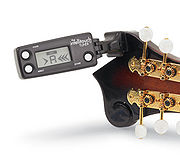
"Clip-on" tuners attach with a spring-loaded clip to an instrument (commonly at the headstock
Headstock
Headstock or peghead is a part of guitar or similar stringed instrument. The main function of a headstock is holding the instrument's strings. Strings go from the bridge past the nut and are usually fixed on machine heads on headstock...
of a guitar or scroll
Scroll (music)
A scroll is the decoratively carved end of the neck of certain stringed instruments, mainly members of the violin family. The scroll is typically carved in the shape of a volute according to a canonical pattern, although some violins are adorned with carved heads, human and animal. The quality of...
of a violin) and pick up vibrations, rather than using a microphone or input jack to sense the input frequency. The tuner then displays the pitch of the instrument's vibration on its large LCD display. Clip-on tuners are less likely to be confused by background noise than a microphone-based tuner, because the clip-on tuners pick up the vibrations of the instrument directly from the body of the instrument. The pioneer of the clip-on tuner industry was the Intellitouch PT1
Intellitouch Tuner
The Intellitouch Tuner is a tuner that can clip on to instruments such as the guitar, ukulele, violin, trombone, and many others. The Intellitouch tuner is a vibration-based tuner, which gives it many advantages over traditional microphone-based tuners...
built by OnBoard Research Corporation.
The "String Master" tuner consists of a regular LED tuner where the electric instrument plugs into the unit's base with a 1/4" TRS
TRS connector
A TRS connector is a common family of connector typically used for analog signals including audio. It is cylindrical in shape, typically with three contacts, although sometimes with two or four . It is also called an audio jack, phone jack, phone plug, and jack plug...
cable, or an acoustic instrument via a microphone cable. The unit has a built-in motor which drives a string winder tool at the top to the unit. The unit is then placed over the tuning button of the machine head
Machine head
A machine head is part of a string instrument ranging from guitars to double basses, a geared apparatus for applying tension and thereby tuning a string, usually located at the headstock. A headstock has several machine heads, one per string...
of the string to be tuned, and a note on the relevant string is played. The unit detects the input note and robot
Robot
A robot is a mechanical or virtual intelligent agent that can perform tasks automatically or with guidance, typically by remote control. In practice a robot is usually an electro-mechanical machine that is guided by computer and electronic programming. Robots can be autonomous, semi-autonomous or...
ically corrects the pitch to a desired frequency by mechanically turning the tuner button to the correct position. It monitors the change in frequency until the "in tune" signal is given.
Some electric guitar tuners are fitted to the instrument itself, such as the Sabine AX3000 and the "NTune" device. The NTune consists of a switching potentiometer
Potentiometer
A potentiometer , informally, a pot, is a three-terminal resistor with a sliding contact that forms an adjustable voltage divider. If only two terminals are used , it acts as a variable resistor or rheostat. Potentiometers are commonly used to control electrical devices such as volume controls on...
, a wiring harness, illuminated plastic display disc, a circuit board and a battery holder. The unit installs in place of an electric guitar's existing volume knob control. The unit functions as a regular volume knob when not in tuner mode. To operate the tuner, the player pulls the volume knob up. The tuner disconnects the guitar's output so the tuning process is not amplified. The lights on the illuminated ring, under the volume knob, indicate which note is being tuned. When the note is brought into tune a green "in tune" indicator light is illuminated. After tuning is complete the volume knob is pushed back down, disconnecting the tuner from the circuit and re-connecting the pickups to the output jack.
Gibson guitars
Gibson Guitar Corporation
The Gibson Guitar Corporation, formerly of Kalamazoo, Michigan and currently of Nashville, Tennessee, manufactures guitars and other instruments which sell under a variety of brand names...
released a model in 2008 called the "Robot Guitar
Gibson Robot Guitar
The Gibson Robot Guitar typically refers to a sub-class of Les Paul style guitars from Gibson. This is because the first run of limited edition Robot Guitars was exclusively made up of Les Paul bodies...
". It is a customized version of either the Les Paul
Gibson Les Paul
The Gibson Les Paul was the result of a design collaboration between Gibson Guitar Corporation and the late jazz guitarist and electronics inventor Les Paul. In 1950, with the introduction of the Fender Telecaster to the musical market, electric guitars became a public craze. In reaction, Gibson...
or SG
Gibson SG
At the launch of the SG in 1961, Gibson offered four variants of the SG; the SG Junior , the SG Special, the SG Standard, and the top-of-the-line SG Custom. However, Gibson's current core variants as of 2010 are the SG Standard and the SG Special...
model. The guitar is fitted with a special tailpiece, looking like a regular unit, with in-built sensors that pick up the frequency of the strings. There is an illuminated control knob with which the player can select different tuning options. The headstock
Headstock
Headstock or peghead is a part of guitar or similar stringed instrument. The main function of a headstock is holding the instrument's strings. Strings go from the bridge past the nut and are usually fixed on machine heads on headstock...
is fitted with custom-built motorized machine heads that automatically tune the guitar. This system can assist the player to intonate the guitar when the unit is put into "intonation" mode, displaying how much adjustment the bridge requires with a system of flashing LEDs on the control knob.
The first automated guitar tuner was invented by JD Richard in 1982 while studying Electrical Engineering at the University of New Brunswick, New Brunswick Canada. This tuner was based on phase-locked-looped feedback design that listened to the frequency of the string and turned a stepper motor (with a 400/1 gear ratio) attached to the tuning peg of the guitar. This first design never went into production although the thesis paper can still be obtained at the university.
Regular needle, LCD and LED display tuners
A needle, LCD or regular LED type tuner uses a microprocessor to measure the average period of the waveform. It uses this to then drive the needle or array of lights. The array of lights from LED that appears to move to left or right seems better than the meter needle of the early meter tuners. When the musician plays a single note, the tuner senses the input from the microphoneMicrophone
A microphone is an acoustic-to-electric transducer or sensor that converts sound into an electrical signal. In 1877, Emile Berliner invented the first microphone used as a telephone voice transmitter...
or input jack (from an electric instrument). The tuner then displays the input frequency in relation to the desired pitch and indicates whether the pitch of that note is lower, higher, or approximately equal to the desired pitch
Pitch (music)
Pitch is an auditory perceptual property that allows the ordering of sounds on a frequency-related scale.Pitches are compared as "higher" and "lower" in the sense associated with musical melodies,...
. With needle displays, the note is in tune when the needle is in a 90o vertical position, with leftward or rightward deviations indicating that the note is flat or sharp, respectively. Tuners with a needle are often supplied with a backlight
Backlight
A backlight is a form of illumination used in liquid crystal displays . As LCDs do not produce light themselves , they need illumination to produce a visible image...
, so that the display can be read on a darkened stage.
LEd
LEd is a TeX/LaTeX editing software working under Microsoft Windows. It is a freeware product....
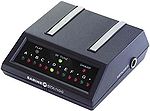
or LCD display tuners, markings on the readout drift left if the note is flat and right if the note is sharp from the desired pitch. If the input frequency is matched to the desired pitch frequency the LEDs are steady in the middle and an 'in tune' reading is given.
Some LCD displays mimic
Mimic
In evolutionary biology, mimicry is the similarity of one species to another which protects one or both. This similarity can be in appearance, behaviour, sound, scent and even location, with the mimics found in similar places to their models....
needle tuners with a needle graphic that moves in the same way as a genuine needle tuner. Somewhat misleadingly, many LED displays have a 'strobe mode' that mimics strobe tuners by scrolling the flashing of the LEDs cyclically to simulate the display of a true strobe. However, these are all just display options. The way a regular tuner 'hears' and compares the input note to a desired pitch is exactly the same, with no change in accuracy. For more on how strobe tuners work see the dedicated section.
The least expensive models only detect and display a small number of pitches, often those pitches that are required to tune a given instrument (e.g., E, A, D, G, B, E of standard guitar tuning). While this type of tuner is useful for bands that only use stringed instruments such as guitar and electric bass, it is not that useful for tuning brass or woodwind instruments. Tuners at the next price point offer "chromatic tuning", which means that the device will detect and assess all of the pitches in the chromatic scale (e.g., C, C#, D, D#, etc.). Chromatic tuners can thus be used for Bb and Eb brass instruments such as saxophones and horns.
Many models have circuitry that automatically detects which pitch is being played, and then compares it against the correct pitch. Less expensive models require the musician to specify the target pitch via a switch or slider. Most low- and mid-priced electronic tuners only allow tuning to an equal temperament
Equal temperament
An equal temperament is a musical temperament, or a system of tuning, in which every pair of adjacent notes has an identical frequency ratio. As pitch is perceived roughly as the logarithm of frequency, this means that the perceived "distance" from every note to its nearest neighbor is the same for...
scale.
Electric guitar
Electric guitar
An electric guitar is a guitar that uses the principle of direct electromagnetic induction to convert vibrations of its metal strings into electric audio signals. The signal generated by an electric guitar is too weak to drive a loudspeaker, so it is amplified before sending it to a loudspeaker...
and electric bass
Electric Bass
Electric bass can mean:*Electric upright bass, the electric version of a double bass*Electric bass guitar*Bass synthesizer*Big Mouth Billy Bass, a battery-powered singing fish...
players who perform concerts may use electronic tuners which are built into an effects pedal often called a "stomp box". These tuners have a rugged metal or heavy-duty plastic housing and a foot-operated switch to toggle between the tuner and a bypass mode. Professional guitarists may use a more expensive version of the LED tuner which is mounted in a rack-mount case, and has a larger range of LEDs, thus allowing a more accurate display of the flatness or sharpness. More expensive models allow the user to select reference pitches other than A440.
Baroque music
Baroque music describes a style of Western Classical music approximately extending from 1600 to 1760. This era follows the Renaissance and was followed in turn by the Classical era...
musicians playing period instruments perform at lower reference pitches such as A435. Some higher-priced electronic tuners allow tuning to a range of different temperaments, which is a feature of interest to some guitarists and to harpsichord players.
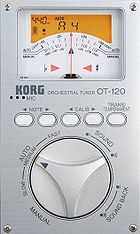
Some expensive tuners also include an on-board speaker and amplifier which can sound notes, either to facilitate tuning "by ear" or to act as a pitch reference point for intonation practice, while scales or arpeggios are being practiced. Another feature offered on the most expensive tuners is an adjustable "read time", which determines whether the circuitry will attempt to make a quick assessment of the pitch, or make its assessment over a longer period. Due to their combination of all the above mentioned features, very high-quality needle tuners are suitable for tuning the different types of instruments in an orchestra
Orchestra
An orchestra is a sizable instrumental ensemble that contains sections of string, brass, woodwind, and percussion instruments. The term orchestra derives from the Greek ορχήστρα, the name for the area in front of an ancient Greek stage reserved for the Greek chorus...
; these are sometimes called "orchestral tuners".
Strobe tuner
Personal computer
A personal computer is any general-purpose computer whose size, capabilities, and original sales price make it useful for individuals, and which is intended to be operated directly by an end-user with no intervening computer operator...
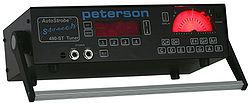
s. A strobe tuner shows the difference between a reference frequency and the musical note. Even the slightest difference between the two will show up as a rotating motion in the strobe display. The accuracy of the tuner is only limited by the internal frequency generator. The strobe tuner detects the pitch either from an TRS input jack or a built-in or external microphone connected to the tuner.
The first strobe tuner dates back to 1936 and was originally made by the Conn company; it was called the Stroboconn and was produced for approximately 40 years. However, these strobes are now mainly collector pieces. They had 12 strobe discs, driven by one motor. The gearing between discs was a very close approximation to the 12th root of two ratio. This tuner had an electrically driven temperature-compensated tuning fork; the electrical output of this fork was amplified to run the motor. The fork had sliding weights, an adjustment knob, and a dial to show the position of the weights. These weights permitted setting it to different reference frequencies (such as A4 = 435 Hz), although over a relatively narrow range, perhaps a whole tone. When set at A4 = 440 Hz the tuning fork produced a 55 Hz signal, which drove the four-pole 1650 RPM synchronous motor to which the A disc was mounted. (The other discs were all gear-driven off of this one.) Incoming audio was amplified to feed a long neon tube common to all 12 discs. Wind instrument repair people liked this tuner because it needed no adjustment to show different notes. Anyone who had to move this tuner around was less inclined to like it because of its size and weight: two record-player-sized cases of 30-40 pounds each.
The best known brand in strobe tuner technology is Peterson Tuners who in 1967 marketed their first strobe tuner, the "Model 400". Other companies, such as Sonic Research and Planet Waves, sell affordable LED-based true strobing tuners. There are other tuners with LEDs that have a 'strobe mode' which simulates the appearance of a strobe. However, the accuracy of these tuners when used in strobe mode is no better than when in any other mode, as it uses the same technique as a needle tuner to measure the frequency of the note, and then it sets the speed of the pattern in the LEDs instead of driving a needle.
How a Strobe tuner works

LEd
LEd is a TeX/LaTeX editing software working under Microsoft Windows. It is a freeware product....
s powered by amplified audio from the instrument; they flash (or strobe) at the same frequency as the input signal. For instance an 'A' played on a guitar's 6th string at the 5th fret has the frequency of 110 Hz
Hertz
The hertz is the SI unit of frequency defined as the number of cycles per second of a periodic phenomenon. One of its most common uses is the description of the sine wave, particularly those used in radio and audio applications....
when in tune. An 'A' played on the 1st string at the 5th fret vibrates at 440 Hz. As such, the lamps would flash either 110 or 440 times per second in the above examples. In front of these flashing lights is a motor-driven, translucent printed disc with rings of alternating transparent and opaque sectors.
This disc rotates at a fixed specific speed, set by the user. Each disc rotation speed is set to a particular frequency of the desired note. If the note being played (and making the lamps behind the disc flash) is at exactly the same frequency as the spinning of the disc, then the disc appears to be static (due to an optical illusion
Optical illusion
An optical illusion is characterized by visually perceived images that differ from objective reality. The information gathered by the eye is processed in the brain to give a perception that does not tally with a physical measurement of the stimulus source...
) from the strobing effect. If the note is out of tune then the pattern appears to be moving as the light flashing and the disc rotation are out of sync from each other. The more out of tune the played note is, the faster the pattern seems to be moving, although in reality it always spins at the same speed for a given note.
Many good turntables for vinyl disc records have stroboscopic patterns lit by the incoming AC power (mains). The power frequency, either 50 or 60 Hz, serves as the reference, although commercial power frequency is sometimes shifted slightly to meet load demand. The operating principle is the same; although turntable speed is adjusted to stop drifting of the pattern.

Strobe units can often be calibrated for many tunings and preset temperaments and allow for custom temperament programming, stretched tuning
Stretched tuning
Stretched tuning is a detail of musical tuning, applied to wire-stringed musical instruments, older, non-digital electric pianos , and some sample-based synthesizers based on these instruments, to accommodate the natural inharmonicity of their vibrating elements...
, "sweetened" temperament tunings and Buzz Feiten
Buzz Feiten
Howard "Buzz" Feiten is a North American singer-songwriter, guitarist, and session musician.He is best known as a lead and rhythm electric guitarist, and for having patented a unique, scientifically designed tuning system which re-configures its stringboard / neck for more accurate tonality...
tuning modifications. Due to their accuracy and ability to display partials even on instruments with a very short 'voice', strobe tuners can perform tuning tasks that would be very difficult, if not impossible, for needle-type tuners. For instance, needle/LED display type tuners cannot track the signal to identify a tone of the Caribbean steelpan
Steelpan
Steelpans is a musical instrument originating from The Republic of Trinidad and Tobago...
(often nicknamed the "steeldrum") due to its very short 'voice'. A tuner needs to able to detect the first few partials for tuning such an instrument, which means that only a strobe tuner can be used for steelpan tuning. This is also true of musical pins used in music producing machines like Music Boxes and the like. In such cases a technician has to physically trim off metal from the pin to reach the desired note. The metal pin will only resonate a little when struck. Great accuracy is required as once the metal is trimmed or filed a permanent change in the pin takes place. As such, the strobe-type tuners are the unit of choice for such tasks. Tuners with an accuracy of better than 0.2 cent are required for guitar intonation tuning.
One of the most expensive strobe tuners is the Peterson "Strobe Center", which has twelve separate mechanical strobe displays; one for each note in the chromatic scale. This unit (retailing at about $3,500 US) can tune multiple notes of a sound or chord, displaying each note's overtone sub-structure simultaneously. This gives an overall picture of tuning within a sound, note or chord
Chord (music)
A chord in music is any harmonic set of two–three or more notes that is heard as if sounding simultaneously. These need not actually be played together: arpeggios and broken chords may for many practical and theoretical purposes be understood as chords...
, which is not possible with any other tuning device. It is often used for tuning complex instruments/sound sources or difficult-to-tune instruments where the technician requires a very accurate and complete aural picture of an instrument's output. For instance, when tuning musical bell
Bell (instrument)
A bell is a simple sound-making device. The bell is a percussion instrument and an idiophone. Its form is usually a hollow, cup-shaped object, which resonates upon being struck...
s, this model will display several of the bell's partials (hum, second partial, tierce
Organ stop
An organ stop is a component of a pipe organ that admits pressurized air to a set of organ pipes. Its name comes from the fact that stops can be used selectively by the organist; some can be "on" , while others can be "off" .The term can also refer...
, quint and nominal/naming note) as well as the prime, and each of their partials, on separate displays. The unit is heavy and fragile, and it requires a regular maintenance schedule. Each of the twelve displays requires re-calibration over time, dependent on how much it is used. It can be used to teach students about note substructures, which are displayed on the separate strobing displays.
Strobe developments
Mechanical disc strobe tuners are expensive, bulky, delicate, and require periodic maintenance (keeping the motor that spins the disc at the correct speed, replacing the strobing LED backlight, etc.).For many, a mechanical strobe tuner is simply not practical for one or all of the above reasons. To address these issues, in 2001 Peterson Tuners added a line of non-mechanical electronic strobe tuners that have LCD dot-matrix displays mimicking a mechanical strobe disc display, giving a stroboscopic effect. In 2004 Peterson made a model of LCD strobe in a sturdy floor based "stomp box" for live on-stage use.
Virtual strobe tuners are as accurate as standard mechanical disc strobe tuners. However, there are limitations to the virtual system compared to the disc strobes. The virtual strobes display fewer bands to read note information and it does not pick up harmonic partials like a disc strobe. Rather, each band on a virtual strobe represents octaves of the fundamental being played. On a disc strobe there is "one band correspondence", where each band displays a particular frequency of the note being played. On the virtual strobe system, each band has a few close frequencies combined for ease of reading from an LCD display. This is still accurate for tuning and intonating most instruments, but for instruments where more information on partials is required, like idiophone
Idiophone
An idiophone is any musical instrument which creates sound primarily by way of the instrument's vibrating, without the use of strings or membranes. It is the first of the four main divisions in the original Hornbostel-Sachs scheme of musical instrument classification...
s, there is not a clear separation of the partials.
Sonic Research and Planet Waves both released a true-strobe with a bank of LEDs arranged in a circle that gives a strobing effect based upon the frequency of the input note.
Both LCD and LED display true strobes do not require mechanical servicing and are much cheaper than the mechanical types. As such, they are a popular option for musicians who want the accuracy of a strobe without the high cost and maintenance schedule. However, LED strobe displays offer no information about the harmonic structure of a note, unlike LCD types which do offer four bands of consolidated information.
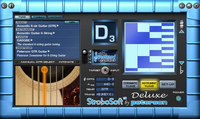
In 2009 Peterson Tuners released a VirtualStrobe tuner as an end-user application add-on for Apple's iPhone
IPhone
The iPhone is a line of Internet and multimedia-enabled smartphones marketed by Apple Inc. The first iPhone was unveiled by Steve Jobs, then CEO of Apple, on January 9, 2007, and released on June 29, 2007...
and iPod Touch
IPod Touch
The iPod Touch is a portable media player, personal digital assistant, handheld game console, and Wi-Fi mobile device designed and marketed by Apple Inc. The iPod Touch adds the multi-touch graphical user interface to the iPod line...
where the application is bought cheaply as a download and installed onto the unit. There's a special 1/4" TRS jack adapter for connecting an electric instrument to the iPhone. This is a very notable achievement in strobe tuner technology, making such tuning widely available to many. However, a compatible iPod or iPhone must already be owned to utilize this application.
As both mechanical and electronic strobes are still much more expensive ($200 to about $3,500 US) than regular tuners (around $10–$100) their use is usually limited to people who tune piano
Piano
The piano is a musical instrument played by means of a keyboard. It is one of the most popular instruments in the world. Widely used in classical and jazz music for solo performances, ensemble use, chamber music and accompaniment, the piano is also very popular as an aid to composing and rehearsal...
s, harp
Harp
The harp is a multi-stringed instrument which has the plane of its strings positioned perpendicularly to the soundboard. Organologically, it is in the general category of chordophones and has its own sub category . All harps have a neck, resonator and strings...
s, and early instruments (e.g., harpsichord
Harpsichord
A harpsichord is a musical instrument played by means of a keyboard. It produces sound by plucking a string when a key is pressed.In the narrow sense, "harpsichord" designates only the large wing-shaped instruments in which the strings are perpendicular to the keyboard...
s) or accurately intonate instruments on a regular basis, such as luthier
Luthier
A luthier is someone who makes or repairs lutes and other string instruments. In the United States, the term is used interchangeably with a term for the specialty of each maker, such as violinmaker, guitar maker, lute maker, etc...
s, instrument restorers and technicians. These tuners make the intonation
Intonation
Intonation may refer to:*Intonation , the variation of tone used when speaking*Intonation , a musician's realization of pitch accuracy, or the pitch accuracy of a musical instrument*Intonation Music Festival, held in Chicago...
process more precise, which is important for the correct set-up of an instrument. Low cost tuners with an accuracy of at least 1 cent do not work well for guitar intonation tuning.
Classical music
In classical music, there is a longstanding tradition to tune "by ear", by adjusting the pitch of instruments to a reference pitch. In an orchestra, the oboe player gives a 440 Hz "A", and the different instrument sections tune to this note. In chamber music, either one of the woodwind players gives an "A", or if there are no wind players, the first violinist plays their open "A" string. More rarely, the cello player from a string quartet may give the tuning "A". Despite this tradition for tuning by ear, electronic tuners are still widely used in classical music. In orchestras, the oboist who plays the tuning "A" often has a high-end electronic tuner to ensure that his or her "A" is correct. As well, other brass or woodwind players may use electronic tuners to ensure that their instruments are correctly tuned. Classical performers also use tuners off-stage, for practice purposes, either to check their tuning or practice ear training with tuners that sound notes with a speaker.Electronic tuners are also used in opera orchestras for offstage trumpet effects. In offstage trumpet effects, the trumpet player performs a melody from the backstage or from a hallway behind the stage, creating a haunting, muted effect. Since the trumpet player cannot hear the orchestra, they cannot know if they are in tune with the rest of the ensemble; to resolve this problem, some trumpet players use a high-end, sensitive tuner so that they can monitor the pitch of their notes.
Piano tuners, harp makers, and early instrument restorers and makers (e.g., harpsichords) use high-end tuners to assist with their tuning. Even piano tuners who work mostly "by ear" may use an electronic tuner to tune the first note on the piano, to which they then adjust the other notes. Piano tuners may also use electronic tuners to get a very out-of-tune piano roughly in pitch, after which point they will tune by ear.
Popular and folk music
In popular music, amateur bands from styles as varied as country and heavy metal use electronic tuners to ensure that the guitars and electric bass are correctly tuned.In loud popular music genres, such as rock, there is a great deal of stage volume, so it would be difficult to tune "by ear". Electronic tuners are helpful aids at jam sessions where a number of players are sharing the stage, because it helps all of the players to have their instruments tuned to the same pitch, even if they have come to the session halfway through. Tuners are helpful with acoustic instruments, because they are more affected by temperature and humidity changes. An acoustic guitar or upright bass that is perfectly in tune backstage will change in pitch under the heat of the stage lights and from the humidity from thousands of dancing audience members.
Tuners are used by guitar technicians
Guitar technician
A guitar technician is a member of a music ensemble's road crew who maintains and sets up the musical equipment for one or more guitarists during a concert tour...
who are hired by rock and pop bands to ensure that all of the band's instruments are ready to play at all times. Guitar technicians (often called guitar techs) tune all of the instruments (electric guitars, electric basses, acoustic guitars, mandolins, etc.) before the show, after they are played, and before they are used onstage. Whereas amateur musicians will typically use a relatively inexpensive quartz tuner, guitar technicians typically use expensive, high-end tuners such as strobe tuners. (Most strobe tuners, counter-intuitively, also use quartz crystal oscillators as time references, although the responses are processed differently by the different units.)