
All Topics  
Electronic keyboard

 
Electronic Keyboard

   Email Print
   Bookmark   Link


Electronic keyboard


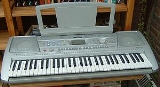
An electronic keyboard or digital keyboard is a type of keyboard instrument
Keyboard instrument

A keyboard instrument is any musical instrument played using a musical keyboard. The most common of these is the piano. Other widely used keyboard instruments include various types of organ s as well as other mechanical, electromechanical and electronic musical instrument....
. Its sound is generated or amplified by one or more electronic devices.

Electronic keyboards perhaps were most popular in the 1980s, and are closely related to 1980s pop and New Wave music
New Wave music

New Wave is a genre of rock music which originated from the late 1970s. It emerged from punk rock as a reaction against the popular music of the 1970s....
, but they have remained popular since.

Modern usage of the term "electronic keyboard" typically describes a type of inexpensive sampler
Sampler (musical instrument)

A sampler is an electronic musical instrument closely related to a synthesizer. Instead of generating sounds from scratch, however, a sampler starts with multiple recordings of different sounds added by the user, and then plays each back based on how the instrument is configured....
 marketed to amateurs and children.


Discussion
Ask a question about 'Electronic keyboard'
Start a new discussion about 'Electronic keyboard'
Answer questions from other users
Full Discussion Forum


Recent Posts


Encyclopedia


Yamahakeyboard
An electronic keyboard or digital keyboard is a type of keyboard instrument
Keyboard instrument

A keyboard instrument is any musical instrument played using a musical keyboard. The most common of these is the piano. Other widely used keyboard instruments include various types of organ s as well as other mechanical, electromechanical and electronic musical instrument....
. Its sound is generated or amplified by one or more electronic devices.

Electronic keyboards perhaps were most popular in the 1980s, and are closely related to 1980s pop and New Wave music
New Wave music

New Wave is a genre of rock music which originated from the late 1970s. It emerged from punk rock as a reaction against the popular music of the 1970s....
, but they have remained popular since.

Modern usage of the term "electronic keyboard" typically describes a type of inexpensive sampler
Sampler (musical instrument)

A sampler is an electronic musical instrument closely related to a synthesizer. Instead of generating sounds from scratch, however, a sampler starts with multiple recordings of different sounds added by the user, and then plays each back based on how the instrument is configured....
 marketed to amateurs and children. The term is occasionally used as an umbrella descriptor for any electronic musical instrument
Electronic musical instrument

An electronic musical instrument is a musical instrument that produces its sounds using electronics. In contrast, the term electric instrument is used to mean instruments whose sound is produced mechanically, and only amplified or altered electronically - for example an electric guitar....
s with a musical keyboard
Musical keyboard

A musical keyboard is the set of adjacent depressible levers or keys on a musical instrument, particularly the piano. Keyboards typically contain keys for playing the twelve notes of the Western musical scale, with a combination of larger, longer keys and smaller, shorter keys that repeats at the interval of an octave....
 (including but not limited to electric piano
Electric piano

An electric piano is an electric musical instrument. The popularity of the electric piano began to grow in the late 1960s, reaching its greatest height during the 1970s....
s, digital piano
Digital piano

A digital piano is a modern electronic musical instrument designed to serve primarily as an alternative to a traditional piano, both in the way it feels to play and in the sound produced....
s, synthesizer
Synthesizer

A synthesizer is an electronic instrument capable of producing a variety of sounds by generating and combining signals of different frequency....
s, mellotron
Mellotron

The Mellotron is an electro-mechanical, polyphony keyboard originally developed and built in Birmingham, England in the early 1960s. It superseded the Chamberlin, which was the world's first sampling keyboard....
s, sampler
Sampler (musical instrument)

A sampler is an electronic musical instrument closely related to a synthesizer. Instead of generating sounds from scratch, however, a sampler starts with multiple recordings of different sounds added by the user, and then plays each back based on how the instrument is configured....
s, electronic organ
Electronic organ

An electronic organ is an electronic keyboard instrument originally designed to imitate the sound of a pipe organ. It has developed today into two forms of the instrument, the digital church organ that imitates a pipe organ for classical music and use in churches, and the Hammond organ-style instrument used in more popular music genres....
s, and arranger keyboards) but professional musicians generally refer to these instruments by name or simply as "keyboards", reserving the term "electronic keyboard" for the inexpensive type noted above.

Such electronic keyboard instruments are typically inexpensive, smaller, with mediocre sound quality, and lack many features offered by professional instruments. They can generally be located in electronics stores side-by-side with stereos, video games and the like, or even in toy stores.

However, the line between "professional" and "amateur" instruments can often be blurred: professional musicians may use inexpensive keyboards for novelty or out of necessity (for example, reggae
Reggae

Reggae is a music genre first developed in Jamaica in the late 1960s.While sometimes used in a broader sense to refer to most types of Music of Jamaica, the term reggae more properly denotes a particular music style that originated following on the development of ska and rocksteady....
 music in the '80s made frequent use of pre-programmed rhythm patterns on inexpensive digital keyboards), and due to advances in computer and electronics technology, many relatively inexpensive keyboards (under US$1000) have an array of features that would have been unavailable on even the most expensive synthesizers of past decades.

Internal architecture

To facilitate the engineering processes of design and development of electronic keyboards, keyboards divided into major components:
  • Musical keyboard
    Musical keyboard

    A musical keyboard is the set of adjacent depressible levers or keys on a musical instrument, particularly the piano. Keyboards typically contain keys for playing the twelve notes of the Western musical scale, with a combination of larger, longer keys and smaller, shorter keys that repeats at the interval of an octave....
    : An electro-mechanical component connects the switches when the key is depressed, which triggers the note or other sound. Most keyboards use a keyboard matrix circuit
    Keyboard matrix (music)

    Most electronic musical keyboards used in synthesizers, electronic organs, and digital pianos use a keyboard matrix circuit to connect the switches for each key....
     to reduce the amount of wiring that is needed.
  • User interface software: A program (usually embedded in a chip) which handles user interaction with control keys and menus, which allows the user to select tones (e.g., piano, organ, flute), effects (echo or sustain), and other features (e.g., transposition)
  • Rhythm & chord generator: This part which is again in the form of software program produces rhythms and chords by the mean of MIDI commands.
  • Sound generator: An electronic sound module
    Sound module

    A sound module is an electronic musical instrument without a human-playable interface such as a Musical keyboard, for example. Sound modules have to be "played" using an externally connected device....
    , typically contained within an integrated circuit or chip, which is capable of accepting MIDI commands and producing sounds.
  • Amplifier and speaker: a low-powered audio amplifier and a small speaker that amplify the sounds so that the listener can hear them.


Pre-programmed features

  • Auto accompaniment: Auto accompaniment is used on programmed styles to trigger specific chords that will sound on the style.
  • Demonstration: Programmed demo songs loaded on the RAM
    Ram

    Ram, ram, or RAM as a non-acronymic wordAs a non-acronymic word Ram, ram, or RAM may refer to:...
     of keyboards can help users for entertainment or add to their learned songs.


Concepts and definitions

  • Touch response (also called Touch Sensitivity or found under the keyword Velocity in some keyboard manuals) : While the least expensive keyboards are simply "on-off" switches, mid-range and higher-range instruments incorporate simulating the process of sound generation in chordophone
    Chordophone

    A Chordophone is any musical instrument which makes sound by way of a vibrating string or strings stretched between two points. It is one of the four main divisions of instruments in the original Hornbostel-Sachs scheme of musical instrument classification....
    s which are sensitive to the velocity of a key press. For implementation two sensors are installed for each key: a sensor detects whenever a key is beginning to be pressed and the other fired when the key is pressed completely. By a time reference a device can estimate the velocity of pressure. As the key mass is constant this velocity can also be considered as the strength of key press. Based on this value, the sound generator produces the appropriate loud or soft sound.


  • After touch : A feature brought in in the late 1980s, whereby dynamics are added after the key is hit, allowing the sound to be modulated in some way (such as fade away or return), based upon the amount of pressure applied to the keyboard. After-touch is found on many synthesizers, and is an important modulation source on modern keyboards. After-touch is most prevalent in music of the mid to late 1980s, such as the opening string-pad on Cock Robin's
    Cock Robin (band)

    Cock Robin is a United States pop-rock musical ensemble, mostly popular in the 1980s, particularly in Europe where they were to become famous. The band was founded by singer-songwriter Peter Kingsbery in 1982, split up in 1990, and was reformed in 2006....
     "When Your Heart Is Weak", which is only possible with the use of after-touch (or one hand on the volume control).


  • Polyphony
    Polyphony (instrument)

    Polyphony is the property of an electronic musical instrument which describes how many notes it can sound at one time. An instrument which can produce multiple notes at a time is said to be polyphonic....
    : In digital music and electronic keyboard terminology, polyphony refers to the number of notes that can be played concurrently. Some of the least expensive toy electronic keyboards designed for children can only play one note at a time. Many low-priced keyboards can perform polyphonic parts, but they are often limited to four or five notes at a time. Better-quality keyboards can perform over ten notes at a time.


  • Multi-timbre: The ability to play more than one kind of instrument sound at the same time. Such as with the Roland MT-32's ability to play up to eight different instruments at once.


  • Tempo: A parameter that determines the speed of rhythms, chords and other auto-generated content on electronic keyboards. The unit of this parameter is beats per minute.


  • Split point: The point where a keyboard is split to allow two instrument sounds to be played at once on a single keyboard. In the late 1980s it was common to use a MIDI controller to control more than one keyboard from a single device. The MIDI controller had no sound of its own, but was designed for the sole purpose of allowing access to more sound controls for performance purposes. Midi controllers allowed one to split the keyboard into two or more sections and assign each section to a midi channel, to send note data to an external keyboard. Many consumer keyboards offer at least one split to separate bass or auto-accompaniment chording instruments from the melody instrument.


  • Style: Pre-programmed styles, usually depend on the chord given by the player, consist of a variety of genres for the player to use.


  • Synchronization: Usually, styles on keyboards nowadays compose of two to four sections, so adding transition effects, called syncs, can add that realistic effect that a listener and a player wants to have.


  • Auto harmony: A feature of some keyboards that automatically adds secondary tones to a note based upon chording given by the accompaniment system, made to make harmony easier for those who lack the ability to make complex chording changes with their left hand.


  • Wheels and knobs: Used in performances to add qualities to a sound that are not present by default, such as vibrato, panning, tremolo, pitch changes, and so on. Maybe the most common wheel on contemporary keyboards is the pitch bend which is used to change the pitch of a note in a range of ±1 tone
    Tone

    Tone may refer to:...
    . The pitch bend (wheel) is usually on the left of the keyboard and it is spring loaded.


  • Keyboard response: Weighted or spring loaded keys. "Weighted response" refers to keys with weights and springs in them, which give a "hammer action" response similar to a piano. Most electronic keyboards use "spring-loaded" keys that make some kinds of playing techniques, such as backhanded sweeps, impossible but also make the keyboards lighter and easier to transport. Pianists who are accustomed to standard weighted piano keys may find non-weighted spring-action keyboards uncomfortable and difficult to play effectively. Conversely, keyboard players who are used to the non-weighted action may encounter difficulty and discomfort playing on a piano or electronic piano with weighted keys.


MIDI controls

Electronic keyboards typically use MIDI signals to send and receive data, a standard format now universally used across most digital electronic musical instruments. On the simplest example of an electronic keyboard, MIDI signals would be sent when a note is pressed on the keyboard, and would determine which note is pressed and for how long. Additionally, most electronic keyboards now have a "touch sensitivity", or "touch response" function which operates by an extra sensor in each key, which estimates the pressure of each note being pressed by the difference in time between when the key begins to be pressed and when it is pressed completely. The values calculated by these sensors are then converted into MIDI data which gives a velocity value for each note, which is usually directly proportional to amplitude of the note when played.

MIDI data can also be used to add digital effects to the sounds played, such as reverb, chorus
Chorus

Chorus may refer to:...
, delay and tremolo
Tremolo

Tremolo, or tremolando, is a Musical terminology with several meanings:* A regular and repetitive variation in amplitude for the duration of a single note; this is the most common meaning....
. These effects are usually mapped to three of the 127 MIDI controls within the keyboard's infrastructure — one for reverb, one for chorus and one for other effects — and are generally configurable through the keyboard's graphical interface. Additionally, many keyboards have "auto-harmony" effects which will complement each note played with one or more notes of higher or lower pitch, to create an interval
Interval (music)

In music theory, the term interval describes the relationship between the pitch of two notes.Intervals may be described as:*vertical if the two notes sound simultaneously...
 or chord
Chord

Chord may mean:* Chord , a aggregate of musical pitches sounded simultaneously.** Guitar chord an aggregate of musical pitches played simultaneously on a guitar...
.

DSP effects can also be controlled on the fly by physical controllers. Electronic keyboards often have two wheels on the left hand side, generally known as a pitch bend and a modulation wheel. The difference between these is that the pitch bend wheel always flicks back to its default position — the centre — while the modulation wheel can be placed freely. By default, the pitch bend wheel controls the pitch of the note in small values, allowing the simulation of slides and other techniques which control the pitch more subtlely. The modulation wheel is usually set to control a tremolo effect by default. However, on most electronic keyboards, the user will be able to map any MIDI control to these wheels. Professional MIDI controller keyboards often also have an array of knobs and sliders to modulate various MIDI controls, which are often used to control DSP effects.

Most electronic keyboards also have a socket at the back, into which a foot switch can be plugged. These are often called "sustain pedals" by keyboardists, as their most common function is to simulate the sustain pedal
Sustain pedal

A sustain pedal or sustaining pedal is the most commonly used piano pedals in a modern piano. It is typically the rightmost of two or three pedals....
 on a piano by turning on and off the MIDI control which adds sustain to a note. However, since they are also simple MIDI devices, foot switches can usually be configured to turn on and off any MIDI control, such as turning of one of the DSP effects, or the auto-harmony.

A partial list of manufacturers

  • Alesis
    Alesis

    Alesis is a manufacturer of electronic musical instruments owned by Numark and based in Cumberland, Rhode Island, Rhode Island....
  • Casio
    Casio

    is a multinational electronic devices manufacturing corporation founded in 1946, with its headquarters in Shibuya, Tokyo, Tokyo, Japan. Casio is best known for its calculators, sound reproduction equipment, Personal digital assistants, cameras, musical instruments, and watches....
  • Ensoniq
    Ensoniq

    Ensoniq Corp. was an United States electronics manufacturer, best known throughout the mid 1980s and 1990s for its musical instruments, principally Sampler s and synthesizers....
  • E-mu
  • Kawai
    Kawai

    The Kawai Musical Instruments Manufacturing Co. Ltd. of Japan is best known for its pianos, electronic keyboards & electronic synthesizers. The company was established in August, 1927, and is headquartered in Hamamatsu, Shizuoka....
  • Ketron
  • Korg
    Korg

    is a Japanese multinational corporation that manufactures electronics musical instruments and electronic tuners. The company is one of the most widely used and respected names in professional music worldwide....
  • Kurzweil Music Systems
    Kurzweil Music Systems

    Kurzweil Music Systems is a company that produces electronic musical instruments for professionals and home users. Founded in 1982 by Raymond Kurzweil, a developer of Optical character recognition for the blindness, the company made use of many of the technologies originally designed for reading machines and adapted them to musical purposes....
  • M-Audio
    M-Audio

    M-Audio , a business unit of Avid Technology, is a manufacturer of a variety of audio products, including digital audio workstation interfaces, Musical keyboard MIDI controllers, condenser microphones, and studio monitors....
  • Moog Music
    Moog Music

    Moog Music is an United States of America company based in Asheville, North Carolina which manufactures electronic musical instruments. The current Moog Music is the second company to trade under that name....
  • Ne-Ko
  • Roland
    Roland Corporation

    is a Japanese manufacturer of electronic musical instruments, electronic equipment and software. It was founded by Ikutaro Kakehashi in Osaka on April 18, 1972, with ?33 million in capital....
  • Technics
    Technics

    Technics may refer to:* Technics , a brand name of the Panasonic Corporation* Technics , a legal concept...
  • Yamaha
  • Sonic
    Sonic

    Sonic may refer to:*Sonic, , of or relating to audible sounds.*-sonic-, a Prefix /infix/suffix for words with meanings that relate to acoustics....


See also

  • Synthesizer
    Synthesizer

    A synthesizer is an electronic instrument capable of producing a variety of sounds by generating and combining signals of different frequency....
  • Keyboard instruments
  • Keyboard Magazine
    Keyboard Magazine

    Keyboard Magazine is a magazine that originally covered electronic keyboard instruments and keyboardists, though with the advent of computer based recording and audio technology, they have added digital music technology to their regular coverage, including those not strictly pertaining to the keyboard related instruments....


External links

  • -- Famous players, suggested listening, and history