
All Topics  
Electrical synapse


   Email Print
   Bookmark   Link


Electrical synapse


An electrical synapse is a mechanical and electrically conductive link between two abutting neuron
Neuron

Neurons are responsive cell in the nervous system that process and transmit information by electrochemical Signal . They are the core components of the brain, the vertebrate spinal cord, the invertebrate ventral nerve cord, and the peripheral nerves....
 cell
Cell (biology)

The cell is the structural and functional unit of all known Life organisms. It is the smallest unit of an organism that is classified as living, and is often called the building bricks of life....
s that is formed at a narrow gap between the pre- and postsynaptic cells known as a gap junction
Gap junction

A gap junction or nexus is a specialized intercellular connection between certain animal cell -types. It directly connects the cytoplasm of two cells, which allows various molecules and ions to pass freely between cells....
. At gap junctions, such cells approach within about 3.5 nm of each other (Kandel et al. 2000), a much shorter distance than the 20 to 40 nm distance that separates cells at chemical synapse
Chemical synapse

Chemical synapses are specialized junctions through which neurons signal to each other and to non-neuronal cells such as those in neuromuscular junctions or glands....
 (Hormuzdi et al. 2004).


Discussion
Ask a question about 'Electrical synapse'
Start a new discussion about 'Electrical synapse'
Answer questions from other users
Full Discussion Forum


Recent Posts


Encyclopedia


An electrical synapse is a mechanical and electrically conductive link between two abutting neuron
Neuron

Neurons are responsive cell in the nervous system that process and transmit information by electrochemical Signal . They are the core components of the brain, the vertebrate spinal cord, the invertebrate ventral nerve cord, and the peripheral nerves....
 cell
Cell (biology)

The cell is the structural and functional unit of all known Life organisms. It is the smallest unit of an organism that is classified as living, and is often called the building bricks of life....
s that is formed at a narrow gap between the pre- and postsynaptic cells known as a gap junction
Gap junction

A gap junction or nexus is a specialized intercellular connection between certain animal cell -types. It directly connects the cytoplasm of two cells, which allows various molecules and ions to pass freely between cells....
. At gap junctions, such cells approach within about 3.5 nm of each other (Kandel et al. 2000), a much shorter distance than the 20 to 40 nm distance that separates cells at chemical synapse
Chemical synapse

Chemical synapses are specialized junctions through which neurons signal to each other and to non-neuronal cells such as those in neuromuscular junctions or glands....
 (Hormuzdi et al. 2004). In organisms, electrical synapse-based systems co-exist with chemical synapses.

Compared to chemical synapse
Chemical synapse

Chemical synapses are specialized junctions through which neurons signal to each other and to non-neuronal cells such as those in neuromuscular junctions or glands....
s, electrical synapses conduct nerve impulses faster, but unlike chemical synapses they do not have gain (the signal in the post synaptic neuron is always smaller than that of the originating neuron). Electrical synapses are often found in neural systems that require the fastest possible response, such as defensive reflexes. An important characteristic of electrical synapses is that most of the time, they are bidirectional, i.e. they allow impulse transmission in either direction. However, some gap junctions do allow for communication in only one direction.

Structure

Gap Cell Junction
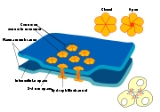
Each gap junction (aka nexus junction) contains numerous gap junction channel
Ion channel

Ion channels are pore-forming proteins that help establish and control the small voltage gradient across the plasma membrane of all living cell s by allowing the flow of ions down their electrochemical gradient....
s which cross the membranes
Cell membrane

The cell membrane is the interface between the cellular machinery inside the cell and the fluid outside.It is a semipermeable lipid bilayer found in all cell ....
 of both cells (Gibson et al., 2004). With a lumen diameter of about 1.2 to 2.0 nm (Bennet and Zukin, 2004; Hormuzdi et al., 2004), the pore of a gap junction channel is wide enough to allow ions and even medium sized molecules like signaling molecules to flow from one cell to the next (Kandel et al., 2000, p. 178-180; Hormuzdi et al., 2004), thereby connecting the two cells' cytoplasm
Cytoplasm

The cytoplasm is the part of a Cell that is enclosed within the plasma membrane. In eukaryote cells the cytoplasm contains organelles, such as mitochondrion, that are filled with liquid kept separate from the rest of the cytoplasm by biological membranes....
. Thus when the voltage of one cell changes, ion
Ion

An ion is an atom or molecule which has lost or gained one or more electrons, giving it a positive or negative electrical charge. According to the Bohr_model this will be from or in the outer shield 'n'....
s may move through from one cell to the next, carrying positive charge with them and depolarizing the postsynaptic cell.

Gap junction funnels are composed of two hemi-channels called connexon
Connexon

In biology, a connexon is an assembly of 6 proteins called connexins that forms a bridge called a gap junction between the cytoplasm of two adjacent cell ....
s in vertebrates, one contributed by each cell at the synapse (Kandel et al., 2000, p. 178; Bennet and Zukin, 2004; Hormuzdi et al., 2004). Connexons are formed by six 7.5 nm long, four-pass membrane-spanning protein
Protein

Proteins are organic compounds made of amino acids arranged in a linear chain and joined together by peptide bonds between the carboxyl and amino groups of adjacent amino acid Residue ....
 subunits called connexin
Connexin

Connexins, or gap junction proteins, are a family of structurally-related transmembrane proteins that assemble to form vertebrate gap junctions ....
s, which may be identical or slightly different from one another (Bennet and Zukin, 2004).

Effects

The simplicity of electrical synapses results in synapses that are fast, but can only produce simple behaviours compared to the more complex chemical synapse
Chemical synapse

Chemical synapses are specialized junctions through which neurons signal to each other and to non-neuronal cells such as those in neuromuscular junctions or glands....
s.
  • Without the need for receptors to recognize chemical messengers, signaling at electrical synapses is more rapid than that which occurs across chemical synapses, the predominant kind of junctions between neurons. The synaptic delay for a chemical synapse is typically about 2 ms, while the synaptic delay for an electrical synapse may be about 0.2 ms. However, the difference in speed between chemical and electrical synapses is not as important in mammals as it is in cold-blooded animals (Bennet and Zukin, 2004).
  • The response is always the same sign as the source. An excitation cannot produce an inhibiting response.
  • Electrical synapses do not have gain - the induced response is always smaller than the original signal in the source neuron. Also, the response depends on the relative sizes of the cells - a small pre-synaptic cell cannot produce much effect in a larger post-synaptic cell, unlike a chemical neuron.
  • There is little mechanism suited for making long-term changes in the properties of an electrical synapse.


The relative speed of electrical synapses also allows for many neurons to fire synchronously (Kandel et al., 2000, p. 180; Bennet and Zukin, 2004; Gibson et al., 2004). Because of the speed of transmission, electrical synapses are found in escape mechanisms and other processes that require quick responses, such as the response to danger of the sea hare
Sea hare

The suborder Aplysiomorpha or Sea hares are very large sea slugs with a soft internal shell made of protein. These are marine gastropod molluscs in the superfamilies Aplysioidea and Akeroidea....
 Aplysia
Aplysia

The genus Aplysia belongs to the family Aplysiidae and is a genus of sea hares, which are a type of large Opisthobranchia. The general description of these sea hares can be found under the entry about the superfamily Aplysioidea ...
, which quickly releases large quantities of ink to obscure enemies' vision (Kandel et al., 2000).

Normally current carried by ions could travel in either direction through this type of synapse (Hormuzdi et al., 2004). However, sometimes the junctions are rectifying synapses (Hormuzdi et al., 2004), containing voltage-dependent gates that open in response to a depolarization
Depolarization

In biology, depolarization is a decrease in the absolute value of a cell's membrane potential. Thus, changes in membrane voltage in which the membrane potential becomes less positive or less negative are both depolarizations....
 and prevent current from traveling in one of the two directions (Kandel et al., 2000, p. 180). Some channels may also close in response to increased calcium
Calcium in biology

Calcium plays a pivotal role in the physiology and biochemistry of organisms and the cell . It plays an important role in signal transduction pathways, where it acts as a second messenger, in neurotransmitter release from neurons, contraction of all muscle cell types, and fertilization....
 (Ca++) or hydrogen
Hydrogen

Hydrogen is the chemical element with atomic number 1. It is represented by the chemical symbol H. At standard temperature and pressure, hydrogen is a colorless, odorless, nonmetallic, tasteless, highly combustion and explosive Diatomic molecule gas with the molecular formula H2....
 (H+) ion concentration so as not to spread damage from one cell to another (Kandel et al., 2000, p. 180).

There is also evidence for "plasticity
Synaptic plasticity

In neuroscience, synaptic plasticity is the ability of the connection, or synapse, between two neurons to change in Synapse#Synaptic strength. There are several underlying mechanisms that cooperate to achieve synaptic plasticity, including changes in the quantity of neurotransmitters released into a synapse and changes in how effectively cell...
" at some of these synapses—that is, that the electrical connection they establish can strengthen or weaken as a result of activity.

Electrical synapses are abundant in the retina
Retina

The vertebrate retina is a light sensitive tissue lining the inner surface of the eye. The optics of the eye create an image of the visual world on the retina, which serves much the same function as the film in a camera....
 and cerebral cortex
Cerebral cortex

The cerebral cortex is a structure within the brain that plays a key role in memory, attention, perceptual awareness, thought, language, and consciousness....
 of vertebrate
Vertebrate

Vertebrates are members of the subphylum Vertebrata, chordates with Vertebras or Vertebral columns. The grouping sometimes includes the hagfish, which have no vertebrae, but are genetically quite closely related to lampreys, which do have vertebrae....
s.

History

The model of a reticular network of directly interconnected cells was one of the early hypotheses for the organization of the nervous system at the beginning of the 20th century. This reticular hypothesis was considered to conflict directly with the now predominant neuron doctrine
Neuron doctrine

The neuron doctrine is the now fundamental idea that neurons are the basic structural and functional units of the nervous system. The theory was first proposed by Santiago Ram?n y Cajal and completed by the eminent Heinrich Wilhelm Gottfried von Waldeyer-Hartz in the late 19th century....
, a model in which isolated, individual neurons signal to each other chemically across synaptic gaps. These two models came into sharp contrast at the award ceremony for the 1906 Nobel Prize in Physiology or Medicine
Nobel Prize in Physiology or Medicine

The Nobel Prize in Physiology or Medicine is awarded once a year by the Swedish Karolinska Institutet. It is one of the five Nobel Prizes established by the will of Alfred Nobel in 1895, awarded for outstanding contributions in Nobel Prize in Physics, Nobel Prize in Chemistry, Nobel Prize in Literature, Nobel Peace Prize, and Physiology or Medic...
, in which the award went jointly to Camillo Golgi
Camillo Golgi

Camillo Golgi was an Italy physician, pathologist and scientist....
, a reticularist and hugely famous cell biologist, and Santiago Ramón y Cajal
Santiago Ramón y Cajal

Santiago Ram?n y Cajal was a Spanish people histology, physician, pathologist and Nobel laureate. His pioneering investigations of the microscopic structure of the brain were so original and influential that he is considered by many to be the greatest neuroscientist of all time....
, the champion of the neuron doctrine
Neuron doctrine

The neuron doctrine is the now fundamental idea that neurons are the basic structural and functional units of the nervous system. The theory was first proposed by Santiago Ram?n y Cajal and completed by the eminent Heinrich Wilhelm Gottfried von Waldeyer-Hartz in the late 19th century....
 and the father of modern neuroscience. Golgi delivered his Nobel lecture first, in part detailing evidence for a reticular model of the nervous system. Ramón y Cajal then took the podium and refuted Golgi's conclusions in his lecture. Modern understanding of the coexistence of chemical and electrical synapses, however, suggests that both models are physiologically significant; it could be said that the Nobel committee
Nobel Prize

The Nobel Prize , established in the 1895 will of Swedish chemist Alfred Nobel; it was first awarded in Nobel Prize in Physics, Nobel Prize in Chemistry, Nobel Prize in Physiology or Medicine, Nobel Prize in Literature, and Nobel Peace Prize in 1901....
 acted with great foresight in awarding the Prize jointly.

There was substantial debate on whether the transmission of information between neurons was chemical or electrical in the first decades of the twentieth century, but chemical synaptic transmission was seen as the only answer after Otto Loewi
Otto Loewi

Otto Loewi was a Germany pharmacology whose discovery of acetylcholine helped enhance medical therapy. The discovery earned for him the Nobel Prize in Physiology or Medicine in 1936 which he shared with Sir Henry Dale....
's demonstration of chemical communication between neurons and heart muscle. Thus, the discovery of electrical communication was surprising.

Electrical synapses were first demonstrated between escape-related giant neurons in crayfish
Crayfish

Crayfish, crawfish, or crawdads are fresh water crustaceans resembling small lobsters, to which they are related. They breathe through feather-like gills and are found in bodies of water that do not freeze to the bottom; they are also mostly found in brooks and streams where there is fresh water running, and which have shelter ag...
 in the late 1950s, and were later found in vertebrates.

See also