
Discussion
Ask a question about 'Electric fireplace'
Start a new discussion about 'Electric fireplace'
Answer questions from other users
|
An
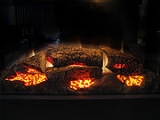
electric fireplace is an electric heater that mimics a
fireplaceA fireplace is an architectural structure to contain a fire for heating and, especially historically, for cooking. A fire is contained in a firebox or firepit; a chimney or other flue allows gas and particulate exhaust to escape...
burning
coalCoal is a combustible black or brownish-black sedimentary rock usually occurring in rock strata in layers or veins called coal beds or coal seams. The harder forms, such as anthracite coal, can be regarded as metamorphic rock because of later exposure to elevated temperature and pressure...
,
woodWood fuel is wood used as fuel. The burning of wood is currently the largest use of energy derived from a solid fuel biomass. Wood fuel can be used for cooking and heating, and occasionally for fueling steam engines and steam turbines that generate electricity. Wood fuel may be available as...
, or
natural gasNatural gas is a naturally occurring gas mixture consisting primarily of methane, typically with 0–20% higher hydrocarbons . It is found associated with other hydrocarbon fuel, in coal beds, as methane clathrates, and is an important fuel source and a major feedstock for fertilizers.Most natural...
. Electric fireplaces are often placed in conventional fireplaces, which can then no longer be used for conventional fires. They plug into the wall, and can run on a "flame only" setting, or can be used as a heater, typically consuming 1.4-1.6 kW, that can heat a 400 sq ft (37.2 m²) room.
History
Techniques for electrical "flame effects" have been around since at least 1981.
Commercial electric fireplace techniques include the Optiflame, introduced in 1988 by implex.
Dimplex claims to have produced the first electric fireplace with a "realistic" wood-burning flame effect in 1995. It is unclear what specific technique is being referred to, although it may be .
Advantages compared to traditional fireplaces
Advantages of electric fireplaces are that they:
- do not require chimney
A chimney is a structure for venting hot flue gases or smoke from a boiler, stove, furnace or fireplace to the outside atmosphere. Chimneys are typically vertical, or as near as possible to vertical, to ensure that the gases flow smoothly, drawing air into the combustion in what is known as the...
s;
- are often portable;
- do not require remodeling to install.
Disadvantages compared to traditional fireplaces
Disadvantages of electric fireplaces are that they:
- are often less efficient, because of the inefficiency in generating electricity;
- cost more to buy than typical electric heaters;
- are not as realistic as real flames, even in gas fireplaces;
- cannot be exposed to weather.
See also
- Wood-fired oven
Wood-fired ovens, also known as wood ovens , are ovens that use wood fuel for cooking. There are two types of wood-fired ovens: "black ovens" and "white ovens"...
- Fireplace
A fireplace is an architectural structure to contain a fire for heating and, especially historically, for cooking. A fire is contained in a firebox or firepit; a chimney or other flue allows gas and particulate exhaust to escape...
- Firebox
A firebox or firepit is the part of the fireplace where fuel is combusted, in distinction to the hearth, chimney, mantel, overdoor and flue elements of the total fireplace system. The firebox normally sits on a masonry base at the floor level of the room...
- Fireplace mantel
Fireplace mantel or mantelpiece, also known as a chimneypiece, originated in medieval times as a hood that projected over a grate to catch the smoke. The term has evolved to include the decorative framework around the fireplace, and can include elaborate designs extending to the ceiling...
- Fireplace insert
Invented in 1869 by Joab R. Donaldson of Oliphant Furnace, Pennsylvania, USA. The fireplace insert is a device inserted into an existing masonry or prefabricated wood fireplace....