
Home      Discussion      Topics      Dictionary      Almanac
Signup       Login
Electric arc furnace

Electric arc furnace

Overview
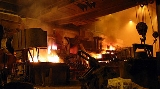
An electric arc furnace (EAF) is a furnace
Furnace
A furnace is a device used for heating. The name derives from Latin fornax, oven.In American English and Canadian English, the term furnace on its own is generally used to describe household heating systems based on a central furnace , and sometimes as a synonym for kiln, a device used in the...

 that heats charged material by means of an electric arc
Electric arc
An electric arc is an electrical breakdown of a gas which produces an ongoing plasma discharge, resulting from a current flowing through normally nonconductive media such as air. A synonym is arc discharge. An arc discharge is characterized by a lower voltage than a glow discharge, and relies on...

.
Discussion
Ask a question about 'Electric arc furnace'
Start a new discussion about 'Electric arc furnace'
Answer questions from other users
Full Discussion Forum
 
Unanswered Questions
Encyclopedia
An electric arc furnace (EAF) is a furnace
Furnace
A furnace is a device used for heating. The name derives from Latin fornax, oven.In American English and Canadian English, the term furnace on its own is generally used to describe household heating systems based on a central furnace , and sometimes as a synonym for kiln, a device used in the...

 that heats charged material by means of an electric arc
Electric arc
An electric arc is an electrical breakdown of a gas which produces an ongoing plasma discharge, resulting from a current flowing through normally nonconductive media such as air. A synonym is arc discharge. An arc discharge is characterized by a lower voltage than a glow discharge, and relies on...

.

Arc furnaces range in size from small units of approximately one ton
Ton
The ton is a unit of measure. It has a long history and has acquired a number of meanings and uses over the years. It is used principally as a unit of weight, and as a unit of volume. It can also be used as a measure of energy, for truck classification, or as a colloquial term.It is derived from...

 capacity (used in foundries
Foundry
A foundry is a factory that produces metal castings. Metals are cast into shapes by melting them into a liquid, pouring the metal in a mold, and removing the mold material or casting after the metal has solidified as it cools. The most common metals processed are aluminum and cast iron...

 for producing cast iron
Cast iron
Cast iron is derived from pig iron, and while it usually refers to gray iron, it also identifies a large group of ferrous alloys which solidify with a eutectic. The color of a fractured surface can be used to identify an alloy. White cast iron is named after its white surface when fractured, due...

 products) up to about 400 ton units used for secondary steelmaking
Steelmaking
Steelmaking is the second step in producing steel from iron ore. In this stage, impurities such as sulfur, phosphorus, and excess carbon are removed from the raw iron, and alloying elements such as manganese, nickel, chromium and vanadium are added to produce the exact steel required.-Older...

. Arc furnaces used in research laboratories and by dentists
Dentistry
Dentistry is the branch of medicine that is involved in the study, diagnosis, prevention, and treatment of diseases, disorders and conditions of the oral cavity, maxillofacial area and the adjacent and associated structures and their impact on the human body. Dentistry is widely considered...

 may have a capacity of only a few dozen grams. Industrial electric arc furnace temperatures can be up to 1,800 degrees Celsius, while laboratory units can exceed 3,000 °C. Arc furnaces differ from induction furnace
Induction furnace
An induction furnace is an electrical furnace in which the heat is applied by induction heating of metal. The advantage of the induction furnace is a clean, energy-efficient and well-controllable melting process compared to most other means of metal melting...

s in that the charge material is directly exposed to an electric arc, and the current in the furnace terminals passes through the charged material.

History


In the 19th century, a number of men had employed an electric arc to melt iron
Iron
Iron is a chemical element with the symbol Fe and atomic number 26. It is a metal in the first transition series. It is the most common element forming the planet Earth as a whole, forming much of Earth's outer and inner core. It is the fourth most common element in the Earth's crust...

. Sir Humphry Davy
Humphry Davy
Sir Humphry Davy, 1st Baronet FRS MRIA was a British chemist and inventor. He is probably best remembered today for his discoveries of several alkali and alkaline earth metals, as well as contributions to the discoveries of the elemental nature of chlorine and iodine...

 conducted an experimental demonstration in 1810; welding was investigated by Pepys in 1815; Pinchon attempted to create an electrothermic furnace in 1853; and, in 1878–79, Sir William Siemens
Carl Wilhelm Siemens
Carl Wilhelm Siemens was a German born engineer who for most of his life worked in Britain and later became a British subject.-Biography:...

 took out patent
Patent
A patent is a form of intellectual property. It consists of a set of exclusive rights granted by a sovereign state to an inventor or their assignee for a limited period of time in exchange for the public disclosure of an invention....

s for electric furnaces of the arc type.

The first electric arc furnaces were developed by Paul Héroult
Paul Héroult
The French scientist Paul Héroult was the inventor of the aluminium electrolysis and of the electric steel furnace. He lived in Thury-Harcourt, Normandy.Christian Bickert said of him...

, of France
France
The French Republic , The French Republic , The French Republic , (commonly known as France , is a unitary semi-presidential republic in Western Europe with several overseas territories and islands located on other continents and in the Indian, Pacific, and Atlantic oceans. Metropolitan France...

, with a commercial plant established in the United States
United States
The United States of America is a federal constitutional republic comprising fifty states and a federal district...

 in 1907. The Sanderson brothers formed The Sanderson Brothers steel Co. in Syracuse, New York, installing the first electric arc furnace in the U.S. This furnace is now on display at Station Square, Pittsburgh, Pennsylvania.

Initially "electric steel" was a specialty product for such uses as machine tool
Machine tool
A machine tool is a machine, typically powered other than by human muscle , used to make manufactured parts in various ways that include cutting or certain other kinds of deformation...

s and spring steel
Spring steel
Spring steel is a low alloy, medium carbon steel or high carbon steel with a very high yield strength. This allows objects made of spring steel to return to their original shape despite significant bending or twisting.-Grades:...

. Arc furnaces were also used to prepare calcium carbide
Calcium carbide
thumb|right|Calcium carbide.Calcium carbide is a chemical compound with the chemical formula of CaC2. The pure material is colorless, however pieces of technical grade calcium carbide are grey or brown and consist of only 80-85% of CaC2 . Because of presence of PH3, NH3, and H2S it has a...

 for use in carbide lamp
Carbide lamp
Carbide lamps, properly known as acetylene gas lamps, are simple lamps that produce and burn acetylene which is created by the reaction of calcium carbide with water....

s. The Stessano electric furnace is an arc type furnace
Furnace
A furnace is a device used for heating. The name derives from Latin fornax, oven.In American English and Canadian English, the term furnace on its own is generally used to describe household heating systems based on a central furnace , and sometimes as a synonym for kiln, a device used in the...

 that usually rotates to mix the bath. The Girod furnace is similar to the Héroult furnace.

While EAFs were widely used in World War II for production of alloy steels, it was only later that electric steelmaking began to expand. The low capital cost for a mini-mill—around US$140–200 per ton
Ton
The ton is a unit of measure. It has a long history and has acquired a number of meanings and uses over the years. It is used principally as a unit of weight, and as a unit of volume. It can also be used as a measure of energy, for truck classification, or as a colloquial term.It is derived from...

 of annual installed capacity, compared with US$1,000 per ton of annual installed capacity for an integrated steel mill—allowed mills to be quickly established in war-ravaged Europe, and also allowed them to successfully compete with the big United States
United States
The United States of America is a federal constitutional republic comprising fifty states and a federal district...

 steelmakers, such as Bethlehem Steel
Bethlehem Steel
The Bethlehem Steel Corporation , based in Bethlehem, Pennsylvania, was once the second-largest steel producer in the United States, after Pittsburgh, Pennsylvania-based U.S. Steel. After a decline in the U.S...

 and U.S. Steel
U.S. Steel
The United States Steel Corporation , more commonly known as U.S. Steel, is an integrated steel producer with major production operations in the United States, Canada, and Central Europe. The company is the world's tenth largest steel producer ranked by sales...

, for low-cost, carbon steel "long products" (structural steel
Structural steel
Structural steel is steel construction material, a profile, formed with a specific shape or cross section and certain standards of chemical composition and mechanical properties...

, rod and bar, wire
Wire
A wire is a single, usually cylindrical, flexible strand or rod of metal. Wires are used to bear mechanical loads and to carry electricity and telecommunications signals. Wire is commonly formed by drawing the metal through a hole in a die or draw plate. Standard sizes are determined by various...

, and fastener
Fastener
A fastener is a hardware device that mechanically joins or affixes two or more objects together.Fasteners can also be used to close a container such as a bag, a box, or an envelope; or they may involve keeping together the sides of an opening of flexible material, attaching a lid to a container,...

s) in the U.S. market.

When Nucor
Nucor
Nucor Corporation , a Fortune 300 company headquartered in Charlotte, North Carolina, is one of the largest steel producers in the United States, and the largest of the "mini-mill" operators...

—now one of the largest steel producers in the U.S.—decided to enter the long products market in 1969, they chose to start up a mini-mill, with an EAF as its steelmaking furnace, soon followed by other manufacturers. Whilst Nucor expanded rapidly in the Eastern US, the companies that followed them into mini-mill operations concentrated on local markets for long products, where the use of an EAF allowed the plants to vary production according to local demand. This pattern was also followed globally, with EAF steel production primarily used for long products, while integrated mills, using blast furnace
Blast furnace
A blast furnace is a type of metallurgical furnace used for smelting to produce industrial metals, generally iron.In a blast furnace, fuel and ore and flux are continuously supplied through the top of the furnace, while air is blown into the bottom of the chamber, so that the chemical reactions...

s and basic oxygen furnaces, cornered the markets for "flat products"—sheet steel
Sheet metal
Sheet metal is simply metal formed into thin and flat pieces. It is one of the fundamental forms used in metalworking, and can be cut and bent into a variety of different shapes. Countless everyday objects are constructed of the material...

 and heavier steel plate. In 1987, Nucor made the decision to expand into the flat products market, still using the EAF production method.

Construction


An electric arc furnace used for steelmaking consists of a refractory
Refractory
A refractory material is one that retains its strength at high temperatures. ASTM C71 defines refractories as "non-metallic materials having those chemical and physical properties that make them applicable for structures, or as components of systems, that are exposed to environments above...

-lined vessel, usually water-cooled in larger sizes, covered with a retractable roof, and through which one or more graphite
Graphite
The mineral graphite is one of the allotropes of carbon. It was named by Abraham Gottlob Werner in 1789 from the Ancient Greek γράφω , "to draw/write", for its use in pencils, where it is commonly called lead . Unlike diamond , graphite is an electrical conductor, a semimetal...

 electrode
Electrode
An electrode is an electrical conductor used to make contact with a nonmetallic part of a circuit...

s enter the furnace.
The furnace is primarily split into three sections:
  • the shell, which consists of the sidewalls and lower steel "bowl";
  • the hearth, which consists of the refractory that lines the lower bowl;
  • the roof, which may be refractory-lined or water-cooled, and can be shaped as a section of a sphere
    Sphere
    A sphere is a perfectly round geometrical object in three-dimensional space, such as the shape of a round ball. Like a circle in two dimensions, a perfect sphere is completely symmetrical around its center, with all points on the surface lying the same distance r from the center point...

    , or as a frustum
    Frustum
    In geometry, a frustum is the portion of a solid that lies between two parallel planes cutting it....

     (conical section). The roof also supports the refractory delta in its centre, through which one or more graphite
    Graphite
    The mineral graphite is one of the allotropes of carbon. It was named by Abraham Gottlob Werner in 1789 from the Ancient Greek γράφω , "to draw/write", for its use in pencils, where it is commonly called lead . Unlike diamond , graphite is an electrical conductor, a semimetal...

     electrodes enter.


The hearth may be hemispherical in shape, or in an eccentric bottom tapping furnace (see below), the hearth has the shape of a halved egg. In modern meltshops, the furnace is often raised off the ground floor, so that ladles
Ladle (metallurgy)
In a foundry, a ladle is a vessel used to transport and pour out molten metals. Ladles range in size from small hand carried vessels that resemble a kitchen ladle and hold or to large steelmill ladles that hold up to...

 and slag pots can easily be maneuvered under either end of the furnace. Separate from the furnace structure is the electrode support and electrical system, and the tilting platform on which the furnace rests. Two configurations are possible: the electrode supports and the roof tilt with the furnace, or are fixed to the raised platform.

A typical alternating current
Alternating current
In alternating current the movement of electric charge periodically reverses direction. In direct current , the flow of electric charge is only in one direction....

 furnace has three
Three-phase electric power
Three-phase electric power is a common method of alternating-current electric power generation, transmission, and distribution. It is a type of polyphase system and is the most common method used by grids worldwide to transfer power. It is also used to power large motors and other heavy loads...

 electrodes. Electrodes are round in section, and typically in segments with threaded couplings, so that as the electrodes wear, new segments can be added. The arc forms between the charged material and the electrode, the charge is heated both by current passing through the charge and by the radiant energy evolved by the arc. The electrodes are automatically raised and lowered by a positioning system, which may use either electric winch
Winch
A winch is a mechanical device that is used to pull in or let out or otherwise adjust the "tension" of a rope or wire rope . In its simplest form it consists of a spool and attached hand crank. In larger forms, winches stand at the heart of machines as diverse as tow trucks, steam shovels and...

 hoists or hydraulic cylinder
Hydraulic cylinder
A Hydraulic cylinder is a mechanical actuator that is used to give a unidirectional force through a unidirectional stroke. It has many applications, notably in engineering vehicles.- Operation :...

s. The regulating system maintains approximately constant current and power input during the melting of the charge, even though scrap may move under the electrodes as it melts. The mast arms holding the electrodes carry heavy busbar
Busbar
In electrical power distribution, a bus bar is a strip of copper or aluminium that conducts electricity within a switchboard, distribution board, substation or other electrical apparatus....

s, which may be hollow water-cooled copper
Copper
Copper is a chemical element with the symbol Cu and atomic number 29. It is a ductile metal with very high thermal and electrical conductivity. Pure copper is soft and malleable; an exposed surface has a reddish-orange tarnish...

 pipes carrying current to the electrode holders. Modern systems use "hot arms", where the whole arm carries the current, increasing efficiency. These can be made from copper-clad steel or aluminium
Aluminium
Aluminium or aluminum is a silvery white member of the boron group of chemical elements. It has the symbol Al, and its atomic number is 13. It is not soluble in water under normal circumstances....

. Since the electrodes move up and down automatically for regulation of the arc, and are raised to allow removal of the furnace roof, heavy water-cooled cable
Cable
A cable is two or more wires running side by side and bonded, twisted or braided together to form a single assembly. In mechanics cables, otherwise known as wire ropes, are used for lifting, hauling and towing or conveying force through tension. In electrical engineering cables are used to carry...

s connect the bus tubes/arms with the transformer
Transformer
A transformer is a device that transfers electrical energy from one circuit to another through inductively coupled conductors—the transformer's coils. A varying current in the first or primary winding creates a varying magnetic flux in the transformer's core and thus a varying magnetic field...

 located adjacent to the furnace. To protect the transformer from heat, it is installed in a vault..

The furnace is built on a tilting platform so that the liquid steel can be poured into another vessel for transport. The operation of tilting the furnace to pour molten steel is called "tapping". Originally, all steelmaking furnaces had a tapping spout closed with refractory that washed out when the furnace was tilted, but often modern furnaces have an eccentric bottom tap-hole (EBT) to reduce inclusion of nitrogen
Nitrogen
Nitrogen is a chemical element that has the symbol N, atomic number of 7 and atomic mass 14.00674 u. Elemental nitrogen is a colorless, odorless, tasteless, and mostly inert diatomic gas at standard conditions, constituting 78.08% by volume of Earth's atmosphere...

 and slag
Slag
Slag is a partially vitreous by-product of smelting ore to separate the metal fraction from the unwanted fraction. It can usually be considered to be a mixture of metal oxides and silicon dioxide. However, slags can contain metal sulfides and metal atoms in the elemental form...

 in the liquid steel. These furnaces have a taphole that passes vertically through the hearth and shell, and is set off-centre in the narrow "nose" of the egg-shaped hearth. It is filled with refractory sand, such as olivine
Olivine
The mineral olivine is a magnesium iron silicate with the formula 2SiO4. It is a common mineral in the Earth's subsurface but weathers quickly on the surface....

, when it is closed off. Modern plants may have two shells with a single set of electrodes that can be transferred between the two; one shell preheats scrap while the other shell is utilised for meltdown. Other DC-based furnaces have a similar arrangement, but have electrodes for each shell and one set of electronics.

AC furnaces usually exhibit a pattern of hot and cold-spots around the hearth perimeter, with the cold-spots located between the electrodes. Modern furnaces mount oxygen-fuel burners in the sidewall and use them to provide chemical energy to the cold-spots, making the heating of the steel more uniform. Additional chemical energy is provided by injecting oxygen and carbon into the furnace; historically this was done through lances in the slag door, now this is mainly done through multiple wall-mounted injection units.

A mid-sized modern steelmaking furnace would have a transformer
Transformer
A transformer is a device that transfers electrical energy from one circuit to another through inductively coupled conductors—the transformer's coils. A varying current in the first or primary winding creates a varying magnetic flux in the transformer's core and thus a varying magnetic field...

 rated about 60,000,000 volt-amperes (60 MVA), with a secondary voltage between 400 and 900 volts and a secondary current in excess of 44,000 amperes. In a modern shop such a furnace would be expected to produce a quantity of 80 metric tonnes of liquid steel in approximately 60 minutes from charging with cold scrap to tapping the furnace. In comparison, basic oxygen furnaces can have a capacity of 150–300 tonnes per batch, or "heat", and can produce a heat in 30–40 minutes. Enormous variations exist in furnace design details and operation, depending on the end product and local conditions, as well as ongoing research to improve furnace efficiency. The largest scrap-only furnace (in terms of tapping weight and transformer rating) is in Turkey, with a tap weight of 300 metric tonnes and a transformer of 300 MVA.

To produce a ton of steel in an electric arc furnace requires approximately 400 kilowatt-hours per short ton
Short ton
The short ton is a unit of mass equal to . In the United States it is often called simply ton without distinguishing it from the metric ton or the long ton ; rather, the other two are specifically noted. There are, however, some U.S...

 or about 440 kWh per metric tonne; the theoretical minimum amount of energy required to melt a tonne of scrap steel is 300 kWh (melting point 1520°C/2768°F). Therefore, the 300-tonne, 300 MVA EAF mentioned above will require approximately 132 MWh of energy to melt the steel, and a "power-on time" (the time that steel is being melted with an arc) of approximately 37 minutes, allowing for the power factor
Power factor
The power factor of an AC electric power system is defined as the ratio of the real power flowing to the load over the apparent power in the circuit, and is a dimensionless number between 0 and 1 . Real power is the capacity of the circuit for performing work in a particular time...

. Electric arc steelmaking is only economical where there is plentiful electricity, with a well-developed electrical grid. In many locations, mills operate during off-peak hours when utilities have surplus power generating capacity.

Operation


Scrap
Scrap
Scrap is a term used to describe recyclable and other materials left over from every manner of product consumption, such as parts of vehicles, building supplies, and surplus materials. Unlike waste, scrap has significant monetary value...

 metal is delivered to a scrap bay, located next to the melt shop. Scrap generally comes in two main grades: shred (whitegoods, cars and other objects made of similar light-gauge steel) and heavy melt (large slabs and beams), along with some direct reduced iron
Direct reduced iron
Direct-reduced iron , also called sponge iron, is produced from direct reduction of iron ore by a reducing gas produced from natural gas or coal. The reducing gas is a mixture majority of hydrogen and carbon monoxide which acts as reducing agent...

 (DRI) or pig iron
Pig iron
Pig iron is the intermediate product of smelting iron ore with a high-carbon fuel such as coke, usually with limestone as a flux. Charcoal and anthracite have also been used as fuel...

 for chemical balance. Some furnaces melt almost 100% DRI.

The scrap is loaded into large buckets called baskets, with "clamshell" doors for a base. Care is taken to layer the scrap in the basket to ensure good furnace operation; heavy melt is placed on top of a light layer of protective shred, on top of which is placed more shred. These layers should be present in the furnace after charging. After loading, the basket may pass to a scrap pre-heater, which uses hot furnace off-gases to heat the scrap and recover energy, increasing plant efficiency.

The scrap basket is then taken to the melt shop, the roof is swung off the furnace, and the furnace is charged with scrap from the basket. Charging is one of the more dangerous operations for the EAF operators. There is a lot of potential energy
Potential energy
In physics, potential energy is the energy stored in a body or in a system due to its position in a force field or due to its configuration. The SI unit of measure for energy and work is the Joule...

 released by multiple tonnes of falling metal; any liquid metal in the furnace is often displaced upwards and outwards by the solid scrap, and the grease
Petroleum
Petroleum or crude oil is a naturally occurring, flammable liquid consisting of a complex mixture of hydrocarbons of various molecular weights and other liquid organic compounds, that are found in geologic formations beneath the Earth's surface. Petroleum is recovered mostly through oil drilling...

 and dust on the scrap is ignited if the furnace is hot, resulting in a fireball erupting. In some twin-shell furnaces, the scrap is charged into the second shell while the first is being melted down, and pre-heated with off-gas from the active shell. Other operations are continuous charging—pre-heating scrap on a conveyor belt, which then discharges the scrap into the furnace proper, or charging the scrap from a shaft set above the furnace, with off-gases directed through the shaft. Other furnaces can be charged with hot (molten) metal from other operations.

After charging, the roof is swung back over the furnace and meltdown commences. The electrodes are lowered onto the scrap, an arc is struck and the electrodes are then set to bore into the layer of shred at the top of the furnace. Lower voltages are selected for this first part of the operation to protect the roof and walls from excessive heat and damage from the arcs. Once the electrodes have reached the heavy melt at the base of the furnace and the arcs are shielded by the scrap, the voltage can be increased and the electrodes raised slightly, lengthening the arcs and increasing power to the melt. This enables a molten pool to form more rapidly, reducing tap-to-tap times. Oxygen
Oxygen
Oxygen is the element with atomic number 8 and represented by the symbol O. Its name derives from the Greek roots ὀξύς and -γενής , because at the time of naming, it was mistakenly thought that all acids required oxygen in their composition...

 is blown into the scrap, combusting or cutting the steel, and extra chemical heat is provided by wall-mounted oxygen-fuel burners. Both processes accelerate scrap meltdown. Supersonic nozzles enable oxygen jets to penetrate foaming slag and reach the liquid bath.

An important part of steelmaking is the formation of slag
Slag
Slag is a partially vitreous by-product of smelting ore to separate the metal fraction from the unwanted fraction. It can usually be considered to be a mixture of metal oxides and silicon dioxide. However, slags can contain metal sulfides and metal atoms in the elemental form...

, which floats on the surface of the molten steel. Slag usually consists of metal oxide
Oxide
An oxide is a chemical compound that contains at least one oxygen atom in its chemical formula. Metal oxides typically contain an anion of oxygen in the oxidation state of −2....

s, and acts as a destination for oxidised impurities, as a thermal blanket (stopping excessive heat loss) and helping to reduce erosion of the refractory
Refractory
A refractory material is one that retains its strength at high temperatures. ASTM C71 defines refractories as "non-metallic materials having those chemical and physical properties that make them applicable for structures, or as components of systems, that are exposed to environments above...

 lining. For a furnace with basic
Base (chemistry)
For the term in genetics, see base A base in chemistry is a substance that can accept hydrogen ions or more generally, donate electron pairs. A soluble base is referred to as an alkali if it contains and releases hydroxide ions quantitatively...

 refractories, which includes most carbon steel-producing furnaces, the usual slag formers are calcium oxide
Calcium oxide
Calcium oxide , commonly known as quicklime or burnt lime, is a widely used chemical compound. It is a white, caustic, alkaline crystalline solid at room temperature....

 (CaO, in the form of burnt lime
Lime (mineral)
Lime is a general term for calcium-containing inorganic materials, in which carbonates, oxides and hydroxides predominate. Strictly speaking, lime is calcium oxide or calcium hydroxide. It is also the name for a single mineral of the CaO composition, occurring very rarely...

) and magnesium oxide
Magnesium oxide
Magnesium oxide , or magnesia, is a white hygroscopic solid mineral that occurs naturally as periclase and is a source of magnesium . It has an empirical formula of and consists of a lattice of Mg2+ ions and O2– ions held together by ionic bonds...

 (MgO, in the form of dolomite
Dolomite
Dolomite is a carbonate mineral composed of calcium magnesium carbonate CaMg2. The term is also used to describe the sedimentary carbonate rock dolostone....

 and magnesite
Magnesite
Magnesite is magnesium carbonate, MgCO3. Iron substitutes for magnesium with a complete solution series with siderite, FeCO3. Calcium, manganese, cobalt, and nickel may also occur in small amounts...

). These slag formers are either charged with the scrap, or blown into the furnace during meltdown. Another major component of EAF slag is iron oxide
Iron oxide
Iron oxides are chemical compounds composed of iron and oxygen. All together, there are sixteen known iron oxides and oxyhydroxides.Iron oxides and oxide-hydroxides are widespread in nature, play an important role in many geological and biological processes, and are widely utilized by humans, e.g.,...

 from steel combusting with the injected oxygen. Later in the heat, carbon (in the form of coke
Coke (fuel)
Coke is the solid carbonaceous material derived from destructive distillation of low-ash, low-sulfur bituminous coal. Cokes from coal are grey, hard, and porous. While coke can be formed naturally, the commonly used form is man-made.- History :...

 or coal
Coal
Coal is a combustible black or brownish-black sedimentary rock usually occurring in rock strata in layers or veins called coal beds or coal seams. The harder forms, such as anthracite coal, can be regarded as metamorphic rock because of later exposure to elevated temperature and pressure...

) is injected into this slag layer, reacting with the iron oxide to form metallic iron and carbon monoxide
Carbon monoxide
Carbon monoxide , also called carbonous oxide, is a colorless, odorless, and tasteless gas that is slightly lighter than air. It is highly toxic to humans and animals in higher quantities, although it is also produced in normal animal metabolism in low quantities, and is thought to have some normal...

 gas, which then causes the slag to foam
Foam
-Definition:A foam is a substance that is formed by trapping gas in a liquid or solid in a divided form, i.e. by forming gas regions inside liquid regions, leading to different kinds of dispersed media...

, allowing greater thermal efficiency
Thermal efficiency
In thermodynamics, the thermal efficiency is a dimensionless performance measure of a device that uses thermal energy, such as an internal combustion engine, a boiler, a furnace, or a refrigerator for example.-Overview:...

, and better arc stability and electrical efficiency. The slag blanket also covers the arcs, preventing damage to the furnace roof and sidewalls from radiant heat.

Once flat bath conditions are reached, i.e., the scrap has been completely melted down, another bucket of scrap can be charged into the furnace and melted down, although EAF development is moving towards single-charge designs. After the second charge is completely melted, refining operations take place to check and correct the steel chemistry and superheat the melt above its freezing temperature in preparation for tapping. More slag formers are introduced and more oxygen is blown into the bath, burning out impurities such as silicon
Silicon
Silicon is a chemical element with the symbol Si and atomic number 14. A tetravalent metalloid, it is less reactive than its chemical analog carbon, the nonmetal directly above it in the periodic table, but more reactive than germanium, the metalloid directly below it in the table...

, sulfur
Sulfur
Sulfur or sulphur is the chemical element with atomic number 16. In the periodic table it is represented by the symbol S. It is an abundant, multivalent non-metal. Under normal conditions, sulfur atoms form cyclic octatomic molecules with chemical formula S8. Elemental sulfur is a bright yellow...

, phosphorus
Phosphorus
Phosphorus is the chemical element that has the symbol P and atomic number 15. A multivalent nonmetal of the nitrogen group, phosphorus as a mineral is almost always present in its maximally oxidized state, as inorganic phosphate rocks...

, aluminium
Aluminium
Aluminium or aluminum is a silvery white member of the boron group of chemical elements. It has the symbol Al, and its atomic number is 13. It is not soluble in water under normal circumstances....

, manganese
Manganese
Manganese is a chemical element, designated by the symbol Mn. It has the atomic number 25. It is found as a free element in nature , and in many minerals...

, and calcium
Calcium
Calcium is the chemical element with the symbol Ca and atomic number 20. It has an atomic mass of 40.078 amu. Calcium is a soft gray alkaline earth metal, and is the fifth-most-abundant element by mass in the Earth's crust...

, and removing their oxides to the slag. Removal of carbon
Carbon
Carbon is the chemical element with symbol C and atomic number 6. As a member of group 14 on the periodic table, it is nonmetallic and tetravalent—making four electrons available to form covalent chemical bonds...

 takes place after these elements have burnt out first, as they have a greater affinity for oxygen. Metals that have a poorer affinity for oxygen than iron, such as nickel
Nickel
Nickel is a chemical element with the chemical symbol Ni and atomic number 28. It is a silvery-white lustrous metal with a slight golden tinge. Nickel belongs to the transition metals and is hard and ductile...

 and copper
Copper
Copper is a chemical element with the symbol Cu and atomic number 29. It is a ductile metal with very high thermal and electrical conductivity. Pure copper is soft and malleable; an exposed surface has a reddish-orange tarnish...

, cannot be removed through oxidation and must be controlled through scrap chemistry alone, such as introducing the direct reduced iron and pig iron mentioned earlier. A foaming slag is maintained throughout, and often overflows the furnace to pour out of the slag door into the slag pit. Temperature sampling and chemical sampling take place via automatic lances. Oxygen and carbon can be automatically measured via special probes that dip into the steel, but for all other elements, a "chill" sample—a small, solidified sample of the steel—is analysed on an arc-emission spectrometer
Spectrometer
A spectrometer is an instrument used to measure properties of light over a specific portion of the electromagnetic spectrum, typically used in spectroscopic analysis to identify materials. The variable measured is most often the light's intensity but could also, for instance, be the polarization...

.

Once the temperature and chemistry are correct, the steel is tapped out into a preheated ladle through tilting the furnace. For plain-carbon steel furnaces, as soon as slag is detected during tapping the furnace is rapidly tilted back towards the deslagging side, minimising slag carryover into the ladle. For some special steel grades, including stainless steel, the slag is poured into the ladle as well, to be treated at the ladle furnace to recover valuable alloying elements. During tapping some alloy additions are introduced into the metal stream, and more lime is added on top of the ladle to begin building a new slag layer. Often, a few tonnes of liquid steel and slag is left in the furnace in order to form a "hot heel", which helps preheat the next charge of scrap and accelerate its meltdown. During and after tapping, the furnace is "turned around": the slag door is cleaned of solidified slag, repairs may take place, and electrodes are inspected for damage or lengthened through the addition of new segments; the taphole is filled with sand at the completion of tapping. For a 90-tonne, medium-power furnace, the whole process will usually take about 60–70 minutes from the tapping of one heat to the tapping of the next (the tap-to-tap time).

Advantages of electric arc furnace for steelmaking


The use of EAFs allows steel to be made from a 100% scrap metal feedstock, commonly known as "cold ferrous feed" to emphasise the fact that for an EAF, scrap is a regulated feed material. The primary benefit of this is the large reduction in specific energy (energy per unit weight) required to produce the steel. Another benefit is flexibility: while blast furnace
Blast furnace
A blast furnace is a type of metallurgical furnace used for smelting to produce industrial metals, generally iron.In a blast furnace, fuel and ore and flux are continuously supplied through the top of the furnace, while air is blown into the bottom of the chamber, so that the chemical reactions...

s cannot vary their production by much and are never stopped, EAFs can be rapidly started and stopped, allowing the steel mill to vary production according to demand. During the peak of global meltdown in 2009, an estimated quantity of only 1 million tonne was produced in USA employing BOF technique. Although steelmaking arc furnaces generally use scrap steel as their primary feedstock, if hot metal from a blast furnace or direct-reduced iron is available economically, these can also be used as furnace feed.

A typical steelmaking arc furnace is the source of steel for a mini-mill, which may make bars or strip product. Mini-mills can be sited relatively near to the markets for steel products, and the transport requirements are less than for an integrated mill, which would commonly be sited near a harbour for access to shipping.

Environmental issues


Although the modern electric arc furnace is a highly efficient recycler of steel scrap
Scrap
Scrap is a term used to describe recyclable and other materials left over from every manner of product consumption, such as parts of vehicles, building supplies, and surplus materials. Unlike waste, scrap has significant monetary value...

, operation of an arc furnace shop can have adverse environmental effects. Much of the capital cost of a new installation will be devoted to systems intended to reduce these effects, which include:
  • enclosures to reduce high sound levels
  • Dust collector
    Dust collector
    A dust collector is a system used to enhance the quality of air released from industrial and commercial processes by collecting dust and other impurities from air or gas. Designed to handle heavy dust loads, a dust collector system consists of a blower, dust filter, a filter-cleaning system, and a...

     for furnace off-gas
  • Slag production
  • Cooling water demand
  • Heavy truck traffic for scrap, materials handling, and products
  • Environmental effects of electricity generation


Because of the very dynamic quality of the arc furnace load, power systems may require technical measures to maintain the quality of power for other customers; flicker and harmonic distortion are common side-effects of arc furnace operation on a power system.

Other electric arc furnaces


For steelmaking, direct current
Direct current
Direct current is the unidirectional flow of electric charge. Direct current is produced by such sources as batteries, thermocouples, solar cells, and commutator-type electric machines of the dynamo type. Direct current may flow in a conductor such as a wire, but can also flow through...

 (DC) arc furnaces are used, with a single electrode in the roof and the current return through a conductive bottom lining or conductive pins in the base. The advantage of DC is lower electrode consumption per ton of steel produced, since only one electrode is used, as well as less electrical harmonics and other similar problems. The size of DC arc furnaces is limited by the current carrying capacity of available electrodes, and the maximum allowable voltage. Maintenance of the conductive furnace hearth is a bottleneck in extended operation of a DC arc furnace. Danieli
Danieli
Danieli is the third largest supplier of equipment and plants to themetal industry in the world. The company has six factories in Italy, Germany, France, Sweden, Thailand and China....

—makers of steel plant equipment—are preparing to install a 420-tonne DC furnace, powered by two 160 MVA transformers, in a Japanese steel mill. Instead of an upper graphite electrode and a lower conductive hearth, this EAF would have two upper graphite electrodes.

In a steel plant, a ladle furnace (LF) is used to maintain the temperature of liquid steel during processing after tapping from EAF or to change the alloy composition. The ladle is used for the first purpose when there is a delay later in the steelmaking process. The ladle furnace consists of a refractory roof, a heating system, and, when applicable, a provision for injecting argon gas into the bottom of the melt for stirring. Unlike a scrap melting furnace, a ladle furnace does not have a tilting or scrap charging mechanism.

Electric arc furnaces are also used for production of ferroalloy
Ferroalloy
Ferroalloy refers to various alloys of iron with a high proportion of one or more other element, manganese or silicon for example. It is used in the production of steels and alloys as a raw material.The main ferroalloys are:*FeAl – ferroaluminum...

s and other non-ferrous alloy
Alloy
An alloy is a mixture or metallic solid solution composed of two or more elements. Complete solid solution alloys give single solid phase microstructure, while partial solutions give two or more phases that may or may not be homogeneous in distribution, depending on thermal history...

s, and for production of phosphorus
Phosphorus
Phosphorus is the chemical element that has the symbol P and atomic number 15. A multivalent nonmetal of the nitrogen group, phosphorus as a mineral is almost always present in its maximally oxidized state, as inorganic phosphate rocks...

. Furnaces for these services are physically different from steel-making furnaces and may operate on a continuous, rather than batch, basis. Continuous process furnaces may also use paste-type, Søderberg electrodes to prevent interruptions due to electrode changes. Such a furnace is known as a submerged arc furnace because the electrode tips are buried in the slag/charge, and arcing occurs through the slag, between the matte
Matte (metallurgy)
Matte is a term used in the field of pyrometallurgy given to the molten metal sulfide phases typically formed during smelting of copper, nickel, and other base metals. Typically, a matte is the phase in which the principal metal being extracted is recovered prior to a final reduction process to...

 and the electrode. A steelmaking arc furnace, by comparison, arcs in the open. The key is the electrical resistance
Electrical resistance
The electrical resistance of an electrical element is the opposition to the passage of an electric current through that element; the inverse quantity is electrical conductance, the ease at which an electric current passes. Electrical resistance shares some conceptual parallels with the mechanical...

, which is what generates the heat required: the resistance in a steelmaking furnace is the atmosphere, while in a submerged-arc furnace the slag or charge forms the resistance. The liquid metal formed in either furnace is too conductive to form an effective heat-generating resistance.

Amateurs have constructed a variety of arc furnaces, often based on electric arc welding kits contained by silical blocks or flower pots. Though crude, these simple furnaces are capable of melting a wide range of materials and creating calcium carbide
Calcium carbide
thumb|right|Calcium carbide.Calcium carbide is a chemical compound with the chemical formula of CaC2. The pure material is colorless, however pieces of technical grade calcium carbide are grey or brown and consist of only 80-85% of CaC2 . Because of presence of PH3, NH3, and H2S it has a...

 etc. An example is shown here.

Plasma arc furnace


A plasma arc furnace (PAF) uses plasma
Plasma (physics)
In physics and chemistry, plasma is a state of matter similar to gas in which a certain portion of the particles are ionized. Heating a gas may ionize its molecules or atoms , thus turning it into a plasma, which contains charged particles: positive ions and negative electrons or ions...

 torches instead of graphite electrodes. Each of these torches consists of a casing provided with a nozzle and an axial tubing for feeding a plasma-forming gas (either nitrogen or argon), and a burnable cylindrical graphite electrode located within the tubing. Such furnaces can be referred to as "PAM" (Plasma Arc Melt) furnaces. They are used extensively in the titanium melt industry and similar specialty metals industries.

Vacuum arc remelting


Vacuum arc remelting (VAR) is a secondary remelting process for vacuum refining and manufacturing of ingots with improved chemical and mechanical homogeneity.

In critical military and commercial aerospace applications, material engineers commonly specify VIM-VAR steels. VIM means Vacuum Induction Melted and VAR means Vacuum Arc Remelted. VIM-VAR steels become bearings for jet engines, rotor shafts for military helicopters, flap actuators for fighter jets, gears in jet or helicopter transmissions, mounts or fasteners for jet engines, jet tail hooks and other demanding applications.

Most grades of steel are melted once and are then cast or teemed into a solid form prior to extensive forging or rolling to a metallurgically sound form. In contrast, VIM-VAR steels go through two more highly purifying melts under vacuum. After melting in an electric arc furnace and alloying in an argon oxygen decarburization vessel, steels destined for vacuum remelting are cast into ingot molds. The solidified ingots then head for a vacuum induction melting furnace. This vacuum remelting process rids the steel of inclusions and unwanted gases while optimizing the chemical composition. The VIM operation returns these solid ingots to the molten state in the contaminant-free void of a vacuum. This tightly controlled melt often requires up to 24 hours. Still enveloped by the vacuum, the hot metal flows from the VIM furnace crucible into giant electrode molds. A typical electrode stands about 15 feet (5 m) tall and will be in various diameters. The electrodes solidify under vacuum.

For VIM-VAR steels, the surface of the cooled electrodes must be ground to remove surface irregularities and impurities before the next vacuum remelt. Then the ground electrode is placed in a VAR furnace. In a VAR furnace the steel gradually melts drop-by-drop in the vacuum-sealed chamber. Vacuum arc remelting further removes lingering inclusions to provide superior steel cleanliness and further remove gases such as oxygen, nitrogen and hydrogen. Controlling the rate at which these droplets form and solidify ensures a consistency of chemistry and microstructure throughout the entire VIM-VAR ingot. This in turn makes the steel more resistant to fracture and/or fatigue. This refinement process is essential to meet the performance characteristics of parts like a helicopter rotor shaft, a flap actuator on a military jet or a bearing in a jet engine.

For some commercial or military applications, steel alloys may go through only one vacuum remelt, namely the VAR. For example, steels for solid rocket cases, landing gears or torsion bars for fighting vehicles typically involve the one vacuum remelt.

Vacuum arc remelting is also used in production of titanium
Titanium
Titanium is a chemical element with the symbol Ti and atomic number 22. It has a low density and is a strong, lustrous, corrosion-resistant transition metal with a silver color....

 and other metals which are reactive or in which high purity is required.

Further reading

  • J.A.T. Jones, B. Bowman, P.A. Lefrank, "Electric Furnace Steelmaking", in The Making, Shaping and Treating of Steel, R.J. Fruehan, Editor. 1998, The AISE Steel Foundation: Pittsburgh. p. 525–660.
  • Thomas Commerford Martin
    Thomas Commerford Martin
    Thomas Commerford Martin was an American electrical engineer and editor, born in London, England. His father worked with Lord Kelvin and other pioneers of submarine telegraph cables, and Martin spent much time on the cable-laying ship SS Great Eastern. Educated as a theological student, Martin...

     and Stephen Leidy Coles, The Story of Electricity, New York 1919, no ISBN, Chapter 13 "The Electric Furnace", available on the Internet Archive
    Internet Archive
    The Internet Archive is a non-profit digital library with the stated mission of "universal access to all knowledge". It offers permanent storage and access to collections of digitized materials, including websites, music, moving images, and nearly 3 million public domain books. The Internet Archive...


External links