
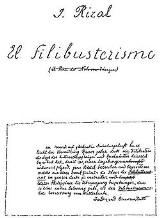
El filibusterismo (lit. Spanish for "The
FilibusteringA filibuster is someone who engages in an unauthorized military expedition into a foreign country to foment or support a revolution. The term is usually used to describe United States citizens who attempted to foment insurrections in Latin America in the mid-19th century.Filibusters were irregular...
"), also known by its English alternate title
The Reign of Greed, is the second novel written by Philippine national hero
José RizalJosé Protasio Rizal Mercado y Alonso Realonda Quintos , was a Filipino polymath: a poet, writer, artist, intellectual, and educator. He was a nationalist and the pre-eminent advocate for reforms in the Philippines during the Spanish colonial era. Rizal's 1896 court-martial and execution made him...
. It is the sequel to
Noli Me TangereNoli Me Tangere is a novel written in Spanish by Filipino writer and national hero José Rizal, first published in 1887 in Berlin, Germany...
and like the first book, was written in Spanish.
The writing of the novel
Rizal began writing
El Filibusterismo in October 1887 while he was in
CalambaCalamba is the name of two places in the Philippines:* Calamba City, Laguna* Calamba, Misamis Occidental...
. In London (1888), he revised the plot and some chapters. Rizal continued to work on his manuscript in
ParisParis is the capital of France and the country's most populous city. It is situated on the river Seine, in northern France, at the heart of the Île-de-France region...
. He later moved to
BrusselsBrussels , officially the Brussels Region or Brussels-Capital Region , is the de facto capital city of the European Union and the largest urban area in Belgium...
where the cost of living was cheaper and he would be less likely to be distracted by social events so he could focus on finishing the book. He finally completed the book on March 29, 1891 in
BiarritzBiarritz is a city which lies on the Bay of Biscay, on the Atlantic coast, in south-western France. It is a luxurious seaside town and is popular with tourists and surfers....
. It was published in September of that year in
GhentGhent is a city and a municipality located in the Flemish region of Belgium. It is the capital and biggest city of the East Flanders province. The city started as a settlement at the confluence of the Rivers Scheldt and Lys and in the Middle Ages became one of the largest and richest cities of...
,
BelgiumThe Kingdom of Belgium is a country in northwest Europe. It is a founding member of the European Union and hosts its headquarters, as well as those of other major international organizations, including NATO...
, partially funded by Rizal's friend
Valentin VenturaValentin Ventura was a reformist during the revolutionary period. He was the one who financed the publication of Jose Rizal's El Filibusterismo.-Life:...
.
The title
Rizal had to define the word
filibustero to his German friend
Ferdinand BlumentrittFerdinand Blumentritt Ferdinand Blumentritt Ferdinand Blumentritt (born September 10, 1853 in Prague, Czech Republic; died September 20, 1913 in Litoměřice (Leitmeritz), Czech Republic (in former Austro-Hungarian Empire) was a Sudeten-German teacher, secondary school principal in Litoměřice,...
, who did not understand his use of the word in
Noli Me TangereNoli Me Tangere is a novel written in Spanish by Filipino writer and national hero José Rizal, first published in 1887 in Berlin, Germany...
. In a letter, Rizal explained: "The word
filibustero is little known in the
PhilippinesThe Philippines officially known as the Republic of the Philippines, is a country in Southeast Asia with Manila as its capital city. It comprises 7,107 islands in the western Pacific Ocean....
. The masses do not know it yet. I heard it for the first time in 1872 when the tragic executions (of the
GomburzaGomburza or GOMBURZA is an acronym denoting the surnames of Fathers Mariano Gómez, José Apolonio Burgos, and Jacinto Zamora, three Filipino priests who were executed on 17 February 1872 at Bagumbayan in Manila, Philippines by Spanish colonial authorities on charges of subversion arising from the...
) took place. I still remember the panic that this word created. Our father forbade us to utter it, as well as the words
CaviteCavite is a province of the Philippines located on the southern shores of Manila Bay in the CALABARZON region in Luzon, just 30 kilometers south of Manila. Cavite is surrounded by Laguna to the east, Metro Manila to the northeast, and Batangas to the south...
,
Jose BurgosJosé Apolonio Burgos y García was a Filipino secular priest, part of the Gomburza trio who were falsely accused of mutiny by the Spanish colonial authorities in the Philippines in the 19th century...
(one of the executed priests), etc. The
ManilaThe City of Manila , or simply Manila or Maynila, is the capital of the Philippines and one of the 17 cities and municipalities that make up Metro Manila. It is located on the eastern shores of Manila Bay, on the western portion of the National Capital Region, in the western side of Luzon...
newspapers and the Spaniards apply this word to one whom they want to make a revolutionary suspect. The Filipinos belonging to the educated class fear the reach of the word. It does not have the meaning of freebooters; it rather means a dangerous patriot who will soon be hanged or well, a presumptuous man." By the end of the nineteenth century, the word
filibustero had acquired the meaning "subversive" in the Philippines, hence the book is about
subversionThis article is about the political concept. For other uses see Subversion .Subversion refers to an attempt to overthrow structures of authority, including the state. It is an overturning or uprooting...
.
Plot summary
Thirteen years after he left the Philippines, Juan Crisostomo Ibarra (the main character from
Noli Me TangereNoli me tangere, meaning "don't touch me", is the Latin version of words spoken, according to , by Jesus to Mary Magdalene when she recognizes him after his resurrection.The words were a popular trope in Gregorian chant...
) returned as Simoun, a rich jeweler sporting a beard and blue-tinted glasses, and a confidant of the Governor-General of the Philippines Captain-General. Abandoning his idealism, he becomes a cynical saboteur, the titular
Filibuster (military)|filibustero, seeking revenge against the Spanish Philippines system responsible for his misfortunes by plotting a revolution. Simoun insinuates himself into Manila high society and influences every decision of the Captain-General to mismanage the country’s affairs so that a revolution will break out. He cynically sides with the upper classes, encouraging them to commit abuses against the masses so that the latter would be encouraged to revolt against the oppressive Spanish colonial regime. This time, he does not attempt to fight the authorities through legal means, but through violent revolution using the masses. Simoun has reasons for instigating a revolution. First is to rescue María Clara from the convent and second, to get rid of ills and evils of Philippine society. His true identity is discovered by a now grown-up Basilio while visiting the grave of his mother, Sisa, as Simoun was digging near the grave site for his buried treasures. Simoun spares Basilio’s life and asks him to join in his planned revolution against the government, egging him on by bringing up the tragic misfortunes of the latter's family. Basilio declines the offer as he still hopes that the country’s condition will improve.
Basilio, at this point, is a graduating student of medicine at the Ateneo de Manila University Ateneo Municipal de Manila. After the death of his mother, Sisa, and the disappearance of his younger brother, Crispín, Basilio heeded the advice of the dying boatman, Elías, and traveled to Manila to study. Basilio was adopted by Captain Tiago after María Clara entered the convent. With Captain Tiago’s help, Basilio was able to go to Colegio de San Juan de Letrán where, at first, he is frowned upon by his peers and teachers not only because of the color of his skin but also because of his shabby appearance which he also experience at Ateneo. Captain Tiago’s confessor, Father Irene is making Captain Tiago’s health worse by giving him opium even as Basilio tries hard to prevent Captain Tiago from smoking it. He and other students want to establish a Spanish language academy so that they can learn to speak and write Spanish language in the Philippines Spanish despite the opposition from the Dominican Order Dominican friars of the University of Santo Tomas|Universidad de Santo Tomas. With the help of a reluctant Father Irene as their mediator and Don Custodio’s decision, the academy is established; however they will only serve as caretakers of the school not as the teachers. Dejected and defeated, they hold a mock celebration at a
pancitería while a spy for the friars witnesses the proceedings.
Simoun, for his part, keeps in close contact with the bandit group of Kabesang Tales, a former
cabeza de barangay who suffered misfortunes at the hands of the friars. Once a farmer owning a prosperous sugarcane plantation and a
cabeza de barangay (barangay head), he was forced to give everything to the greedy and unscrupulous Spanish friars. His son, Tano, who became a civil guard was captured by bandits; his daughter Julî had to work as a maid to get enough ransom money for his freedom; and his father, Tandang Selo, suffered a stroke and became mute. Before joining the bandits, Tales took Simoun’s revolver while Simoun was staying at his house for the night. As payment, Tales leaves a locket that once belonged to María Clara. To further strengthen the revolution, Simoun has Quiroga, a China|Chinese man hoping to be appointed consul to the Philippines, smuggle weapons into the country using Quiroga’s bazaar as a front. Simoun wishes to attack during a stage play with all of his enemies in attendance. He, however, abruptly aborts the attack when he learns from Basilio that María Clara had died earlier that day in the convent.
A few days after the mock celebration by the students, the people are agitated when disturbing posters are found displayed around the city. The authorities accuse the students present at the
pancitería of agitation and disturbing peace and has them arrested. Basilio, although not present at the mock celebration, is also arrested. Captain Tiago dies after learning of the incident and as stated in his will—forged by Father Irene, all his possessions are given to the Church, leaving nothing for Basilio. Basilio is left in prison as the other students are released. A high official tries to intervene for the release of Basilio but the Captain-General, bearing grudges against the high official, coerces him to tender his resignation. Julî, Basilio’s girlfriend and the daughter of Kabesang Tales, tries to ask Father Camorra’s help upon the advice of an elder woman. Instead of helping Julî, however, Father Camorra tries to rape her as he has long-hidden desires for Julî. Julî, rather than submit to the will of the friar, jumps over the balcony to her death.
Basilio is soon released with the help of Simoun. Basilio, now a changed man, and after hearing about Julî's suicide, finally joins Simoun’s revolution. Simoun then tells Basilio his plan at the wedding of Paulita Gómez and Juanito, Basilio’s hunch-backed classmate. His plan was to conceal an explosive inside a pomegranate-styled Kerosene lamp|lamp that Simoun will give to the newlyweds as a gift during the wedding reception. The reception will take place at the former home of the late Captain Tiago, which was now filled with explosives planted by Simoun. According to Simoun, the lamp will stay lighted for only 20 minutes before it flickers; if someone attempts to turn the wick, it will explode and kill everyone—important members of civil society and the Roman Catholic Church in the Philippines|Church hierarchy—inside the house. Basilio has a change of heart and attempts to warn the people inside, including Isagani, his friend and the former boyfriend of Paulita. Simoun leaves the reception early as planned and leaves a note behind;
"The writing on the wall|Mene Thecel Phares."
Juan Crisostomo Ibarra.
Initially thinking that it was simply a bad joke by those left behind, Father Salví recognizes the handwriting and confirms that it was indeed Ibarra’s. As people begin to panic, the lamp flickers. Father Irene tries to turn the wick up when Isagani, due to his undying love for Paulita, bursts in the room and throws the lamp into the river, sabotaging Simoun's plans. He escapes by diving into the river as guards chase after him. He later regrets his impulsive action because he had contradicted his own belief that he loved his nation more than Paulita and that the explosion and revolution could have fulfilled his ideals for Filipino society.
Simoun, now unmasked as the perpetrator of the attempted arson and failed revolution, becomes a
fugitiveA fugitive is a person who is fleeing from custody, whether it be from private slavery, a government arrest, government or non-government questioning, vigilante violence, or outraged private individuals. As a verbal metaphor and psychological concept, one might also be described as a "fugitive...
. Wounded and exhausted after he was shot by the pursuing Guardia Civil soldiers, he seeks shelter at the home of Father Florentino, Isagani’s uncle, and comes under the care of Doctor Tiburcio de Espadaña, the husband of Doña Victorina, who was also hiding at the house. Simoun takes poison in order for him not to be captured alive by the authorities. Before he dies, he reveals his real identity to Father Florentino while they exchange thoughts about the failure of his revolution and why God forsook him. Father Florentino opines that God did not forsake him and that his plans were not for the greater good but for personal gain. Simoun, finally accepting Father Florentino’s explanation, squeezes his hand and dies. Father Florentino then takes Simoun’s remaining jewels and throws them into the sea, hoping that they would not be used by the greedy, and that when the time came that it would be used for the greater good, when the nation would be finally deserving liberty for themselves, the sea would reveal the treasures.
Characters
Below are some of the major characters in the novel.
- Simoun - Crisóstomo Ibarra disguised as a wealthy jeweler, bent on starting a revolution
- Basilio - Sisa's son, now an aspiring doctor
- Isagani - poet and Basilio's best friend; portrayed as emotional and reactive; Paulita Gómez' boyfriend before being dumped for fellow student Juanito Peláez
- Kabesang Tales - Telesforo Juan de Dios, a former cabeza de barangay (barangay head) who resurfaced as the feared Luzón bandit Matanglawin (Tagalog for "Hawkeye"); his father, Tandang Selo, dies eventually after his own son Tano, who became a guardia civil, unknowingly shoots his grandfather in an encounter
- Don Custodio - Custodio de Salazar y Sánchez de Monteredondo, a famous "journalist" who was asked by the students about his decision for the Academia de Castellano. In reality, he is quite an ordinary fellow who married a rich woman in order to be a member of Manila's high society.
- Paulita Gómez - The girlfriend of Isagani and the niece of Doña Victorina, the old India who Passing (racial identity)passes herself off as a Peninsulares|Peninsular, who is the wife of the quack doctor Tiburcio de Espadaña. In the end, she and Juanito Peláez are wed, and she dumps Isagani, believing that she will have no future if she marries him.
- Father Florentino - Isagani's godfather, and a secular priest; was engaged to be married, but chose to be a priest after being pressured by his mother, the story hinting at the ambivalence of his decision as he chooses an assignment to a remote place, living in solitude near the sea.
- Juli - Juliana de Dios, the girlfriend of Basilio, and the youngest daughter of Kabesang Tales.
- Ben Zayb - Abraham Ibañez is his real name. He is a journalist who thinks he is the "only" one thinking in the Philippines.
- Placido Penitente - a student of the University of Santo Tomas who was very intelligent and wise but did not want, if not only by his mother's plea, to pursue his studies. He also controls his temper against his Physics teacher, Father Millon
- Quiroga - a Chinese businessman who dreamt of being a consul of a "Consulate of China" in the Philippines. He hid Simoun's weapons inside his house.
- Tandang Selo - father of Kabesang Tales. He raised the sick and young Basilio after his mother Sisa had died.
- Father Fernandez - the priest-friend of Isagani. He promised to Isagani that he and the other priests will give in to the students' demands.
- Attorney Pasta - one of the great lawyers of mid-Hispanic Manila.
- Captain-General (no specific name)- the powerful highest official in the Philippines.
- Padre Sibyla- Hernando de la Sibyla, a Filipino friar and now vice-rector of the University of Santo Tomas.
Legacy
Noli Me Tangere and El Filibusterismo, are required reading for Junior and Senior High School students in the Philippines today. Textbooks on the novels designed for students by various publishers are also required reading.
External links
- Complete Spanish text: images, OCR
- El filibusterismo (1912 English translation by Charles Derbyshire) from Project Gutenberg
Project Gutenberg, abbreviated as PG, is a volunteer effort to digitize and archive cultural works, to "encourage the creation and distribution of eBooks." Founded in 1971 by Michael S. Hart, it is the oldest digital library. Most of the items in its collection are the full texts of public domain...
- El filibusterismo (Summaries and study guide questions in Filipino)
- El filibusterismo Chapter Summaries (Multimedia chapter summaries in English)
- Caiñgat Cayo! Pamphlet written by Fr. Jose Rodriguez criticizing Rizal and arguing that reading the book is tantamount to committing mortal sin.
- Caiñgat Cayo! English Translation and original image scans of the pamphlet written in 1889.