

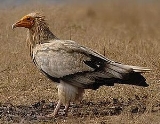
Egyptian Vulture

Encyclopedia
The Egyptian Vulture is a small Old World vulture
, found widely distributed from southwestern Europe
and northern Africa
to southern Asia
. It is the only living member of the genus Neophron. It has sometimes also been known as the White Scavenger Vulture or Pharaoh's Chicken. Like other vultures it soars on thermals and the underwing black and white pattern and wedge tail make it distinctive. It sometimes uses stones to break the eggs of birds making it one of the few birds that make use of tools. Birds that breed in the temperate region migrate south in winter while tropical populations are relatively sedentary. Populations of this species have declined in the 20th Century and some isolated island forms are particularly endangered.
of North America
placed in the genus Neophrontops (the name meaning "looks like Neophron") are believed to have been very similar to these vultures in lifestyle but the relationships are unclear. The genus is considered to be among the oldest branching species within the vultures and the closest living relative is the Lammergeier
(Gypaetus barbatus). Some authors have suggested that they should be placed in a separate subfamily, the Gypaetinae. There are three widely recognised subspecies of the Egyptian Vulture although there is considerable gradation due to movement and intermixing of the populations. A subspecies rubripersonatus from Baluchistan and the northwestern Himalayas (said to have a dark bill with a yellowish tip) described by Nikolai Zarudny
and Härms is rarely recognized.
The genus name is derived from Greek mythology. Neophron was the son of Timandra
, the mistress of Aegypius
. Neophron tricked Aegypius into sleeping with his own mother Bulis imagining it was Timandra. When the deception was found, Bulis sought to take out the eyes of her son but Zeus changed Aegypius and Neophron into vultures. The species name refers to the black wings ("περκνóς" =blue-black +"πτερόν"=wing).
 The adult plumage
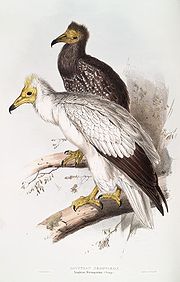
is white, with black flight feathers in the wings. The white plumage however usually appears soiled due to the habits of the birds. The bill is slender and long and the tip of the upper mandible is hooked. The nostril is an elongated horizontal slit. The feathers on the neck are long and form a hackle. The wings are pointed with the third primary being the longest. The tail is wedge shaped. The claws are long and straight and the 3rd and 4th toes are slightly webbed at the base. The bill is black in the nominate population but is pale or yellowish in the smaller Indian ginginianus, but this variation may need further study. The facial skin is yellow and crop is unfeathered. Young birds are blackish or chocolate brown with black and white patches.
The adult Egyptian Vulture measures 47–70 cm (21–28 in) from the point of the beak to the extremity of the tail feathers and 1.5-1.7 metre (5-5.6 ft) between the tips of the wings. In N. p. ginginianus males are about 47.5-52.5 cm long while females are 52-55.5 cm long. It weighs about 2 kilograms (4.4 lbs) although birds of the subspecies majorensis average 2.4 kilograms (5.3 lbs), about 18% heavier than birds from Iberia
.
, in northern Africa
, and in western and South Asia
. Their habitat is mainly in the dry plains and nest mainly in arid and rocky hill regions. It is a rare vagrant in Sri Lanka
. Vagrants are sometimes found further north in Europe and in South Africa. European populations have been recorded migrating south into Africa about 3500 to 5500 km, sometimes covering nearly 500 km in a single day. A bird that bred in France migrated south only in its third year. Like many other soaring diurnal migrants, they avoid making long crossings over water. Italian birds cross over through Sicily and into Tunisia over the islands of Marettimo
and Pantelleria
.
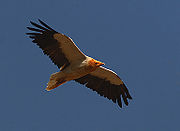 This species is often seen soaring in thermals often with other scavengers. They feed on a range of food including mammal faeces (especially human), insects in dung, carrion as well as vegetable matter and sometimes small live prey. Studies suggest that feeding on mammalian (in this case, ungulate
) faeces helps in obtaining carotenoid
pigments responsible for the bright yellow and orange facial skin. They are usually silent but near the nest they make high-pitched mewing or hissing notes.
They roost communally and nests are often traditionally used year after year. Birds are however usually seen singly or in pairs. They are socially monogamous and pair bonds may be maintained for more than one breeding season. Extra-pair copulation with neighbouring birds is however noted and adult males tend to stay close to the female before and during the egg laying period. The nest sites include cliffs, buildings as well as trees. Unusual nest sites such as on the ground have been recorded in N. p. ginginianus and N. p. majorensis. The nesting season is February to April in India. Both parents incubate and the two eggs hatch after about 42 days. The second chick may hatch after an interval of 3 to 5 days or more. The longer the interval, the more likely is the death of the second chick due to starvation. In areas where nests are close to each other, young birds may sometimes move to neighbouring nests to obtain food. In the Spanish population, young fledge and leave the nest after 90 to 110 days. Young birds disperse from their nest site and birds in Spain have been recorded to move nearly 500 km away from their nest site. The full adult plumage is attained in the fourth or fifth year. In captivity, birds have been known to live for up to 37 years.
Healthy adults do not have any predators but mortality from powerlines, pollution and poisoning have been noted. Young birds have been known to be taken by Golden Eagle
s, Eagle Owls and Red Fox. Birds falling off the cliffs may be picked up by Jackals.
The nominate population, especially in Africa is well known for their use of stones as tools. When a large egg, such as that of an ostrich or bustard is located, the bird approaches it with a large pebble held in the bill and tosses it by standing near the egg and swinging the neck down. The operation is repeated until the egg cracks from the blows. This behaviour has not been recorded in N. p. ginginianus. Tests with hand-reared and wild birds suggest that the behaviour is shown by naive birds raised alone in captivity (and therefore not learnt from observing other birds) and is displayed once they associate eggs with food. They show a strong preference for rounded pebbles rather than jagged rocks. Bulgarian birds have been observed to use twigs to roll up and gather strands of wool that they make use of in their nest lining.
 The Egyptian Vulture is declining in large parts of its range, often severely. In Europe and most of the Middle East
, it is half as plentiful as it was about twenty years ago, and the populations in India
and southwestern Africa
have greatly declined. In 1967-70, the area around Delhi
was estimated to have 12000-15000 of these vultures with an average density of about 5 pairs per 10 km2. The cause of the decline is not known but has been linked with the use of the NSAID
Diclofenac
which has been known to cause death in Gyps vultures. In southern Europe, suggested causes of the decline include poisoning by accumulation of lead, pesticides (especially due to large-scale use in the control of Schistocerca gregaria locust swarms) and by electrocution. Studies in Spain have suggested that the absorption of veterinary antibiotics suppresses their innate immunity, making them more prone to infection.
The population in the Canary Islands have been isolated from populations in Europe and Africa for a significant period of time and have declined greatly and are of particular concern due to their genetic distinctiveness. The Canarian Egyptian Vulture was historically common, occurring on the islands of La Gomera
, Tenerife
, Gran Canaria
, Fuerteventura
and Lanzarote
. It is now restricted to Fuerteventura and Lanzarote, the two easternmost islands. The total population in 2000 was estimated at about 130 individuals, including 25–30 breeding pairs. The island birds appear to be more susceptible to infections. Island birds appear to accumulate significant amounts of lead from scavenging on hunted animal carcasses and the long-term effect of this poison at a sublethal level is not known although it alters the mineralization of their bones. In order to provide safe and uncontaminated food for nesting birds, attempts have been made to create "vulture restaurants" where carcasses are made available. These interventions however may also encourage opportunist predators and scavengers to concentrate at the site and pose a threat to nesting birds in the vicinity.
, the vulture hieroglyph
was the uniliteral sign
used for the glottal sound (3). The Hebrew word rachamah/racham used in the Bible and translated into English as gier-eagle refers to this species. The bird was held sacred to Isis
. The association of the vulture as a symbol of royalty
in Egyptian culture led to the use of the name "Pharaoh's Chicken" for the species.
A southern Indian temple at Thirukalukundram
near Chengalpattu is famed for a pair of birds that have reputedly visited the site for "centuries". These birds are traditionally fed by the temple priests and arrive before noon to feed on offerings made from rice, wheat, ghee
and sugar. Although punctual, the failure of the birds to turn up was attributed to the presence of "sinners" among the onlookers. Legend has it the vultures (or "eagles") represent eight sages who were punished by Shiva
with two of them leaving in each of a series of epochs.
The habit of coprophagy has led to the Spanish names of "churretero" and "moñiguero" which mean "dung-eater". British naturalists in colonial India considered them among the ugliest birds and their habit of feeding on faeces was particularly despised.
Old World vulture
Old World vultures belong to the family Accipitridae, which also includes eagles, buzzards, kites, and hawks.Old World vultures are not closely related to the superficially similar New World vultures and condors, and do not share that group's good sense of smell. The similarities between the two...
, found widely distributed from southwestern Europe
Europe
Europe is, by convention, one of the world's seven continents. Comprising the westernmost peninsula of Eurasia, Europe is generally 'divided' from Asia to its east by the watershed divides of the Ural and Caucasus Mountains, the Ural River, the Caspian and Black Seas, and the waterways connecting...
and northern Africa
Africa
Africa is the world's second largest and second most populous continent, after Asia. At about 30.2 million km² including adjacent islands, it covers 6% of the Earth's total surface area and 20.4% of the total land area...
to southern Asia
Asia
Asia is the world's largest and most populous continent, located primarily in the eastern and northern hemispheres. It covers 8.7% of the Earth's total surface area and with approximately 3.879 billion people, it hosts 60% of the world's current human population...
. It is the only living member of the genus Neophron. It has sometimes also been known as the White Scavenger Vulture or Pharaoh's Chicken. Like other vultures it soars on thermals and the underwing black and white pattern and wedge tail make it distinctive. It sometimes uses stones to break the eggs of birds making it one of the few birds that make use of tools. Birds that breed in the temperate region migrate south in winter while tropical populations are relatively sedentary. Populations of this species have declined in the 20th Century and some isolated island forms are particularly endangered.
Taxonomy and systematics
The genus Neophron contains only a single species. A few prehistoric species from the NeogeneNeogene
The Neogene is a geologic period and system in the International Commission on Stratigraphy Geologic Timescale starting 23.03 ± 0.05 million years ago and ending 2.588 million years ago...
of North America
North America
North America is a continent wholly within the Northern Hemisphere and almost wholly within the Western Hemisphere. It is also considered a northern subcontinent of the Americas...
placed in the genus Neophrontops (the name meaning "looks like Neophron") are believed to have been very similar to these vultures in lifestyle but the relationships are unclear. The genus is considered to be among the oldest branching species within the vultures and the closest living relative is the Lammergeier
Lammergeier
The Lammergeier, Lammergeyer, or Bearded Vulture, Gypaetus barbatus , is the only member of the genus Gypaetus. Traditionally considered an Old World vulture, it actually forms a minor lineage of Accipitridae together with the Egyptian Vulture , its closest living relative...
(Gypaetus barbatus). Some authors have suggested that they should be placed in a separate subfamily, the Gypaetinae. There are three widely recognised subspecies of the Egyptian Vulture although there is considerable gradation due to movement and intermixing of the populations. A subspecies rubripersonatus from Baluchistan and the northwestern Himalayas (said to have a dark bill with a yellowish tip) described by Nikolai Zarudny
Nikolai Zarudny
Nikolai Alekseyvich Zarudny was a Ukrainian-Russian explorer and zoologist of Ukrainian origin, who studied the fauna, especially the birds of Central Asia. He was born in Gryakovo, Ukraine . He wrote his first ornithology book in 1896 and made five expeditions in the Caspian region from 1884 and...
and Härms is rarely recognized.
- N. p. percnopterus, the nominate subspecies, has the largest range, occurring in southern Europe, northern Africa, the Middle East, Central Asia and the north-west of the Indian subcontinent. Populations breeding in the temperate zone migrate south during winter.
- N. p. ginginianus, the smallest subspecies with an all pale bill, occurs in most of the Indian subcontinent. The name is derived from GingeeGingeeGingee is a panchayat town in Viluppuram district in the Indian state of Tamil Nadu. The nearest town with a railway station is Tindivanam, 28 km away....
in southern India. - N. p. majorensis, the Canarian Egyptian Vulture, the largest subspecies with by far the smallest and most restricted population, is found only in the eastern Canary IslandsCanary IslandsThe Canary Islands , also known as the Canaries , is a Spanish archipelago located just off the northwest coast of mainland Africa, 100 km west of the border between Morocco and the Western Sahara. The Canaries are a Spanish autonomous community and an outermost region of the European Union...
where they are known by the name of guirre. Described as a new subspecies only in 2002, studies suggest that it is more genetically distant from N. p. percnopterus than N. p. ginginianus is. Unlike neighbouring populations in Africa and southern Europe, they are not migratory and are consistently larger in size. The name majorensis is derived from “Majorata”, the ancient name for the island of Fuerteventura. The island was named by Spanish conquerors in the 15th century after the “Majos”, the main native Guanche tribe there. A study suggests that the species colonized the island around 2500 years ago and the establishment of the population may have been aided by human colonization at around the same time.
The genus name is derived from Greek mythology. Neophron was the son of Timandra
Timandra
Timandra may refer to:*Timandra , sister of Helen of Troy*Timandra, lover of Aegypius *Timandra, Alcibiades' mistress at the time of his assassination*Timandra, name of a genus of moth, including the blood-vein moth...
, the mistress of Aegypius
Aegypius (mythology)
In Greek mythology, Aegypius , son of Antheus, son of Nomion, a Thessalian, was the lover of Timandre, a widow. Her son, Neophron, resented this relationship, and plotted against it by seducing Bulis , Aegypius' mother...
. Neophron tricked Aegypius into sleeping with his own mother Bulis imagining it was Timandra. When the deception was found, Bulis sought to take out the eyes of her son but Zeus changed Aegypius and Neophron into vultures. The species name refers to the black wings ("περκνóς" =blue-black +"πτερόν"=wing).
Description
Plumage
Plumage refers both to the layer of feathers that cover a bird and the pattern, colour, and arrangement of those feathers. The pattern and colours of plumage vary between species and subspecies and can also vary between different age classes, sexes, and season. Within species there can also be a...
is white, with black flight feathers in the wings. The white plumage however usually appears soiled due to the habits of the birds. The bill is slender and long and the tip of the upper mandible is hooked. The nostril is an elongated horizontal slit. The feathers on the neck are long and form a hackle. The wings are pointed with the third primary being the longest. The tail is wedge shaped. The claws are long and straight and the 3rd and 4th toes are slightly webbed at the base. The bill is black in the nominate population but is pale or yellowish in the smaller Indian ginginianus, but this variation may need further study. The facial skin is yellow and crop is unfeathered. Young birds are blackish or chocolate brown with black and white patches.
The adult Egyptian Vulture measures 47–70 cm (21–28 in) from the point of the beak to the extremity of the tail feathers and 1.5-1.7 metre (5-5.6 ft) between the tips of the wings. In N. p. ginginianus males are about 47.5-52.5 cm long while females are 52-55.5 cm long. It weighs about 2 kilograms (4.4 lbs) although birds of the subspecies majorensis average 2.4 kilograms (5.3 lbs), about 18% heavier than birds from Iberia
Iberia
The name Iberia refers to three historical regions of the old world:* Iberian Peninsula, in Southwest Europe, location of modern-day Portugal and Spain** Prehistoric Iberia...
.
Distribution
Egyptian Vultures are widely distributed and may be found in southern EuropeEurope
Europe is, by convention, one of the world's seven continents. Comprising the westernmost peninsula of Eurasia, Europe is generally 'divided' from Asia to its east by the watershed divides of the Ural and Caucasus Mountains, the Ural River, the Caspian and Black Seas, and the waterways connecting...
, in northern Africa
Africa
Africa is the world's second largest and second most populous continent, after Asia. At about 30.2 million km² including adjacent islands, it covers 6% of the Earth's total surface area and 20.4% of the total land area...
, and in western and South Asia
South Asia
South Asia, also known as Southern Asia, is the southern region of the Asian continent, which comprises the sub-Himalayan countries and, for some authorities , also includes the adjoining countries to the west and the east...
. Their habitat is mainly in the dry plains and nest mainly in arid and rocky hill regions. It is a rare vagrant in Sri Lanka
Sri Lanka
Sri Lanka, officially the Democratic Socialist Republic of Sri Lanka is a country off the southern coast of the Indian subcontinent. Known until 1972 as Ceylon , Sri Lanka is an island surrounded by the Indian Ocean, the Gulf of Mannar and the Palk Strait, and lies in the vicinity of India and the...
. Vagrants are sometimes found further north in Europe and in South Africa. European populations have been recorded migrating south into Africa about 3500 to 5500 km, sometimes covering nearly 500 km in a single day. A bird that bred in France migrated south only in its third year. Like many other soaring diurnal migrants, they avoid making long crossings over water. Italian birds cross over through Sicily and into Tunisia over the islands of Marettimo
Marettimo
Marettimo is one of the Aegadian Islands in the Mediterranean Sea west of Sicily, Italy. It forms a part of the municipality of Favignana in the Province of Trapani. From Trapani, the island takes about an hour to reach.Marettimo is the second largest of the Aegadian Islands...
and Pantelleria
Pantelleria
Pantelleria , the ancient Cossyra, is an Italian island in the Strait of Sicily in the Mediterranean Sea, southwest of Sicily and just east of the Tunisian coast. Administratively Pantelleria is a comune belonging to the Sicilian province of Trapani...
.
Behaviour and ecology
Ungulate
Ungulates are several groups of mammals, most of which use the tips of their toes, usually hoofed, to sustain their whole body weight while moving. They make up several orders of mammals, of which six to eight survive...
) faeces helps in obtaining carotenoid
Carotenoid
Carotenoids are tetraterpenoid organic pigments that are naturally occurring in the chloroplasts and chromoplasts of plants and some other photosynthetic organisms like algae, some bacteria, and some types of fungus. Carotenoids can be synthesized fats and other basic organic metabolic building...
pigments responsible for the bright yellow and orange facial skin. They are usually silent but near the nest they make high-pitched mewing or hissing notes.
They roost communally and nests are often traditionally used year after year. Birds are however usually seen singly or in pairs. They are socially monogamous and pair bonds may be maintained for more than one breeding season. Extra-pair copulation with neighbouring birds is however noted and adult males tend to stay close to the female before and during the egg laying period. The nest sites include cliffs, buildings as well as trees. Unusual nest sites such as on the ground have been recorded in N. p. ginginianus and N. p. majorensis. The nesting season is February to April in India. Both parents incubate and the two eggs hatch after about 42 days. The second chick may hatch after an interval of 3 to 5 days or more. The longer the interval, the more likely is the death of the second chick due to starvation. In areas where nests are close to each other, young birds may sometimes move to neighbouring nests to obtain food. In the Spanish population, young fledge and leave the nest after 90 to 110 days. Young birds disperse from their nest site and birds in Spain have been recorded to move nearly 500 km away from their nest site. The full adult plumage is attained in the fourth or fifth year. In captivity, birds have been known to live for up to 37 years.
Healthy adults do not have any predators but mortality from powerlines, pollution and poisoning have been noted. Young birds have been known to be taken by Golden Eagle
Golden Eagle
The Golden Eagle is one of the best known birds of prey in the Northern Hemisphere. Like all eagles, it belongs to the family Accipitridae. Once widespread across the Holarctic, it has disappeared from many of the more heavily populated areas...
s, Eagle Owls and Red Fox. Birds falling off the cliffs may be picked up by Jackals.
The nominate population, especially in Africa is well known for their use of stones as tools. When a large egg, such as that of an ostrich or bustard is located, the bird approaches it with a large pebble held in the bill and tosses it by standing near the egg and swinging the neck down. The operation is repeated until the egg cracks from the blows. This behaviour has not been recorded in N. p. ginginianus. Tests with hand-reared and wild birds suggest that the behaviour is shown by naive birds raised alone in captivity (and therefore not learnt from observing other birds) and is displayed once they associate eggs with food. They show a strong preference for rounded pebbles rather than jagged rocks. Bulgarian birds have been observed to use twigs to roll up and gather strands of wool that they make use of in their nest lining.
Conservation status
Middle East
The Middle East is a region that encompasses Western Asia and Northern Africa. It is often used as a synonym for Near East, in opposition to Far East...
, it is half as plentiful as it was about twenty years ago, and the populations in India
India
India , officially the Republic of India , is a country in South Asia. It is the seventh-largest country by geographical area, the second-most populous country with over 1.2 billion people, and the most populous democracy in the world...
and southwestern Africa
Africa
Africa is the world's second largest and second most populous continent, after Asia. At about 30.2 million km² including adjacent islands, it covers 6% of the Earth's total surface area and 20.4% of the total land area...
have greatly declined. In 1967-70, the area around Delhi
Delhi
Delhi , officially National Capital Territory of Delhi , is the largest metropolis by area and the second-largest by population in India, next to Mumbai. It is the eighth largest metropolis in the world by population with 16,753,265 inhabitants in the Territory at the 2011 Census...
was estimated to have 12000-15000 of these vultures with an average density of about 5 pairs per 10 km2. The cause of the decline is not known but has been linked with the use of the NSAID
Non-steroidal anti-inflammatory drug
Nonsteroidal anti-inflammatory drugs, usually abbreviated to NSAIDs or NAIDs, but also referred to as nonsteroidal anti-inflammatory agents/analgesics or nonsteroidal Anti-inflammatory medicines , are drugs with analgesic and antipyretic effects and which have, in higher doses, anti-inflammatory...
Diclofenac
Diclofenac
Diclofenac is a non-steroidal anti-inflammatory drug taken to reduce inflammation and as an analgesic reducing pain in certain conditions....
which has been known to cause death in Gyps vultures. In southern Europe, suggested causes of the decline include poisoning by accumulation of lead, pesticides (especially due to large-scale use in the control of Schistocerca gregaria locust swarms) and by electrocution. Studies in Spain have suggested that the absorption of veterinary antibiotics suppresses their innate immunity, making them more prone to infection.
The population in the Canary Islands have been isolated from populations in Europe and Africa for a significant period of time and have declined greatly and are of particular concern due to their genetic distinctiveness. The Canarian Egyptian Vulture was historically common, occurring on the islands of La Gomera
La Gomera
La Gomera is one of Spain's Canary Islands, located in the Atlantic Ocean off the coast of Africa. In area, it is the second-smallest of the seven main islands of this group.- Political organization :...
, Tenerife
Tenerife
Tenerife is the largest and most populous island of the seven Canary Islands, it is also the most populated island of Spain, with a land area of 2,034.38 km² and 906,854 inhabitants, 43% of the total population of the Canary Islands. About five million tourists visit Tenerife each year, the...
, Gran Canaria
Gran Canaria
Gran Canaria is the second most populous island of the Canary Islands, with a population of 838,397 which constitutes approximately 40% of the population of the archipelago...
, Fuerteventura
Fuerteventura
Fuerteventura , a Spanish island, is one of the Canary Islands, in the Atlantic Ocean off the coast of Africa. It is situated at 28°20' north, 14°00' west. At 1,660 km² it is the second largest of the Canary Islands, after Tenerife...
and Lanzarote
Lanzarote
Lanzarote , a Spanish island, is the easternmost of the autonomous Canary Islands, in the Atlantic Ocean, approximately 125 km off the coast of Africa and 1,000 km from the Iberian Peninsula. Covering 845.9 km2, it stands as the fourth largest of the islands...
. It is now restricted to Fuerteventura and Lanzarote, the two easternmost islands. The total population in 2000 was estimated at about 130 individuals, including 25–30 breeding pairs. The island birds appear to be more susceptible to infections. Island birds appear to accumulate significant amounts of lead from scavenging on hunted animal carcasses and the long-term effect of this poison at a sublethal level is not known although it alters the mineralization of their bones. In order to provide safe and uncontaminated food for nesting birds, attempts have been made to create "vulture restaurants" where carcasses are made available. These interventions however may also encourage opportunist predators and scavengers to concentrate at the site and pose a threat to nesting birds in the vicinity.
In culture
In Ancient EgyptAncient Egypt
Ancient Egypt was an ancient civilization of Northeastern Africa, concentrated along the lower reaches of the Nile River in what is now the modern country of Egypt. Egyptian civilization coalesced around 3150 BC with the political unification of Upper and Lower Egypt under the first pharaoh...
, the vulture hieroglyph
Egyptian hieroglyphs
Egyptian hieroglyphs were a formal writing system used by the ancient Egyptians that combined logographic and alphabetic elements. Egyptians used cursive hieroglyphs for religious literature on papyrus and wood...
was the uniliteral sign
Transliteration of ancient Egyptian
In the field of Egyptology, transliteration is the process of converting texts written in the Egyptian language to alphabetic symbols representing uniliteral hieroglyphs or their hieratic and demotic counterparts...
used for the glottal sound (3). The Hebrew word rachamah/racham used in the Bible and translated into English as gier-eagle refers to this species. The bird was held sacred to Isis
Isis
Isis or in original more likely Aset is a goddess in Ancient Egyptian religious beliefs, whose worship spread throughout the Greco-Roman world. She was worshipped as the ideal mother and wife as well as the matron of nature and magic...
. The association of the vulture as a symbol of royalty
Nekhbet
In Egyptian mythology, Nekhbet was an early predynastic local goddess who was the patron of the city of Nekheb, her name meaning of Nekheb...
in Egyptian culture led to the use of the name "Pharaoh's Chicken" for the species.
A southern Indian temple at Thirukalukundram
Thirukazhukundram
For the village, Thirukazhukundram, refer TirukalukundramThirukazhukundram or Thirukkalukundram is an ancient town in Kanchipuram district of the South Indian state of Tamil Nadu.-The Temple:...
near Chengalpattu is famed for a pair of birds that have reputedly visited the site for "centuries". These birds are traditionally fed by the temple priests and arrive before noon to feed on offerings made from rice, wheat, ghee
Ghee
Ghee is a class of clarified butter that originated in South Asia and is commonly used in South Asian cuisine....
and sugar. Although punctual, the failure of the birds to turn up was attributed to the presence of "sinners" among the onlookers. Legend has it the vultures (or "eagles") represent eight sages who were punished by Shiva
Shiva
Shiva is a major Hindu deity, and is the destroyer god or transformer among the Trimurti, the Hindu Trinity of the primary aspects of the divine. God Shiva is a yogi who has notice of everything that happens in the world and is the main aspect of life. Yet one with great power lives a life of a...
with two of them leaving in each of a series of epochs.
The habit of coprophagy has led to the Spanish names of "churretero" and "moñiguero" which mean "dung-eater". British naturalists in colonial India considered them among the ugliest birds and their habit of feeding on faeces was particularly despised.