
Home      Discussion      Topics      Dictionary      Almanac
Signup       Login
Edwin Armstrong

Edwin Armstrong

Overview
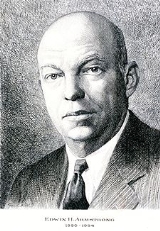
Edwin Howard Armstrong (December 18, 1890 – January 31, 1954) was an American electrical engineer and inventor. Armstrong was the inventor of modern frequency modulation
Frequency modulation
In telecommunications and signal processing, frequency modulation conveys information over a carrier wave by varying its instantaneous frequency. This contrasts with amplitude modulation, in which the amplitude of the carrier is varied while its frequency remains constant...

 (FM) radio.
Discussion
Ask a question about 'Edwin Armstrong'
Start a new discussion about 'Edwin Armstrong'
Answer questions from other users
Full Discussion Forum
 
Unanswered Questions
Encyclopedia
Edwin Howard Armstrong (December 18, 1890 – January 31, 1954) was an American electrical engineer and inventor. Armstrong was the inventor of modern frequency modulation
Frequency modulation
In telecommunications and signal processing, frequency modulation conveys information over a carrier wave by varying its instantaneous frequency. This contrasts with amplitude modulation, in which the amplitude of the carrier is varied while its frequency remains constant...

 (FM) radio.

Edwin Howard Armstrong was born in New York City, New York, in 1890. He studied at Columbia University
Columbia University
Columbia University in the City of New York is a private, Ivy League university in Manhattan, New York City. Columbia is the oldest institution of higher learning in the state of New York, the fifth oldest in the United States, and one of the country's nine Colonial Colleges founded before the...

 where he was a member of the Epsilon Chapter of the Theta Xi
Theta Xi
Theta Xi was founded at Rensselaer Polytechnic Institute in Troy, New York on 29 April 1864. Theta Xi Fraternity was originally founded as an engineering fraternity, the first professional fraternity...

 Fraternity. He later became a professor at Columbia University. He invented the regenerative circuit
Regenerative circuit
The regenerative circuit or "autodyne" allows an electronic signal to be amplified many times by the same vacuum tube or other active component such as a field effect transistor. It consists of an amplifying vacuum tube or transistor with its output connected to its input through a feedback...

 while he was an undergraduate and patent
Patent
A patent is a form of intellectual property. It consists of a set of exclusive rights granted by a sovereign state to an inventor or their assignee for a limited period of time in exchange for the public disclosure of an invention....

ed it in 1914, followed by the super-regenerative circuit in 1922, and the superheterodyne receiver
Superheterodyne receiver
In electronics, a superheterodyne receiver uses frequency mixing or heterodyning to convert a received signal to a fixed intermediate frequency, which can be more conveniently processed than the original radio carrier frequency...

 in 1918.

Early life


Armstrong was born in the Chelsea
Chelsea, Manhattan
Chelsea is a neighborhood on the West Side of the borough of Manhattan in New York City. The district's boundaries are roughly 14th Street to the south, 30th Street to the north, the western boundary of the Ladies' Mile Historic District – which lies between the Avenue of the Americas and...

 district of New York City
New York City
New York is the most populous city in the United States and the center of the New York Metropolitan Area, one of the most populous metropolitan areas in the world. New York exerts a significant impact upon global commerce, finance, media, art, fashion, research, technology, education, and...

 to John and Emily Armstrong. In 1902 the family moved to Yonkers
Yonkers, New York
Yonkers is the fourth most populous city in the state of New York , and the most populous city in Westchester County, with a population of 195,976...

. Armstrong showed an interest in electrical and mechanical devices, particularly trains, from an early age.

He loved heights and constructed a makeshift radio antenna tower in his back yard. Swinging on a bosun's chair
Bosun's chair
A bosun's chair or boatswain's chair is a device used to suspend a person from a rope to perform work aloft. It is distinguished from a climbing harness by the inclusion of a more or less rigid seat, providing more comfort than even the best-padded straps for long-term use...

, he would hoist himself up and down the tower to the concern of his neighbors. A case of rheumatic fever as a child left him with a tic in one eye.

In late 1917, Armstrong was invited to join the U.S. Army Signal Corps with the rank of captain and was sent to Paris to help set up a wireless communication system for the Army. He returned to the United States in the fall of 1919.

During his service in both world wars, Armstrong gave the U.S. military free use of his patents. Use of these was critical to the Allied victories.

Unlike many engineers, Armstrong was never a corporate employee. He performed research and development by himself and owned his patents outright. He did not subscribe to conventional wisdom and was quick to question the opinions of his professors and his peers.

Work and patent disputes


Edwin Armstrong contributed the most to modern electronics technology. His discoveries revolutionized electronic communications. Regeneration
Regenerative circuit
The regenerative circuit or "autodyne" allows an electronic signal to be amplified many times by the same vacuum tube or other active component such as a field effect transistor. It consists of an amplifying vacuum tube or transistor with its output connected to its input through a feedback...

, or amplification via positive feedback is still in use to this day. Also, Armstrong discovered that Lee De Forest
Lee De Forest
Lee De Forest was an American inventor with over 180 patents to his credit. De Forest invented the Audion, a vacuum tube that takes relatively weak electrical signals and amplifies them. De Forest is one of the fathers of the "electronic age", as the Audion helped to usher in the widespread use...

's Audion
Audion
An Audion is a wireless signal detector device invented by Lee De Forest in 1906.Audion may also refer to:* Audion , an electronic music album by Larry Fast* Audion , a media player for Apple Macintosh created by Panic...

 would go into oscillation
Electronic oscillator
An electronic oscillator is an electronic circuit that produces a repetitive electronic signal, often a sine wave or a square wave. They are widely used in innumerable electronic devices...

 when feedback was increased. Thus, the Audion could not only detect and amplify radio signals, it could transmit them as well.

While De Forest's addition of a third element to the Audion
Audion
An Audion is a wireless signal detector device invented by Lee De Forest in 1906.Audion may also refer to:* Audion , an electronic music album by Larry Fast* Audion , a media player for Apple Macintosh created by Panic...

 (the grid) and the subsequent move to modulated (voice) radio is not disputed, De Forest did not put his device to work. Armstrong's research and experimentation with the Audion moved radio reception beyond the crystal set and spark-gap transmitters. Radio signals could be amplified via regeneration to the point of human hearing without a headset. Armstrong later published a paper detailing how the Audion worked, something De Forest could not do. De Forest did not understand the workings of his Audion.

Armstrong's discovery and development of superheterodyne technology made radio receivers, then the primary communications devices of the time, more sensitive and selective. Before heterodyning, radio signals often overrode and interfered with each other. Heterodyning also made radio receivers much easier to use, rendering obsolete the multitude of tuning controls on radio sets of the time. The superheterodyne technology is still used today.

Armstrong is possibly best known for his discovery of wide-band frequency modulation
Frequency modulation
In telecommunications and signal processing, frequency modulation conveys information over a carrier wave by varying its instantaneous frequency. This contrasts with amplitude modulation, in which the amplitude of the carrier is varied while its frequency remains constant...

. FM was born of a request by David Sarnoff
David Sarnoff
David Sarnoff was an American businessman and pioneer of American commercial radio and television. He founded the National Broadcasting Company and throughout most of his career he led the Radio Corporation of America in various capacities from shortly after its founding in 1919 until his...

 of RCA
RCA
RCA Corporation, founded as the Radio Corporation of America, was an American electronics company in existence from 1919 to 1986. The RCA trademark is currently owned by the French conglomerate Technicolor SA through RCA Trademark Management S.A., a company owned by Technicolor...

 as a means to eliminate static in radio reception. While Sarnoff was understandably impressed with Armstrong's FM system, he also understood that it was not compatible with his own AM empire. Sarnoff came to regard FM as a threat and refused to support it any further.

Many of Armstrong's inventions were ultimately claimed by others in patent lawsuits. In particular, the regenerative circuit, which Armstrong patented in 1914 as a "wireless receiving system," was subsequently patented by Lee De Forest
Lee De Forest
Lee De Forest was an American inventor with over 180 patents to his credit. De Forest invented the Audion, a vacuum tube that takes relatively weak electrical signals and amplifies them. De Forest is one of the fathers of the "electronic age", as the Audion helped to usher in the widespread use...

 in 1916; De Forest then sold the rights to his patent to AT&T
AT&T
AT&T Inc. is an American multinational telecommunications corporation headquartered in Whitacre Tower, Dallas, Texas, United States. It is the largest provider of mobile telephony and fixed telephony in the United States, and is also a provider of broadband and subscription television services...

. Between 1922 and 1934, Armstrong found himself embroiled in a patent war, between himself, RCA
RCA
RCA Corporation, founded as the Radio Corporation of America, was an American electronics company in existence from 1919 to 1986. The RCA trademark is currently owned by the French conglomerate Technicolor SA through RCA Trademark Management S.A., a company owned by Technicolor...

, and Westinghouse on one side, and De Forest and AT&T on the other. At the time, this action was the longest patent lawsuit ever litigated, at 12 years. Armstrong won the first round of the lawsuit, lost the second, and stalemated in a third. Before the Supreme Court of the United States
Supreme Court of the United States
The Supreme Court of the United States is the highest court in the United States. It has ultimate appellate jurisdiction over all state and federal courts, and original jurisdiction over a small range of cases...

, De Forest was granted the regeneration patent in what is today widely regarded as a misunderstanding of the technical facts by the Supreme Court justices.

By early 1923, however, Armstrong was a millionaire as a result of licensing his patents to RCA.

In 1946 the FCC's
Federal Communications Commission
The Federal Communications Commission is an independent agency of the United States government, created, Congressional statute , and with the majority of its commissioners appointed by the current President. The FCC works towards six goals in the areas of broadband, competition, the spectrum, the...

 decision to use Armstrong's FM system as the standard for NTSC
NTSC
NTSC, named for the National Television System Committee, is the analog television system that is used in most of North America, most of South America , Burma, South Korea, Taiwan, Japan, the Philippines, and some Pacific island nations and territories .Most countries using the NTSC standard, as...

 television sound gave Armstrong another chance at royalty payments. However, RCA refused to pay him royalties and encouraged other television makers not to pay them either.

FM radio


Even as the regenerative-circuit lawsuit continued, Armstrong was working on another momentous invention. While working in the basement laboratory of Columbia's Philosophy Hall
Philosophy Hall
Philosophy Hall is a building on the campus of Columbia University in New York City. It houses the English, Philosophy, and French departments, along with the university's writing center, part of its registrar's office, and the student lounge of its Graduate School of Arts and Sciences...

, he created wide-band frequency modulation
Frequency modulation
In telecommunications and signal processing, frequency modulation conveys information over a carrier wave by varying its instantaneous frequency. This contrasts with amplitude modulation, in which the amplitude of the carrier is varied while its frequency remains constant...

 radio (FM). Rather than varying the amplitude of a radio wave to create sound, Armstrong's method varied the frequency of the wave instead. FM radio broadcasts delivered a much clearer sound, free of static, than the AM radio dominant at the time. (Armstrong received a patent on wide-band FM on December 26, 1933.

In 1922, John Renshaw Carson
John Renshaw Carson
John Renshaw Carson , who published as J. R. Carson, was a noted transmission theorist for early communications systems...

 of AT&T, inventor of Single-sideband modulation
Single-sideband modulation
Single-sideband modulation or Single-sideband suppressed-carrier is a refinement of amplitude modulation that more efficiently uses electrical power and bandwidth....

 (SSB modulation), had published a paper in the Proceedings of the IRE arguing that FM did not appear to offer any particular advantage. Armstrong managed to demonstrate the advantages of FM radio despite Carson's skepticism in a now-famous paper on FM in the Proceedings of the IRE in 1936, which was reprinted in the August 1984 issue of Proceedings of the IEEE
Proceedings of the IEEE
The Proceedings of the IEEE is a peer-reviewed scientific journal published by the Institute of Electrical and Electronics Engineers...

.

Today the consensus regarding FM is that narrow band FM is not so advantageous in terms of noise reduction, but wide band FM can bring great improvement in signal to noise ratio if the signal is stronger than a certain threshold. Hence Carson was not entirely wrong, and the Carson bandwidth rule
Carson bandwidth rule
In telecommunication, Carson's bandwidth rule defines the approximate bandwidth requirements of communications system components for a carrier signal that is frequency modulated by a continuous or broad spectrum of frequencies rather than a single frequency. Carson's rule does not apply well when...

 for FM is still important today. Thus, both Carson and Armstrong ultimately contributed significantly to the science and technology of radio. The threshold concept was discussed by Murray G. Crosby (inventor of Crosby system
Crosby system
The Crosby system was an FM stereophonic broadcasting standard, developed by Murray G. Crosby, that used an FM subcarrier for higher fidelity. It competed with the Zenith/GE system that used an AM subcarrier...

 for FM Stereo) who pointed out that for wide band FM to provide better signal to noise ratio, the signal should be above a certain threshold, according to his paper published in Proceedings of the IRE in 1937. Thus Crosby's work supplemented Armstrong's paper in 1936.

Armstrong conducted the first large scale field tests of his FM radio technology on the 85th floor of RCA
RCA
RCA Corporation, founded as the Radio Corporation of America, was an American electronics company in existence from 1919 to 1986. The RCA trademark is currently owned by the French conglomerate Technicolor SA through RCA Trademark Management S.A., a company owned by Technicolor...

's (Radio Corporation of America) Empire State Building
Empire State Building
The Empire State Building is a 102-story landmark skyscraper and American cultural icon in New York City at the intersection of Fifth Avenue and West 34th Street. It has a roof height of 1,250 feet , and with its antenna spire included, it stands a total of 1,454 ft high. Its name is derived...

 from May 1934 until October 1935. However RCA had its eye on television broadcasting, and chose not to buy the patents for the FM technology. A June 17, 1936, presentation at the Federal Communications Commission
Federal Communications Commission
The Federal Communications Commission is an independent agency of the United States government, created, Congressional statute , and with the majority of its commissioners appointed by the current President. The FCC works towards six goals in the areas of broadband, competition, the spectrum, the...

 (FCC) headquarters made headlines nationwide. He played a jazz record over conventional AM radio, then switched to an FM broadcast. "[I]f the audience of 50 engineers had shut their eyes they would have believed the jazz band was in the same room. There were no extraneous sounds," noted one reporter. He added that several engineers described the invention "as one of the most important radio developments since the first earphone crystal sets were introduced."

In 1937, Armstrong financed construction of the first FM radio station, W2XMN, a 40 kilowatt broadcaster in Alpine, New Jersey
Alpine, New Jersey
Alpine is a borough in Bergen County, New Jersey, United States. It is a suburb of New York City, located northwest of Midtown Manhattan. As of the 2010 United States Census, the borough population was 1,849....

. The signal (at 42.8 MHz) could be heard clearly 100 miles (160 km) away, despite the use of less power than an AM radio station.

RCA began to lobby
Lobbying
Lobbying is the act of attempting to influence decisions made by officials in the government, most often legislators or members of regulatory agencies. Lobbying is done by various people or groups, from private-sector individuals or corporations, fellow legislators or government officials, or...

 for a change in the law or FCC regulations that would prevent FM radios from becoming dominant. By June 1945, the RCA had pushed the FCC hard on the allocation of electromagnetic frequencies for the fledgling television industry. Although they denied wrongdoing, David Sarnoff
David Sarnoff
David Sarnoff was an American businessman and pioneer of American commercial radio and television. He founded the National Broadcasting Company and throughout most of his career he led the Radio Corporation of America in various capacities from shortly after its founding in 1919 until his...

 and RCA managed to get the FCC to move the FM radio spectrum from (42-50 MHz), to (88-108 MHz), while getting new low-powered community television stations allocated to a new Channel 1 in the 44-50 MHz range. In fairness to the FCC, the 42-50 MHz band was plagued by frequent tropospheric and E-layer stratospheric propagation which caused distant high powered stations to interfere with each other. The problem becomes even more severe on a cyclical basis when sunspot levels reach a maximum every 11 years and lower VHF band signals below 50 MHz can travel across the Atlantic Ocean or from coast to coast within North America on occasion. Sunspot levels were near their cyclical peak when the FCC reallocated FM in 1945. The 88-108 MHz range is a technically better location for FM broadcast because it is less susceptible to this kind of frequent interference. (Channel 1 eventually had to be deleted as well, with all TV broadcasts licensed at frequencies 54 MHz or higher, and the band is no longer widely used for emergency first responders either, those services having moved mostly to UHF.)

But the immediate economic impact of the shift, whatever its technical merit, was devastating to early FM broadcasters. This single FCC action would render all Armstrong-era FM receivers useless within a short time as stations were moved to the new band, while it also protected both RCA's AM-radio stronghold and that of the other major competing networks, CBS, ABC and Mutual. Armstrong's radio network did not survive the shift into the high frequencies and was set back by the FCC decision. This change was strongly supported by AT&T
AT&T
AT&T Inc. is an American multinational telecommunications corporation headquartered in Whitacre Tower, Dallas, Texas, United States. It is the largest provider of mobile telephony and fixed telephony in the United States, and is also a provider of broadband and subscription television services...

, because loss of FM relaying stations forced radio stations to buy wired links from AT&T.

Furthermore, RCA also claimed invention of FM radio and won its own patent on the technology. A patent fight between RCA and Armstrong ensued. RCA's momentous victory in the courts left Armstrong unable to claim royalties on any FM receivers, including televisions, which were sold in the United States. The undermining of the Yankee Network
Yankee Network
For the radio network of the New York Yankees, see New York Yankees Radio Network.The Yankee Network was an American radio network. It was founded in 1930 by John Shepard III; in 1949, a controlling interest in the network was purchased by General Tire when Robert Shepard chairman of the network's...

 and his costly legal battles brought ruin to Armstrong, by then almost penniless and emotionally distraught. Eventually, after Armstrong's death, many of the lawsuits were decided or settled in his favor, greatly enriching his estate and heirs. But the decisions came too late for Armstrong himself to enjoy his legal vindication.

Personal life


Armstrong married Sarnoff's secretary, Marion McInnis, in December 1922. He gave Marion the world's first portable radio as a wedding gift. Armstrong bought a Hispano-Suiza
Hispano-Suiza
Hispano-Suiza was a Spanish automotive and engineering firm, best known for its luxury cars and aviation engines in the pre-World War II period of the twentieth century. In 1923, its French subsidiary became a semi-autonomous partnership with the parent company and is now part of the French SAFRAN...

 motor car before the wedding, which they drove to Palm Beach, Florida
Palm Beach, Florida
The Town of Palm Beach is an incorporated town in Palm Beach County, Florida, United States. The Intracoastal Waterway separates it from the neighboring cities of West Palm Beach and Lake Worth...

 for their honeymoon. He kept the car until his death. He was an avid tennis player until an injury in 1940, and drank an Old Fashioned
Old Fashioned
The Old Fashioned is a type of cocktail made by muddling dissolved sugar with bitters then adding alcohol, such as jenever, whiskey, or brandy, and a twist of citrus rind. The name references the combination's age: it is possibly the first drink to be called a cocktail...

 with dinner.

Death


Financially broken and mentally beaten after years of legal tussles with RCA and others, Armstrong lashed out at his wife one day with a fireplace poker, striking her on the arm. Fearing for her life, Marion Armstrong fled their apartment and went to stay with her sister. Alone and depressed over the FM patent disputes, Armstrong removed the air conditioner from the window, dressed in his coat and hat, and jumped to his death from the thirteenth floor of his New York City apartment on January 31, 1954. His body was found the next morning by a maintenance worker. His suicide note to his wife read: "May God help you and have mercy on my soul". Upon hearing the news, David Sarnoff
David Sarnoff
David Sarnoff was an American businessman and pioneer of American commercial radio and television. He founded the National Broadcasting Company and throughout most of his career he led the Radio Corporation of America in various capacities from shortly after its founding in 1919 until his...

 remarked "I did not kill Armstrong." Armstrong's widow Marion renewed the patent fight against RCA and finally prevailed. Unlike her husband, Marion was willing to compromise.

Edwin Armstrong was buried in Locus Grove Cemetery, Merrimac, Massachusetts
Merrimac, Massachusetts
Merrimac is a town in Essex County, Massachusetts, United States, and on the southeastern border of New Hampshire, approximately northeast of Boston and west of the Atlantic Ocean. It is situated along the north bank of the Merrimack River in the Merrimack Valley. The population was 6,504 in 2008...

.

Legacy


It took decades following Armstrong's death for FM broadcasting
FM broadcasting
FM broadcasting is a broadcasting technology pioneered by Edwin Howard Armstrong which uses frequency modulation to provide high-fidelity sound over broadcast radio. The term "FM band" describes the "frequency band in which FM is used for broadcasting"...

 to meet and surpass the saturation of the AM band, and longer still for FM radio to become profitable for broadcasters. Two developments made a difference in the 1960s. One was the development of true stereophonic broadcasting on FM by General Electric, which resulted in the approval of an FM stereo broadcast standard by the FCC in 1961, and the conversion of hundreds of stations to stereo within a few years.

The other was an FCC rulemaking in 1966 that required broadcasters who owned both fulltime AM stations and FM properties in the same city to program each of them with separate programming during a majority of the day. This meant FM no longer just simulcast AM with better sound quality, but offered unique program choices expanding what listeners could hear. Programmers took advantage by turning their FM stations into venues for formats from country to progressive rock to jazz and classical music, all with the enhanced quality that stereo sound could bring. For example, some AM stations paused Sunday morning music programming for religious voicetracks by ministers. Sister stations on FM continued the music programming.

Within a few years a majority of households were FM equipped, by the 1980s a majority of cars sold had FM stereo radios and a majority of listening in the U.S. was devoted to FM signals according to the Arbitron rating service. The stereo sound revolution, followed by the programming revolution, accomplished what cleaner and crisper sound alone was unable to achieve, and made FM radio a permanent and important part of the communications landscape.

Armstrong was of the opinion that anyone who had actual contact with the development of radio
History of radio
The early history of radio is the history of technology that produced radio instruments that use radio waves. Within the timeline of radio, many people contributed theory and inventions in what became radio. Radio development began as "wireless telegraphy"...

 understood that the radio art was the product of experiment
Experiment
An experiment is a methodical procedure carried out with the goal of verifying, falsifying, or establishing the validity of a hypothesis. Experiments vary greatly in their goal and scale, but always rely on repeatable procedure and logical analysis of the results...

 and work based on physical reasoning, rather than on the mathematician
Mathematician
A mathematician is a person whose primary area of study is the field of mathematics. Mathematicians are concerned with quantity, structure, space, and change....

s' calculation
Calculation
A calculation is a deliberate process for transforming one or more inputs into one or more results, with variable change.The term is used in a variety of senses, from the very definite arithmetical calculation of using an algorithm to the vague heuristics of calculating a strategy in a competition...

s and formulae (known today as part of "mathematical physics
Mathematical physics
Mathematical physics refers to development of mathematical methods for application to problems in physics. The Journal of Mathematical Physics defines this area as: "the application of mathematics to problems in physics and the development of mathematical methods suitable for such applications and...

"). His work, as important as it was in its own right, was a part of a continuum of progress in communications and electronics that since his time has brought forward color television, the personal computer, the Internet, cable and satellite radio and TV, personal mobile phones, audio, video and computing, digital stereo radio on both the medium wave and VHF-FM bands, and digital high definition television on VHF, UHF, cable and satellite. Armstrong's FM system was used for communications between NASA
NASA
The National Aeronautics and Space Administration is the agency of the United States government that is responsible for the nation's civilian space program and for aeronautics and aerospace research...

 and the Apollo program astronauts.

After her husband's death, Marion Armstrong became extraordinarily wealthy as a result of successful FM patent litigation against RCA and other companies. Mr. Dana Raymond of Cravath, Swain & Moore in New York served as her counsel in that litigation.

Honors


In 1917 Armstrong was the first recipient of the IRE
Institute of Radio Engineers
The Institute of Radio Engineers was a professional organization which existed from 1912 until January 1, 1963, when it merged with the American Institute of Electrical Engineers to form the Institute of Electrical and Electronics Engineers .-Founding:Following several attempts to form a...

's, now IEEE Medal of Honor
IEEE Medal of Honor
The IEEE Medal of Honor is the highest recognition of the Institute of Electrical and Electronics Engineers . It has been awarded since 1917, when its first recipient was Major Edwin H. Armstrong. It is given for an exceptional contribution or an extraordinary career in the IEEE fields of...

. For his wartime work on radio the French government gave him the Legion of Honor in 1919. He was awarded the 1941 Franklin Medal
Franklin Medal
The Franklin Medal was a science and engineering award presented by the Franklin Institute, of Philadelphia, PA, USA.-Laureates:*1915 - Thomas Alva Edison *1915 - Heike Kamerlingh Onnes *1916 - John J...

. He received in 1942 the AIEEs Edison Medal "for distinguished contributions to the art of electric communication, notably the regenerative circuit, the superheterodyne, and frequency modulation". The ITU
Itu
Itu is an old and historic municipality in the state of São Paulo in Brazil. The population in 2009 was 157,384 and the area is 641.68 km². The elevation is 583 m. This place name comes from the Tupi language, meaning big waterfall. Itu is linked with the highway numbered the SP-75 and are flowed...

 added him to its roster of great inventors of electricity in 1955. In 1980 he was inducted into the National Inventors Hall of Fame
National Inventors Hall of Fame
The National Inventors Hall of Fame is a not-for-profit organization dedicated to recognizing, honoring and encouraging invention and creativity through the administration of its programs. The Hall of Fame honors the men and women responsible for the great technological advances that make human,...

, and was on a U.S. postage stamp
Postage stamp
A postage stamp is a small piece of paper that is purchased and displayed on an item of mail as evidence of payment of postage. Typically, stamps are made from special paper, with a national designation and denomination on the face, and a gum adhesive on the reverse side...

 in 1983. The Consumer Electronics Hall of Fame
Consumer Electronics Hall of Fame
The Consumer Electronics Hall of Fame, founded by the Consumer Electronics Association , honors leaders whose creativity, persistence, determination and personal charisma helped to shape the industry and made the consumer electronics marketplace what it is today...

 inducted him in 2000, "in recognition of his contributions and pioneering spirit that have laid the foundation for consumer electronics."

Philosophy Hall, the Columbia building where Armstrong developed FM, was declared a National Historic Landmark
National Historic Landmark
A National Historic Landmark is a building, site, structure, object, or district, that is officially recognized by the United States government for its historical significance...

 in 2003 in recognition of that fact. Armstrong's home
Edwin H. Armstrong House
The Edwin H. Armstrong House, in Yonkers in Westchester County, New York, is unusual for having achieved listing on the National Register of Historic Places and even designation as a National Historic Landmark, only to be demolished. Its subsequent removal from National Historic Landmark status is...

 in Yonkers
Yonkers, New York
Yonkers is the fourth most populous city in the state of New York , and the most populous city in Westchester County, with a population of 195,976...

 also received designation in both the NHL and the National Register of Historic Places
National Register of Historic Places
The National Register of Historic Places is the United States government's official list of districts, sites, buildings, structures, and objects deemed worthy of preservation...

, but both were withdrawn when the house was later demolished
Demolition
Demolition is the tearing-down of buildings and other structures, the opposite of construction. Demolition contrasts with deconstruction, which involves taking a building apart while carefully preserving valuable elements for re-use....

.

Armstrong Hall at Columbia is also named in his honor. The building, at the northeast corner of Broadway
Broadway (New York City)
Broadway is a prominent avenue in New York City, United States, which runs through the full length of the borough of Manhattan and continues northward through the Bronx borough before terminating in Westchester County, New York. It is the oldest north–south main thoroughfare in the city, dating to...

 and 112th Street, was originally an apartment house but was converted to research space after Columbia bought it. It is now home to the Goddard Institute for Space Studies
Goddard Institute for Space Studies
The NASA Goddard Institute for Space Studies , at Columbia University in New York City, is a component laboratory of NASA's Goddard Space Flight Center Earth-Sun Exploration Division and a unit of The Earth Institute at Columbia University...

, a research institute jointly operated by Columbia and the National Aeronautics and Space Administration dedicated to atmospheric and climate science. A storefront in the corner of the building houses Tom's Restaurant, a longtime neighborhood fixture that was featured as the fictional diner "Monk's" for establishing shots in the television series "Seinfeld
Seinfeld
Seinfeld is an American television sitcom that originally aired on NBC from July 5, 1989, to May 14, 1998, lasting nine seasons, and is now in syndication. It was created by Larry David and Jerry Seinfeld, the latter starring as a fictionalized version of himself...

". The same restaurant also inspired Susanne Vega's song "Tom's Diner
Tom's Diner
"Tom's Diner" is an a cappella pop song written in 1981 by American singer-songwriter Suzanne Vega. It was first released as a track on the January 1984 issue of Fast Folk Musical Magazine. When first featured on one of her own studio albums, it appeared as the first track of her Solitude Standing...

".

In addition, Columbia established the Edwin Howard Armstrong Professorship in Computer Science
Computer science
Computer science or computing science is the study of the theoretical foundations of information and computation and of practical techniques for their implementation and application in computer systems...

 in Armstrong's memory.

Also, the United States Army Communications and Electronics Life Cycle Management Command (CECOM-LCMC) Headquarters at Aberdeen Proving Ground, Maryland is named Armstrong Hall in his honor.

Patents


Armstrong received 42 patents in total; a selection are listed below: : "Wireless Receiving System" : "Electric Wave Transmission" (Note: Co-patentee with Michael I. Pupin)
  • U.S. Patent 1,336,378: "Antenna with Distributed Positive Resistance" : "Method of Receiving High Frequency Oscillation" : "Selectively Opposing Impedance to Received Electrical Oscillations" (Note: Co-patentee with M. I. Pupin)
  • U.S. Patent 1,424,065: "Signaling System" : "Wireless Receiving System for Continuous Wave" : "Radio Signaling System" (Note: This is one of the patents issued for wideband FM in 1933.) : "Radiosignaling" (Note: This is one of the patents issued for wideband FM in 1933.) : "Radiosignaling" (Note: This is one of the patents issued for wideband FM in 1933.)

See also


  • Armstrong oscillator
    Armstrong oscillator
    The Armstrong oscillator is named after its inventor, the electrical engineer Edwin Armstrong. It is sometimes called a tickler oscillator because the feedback needed to produce oscillations is provided using a tickler coil via magnetic coupling between coil L and coil T...

     — basic circuit for reception of AM radio signals
  • Armstrong Tower
    Armstrong Tower
    The Armstrong Tower, also known as Alpine Tower, is a 425 foot tall lattice tower built and used by Edwin Armstrong in 1938 at Alpine, New Jersey, United States, at 40°57'39.0" N and 73°55'21.0" W for his transmission experiments that led to modern FM radio. The original transmissions occurred at...

     — tall lattice tower built and used by Edwin Armstrong in 1938
  • Armstrong Phase Modulator
    Armstrong phase modulator
    In 1933, Edwin H. Armstrong patented a method for generating frequency modulation of radio signals. The Armstrong method generates a double sideband suppressed carrier signal, phase shifts this signal, and then reinserts the carrier to produce a frequency modulated signal.Frequency modulation...

  • Awards named after E. H. Armstrong

Further reading

  • Ira Brodsky. The History of Wireless: How Creative Minds Produced Technology for the Masses. St. Louis: Telescope Books, 2008.
  • Ken Burns
    Ken Burns
    Kenneth Lauren "Ken" Burns is an American director and producer of documentary films, known for his style of using archival footage and photographs...

    . Empire of the Air. Documentary that first aired on PBS
    Public Broadcasting Service
    The Public Broadcasting Service is an American non-profit public broadcasting television network with 354 member TV stations in the United States which hold collective ownership. Its headquarters is in Arlington, Virginia....

     in 1992.
  • Gary L. Frost. Early FM Radio: Incremental Technology in Twentieth-Century America. Baltimore: Johns Hopkins University Press, 2010. ISBN 0801894409, ISBN 978-0801894404.
  • Lawrence Lessing
    Lawrence Lessing
    Lawrence P. Lessing is an award-winning science writer.A native of Buffalo, New York, he started his career as a newspaper man in Pittsburgh. There he was a correspondent for Time Magazine...

    . Man of High Fidelity: Edwin Howard Armstrong. Philadelphia: J.B. Lippincott Company, 1956.
  • Tom Lewis. Empire of the Air: the Men Who Made Radio. New York: HarperCollins, 1991.

External links