


Edward Weston

Encyclopedia
Edward Henry Weston was a 20th century American
photographer
. He has been called "one of the most innovative and influential American photographers…" and "one of the masters of 20th century photography." Over the course of his forty-year career Weston photographed an increasingly expansive set of subjects, including landscapes, still lifes, nudes, portraits, genre scenes and even whimsical parodies. It is said that he developed a "quintessentially American, and specially Californian, approach to modern photography" because of his focus on the people and places of the American West. In 1937 Weston was the first photographer to receive a Guggenheim Fellowship
, and over the next two years he produced nearly 1,400 negatives using his 8 × 10 view camera. Some of his most famous photographs were taken of the trees and rocks at Point Lobos, California, near where he lived for many years.
Weston was born in Chicago and moved to California when he was 21. He knew he wanted to be a photographer from an early age, and initially his work was typical of the soft focus
pictorialism
that was popular at the time. Within a few years, however, he abandoned that style and went on to be one of the foremost champions of highly detailed photographic images.
In 1947 he was diagnosed with Parkinson's disease
and he stopped photographing soon thereafter. He spent the remaining ten years of his life overseeing the printing of more than 1,000 of his most famous images.
, Illinois
, the second child and only son of Edward Burbank Weston, an obstetrician, and Alice Jeanette Brett, a Shakespearean actress. His mother died when he was five and he was raised mainly by his sister Mary, whom he called "May" or "Mazie". She was nine years older than he, and they developed a very close bond that was one of the few steady relationships in Weston's life.
His father remarried when he was nine, but neither Weston nor his sister got along with their new stepmother and stepbrother. After May was married and left their home in 1897, Weston's father devoted most of his time to his new wife and her son. Weston was left on his own much of the time; he stopped going to school and withdrew into his own room in their large home.
As a present for his 16th birthday Weston's father gave him his first camera
, a Kodak Bull's-Eye #2, which was a simple box camera. He took it on vacation in the Midwest, and by the time he returned home his interest in photography was enough to lead him to purchase a used 5 × 7 inch view camera. He began photographing in Chicago
parks and a farm owned by his aunt, and developed his own film and prints. Later he would remember that even at that early age his work showed strong artistic merit. He said, "I feel that my earliest work of 1903 ‒ though immature ‒ is related more closely, both with technique and composition, to my latest work than are several of my photographs dating from 1913-1920, a period in which I was trying to be artistic."
In 1904 May and her family moved to California, leaving Weston further isolated in Chicago. He earned a living by taking a job at a local department store, but he continued to spend most of his free time taking photos, Within two years he felt confident enough of his photography that he submitted his work to the magazine Camera and Darkroom, and in the April, 1906, issue they published a full-page reproduction of his picture Spring, Chicago. This is the first known publication of any of his photographs.
). He decided to stay there and pursue a career
in photography, but he soon realized he needed more professional training. A year later he moved to Effingham, Illinois
, in order to enroll in the Illinois School of Photography. They taught a nine-month course, but Weston finished all of the class work in six months. The school refused to give him a diploma unless he paid for the full nine months; Weston refused and instead moved back to California in the spring of 1908.
He briefly worked at the photography studio of George Steckel in Los Angeles, as a negative retoucher. Within a few months he moved to the more established studio of Louis Mojonier. For the next several years he learned the techniques and business of operating a photography studio under Mojonier's direction.
Sometime in the summer of 1908 Weston was introduced to his sister's best friend, Flora May Chandler. She was a grade-school teacher, seven years older than Weston and second cousin to Harry Chandler
, who at that time was described as the head of "the single most powerful family in Southern California.". Chandler had inherited some money when her father died, and although she was not as wealthy as her cousins, Weston recognized that she had enough money to allow him to start working full-time as a photographer.
On January 30, 1909, Weston and Chandler married in a simple ceremony. The first of their four sons, Edward Chandler Weston (1910–1993), known as Chandler, was born on April 26, 1910. Named after Weston and his wife, he later became a portrait photographer and sometimes assistant to his father.
In 1911 Weston opened his own business, called "The Little Studio", in Tropico. His sister later asked him why he opened his studio in Tropico rather than in the nearby metropolis of Los Angeles, and he replied "Sis, I'm going to make my name so famous that it won’t matter where I live."
For the next three years he worked alone in his studio, making portraits of children and friends. Even at that early stage of his career he was highly particular about his work; in an interview at that time he said "[photographic] plates are nothing to me unless I get what I want. I have used thirty of them at a sitting if I did not secure the effect to suit me."
His critical eye paid off as he quickly gained more recognition for his work. He won prizes in national competitions, published several more photographs and wrote articles for magazines such as Photo-Era and American Photography, championing the pictorial style
.
On December 16, 1911, Weston's second son, Theodore Brett Weston
(1911–1993), was born. He became a long-time artistic collaborator with his father and an important photographer on his own.
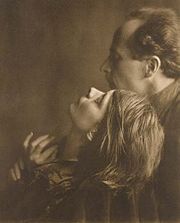 Sometime in the fall of 1913 Los Angeles photographer Margrethe Mather
visited Weston's studio because of his growing reputation, and within a few months they developed an intense relationship. Weston was a quiet Midwestern transplant to California, and Mather was a part of the growing bohemian cultural scene in Los Angeles. She was very outgoing and artistic in a flamboyant way, and her permissive sexual morals were far different from the conservative Weston at the time - Mather had been a prostitute and was bisexual with a preference for women. Mather presented a stark contrast to Weston's home life; his wife Flora was described as a "homely, rigid Puritan, and an utterly conventional woman, with whom he had little in common since he abhorred conventions" ‒ and he found Mather's uninhibited lifestyle irresistible and her photographic vision intriguing.
He asked Mather to be his studio assistant, and for the next decade they worked closely together, making individual and jointly signed portraits of such luminaries as Carl Sandburg
and Max Eastman
. A joint exhibition of their work in 2001 revealed that during this period Weston emulated Mather's style and, later, her choice of subjects. On her own Mather photographed "fans, hands, eggs, melons, waves, bathroom fixtures, seashells and birds wings, all subjects that Weston would also explore." A decade later he described her as "the first important person in my life, and perhaps even now, though personal contact has gone, the most important."
In early 1915 Weston began keeping detailed journals he later came to call his "Daybooks". For the next two decades he recorded his thoughts about his work, observations about photography, and his interactions with friends, lovers and family. On December 6, 1916, a third son, Lawrence Neil Weston, was born. He also followed in the footsteps of his father and became a well-known photographer. It was during this period that Weston first met photographer Johan Hagemeyer
, whom Weston mentored and lent his studio to from time to time. Later, Hagemeyer would return the favor by letting Weston use his studio in Carmel after he returned from Mexico. For the next several years Weston continued to earn a living by taking portraits in his small studio which he called "the shack".
Meanwhile, Flora was spending all of her time caring for their children. Their fourth son, Cole Weston
(1919–2003), was born on January 30, 1919, and afterward she rarely had time to leave their home.
Over the summer of 1920 Weston met two people who were part of the growing Los Angeles cultural scene: Roubaix de l'Abrie Richey, known as "Robo" and a woman he called his wife, Tina Modotti
. Modotti, who was then known only as a stage and film actress, was never married to Robo, but they pretended to be for the sake of his family. Weston and Modotti were immediately attracted to each other, and they soon became lovers. Richey knew of Modotti's affair, but he continued to be friends with Weston and later invited him to come to Mexico and share his studio.
The following year Weston agreed to allow Mather to become an equal partner in his studio. For several months they took portraits that they signed with both of their names. This was only time in his long career that Weston shared credit with another photographer.
Sometime in 1920 he began photographing nude models for the first time. His first models were his wife Flora and their children, but soon thereafter he took at least three nude studies of Mather. He followed these with several more photographs of nude models, the first of dozens of figure studies he would make of friends and lovers over the next twenty years.
Until now Weston had kept his relationships with other women a secret from his wife, but as he began to photograph more nudes Flora became suspicious about what went on with his models. Chandler recalled that his mother regularly sent him on "errands" to his father's studio and asked him to tell her who was there and what they were doing.
One of the first who agreed to model nude for Weston was Modotti. She became his primary model for the next several years.
In 1922 he visited his sister May, who had moved to Middletown, Ohio
. While there he made five or six photographs of the tall smoke stacks at the nearby Armco steel mill. These images signaled a change in Weston's photographic style, a transition from the soft-focus pictorialism of the past to a new, cleaner-edge style. He immediately recognized the change and later recorded it in his notes: "The Middletown visit was something to remember…most of all in importance was my photographing of 'Armco'…That day I made great photographs, even Stieglitz thought they were important!"
At that time New York City was the cultural center for photography as an art form in America, and Alfred Stieglitz
was the most influential figure in photography. Weston badly wanted to go to New York to meet with him, but he did not have enough money to make the trip. His brother-in-law gave him enough money to continue on from Middletown to New York City, and he spent most of October and early November there. While there he met artist Charles Sheeler
, photographers Clarence H. White, Gertrude Kasebier
and finally, Stieglitz. Weston wrote that Stieglitz told him, "Your work and attitude reassures me. You have shown me at least several prints which have given me a great deal of joy. And I can seldom say that of photographs."
Soon after Weston returned from New York, Robo moved to Mexico and set up a studio there to create batik
s. Within a short while he had arranged for a joint exhibition of his work and of photographs by Weston, Mather and a few others. In early 1923 Modotti left by train to be with Robo in Mexico, but he contracted smallpox
and died shortly before she arrived. Modotti was grief stricken, but within a few weeks she felt well enough that she decided to stay and carry out the exhibition that Robo had planned. The show was a success, and, due in no small part to his nude studies of Modotti, it firmly established Weston's artistic reputation in Mexico.
After the show closed Modotti returned to California, and Weston and she made plans to return to Mexico together. He wanted to spend a couple of months there photographing and promoting his work, and, conveniently, he could travel under the pretense of Modotti being his assistant and translator.
The week before he left for Mexico, Weston briefly reunited with Mather and took several nudes of her lying in the sand at Redondo Beach. These images were very different from his previous nude studies - sharply focused and showing her entire body in relation to the natural setting. They have been called the artistic prototypes for the famous nudes of Charis Wilson he would take more than a decade later.
They arrived in Mexico City on August 11 and rented a large hacienda outside of the city.. Within a month he had arranged for an exhibition of his work at the Aztec Land Gallery, and on October 17 the show opened to glowing press reviews. He was particularly proud of a review by Marius de Zayas
that said "Photography is beginning to be photography, for until now it has only been art."
The different culture and scenery in Mexico forced Weston to look at things in new ways. He became more responsive to what was in front of him, and he turned his camera on everyday objects like toys, doorways and bathroom fixtures. He also made several intimate nudes and portraits of Modotti. He wrote in his Daybooks:
Weston continued to photograph the people and things around him, and his reputation in Mexico increased the longer he stayed. He had a second exhibition at the Aztec Land Galley in 1924, and he had a steady stream of local socialites asking him to take their portraits. At the same time, Weston began to miss his other sons back in the U.S. As with many of his actions, though, it was a woman who motivated him most. He had recently corresponded with a woman he had known for several years named Miriam Learner, and as her letters became more passionate he longed to see her again.
He and Chandler returned to San Francisco at the end of 1924, and the next month he set up a studio with Hagemeyer. Weston seemed to be struggling with his past and his future during this period. He burned all of his pre-Mexico journals, as though trying to erase the past, and started a new series of nudes with Lerner and with his son Neil. He wrote that these images were "the start of a new period in my approach and attitude towards photography."
His new relationship with Lerner did not last long, and in August 1925 he returned to Mexico, this time with his son Brett. Modotti had arranged a joint show of their photographs, and it opened the week he returned. He received new critical acclaim, and six of his prints were purchased for the State Museum. For the next several months he concentrated once again on photographing folk art, toys and local scenes. One of his strongest images of this period is of three black clay pots that art historian Rene d'Harnoncourt
described as "the beginning of a new art."
In May 1926 Weston signed a contract with writer Anita Brenner for $1,000 to make photographs for a book she was writing about Mexican folk art. In June he, Modotti and Brett started traveling around the country in search of lesser known native arts and crafts. His contract required him to give Brenner three finished prints from 400 8x10 negatives, and it took him until November of that year to complete the work. During their travels, Brett received a crash course in photography from his father, and he made more than two dozen prints that his father judged to be of exceptional quality.
By the time they returned from their trip, Weston and Modotti's relationship had crumbled, and within less than two weeks he and Brett returned to California. He never traveled to Mexico again.
In February he started a new series of nudes, this time of dancer Bertha Wardell. One of this series, of her kneeling body cut off at the shoulders, is one of Weston's most well-known figure studies. At this same time he met Canadian painter Henrietta Shore
, whom he asked to comment on the photos of Wardell. He was surprised by her honest critique: "I wish you would not do so many nudes - you are getting used to them, the subject no longer amazes you ‒ most of these are just nudes."
He asked to look at her work and was intrigued by her large paintings of sea shells He borrowed several shells from her, thinking he might find some inspiration for a new still life series. Over the next few weeks he explored many different kinds of shell and background combinations - in his log of photographs taken for 1927 he listed fourteen negatives of shells. One of these, simply called Nautilus
, 1927" (sometimes called Shell, 1927), became one of his most famous images. Modotti called the image "mystical and erotic," and when she showed it to Rene d'Harnoncourt he said he felt "weak at the knees." Weston is known to have made at least twenty-eight prints of this image, more than he had made of any other shell image.
In September of that year Weston had a major exhibition at Palace of the Legion of Honor. At the open of the show he met fellow photographer Willard Van Dyke
, who later introduced Weston to Ansel Adams
.
In May, 1928, Weston and Brett made a brief but important trip to the Mojave Desert. It was there that he first explored and photographed landscapes as an art form. He found the stark rock forms and empty spaces to be a visual revelation, and over a long weekend he took twenty-seven photographs. In his journal he declared "these negatives are the most important I have ever done."
Later that year he and Brett moved to San Francisco, where they lived and worked in a small studio owned by Hagemeyer. He made portraits to earn an income, but he longed to get away by himself and get back to his art. In early 1929 he moved to Hagemeyer's cottage in Carmel, and it was there that he finally found the solitude and the inspiration that he was seeking. He placed a sign in studio window that said, "Edward Weston, Photographer, Unretouched Portraits, Prints for Collectors."
He started making regular trips to nearby Point Lobos, where he would continue to photograph until the end of his career. It was there that he learned to fine-tune his photographic vision to match the visual space of his view camera, and the images he took there, of kelp, rocks and wind-blown trees, are among his finest. Looking at his work from this period, one biographer wrote:
In early April, 1929, Weston met photographer Sonya Noskowiak
at a party, and by the end of the month she was living with him. As with many of his other relationships, she became his model, muse, pupil and assistant. They would continue to live together for five years.
Intrigued by the many kinds and shapes of kelp he found on the beaches near Carmel, in 1930 Weston began taking close-ups of vegetables and fruits. He made a variety of photographs of cabbage, kale, onions, bananas, and finally, his most iconic image, peppers. In August of that year Noskowiak brought him several green peppers, and over a four-day period he shot at least thirty different negatives. Of these, Pepper No. 30
, is among the all-time masterpieces of photography.
Weston had a series of important one-man exhibitions in 1930-31. The first was at Alma Reed's Delphic Studio Galley in New York, followed closely by a mounting of the same show at the Denny Watrous Gallery in Carmel. Both received rave reviews, including a two-page article in the New York Times Magazine. These were followed by shows at De Young Museum in San Francisco and the Galerie Jean Naert in Paris.
Although he was succeeding professionally his personal life was very complex. For most of their marriage, Flora was able to take care of their children because of an inheritance from her parents. However, the Wall Street Crash of 1929
had wiped out most of her savings, and Weston felt increased pressure to help provide more for her and his sons. He described this time as "the most trying economic period of my life."
In 1932, The Art of Edward Weston, the first book devoted exclusively to Weston's work, was published. It was edited by Merle Armitage and dedicated to Alice Rohrer, an admirer and patron of Weston whose $500 donation helped pay for the book to be published.
During the same time a small group of like-minded photographers in the San Francisco area, led by Van Dyke and Ansel Adams, began informally meeting to discuss their common interest and aesthetics. Inspired by Weston's show at the De Young Museum the previous year, they approached the museum with the idea of mounting a group exhibition of their work. They named themselves Group f/64
, and in November, 1932, an exhibition of 80 of their prints opened at the museum. The show was a critical success.
In 1933 Weston bought a 4 × 5 Graflex camera, which was much smaller and lighter than the large view camera he had used for many years. He began taking close-up nudes of Noskowiak and other models. The smaller camera allowed him to interact more with his models, while at the same time the nudes he took during this period began to resemble some of the contorted root and vegetables he had taken the year before.
In early 1934, "a new and important chapter opened" in Weston's life when he met Charis Wilson
at a concert. Even more than with his previous lovers, Weston was immediately captivated by her beauty and her personality. He wrote: "A new love came into my life, a most beautiful one, one which will, I believe, stand the test of time." On April 22 he photographed her nude for the first time, and they entered into an intense relationship. He was still living with Noskowiak at that time, but within two weeks he asked her to move out, declaring that for him other women were "as inevitable as the tides".
Perhaps because of the intensity of his new relationship, he stopped writing in his Daybooks at this same time. Six months later he wrote one final entry, looking back from April 22:
Almost immediately he began taking a new series of nudes with Wilson as the model. One of the first photographs he took of her, on the balcony of their home, became one of his most published images (Nude (Charis, Santa Monica)
). Soon after they took the first of several trips to Oceano Dunes, not far from Santa Monica. It was there that Weston made some of his most daring and intimate photographs of any of his models, capturing Wilson in completely uninhibited poses in the sand dunes. He exhibited only one or two of this series in his lifetime, thinking several of the others were "too erotic" for the general public.
Although his recent work had received critical acclaim, he was not earning enough income from his artistic images to provide a steady income. Rather than going back to relying solely on portraiture, he started the “Edward Weston Print of the Month Club”, offering selections of his photos for a monthly $5 subscription. Each month subscribers would receive a new print from Weston, with a limited edition of 40 copies of each print. Although he created these prints with the same high standards that he did for his exhibition prints, it is thought that he never had more than eleven subscribers.
At the suggestion of Beaumont Newhall, Weston decided to apply for a Guggenheim Foundation grant (now known as a Guggenheim Fellowship
). He wrote a two-sentence description about his work, assembled thirty-five of his favorites prints, and sent it in. Afterward Dorothea Lange
and her husband suggested that the application was too brief to be seriously considered, and Weston resubmitted it with a four-page letter and work plan. He did not mention that Wilson had written the new application for him.
On March 22, 1937, Weston received notification that he had been awarded a Guggenheim grant, the first ever given to a photographer. The award was $2,000 for one year, a significant amount of money at that time. He was able to further capitalize on the award by arranging to provide the editor of AAA Westway Magazine with 8-10 photos per month for $50 during their travels, with Wilson getting an additional $15 monthly for photo captions and short narratives. They purchased a new car and set out on Weston's dream trip to go and photograph whatever he wanted. Over the next twelve months they made seventeen trips and covered 16,697 miles according to Wilson's detailed log. Weston made 1,260 negatives during the trip.
The freedom of this trip with the "love of his life", combined with all of his sons now reaching the age of adulthood, gave Weston the motivation to finally divorce his wife. They had been living apart for sixteen years.
Due to the success of the past year, Weston applied for and received a second year of Guggenheim support. Although he wanted to do some additional traveling, he intended to use most of the money to allow him to print his past year's work. He commissioned Neil to build a small home in the Carmel Highlands on property owned by Wilson's father. They named the place "Wildcat Hill" because of the many domestic cats that soon occupied the grounds.
Wilson set up a writing studio in what was intended to be a small garage behind the house, and she spent several months writing and editing stories from their travels.
In 1939, Seeing California with Edward Weston was published, with photographs by Weston and writing by Wilson. Finally relieved from the financial stresses of the past and inordinately happy with his work and his relationship, Weston married Wilson in a small ceremony on April 24.
Buoyed by the success of their first book, in 1940 they published California and the West. The first edition, featuring 96 of Weston's photos with text by Wilson, sold for $3.95. Over the summer, Weston taught photography at the first Ansel Adams Workshop at Yosemite National Park
.
Just as the Guggenheim money was running out, Weston was invited to illustrate a new edition of Walt Whitman
's Leaves of Grass
. He would receive $1,000 for photographs and $500 travel expenses. Weston insisted on having artistic control of the images he would take and insisted that he would not be taking literal illustrations of Whitman's text. On May 28 he and Wilson began a trip that would cover 20,000 miles through 24 states; he took between 700 and 800 8x10 negatives as well as dozens of Graflex portraits.
On December 7, 1941, Pearl Harbor
was attacked, and the United States entered World War II
. Weston was near the end of the Whitman trip, and he was deeply affected by the outbreak of the war. He wrote: "When the war broke out we scurried home. Charis did not want to scurry. I did."
He spent the first few months of 1942 organizing and printing the negatives from the Whitman trip. Of the hundred of images he took, forty-nine were selected for publication.
Due to the war, Point Lobos was closed to the public for several years. Weston continued to work on images centered on Wildcat Hill, including shots of the many cats that lived there. Weston treated them with the same serious intent that he applied to all of his other subjects, and Charis assembled the results into their most unusual publication, The Cats of Wildcat Hill, which was finally published in 1947.
The year 1945 marked the beginning of significant changes for Weston. He began to experience the first symptoms of Parkinson's disease
, a debilitating ailment that gradually stole his strength and his ability to photograph. He withdrew from Wilson, who at the same time began to become more involved in local politics and the Carmel cultural scene. A strength that originally brought them together - her lack of interest in becoming a photographer herself - eventually led to their break-up. She wrote, "My flight from Edward was also partly an escape from photography, which had taken up so much room in my life for so many years."
While working on a major retrospective exhibition for the Museum of Modern Art, he and Wilson separated. Weston returned to Glendale since the land for their cabin at Wildcat Hill still belonged to Wilson's father. Within a few months she moved out and arranged to sell the property to him.
transparencies for their advertising campaign. Weston had never worked in color before, primarily because he had no means of developing or printing the more complicated color process. He accepted their offer in no small part because they offered him $250 per image, the highest amount he would be paid for any single work in his lifetime. He eventually sold seven color works to Kodak of landscapes and scenery at Point Lobos and nearby Monterey harbor.
By late 1948 he was no longer physically able to use his large view camera. That year he took his last photographs, at Point Lobos. His final negative was an image he called, "Rocks and Pebbles, 1948". Although diminished in his capacity, Weston never stopped being a photographer. He worked with his sons and others to catalog his images and especially to oversee the publication and printing of his work. In 1950 there was a major retrospective of his work at the Musee National d'Art Moderne
in Paris, and in 1952 he published a Fiftieth Anniversary portfolio, with images printed by Brett.
During this time he worked with Cole, Brett, and Brett's wife Dody Warren to select and have them print a master set of what he considered his best work. They spent many long hours together in the darkroom, and by 1956 they had produced what Weston called “The Project Prints,” eight sets of 8” × 10” prints from 830 of his negatives. The only complete set today is housed at the University of California, Santa Cruz
. Later that same year the Smithsonian Institution displayed nearly 100 of these prints at a major exhibit, “The World of Edward Weston”, paying tribute to his accomplishments in American photography.
Weston died at his home on Wildcat Hill on New Year’s Day, 1958. His sons scattered his ashes into the Pacific Ocean at an area then known as Pebbly Beach on Point Lobos. Due to Weston's significant influence in the area, the beach was later renamed Weston Beach. He had $300 in his bank account at the time of his death.
Film and Paper
Prior to 1921 Weston used an orthochromatic
sheet film, but after panchromatic
film became widely available in 1921 he switched to it exclusively. Notations he made about his exposures indicate that the film he used would be rated approximately equivalent to 16 on the today's ISO scale
. This necessitated very long exposures when using his view camera, ranging from 1 to 3 seconds for outdoor landscape exposures to as long as 4½ hours for still lifes such his peppers or shells.
The 8 × 10 he preferred was large and heavy, and due to its weight and the cost of the film he never carried more than twelve sheet film holders with him. At the end of each day, he had to go into a darkroom, unload the film holders and load them with new film. This was especially challenging when he was traveling since he had to find a darkened room somewhere or else set up a makeshift darkroom made from heavy canvas.
In spite of the bulky size of the view camera, Weston boasted he could "set up the tripod, fasten the camera securely to it, attach the lens to the camera, open the shutter, study the image on the ground lass, focus it, close the shutter, insert the plate holder, cock the shutter, set it to the appropriate aperture and speed, remove the slide from the plate holder, make the exposure, replace the slide, and remove the plate holder in two minutes and twenty seconds."
He printed on several kinds of paper. Initially he used standard silver gelatin paper for his portraits and other early photos, but in Mexico he learned how to use platinum and palladium paper that was imported from England.
After his return to California, he abandoned platinum and palladium printing due to the scarcity and price of the paper. Eventually he was able to get most of the same qualities he preferred with regular chloro-bromide papers.
Weston always made contact print
s, meaning that the print was exactly the same size as the negative. This was essential for the platinum printing that he preferred, since at that time the platinum papers required ultra-violet light to activate.
When he wanted a print that was larger than the original negative size, he used an enlarger to create a larger inter-positive, then contact printed it to a new negative. The new larger negative was then used to make a print of that size.
United States
The United States of America is a federal constitutional republic comprising fifty states and a federal district...
photographer
Photography
Photography is the art, science and practice of creating durable images by recording light or other electromagnetic radiation, either electronically by means of an image sensor or chemically by means of a light-sensitive material such as photographic film...
. He has been called "one of the most innovative and influential American photographers…" and "one of the masters of 20th century photography." Over the course of his forty-year career Weston photographed an increasingly expansive set of subjects, including landscapes, still lifes, nudes, portraits, genre scenes and even whimsical parodies. It is said that he developed a "quintessentially American, and specially Californian, approach to modern photography" because of his focus on the people and places of the American West. In 1937 Weston was the first photographer to receive a Guggenheim Fellowship
Guggenheim Fellowship
Guggenheim Fellowships are American grants that have been awarded annually since 1925 by the John Simon Guggenheim Memorial Foundation to those "who have demonstrated exceptional capacity for productive scholarship or exceptional creative ability in the arts." Each year, the foundation makes...
, and over the next two years he produced nearly 1,400 negatives using his 8 × 10 view camera. Some of his most famous photographs were taken of the trees and rocks at Point Lobos, California, near where he lived for many years.
Weston was born in Chicago and moved to California when he was 21. He knew he wanted to be a photographer from an early age, and initially his work was typical of the soft focus
Soft focus
In photography, soft focus is a lens flaw, in which the lens forms images that are blurred due to spherical aberration. A soft focus lens deliberately introduces spherical aberration in order to give the appearance of blurring the image while retaining sharp edges; it is not the same as an...
pictorialism
Pictorialism
Pictorialism is the name given to a photographic movement in vogue from around 1885 following the widespread introduction of the dry-plate process. It reached its height in the early years of the 20th century, and declined rapidly after 1914 after the widespread emergence of Modernism...
that was popular at the time. Within a few years, however, he abandoned that style and went on to be one of the foremost champions of highly detailed photographic images.
In 1947 he was diagnosed with Parkinson's disease
Parkinson's disease
Parkinson's disease is a degenerative disorder of the central nervous system...
and he stopped photographing soon thereafter. He spent the remaining ten years of his life overseeing the printing of more than 1,000 of his most famous images.
1885–1906: Early life
Weston was born in Highland ParkHighland Park, Illinois
Highland Park is a suburban municipality in Lake County, Illinois, United States, about north of downtown Chicago. As of 2009, the population is 33,492. Highland Park is one of several municipalities located on the North Shore of the Chicago Metropolitan Area.-Overview:Highland Park was founded...
, Illinois
Illinois
Illinois is the fifth-most populous state of the United States of America, and is often noted for being a microcosm of the entire country. With Chicago in the northeast, small industrial cities and great agricultural productivity in central and northern Illinois, and natural resources like coal,...
, the second child and only son of Edward Burbank Weston, an obstetrician, and Alice Jeanette Brett, a Shakespearean actress. His mother died when he was five and he was raised mainly by his sister Mary, whom he called "May" or "Mazie". She was nine years older than he, and they developed a very close bond that was one of the few steady relationships in Weston's life.
His father remarried when he was nine, but neither Weston nor his sister got along with their new stepmother and stepbrother. After May was married and left their home in 1897, Weston's father devoted most of his time to his new wife and her son. Weston was left on his own much of the time; he stopped going to school and withdrew into his own room in their large home.
As a present for his 16th birthday Weston's father gave him his first camera
Camera
A camera is a device that records and stores images. These images may be still photographs or moving images such as videos or movies. The term camera comes from the camera obscura , an early mechanism for projecting images...
, a Kodak Bull's-Eye #2, which was a simple box camera. He took it on vacation in the Midwest, and by the time he returned home his interest in photography was enough to lead him to purchase a used 5 × 7 inch view camera. He began photographing in Chicago
Chicago
Chicago is the largest city in the US state of Illinois. With nearly 2.7 million residents, it is the most populous city in the Midwestern United States and the third most populous in the US, after New York City and Los Angeles...
parks and a farm owned by his aunt, and developed his own film and prints. Later he would remember that even at that early age his work showed strong artistic merit. He said, "I feel that my earliest work of 1903 ‒ though immature ‒ is related more closely, both with technique and composition, to my latest work than are several of my photographs dating from 1913-1920, a period in which I was trying to be artistic."
In 1904 May and her family moved to California, leaving Weston further isolated in Chicago. He earned a living by taking a job at a local department store, but he continued to spend most of his free time taking photos, Within two years he felt confident enough of his photography that he submitted his work to the magazine Camera and Darkroom, and in the April, 1906, issue they published a full-page reproduction of his picture Spring, Chicago. This is the first known publication of any of his photographs.
1906–23: Becoming a photographer
At the urging of his sister, Weston left Chicago in the spring of 1906 and moved near May's home in Tropico, California (now a neighborhood in GlendaleGlendale, California
Glendale is a city in Los Angeles County, California, United States. As of the 2010 Census, the city population is 191,719, down from 194,973 at the 2000 census. making it the third largest city in Los Angeles County and the 22nd largest city in the state of California...
). He decided to stay there and pursue a career
Career
Career is defined by the Oxford English Dictionary as a person's "course or progress through life ". It is usually considered to pertain to remunerative work ....
in photography, but he soon realized he needed more professional training. A year later he moved to Effingham, Illinois
Effingham, Illinois
Effingham is a city in Effingham County, Illinois, United States. The population was 12,384 at the 2000 census. It is the county seat of Effingham County....
, in order to enroll in the Illinois School of Photography. They taught a nine-month course, but Weston finished all of the class work in six months. The school refused to give him a diploma unless he paid for the full nine months; Weston refused and instead moved back to California in the spring of 1908.
He briefly worked at the photography studio of George Steckel in Los Angeles, as a negative retoucher. Within a few months he moved to the more established studio of Louis Mojonier. For the next several years he learned the techniques and business of operating a photography studio under Mojonier's direction.
Sometime in the summer of 1908 Weston was introduced to his sister's best friend, Flora May Chandler. She was a grade-school teacher, seven years older than Weston and second cousin to Harry Chandler
Harry Chandler
Harry Chandler was an American newspaper publisher and investor who became owner of the largest real estate empire in the U.S.-Biography:...
, who at that time was described as the head of "the single most powerful family in Southern California.". Chandler had inherited some money when her father died, and although she was not as wealthy as her cousins, Weston recognized that she had enough money to allow him to start working full-time as a photographer.
On January 30, 1909, Weston and Chandler married in a simple ceremony. The first of their four sons, Edward Chandler Weston (1910–1993), known as Chandler, was born on April 26, 1910. Named after Weston and his wife, he later became a portrait photographer and sometimes assistant to his father.
In 1911 Weston opened his own business, called "The Little Studio", in Tropico. His sister later asked him why he opened his studio in Tropico rather than in the nearby metropolis of Los Angeles, and he replied "Sis, I'm going to make my name so famous that it won’t matter where I live."
For the next three years he worked alone in his studio, making portraits of children and friends. Even at that early stage of his career he was highly particular about his work; in an interview at that time he said "[photographic] plates are nothing to me unless I get what I want. I have used thirty of them at a sitting if I did not secure the effect to suit me."
His critical eye paid off as he quickly gained more recognition for his work. He won prizes in national competitions, published several more photographs and wrote articles for magazines such as Photo-Era and American Photography, championing the pictorial style
Pictorialism
Pictorialism is the name given to a photographic movement in vogue from around 1885 following the widespread introduction of the dry-plate process. It reached its height in the early years of the 20th century, and declined rapidly after 1914 after the widespread emergence of Modernism...
.
On December 16, 1911, Weston's second son, Theodore Brett Weston
Brett Weston
Brett Weston was an American photographer and grew up in LA. He was the second son of photographer Edward Weston. Van Deren Coke, former curator of the San Francisco Museum of Art referred to Brett Weston as the "child genius of American photography." Brett began taking photographs in 1925 and...
(1911–1993), was born. He became a long-time artistic collaborator with his father and an important photographer on his own.
Margrethe Mather
Margrethe Mather was a photographer who, through her exploration of light and form, helped to transform photography into a modern art.- Personal life :...
visited Weston's studio because of his growing reputation, and within a few months they developed an intense relationship. Weston was a quiet Midwestern transplant to California, and Mather was a part of the growing bohemian cultural scene in Los Angeles. She was very outgoing and artistic in a flamboyant way, and her permissive sexual morals were far different from the conservative Weston at the time - Mather had been a prostitute and was bisexual with a preference for women. Mather presented a stark contrast to Weston's home life; his wife Flora was described as a "homely, rigid Puritan, and an utterly conventional woman, with whom he had little in common since he abhorred conventions" ‒ and he found Mather's uninhibited lifestyle irresistible and her photographic vision intriguing.
He asked Mather to be his studio assistant, and for the next decade they worked closely together, making individual and jointly signed portraits of such luminaries as Carl Sandburg
Carl Sandburg
Carl Sandburg was an American writer and editor, best known for his poetry. He won three Pulitzer Prizes, two for his poetry and another for a biography of Abraham Lincoln. H. L. Mencken called Carl Sandburg "indubitably an American in every pulse-beat."-Biography:Sandburg was born in Galesburg,...
and Max Eastman
Max Eastman
Max Forrester Eastman was an American writer on literature, philosophy and society, a poet, and a prominent political activist. For many years, Eastman was a supporter of socialism, a leading patron of the Harlem Renaissance and an activist for a number of liberal and radical causes...
. A joint exhibition of their work in 2001 revealed that during this period Weston emulated Mather's style and, later, her choice of subjects. On her own Mather photographed "fans, hands, eggs, melons, waves, bathroom fixtures, seashells and birds wings, all subjects that Weston would also explore." A decade later he described her as "the first important person in my life, and perhaps even now, though personal contact has gone, the most important."
In early 1915 Weston began keeping detailed journals he later came to call his "Daybooks". For the next two decades he recorded his thoughts about his work, observations about photography, and his interactions with friends, lovers and family. On December 6, 1916, a third son, Lawrence Neil Weston, was born. He also followed in the footsteps of his father and became a well-known photographer. It was during this period that Weston first met photographer Johan Hagemeyer
Johan Hagemeyer
Johan Hagemeyer was a Dutch born horticulturalist and vegetarian who is remembered primarily for being an early 20th century photographer and artistic intellectual...
, whom Weston mentored and lent his studio to from time to time. Later, Hagemeyer would return the favor by letting Weston use his studio in Carmel after he returned from Mexico. For the next several years Weston continued to earn a living by taking portraits in his small studio which he called "the shack".
Meanwhile, Flora was spending all of her time caring for their children. Their fourth son, Cole Weston
Cole Weston
Cole Weston was the youngest son of photographer Edward Weston and brother of photographer Brett Weston. He dedicated his life to photography and the theater....
(1919–2003), was born on January 30, 1919, and afterward she rarely had time to leave their home.
Over the summer of 1920 Weston met two people who were part of the growing Los Angeles cultural scene: Roubaix de l'Abrie Richey, known as "Robo" and a woman he called his wife, Tina Modotti
Tina Modotti
Tina Modotti was an Italian photographer, model, actress, and revolutionary political activist.- Early life :Modotti was born Assunta Adelaide Luigia Modotti Mondini in Udine, Friuli, Italy...
. Modotti, who was then known only as a stage and film actress, was never married to Robo, but they pretended to be for the sake of his family. Weston and Modotti were immediately attracted to each other, and they soon became lovers. Richey knew of Modotti's affair, but he continued to be friends with Weston and later invited him to come to Mexico and share his studio.
The following year Weston agreed to allow Mather to become an equal partner in his studio. For several months they took portraits that they signed with both of their names. This was only time in his long career that Weston shared credit with another photographer.
Sometime in 1920 he began photographing nude models for the first time. His first models were his wife Flora and their children, but soon thereafter he took at least three nude studies of Mather. He followed these with several more photographs of nude models, the first of dozens of figure studies he would make of friends and lovers over the next twenty years.
Until now Weston had kept his relationships with other women a secret from his wife, but as he began to photograph more nudes Flora became suspicious about what went on with his models. Chandler recalled that his mother regularly sent him on "errands" to his father's studio and asked him to tell her who was there and what they were doing.
One of the first who agreed to model nude for Weston was Modotti. She became his primary model for the next several years.
In 1922 he visited his sister May, who had moved to Middletown, Ohio
Middletown, Ohio
Middletown is an All-America City located in Butler and Warren counties in the southwestern part of the U.S. state of Ohio. Formerly in Lemon, Turtlecreek, and Franklin townships, Middletown was incorporated by the Ohio General Assembly on February 11, 1833, and became a city in 1886...
. While there he made five or six photographs of the tall smoke stacks at the nearby Armco steel mill. These images signaled a change in Weston's photographic style, a transition from the soft-focus pictorialism of the past to a new, cleaner-edge style. He immediately recognized the change and later recorded it in his notes: "The Middletown visit was something to remember…most of all in importance was my photographing of 'Armco'…That day I made great photographs, even Stieglitz thought they were important!"
At that time New York City was the cultural center for photography as an art form in America, and Alfred Stieglitz
Alfred Stieglitz
Alfred Stieglitz was an American photographer and modern art promoter who was instrumental over his fifty-year career in making photography an accepted art form...
was the most influential figure in photography. Weston badly wanted to go to New York to meet with him, but he did not have enough money to make the trip. His brother-in-law gave him enough money to continue on from Middletown to New York City, and he spent most of October and early November there. While there he met artist Charles Sheeler
Charles Sheeler
Charles Rettew Sheeler, Jr. was an American artist. He is recognized as one of the founders of American modernism and one of the master photographers of the 20th century.-Early life and career:...
, photographers Clarence H. White, Gertrude Kasebier
Gertrude Käsebier
Gertrude Käsebier was one of the most influential American photographers of the early 20th century. She was known for her evocative images of motherhood, her powerful portraits of Native Americans and her promotion of photography as a career for women.-Early life :Käsebier was born Gertrude...
and finally, Stieglitz. Weston wrote that Stieglitz told him, "Your work and attitude reassures me. You have shown me at least several prints which have given me a great deal of joy. And I can seldom say that of photographs."
Soon after Weston returned from New York, Robo moved to Mexico and set up a studio there to create batik
Batik
Batik is a cloth that traditionally uses a manual wax-resist dyeing technique. Batik or fabrics with the traditional batik patterns are found in Indonesia, Malaysia, Japan, China, Azerbaijan, India, Sri Lanka, Egypt, Nigeria, Senegal, and Singapore.Javanese traditional batik, especially from...
s. Within a short while he had arranged for a joint exhibition of his work and of photographs by Weston, Mather and a few others. In early 1923 Modotti left by train to be with Robo in Mexico, but he contracted smallpox
Smallpox
Smallpox was an infectious disease unique to humans, caused by either of two virus variants, Variola major and Variola minor. The disease is also known by the Latin names Variola or Variola vera, which is a derivative of the Latin varius, meaning "spotted", or varus, meaning "pimple"...
and died shortly before she arrived. Modotti was grief stricken, but within a few weeks she felt well enough that she decided to stay and carry out the exhibition that Robo had planned. The show was a success, and, due in no small part to his nude studies of Modotti, it firmly established Weston's artistic reputation in Mexico.
After the show closed Modotti returned to California, and Weston and she made plans to return to Mexico together. He wanted to spend a couple of months there photographing and promoting his work, and, conveniently, he could travel under the pretense of Modotti being his assistant and translator.
The week before he left for Mexico, Weston briefly reunited with Mather and took several nudes of her lying in the sand at Redondo Beach. These images were very different from his previous nude studies - sharply focused and showing her entire body in relation to the natural setting. They have been called the artistic prototypes for the famous nudes of Charis Wilson he would take more than a decade later.
1923–27: Mexico
On July 30, 1923, Weston, his son Chandler, and Modotti left on a steamer for the extended trip to Mexico. His wife, Flora, and their other three sons waved goodbye to them at the dock. It's unknown what Flora understood or thought about the relationship between Weston and Modotti, but she is reported to have called out at the dock, "Tina, take good care of my boys."They arrived in Mexico City on August 11 and rented a large hacienda outside of the city.. Within a month he had arranged for an exhibition of his work at the Aztec Land Gallery, and on October 17 the show opened to glowing press reviews. He was particularly proud of a review by Marius de Zayas
Marius de Zayas
Marius de Zayas Enriquez y Calmet , was an early 20th century Mexican artist, writer and art gallery owner who was influential in the New York arts circles of the 1910s and 1920s.-Life:...
that said "Photography is beginning to be photography, for until now it has only been art."
The different culture and scenery in Mexico forced Weston to look at things in new ways. He became more responsive to what was in front of him, and he turned his camera on everyday objects like toys, doorways and bathroom fixtures. He also made several intimate nudes and portraits of Modotti. He wrote in his Daybooks:
- The camera should be used for a recording of life, for rendering the very substance and quintessence of the thing itself…I feel definite in the belief that the approach to photography is through realism.
Weston continued to photograph the people and things around him, and his reputation in Mexico increased the longer he stayed. He had a second exhibition at the Aztec Land Galley in 1924, and he had a steady stream of local socialites asking him to take their portraits. At the same time, Weston began to miss his other sons back in the U.S. As with many of his actions, though, it was a woman who motivated him most. He had recently corresponded with a woman he had known for several years named Miriam Learner, and as her letters became more passionate he longed to see her again.
He and Chandler returned to San Francisco at the end of 1924, and the next month he set up a studio with Hagemeyer. Weston seemed to be struggling with his past and his future during this period. He burned all of his pre-Mexico journals, as though trying to erase the past, and started a new series of nudes with Lerner and with his son Neil. He wrote that these images were "the start of a new period in my approach and attitude towards photography."
His new relationship with Lerner did not last long, and in August 1925 he returned to Mexico, this time with his son Brett. Modotti had arranged a joint show of their photographs, and it opened the week he returned. He received new critical acclaim, and six of his prints were purchased for the State Museum. For the next several months he concentrated once again on photographing folk art, toys and local scenes. One of his strongest images of this period is of three black clay pots that art historian Rene d'Harnoncourt
Rene d'Harnoncourt
Rene d'Harnoncourt was an art curator, and a Director of the Museum of Modern Art, New York, from 1949 to 1967....
described as "the beginning of a new art."
In May 1926 Weston signed a contract with writer Anita Brenner for $1,000 to make photographs for a book she was writing about Mexican folk art. In June he, Modotti and Brett started traveling around the country in search of lesser known native arts and crafts. His contract required him to give Brenner three finished prints from 400 8x10 negatives, and it took him until November of that year to complete the work. During their travels, Brett received a crash course in photography from his father, and he made more than two dozen prints that his father judged to be of exceptional quality.
By the time they returned from their trip, Weston and Modotti's relationship had crumbled, and within less than two weeks he and Brett returned to California. He never traveled to Mexico again.
1927–35: Glendale to Carmel
Weston initially returned to his old studio in Glendale (previously called Tropico). He quickly arranged a dual exhibition at University of California of the photographs that he and Brett had made the year before. The father showed one hundred prints and the son showed twenty. Brett was only 15 years old at the time.In February he started a new series of nudes, this time of dancer Bertha Wardell. One of this series, of her kneeling body cut off at the shoulders, is one of Weston's most well-known figure studies. At this same time he met Canadian painter Henrietta Shore
Henrietta Shore
Henrietta Shore was a post-impressionist Canadian painter who exhibited contemporaneously with Georgia O'Keeffe and influenced the photographer Edward Weston. Her media were oils, murals, watercolors, and lithographs....
, whom he asked to comment on the photos of Wardell. He was surprised by her honest critique: "I wish you would not do so many nudes - you are getting used to them, the subject no longer amazes you ‒ most of these are just nudes."
He asked to look at her work and was intrigued by her large paintings of sea shells He borrowed several shells from her, thinking he might find some inspiration for a new still life series. Over the next few weeks he explored many different kinds of shell and background combinations - in his log of photographs taken for 1927 he listed fourteen negatives of shells. One of these, simply called Nautilus
Nautilus (photograph)
Nautilus is a black-and-white photograph taken by Edward Weston in 1927 of a single nautilus shell standing on its end against a dark background...
, 1927" (sometimes called Shell, 1927), became one of his most famous images. Modotti called the image "mystical and erotic," and when she showed it to Rene d'Harnoncourt he said he felt "weak at the knees." Weston is known to have made at least twenty-eight prints of this image, more than he had made of any other shell image.
In September of that year Weston had a major exhibition at Palace of the Legion of Honor. At the open of the show he met fellow photographer Willard Van Dyke
Willard Van Dyke
Willard Van Dyke was an American filmmaker and photographer who believed that photography could have a major influence on the world....
, who later introduced Weston to Ansel Adams
Ansel Adams
Ansel Easton Adams was an American photographer and environmentalist, best known for his black-and-white photographs of the American West, especially in Yosemite National Park....
.
In May, 1928, Weston and Brett made a brief but important trip to the Mojave Desert. It was there that he first explored and photographed landscapes as an art form. He found the stark rock forms and empty spaces to be a visual revelation, and over a long weekend he took twenty-seven photographs. In his journal he declared "these negatives are the most important I have ever done."
Later that year he and Brett moved to San Francisco, where they lived and worked in a small studio owned by Hagemeyer. He made portraits to earn an income, but he longed to get away by himself and get back to his art. In early 1929 he moved to Hagemeyer's cottage in Carmel, and it was there that he finally found the solitude and the inspiration that he was seeking. He placed a sign in studio window that said, "Edward Weston, Photographer, Unretouched Portraits, Prints for Collectors."
He started making regular trips to nearby Point Lobos, where he would continue to photograph until the end of his career. It was there that he learned to fine-tune his photographic vision to match the visual space of his view camera, and the images he took there, of kelp, rocks and wind-blown trees, are among his finest. Looking at his work from this period, one biographer wrote:
- "Weston arranged his compositions so that things happened on the edges; lines almost cross or meet and circular lines just touch the edges tangentially; his compositions were now created exclusively for a space with the proportions of eight by ten. There is no extraneous space nor is there too little."
In early April, 1929, Weston met photographer Sonya Noskowiak
Sonya noskowiak
Sonya Noskowiak was an American photographer and member of the famous San Francisco photography collective Group f/64 that included Ansel Adams and Edward Weston.-Life:...
at a party, and by the end of the month she was living with him. As with many of his other relationships, she became his model, muse, pupil and assistant. They would continue to live together for five years.
Intrigued by the many kinds and shapes of kelp he found on the beaches near Carmel, in 1930 Weston began taking close-ups of vegetables and fruits. He made a variety of photographs of cabbage, kale, onions, bananas, and finally, his most iconic image, peppers. In August of that year Noskowiak brought him several green peppers, and over a four-day period he shot at least thirty different negatives. Of these, Pepper No. 30
Pepper No. 30
Pepper No. 30 is one of the best-known photographs taken by Edward Weston. It depicts a solitary green pepper in rich black-and-white tones, with strong illumination from above....
, is among the all-time masterpieces of photography.
Weston had a series of important one-man exhibitions in 1930-31. The first was at Alma Reed's Delphic Studio Galley in New York, followed closely by a mounting of the same show at the Denny Watrous Gallery in Carmel. Both received rave reviews, including a two-page article in the New York Times Magazine. These were followed by shows at De Young Museum in San Francisco and the Galerie Jean Naert in Paris.
Although he was succeeding professionally his personal life was very complex. For most of their marriage, Flora was able to take care of their children because of an inheritance from her parents. However, the Wall Street Crash of 1929
Wall Street Crash of 1929
The Wall Street Crash of 1929 , also known as the Great Crash, and the Stock Market Crash of 1929, was the most devastating stock market crash in the history of the United States, taking into consideration the full extent and duration of its fallout...
had wiped out most of her savings, and Weston felt increased pressure to help provide more for her and his sons. He described this time as "the most trying economic period of my life."
In 1932, The Art of Edward Weston, the first book devoted exclusively to Weston's work, was published. It was edited by Merle Armitage and dedicated to Alice Rohrer, an admirer and patron of Weston whose $500 donation helped pay for the book to be published.
During the same time a small group of like-minded photographers in the San Francisco area, led by Van Dyke and Ansel Adams, began informally meeting to discuss their common interest and aesthetics. Inspired by Weston's show at the De Young Museum the previous year, they approached the museum with the idea of mounting a group exhibition of their work. They named themselves Group f/64
Group f/64
Group f/64 was a group of seven 20th century San Francisco photographers who shared a common photographic style characterized by sharp-focused and carefully framed images seen through a particularly Western viewpoint...
, and in November, 1932, an exhibition of 80 of their prints opened at the museum. The show was a critical success.
In 1933 Weston bought a 4 × 5 Graflex camera, which was much smaller and lighter than the large view camera he had used for many years. He began taking close-up nudes of Noskowiak and other models. The smaller camera allowed him to interact more with his models, while at the same time the nudes he took during this period began to resemble some of the contorted root and vegetables he had taken the year before.
In early 1934, "a new and important chapter opened" in Weston's life when he met Charis Wilson
Charis Wilson
Helen Charis Wilson , most widely known as a subject of Edward Weston's photographs, was a model and writer.-Early life:...
at a concert. Even more than with his previous lovers, Weston was immediately captivated by her beauty and her personality. He wrote: "A new love came into my life, a most beautiful one, one which will, I believe, stand the test of time." On April 22 he photographed her nude for the first time, and they entered into an intense relationship. He was still living with Noskowiak at that time, but within two weeks he asked her to move out, declaring that for him other women were "as inevitable as the tides".
Perhaps because of the intensity of his new relationship, he stopped writing in his Daybooks at this same time. Six months later he wrote one final entry, looking back from April 22:
- After eight months we are closer together than ever. Perhaps C. will be remembered as the great love of my life. Already I have achieved certain heights reached with no other love.
1935–45: Guggenheim grant to Wildcat Hill
In January, 1935 Weston was facing increasing financial difficulties. He closed his studio in Carmel and moved to Santa Monica Canyon, California, where he opened a new studio with Brett. He implored Wilson to come and live with him, and in August 1935 she finally agreed. While she had an intense interest in his work, Wilson was the first woman Weston had lived with since Flora who had no interest in becoming a photographer. This allowed Weston to concentrate on her as his muse and model, and in turn Wilson devoted her time to promoting Weston's art as his assistant and quasi-agent.Almost immediately he began taking a new series of nudes with Wilson as the model. One of the first photographs he took of her, on the balcony of their home, became one of his most published images (Nude (Charis, Santa Monica)
Nude (Charis, Santa Monica)
Nude is a photograph taken by Edward Weston in 1936. It shows an apparently nude woman with her arms wrapped around her legs while she sits on a blanket in bright sunlight against a darkened doorway...
). Soon after they took the first of several trips to Oceano Dunes, not far from Santa Monica. It was there that Weston made some of his most daring and intimate photographs of any of his models, capturing Wilson in completely uninhibited poses in the sand dunes. He exhibited only one or two of this series in his lifetime, thinking several of the others were "too erotic" for the general public.
Although his recent work had received critical acclaim, he was not earning enough income from his artistic images to provide a steady income. Rather than going back to relying solely on portraiture, he started the “Edward Weston Print of the Month Club”, offering selections of his photos for a monthly $5 subscription. Each month subscribers would receive a new print from Weston, with a limited edition of 40 copies of each print. Although he created these prints with the same high standards that he did for his exhibition prints, it is thought that he never had more than eleven subscribers.
At the suggestion of Beaumont Newhall, Weston decided to apply for a Guggenheim Foundation grant (now known as a Guggenheim Fellowship
Guggenheim Fellowship
Guggenheim Fellowships are American grants that have been awarded annually since 1925 by the John Simon Guggenheim Memorial Foundation to those "who have demonstrated exceptional capacity for productive scholarship or exceptional creative ability in the arts." Each year, the foundation makes...
). He wrote a two-sentence description about his work, assembled thirty-five of his favorites prints, and sent it in. Afterward Dorothea Lange
Dorothea Lange
Dorothea Lange was an influential American documentary photographer and photojournalist, best known for her Depression-era work for the Farm Security Administration...
and her husband suggested that the application was too brief to be seriously considered, and Weston resubmitted it with a four-page letter and work plan. He did not mention that Wilson had written the new application for him.
On March 22, 1937, Weston received notification that he had been awarded a Guggenheim grant, the first ever given to a photographer. The award was $2,000 for one year, a significant amount of money at that time. He was able to further capitalize on the award by arranging to provide the editor of AAA Westway Magazine with 8-10 photos per month for $50 during their travels, with Wilson getting an additional $15 monthly for photo captions and short narratives. They purchased a new car and set out on Weston's dream trip to go and photograph whatever he wanted. Over the next twelve months they made seventeen trips and covered 16,697 miles according to Wilson's detailed log. Weston made 1,260 negatives during the trip.
The freedom of this trip with the "love of his life", combined with all of his sons now reaching the age of adulthood, gave Weston the motivation to finally divorce his wife. They had been living apart for sixteen years.
Due to the success of the past year, Weston applied for and received a second year of Guggenheim support. Although he wanted to do some additional traveling, he intended to use most of the money to allow him to print his past year's work. He commissioned Neil to build a small home in the Carmel Highlands on property owned by Wilson's father. They named the place "Wildcat Hill" because of the many domestic cats that soon occupied the grounds.
Wilson set up a writing studio in what was intended to be a small garage behind the house, and she spent several months writing and editing stories from their travels.
In 1939, Seeing California with Edward Weston was published, with photographs by Weston and writing by Wilson. Finally relieved from the financial stresses of the past and inordinately happy with his work and his relationship, Weston married Wilson in a small ceremony on April 24.
Buoyed by the success of their first book, in 1940 they published California and the West. The first edition, featuring 96 of Weston's photos with text by Wilson, sold for $3.95. Over the summer, Weston taught photography at the first Ansel Adams Workshop at Yosemite National Park
Yosemite National Park
Yosemite National Park is a United States National Park spanning eastern portions of Tuolumne, Mariposa and Madera counties in east central California, United States. The park covers an area of and reaches across the western slopes of the Sierra Nevada mountain chain...
.
Just as the Guggenheim money was running out, Weston was invited to illustrate a new edition of Walt Whitman
Walt Whitman
Walter "Walt" Whitman was an American poet, essayist and journalist. A humanist, he was a part of the transition between transcendentalism and realism, incorporating both views in his works. Whitman is among the most influential poets in the American canon, often called the father of free verse...
's Leaves of Grass
Leaves of Grass
Leaves of Grass is a poetry collection by the American poet Walt Whitman . Though the first edition was published in 1855, Whitman spent his entire life writing Leaves of Grass, revising it in several editions until his death...
. He would receive $1,000 for photographs and $500 travel expenses. Weston insisted on having artistic control of the images he would take and insisted that he would not be taking literal illustrations of Whitman's text. On May 28 he and Wilson began a trip that would cover 20,000 miles through 24 states; he took between 700 and 800 8x10 negatives as well as dozens of Graflex portraits.
On December 7, 1941, Pearl Harbor
Pearl Harbor
Pearl Harbor, known to Hawaiians as Puuloa, is a lagoon harbor on the island of Oahu, Hawaii, west of Honolulu. Much of the harbor and surrounding lands is a United States Navy deep-water naval base. It is also the headquarters of the U.S. Pacific Fleet...
was attacked, and the United States entered World War II
World War II
World War II, or the Second World War , was a global conflict lasting from 1939 to 1945, involving most of the world's nations—including all of the great powers—eventually forming two opposing military alliances: the Allies and the Axis...
. Weston was near the end of the Whitman trip, and he was deeply affected by the outbreak of the war. He wrote: "When the war broke out we scurried home. Charis did not want to scurry. I did."
He spent the first few months of 1942 organizing and printing the negatives from the Whitman trip. Of the hundred of images he took, forty-nine were selected for publication.
Due to the war, Point Lobos was closed to the public for several years. Weston continued to work on images centered on Wildcat Hill, including shots of the many cats that lived there. Weston treated them with the same serious intent that he applied to all of his other subjects, and Charis assembled the results into their most unusual publication, The Cats of Wildcat Hill, which was finally published in 1947.
The year 1945 marked the beginning of significant changes for Weston. He began to experience the first symptoms of Parkinson's disease
Parkinson's disease
Parkinson's disease is a degenerative disorder of the central nervous system...
, a debilitating ailment that gradually stole his strength and his ability to photograph. He withdrew from Wilson, who at the same time began to become more involved in local politics and the Carmel cultural scene. A strength that originally brought them together - her lack of interest in becoming a photographer herself - eventually led to their break-up. She wrote, "My flight from Edward was also partly an escape from photography, which had taken up so much room in my life for so many years."
While working on a major retrospective exhibition for the Museum of Modern Art, he and Wilson separated. Weston returned to Glendale since the land for their cabin at Wildcat Hill still belonged to Wilson's father. Within a few months she moved out and arranged to sell the property to him.
1946–58: Final years
In February, 1946, Weston's major retrospective opened at the Museum of Modern Art in New York. He and Beaumont Newhall selected 313 prints for the exhibition, and eventually 250 photographs were displayed along with 11 negatives. At that time many of his prints were still for sale, and he sold 97 prints from the exhibit at $25 per print. Later that year, Weston was asked by Dr. George L. Waters of Kodak to produce 8 × 10 KodachromeKodachrome
Kodachrome is the trademarked brand name of a type of color reversal film that was manufactured by Eastman Kodak from 1935 to 2009.-Background:...
transparencies for their advertising campaign. Weston had never worked in color before, primarily because he had no means of developing or printing the more complicated color process. He accepted their offer in no small part because they offered him $250 per image, the highest amount he would be paid for any single work in his lifetime. He eventually sold seven color works to Kodak of landscapes and scenery at Point Lobos and nearby Monterey harbor.
By late 1948 he was no longer physically able to use his large view camera. That year he took his last photographs, at Point Lobos. His final negative was an image he called, "Rocks and Pebbles, 1948". Although diminished in his capacity, Weston never stopped being a photographer. He worked with his sons and others to catalog his images and especially to oversee the publication and printing of his work. In 1950 there was a major retrospective of his work at the Musee National d'Art Moderne
Musée National d'Art Moderne
The Musée National d'Art Moderne is the national museum for modern art of France. It is located in Paris and is housed in the Centre Pompidou in the 4th arrondissement of the city. Created in 1947, it was then housed in the Palais de Tokyo and moved to its current location in 1977...
in Paris, and in 1952 he published a Fiftieth Anniversary portfolio, with images printed by Brett.
During this time he worked with Cole, Brett, and Brett's wife Dody Warren to select and have them print a master set of what he considered his best work. They spent many long hours together in the darkroom, and by 1956 they had produced what Weston called “The Project Prints,” eight sets of 8” × 10” prints from 830 of his negatives. The only complete set today is housed at the University of California, Santa Cruz
University of California, Santa Cruz
The University of California, Santa Cruz, also known as UC Santa Cruz or UCSC, is a public, collegiate university; one of ten campuses in the University of California...
. Later that same year the Smithsonian Institution displayed nearly 100 of these prints at a major exhibit, “The World of Edward Weston”, paying tribute to his accomplishments in American photography.
Weston died at his home on Wildcat Hill on New Year’s Day, 1958. His sons scattered his ashes into the Pacific Ocean at an area then known as Pebbly Beach on Point Lobos. Due to Weston's significant influence in the area, the beach was later renamed Weston Beach. He had $300 in his bank account at the time of his death.
Legacy
Two of Weston's photographs, a nude taken in 1925 and a shell taken in 1927, are among the most expensive photographs ever sold as of 2010.Cameras and techniques
During his lifetime Weston worked with several cameras.- 8 × 10 Seneca folding-bed view camera with one of several lenses: a Graf Variable, Wollensak Verito or Rapid Rectilinear
- 8 × 10 Universal view camera with either a triple convertible Turner Reich or a 19" Protar
- 4 × 5 view camera, type unknown.
- 3¼ × 4¼ Graflex with a ƒ/4.5 Tessar lens
Film and Paper
Prior to 1921 Weston used an orthochromatic
Orthochromatic
- Orthochromatic photography :Orthochromatic photography refers to a photographic emulsion that is sensitive to only blue and green light, and thus can be processed with a red safelight. The increased blue sensitivity causes blue objects to appear lighter and red ones darker...
sheet film, but after panchromatic
Panchromatic
Panchromatic film is a type of black-and-white photographic film that is sensitive to all wavelengths of visible light. A panchromatic film therefore produces a realistic reproduction of a scene as it appears to the human eye. Almost all modern photographic film is panchromatic, but some types are...
film became widely available in 1921 he switched to it exclusively. Notations he made about his exposures indicate that the film he used would be rated approximately equivalent to 16 on the today's ISO scale
Film speed
Film speed is the measure of a photographic film's sensitivity to light, determined by sensitometry and measured on various numerical scales, the most recent being the ISO system....
. This necessitated very long exposures when using his view camera, ranging from 1 to 3 seconds for outdoor landscape exposures to as long as 4½ hours for still lifes such his peppers or shells.
The 8 × 10 he preferred was large and heavy, and due to its weight and the cost of the film he never carried more than twelve sheet film holders with him. At the end of each day, he had to go into a darkroom, unload the film holders and load them with new film. This was especially challenging when he was traveling since he had to find a darkened room somewhere or else set up a makeshift darkroom made from heavy canvas.
In spite of the bulky size of the view camera, Weston boasted he could "set up the tripod, fasten the camera securely to it, attach the lens to the camera, open the shutter, study the image on the ground lass, focus it, close the shutter, insert the plate holder, cock the shutter, set it to the appropriate aperture and speed, remove the slide from the plate holder, make the exposure, replace the slide, and remove the plate holder in two minutes and twenty seconds."
He printed on several kinds of paper. Initially he used standard silver gelatin paper for his portraits and other early photos, but in Mexico he learned how to use platinum and palladium paper that was imported from England.
After his return to California, he abandoned platinum and palladium printing due to the scarcity and price of the paper. Eventually he was able to get most of the same qualities he preferred with regular chloro-bromide papers.
Weston always made contact print
Contact print
A contact print is a photographic image produced from film; sometimes from a film negative, and sometimes from a film positive. The defining characteristic of a contact print is that the photographic result is made by exposing through the film negative or positive, onto a light sensitive material...
s, meaning that the print was exactly the same size as the negative. This was essential for the platinum printing that he preferred, since at that time the platinum papers required ultra-violet light to activate.
When he wanted a print that was larger than the original negative size, he used an enlarger to create a larger inter-positive, then contact printed it to a new negative. The new larger negative was then used to make a print of that size.
External links
- A brief biography from the Getty Museum
- edward-weston.com
- Center for Creative Photography, University of Arizona, Tucson, AZ
- kimweston.com
- Edward Weston's portfolio (138 photos)
- Peppers and Nudes: The Photographer Edward Weston
- A Gallery for Fine Photography
- Eloquent Nude: The Love and Legacy of Edward Weston & Charis Wilson
- All Edward Weston Images Online Center for Creative Photography (CCP) CCP at the University of Arizona has released a digital catalog of all Weston's images.