

Edward Walter Maunder

Encyclopedia
Edward Walter Maunder was an English astronomer
best remembered for his study of sunspot
s and the solar magnetic cycle that led to his identification of the period from 1645 to 1715 that is now known as the Maunder Minimum
.
. He attended King's College London
but never graduated. He took a job in a London bank to finance his studies.
Edward Maunder married twice. In 1873 Edward Maunder returned to the Royal Observatory
, taking a position as a spectroscopic
assistant. Shortly after, in 1875, he married Edith Hannah Bustin, who gave birth to six children. Following the death of Edith Hannah in 1888, he met Annie Scott Dill Russell
(1868–1947) in 1890, a mathematician with whom he collaborated for the remainder of his life. In 1895 Maunder and Russell
married. In 1916 Annie Maunder
became one of the first women accepted by the Royal Astronomical Society.
Maunder was also an esteemed biblical scholar.
 Part of Maunder's job at the Observatory
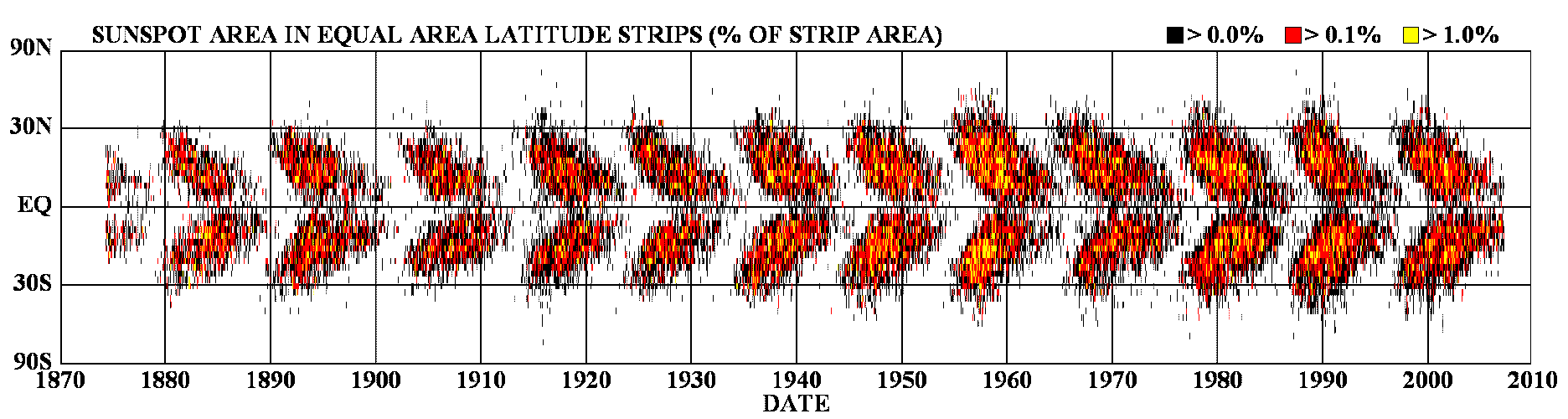
involved photographing and measuring sunspots, and in doing so he observed that the solar
latitudes at which sunspots occur varies in a regular way over the course of the 11 year cycle. After 1891, he was assisted in his work by his second wife, Annie Scott Dill Maunder
(née Russell), a mathematician
educated at Girton College in Cambridge
. She worked as a "lady computer" at the Observatory from 1890 to 1895. In 1904, he published their results in the form of the "butterfly" diagram.
After studying the work of Gustav Spörer
, who examined old records from the different observatories archives looking for changes of the heliographic latitude of sunspots, Maunder announced Spörer's conclusions in own paper edited in 1894. The period
, recognized earlier by Spörer, now bears Maunder name.
or an upper tangent arc
. However, Maunder wrote that the phenomenon moved rapidly from horizon to horizon, which would rule out a noctilucent cloud or upper tangent arc. Further, upper tangent arc cannot occur during nighttime when the observation was made. Since he made his observation during highly intense auroral activity, he assumed it was some extraordinary auroral phenomenon, though one he had never observed again before or after.
He observed Mars
and was a sceptic of the notion of Martian canals
. He conducted visual experiments using marked circular disks which led him to conclude, correctly, that the viewing of canals arose as an optical illusion
. Also he was convinced that there cannot be life "as in our world" on Mars, as there are no temperature-equating winds and too low mean temperatures. Craters
on Mars and the Moon
were named in his and his wife Annie
's honours.
. Although he had been fellow of the Royal Astronomical Society
since 1875, Maunder wanted an association of astronomers open to every person interested in astronomy, from every class of society, and especially open for women.
Edward Maunder was the first editor of the Journal of the BAA
, an office later taken by his wife Annie Maunder
. His older brother, Thomas Frid Maunder (1841–1935), was a co-founder, and secretary of the Association
for 38 years.
by Hector Macpherson, London: Gall & Inglis, 1905
Astronomer
An astronomer is a scientist who studies celestial bodies such as planets, stars and galaxies.Historically, astronomy was more concerned with the classification and description of phenomena in the sky, while astrophysics attempted to explain these phenomena and the differences between them using...
best remembered for his study of sunspot
Sunspot
Sunspots are temporary phenomena on the photosphere of the Sun that appear visibly as dark spots compared to surrounding regions. They are caused by intense magnetic activity, which inhibits convection by an effect comparable to the eddy current brake, forming areas of reduced surface temperature....
s and the solar magnetic cycle that led to his identification of the period from 1645 to 1715 that is now known as the Maunder Minimum
Maunder Minimum
The Maunder Minimum is the name used for the period roughly spanning 1645 to 1715 when sunspots became exceedingly rare, as noted by solar observers of the time....
.
Early and personal life
Edward Maunder was born in 1851, in London, the youngest child of a minister of the Wesleyan SocietyJohn Wesley
John Wesley was a Church of England cleric and Christian theologian. Wesley is largely credited, along with his brother Charles Wesley, as founding the Methodist movement which began when he took to open-air preaching in a similar manner to George Whitefield...
. He attended King's College London
King's College London
King's College London is a public research university located in London, United Kingdom and a constituent college of the federal University of London. King's has a claim to being the third oldest university in England, having been founded by King George IV and the Duke of Wellington in 1829, and...
but never graduated. He took a job in a London bank to finance his studies.
Edward Maunder married twice. In 1873 Edward Maunder returned to the Royal Observatory
Royal Observatory, Greenwich
The Royal Observatory, Greenwich , in London, England played a major role in the history of astronomy and navigation, and is best known as the location of the prime meridian...
, taking a position as a spectroscopic
Spectroscopy
Spectroscopy is the study of the interaction between matter and radiated energy. Historically, spectroscopy originated through the study of visible light dispersed according to its wavelength, e.g., by a prism. Later the concept was expanded greatly to comprise any interaction with radiative...
assistant. Shortly after, in 1875, he married Edith Hannah Bustin, who gave birth to six children. Following the death of Edith Hannah in 1888, he met Annie Scott Dill Russell
Annie Scott Dill Maunder
Annie Scott Dill Maunder, née Russell was an Irish astronomer and mathematician.She was born in Strabane, County Tyrone, Ireland to William Andrew Russell and Hessy Nesbitt Dill. Her father was the minister of the Presbyterian Church in Strabane until 1882.Annie received her secondary education at...
(1868–1947) in 1890, a mathematician with whom he collaborated for the remainder of his life. In 1895 Maunder and Russell
Annie Scott Dill Maunder
Annie Scott Dill Maunder, née Russell was an Irish astronomer and mathematician.She was born in Strabane, County Tyrone, Ireland to William Andrew Russell and Hessy Nesbitt Dill. Her father was the minister of the Presbyterian Church in Strabane until 1882.Annie received her secondary education at...
married. In 1916 Annie Maunder
Annie Scott Dill Maunder
Annie Scott Dill Maunder, née Russell was an Irish astronomer and mathematician.She was born in Strabane, County Tyrone, Ireland to William Andrew Russell and Hessy Nesbitt Dill. Her father was the minister of the Presbyterian Church in Strabane until 1882.Annie received her secondary education at...
became one of the first women accepted by the Royal Astronomical Society.
Maunder was also an esteemed biblical scholar.
Solar observations
Royal Observatory, Greenwich
The Royal Observatory, Greenwich , in London, England played a major role in the history of astronomy and navigation, and is best known as the location of the prime meridian...
involved photographing and measuring sunspots, and in doing so he observed that the solar
Sun
The Sun is the star at the center of the Solar System. It is almost perfectly spherical and consists of hot plasma interwoven with magnetic fields...
latitudes at which sunspots occur varies in a regular way over the course of the 11 year cycle. After 1891, he was assisted in his work by his second wife, Annie Scott Dill Maunder
Annie Scott Dill Maunder
Annie Scott Dill Maunder, née Russell was an Irish astronomer and mathematician.She was born in Strabane, County Tyrone, Ireland to William Andrew Russell and Hessy Nesbitt Dill. Her father was the minister of the Presbyterian Church in Strabane until 1882.Annie received her secondary education at...
(née Russell), a mathematician
Mathematician
A mathematician is a person whose primary area of study is the field of mathematics. Mathematicians are concerned with quantity, structure, space, and change....
educated at Girton College in Cambridge
Cambridge
The city of Cambridge is a university town and the administrative centre of the county of Cambridgeshire, England. It lies in East Anglia about north of London. Cambridge is at the heart of the high-technology centre known as Silicon Fen – a play on Silicon Valley and the fens surrounding the...
. She worked as a "lady computer" at the Observatory from 1890 to 1895. In 1904, he published their results in the form of the "butterfly" diagram.
After studying the work of Gustav Spörer
Gustav Spörer
Friederich Wilhelm Gustav Spörer was a German astronomer.He is noted for his studies of sunspots and sunspot cycles. In this regard he is often mentioned together with Edward Maunder. Spörer was the first to note a prolonged period of low sunspot activity from 1645 to 1715...
, who examined old records from the different observatories archives looking for changes of the heliographic latitude of sunspots, Maunder announced Spörer's conclusions in own paper edited in 1894. The period
Maunder Minimum
The Maunder Minimum is the name used for the period roughly spanning 1645 to 1715 when sunspots became exceedingly rare, as noted by solar observers of the time....
, recognized earlier by Spörer, now bears Maunder name.
Other astronomical observations
In 1882 Maunder (and some other European astronomers) observed what he called an "auroral beam"; as yet unexplained, it had some similarity in appearance to either a noctilucent cloudNoctilucent cloud
Night clouds or Noctilucent clouds are tenuous cloud-like phenomena that are the "ragged-edge" of a much brighter and pervasive polar cloud layer called polar mesospheric clouds in the upper atmosphere, visible in a deep twilight. They are made of crystals of water ice. The name means roughly night...
or an upper tangent arc
Upper tangent arc
An upper tangent arc is a halo, an atmospheric optical phenomenon which appears over and tangent to the 22° halo around the sun.The shape of an upper tangent arc varies with the elevation of the sun; while the sun is low it appears as an arc over the sun forming a sharp angle...
. However, Maunder wrote that the phenomenon moved rapidly from horizon to horizon, which would rule out a noctilucent cloud or upper tangent arc. Further, upper tangent arc cannot occur during nighttime when the observation was made. Since he made his observation during highly intense auroral activity, he assumed it was some extraordinary auroral phenomenon, though one he had never observed again before or after.
He observed Mars
Mars
Mars is the fourth planet from the Sun in the Solar System. The planet is named after the Roman god of war, Mars. It is often described as the "Red Planet", as the iron oxide prevalent on its surface gives it a reddish appearance...
and was a sceptic of the notion of Martian canals
Martian canals
For a time in the late 19th and early 20th centuries, it was erroneously believed that there were canals on Mars. These were a network of long straight lines that appeared in drawings of the planet Mars in the equatorial regions from 60° N. to 60° S. Lat., first observed by the Italian astronomer...
. He conducted visual experiments using marked circular disks which led him to conclude, correctly, that the viewing of canals arose as an optical illusion
Optical illusion
An optical illusion is characterized by visually perceived images that differ from objective reality. The information gathered by the eye is processed in the brain to give a perception that does not tally with a physical measurement of the stimulus source...
. Also he was convinced that there cannot be life "as in our world" on Mars, as there are no temperature-equating winds and too low mean temperatures. Craters
Impact crater
In the broadest sense, the term impact crater can be applied to any depression, natural or manmade, resulting from the high velocity impact of a projectile with a larger body...
on Mars and the Moon
Maunder (lunar crater)
Maunder is a lunar impact crater that is located on the far side of the Moon, just beyond the western limb. This region is sometimes brought into view during favorable librations, but not much detail can be seen. The crater lies at the northern end of the Mare Orientale, within the ring of...
were named in his and his wife Annie
Annie Scott Dill Maunder
Annie Scott Dill Maunder, née Russell was an Irish astronomer and mathematician.She was born in Strabane, County Tyrone, Ireland to William Andrew Russell and Hessy Nesbitt Dill. Her father was the minister of the Presbyterian Church in Strabane until 1882.Annie received her secondary education at...
's honours.
Establishment of the British Astronomical Association
In 1890, Maunder was a driving force in the foundation of the British Astronomical AssociationBritish Astronomical Association
The British Astronomical Association is the senior national association of amateur astronomers in the UK.-Function:It encourages observational astronomy by non-professionals in areas which cannot be covered by professional observatories...
. Although he had been fellow of the Royal Astronomical Society
Royal Astronomical Society
The Royal Astronomical Society is a learned society that began as the Astronomical Society of London in 1820 to support astronomical research . It became the Royal Astronomical Society in 1831 on receiving its Royal Charter from William IV...
since 1875, Maunder wanted an association of astronomers open to every person interested in astronomy, from every class of society, and especially open for women.
Edward Maunder was the first editor of the Journal of the BAA
British Astronomical Association
The British Astronomical Association is the senior national association of amateur astronomers in the UK.-Function:It encourages observational astronomy by non-professionals in areas which cannot be covered by professional observatories...
, an office later taken by his wife Annie Maunder
Annie Scott Dill Maunder
Annie Scott Dill Maunder, née Russell was an Irish astronomer and mathematician.She was born in Strabane, County Tyrone, Ireland to William Andrew Russell and Hessy Nesbitt Dill. Her father was the minister of the Presbyterian Church in Strabane until 1882.Annie received her secondary education at...
. His older brother, Thomas Frid Maunder (1841–1935), was a co-founder, and secretary of the Association
British Astronomical Association
The British Astronomical Association is the senior national association of amateur astronomers in the UK.-Function:It encourages observational astronomy by non-professionals in areas which cannot be covered by professional observatories...
for 38 years.
Further reading
- Willie Wei-Hock Soon and Steven H. Yaskell: The Maunder Minimum and the Variable Sun-Earth Connection, World Scientific, 2003, ISBN 981-238-274-7
by Hector Macpherson, London: Gall & Inglis, 1905
- A. J. Kinder "Edward Walter Maunder His Life and Times" Journal of the British Astronomical Association" Vol. 118 (1) 21-42 (2008).
External links
- Online catalogue of Maunder's personal and working papers (part of the Royal Greenwich Observatory Archive held at Cambridge University Library)
- J. E. Evans and E. W. Maunder, "Experiments as to the Actuality of the 'Canals' observed on Mars", MNRAS, 63 (1903) 488
- Drawing of the butterfly plot