
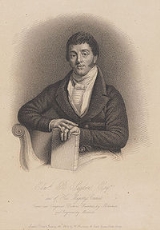
Edward Burtenshaw Sugden, 1st Baron St Leonards PC (12 February 1781 – 29 January 1875) was a British lawyer, judge and
ConservativeThe Conservative Party, formally the Conservative and Unionist Party, is a centre-right political party in the United Kingdom that adheres to the philosophies of conservatism and British unionism. It is the largest political party in the UK, and is currently the largest single party in the House...
politician.
Background
St Leonards was the son of a high-class hairdresser and wig-maker in
WestminsterWestminster is an area of central London, within the City of Westminster, England. It lies on the north bank of the River Thames, southwest of the City of London and southwest of Charing Cross...
,
LondonLondon is the capital city of :England and the :United Kingdom, the largest metropolitan area in the United Kingdom, and the largest urban zone in the European Union by most measures. Located on the River Thames, London has been a major settlement for two millennia, its history going back to its...
.
Legal and political career
After practicing for some years as a
conveyancerIn Commonwealth countries, a conveyancer is a specialist lawyer who specialises in the legal aspects of buying and selling real property, or conveyancing. A conveyancer can also be a solicitor, licensed conveyancer, or a fellow of the Institute of Legal Executives.In the United Kingdom,...
, St Leonards was called to the bar at
Lincoln's InnThe Honourable Society of Lincoln's Inn is one of four Inns of Court in London to which barristers of England and Wales belong and where they are called to the Bar. The other three are Middle Temple, Inner Temple and Gray's Inn. Although Lincoln's Inn is able to trace its official records beyond...
in 1807, having already published his well-known 'Concise and Practical Treatise on the Law of Vendors and Purchasers of Estates'. In 1822 he was made King's Counsel He was returned at different times for various boroughs to the
House of CommonsThe House of Commons is the lower house of the Parliament of the United Kingdom, which also comprises the Sovereign and the House of Lords . Both Commons and Lords meet in the Palace of Westminster. The Commons is a democratically elected body, consisting of 650 members , who are known as Members...
, where he made himself prominent by his opposition to the
Reform Bill of 1832The Representation of the People Act 1832 was an Act of Parliament that introduced wide-ranging changes to the electoral system of England and Wales...
. He was appointed
Solicitor GeneralHer Majesty's Solicitor General for England and Wales, often known as the Solicitor General, is one of the Law Officers of the Crown, and the deputy of the Attorney General, whose duty is to advise the Crown and Cabinet on the law...
in 1829. As Solicitor-General he took a narrow view of
Jewish emancipationThe Emancipation of the Jews in England was the culmination of efforts in the 19th century over several hundred years to loosen the legal restrictions set in place on England's Jewish population...
, arguing that "They had possessed nothing; they held nothing. They had no civil rights; they never had any."
In 1834 he was
Lord Chancellor of IrelandThe office of Lord Chancellor of Ireland was the highest judicial office in Ireland until the establishment of the Irish Free State in 1922. From 1721 to 1801 it was also the highest political office of the Irish Parliament.-13th century:...
, and again from 1841 to 1846. In 1849, St leonards published 'A Treatise on the Law of Property as administered in the House of Lords', in which he criticised the decisions given in the
House of LordsThe House of Lords is the upper house of the Parliament of the United Kingdom. Like the House of Commons, it meets in the Palace of Westminster....
when acting as a
Court of AppealThe Court of Appeal of England and Wales is the second most senior court in the English legal system, with only the Supreme Court of the United Kingdom above it...
. In
Lord Derby'sEdward George Geoffrey Smith-Stanley, 14th Earl of Derby, KG, PC was an English statesman, three times Prime Minister of the United Kingdom, and to date the longest serving leader of the Conservative Party. He was known before 1834 as Edward Stanley, and from 1834 to 1851 as Lord Stanley...
first government in 1852 be became
Lord ChancellorThe Lord High Chancellor of Great Britain, or Lord Chancellor, is a senior and important functionary in the government of the United Kingdom. He is the second highest ranking of the Great Officers of State, ranking only after the Lord High Steward. The Lord Chancellor is appointed by the Sovereign...
and was raised to the
peerageThe Peerage is a legal system of largely hereditary titles in the United Kingdom, which constitute the ranks of British nobility and is part of the British honours system...
as
Baron St Leonards, of
SlaughamSlaugham is a village and civil parish in the Mid Sussex District of West Sussex, England. It is located seven miles to the south of Crawley, on the A23 road to Brighton...
in the
County of SussexSussex , from the Old English Sūþsēaxe , is an historic county in South East England corresponding roughly in area to the ancient Kingdom of Sussex. It is bounded on the north by Surrey, east by Kent, south by the English Channel, and west by Hampshire, and is divided for local government into West...
. In this position he devoted himself with energy and vigour to the reform of the law; Lord Derby on his return to power in 1858 again offered him the same office, which from considerations of health he declined. He continued, however, to take an active interest especially in the legal matters that came before the
House of LordsThe House of Lords is the upper house of the Parliament of the United Kingdom. Like the House of Commons, it meets in the Palace of Westminster....
, and bestowed his particular attention on the reform of the law of property. He championed the fulfilment of the will of
J. M. W. TurnerJoseph Mallord William Turner RA was an English Romantic landscape painter, watercolourist and printmaker. Turner was considered a controversial figure in his day, but is now regarded as the artist who elevated landscape painting to an eminence rivalling history painting...
with regard to his art bequests in 1857-70. His view on that was supported by Leolin Price in 2006.
Publications
Lord St Leonards was the author of various important legal publications, many of which have passed through several editions. Besides the treatise on purchasers already mentioned, they include Powers, Cases decided by the House of Lords, Gilbert on Uses, New Real Property Laws and Handybook of Property Law, Misrepresentations in Campbells Lives of Lyndhurst and Brougham, corrected by St Leonards.
Connection to Thames Ditton
Lord St Leonards was popular in
Thames DittonThames Ditton is a village in Surrey, England, bordering Greater London. It is situated 12.2 miles south-west of Charing Cross between the towns of Kingston upon Thames, Surbiton, Esher and East Molesey...
. In 1860 he entertained at
Boyle FarmBoyle Farm was the earlier name of the 'Home of Compassion', a mansion on the banks of the River Thames in Thames Ditton, Surrey. The house was built on the site of Forde's Farm by Charlotte Boyle Walsingham in the late 18th century. Although the estate has been sold and divided into expensive...
250 children from the
WandsworthWandsworth is a district of south London, England, in the London Borough of Wandsworth. It is situated southwest of Charing Cross. The area is identified in the London Plan as one of 35 major centres in Greater London.-Toponymy:...
Asylum for female orphans of soldiers killed in the Crimea War. In the 1870s he also made a speech in the
House of LordsThe House of Lords is the upper house of the Parliament of the United Kingdom. Like the House of Commons, it meets in the Palace of Westminster....
against a proposal by the Chelsea Waterworks to buy 50 acres (202,343 m²) of meadow in Thames Ditton to build reservoirs. The village rejoiced when the House of Lords threw out the Bill. No doubt St Leonards was spurred on by the damage the Waterworks proposal would have done to his
Boyle FarmBoyle Farm was the earlier name of the 'Home of Compassion', a mansion on the banks of the River Thames in Thames Ditton, Surrey. The house was built on the site of Forde's Farm by Charlotte Boyle Walsingham in the late 18th century. Although the estate has been sold and divided into expensive...
estate.
Family
Lord St Leonards married Winifred, daughter of John Knapp, in 1808. She died in May 1861, Lord St leonards died at
Boyle FarmBoyle Farm was the earlier name of the 'Home of Compassion', a mansion on the banks of the River Thames in Thames Ditton, Surrey. The house was built on the site of Forde's Farm by Charlotte Boyle Walsingham in the late 18th century. Although the estate has been sold and divided into expensive...
,
Thames DittonThames Ditton is a village in Surrey, England, bordering Greater London. It is situated 12.2 miles south-west of Charing Cross between the towns of Kingston upon Thames, Surbiton, Esher and East Molesey...
, in January 1875, aged 93, and was succeeded in the barony by his grandson, Edward. After his death his will was missing, but his daughter, Charlotte Sugden, was able to recollect the contents of a most intricate document, and in the action of Sugden v. Lord St Leonards (L.R. 1 P.D. 154) the court accepted her evidence and granted probate of a paper propounded as containing the provisions of the lost will. This decision established the proposition that the contents of a lost will may be proved by secondary evidence, even of a single witness. It is said that Lord St Leonards was in the habit of reading his will every night, that his daughter Charlotte had to listen to it and over some years memorised it and that this became a well known fact in legal circles.
External links