
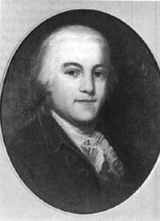
Edward Rutledge was an American politician and youngest signer of the
United States Declaration of IndependenceThe Declaration of Independence was a statement adopted by the Continental Congress on July 4, 1776, which announced that the thirteen American colonies then at war with Great Britain regarded themselves as independent states, and no longer a part of the British Empire. John Adams put forth a...
. He later served as the
39th Governor of South CarolinaThe Governor of the State of South Carolina is the head of state for the State of South Carolina. Under the South Carolina Constitution, the Governor is also the head of government, serving as the chief executive of the South Carolina executive branch. The Governor is the ex officio...
.
Early years and career
Like his eldest brother
John RutledgeJohn Rutledge was an American statesman and judge. He was the first Governor of South Carolina following the signing of the Declaration of Independence, the 31st overall...
, Edward was born in
CharlestonCharleston is the second largest city in the U.S. state of South Carolina. It was made the county seat of Charleston County in 1901 when Charleston County was founded. The city's original name was Charles Towne in 1670, and it moved to its present location from a location on the west bank of the...
. He was the youngest of seven children (5 sons and 2 daughters) born to Dr. John Rutledge and Sarah Hext in 1749. He studied law at
Oxford UniversityThe University of Oxford is a university located in Oxford, United Kingdom. It is the second-oldest surviving university in the world and the oldest in the English-speaking world. Although its exact date of foundation is unclear, there is evidence of teaching as far back as 1096...
and was admitted to the
EnglishEngland is a country that is part of the United Kingdom. It shares land borders with Scotland to the north and Wales to the west; the Irish Sea is to the north west, the Celtic Sea to the south west, with the North Sea to the east and the English Channel to the south separating it from continental...
bar (
Middle TempleThe Honourable Society of the Middle Temple, commonly known as Middle Temple, is one of the four Inns of Court exclusively entitled to call their members to the English Bar as barristers; the others being the Inner Temple, Gray's Inn and Lincoln's Inn...
), and returned to
CharlestonCharleston is the second largest city in the U.S. state of South Carolina. It was made the county seat of Charleston County in 1901 when Charleston County was founded. The city's original name was Charles Towne in 1670, and it moved to its present location from a location on the west bank of the...
to practice. He was married, on 1 March 1774, Henrietta Middleton (17 November 1750-22 April 1792), daughter of
Henry MiddletonHenry Middleton was a plantation owner and public official from South Carolina. He was the second President of the Continental Congress from October 22, 1774, until Peyton Randolph was able to resume his duties briefly beginning on May 10, 1775.-Early life:Henry Middleton was born in 1717 near...
. The couple had three children;
- Maj. Henry Middleton Rutledge (5 April 1775-20 January 1844)
- Edward Rutledge (20 March 1778-1780)
- Sarah Rutledge (1782–1855)
Rutledge had a successful law practice with his partner,
Charles Cotesworth PinckneyCharles Cotesworth “C. C.” Pinckney , was an early American statesman of South Carolina, Revolutionary War veteran, and delegate to the Constitutional Convention. He was twice nominated by the Federalist Party as their presidential candidate, but he did not win either election.-Early life and...
. He became a leading citizen of
CharlestonCharleston is the second largest city in the U.S. state of South Carolina. It was made the county seat of Charleston County in 1901 when Charleston County was founded. The city's original name was Charles Towne in 1670, and it moved to its present location from a location on the west bank of the...
, and owned more than 50 slaves.
American Revolution
Along with his brother
JohnJohn Rutledge was an American statesman and judge. He was the first Governor of South Carolina following the signing of the Declaration of Independence, the 31st overall...
, Rutledge represented
South CarolinaSouth Carolina is a state in the Deep South of the United States that borders Georgia to the south, North Carolina to the north, and the Atlantic Ocean to the east. Originally part of the Province of Carolina, the Province of South Carolina was one of the 13 colonies that declared independence...
in the
Continental CongressThe Continental Congress was a convention of delegates called together from the Thirteen Colonies that became the governing body of the United States during the American Revolution....
. He worked to have African Americans expelled from the
Continental ArmyThe Continental Army was formed after the outbreak of the American Revolutionary War by the colonies that became the United States of America. Established by a resolution of the Continental Congress on June 14, 1775, it was created to coordinate the military efforts of the Thirteen Colonies in...
. Although a firm supporter of colonial rights, he (as a delegate) was instructed initially to oppose
Lee'sRichard Henry Lee was an American statesman from Virginia best known for the motion in the Second Continental Congress calling for the colonies' independence from Great Britain. He was a signatory to the Articles of Confederation and his famous resolution of June 1776 led to the United States...
Resolution of independenceright|thumb|[[Richard Henry Lee]] proposed the resolution on June 7, 1776.The Lee Resolution, also known as the resolution of independence, was an act of the Second Continental Congress declaring the United Colonies to be independent of the British Empire...
;
South Carolina'sSouth Carolina is a state in the Deep South of the United States that borders Georgia to the south, North Carolina to the north, and the Atlantic Ocean to the east. Originally part of the Province of Carolina, the Province of South Carolina was one of the 13 colonies that declared independence...
leaders were unsure that the time was "ripe." By early July, 1776, he was instructed to vote in favor. Contrary to popular opinion, there is no evidence that he opposed the anti-slavery clause in the
DeclarationThe Declaration of Independence was a statement adopted by the Continental Congress on July 4, 1776, which announced that the thirteen American colonies then at war with Great Britain regarded themselves as independent states, and no longer a part of the British Empire. John Adams put forth a...
. At age 26 he was the youngest to sign the
Declaration of IndependenceThe Declaration of Independence was a statement adopted by the Continental Congress on July 4, 1776, which announced that the thirteen American colonies then at war with Great Britain regarded themselves as independent states, and no longer a part of the British Empire. John Adams put forth a...
.
He returned home in November 1776 to take a seat in the South Carolina Assembly. He served as a captain of
artilleryOriginally applied to any group of infantry primarily armed with projectile weapons, artillery has over time become limited in meaning to refer only to those engines of war that operate by projection of munitions far beyond the range of effect of personal weapons...
in the South Carolina militia, and fought at the
Battle of BeaufortThe Battle of Beaufort or the Battle of Port Royal Island was a battle of the American Revolutionary War that took place on February 3, 1779 near Beaufort, South Carolina. The British commander of forces at Savannah, Georgia, General Augustine Prevost, sent 200 British regulars to seize Port Royal...
in 1779. The next year he was captured by the British in the
fall of CharlestonThe Siege of Charleston was one of the major battles which took place towards the end of the American Revolutionary War, after the British began to shift their strategic focus towards the American Southern Colonies. After about six weeks of siege, Continental Army Major General Benjamin Lincoln...
, and held prisoner until July 1781.
Later life and legacy
After his release he returned to the state assembly, where he served until 1796. He was known as an active member and an advocate for the confiscation of
LoyalistLoyalists were American colonists who remained loyal to the Kingdom of Great Britain during the American Revolutionary War. At the time they were often called Tories, Royalists, or King's Men. They were opposed by the Patriots, those who supported the revolution...
property. He served in the state senate for two years, then was elected governor in 1798. He had to go to an important meeting in Columbia. While there he had to be sent home because of his
goutGout is a medical condition usually characterized by recurrent attacks of acute inflammatory arthritis—a red, tender, hot, swollen joint. The metatarsal-phalangeal joint at the base of the big toe is the most commonly affected . However, it may also present as tophi, kidney stones, or urate...
. He died in
CharlestonCharleston is the second largest city in the U.S. state of South Carolina. It was made the county seat of Charleston County in 1901 when Charleston County was founded. The city's original name was Charles Towne in 1670, and it moved to its present location from a location on the west bank of the...
before the end of his term. Some said at the time that he died from
apoplexyApoplexy is a medical term, which can be used to describe 'bleeding' in a stroke . Without further specification, it is rather outdated in use. Today it is used only for specific conditions, such as pituitary apoplexy and ovarian apoplexy. In common speech, it is used non-medically to mean a state...
resulting from hearing the news of
George WashingtonGeorge Washington was the dominant military and political leader of the new United States of America from 1775 to 1799. He led the American victory over Great Britain in the American Revolutionary War as commander-in-chief of the Continental Army from 1775 to 1783, and presided over the writing of...
's death.
In popular culture
Rutledge was a main character in the musical play
1776, in which he sings the song "Molasses to Rum" about slavery and the Triangle Trade. He is depicted as the secondary antagonist in the play in obstructing
John AdamsJohn Adams was an American lawyer, statesman, diplomat and political theorist. A leading champion of independence in 1776, he was the second President of the United States...
,
Benjamin FranklinDr. Benjamin Franklin was one of the Founding Fathers of the United States. A noted polymath, Franklin was a leading author, printer, political theorist, politician, postmaster, scientist, musician, inventor, satirist, civic activist, statesman, and diplomat...
and
Thomas JeffersonThomas Jefferson was the principal author of the United States Declaration of Independence and the Statute of Virginia for Religious Freedom , the third President of the United States and founder of the University of Virginia...
. Rutledge was portrayed by
Clifford DavidClifford David is an American actor born in Toledo, Ohio on June 30, 1938. He is recognized for his many Broadway, film and television performances.-Career:...
in the original Broadway production, and
John CullumJohn Cullum is an American actor and singer. He has appeared in many stage musicals and dramas, including On the Twentieth Century and Shenandoah , winning the Tony Awards for Best Leading Actor in a Musical for each...
in the 1972 film.
1776 claims that Rutledge led the opposition to an anti-slavery clause in the original draft of the Declaration. This is false on two counts. 1) The clause was the
opposite of "anti-slavery" -- it complained about the
freeing of slaves. The clause did complain about King George vetoing attempts to put tariffs on the slave trade -- an economic not moral issue in Jefferson's Virginia, where the slave trade was diluting the value of slaves-as-property. Georgia and South Carolina needed slaves-as-workers, and thus opposed Virginia's proposed tariffs on slaves. Jefferson expressed outrage that the Virginia tariff was vetoed, and with florid rhetoric called George a hypocrite (in effect) for supporting the slave trade -- but that wasn't the relevant point: The clause was included in the section of the Declaration concerning war grievances, and its specific grievance is that, following Lord
Dunmore's ProclamationDunmore's Proclamation is a historical document issued on November 7, 1775, by John Murray, 4th Earl of Dunmore, royal governor of the British Colony of Virginia...
, England was granting freedom to runaway slaves who joined the army. So, as opposed to being "anti-slavery," the clause complained about the
freeing of slaves. 2) Rutledge's leadership against the clause is completely fictional. According to Jefferson, the clause was opposed by South Carolina and Georgia, plus unspecified "northern brethren"; that is the
limit of known information about opposition to the clause. Rutledge was a delegate from South Carolina, but there is not one item of evidence in the historical record that he played any part -- much less that of leader -- in the opposition to the clause.
In the 2008 miniseries
John AdamsJohn Adams is a 2008 American television miniseries chronicling most of President John Adams's political life and his role in the founding of the United States. Paul Giamatti portrays John Adams. The miniseries was directed by Tom Hooper. Kirk Ellis wrote the screenplay based on the book John...
, Rutledge was portrayed by
Clancy O'ConnorClancy O'Connor is an American actor who played Edward Rutledge in the John Adams miniseries. -References:...
.
External links