
All Topics  
Education in Germany

 
Education in Germany

   Email Print
   Bookmark   Link


Education in Germany


Responsibility for German education system lies primarily with the Bundesländer (states
States of Germany

Germany is a federation consisting of sixteen states, known in German language as L?nder . Since Land is the literal German word for "country", the term Bundesl?nder is commonly used colloquially, as it is more specific, though technically incorrect within the corpus of German law....
) while the federal government only has a minor role. Optional kindergarten
Kindergarten

is a form of education for young children which serves as a transition from home to the commencement of more formal schooling. Children are taught to develop basic skills through creative play and social interaction....
 education is provided for all children between three and six years old, after which school attendance is compulsory
Compulsory education

Compulsory education is education which children are required by law to receive and governments are required by law to provide. The compulsion is an aspect of public education....
 for twelve years. In the first nine years all students attend school from age six to eighteen or nineteen. The system varies throughout Germany because each Bundesland decides on their own educational policies.


Discussion
Ask a question about 'Education in Germany'
Start a new discussion about 'Education in Germany'
Answer questions from other users
Full Discussion Forum


Recent Posts


Encyclopedia


Responsibility for German education system lies primarily with the Bundesländer (states
States of Germany

Germany is a federation consisting of sixteen states, known in German language as L?nder . Since Land is the literal German word for "country", the term Bundesl?nder is commonly used colloquially, as it is more specific, though technically incorrect within the corpus of German law....
) while the federal government only has a minor role. Optional kindergarten
Kindergarten

is a form of education for young children which serves as a transition from home to the commencement of more formal schooling. Children are taught to develop basic skills through creative play and social interaction....
 education is provided for all children between three and six years old, after which school attendance is compulsory
Compulsory education

Compulsory education is education which children are required by law to receive and governments are required by law to provide. The compulsion is an aspect of public education....
 for twelve years. In the first nine years all students attend school from age six to eighteen or nineteen. The system varies throughout Germany because each Bundesland decides on their own educational policies. Most children, however, first attend Grundschule from age six to nine.

In contrast, secondary education
Secondary education

Secondary education is the stage of education following primary education. Secondary education is generally the final stage of compulsory education....
 includes four types of schools based on a pupil's ability as determined by teacher recommendations: the Gymnasium includes the most gifted children and prepares students for university studies; the Realschule
Realschule

The Realschule is a type of secondary school in Germany, Austria, Switzerland, and Liechtenstein. It has also existed in Croatia , Denmark , Sweden , Hungary and Russian Empire ....
 has a broader range of emphasis for intermediary students; the Hauptschule
Hauptschule

A "Hauptschule" is a secondary school in Germany and Austria, starting after 4 years of elementary schooling. Any student who went to a German elementary school can go to a Hauptschule afterwards, whereas students who want to attend a Realschule or Gymnasium need to have good marks in order to do so....
 prepares pupils for vocational education, and the Gesamtschule, or comprehensive school, combines the three approaches. There are also Förderschulen (schools for the mentally challenged and physically challenged). One in 21 students attends a Förderschule

In order to enter higher education, students are required to take the Abitur
Abitur

'Abitur' is a designation used in Germany and Finland for final exams that pupils take at the end of their secondary education, usually after 12 or 13 years of schooling ....
 examination; however, students possessing a diploma from a vocational school may also apply to enter. A special system of apprenticeship called Duale Ausbildung allows pupils in vocational training to learn in a company as well as in a state-run school. Although Germany has had a history of a strong educational system, recent PISA student assessments
Programme for International Student Assessment

The Programme for International Student Assessment is a triennial world-wide test of 15-year-old schoolchildren's scholastic performance, the implementation of which is coordinated by the Organisation for Economic Co-operation and Development ....
 demonstrated a weakness in certain subjects. In the test of 43 countries in the year 2000, Germany ranked 21st in reading and 20th in both mathematics
Mathematics

Mathematics is the study of quantity, structure, space, change, and related topics of pattern and form. Mathematicians seek out patterns whether found in numbers, space, natural science, computers, imaginary abstractions, or elsewhere....
 and the natural sciences, prompting calls for reform.

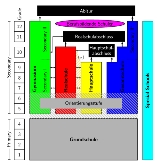
Overview of the German school system


Grade Average ages of Students School level
(Berlin/Brandenburg)
School level
(rest of Germany)
1 6/7 primary primary
2 7/8 primary primary
3 8/9 primary primary
4 9/10 primary primary
5 10/11 primary secondary
6 11/12 primary secondary
7 12/13 secondary secondary
8 13/14 secondary secondary
9 14/15 secondary secondary
10 15/16 secondary secondary
11 16/17 secondary secondary
12 17/18 secondary secondary
13 18/19 secondary secondary


Grundschule (elementary/primary school) can be preceded by voluntary Kindergarten
Kindergarten

is a form of education for young children which serves as a transition from home to the commencement of more formal schooling. Children are taught to develop basic skills through creative play and social interaction....
 or Vorschulklassen (preparatory classes for elementary school) and lasts four or six years, depending on the state. Year 13 is being phased out in some states.

Parents who are looking for a suitable school for their child have a considerable choice of elementary schools in Germany today:
  • State school. State schools are free of charge. A large majority of German students attend state schools in their neighbourhood. Schools in rich neighbourhoods tend to be better than schools in poor ones. Once children reach school age, many middle-class and working-class class families move away from lower-class areas.
  • or, alternatively
    • Waldorf School (206 schools in 2007)
    • Montessori method
      Montessori method

      The Montessori method is a child-centered alternative educational method for children, based on theories of child development originated by Italy educator Maria Montessori in the late 19th and early 20th centuries....
       school (272)
    • Freie Alternativschule (Free Alternative Schools) (65)
    • Protestant
      Evangelical Church in Germany

      Evangelical Church in Germany is a federation of 23 regional Lutheran, Reformed churches and United and uniting churches Protestant churches. In fact only one member church is not restricted to a certain territory....
       (63) or Catholic
      Roman Catholic Church

      The Roman Catholic Church, officially known as the Catholic Church is the world's largest Christianity Ecclesia , representing over half of all Christians and one-sixth of the world population....
       (114) parochial school
      Parochial school

      Parochial school is one term used to describe a school that engages in religious education in addition to conventional education. In a narrow sense, parochial schools are Christianity grammar schools or high schools run by parishes, but this distinction is not universally made....
      s


After children have completed their primary education (at 10 years of age, 12 in Berlin and Brandenburg), there are four options for secondary schooling:
  • Hauptschule
    Hauptschule

    A "Hauptschule" is a secondary school in Germany and Austria, starting after 4 years of elementary schooling. Any student who went to a German elementary school can go to a Hauptschule afterwards, whereas students who want to attend a Realschule or Gymnasium need to have good marks in order to do so....
     (the least academic, much like a modernized Volksschule
    Volksschule

    A Volkschule was an 18th century system of state-supported primary schools established in the Habsburg Austrian Empire. Attendance was supposedly compulsory, but a 1781 census reveals that only one fourth of the school-age children attended....
     [elementary school]) until grade 9 (with Hauptschulabschluss as exit exam);
  • Realschule
    Realschule

    The Realschule is a type of secondary school in Germany, Austria, Switzerland, and Liechtenstein. It has also existed in Croatia , Denmark , Sweden , Hungary and Russian Empire ....
     until grade 10 (with Mittlere Reife (Realschulabschluss) as exit exam);
  • Gymnasium (Grammar School) until grade 12 or 13 (with Abitur
    Abitur

    'Abitur' is a designation used in Germany and Finland for final exams that pupils take at the end of their secondary education, usually after 12 or 13 years of schooling ....
     as exit exam, qualifying for university); and
  • Gesamtschule
    Comprehensive school

    A comprehensive school is a secondary school and State school for children from the age of 11 to at least 16 that does not select children on the basis of academic achievement or aptitude....
     (comprehensive school) often with all the options of the three "tracks" above but it can also be a school between Realschule and Hauptschule, having no possibility for Abitur.
  • After each of those schools, graduates can start a professional career with an apprenticeship in the Berufsschule (vocational school). The Berufsschule is normally attended twice a week during a two, three, or three-and-a-half year apprenticeship
    Apprenticeship

    Apprenticeship is a system of training a new generation of practitioners of a skill. Apprentices or prot?g?s build their careers from apprenticeships....
    ; the other days are spent working at a company. This should bring the students knowledge of theory and practice. The company must accept the apprentice to start the apprenticeship. After this, the student is registered on a list at the Industrie- und Handelskammer IHK (board of trade). During the apprenticeship(s, he/she is a part-time employee of the company and receives a salary from the company. After successful passing of the Berufsschule and the exit exams of the IHK, he/she receives a certificate and is ready for a professional career up to a low management level. In some areas, the apprenticeship teaches skills that are required by law (special positions in a bank, legal assistants).


The grades 5 and 6 form an orientation phase (Orientierunsstufe) in which students, their parents and teachers should decide which of the above-mentioned tracks the students should follow. In all states except Berlin
Berlin

Berlin is the Capital of Germany city and one of sixteen States of Germany of Germany. With a population of 3.4 million within its city limits, Berlin is the country's largest city....
 and Brandenburg
Brandenburg

Brandenburg is one of the sixteen states of Germany of Germany. It lies in the east of the country and is one of the new federal states that were re-created in 1990 upon the reunification of the former West Germany and East Germany....
, this orientation phase is embedded into the program of the secondary schools. In Berlin and Brandenburg, the orientation is embedded into elementary schools. Teachers give a so-called educational (track) recommendation (Bildungs(gang)empfehlung) based on scholastic achievements in the main subjects (mathematics, German, science, foreign language), with details and legal implications differing from state to state.

In Germany, the 16 states have exclusive responsibility in the field of education. The federal parliament and the federal government can influence the educational system only by financial aid (to the states). Therefore, there are many different school systems; however, in every state the starting point is Grundschule (elementary school) for a period of four years (six in Berlin and Brandenburg).

All German states have Gymnasium as one possibility for skilled children, and all states - except Baden-Württemberg
Baden-Württemberg

Baden-W?rttemberg is one of the 16 States of Germany of the Federal Republic of Germany. Baden-W?rttemberg is in the southwestern part of the country to the east of the Upper Rhine?but one which has some of its major cities straddling the banks of the Neckar River ....
, Bavaria
Bavaria

Bavaria , with an area of and almost 12.5 million inhabitants, is a region located in the southeast of Germany and is the largest States of Germany of Germany by area....
, Saxony
Saxony

The Free State of Saxony is a States of Germany of Germany. Located in the southeastern part of present-day Germany. It is the tenth-largest German state in area and the sixth largest in population , of Germany's sixteen states....
 - have Gesamtschule, but in different forms. The eastern states Saxony, Saxony-Anhalt and Thuringia combine Hauptschule and Realschule to Sekundarschule, Mittelschule and Regelschule respectively. All other states distinguish between these schools types.

English is compulsory statewide in secondary schools. In some states, foreign language education starts in Grundschule. For example, in North Rhine-Westphalia
North Rhine-Westphalia

North Rhine - Westphalia is the westernmost and - in terms of population and economic output - the largest States of Germany of Germany. North Rhine - Westphalia has over 18 million inhabitants, contributes about 22% of Germany's gross domestic product and comprises a land area of 34,083 km? ....
, English study starts in the third year of school; Brandenburg
Brandenburg

Brandenburg is one of the sixteen states of Germany of Germany. It lies in the east of the country and is one of the new federal states that were re-created in 1990 upon the reunification of the former West Germany and East Germany....
 starts either English or Polish, and Baden-Württemberg
Baden-Württemberg

Baden-W?rttemberg is one of the 16 States of Germany of the Federal Republic of Germany. Baden-W?rttemberg is in the southwestern part of the country to the east of the Upper Rhine?but one which has some of its major cities straddling the banks of the Neckar River ....
 starts English in the first year. The list of available second foreign languages, as well as the amount of obligatory study of foreign languages, differs from state to state. French, Spanish and Latin are most frequently taken as the second foreign language. Many schools also offer volunteer study groups for learning other languages.

It may be problematic in terms of school studies for families to move from one state to another, because there are quite different curricula for almost every subject.

Adults who did not complete their high school education have the option of attending an Abendgymnasium
Abendgymnasium

An Abendgymnasium or "Evening Gymnasium " is a German class of secondary school for adults over the age of 19 which allows them to gain the Abitur....
 or Abendrealschule (night school) later in life.

History of German education


The Prussian era (1814 – 1871)

Historically, the Lutheran denomination had a strong influence on German culture, including its education. Martin Luther
Martin Luther

Martin Luther was a Germans monk, theology, university professor, priest, father of Protestantism, and Protestant Reformers whose ideas started the Protestant Reformation and changed the course of Western culture....
 advocated compulsory schooling so that all people would independently be able to read and interpret the Bible. This concept became a model for schools throughout Germany.

During the 18th century, the Kingdom of Prussia
Prussia

Prussia was, most recently, a historic state originating out of the Duchy of Prussia and the Margraviate of Brandenburg. This state had for centuries substantial influence on Germany and European history....
 was among the first countries in the world to introduce free and generally compulsory primary education, consisting of an eight-year course of primary education, Volksschule
Volksschule

A Volkschule was an 18th century system of state-supported primary schools established in the Habsburg Austrian Empire. Attendance was supposedly compulsory, but a 1781 census reveals that only one fourth of the school-age children attended....
. It provided not only the skills needed in an early industrialized world (reading, writing, and arithmetic), but also a strict education in ethics, duty, discipline, and obedience. Affluent children often went on to attend preparatory private schools for an additional four years, but the general population had virtually no access to secondary education.

In 1810, after the Napoleonic wars
Napoleonic Wars

The Napoleonic Wars were a series of conflicts involving Napoleon I of France First French Empire and changing sets of European allies and opposing coalitions that ran from 1803 to 1815....
, Prussia introduced state certification requirements for teachers, which significantly raised the standard of teaching. The final examination, Abitur
Abitur

'Abitur' is a designation used in Germany and Finland for final exams that pupils take at the end of their secondary education, usually after 12 or 13 years of schooling ....
, was introduced in 1788, implemented in all Prussian secondary schools by 1812, and extended to all of Germany in 1871. The state also established normal schools for the training of teachers in the common or elementary grade levels.

German Empire (1871-1918)

When the German Empire
German Empire

The German Empire is the name commonly used in English to describe Germany from the unification of Germany and proclamation of William I, German Emperor as German Emperor on 18 January 1871, to 1918, when it became Weimar republic after defeat in World War I and the abdication of William II, German Emperor ....
 was formed in 1871, the school system became more centralized. In 1872, Prussia recognized the first separate secondary schools for girls. As learned professions demanded well-educated young people, more secondary schools were established, and the state claimed the sole right to set standards and to supervise the newly established schools.

Four different types of secondary schools developed:
  • A nine-year classical Gymnasium (focusing on Latin and Greek or Hebrew, plus one modern language);
  • A nine-year Realgymnasium (focusing on Latin, modern languages, science and mathematics);
  • A six-year Realschule (without university entrance qualification, but with the option of becoming a trainee in one of the modern industrial, office
    Office

    An office is generally a room or other area in which people employment, but may also denote a position within an organization with specific duties attached to it ; the latter is in fact an earlier usage, office as place originally referring to the location of one's duty....
     or technical jobs); and
  • A nine-year Oberrealschule (focusing on modern languages, science and mathematics).


By the turn of the 20th century, the four types of schools had achieved equal rank and privilege, although they did not have equal prestige.

Weimar Republic (1919-1933) to the present

After World War I
World War I

World War I, or the First World War , was a global military conflict which involved the Great powers, organized into two opposing military alliances: the Allies of World War I and the Central Powers....
, the Weimar Republic
Weimar Republic

The Weimar Republic was the democracy and republican period of Germany from 1919 to 1933. Following World War I, the republic emerged from the German Revolution in November 1918....
 established a free, universal 4-year elementary school (Grundschule). Most students continued at these schools for another 4-year course. Those who were able to pay a small fee went on to an Intermediate school (Mittelschule) that provided a more challenging curriculum for an additional one or two years. Upon passing a rigorous entrance exam after year four, students could also enter one of the four types of secondary school.

During the Nazi
Nazism

Nazism, officially National Socialism , refers to the ideology and practices of the National Socialist German Workers? Party under Adolf Hitler, and the policies adopted by the dictatorial government of Nazi Germany from 1933 to 1945....
 era (1933-1945), indoctrination
Indoctrination

Indoctrination is the process of wikt:inculcate ideas, attitude , cognition or a professional methodology. It is often distinguished from education by the fact that the indoctrinated person is expected not to question or critical thinking the doctrine they have learned....
 of Nazi ideologies was added to student education; however, the basic education system remained unchanged. See also: Nazi university.

After World War II
World War II

World War II, or the Second World War , was a global military conflict which involved a Participants in World War II, including all of the great powers, organised into two opposing military alliances: the Allies of World War II and the Axis powers....
, the Allied powers (Soviet Union
Soviet Union

The Union of Soviet Socialist Republics was a Constitution of the Soviet Union socialist state that existed in Eurasia from 1922 to 1991.The name is a translation of the , romanization of Russian Soyuz Sovetskikh Sotsialisticheskikh Respublik, abbreviated ????, SSSR....
, France
France

France , officially the French Republic , is a country whose Metropolitan France is located in Western Europe and that also comprises various Overseas departments and territories of France....
, Britain
United Kingdom

The United Kingdom of Great Britain and Northern Ireland, commonly known as the United Kingdom , the UK or Britain,is a sovereign state located off the northwestern coast of continental Europe....
, and the USA) ensured that Nazi ideas were eliminated from the curriculum. They installed educational systems in their respective occupation zones that reflected their own ideas. When West Germany gained partial independence in 1949, its new constitution (Grundgesetz) granted educational autonomy to the state (Länder
Länder

----L?nder refers to one or any of:* Colloquially used for States of Austria, the technically correct German language name for the federal states of Austria is Bundesl?nder, which is hardly used in Austria....
) governments. This led to a widely varying school systems, often making it difficult for children to continue schooling whilst moving between states.

More recently, multi-state agreements ensure that basic requirements are universally met by all state school systems. Thus, all children are required to attend one type of school on a full-time basis (i.e. five or six days a week) from the age of 6 to the age of 16. A student may change schools if a student shows exceptionally good (or exceptionally poor) abilities. Graduation certificates from one state are recognized by all the other states. Training qualifies teachers for teaching posts in every state.

Education in East Germany

The German Democratic Republic
German Democratic Republic

The German Democratic Republic was a self-declared socialist state created in the Soviet Zone of occupied Germany and the East Berlin of Allied Occupation Zones in Germany....
 (East Germany) started its own standardized education system in the 1960s. The East German equivalent of both primary and secondary schools was the Polytechnische Oberschule (poly-technical high school), which all students attended for 10 years, from the ages of 6 to 16. At the end of the 10th year, an exit examination was given. Depending upon the results, a student could choose to end their education or undertake an apprenticeship for an additional two years, followed by an Abitur. Students who performed very well and displayed loyalty to the ruling party could change to the Erweiterte Oberschule (extended high school), where they could take their Abitur examinations after 12 school years. Although this system was abolished in the early 1990s after reunification, it continues to influence school life in the eastern German states.

Unequal opportunities


See also: Poverty in Germany
Poverty in Germany

Poverty in Germany refers to people living in relative poverty in Germany.During the last decades the number of people living in poverty has been increasing....


Children from poor immigrant or working class families are less likely to succeed in school than children from middle or upper-class backgrounds. This disadvantage for the financially challenged part of the population of Germany is bigger than in any other industrialized nation. However, the true reasons stretch beyond economic ones. The poor also tend to be less educated. After controlling for parental education, money does not play a major role in children's academic outcomes.

Immigrant children and youth, most of lower-class background, are the fastest-growing segment of the German population, so their prospects bear heavily on the well-being of the country. 30% of Germans aged 15 years and younger have at least one parent born abroad. In the big cities 60% of children aged 5 years and younger have at least one parent born abroad.. Immigrant children academically underperform their peers Immigrants have tended to be less educated than native Germans. After controlling for parental education, ethnic group does not play a role in children's academic outcomes.

Immigrants from China and Vietnam are doing exceptionally well. In eastern Germany, Vietnamese and Chinese of lower-class background outperform students from European backgrounds (despite the fact that in most cases their parents are poorer and less educated than the parents of their European-born peers). Teachers in Eastern Germany also have been shown to be more motivated than teachers in Western Germany. That might be another reason for Asian achievement.

Male gender is associated with low educational attainment in Germany. 63% percent of students attending special education programs for the academically challenged are male. Boys are less likely to meet the state-wide performance targets, more likely to drop out of school and are more likely to be classified emotionally disturbed. 86% of the students receiving special training because of emotional disturbance are male. Research shows a class-effect: Middle-class boys are doing as well as middle-class girls in terms of educational achievement but lower-class boys are lagging behind lower-class girls. Lack of male role models contributes to lower-class boys' low academic achievement.

Helping kids at risk


Children whose families receive welfare, children whose parents dropped out of school, children of teenage parents, children raised by a lone parent, children raised in crime-ridden inner-city neighbourhoods, children who have multiple young siblings, and children who live in overcrowded substandard apartments are at risk of poor educational achievement in Germany. Often these factors go together, making it very hard for children to overcome the odds. A number of measures have been assessed to help those children reach their full potential.

Kindergarten

Kindergarten has been shown to improve school readiness in children at risk. Children attending a Kindergarten were less likely to have impaired speech or impaired motor development. Only 50% of children whose parents did not graduate from school, are ready for school at age six. If such children were enrolled in a high-quality three-year Kindergarten programme, 87% were ready for school at age six. Thus Kindergarten helps to overcome unequal opportunities.

Home-visits to families in need

Families whose children are at risk for low academic achievement may be visited by trained professionals. They offer a wide variety of services that relate to each child's and each family's background and needs. Such professionals may visit pregnant low-income women and talk with them about positive health-related behaviors, such as following a healthy diet or refraining from the use of alcohol or tobacco while pregnant. Positive health-related behavior may have a major impact on children's school performance.

Home visitors may provide information on childcare and social services, help parents in crisis and model problem-solving skills. They may help implement the preschool/school curriculum at home or provide a curriculum of educational games designed to improve language, development and cognitive skills. In most cases, such support is offered to families on a voluntary basis. Families who are eligible for the program may decide for themselves whether or not they want to participate. There are no penalties if they decide against it or against continuing with the program.

Is the German school system biased against working class students?

In Germany most children are streamed by ability into different schools after fourth grade. The Progress in International Reading Literacy Study revealed that working class children needed better reading abilities than middle-class children to be nominated for the Gymnasium. After controlling for reading abilities, odds to be nominated to Gymnasium for upper middle-class children were still 2.63 times better than for working-class children.

Points needed
to be nominated for Gymnasium
... teachers nominating child for Gymnasium... parents wanting child to attend Gymnasium
children from upper-middle class backgrounds537 498
children from lower-middle class backgrounds569 559
children of parents holding pink collar jobs582 578
children of self-employed parents580556
children from upper working class backgrounds592 583
children from lower working class backgrounds 614606
http://www.iglu.ifs-dortmund.de/assets/files/iglu/IGLU2006_Pressekonferenz.doc retrieved May 27th 2008


Life in a German school

Klasse
Although German students are not very different from other students across the world, there are organizational differences. The main points are outlined below; however, it should be noted that there are additional differences across the 16 states of Germany.

  • Every Bundesland has its own school system


  • Each group of students born in the same year forms one grade or class, which remains the same for elementary school (years 1 to 4), orientation school (if there's orientation school in the state) or orientation phase (at Gymnasium years 5 to 6), and secondary school (years 5 to 10 in "Realschulen" and "Hauptschulen"; years 5 to 11 (differences between states) in "Gymnasien"). Changes are possible, though, when there is a choice of subjects, e.g. additional languages, and the class is split.
  • Most subjects (except PE, art, sciences, music and the subjects which are taught in courses, like French) are taught in the students' own classroom (similar to a "home room"); the pupils stay in their room whilst the teachers move from class to class. This is common throughout school up to year 11 (5 in Saxony, 7 in Brandenburg).
  • Sometimes there is also a "Sanitätsdienst" (medical service), where pupils voluntarily perform first aid.
  • Students sit at tables, not desks (usually two pupils at one table), sometimes arranged in a semi-circle or another geometric or functional shape. During exams in classrooms, the tables are sometimes arranged in columns with one pupil per table (if permitted by the room's capacities) in order to prevent cheating; at many schools, this is only the case for some exams in the two final years of school, i.e. some of the exams counting for the final grade on the high school diploma.
  • There normally is no school uniform
    School uniform

    File:Primary Student of Pakistan.JPGSchool uniforms are common in primary school and secondary schools in many nations. They are the most widely known form of student uniform; other types of which include uniforms worn by students participating in higher vocational training, such as in health occupations....
     or dress code other than the most basic rules of decency. Many private schools have a very simple dress code consisting of, for example, "no shorts, no sandals, no clothes with holes". Some schools are trying out school uniforms, but those aren't as formal as seen in for example the UK. They mostly consist of a normal pullover/shirt and jeans of a certain color, sometimes with the school's symbol on it.
  • Sometimes students can buy school T-shirts which they can wear voluntarily.
  • School usually starts between 7.30 a.m. and 8:15 a.m. and can finish as early as 12; instruction at lower classes almost always ends before lunch. In higher grades, however, afternoon lessons are very common and periods may have longer gaps without teacher supervision between them. Ordinarily, afternoon classes are not offered every day and/or continuously until early evening, leaving students with large parts of their afternoons free of school; some schools (Ganztagsschulen), however, offer classes or mainly supervised activities throughout the afternoons in order to offer supervision of the students rather than an increase in teaching. Afternoon lessons can go up to 6 o'clock.
  • Depending on the school, there are breaks of 5 to 10 minutes after each period. There is no lunch break as school usually finishes before 1:30 for junior school. However, at schools that have "Nachmittagsunterricht" (= afternoon classes) ending after 1:30 there's sometimes a lunch break of 45 to 90 minutes, though many schools lack any special break in general. Some schools that have regular breaks of 5 minutes between periods have additional 15 or 20 minute breaks after the second and fourth period.
  • In German state schools periods are exactly 45 minutes. Each subject is usually taught for two to three periods every week (main subjects like Mathematics, German or foreign languages are taught for four to six periods) and usually no more than two periods consecutively. The beginning of every period and, usually, break is generally announced with an audible signal such as a bell.
  • Exams (which are always supervised) are usually essay
    Essay

    An essay is usually a short piece of writing. It is often written from an author's personal Perspective . Essays can be literary criticism, political manifestos, learned arguments, observations of daily life, recollections, and reflections of the author....
     based, rather than multiple choice
    Multiple choice

    Multiple choice is a form of assessment in which respondents are asked to select one or more choices from a list. The multiple choice format is most frequently used in educational testing, in market research, and in elections-- when a person chooses between multiple candidates, Political party, or policies....
    . As of 11th grade exams usually consist of no more than three separate exercises. While most exams in the first grades of secondary schools usually span no more than 90 minutes, exams in 11th to 13th grade may span four periods or more (without breaks).
  • At every school type, students study one foreign language
    Foreign language

    A foreign language is a language not spoken by the people of a certain place: for example, not only English language but also Late Old Japanese is a foreign language in Japan....
     (in most cases English) for at least five years. The study is, however, far more rigorous in Gymnasium. Students leaving Hauptschule rarely attain fluency. In Gymnasium, students can choose from a wider range of languages (mostly English, French, Russian (mostly in east german Bundesländer) or Latin) as the first language in 5th grade, and a second mandatory language in 6th or 7th grade. Students are required to study English either as a first or second foreign language. Some types of Gymnasium also require an additional third language (such as Spanish, Italian, Russian, Latin or Ancient Greek) or an alternative subject (usually based on one or two other subjects, e.g. English politics (English & politics), dietetics (biology) or media studies (arts & German) in 9th or 11th grade. Gymnasiums ordinarily offer further subjects starting at 11th grade, with some schools offering a fourth foreign language.
  • A small number of schools have a Raucherecke (smokers' corner), a small area of the schoolyard where students over the age of eighteen are permitted to smoke in their breaks. Those special areas were banned in the states of Berlin
    Berlin

    Berlin is the Capital of Germany city and one of sixteen States of Germany of Germany. With a population of 3.4 million within its city limits, Berlin is the country's largest city....
    , Hessen and Hamburg
    Hamburg

    Hamburg is the second-largest city in Germany , and is the Largest cities of the European Union by population within city limits. The city is home to approximately 1.8 million people, while the Hamburg metropolitan area has more than 4.3 million inhabitants....
    , Brandenburg
    Brandenburg

    Brandenburg is one of the sixteen states of Germany of Germany. It lies in the east of the country and is one of the new federal states that were re-created in 1990 upon the reunification of the former West Germany and East Germany....
     at the beginning of the 2005-06 school year. (Bavaria
    Bavaria

    Bavaria , with an area of and almost 12.5 million inhabitants, is a region located in the southeast of Germany and is the largest States of Germany of Germany by area....
    , Schleswig-Holstein
    Schleswig-Holstein

    Schleswig-Holstein is the Northern Germany of the sixteen States of Germany of Germany. Its capital city is Kiel, other notable cities are L?beck and Flensburg....
    , Lower Saxony
    Lower Saxony

    Lower Saxony lies in northern Germany and is second in area and fourth in population among the sixteen States of Germany of Germany. In rural areas Low German is still spoken, but the number of speakers is declining....
     2006-07)). From now on schools in these states forbid smoking for pupils and teachers and offences at school will be punished. Some other states in Germany are planning to introduce similar laws.
  • As state schools are public, smoking is universally prohibited inside the buildings. Smoking teachers are generally asked not to smoke while at or near school.
  • Students over 14 years are permitted to leave the school compound during breaks at some schools. Teachers or school personnel tend to prevent younger pupils from leaving early and strangers from entering the compound without permission.
  • Tidying up the classroom and schoolyard is often the task of the pupils. Unless a group of pupils volunteers, individuals are picked sequentially.
  • Many schools have AGs or Arbeitsgemeinschaften (clubs) for afternoon activities such as sports, music or acting, but participation is not necessarily common. Some schools also have special mediators, who are student volunteers trained to resolve conflicts between their classmates or younger pupils.
  • Only few schools have actual sports teams that compete with other schools'. Even if the school has a sports team, most students are not very aware of it.
  • While student newspapers used to be very common until the late 20th century, many of them are now very short-lived, usually vanishing when the team graduates. Student newspapers are often financed mostly by advertisements.
  • Usually schools don't have their own radio stations or TV channels. Larger universities often have a local student-run radio station, however.
  • Although most German schools and state universities do not have classrooms equipped with a computer for every student, schools usually have at least one or two computer rooms and most universities offer a limited number of rooms with computers on every desk. State school computers are usually maintained by the same exclusive contractor in the entire city and updated slowly. Internet access is often provided by phone companies free of charge. Especially in schools the teachers' computer skills are often very low.
  • At the end of their schooling, students usually undergo a cumulative written and oral examination (Abitur
    Abitur

    'Abitur' is a designation used in Germany and Finland for final exams that pupils take at the end of their secondary education, usually after 12 or 13 years of schooling ....
     in Gymnasiums or Abschlussprüfung in Realschulen and Hauptschulen). Students leaving Gymnasium after 9th grade do have the leaving examination of the Hauptschule and after 10th grade do have the Mittlere Reife (leaving examination of the Realschule).
  • After 10th grade Gymnasium students may quit school for at least one year of job education if they do not wish to continue. Realschule and Hauptschule students who have passed their Abschlussprüfung may decide to continue schooling at a Gymnasium, but are sometimes required to take additional courses in order to catch up.
  • Corporal punishment
    Corporal punishment

    Corporal punishment is the deliberate infliction of pain intended to punish a person or change his/her behavior. Historically speaking, most forms of punishment, whether in judicial, domestic, or educational settings, were corporal in basis....
     was banned in West Germany in 1973 and at least officially in East Germany in 1949.
  • Fourth grade (or sixth, depending on the state) is often quite stressful for students of lower performance and their families. Many feel tremendous pressure when trying to achieve placement in Gymnasium, or at least when attempting to avoid placement in Hauptschule. Germany is unique compared to other western countries in its early segregation of students based on academic achievement.


Grades

The following table shows the grades and their meanings in German school system:

Points are only used in Secondary II in Gymnasium and Gesamtschule, replacing marks. Although 4 points generally count as "passed", the allowed number of courses with less than 5 points is limited. The pupils decide, following some strict regulations, what courses should be taken into account for calculating the

The school year

The school year starts after the summer break (different from state to state, usually end/mid of August) and is divided into two semesters. There are typically 12 weeks of holidays in addition to public holidays. Exact dates differ between states, but there are generally 6 weeks of summer and two weeks of Christmas holiday. The other holiday periods are given in spring (usually around Easter Sunday) and autumn (the former "harvest holiday", where farmers used to need their children for field work). Schools can also schedule two or three special days off per semester.

Report cards (Zeugnis) are issued twice a year at the end of the semester, usually in February and June or July. Students who do not measure up to minimum standards (usually no 6, no more than one 5 unless there are other subjects with 3 or better) have to repeat a year (which happens to almost 5% of students every year). If pupils have to repeat a year, it is colloquially called sitzenbleiben (literally remain seated). Once they have reached 12th grade, students may usually not fail more than twice in succession or they will not be admitted to the Abitur exams at the end of 13th grade.

Model timetables

Students have about 30-40 periods of 45 minutes each per week, but especially secondary schools today switch to 90 minutes lessons (Block) which count as two 'traditional' lessons. To manage classes that are taught three lessons per week there is still one 45 minute lesson each day, mostly between the first two blocks. There are about 12 compulsory subjects: two or three foreign languages (one to be taken for 9 years, another for at least 3 years), physics, biology, chemistry and usually civics/social studies (for at least 5, 7, 3, and 2 years, respectively), and mathematics, music, art, history, German, geography, PE and religious education/ethics for 9 years. A few afternoon activities are offered at German schools - mainly choir or orchestra, sometimes sports, drama or languages. Many of these are offered as semi-scholastic AG's (Arbeitsgemeinschaften - literally "working groups"), which are mentioned, but not officially graded in students' report cards. Other common extracurricular activities are organized as private clubs, which are very popular in Germany.

Sample grade 10 Gymnasium timetable
Time Monday Tuesday Wednesday Thursday Friday
07.30-08.15 am English Physics Biology Physics French(course)
08.20-09.05 am History English Chemistry Maths Chemistry
09.05-09.25 am break
09.25-10.10 am Latin (course) French (course) Maths Latin (course) Maths
10.15-11.00 am German French (course) Religious studies (course) Latin (course) German
11.00-11.15 am break
11.15-12.00 pm Music Mathematics Sport German Biology
12.05-12.50 pm Religious studies (course) History Sport English Latin (course)
This timetable reflects a school week at a normal 9-year Gymnasium in North Rhine-Westphalia (which should change to 8 years by 2013). There are three blocks of lessons where every "hour" takes 45 minutes. After each block, there is a break of 15-20 minutes, also after the 6th hour (the number of lessons changes from year to year, so it's possible that one would be in school until four o'clock). "Nebenfächer" (= minor fields of study) are taught two times a week, "Hauptfächer" (=major subjects) are taught three times. (Latin is taught four times a week because it is the newly-started third language.)

In grades 11-13, 11-12, or 12-13 (depending on the school system), each student majors in two or three subjects ("Leistungskurse", "Grundkurse"/"Profilkurse"). These are usually taught five hours per week. The other subjects are usually taught three periods per week.

Sample grade 12 Gymnasium timetable
Time Monday Tuesday Wednesday Thursday Friday  
08.00-08.45 am Spanish Chemistry Psychology
08.50-09.35 am Spanish Biology Chemistry Psychology
09.50-10.35 am Arts Mathematics Spanish Mathematics Chemistry
10.40-11.25 am Arts Mathematics Spanish Mathematics Chemistry
11.35-12.20 pm Geography/Social Studies+ German History English Biology
12.25-1.10 pm Geography/Social Studies+ German History English Choir
1.10-1.55 pm  
2.00-2.45 pm English Religious studies  
2.50-3.35 pm English Religious studies  
3.50-4.35 pm German  
4.40-5.25 pm Physical Education German  
5.30-6.15 pm Physical Education  


+Geography in the first part of the year, Social Studies in the second

Example of Baden-Württemberg
Sample grade 12 Gymnasium timetable (Lower-Saxony)
Time Monday Tuesday Wednesday Thursday Friday  
08.00-08.45 am English Religious studies French Physics German
08.50-09.35 am English Religious studies French Physics German
09.55-10.40 am German Geography/Social Studies (taught in English) Mathematics Geography/Social Studies (taught in English) Mathematics
10.45-11.30 am German Geography/Social Studies (taught in English) Mathematics Geography/Social Studies (taught in English) Mathematics
11.50-12.35 pm Physics Politics-Economy History English French
12.40-1.25 pm Physics Politics-Economy History English French
1.40-2.25 pm Arts "Seminarfach"+ History PE (different sports offered as courses)
2.30-3.15 pm Arts "Seminarfach"+ History PE (different sports offered as courses)


+"Seminarfach" is a compulsory class in which each student is prepared to turn in his/her own research paper at the end of the semester. The class is supposed to train the students' scientific research skills that will be necessary in their later university life.

There are many differences in the 16 states of Germany and there are alternatives to this basic pattern, e.g. Waldorfschulen or other private schools. Adults can also go back to evening school and take the Abitur exam.

Organizational aspects

In Germany education is the responsibility of the states (Länder
States of Germany

Germany is a federation consisting of sixteen states, known in German language as L?nder . Since Land is the literal German word for "country", the term Bundesl?nder is commonly used colloquially, as it is more specific, though technically incorrect within the corpus of German law....
) and part of their constitutional sovereignty (Kulturhoheit der Länder). Teachers are hired by the Ministry of Education for the state and usually are employed for life after a certain period (verbeamtet
Beamter

The German language word Beamter means civil servant, and is pronounced with a glottal stop between the 'e' and the 'a'. This English translation may be ambiguous, as German law puts public employees into two classes, namely ordinary employees and Beamte....
) (which, however, is not comparable in timeframe nor competitiveness to the typical tenure track, e.g. at universities in the US). This praxis depends on the state and is currently changing. A parents' council is elected to voice the parents' views to the school's administration. Each class elects one or two "Klassensprecher" (class presidents, if two are elected usually one is male and the other female), the class presidents meet several times a year as the "Schülerrat" (students' council). A team of school presidents is also elected by the students each year, the school presidents' main purpose is organizing school parties, sports tournaments and the like for their fellow students. The local town is responsible for the school building and employs the janitorial and secretarial staff. For an average school of about 600 – 800 students, there may be two janitors and one secretary. School administration is the responsibility of the teachers (who will receive a reduction in their teaching obligations if they participate).

Recent developments

After much public debate about Germany's international ranking (PISA - Programme for International Student Assessment), some things are beginning to change. There has been a trend towards a less ideological discussion on how to develop schools. These are some of the new trends:
  • Establishing federal standards on quality of teaching
  • More practical orientation in teacher training
  • Transfer of some responsibility from the Kultusministerium (Ministry of Education) to local school


Since the 1990s, a few changes have already been taking place in many schools:
  • Introduction of bilingual education
    Bilingual education

    Bilingual education involves teaching most subjects in school through two different languages - in the United States, instruction occurs in English and a minority language, such as Spanish or Chinese, with varying amounts of each language used in accordance with the program model....
     in some subjects
  • Experimentation with different styles of teaching
  • Equipping all schools with computers and Internet access
  • Creation of local school philosophy and teaching goals ("Schulprogramm"), to be evaluated regularly
  • Reduction of Gymnasium school years (Abitur after grade 12) and introduction of afternoon periods as in many other western countries


Gesamtschulen vs. streaming


There has been a public debate about streaming
Tracking (education)

Tracking is the practice, in education, of placing students into different groups within a school, based on academic abilities. For years, schools in the United States and Great Britain have used tracking as a way of dividing students into different ?tracks? to facilitate learning....
 students by ability. Opponents of streaming by ability claim that streaming is unfair and have pointed out that countries that did very well on PISA, such as Finland, do not stream by ability. Proponents of streaming have pointed out that German comprehensive schools ranked below other German schools on PISA and that students from the lower socio-economic groups attending comprehensive schools fare worse on PISA than middle-class students attending the same schools.

College and university


Since the end of World War II
World War II

World War II, or the Second World War , was a global military conflict which involved a Participants in World War II, including all of the great powers, organised into two opposing military alliances: the Allies of World War II and the Axis powers....
, the number of youths entering universities has more than tripled, but university attendance still lags behind many other European nations. This is partly because of the dual education system
Dual education system

A dual education system is practised in several countries, notably Germany, Austria and Switzerland, but also Denmark, the Netherlands and France, and for some years now in China and other countries in Asia ....
, with its strong emphasis on apprenticeship
Apprenticeship

Apprenticeship is a system of training a new generation of practitioners of a skill. Apprentices or prot?g?s build their careers from apprenticeships....
s (see also German model
German model

The term German model is most often used in economics to describe post-World War II West Germany means of using innovative industrial relations, vocational training, and closer relationships between the financial and industrial sectors to cultivate economic prosperity....
).

Universities in Germany are part of the free state education system, which means that there are very few private universities and colleges. While the organizational structure claims to go back to the university reforms by Wilhelm von Humboldt
Wilhelm von Humboldt

Friedrich Wilhelm Christian Karl Ferdinand Freiherr von Humboldt , government functionary, diplomat, philosopher, founder of Humboldt Universit?t in Berlin, friend of Johann Wolfgang von Goethe and in particular of Friedrich Schiller, is especially remembered as a Linguistics who made important contributions to the philosophy of lang...
 in the early 19th century, it has also been criticized by some (including the German-born, former Stanford University
Stanford University

Leland Stanford Junior University, commonly referred to as Stanford University or Stanford, is a private university research university located in Stanford, California, California, United States....
 president Gerhard Casper
Gerhard Casper

Gerhard Casper was the 9th president of Stanford University from 1992-2000. He is currently the Peter and Helen Bing Professor in Undergraduate Education at Stanford....
) for having an unbalanced focus, more on education and less on research, and the lack of independence from state intervention. Many of today's German public universities, in fact, bear less resemblance to the original Humboldt vision than, for example, a typical US institution.

German university students largely choose their own programme of study and professors choose their own subjects for research and teaching. This elective system often results in students spending many years at university before graduating, and is currently under review. There are no fixed classes of students who study together and graduate together. Students change universities according to their interests and the strengths of each university. Sometimes students attend two, three or more different universities in the course of their studies. This mobility means that at German universities there is a freedom and individuality unknown in the USA, the UK, or France.

Upon leaving school, students may choose to go on to university; however, most (male) students will have to serve nine months of military
Conscription in Germany

Germany has conscription for male citizens, stated in the Basic Law for the Federal Republic of Germany. Several special laws are regulating these duties and the exceptions....
 or alternative service (Zivildienst
Zivildienst

Zivildienst is the civilian branch of the national service systems in Germany, Austria and Switzerland. It is a means for conscription persons who are conscientious objectors to fulfill their national service typically in the field of social works , and sometimes, although rare, in the field of environmental protection, agriculture, and pub...
) beforehand.

The Gymnasium graduation (Abitur
Abitur

'Abitur' is a designation used in Germany and Finland for final exams that pupils take at the end of their secondary education, usually after 12 or 13 years of schooling ....
) opens the way to any university; there are no entrance examinations. (Another way to gain access to an university is via a Berufsoberschule
Berufsoberschule

Berufsoberschule is an optional part of the German education system, and is an additional way to be allowed at university for students who didn't get an Abitur at a Gymnasium ....
 The Abiturdurchschnittsnote (similar to GPA in the US, or A-Level results in the UK) is the deciding factor in granting university places; an institution may quote an entry requirement for a particular course. This is called numerus clausus (literally "restricted number"), but it generally only applies to popular courses with very limited places; for example a medical course could require an Abiturgrade of between 1.0 to 1.5.

While at Gymnasium a student cannot take courses that result in university credits. This might also have to do with the fact that the credit system is unknown in Germany so far, although it is being introduced with the Bologna process
Bologna process

The purpose of the Bologna process is to create the European higher education area by making academic degree standards and quality assurance standards more comparable and compatible throughout Europe, in particular under the Lisbon Recognition Convention....
 that is intended to unify education and degrees for all EU states. What counts at the end of one's studies is a bundle of certificates ("Scheine") issued by the professors proving that the required courses (and/or exams) were successfully taken. With a few exceptions students may not receive certificates for courses they attend before officially matriculating at the university (i.e. while at Gymnasium), although their attendance may sometimes be counted as such. Usually there are few required specific courses, rather students choose from a more or less broad range of classes in their field of interest, while this varies greatly upon the choice of subject. Once a student has acquired the needed number of such certificates and can (if he or she is a Magister student) verify his or her regular attendance at a minimum number of optional courses, he or she can decide to register for the final examinations. In many cases, the grades of those certificates are completely discarded and the final diploma grade consists only of the grades of the final exams and master thesis. This can potentially impair the student's motivation to achieve excellence during their studies, although most students try to aim for higher scores in order to comply with requirements for BAFöG or scholarships, or, simply, for vanity.

At Gymnasium, students are under strict observation by teachers, and their attendance at all courses is checked regularly. At German universities, however, class attendance is only checked for courses in which the student requires a certificate, and attendance checks are usually a lot more liberal (usually a signature or sign is considered proof of attendance, even if the signing is not supervised) and sporadic, although repeated failure to attend a course without a proper excuse (i.e. sick note) usually results in the loss of the chance to get a certificate. Life at German universities may seem anonymous and highly individual at first, but most students find a group of fellow students with common interests in their first year, and then often take courses together and study in this group up to the final exam studies.

While there are curricula for the first two or three years in the sciences, in the liberal arts, every student picks the lectures and seminars he or she prefers (usually admission to the Zwischenprüfung requires three certificates, which may each be earned in one of several different seminars), and takes the exams at the end of the study period. Each student decides for him- or herself when he or she feels ready for the final exam. Some take the minimum 4 years, most take 5-6 years, some may even spend 10 years at university (often because they changed subjects several times). After 13 years at school plus maybe 1 year in the military, graduates may sometimes be almost 30 years old when they apply for their first real job in life, although most will have had a number of part-time jobs or temporary employments between semesters.

If they have successfully studied at university for two years (after a Zwischenprüfung/Vordiplom), students can transfer to other countries for graduate studies. Usually they finish studies after 4-6 years with a degree called the Diplom
Diplom

Diplom is an academic degree in some European countries including Germany, Austria, Switzerland, Estonia, Croatia, Serbia, Education in Ukraine, Belarus, Greece and Hungary....
 (in the sciences) or Magister
Magister

Magister may refer to:* The Magister , an academic degreePositions or titles* A Master of the Horse* A Magister officiorum , a civilian post of the Roman Empire...
 (in the arts), which is equivalent to a M.Sc. or M.A., or a Magister Artium.

A special kind of degree is the Staatsexamen
Staatsexamen

The is a Germany government licensing examination that future Physicians, teachers, lawyers, judges, public prosecutors and pharmacists have to pass to be allowed to work in their profession....
. It is a government licensing examination that future doctors, teachers, lawyers, judges, public prosecutors and pharmacists have to pass to be allowed to work in their profession. Students usually study at university for 4-8 years before they take the first Staatsexamen. Afterwards teachers and jurists go on to work in their future jobs for two years, before they are able to take the second Staatsexamen, which tests their practical abilities in their jobs. The first Staatsexamen is equivalent to a M.Sc., M.A, LL.M. or J.D.

However, there is another type of post-Abitur university training available in Germany: the Fachhochschule
Fachhochschule

A Fachhochschule or University of Applied Sciences is a German type of university, sometimes specialized in certain topical areas . Fachhochschulen were founded in Germany and later adopted by Austria, Liechtenstein and Switzerland....
n
(Universities of Applied Science), which offer similar degrees as classic universities, but often concentrate on applied science (as the English name suggests). While in classic universities it is an important part to study "why" a method is scientifically right that point is not so important to students at Universities of Applied Science. There it is stressed to study what systems and methods exist, where they come from, their pros and cons, how to use them in practice and last but not least when are they to use and when not. Students start their courses together and graduate (more or less) together and there is little choice in their schedule (but this must not be at several studies). To get on-the-job experience, internship semesters are a mandatory part of studying at a Fachhochschule. Therefore the students at U-o-A-S are better trained in transferring learned knowledge and skills into practise while students of classic Universities are better trained in method developing. But as professors at U-o-A-S have done their doctorate at classic universities and classic universities have regarded the importance of practice both types are coming closer and closer. It is nowadays more a differentiation between practice orientation and theoretical orientation of science.

After about 4-5 years (depending on how a student arranges the courses he or she takes over the course of his studies, and on whether he or she has to repeat courses) a Fachhochschule student has a complete education and can go right into working life. Fachhochschule graduates received traditionally a title that starts with "Dipl." (Diploma) and ends with "(FH)", e.g. "Dipl. Ing. (FH)" for a graduate engineer from a Fachhochschule. The FH Diploma is roughly equivalent to a Bachelor degree. An FH Diploma does not usually qualify the holder for a Ph.D. program directly -- many universities require an additional entrance exam or participation in theoretical classes from FH candidates. The last point is based on the history. When FHs or U-o-A-S were set up the professors were mainly teachers from higher schools but did not hold a doctorate. This has completely changed since the end of the eighties, but professors of classic universities still regard themselves as "the real professors", which indeed is no longer true. Due to the Bologna process the bachelor and master degrees are introduced to classic universities and universities of applied sciences in the same way.

All courses at the roughly 250 classic universities and universities of applied sciences used to be free - like any school in Germany. One might also say the government offered a full scholarship to everyone. However, students that took longer than the Regelstudienzeit ("regular length of studies", a statistically calculated average that is the minimum amount of time necessary to successfully graduate) did have to pay Langzeitstudiengebühren ("long-time study fees") of about 500 EUR per semester, in a number of states. Today there are a few private institutions (especially business schools) that charge tuition fees, but they do not have high recognition and high standards as public universities have. Another negative impact of the private institution in Germany is that they usually have only one or few subjects so that they can't get high recognition in international competition.

One does have to pay for one's room and board plus one's books. After a certain age, one must obtain obligatory student health insurance (50 EUR per month), and one always has to pay for some other social services for students (40-100 EUR per semester). Students often enjoy very cheap public transport (Semesterticket) in and around the university town. There are cheap rooms for students built by the Studentenwerk, an independent non-profit organization partially funded by the state. These may cost 150 EUR per month, without any food. Otherwise an apartment can cost 500 EUR, but often students share apartments, with 3 or 5 people per apartment. Food is about 100 EUR (figures for 2002). Many banks provide free accounts to students up to a certain age (usually around 25).

The German Constitutional Court recently ruled that a federal law prohibiting tuition fees is unconstitutional, on the grounds that education is the sole responsibility of the states. Following this ruling, several state governments (e.g. in Bavaria
Bavaria

Bavaria , with an area of and almost 12.5 million inhabitants, is a region located in the southeast of Germany and is the largest States of Germany of Germany by area....
 and North Rhine-Westfalia
North Rhine-Westphalia

North Rhine - Westphalia is the westernmost and - in terms of population and economic output - the largest States of Germany of Germany. North Rhine - Westphalia has over 18 million inhabitants, contributes about 22% of Germany's gross domestic product and comprises a land area of 34,083 km? ....
) proclaimed their intention to introduce tuition of around €500 per semester within the next year. Many state legislatures have passed laws that allow, but do not officially force, universities to demand tuition up to a limit, usually €500. In preparation to comply with several local laws aiming to give universities more liberty in their decisions but requiring them to be more economical (effectively privatising them), many universities hastily decided to introduce the fees, usually without any exceptions other than a bare minimum. As a direct result, student demonstrations in the scale of 100 to 10000 participants are frequent in the affected cities, most notably Frankfurt
Frankfurt

is the largest city in the German States of Germany of Hesse and the List of cities in Germany with more than 100,000 inhabitants in Germany, with a 2008 population of 670,000....
 in Hesse
Hesse

Hesse is a States of Germany of Germany with an area of 21,110 km? and just over six million inhabitants. The state capital is Wiesbaden. Hesse's largest city is nearby Frankfurt am Main....
, where the state officially considered introducing universal tuition fees in the €1500 range.

There are no university-sponsored scholarships in Germany, but a number of private and public institutions hand out scholarships, usually to cover the cost of living and books. Moreover, there is a law (BAFöG or Bundesausbildungsförderungsgesetz) that sees to it that needy people can get up to 550 EUR per month for 4-5 years if they or their parents cannot afford all the costs involved with studying. Part (typically half) of this money is given as an interest-free loan and has to be paid back. Many universities planning to introduce tuition fees have announced their intention to use a part of the money to create scholarship programmes, although the exact details are mostly vague.

Most students will move to the university town if it is far away. Getting across Germany from Flensburg to Konstanz takes a full day (1000 km or 620 miles). But, as mentioned above, there is no university-provided student housing on campus in Germany, since most campuses are scattered all over the city for historical reasons. Traditionally, university students rented a private room in town, which was their home away from home. This is no longer the standard, but one still finds this situation. One third to one half of the students works to make a little extra money, often resulting in a longer stay at university.

Figures for Germany are roughly:
  • 1,000,000 new students at all schools put together for one year
  • 400,000 Abitur graduations
  • 30,000 doctoral dissertations per year
  • 1000 habilitation
    Habilitation

    Habilitation is the highest academic qualification a person can achieve by their own pursuit in certain European and Asian countries. Earned after obtaining a research doctorate , the habilitation requires the candidate to write a postdoctoral thesis based on independent scholarly accomplishments, reviewed by and defended before an academic c...
    s per year (qualification to become a professor)


Degrees: Most courses lead up to a diploma called Diplom or Magister and these are equivalent to the Masters degree in other countries (after a minimum of 4 to 5 years). The doctoral degree usually takes another 3-5 years, with no formal classes, but independent research under the tutelage of a single professor. Most doctoral candidates work as teaching- or research assistants, and are paid a reasonably competitive salary.

Recently, changes related to the so-called Bologna-Agreement have started taking place to install a more internationally acknowledged system, which includes new course structures - the (hitherto unknown) Bachelor degree and the Master degree - and ETCS credits. These changes have not been forced on the universities and the hope has been that they will develop them from the bottom up. So far, students have been reluctant to start these new courses because they know that within Germany, employers are not used to them and prefer the well-known system. In the winter semester of 2001, only 5% of all students aspired to complete either a bachelor or master degree, but this has changed as many universities and universities of applied sciences change their course offerings to exclusively provide only bachelor or master degree certificates (e.g. Bremen or Erfurt).

In addition, there are the courses leading to Staatsexamen (state examinations), e. g. for lawyers and teachers, that qualify for entry into German civil service, but which are not recognized elsewhere as an academic degree (although the courses are sometimes identical).

On the whole though, Germany universities are internationally recognized. This is demonstrated by their positioning in international university rankings. Ten German universities were listed in the top 200 universities in the world in the 2006 THES - QS World University Rankings
THES - QS World University Rankings

The THE - QS World University Rankings is an annual publication that ranks the "Top 200 World Universities", and is published by Times Higher Education and Quacquarelli Symonds ....
.

See also

  • Abitur after twelve years
    Abitur after twelve years

    after twelve years, or in eight years describes the reduction from the duration in the Gymnasium from nine to eight school years in a lot of States of Germany....
  • Education in East Germany
  • List of schools in Germany
    List of schools in Germany

    This is a list of schools in Germany sorted by States of Germany. See also List of universities in Germany....
  • List of universities in Germany
    List of universities in Germany

    This is a list of the roundabout 70 university in Germany. The list also includes the 13 German "universities of technology" which have official and full university status, but which usually focus on education in the natural sciences rather than covering the whole spectrum of academic disciplines....


External links

  • The New Student's Reference Work/German Universities