
Home      Discussion      Topics      Dictionary      Almanac
Signup       Login
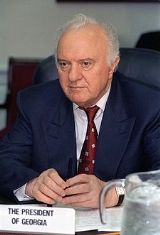
Eduard Shevardnadze

Eduard Shevardnadze

Overview
Eduard Shevardnadze is a former Soviet
Soviet people
Soviet people or Soviet nation was an umbrella demonym for the population of the Soviet Union. Initially used as a nonspecific reference to the Soviet population, it was eventually declared to be a "new historical, social and international unity of people".-Nationality politics in early Soviet...

, and later, Georgian
Georgians
The Georgians are an ethnic group that have originated in Georgia, where they constitute a majority of the population. Large Georgian communities are also present throughout Russia, European Union, United States, and South America....

 statesman from the height to the end of the Cold War
Cold War
The Cold War was the continuing state from roughly 1946 to 1991 of political conflict, military tension, proxy wars, and economic competition between the Communist World—primarily the Soviet Union and its satellite states and allies—and the powers of the Western world, primarily the United States...

. He served as President of Georgia
President of Georgia
The President of Georgia is the head of state, supreme commander-in-chief and holder of the highest office within the Government of Georgia. Executive power is split between the President and the Prime Minister, who is the head of government...

 from 1995 to 2003, and as First Secretary of the Georgian Communist Party
Georgian Communist party
Georgia was incorporated into the Soviet Union as the Georgian Soviet Socialist Republic after 25 February 1921 when the Red Army entered its capital Tbilisi and installed a communist government led by Georgian Bolshevik Filipp Makharadze. After the 1924 August Uprising in Georgia the country was...

 (GPC, the de facto leader of Soviet Georgia), from 1972 to 1985. Shevardnadze was responsible for many top decisions on Soviet foreign policy in the Gorbachev Era. He was forced to retire in 2003 as a consequence of the bloodless Rose Revolution
Rose Revolution
The "Revolution of Roses" was a change of power in Georgia in November 2003, which took place after having widespread protests over the disputed parliamentary elections...

.
Discussion
Ask a question about 'Eduard Shevardnadze'
Start a new discussion about 'Eduard Shevardnadze'
Answer questions from other users
Full Discussion Forum
 
Quotations

"In times of crisis, I always believe one should be where the people are."

While standing on a tank outisde the Parliament building in Moscow during the August 1991 coup.

"Corruption has its own motivations, and one has to thoroughly study that phenomenon and eliminate the foundations that allow corruption to exist."

"You know, to address crowds and make promises does not require very much brains."

"It is time to realize that neither socialism, nor friendship, nor good-neighborliness, nor respect can be produced by bayonets, tanks or blood." Category:Politicians|Shevardnadze, Eduard

Encyclopedia
Eduard Shevardnadze is a former Soviet
Soviet people
Soviet people or Soviet nation was an umbrella demonym for the population of the Soviet Union. Initially used as a nonspecific reference to the Soviet population, it was eventually declared to be a "new historical, social and international unity of people".-Nationality politics in early Soviet...

, and later, Georgian
Georgians
The Georgians are an ethnic group that have originated in Georgia, where they constitute a majority of the population. Large Georgian communities are also present throughout Russia, European Union, United States, and South America....

 statesman from the height to the end of the Cold War
Cold War
The Cold War was the continuing state from roughly 1946 to 1991 of political conflict, military tension, proxy wars, and economic competition between the Communist World—primarily the Soviet Union and its satellite states and allies—and the powers of the Western world, primarily the United States...

. He served as President of Georgia
President of Georgia
The President of Georgia is the head of state, supreme commander-in-chief and holder of the highest office within the Government of Georgia. Executive power is split between the President and the Prime Minister, who is the head of government...

 from 1995 to 2003, and as First Secretary of the Georgian Communist Party
Georgian Communist party
Georgia was incorporated into the Soviet Union as the Georgian Soviet Socialist Republic after 25 February 1921 when the Red Army entered its capital Tbilisi and installed a communist government led by Georgian Bolshevik Filipp Makharadze. After the 1924 August Uprising in Georgia the country was...

 (GPC, the de facto leader of Soviet Georgia), from 1972 to 1985. Shevardnadze was responsible for many top decisions on Soviet foreign policy in the Gorbachev Era. He was forced to retire in 2003 as a consequence of the bloodless Rose Revolution
Rose Revolution
The "Revolution of Roses" was a change of power in Georgia in November 2003, which took place after having widespread protests over the disputed parliamentary elections...

.

Shevardnadze's political career started in the late 1940s as a leading member of his local Komsomol
Komsomol
The Communist Union of Youth , usually known as Komsomol , was the youth division of the Communist Party of the Soviet Union. The Komsomol in its earliest form was established in urban centers in 1918. During the early years, it was a Russian organization, known as the Russian Communist Union of...

 organisation. He was later appointed its Second Secretary, and even First Secretary. His rise up the Georgian Soviet hierarchy continued until 1961 when he was demoted
Demotion
A demotion is a reduction in an employee's rank or job title within the organizational hierarchy of a company, public service department, or other body. A demotion may also lead to the loss of other privileges associated with a more senior rank and/or a reduction in salary or benefits...

 after he insulted a senior official. After spending two years in obscurity, Shevardnadze's returned as a First Secretary of a Tbilisi
Tbilisi
Tbilisi is the capital and the largest city of Georgia, lying on the banks of the Mt'k'vari River. The name is derived from an early Georgian form T'pilisi and it was officially known as Tiflis until 1936...

 city district, and was able to charge the Tbilisi First Secretary at the time for corruption. His anti-corruption work quickly garnered the interest of the Soviet government, and Shevardnadze was appointed to First Deputy of the Ministry of Internal Affairs of the Georgian SSR. He would later become the head of the internal affairs ministry and was able to charge First Secretary (leader of Soviet Georgia) Vasil Mzhavanadze
Vasil Mzhavanadze
Vasil Pavlovich Mzhavanadze was the First Secretary of the Communist Party of the Georgian SSR from September 1953 to September 28, 1972 and a member of the CPSU's Politburo from June 29, 1957 to December 18, 1972...

 for corruption charges.

As First Secretary, Shevardandze started several economic reforms which would spur economic growth in the republic, an uncommon occurrence in the Soviet Union because the country was experiencing a nationwide economic stagnation. Shevardnadze anti-corruption campaign continued until he resigned from his office as First Secretary. Mikhail Gorbachev
Mikhail Gorbachev
Mikhail Sergeyevich Gorbachev is a former Soviet statesman, having served as General Secretary of the Communist Party of the Soviet Union from 1985 until 1991, and as the last head of state of the USSR, having served from 1988 until its dissolution in 1991...

 appointed Shevardnadze to the post of Minister of Foreign Affairs. From then on, with the exception of a brief period between 1990 and 1991, only Gorbachev would outrank Shevardnadze in importance in Soviet foreign policy.

In the aftermath of the Soviet Union's collapse in 1991 Shevardnadze returned to a newly independent Georgia
Georgia (country)
Georgia is a sovereign state in the Caucasus region of Eurasia. Located at the crossroads of Western Asia and Eastern Europe, it is bounded to the west by the Black Sea, to the north by Russia, to the southwest by Turkey, to the south by Armenia, and to the southeast by Azerbaijan. The capital of...

. He became the country's head of state following the removal of Zviad Gamsakhurdia
Zviad Gamsakhurdia
Zviad Gamsakhurdia was a dissident, scientist and writer, who became the first democratically elected President of the Republic of Georgia in the post-Soviet era...

 as President
President of Georgia
The President of Georgia is the head of state, supreme commander-in-chief and holder of the highest office within the Government of Georgia. Executive power is split between the President and the Prime Minister, who is the head of government...

. Three years later, in 1995, Shevardnadze was elected President. His presidency was marked by rampant corruption and accusations of nepotism
Nepotism
Nepotism is favoritism granted to relatives regardless of merit. The word nepotism is from the Latin word nepos, nepotis , from which modern Romanian nepot and Italian nipote, "nephew" or "grandchild" are also descended....

. After allegations of an apparent electoral fraud
Electoral fraud
Electoral fraud is illegal interference with the process of an election. Acts of fraud affect vote counts to bring about an election result, whether by increasing the vote share of the favored candidate, depressing the vote share of the rival candidates or both...

 during the 2003 legislative election Shevardnadze was forced to resign following a series of public protests and demonstrations colloquially known as the Rose Revolution
Rose Revolution
The "Revolution of Roses" was a change of power in Georgia in November 2003, which took place after having widespread protests over the disputed parliamentary elections...

. He has lived in relative obscurity ever since, but has published his memoir
Memoir
A memoir , is a literary genre, forming a subclass of autobiography – although the terms 'memoir' and 'autobiography' are almost interchangeable. Memoir is autobiographical writing, but not all autobiographical writing follows the criteria for memoir set out below...

s.

Early life and career


Shevardnadze was born in Mamati
Mamati
Mamati is a small village in Lanchkhuti, Guria, western Georgia. Since the 2nd President of Georgia Eduard Shevardnadze was born there on 25 January 1928, it has gained prominence....

, Lanchkhuti
Lanchkhuti
Lanchkhuti is a city in western Georgian region of Guria. It has a population of about 8000.Lanchkhuti received city status in 1961. Under the USSR, it was the centre of the Georgian SSR Lanchkhuti area and today continues to serve as the capital of the district of the same name within the Guria...

, Transcaucasian SFSR
Transcaucasian SFSR
The Transcaucasian Socialist Federative Soviet Republic , also known as the Transcaucasian Soviet Federative Socialist Republic, the Transcaucasian SFSR and the TSFSR for short, was a short-lived republic of the Soviet Union, lasting from 1922 to 1936...

, Soviet Union
Soviet Union
The Soviet Union , officially the Union of Soviet Socialist Republics , was a constitutionally socialist state that existed in Eurasia between 1922 and 1991....

 on 25 January 1928. Ambrose, His father, worked as a teacher and was a devoted communist and party official. He was a cousin of Georgian painter and intellectual Dimitri Shevardnadze
Dimitri Shevardnadze
Dimitri Shevardnadze was a Georgian painter, art collector and intellectual purged during the Stalinist repressions....

 purged during Stalinist repressions. His mother however had little respect for the communist government and opposed both Shevardnadze's and his father's party career. In 1937, during the Great Purge
Great Purge
The Great Purge was a series of campaigns of political repression and persecution in the Soviet Union orchestrated by Joseph Stalin from 1936 to 1938...

, his father, who had abandoned Menshevism
Menshevik
The Mensheviks were a faction of the Russian revolutionary movement that emerged in 1904 after a dispute between Vladimir Lenin and Julius Martov, both members of the Russian Social-Democratic Labour Party. The dispute originated at the Second Congress of that party, ostensibly over minor issues...

 for Bolshevism
Bolshevik
The Bolsheviks, originally also Bolshevists , derived from bol'shinstvo, "majority") were a faction of the Marxist Russian Social Democratic Labour Party which split apart from the Menshevik faction at the Second Party Congress in 1903....

 in the mid-1920s, was arrested but was released due to the intervention of an NKVD
NKVD
The People's Commissariat for Internal Affairs was the public and secret police organization of the Soviet Union that directly executed the rule of power of the Soviets, including political repression, during the era of Joseph Stalin....

 officer who had been his pupil. The father of his wife, Nanuli Shevardnadze
Nanuli Shevardnadze
Nanuli Shevardnadze , born Nanuli Tsagareishvili was a Soviet/Georgian journalist and activist...

, was killed by the authorities during at the height of the purge. At first Nanuli rejected Shevardnadze's marriage proposal, fearing that her family background would ruin Shevardnadze's party career. These fears were well justified as many other couples had lost their life for the very same reason. The two married in 1951.

He joined the Georgian Communist Party
Georgian Communist party
Georgia was incorporated into the Soviet Union as the Georgian Soviet Socialist Republic after 25 February 1921 when the Red Army entered its capital Tbilisi and installed a communist government led by Georgian Bolshevik Filipp Makharadze. After the 1924 August Uprising in Georgia the country was...

 (GCP) and the Communist Party of the Soviet Union
Communist Party of the Soviet Union
The Communist Party of the Soviet Union was the only legal, ruling political party in the Soviet Union and one of the largest communist organizations in the world...

 (CPSU) in 1948 at the age of twenty. He rose steadily through the ranks of the Georgian Komsomol
Komsomol
The Communist Union of Youth , usually known as Komsomol , was the youth division of the Communist Party of the Soviet Union. The Komsomol in its earliest form was established in urban centers in 1918. During the early years, it was a Russian organization, known as the Russian Communist Union of...

, and eventually become its First Secretary after serving a term as Second Secretary. It was during his Komsomol First Secretaryship that Shevardnadze would meet Mikhail Gorbachev
Mikhail Gorbachev
Mikhail Sergeyevich Gorbachev is a former Soviet statesman, having served as General Secretary of the Communist Party of the Soviet Union from 1985 until 1991, and as the last head of state of the USSR, having served from 1988 until its dissolution in 1991...

 for his first time. Shevardnadze claims that he grew disillusioned with the Soviet political system
Politics of the Soviet Union
The political system of the Soviet Union was characterized by the superior role of the Communist Party of the Soviet Union , the only party permitted by Constitution.For information about the government, see Government of the Soviet Union-Background:...

 following Nikita Khrushchev
Nikita Khrushchev
Nikita Sergeyevich Khrushchev led the Soviet Union during part of the Cold War. He served as First Secretary of the Communist Party of the Soviet Union from 1953 to 1964, and as Chairman of the Council of Ministers, or Premier, from 1958 to 1964...

's "Secret Speech" to the 20th CPSU Congress. Like many Soviets
Soviet people
Soviet people or Soviet nation was an umbrella demonym for the population of the Soviet Union. Initially used as a nonspecific reference to the Soviet population, it was eventually declared to be a "new historical, social and international unity of people".-Nationality politics in early Soviet...

, the crimes perpetrated by Joseph Stalin
Joseph Stalin
Joseph Vissarionovich Stalin was the Premier of the Soviet Union from 6 May 1941 to 5 March 1953. He was among the Bolshevik revolutionaries who brought about the October Revolution and had held the position of first General Secretary of the Communist Party of the Soviet Union's Central Committee...

 horrified Shevardnadze, and the Soviet government's response to the 1956 Georgian demonstrations shocked him even more. He was demoted in 1961 by the Politburo of the Georgian Communist Party after offending a senior official. His demotion led him to endure several years of obscurity before returning to attention as a First Secretary of a city district in Tbilisi
Tbilisi
Tbilisi is the capital and the largest city of Georgia, lying on the banks of the Mt'k'vari River. The name is derived from an early Georgian form T'pilisi and it was officially known as Tiflis until 1936...

. Shevardnadze challenged Tbilisi First Secretary Otari Lolashvili, and later charged him for corrupion. Shevardnadze left party work after getting appointed to First Deputy of the Ministry of Internal Affairs of the Georgian SSR in 1964. It was his successful attempt at putting Lolashvili behind bar's which got him promoted to the First Deputyship. In 1965 he was appointed Minister of Internal Affairs of the Georgian SSR. After initiatsing a successful anti-corruption
Anti-Corruption
Anti-Corruption is a 1975 Hong Kong film directed by Ng See Yuen and released under the Eternal Film banner.-External links:* Anti-Corruption at...

 campaign supported by the Soviet government Shevardnadze was voted-in as Second Secretary of the Georgian Communist Party. As Minister of Internal Affairs Shevardnadze ordered the arrest of more than 25,000 people; 17,000 of these being party members, many government ministers and 70 KGB
KGB
The KGB was the commonly used acronym for the . It was the national security agency of the Soviet Union from 1954 until 1991, and was the premier internal security, intelligence, and secret police organization during that time.The State Security Agency of the Republic of Belarus currently uses the...

 officials. Several other Georgians would lose their life and/or would face torturing by the authorities. Shevardnadze's corruption campaign increased public enmity
Enmity
Enmity is a Avant-Garde Metal band from Cape Town, South Africa and has been active since 2007. Their debut full-length album, is a concept album exploring the lives of different serial killers from around the world.- History :...

 against him. However, it was these anti-corruption campaigns which garnered the interest of the Soviet government, and in turn, his promotion to the First Secretaryship after Vasil Mzhavanadze
Vasil Mzhavanadze
Vasil Pavlovich Mzhavanadze was the First Secretary of the Communist Party of the Georgian SSR from September 1953 to September 28, 1972 and a member of the CPSU's Politburo from June 29, 1957 to December 18, 1972...

's resignation.

First Secretary of the GCP (1972–1985)


Shevardnadze was appointed to the First Secretaryship of the Georgian Communist Party
Georgian Communist party
Georgia was incorporated into the Soviet Union as the Georgian Soviet Socialist Republic after 25 February 1921 when the Red Army entered its capital Tbilisi and installed a communist government led by Georgian Bolshevik Filipp Makharadze. After the 1924 August Uprising in Georgia the country was...

 by the Soviet government with the task of suppressing the grey
Grey market
A grey market or gray market also known as parallel market is the trade of a commodity through distribution channels which, while legal, are unofficial, unauthorized, or unintended by the original manufacturer...

 and black-market capitalism that had grown under Vasil Mzhavanadze
Vasil Mzhavanadze
Vasil Pavlovich Mzhavanadze was the First Secretary of the Communist Party of the Georgian SSR from September 1953 to September 28, 1972 and a member of the CPSU's Politburo from June 29, 1957 to December 18, 1972...

's rule.

Corruption campaigns


Shevardnadze's rapid rise in Soviet Georgia's political hierarchy was the result of his campaign against corruption. By the time Shevardnadze had become leader Georgia had become the most corrupt-infested republic in the Soviet Union
Soviet Union
The Soviet Union , officially the Union of Soviet Socialist Republics , was a constitutionally socialist state that existed in Eurasia between 1922 and 1991....

. The reign of Vasil Mzhavanadze
Vasil Mzhavanadze
Vasil Pavlovich Mzhavanadze was the First Secretary of the Communist Party of the Georgian SSR from September 1953 to September 28, 1972 and a member of the CPSU's Politburo from June 29, 1957 to December 18, 1972...

, Shevardnadze's predecessor in office, had been characterised by weak leadership, nepotism
Nepotism
Nepotism is favoritism granted to relatives regardless of merit. The word nepotism is from the Latin word nepos, nepotis , from which modern Romanian nepot and Italian nipote, "nephew" or "grandchild" are also descended....

, despotism
Despotism
Despotism is a form of government in which a single entity rules with absolute power. That entity may be an individual, as in an autocracy, or it may be a group, as in an oligarchy...

, bribery and corruption at the upper echelons of power. Throughout most of his leadership, anti-corruption campaigns were central to his authority and policy. In Georgia corruption had been allowed to grow nearly freely. This had led to serious deformations in the system, an example being that only 68 of Georgian goods were exported legally, while goods exported legally from other Soviet Republics amounted close to 100 percent. Shevardnadze rallied up support for his corruption campaigns by establishing the Study of Public Opinion. To combat corruption he indulged himself in subterfuge after halting all external export by dressing up as a peasant, and driving a car filled with tomatoes through the border. After his personal subterfuge the entire Georgian border police was purged. While never proven, it is said that Shevardnadze after taking office, asked all leading officials to show their left hands; he then ordered those who used Western produced watches to replace them with Soviet ones. This story portrayed Shevardnadzes as an active battler against corruption. His campaign against corruption was largely unsuccessful and when he returned to Georgia in 1992, corruption was still an epidemic problem.

Economic policy


Under Shevardnadze's rule Georgia was one of only a handful of Soviet Republics who did not experience economic stagnation, quite to the contrary Georgia experienced rapid economic growth. By 1974 industrial output had increased by 9.6 percent while agricultural output had increased by 18 percent. The shortage economy
Shortage economy
Shortage economy is a term coined by the Hungarian economist, János Kornai. He used this term to criticize the old centrally-planned economies of the communist states of the Eastern Bloc...

 which had evolved into a prevalent problem in other parts of the Soviet Union had in Georgia nearly disappeared. This positive trend can be proven by the fact that the long Food queues in Tbilisi
Tbilisi
Tbilisi is the capital and the largest city of Georgia, lying on the banks of the Mt'k'vari River. The name is derived from an early Georgian form T'pilisi and it was officially known as Tiflis until 1936...

 had been shortened while in Moscow been lengthened. Some of Shevardnadze's economic policies were adopted by the Soviet government on a national level.

In 1973 Shevardnadze launched an agricultural reform in Abasha
Abasha
Abasha is a town in western Georgia with a population of 6,400 . It is situated between the rivers of Abasha and Noghela, at 23m above sea level and is located some to the west of Tbilisi. The settlement of Abasha acquired the status of a town in 1964 and currently functions as an administrative...

, popularly referred to as the "Abasha experiment". This reform was inspired by János Kádár
János Kádár
János Kádár was a Hungarian communist leader and the General Secretary of the Hungarian Socialist Workers' Party, presiding over the country from 1956 until his forced retirement in 1988. His thirty-two year term as General Secretary makes Kádár the longest ruler of the People's Republic of Hungary...

's agricultural policy in the People's Republic of Hungary
People's Republic of Hungary
The People's Republic of Hungary or Hungarian People's Republic was the official state name of Hungary from 1949 to 1989 during its Communist period under the guidance of the Soviet Union. The state remained in existence until 1989 when opposition forces consolidated in forcing the regime to...

 which returned the agricultural decision-making to the local level of governance. Shevardnadze merged all Abasha agricultural institutions in one single entity and established a new remuneration
Remuneration
Remuneration is the total compensation that an employee receives in exchange for the service they perform for their employer. Typically, this consists of monetary rewards, also referred to as wage or salary...

 system. If a farmer fulfilled the five-year plan early he would be awarded a share of the crops. The policy had a positive effect on the Georgian economy, and because of the large increase of agricultural output in Abasha, the reform was introduced elsewhere in the republic. The agricultural reform in Georgia became the model of the nationwide Agricultural-Industrial Organisations established by a decree
Decree
A decree is a rule of law issued by a head of state , according to certain procedures . It has the force of law...

 in 1982.

Shevardnadze has taken much of the credit for Georgia's economic performance under his rule. Seven months before his promotion to the Soviet Foreign Affairs Ministership Shevardnadze claimed that there were thirty, or more, economic experiments operating in Georgia which he claimed would further democratise the economic management.

Political experimentation and nationalism


Shevardnadze was a strong supporter of political reform in the Georgian SSR. Under his rule he created agencies attached to the Central Committee of the Georgian Communist Party who's main task was studying, analysing and molding public opinion. These agencies worked closely with Georgia's communications networks, such as television, and government ministers and Shevardnadze himself were regularly interviewed live on television. Shevardnadze criticised flattery in Georgia, and felt that he along with his government's activities, needed to get criticised more often, especially during party congresses. He also proved himself, even before Mikhail Gorbachev
Mikhail Gorbachev
Mikhail Sergeyevich Gorbachev is a former Soviet statesman, having served as General Secretary of the Communist Party of the Soviet Union from 1985 until 1991, and as the last head of state of the USSR, having served from 1988 until its dissolution in 1991...

's rise to power, to be a firm supporter of people's democracy (e.g. power from below).

The previous Soviet Georgian rulers had given away to nationalist favoratism to the Georgians
Georgians
The Georgians are an ethnic group that have originated in Georgia, where they constitute a majority of the population. Large Georgian communities are also present throughout Russia, European Union, United States, and South America....

, Shevardnadze was however, against this policy of favoratism. Therefore his nationalistic policy is seen as highly controversial in today's Georgia. At the 25th Congress of the Georgian Communist Party Shevardnadze told the congress; "for Georgians, the sun rises not in the east, but in the north—in Russia". Shevardnadze saw "extreme nationalism", coupled with corruption and inefficiencies within the system, as one of the main obstacles to economic growth. During his rule he condemned what he saw as "national narrow-mindedness and isolation" and writers who published works with nationalistic overtones. The 1970s saw an increase in nationalistic tendencies in Georgian society. When the 1978 Georgian demonstrations
1978 Georgian demonstrations
14 April 1978, demonstrations in Tbilisi, capital of the Georgian SSR, took place in response to an attempt by Soviet government to change the constitutional status of the indigenous Georgian language...

 were sparked when the Soviet government decided to amend the Georgian constitution and removing the Georgian language
Georgian language
Georgian is the native language of the Georgians and the official language of Georgia, a country in the Caucasus.Georgian is the primary language of about 4 million people in Georgia itself, and of another 500,000 abroad...

 as the sole state language in the republic. While at first standing at the same side as the Soviet government Shevardnadze quickly reiterated his position and was able to make a compromise with the Soviet government and the demonstrators. The Georgian language was kept as the sole official language of the republic, however, the Supreme Soviet of the Soviet Union passed a legislation which called for an increasing the level of Russian language
Russian language
Russian is a Slavic language used primarily in Russia, Belarus, Uzbekistan, Kazakhstan, Tajikistan and Kyrgyzstan. It is an unofficial but widely spoken language in Ukraine, Moldova, Latvia, Turkmenistan and Estonia and, to a lesser extent, the other countries that were once constituent republics...

 training in the non-Russian republics.

There was another problem facing Shevardnadze during the 1978 demonstrations, some leading Abkhaz intellectuals were writing to Leonid Brezhnev
Leonid Brezhnev
Leonid Ilyich Brezhnev  – 10 November 1982) was the General Secretary of the Central Committee of the Communist Party of the Soviet Union , presiding over the country from 1964 until his death in 1982. His eighteen-year term as General Secretary was second only to that of Joseph Stalin in...

 in the hope that he would let the Abkhaz Autonomous Soviet Socialist Republic
Abkhaz Autonomous Soviet Socialist Republic
The Abkhaz Autonomous Soviet Socialist Republic or Abkhaz ASSR was an autonomous republic of the Soviet Union within the Georgian SSR. It came into existence in February 1931, when the Socialist Soviet Republic of Abkhazia , originally created in March 1921, was transformed to the status of...

 secede from Georgia and merge into the Russian SFSR
Russian Soviet Federative Socialist Republic
The Russian Soviet Federative Socialist Republic , commonly referred to as Soviet Russia, Bolshevik Russia, or simply Russia, was the largest, most populous and economically developed republic in the former Soviet Union....

. To halt this development the Georgian government gave away to concession
Concession (politics)
In politics, a concession is the act of a losing candidate publicly yielding to a winning candidate after an election, when the overall result of the vote has become clear.-Refusal to concede:...

s made by the secessionists. These concessions includes establishing a Abhkaz university, the expansion of Abkhaz publications and creating an Abkhaz television station. Shevardnadze would prove however to be an active supporter of defending minority interest.

National politics and resignation


At the 25th Congress of the Communist Party of the Soviet Union
Communist Party of the Soviet Union
The Communist Party of the Soviet Union was the only legal, ruling political party in the Soviet Union and one of the largest communist organizations in the world...

 (CPSU) in 1976 Shevardnadze held a speech in which he called General Secretary
General Secretary of the Communist Party of the Soviet Union
General Secretary of the Central Committee of the Communist Party of the Soviet Union was the title given to the leader of the Communist Party of the Soviet Union. With some exceptions, the office was synonymous with leader of the Soviet Union...

 Leonid Brezhnev
Leonid Brezhnev
Leonid Ilyich Brezhnev  – 10 November 1982) was the General Secretary of the Central Committee of the Communist Party of the Soviet Union , presiding over the country from 1964 until his death in 1982. His eighteen-year term as General Secretary was second only to that of Joseph Stalin in...

 "vozhd" (leader), a term previously reserved for Joseph Stalin
Joseph Stalin
Joseph Vissarionovich Stalin was the Premier of the Soviet Union from 6 May 1941 to 5 March 1953. He was among the Bolshevik revolutionaries who brought about the October Revolution and had held the position of first General Secretary of the Communist Party of the Soviet Union's Central Committee...

. His adulation was only surpassed by those of Andrei Kirilenko
Andrei Kirilenko (politician)
Andrei Pavlovich Kirilenko was a Soviet statesman from the start to the end of the Cold War. In 1906, Kirilenko was born in Alexeyevka, Belgorod Oblast, Russian Empire, to a Russian working class family. He graduated in the 1920s from a local vocational school, and again in the mid-to-late 1930s...

 and Heydar Aliyev
Heydar Aliyev
Heydar Alirza oglu Aliyev , also spelled as Heidar Aliev, Geidar Aliev, Haydar Aliyev, Geydar Aliyev was the third President of Azerbaijan for the New Azerbaijan Party from June 1993 to October 2003, when his son Ilham Aliyev succeeded him.From 1969 till 1982, Aliyev was also the leader of Soviet...

. As Yegor Ligachev
Yegor Ligachev
Yegor Kuzmich Ligachev is a Russian politician who was a high-ranking official in the Communist Party of the Soviet Union . Originally a protege of Mikhail Gorbachev, Ligachev became a challenger to his leadership.-Early life:...

 later noted, Shevardnadze never contradicted a General Secretary. During Brezhnev's last days Shevardnadze had publicly endorsed Konstantin Chernenko
Konstantin Chernenko
Konstantin Ustinovich Chernenko was a Soviet politician and the fifth General Secretary of the Communist Party of the Soviet Union. He led the Soviet Union from 13 February 1984 until his death thirteen months later, on 10 March 1985...

's candidacy for the General Secretaryship and called him a "great theoretician". However, when it became clear that the secretaryship would not go to Chernenko, but instead Yuri Andropov
Yuri Andropov
Yuri Vladimirovich Andropov was a Soviet politician and the General Secretary of the Communist Party of the Soviet Union from 12 November 1982 until his death fifteen months later.-Early life:...

, Shevardnadze swiftly reiterated his position and gave his support for Andropov. Shevardnadze's became the first Soviet republican head to offer his gratitude to the newly elected leader, in turn, Andropov quickly signaled his appreciation and his support for some of the reforms launched by Shevardnadze. According to Andropov's biographers the anti-corruption campaigned launched by him was inspired by Shervardnadze's Georgian anti-corruption campaign. When Andropov died Shevardnadze became yet again an avid supporter for Chernenko's candidacy for the General Secretaryship. When Chernenko died Shevardnadze's had become a strong supporter Mikhail Gorbachev
Mikhail Gorbachev
Mikhail Sergeyevich Gorbachev is a former Soviet statesman, having served as General Secretary of the Communist Party of the Soviet Union from 1985 until 1991, and as the last head of state of the USSR, having served from 1988 until its dissolution in 1991...

's leadership candidacy. He became a member of the Central Committee
Central Committee of the Communist Party of the Soviet Union
The Central Committee of the Communist Party of the Soviet Union , abbreviated in Russian as ЦК, "Tse-ka", earlier was also called as the Central Committee of the All-Union Communist Party ...

 (CC) of the CPSU in 1976 and in 1978 was promoted to the rank of non-voting candidate member of the Soviet Political Bureau
Politburo of the Central Committee of the Communist Party of the Soviet Union
The Politburo , known as the Presidium from 1952 to 1966, functioned as the central policymaking and governing body of the Communist Party of the Soviet Union.-Duties and responsibilities:The...

 (Politburo). His chance came in 1985 when the veteran Soviet Minister of Foreign Affairs, Andrei Gromyko
Andrei Gromyko
Andrei Andreyevich Gromyko was a Soviet statesman during the Cold War. He served as Minister of Foreign Affairs and as Chairman of the Presidium of the Supreme Soviet . Gromyko was responsible for many top decisions on Soviet foreign policy until he retired in 1987. In the West he was given the...

, left that post for the largely ceremonial position of Chairman of the Presidium
Presidium of the Supreme Soviet
The Presidium of the Supreme Soviet was a Soviet governmental institution – a permanent body of the Supreme Soviets . This body was of the all-Union level , as well as in all Soviet republics and autonomous republics...

 of the Supreme Soviet of the Soviet Union. The de facto leader, Communist Party General Secretary Mikhail Gorbachev
Mikhail Gorbachev
Mikhail Sergeyevich Gorbachev is a former Soviet statesman, having served as General Secretary of the Communist Party of the Soviet Union from 1985 until 1991, and as the last head of state of the USSR, having served from 1988 until its dissolution in 1991...

, appointed Shevardnadze to replace Gromyko as Minister of Foreign Affairs, thus consolidating Gorbachev's circle of relatively young reformers.

Minister of Foreign Affairs (1985–1991)


He subsequently played a key role in the détente
Détente
Détente is the easing of strained relations, especially in a political situation. The term is often used in reference to the general easing of relations between the Soviet Union and the United States in the 1970s, a thawing at a period roughly in the middle of the Cold War...

 which marked the end of the Cold War. He was credited with helping to devise the so-called "Sinatra Doctrine
Sinatra Doctrine
"Sinatra Doctrine" was the name that the Soviet government of Mikhail Gorbachev used jokingly to describe its policy of allowing neighboring Warsaw Pact nations to determine their own internal affairs...

" of allowing the Soviet Union's eastern European satellites to "do it their way" rather than forcibly restraining any attempts to pursue a different course. When democratization and revolution began to sweep across eastern Europe, he rejected the pleas of eastern European Communist leaders for Soviet intervention and smoothed the path for a (mostly) peaceful democratic transformation in the region. He reportedly told hardliners that "it is time to realize that neither socialism, nor friendship, nor good-neighborliness, nor respect can be produced by bayonets, tanks or blood." However, his moderation was seen by some communists and Russian nationalists as a betrayal and earned him the long-term antagonism of powerful figures in Moscow.

During the late 1980s, as the Soviet Union descended into crisis, Gorbachev and Shevardnadze became increasingly estranged from each other over policy differences. Gorbachev fought to preserve a socialist government and the unity of the Soviet Union, while Shevardnadze advocated further political and economic liberalisation. He resigned in protest against Gorbachev's policies in December 1990, delivering a dramatic warning to the Soviet parliament that "Reformers have gone and hidden in the bushes. Dictatorship is coming." A few months later, his fears were partially realised when an unsuccessful coup by Communist hardliners precipitated the collapse of the Soviet Union. Shevardnadze returned briefly as Soviet Foreign Minister in November 1991 but resigned with Gorbachev the following month when the Soviet Union was formally dissolved.

In 1991, Shevardnadze was baptized into the Georgian Orthodox Church
Georgian Orthodox and Apostolic Church
The Georgian Apostolic Autocephalous Orthodox Church is an autocephalous part of the Eastern Orthodox Church. Since the 4th century AD, Georgian Orthodoxy has been the state religion of Georgia, and it remains the country's largest religious institution....

.

Rise to power


The newly independent Republic of Georgia elected as its first president a leader of the national-liberational movement, Zviad Gamsakhurdia
Zviad Gamsakhurdia
Zviad Gamsakhurdia was a dissident, scientist and writer, who became the first democratically elected President of the Republic of Georgia in the post-Soviet era...

, a famous scientist and writer, who had been imprisoned by Shevardnadze's government in the late 1970s. Gamsakhurdia's rule ended abruptly in January 1992 when he was deposed in a bloody coup d'état and forced to flee to the Chechen Republic
Chechnya
The Chechen Republic , commonly referred to as Chechnya , also spelled Chechnia or Chechenia, sometimes referred to as Ichkeria , is a federal subject of Russia . It is located in the southeastern part of Europe in the Northern Caucasus mountains. The capital of the republic is the city of Grozny...

 in neighboring Russia. Shevardnadze was appointed acting chairman of the Georgian state council in March 1992. When the Presidency was restored in November 1995, he was elected with 70% of the vote. He secured a second term in April 2000 in an election that was marred by widespread claims of vote-rigging.

Rule


Shevardnadze's career as Georgian President was in some respects even more challenging than his earlier career as Soviet Foreign Minister. He faced many enemies, some dating back to his campaigns against corruption and nationalism in Soviet times. A civil war in western Georgia broke out in 1993 between supporters of Gamsakhurdia and Shevardnadze but was ended by Russian intervention on Shevardnadze's side and the death of ex-President Gamsakhurdia on 31 December 1993. Three assassination attempts were mounted against Shevardnadze. He escaped an assassination attempt in Abkhazia in 1992: Russian military carried out an attack on Shevardnadze's life. Then in August 1995 and February 1998 which his government blamed on remnants of Gamsakhurdia's party. The 1995 attack had seen his motorcade attacked with anti-tank rockets and small arms fire in Tbilisi
Tbilisi
Tbilisi is the capital and the largest city of Georgia, lying on the banks of the Mt'k'vari River. The name is derived from an early Georgian form T'pilisi and it was officially known as Tiflis until 1936...

 under cover of night.

He also faced separatist conflicts in the regions of South Ossetia
Ossetia
Ossetia Ossetic: Ир, Ирыстон Ir, Iryston; Russian: Осетия, Osetiya; Georgian: ოსეთი, Oset'i) is an ethnolinguistic region located on both sides of the Greater Caucasus Mountains, largely inhabited by the Ossetians. The Ossetian language is part of the Eastern Iranian branch of the Indo-European...

 and Abkhazia
Abkhazia
Abkhazia is a disputed political entity on the eastern coast of the Black Sea and the south-western flank of the Caucasus.Abkhazia considers itself an independent state, called the Republic of Abkhazia or Apsny...

, which caused the deaths of an estimated 10,000 people, as well as an assertively autonomous government in Ajaria.

The war in the Russian republic of Chechnya
Chechnya
The Chechen Republic , commonly referred to as Chechnya , also spelled Chechnia or Chechenia, sometimes referred to as Ichkeria , is a federal subject of Russia . It is located in the southeastern part of Europe in the Northern Caucasus mountains. The capital of the republic is the city of Grozny...

 on Georgia's northern border caused considerable friction with Russia, which accused Shevardnadze of harbouring Chechen
Chechen people
Chechens constitute the largest native ethnic group originating in the North Caucasus region. They refer to themselves as Noxçi . Also known as Sadiks , Gargareans, Malkhs...

 guerrillas and supported Georgian separatists in apparent retaliation. Further friction was caused by Shevardnadze's close relationship with the United States, which saw him as a counterbalance to Russian influence in the strategic Transcaucasus
Caucasus
The Caucasus, also Caucas or Caucasia , is a geopolitical region at the border of Europe and Asia, and situated between the Black and the Caspian sea...

 region. Under Shevardnadze's strongly pro-Western administration, Georgia became a major recipient of U.S. foreign and military aid, signed a strategic partnership with NATO and declared an ambition to join both NATO and the European Union. Perhaps his greatest diplomatic coup was the securing of a $3 billion project to build a pipeline
Pipeline transport
Pipeline transport is the transportation of goods through a pipe. Most commonly, liquids and gases are sent, but pneumatic tubes that transport solid capsules using compressed air are also used....

 carrying oil
Petroleum
Petroleum or crude oil is a naturally occurring, flammable liquid consisting of a complex mixture of hydrocarbons of various molecular weights and other liquid organic compounds, that are found in geologic formations beneath the Earth's surface. Petroleum is recovered mostly through oil drilling...

 from Azerbaijan
Azerbaijan
Azerbaijan , officially the Republic of Azerbaijan is the largest country in the Caucasus region of Eurasia. Located at the crossroads of Western Asia and Eastern Europe, it is bounded by the Caspian Sea to the east, Russia to the north, Georgia to the northwest, Armenia to the west, and Iran to...

 to Turkey
Turkey
Turkey , known officially as the Republic of Turkey , is a Eurasian country located in Western Asia and in East Thrace in Southeastern Europe...

 via Georgia.

At the same time, however, Georgia suffered badly from the effects of crime and rampant corruption, often perpetrated by well-connected officials and politicians. Shevardnadze's closest advisers, including several members of his family, exerted disproportionate economic power. It was estimated by outside observers that Shevardnadze's inner circle controlled as much as 70 per cent of the economy: his wife edited and wrote for one of the country's major newspapers, his daughter was the director of a television film studio and her husband founded one of the country's leading mobile phone networks (with American funding). While Shevardnadze himself was not a conspicuous profiteer, he was accused by many Georgians
Georgians
The Georgians are an ethnic group that have originated in Georgia, where they constitute a majority of the population. Large Georgian communities are also present throughout Russia, European Union, United States, and South America....

 of shielding corrupt supporters and using his powers of patronage to shore up his own position. Georgia
Georgia (country)
Georgia is a sovereign state in the Caucasus region of Eurasia. Located at the crossroads of Western Asia and Eastern Europe, it is bounded to the west by the Black Sea, to the north by Russia, to the southwest by Turkey, to the south by Armenia, and to the southeast by Azerbaijan. The capital of...

 acquired an unenviable reputation as one of the world's most corrupt countries. Eventually, even his American supporters grew tired of pouring money into an apparent black hole.

Downfall


On 2 November 2003, Georgia held a parliamentary election that was widely denounced as unfair by international election observers, as well as by the U.N. and the U.S. government. The outcome sparked fury among many Georgians, leading to mass demonstrations in the capital Tbilisi
Tbilisi
Tbilisi is the capital and the largest city of Georgia, lying on the banks of the Mt'k'vari River. The name is derived from an early Georgian form T'pilisi and it was officially known as Tiflis until 1936...

 and elsewhere. Protesters broke into Parliament on 21 November as the first session of the new Parliament was beginning, forcing President Shevardnadze to escape with his bodyguards. He later declared a state of emergency
State of emergency
A state of emergency is a governmental declaration that may suspend some normal functions of the executive, legislative and judicial powers, alert citizens to change their normal behaviours, or order government agencies to implement emergency preparedness plans. It can also be used as a rationale...

 and insisted that he would not resign.

Despite growing tension, both sides publicly stated their wish to avoid any violence, a particular concern given Georgia's turbulent post-Soviet history. Nino Burjanadze
Nino Burjanadze
Nino Burjanadze is a Georgian politician and lawyer who served as Chairperson of the Parliament of Georgia from November 2001 to June 2008...

, speaker of the Georgian parliament, said she would act as president until the situation was resolved. The leader of the opposition Mikhail Saakashvili stated he would guarantee Shevardnadze's safety and support his return as President provided he promised to call early presidential elections.

On 23 November Shevardnadze met with the opposition leaders Mikheil Saakashvili
Mikheil Saakashvili
Mikheil Saakashvili is a Georgian politician, the third and current President of Georgia and leader of the United National Movement Party.Involved in the national politics since 1995, Saakashvili became president on 25 January 2004 after President Eduard Shevardnadze resigned in a November 2003...

 and Zurab Zhvania
Zurab Zhvania
Zurab Zhvania was a prominent Georgian politician, having served as Prime Minister of Georgia and Speaker of the Parliament of Georgia as well as Minister without Portfolio. Zhvania assumed premiership on 18 February 2004 and remained on the position until his death on 3 February 2005...

 to discuss the situation, in a meeting arranged by Russian Foreign Minister Igor Ivanov
Igor Ivanov
Igor Sergeyevich Ivanov is a Russian politician and was Russian Foreign Minister from 1998 to 2004.- Early life :...

. After this meeting, the president announced his resignation, declaring that he wished to avert a bloody power struggle "so all this can end peacefully and there is no bloodshed and no casualties". However, it was widely speculated that the refusal of the armed forces to enforce his emergency decree was the main cause of his resignation. He claimed the following day that he had been prepared to step down the previous morning, hours before he actually did, but was prevented from doing so by his entourage.

Although it was unclear precisely what role foreign powers played in the toppling of Shevardnadze, it emerged shortly afterwards that both Russia and the United States had played a direct role. U.S. Secretary of State Colin Powell
Colin Powell
Colin Luther Powell is an American statesman and a retired four-star general in the United States Army. He was the 65th United States Secretary of State, serving under President George W. Bush from 2001 to 2005. He was the first African American to serve in that position. During his military...

 communicated regularly with Shevardnadze during the post-election crisis, reportedly pushing him to step down peacefully. Russian foreign minister Igor Ivanov
Igor Ivanov
Igor Sergeyevich Ivanov is a Russian politician and was Russian Foreign Minister from 1998 to 2004.- Early life :...

 flew to Tbilisi to visit three main opposition leaders and Shevardnadze, and arranged on late 23 November for Saakashvili and Zurab Zhvania
Zurab Zhvania
Zurab Zhvania was a prominent Georgian politician, having served as Prime Minister of Georgia and Speaker of the Parliament of Georgia as well as Minister without Portfolio. Zhvania assumed premiership on 18 February 2004 and remained on the position until his death on 3 February 2005...

 to meet Shevardnadze. Ivanov then travelled to the autonomous region of Ajaria for consultations with the Ajaran leader Aslan Abashidze
Aslan Abashidze
Aslan Abashidze was the leader of the Ajarian Autonomous Republic in western Georgia from 1991 to May 5, 2004. He resigned under the pressure of the central Georgian government and mass opposition rallies during the 2004 Adjara crisis, and has since lived in Moscow, Russia...

, who had been pro-Shevardnadze.

Shevardnadze's ouster prompted mass celebrations with drinking and dancing in the streets by tens of thousands of Georgians crowding Tbilisi
Tbilisi
Tbilisi is the capital and the largest city of Georgia, lying on the banks of the Mt'k'vari River. The name is derived from an early Georgian form T'pilisi and it was officially known as Tiflis until 1936...

's Rustaveli Avenue and Freedom Square. The protesters dubbed their actions a "Rose Revolution
Rose Revolution
The "Revolution of Roses" was a change of power in Georgia in November 2003, which took place after having widespread protests over the disputed parliamentary elections...

", deliberately recalling the peaceful toppling of the Communist government in Czechoslovakia
Czechoslovakia
Czechoslovakia or Czecho-Slovakia was a sovereign state in Central Europe which existed from October 1918, when it declared its independence from the Austro-Hungarian Empire, until 1992...

 in the "Velvet Revolution
Velvet Revolution
The Velvet Revolution or Gentle Revolution was a non-violent revolution in Czechoslovakia that took place from November 17 – December 29, 1989...

" of 1989. Observers noted similarities with the overthrow of Yugoslav President Slobodan Milošević
Slobodan Milošević
Slobodan Milošević was President of Serbia and Yugoslavia. He served as the President of Socialist Republic of Serbia and Republic of Serbia from 1989 until 1997 in three terms and as President of the Federal Republic of Yugoslavia from 1997 to 2000...

 in 2000, who was also forced to resign by mass protests. The parallel with Yugoslavia was reinforced when it emerged that the Open Society Institute
Open Society Institute
The Open Society Institute , renamed in 2011 to Open Society Foundations, is a private operating and grantmaking foundation started by George Soros, aimed to shape public policy to promote democratic governance, human rights, and economic, legal, and social reform...

 of George Soros
George Soros
George Soros is a Hungarian-American business magnate, investor, philosopher, and philanthropist. He is the chairman of Soros Fund Management. Soros supports progressive-liberal causes...

 had arranged contacts between the Georgian opposition and the Yugoslav Otpor
Otpor
Otpor! was a civic youth movement that existed as such from 1998 until 2003 in Serbia , employing nonviolent struggle against the regime of Slobodan Milošević as their course of action. In the course of two-year nonviolent struggle against Milosevic, Otpor spread across Serbia and attracted more...

 (Resistance) movement, which had been instrumental in the toppling of Milošević. Otpor activists reportedly advised the Georgian opposition on the methods that they had used to mobilize popular anger against Milošević. According to the then editor-in-chief of The Georgian Messenger newspaper, Zaza Gachechiladze, "It's generally accepted public opinion here that Mr. Soros is the person who planned Shevardnadze's overthrow". IWPR
IWPR
IWPR may refer to:* Institute for War and Peace Reporting* Institute for Women's Policy Research...

 reported that on 28 November, in an interview held with the press at his home, Shevardnadze "spoke with anger" about a plot by "unspecified Western figures" to bring him down. He said that he did not believe that the US administration was involved.

The German government offered Shevardnadze political asylum in Germany, where he is still widely respected for his role as one of the chief Soviet architects of reunification
German reunification
German reunification was the process in 1990 in which the German Democratic Republic joined the Federal Republic of Germany , and when Berlin reunited into a single city, as provided by its then Grundgesetz constitution Article 23. The start of this process is commonly referred by Germans as die...

 in 1990. It was reported (although never confirmed) that his family had purchased a villa in the resort town of Baden-Baden
Baden-Baden
Baden-Baden is a spa town in Baden-Württemberg, Germany. It is located on the western foothills of the Black Forest, on the banks of the Oos River, in the region of Karlsruhe...

. However, he told German TV on 24 November, "Although I am very grateful for the invitation from the German side, I love my country very much and I won't leave it." He has begun to write his memoirs following his forced retirement.

Legacy


Shevardnadze's political career was filled with contradictions. He was a product of the Soviet system, but played a central role in dismantling that system. He built his reputation on fighting political corruption, but came to be seen as using corrupt methods to shore up his own position. He achieved worldwide renown as the most liberal foreign minister in the history of the USSR, but was never nearly as popular in his own country. He succeeded in maintaining Georgia's territorial integrity in the face of strong separatist pressures, but was unable to restore his government's authority in large areas of the country. He helped to establish a viable civil society in Georgia, but resorted to rigging elections to maintain his powerbase.

When Shevardnadze joined the Georgian state council in 1992 in the chaotic aftermath of the coup against Zviad Gamsakhurdia
Zviad Gamsakhurdia
Zviad Gamsakhurdia was a dissident, scientist and writer, who became the first democratically elected President of the Republic of Georgia in the post-Soviet era...

, he presented himself as being the best candidate to guide Georgia through its difficult rebirth as an independent nation. Over time, he seemed to have become convinced that his interests and those of Georgia were the same, justifying the use of unscrupulous tactics in the apparent belief that Georgia could not survive without him. His downfall ushered in a renewed period of uncertainty in Georgian politics. One positive aspect in the eyes of many observers was the fact that, under his rule, a vigorous civil society had become well established and would possibly be better able to meet the challenge than had been the case in the early 1990s.

Shevardnadze published his memoirs in May 2006 under the title pikri tsarsulsa da momavalze, or 'Thoughts about the Past and the Future'. During the 2008 South Ossetia war
2008 South Ossetia war
The 2008 South Ossetia War or Russo-Georgian War was an armed conflict in August 2008 between Georgia on one side, and Russia and separatist governments of South Ossetia and Abkhazia on the other....

, he made public his attempts to restore Georgian diplomatic relations with Russia, and continues to argue for it.

Awards


Shevarnadze was awarded with Azerbaijani Istiglal Order
Istiglal Order
Istiglal Order , is an Azerbaijani award presented by the President of the Republic of Azerbaijan. Istiglal means Sovereignty in Azerbaijani.-History and status:...

 for his contributions to development of Azerbaijan–Georgia relations and strategic cooperation between the states by President of Azerbaijan
President of Azerbaijan
The country of Azerbaijan is a presidential republic, with the President of Azerbaijan as the head of state, and the Prime Minister of Azerbaijan as head of government...

 Heydar Aliyev
Heydar Aliyev
Heydar Alirza oglu Aliyev , also spelled as Heidar Aliev, Geidar Aliev, Haydar Aliyev, Geydar Aliyev was the third President of Azerbaijan for the New Azerbaijan Party from June 1993 to October 2003, when his son Ilham Aliyev succeeded him.From 1969 till 1982, Aliyev was also the leader of Soviet...

 on March 1, 2000.

Further reading

  • Als der Eiserne Vorhang zerriss - Begegnungen und Erinnerungen. Peter W. Metzler Verlag, Duisburg 2007 (German: revised, re-designed and expanded edition. Georgian "Pikri Tsarsulsa da Momawalze - Memuarebi", Tbilisi 2006). The German edition is the basis for all translations and editions. ISBN 978-3-936283-10-5
  • Когда рухнул железный занавес. Встречи и воспоминания.Эдуард Шеварднадзе, экс-президент Грузии, бывший министр Иностранных дел СССР. Предисловие Александра Бессмертных. Translation from German to Russian. Russian license ("Als der Eiserne Vorhang zerriss", Peter W. Metzler Verlag, Duisburg 2007).

М.: Издательство "Европа", 2009, 428 с. ISBN 978-5-9739-0188-2
  • Kui raudne eesriie rebenes. Translation from German to Estonian. Estonian license ("Als der Eiserne Vorhang zerriss", Peter W. Metzler Verlag, Duisburg 2007). Olion, Tallinn, 2009. ISBN 978-9985-66-606-7
  • The Future Belongs To Freedom, by Edvard Shevardnadze, translated by Catherine A. Fitzpatrick

External links and sources