
See Also

Edsger Dijkstra

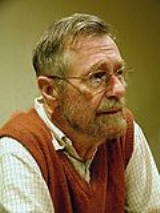
Prof Dr Edsger Wybe Dijkstra was a Dutch Netherlands

The Netherlands is the Europe [i]an part of the Kingdom of the Netherlands [i] , which is formed ... 

 computer scientist. He received the 1972 A. M. Turing Award for fundamental contributions in the area of programming languages, and was the Schlumberger Centennial Chair of Computer Sciences at The University of Texas University of Texas at Austin

The University of Texas at Austin, often called UT or Texas, is the flagship [i] institution ... 

 from 1984 until his death in 2002.

Discussions

  Discussion Features

   Ask a question about 'Edsger Dijkstra'

   Start a new discussion about 'Edsger Dijkstra'

   Answer questions about 'Edsger Dijkstra'

   'Edsger Dijkstra' discussion forum

Timeline

2002   Died


Encyclopedia


Prof Dr Edsger Wybe Dijkstra was a Dutch Netherlands

The Netherlands is the Europe [i]an part of the Kingdom of the Netherlands [i] , which is formed ... 

 computer scientist. He received the 1972 A. M. Turing Award for fundamental contributions in the area of programming languages, and was the Schlumberger Centennial Chair of Computer Sciences at The University of Texas University of Texas at Austin

The University of Texas at Austin, often called UT or Texas, is the flagship [i] institution ... 

 from 1984 until his death in 2002.

Life

Dijkstra studied theoretical physics Physics

Physics , the most fundamental physical science [i], is concerned with the underlying principles of the ... 

 at the University of Leiden Leiden University

Leiden University, located in the city of Leiden [i], is the oldest [i] ... 

, but he quickly realized he was more interested in programming.

Originally employed by the Mathematisch Centrum in Amsterdam, he held a professorship at the Eindhoven University of Technology Eindhoven University of Technology

The Eindhoven University of Technology is a university of technology [i] locat ... 

 in the Netherlands, worked as a research fellow for Burroughs Corporation Burroughs

The Burroughs Corporation began in 1886 as the American Arithmometer Company in St. Louis, Missouri [i]... 

 in the early 1970s 1970s

The 1970s decade [i] refers to the years from 1970 [i] to 1979 [i], inclusive. ... 

, and later held the Schlumberger Centennial Chair in Computer Sciences at the University of Texas at Austin, in the United States United States

The United States of America, also known as the United States, the U.S., the U.S.A., a... 

. He retired in 2000.

Among his contributions to computer science is the shortest path-algorithm Algorithm

In mathematics [i] and computing [i], an algorithm is a procedure for accomplishing some task which, gi... 

, also known as Dijkstra's algorithm, the THE operating system, and the semaphore Semaphore

The semaphore or optical telegraph is an apparatus for conveying information by means of visual si... 

 construct, for coordinating multiple processors and programs. Another concept due to Dijkstra in the field of distributed computing is that of self-stabilization - an alternative way to ensure the reliability of the system.

He was also known for his low opinion of the GOTO statement in computer programming, culminating in the 1968 article "" , regarded as a major step towards the widespread deprecation of the GOTO statement and its effective replacement by structured control constructs such as the while loop. The paper's more famous title, "Go To Statement Considered Harmful", was not the work of Dijkstra, but of Niklaus Wirth Niklaus Wirth

Niklaus E. Wirth is a Swiss [i] computer scientist [i], best known for des ... 

, then editor of Communications of the ACM. Dijkstra was known to be a fan of ALGOL 60 Algol

Algol is a bright star [i] in the constellation [i] Perseus [i]. ... 

, and worked on the team that implemented the first compiler Compiler

A compiler is a computer program [i] that translates text written in a computer language [i] into ano ... 

 for that language. Dijkstra and Jaap Zonneveld, who collaborated on the compiler, agreed not to shave until the project was completed. Zonneveld eventually shaved off his beard; Dijkstra kept his until his death.

From the 1970s 1970s

The 1970s decade [i] refers to the years from 1970 [i] to 1979 [i], inclusive. ... 

, Dijkstra's chief interest was formal verification. The prevailing opinion at the time was that one should first write a program and then provide a mathematical proof of correctness. Dijkstra objected that the resulting proofs are long and cumbersome, and that the proof gives no insight as to how the program was developed. An alternative method is program derivation, to "develop proof and program hand in hand". One starts with a mathematical specification of what a program is supposed to do and applies mathematical transformations to the specification until it is turned into a program that can be executed. The resulting program is then known to be correct by construction. Much of Dijkstra's later work concerns ways to streamline mathematical argument. In a 2001 interview, he stated a desire for "elegance", whereby the correct approach would be to process thoughts mentally, rather than attempt to render them until they are complete. The analogy he made was to contrast the compositional approaches of Mozart Wolfgang Amadeus Mozart

Wolfgang Amadeus Mozart was a prolific and highly influential composer [i] of Classical music [i] ... 

 and Beethoven Ludwig van Beethoven

Ludwig van Beethoven was a German [i] composer [i] and pianist [i]. ... 

.

Dijkstra was known for his essays on programming; he was the first to make the claim that programming is so inherently difficult and complex that programmers need to harness every trick and abstraction possible in hopes of managing the complexity of it successfully. He is also known for his habit of carefully composing manuscripts with his fountain pen Fountain pen

A fountain pen is a pen [i] that contains a reservoir of water-based liquid ink [i]. ... 

. The manuscripts are called EWDs, since Dijkstra numbered them with EWD as prefix. Dijkstra would distribute photocopies of a new EWD among his colleagues; as many recipients photocopied and forwarded their copy, the EWDs spread throughout the international computer science community . The topics are mainly computer science and mathematics, but also include trip reports, letters, and speeches. Many of the more than 1300 EWDs have since been scanned, with a growing number also transcribed to facilitate search, and are available online at the Dijkstra archive of the University of Texas.

Dijkstra is also noted for never owning a computer and rarely using one.

He died in Nuenen, The Netherlands Netherlands

The Netherlands is the Europe [i]an part of the Kingdom of the Netherlands [i] , which is formed ... 

 on August 6, 2002 after a long struggle with cancer Cancer

Cancer is a class of disease [i]s or disorders characterized by uncontrolled division [i] ... 

.

Andrzej Sapkowski Andrzej Sapkowski

Andrzej Sapkowski, born June 21 [i], 1948 [i] in Ldz [i], is a Polish [i] fantasy [i] writer. ... 

, Polish fantasy writer, used Dijkstra's name for one of the main character in the five book "Saga" about The Hexer The Witcher

The Witcher or The Hexer named Geralt [i] is a character created by Andrzej Sapkowski [i]. ... 

.

See also

  • Dijkstra's algorithm
  • Dining philosophers problem Dining philosophers problem

    In computer science [i], the dining philosophers problem is an illustrative example of a common computin ... 

  • "The Cruelty of Really Teaching Computer Science"
  • THE multiprogramming system

References


Writings by E.W. Dijkstra


  • Go To Statement Considered Harmful, Communications of the ACM, Vol. 11 147–148;


  • A Discipline of Programming, Prentice-Hall Series in Automatic Computation, 1976, ISBN 0-13-215871-X
  • Selected Writings on Computing: A Personal Perspective, Texts and Monographs in Computer Science, Springer-Verlag, 1982, ISBN 0-387-90652-5
  • A Method of Programming, E.W. Dijkstra, W.H.J. Feijen, J. Sterringa, Addison Wesley 1988, ISBN 0-201-17536-3

Others about Dijkstra, eulogies

  • Digidome
  • Obituary in Formal Aspects of Computing with a short biography
  • by David Gries
  • by J Strother Moore
  • by Mario Szegedy

External links

  • Luca Cardelli's