

Edmund Gunter

Encyclopedia
Edmund Gunter English
mathematician
, of Welsh
descent, was born in Hertfordshire in 1581.
He was educated at Westminster School
, and in 1599 was elected a student of Christ Church, Oxford
. He took orders, became a preacher in 1614, and in 1615 proceeded to the degree of bachelor in divinity. Mathematics, particularly the relationship between mathematics and the real world, was the one overriding interest throughout his life.
In 1619 the wealthy but earnest Sir Henry Savile put up money to fund Oxford University's first two science faculties, the chairs of astronomy and geometry. Gunter applied to become professor of geometry but Savile was famous for distrusting clever people, and Gunter's behavior annoyed him intensely. As was his habit, Gunter arrived with his sector
and quadrant
, and began demonstrating how they could be used to calculate the position of stars or the distance of churches, until Savile could stand it no longer. "Doe you call this reading of Geometric?" he burst out. "This is mere showing of tricks, man!" and, according to a contemporary account, "dismissed him with scorne."
He was shortly thereafter championed by the far wealthier Earl of Bridgewater, who saw to it that on 6 March 1619 Gunter was appointed professor of astronomy
in Gresham College
, London. This post he held till his death.
With Gunter's name are associated several useful inventions, descriptions of which are given in his treatises on the Sector, Cross-staff, Bow, Quadrant
and other instruments. He contrived his sector about the year 1606, and wrote a description of it in Latin, but it was more than sixteen years afterwards before he allowed the book to appear in English. In 1620 he published his Canon triangulorum.
In 1624 Gunter published a collection of his mathematical works. It was entitled The description and use of sector, the cross-staffe, and other instruments for such as are studious of mathematical practise. One of the most remarkable things about this book is that it was written, and published, in English not Latin. "I am at the last contented that it should come forth in English," he wrote resignedly, "Not that I think it worthy either of my labour or the publique view, but to satisfy their importunity who not understand the Latin yet were at the charge to buy the instrument." It was a manual not for cloistered university fellows but for sailors and surveyors in real world.
There is reason to believe that Gunter was the first to discover (in 1622 or 1625) that the magnetic needle does not retain the same declination
in the same place at all times. By desire of James I
he published in 1624 The Description and Use of His Majesties Dials in Whitehall Garden, the only one of his works which has not been reprinted. He introduced the words cosine and cotangent, and he suggested to Henry Briggs
, his friend and colleague, the use of the arithmetical complement (see Briggs Arithmetica Logarithmica, cap. xv.). His practical inventions are briefly noticed below:
.
The length of the chain normally used led to the linear measurement of 66 feet (20.1 m) being called a chain
.
A rare Gunter quadrant, made by Henry Sutton and dated 1657, can be described as follows: It is a conveniently sized and high-performance instrument that has two pin-hole sights, and the plumb line is inserted at the vertex. The front side is designed as a Gunter quadrant and the rear side as a trigonometric quadrant. The side with the astrolabe has hour lines, a calendar, zodiacs, star positions, astrolabe projections, and a vertical dial. The side with the geometric quadrants features several trigonometric functions, rules, a shadow quadrant, and the chorden line.
s, tangents, rhumbs, etc.), and on the other side the corresponding artificial or logarithmic ones. By means of this instrument questions in navigation
, trigonometry
, etc., are solved with the aid of a pair of compasses. It is a predecessor of the slide rule, a calculating aid used from the 17th century until the 1970s.
Gunter's line, or line of numbers refers to the logarithmically divided scale, like the most common scales used on slide rules for multiplication and division.
England
England is a country that is part of the United Kingdom. It shares land borders with Scotland to the north and Wales to the west; the Irish Sea is to the north west, the Celtic Sea to the south west, with the North Sea to the east and the English Channel to the south separating it from continental...
mathematician
Mathematician
A mathematician is a person whose primary area of study is the field of mathematics. Mathematicians are concerned with quantity, structure, space, and change....
, of Welsh
Wales
Wales is a country that is part of the United Kingdom and the island of Great Britain, bordered by England to its east and the Atlantic Ocean and Irish Sea to its west. It has a population of three million, and a total area of 20,779 km²...
descent, was born in Hertfordshire in 1581.
He was educated at Westminster School
Westminster School
The Royal College of St. Peter in Westminster, almost always known as Westminster School, is one of Britain's leading independent schools, with the highest Oxford and Cambridge acceptance rate of any secondary school or college in Britain...
, and in 1599 was elected a student of Christ Church, Oxford
Christ Church, Oxford
Christ Church or house of Christ, and thus sometimes known as The House), is one of the largest constituent colleges of the University of Oxford in England...
. He took orders, became a preacher in 1614, and in 1615 proceeded to the degree of bachelor in divinity. Mathematics, particularly the relationship between mathematics and the real world, was the one overriding interest throughout his life.
In 1619 the wealthy but earnest Sir Henry Savile put up money to fund Oxford University's first two science faculties, the chairs of astronomy and geometry. Gunter applied to become professor of geometry but Savile was famous for distrusting clever people, and Gunter's behavior annoyed him intensely. As was his habit, Gunter arrived with his sector
Sector (instrument)
The sector, also known as a proportional compass or military compass, was a major calculating instrument in use from the end of the sixteenth century until the nineteenth century. It is an instrument consisting of two rulers of equal length which are joined by a hinge. A number of scales are...
and quadrant
Quadrant (instrument)
A quadrant is an instrument that is used to measure angles up to 90°. It was originally proposed by Ptolemy as a better kind of astrolabe. Several different variations of the instrument were later produced by medieval Muslim astronomers.-Types of quadrants:...
, and began demonstrating how they could be used to calculate the position of stars or the distance of churches, until Savile could stand it no longer. "Doe you call this reading of Geometric?" he burst out. "This is mere showing of tricks, man!" and, according to a contemporary account, "dismissed him with scorne."
He was shortly thereafter championed by the far wealthier Earl of Bridgewater, who saw to it that on 6 March 1619 Gunter was appointed professor of astronomy
Astronomy
Astronomy is a natural science that deals with the study of celestial objects and phenomena that originate outside the atmosphere of Earth...
in Gresham College
Gresham College
Gresham College is an institution of higher learning located at Barnard's Inn Hall off Holborn in central London, England. It was founded in 1597 under the will of Sir Thomas Gresham and today it hosts over 140 free public lectures every year within the City of London.-History:Sir Thomas Gresham,...
, London. This post he held till his death.
With Gunter's name are associated several useful inventions, descriptions of which are given in his treatises on the Sector, Cross-staff, Bow, Quadrant
Quadrant (instrument)
A quadrant is an instrument that is used to measure angles up to 90°. It was originally proposed by Ptolemy as a better kind of astrolabe. Several different variations of the instrument were later produced by medieval Muslim astronomers.-Types of quadrants:...
and other instruments. He contrived his sector about the year 1606, and wrote a description of it in Latin, but it was more than sixteen years afterwards before he allowed the book to appear in English. In 1620 he published his Canon triangulorum.
In 1624 Gunter published a collection of his mathematical works. It was entitled The description and use of sector, the cross-staffe, and other instruments for such as are studious of mathematical practise. One of the most remarkable things about this book is that it was written, and published, in English not Latin. "I am at the last contented that it should come forth in English," he wrote resignedly, "Not that I think it worthy either of my labour or the publique view, but to satisfy their importunity who not understand the Latin yet were at the charge to buy the instrument." It was a manual not for cloistered university fellows but for sailors and surveyors in real world.
There is reason to believe that Gunter was the first to discover (in 1622 or 1625) that the magnetic needle does not retain the same declination
Declination
In astronomy, declination is one of the two coordinates of the equatorial coordinate system, the other being either right ascension or hour angle. Declination in astronomy is comparable to geographic latitude, but projected onto the celestial sphere. Declination is measured in degrees north and...
in the same place at all times. By desire of James I
James I of England
James VI and I was King of Scots as James VI from 24 July 1567 and King of England and Ireland as James I from the union of the English and Scottish crowns on 24 March 1603...
he published in 1624 The Description and Use of His Majesties Dials in Whitehall Garden, the only one of his works which has not been reprinted. He introduced the words cosine and cotangent, and he suggested to Henry Briggs
Henry Briggs (mathematician)
Henry Briggs was an English mathematician notable for changing the original logarithms invented by John Napier into common logarithms, which are sometimes known as Briggsian logarithms in his honour....
, his friend and colleague, the use of the arithmetical complement (see Briggs Arithmetica Logarithmica, cap. xv.). His practical inventions are briefly noticed below:
Gunter's chain
Gunter's interest in geometry led him to develop a method of sea surveying using triangulation. Linear measurements could be taken between topographical features such as corners of a field, and using triangulation the field or other area could be plotted on a plane, and its area calculated. A chain 66 feet (20.1 m) long, with intermediate measurements indicated, was habitually used for the purpose, and is called Gunter's chainGunter's chain
Gunter's chain is a measuring device used for land survey. It was designed and introduced in 1620 by English clergyman and mathematician Edmund Gunter long before the development of the theodolite and other more sophisticated equipment, enabling plots of land to be accurately surveyed and plotted,...
.
The length of the chain normally used led to the linear measurement of 66 feet (20.1 m) being called a chain
Chain (unit)
A chain is a unit of length; it measures 66 feet or 22 yards or 100 links . There are 10 chains in a furlong, and 80 chains in one statute mile. An acre is the area of 10 square chains...
.
Gunter's quadrant
An instrument made of wood, brass or other substance, containing a kind of stereographic projection of the sphere on the plane of the equinoctial, the eye being supposed to be placed in one of the poles, so that the tropic, ecliptic, and horizon form the arcs of circles, but the hour circles are other curves, drawn by means of several altitudes of the sun for some particular latitude every year. This instrument is used to find the hour of the day, the sun's azimuth, etc., and other common problems of the sphere or globe, and also to take the altitude of an object in degrees.A rare Gunter quadrant, made by Henry Sutton and dated 1657, can be described as follows: It is a conveniently sized and high-performance instrument that has two pin-hole sights, and the plumb line is inserted at the vertex. The front side is designed as a Gunter quadrant and the rear side as a trigonometric quadrant. The side with the astrolabe has hour lines, a calendar, zodiacs, star positions, astrolabe projections, and a vertical dial. The side with the geometric quadrants features several trigonometric functions, rules, a shadow quadrant, and the chorden line.
Gunter's scale
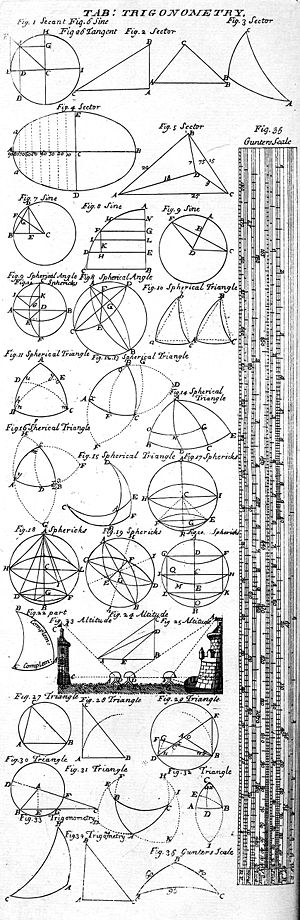
Gunter's scale or Gunter's rule, generally called the "Gunter" by seamen, is a large plane scale, usually 2 foot (0.6096 m) long by about 1½ inches broad (600 mm by 40 mm), and engraved with various scales, or lines. On one side are placed the natural lines (as the line of chords, the line of sineSine
In mathematics, the sine function is a function of an angle. In a right triangle, sine gives the ratio of the length of the side opposite to an angle to the length of the hypotenuse.Sine is usually listed first amongst the trigonometric functions....
s, tangents, rhumbs, etc.), and on the other side the corresponding artificial or logarithmic ones. By means of this instrument questions in navigation
Navigation
Navigation is the process of monitoring and controlling the movement of a craft or vehicle from one place to another. It is also the term of art used for the specialized knowledge used by navigators to perform navigation tasks...
, trigonometry
Trigonometry
Trigonometry is a branch of mathematics that studies triangles and the relationships between their sides and the angles between these sides. Trigonometry defines the trigonometric functions, which describe those relationships and have applicability to cyclical phenomena, such as waves...
, etc., are solved with the aid of a pair of compasses. It is a predecessor of the slide rule, a calculating aid used from the 17th century until the 1970s.
Gunter's line, or line of numbers refers to the logarithmically divided scale, like the most common scales used on slide rules for multiplication and division.