


Edict of Potsdam

Encyclopedia
Frederick William, Elector of Brandenburg
|align=right|Frederick William was Elector of Brandenburg and Duke of Prussia – and thus ruler of Brandenburg-Prussia – from 1640 until his death. A member of the House of Hohenzollern, he is popularly known as the "Great Elector" because of his military and political prowess...
and Duke of Prussia, in Potsdam
Potsdam
Potsdam is the capital city of the German federal state of Brandenburg and part of the Berlin/Brandenburg Metropolitan Region. It is situated on the River Havel, southwest of Berlin city centre....
on October 29, 1685, as a response to the revocation of the Edict of Nantes
Edict of Nantes
The Edict of Nantes, issued on 13 April 1598, by Henry IV of France, granted the Calvinist Protestants of France substantial rights in a nation still considered essentially Catholic. In the Edict, Henry aimed primarily to promote civil unity...
by the Edict of Fontainebleau.
Background
In October 1685, King Louis XIV of France issued the Edict of Fontainebleau, which was part of a program of persecution that closed HuguenotHuguenot
The Huguenots were members of the Protestant Reformed Church of France during the 16th and 17th centuries. Since the 17th century, people who formerly would have been called Huguenots have instead simply been called French Protestants, a title suggested by their German co-religionists, the...
churches and schools. This policy escalated the harassment of religious minorities since the dragonnade
Dragonnade
"Dragonnades" was a French policy instituted by Louis XIV in 1681 to intimidate Huguenot families into either leaving France or re-converting to Catholicism.- History :This policy involved billeting ill-disciplined dragoons in Protestant households...
s created in 1681 in order to intimidate Huguenots into converting
Religious conversion
Religious conversion is the adoption of a new religion that differs from the convert's previous religion. Changing from one denomination to another within the same religion is usually described as reaffiliation rather than conversion.People convert to a different religion for various reasons,...
to Catholicism. As a result, a large number of Protestants — estimates range from 210,000 to 900,000 — left France over the next two decades.
Terms
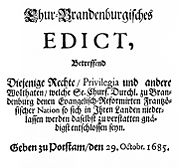
On October 29, 1685, Frederick William, Elector of BrandenburgFrederick William, Elector of Brandenburg
|align=right|Frederick William was Elector of Brandenburg and Duke of Prussia – and thus ruler of Brandenburg-Prussia – from 1640 until his death. A member of the House of Hohenzollern, he is popularly known as the "Great Elector" because of his military and political prowess...
issued the Edict of Potsdam, which encouraged oppressed Huguenots to immigrate to his nation by offering them numerous benefits. The edict gave French
France
The French Republic , The French Republic , The French Republic , (commonly known as France , is a unitary semi-presidential republic in Western Europe with several overseas territories and islands located on other continents and in the Indian, Pacific, and Atlantic oceans. Metropolitan France...
Protestants safe passage to Brandenburg-Prussia
Brandenburg-Prussia
Brandenburg-Prussia is the historiographic denomination for the Early Modern realm of the Brandenburgian Hohenzollerns between 1618 and 1701. Based in the Electorate of Brandenburg, the main branch of the Hohenzollern intermarried with the branch ruling the Duchy of Prussia, and secured succession...
, offered them tax-free status for ten years, and allowed them to hold church services
Service of worship
In the Protestant denominations of Christianity, a service of worship is a meeting whose primary purpose is the worship of God. The phrase is normally shortened to service. It is also commonly called a worship service...
in their native French
French language
French is a Romance language spoken as a first language in France, the Romandy region in Switzerland, Wallonia and Brussels in Belgium, Monaco, the regions of Quebec and Acadia in Canada, and by various communities elsewhere. Second-language speakers of French are distributed throughout many parts...
. As a result, Potsdam became a center of European immigration, its religious freedom attracting not only French Protestants but also the persecuted of Russia
Russia
Russia or , officially known as both Russia and the Russian Federation , is a country in northern Eurasia. It is a federal semi-presidential republic, comprising 83 federal subjects...
, the Netherlands, and Bohemia
Bohemia
Bohemia is a historical region in central Europe, occupying the western two-thirds of the traditional Czech Lands. It is located in the contemporary Czech Republic with its capital in Prague...
. Thus, the immigrants to the Electorate of Brandenburg stabilized and greatly improved the country's economy following the destructive religious wars that had swept through Europe
Europe
Europe is, by convention, one of the world's seven continents. Comprising the westernmost peninsula of Eurasia, Europe is generally 'divided' from Asia to its east by the watershed divides of the Ural and Caucasus Mountains, the Ural River, the Caspian and Black Seas, and the waterways connecting...
in the seventeenth-century.